Shroffing and the Shroff Handbook
The shroffs were responsible for turning foreign silver into usable money within the Canton trade. They weighed silver coins and ingots, tested fineness by cutting, filing, ringing, and applying acids, and judged each piece according to local standards. Coins might be accepted at full value, rejected outright, or discounted for weight or purity. When approved, shroffs often applied chopmarks as personal guarantees, marking silver that could now circulate with a greater level of trust.
Shroffing in Canton
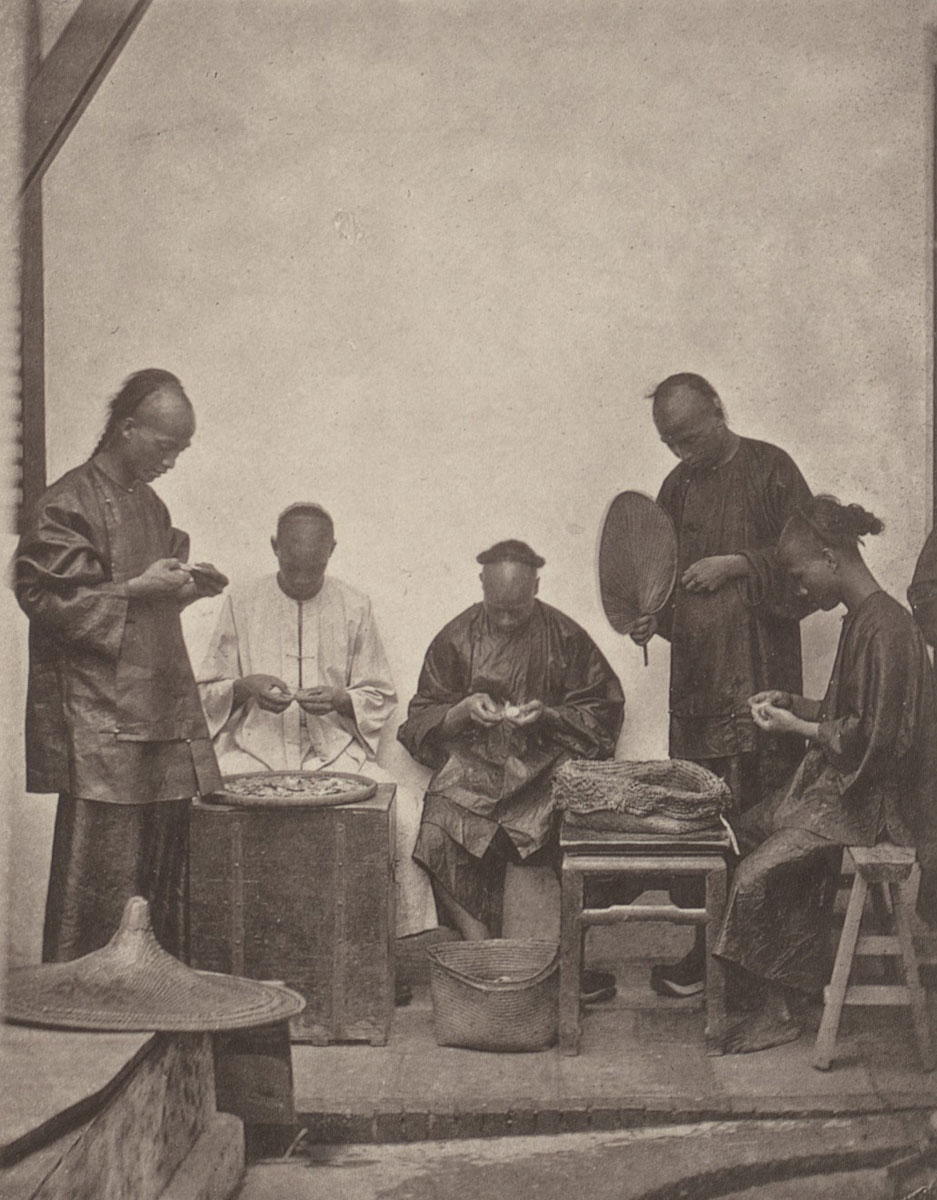
This 1873 photograph is, to my knowledge, the only known image of shroffs at work. Despite how common and essential the profession was to China’s silver economy, it was not one considered worthy of depiction in export paintings or sketches. Few photographers documented the everyday mechanics of the China trade, but John Thomson was a notable exception. Working in China during the mid-to-late 19th century, he captured scenes that would otherwise be lost to history, and this image offers a rare glimpse of shroffs carefully inspecting foreign silver dollars.
In his book, Thomson writes:
"SCHROFFING, or testing and examining dollars, is an operation conducted by the compradore's staff in receiving payment for cargoes, to ascertain that no counterfeit coin has been introduced. These tests are managed with dexterity and speed. In transferring the dollars from one sack to another, two are taken up at a time, poised upon the tips of the fingers, struck, and sounded, the tone of base metal being readily detected. The milling of the edge is also examined, as the Chinese show great cleverness in sawing the dollar asunder, scraping out and re-uniting the two halves, which they fill up with a hard solder made of a cheap metal, that when rung emits a clear silver tone. So deftly is the re-uniting done, that none but an expert can detect the junction of the two halves. When the dollars have all been schroffed, payment is made by weight."
A Scroff School in Canton
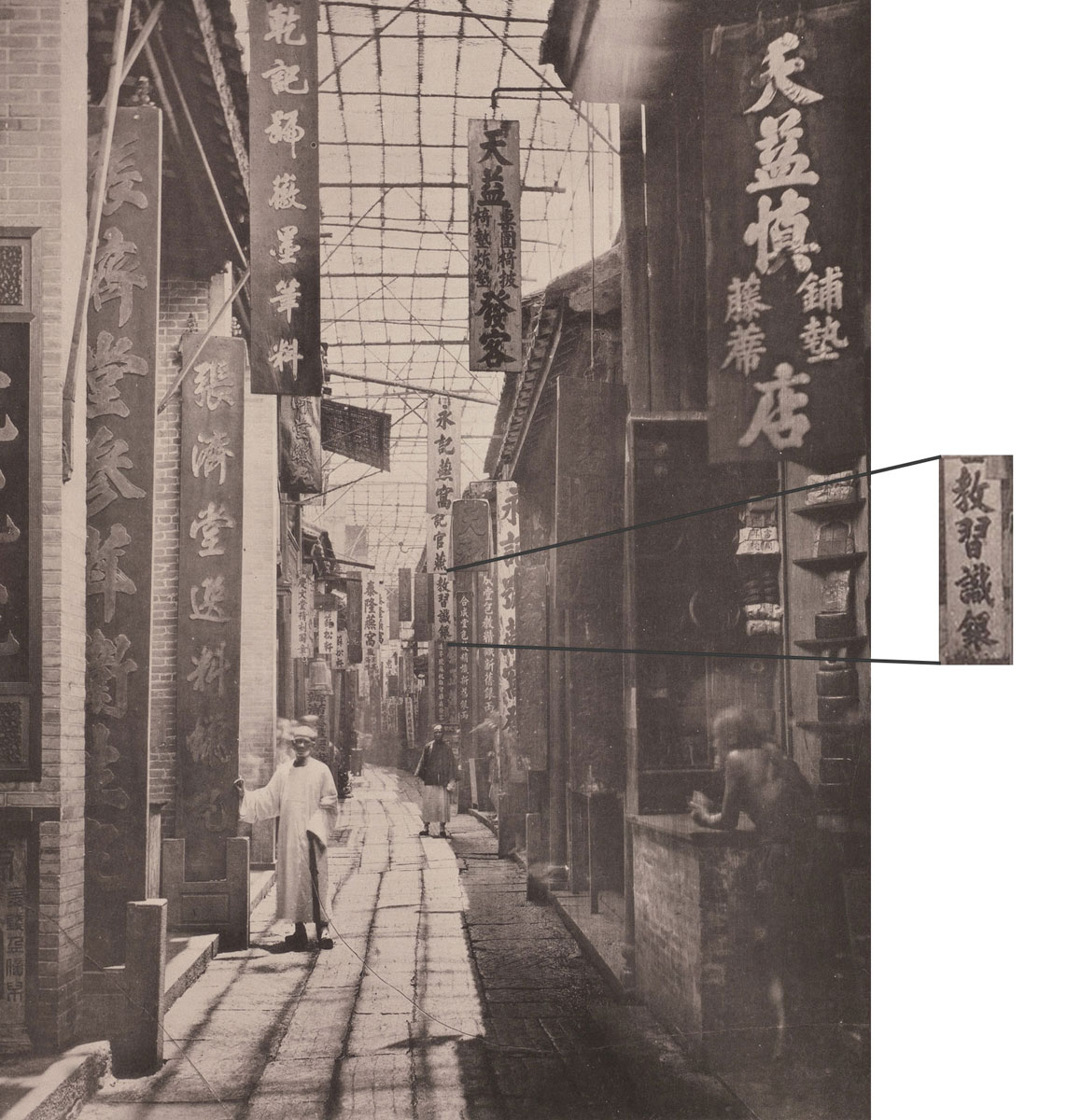
Physic Street, as it was known to Westerners, was located near the Thirteen Factories in Canton. As noted by John Thomson in Volume I of his four-volume photographic series Illustrations of China and Its People: A Series of Two Hundred Photographs, one of the shops pictured is identified by a sign reading 教習識銀. This inscription indicates a shroff training school, a presence that makes sense given the street’s proximity to the foreign factories and its location at the very center of East–West trade.
This sign reads 教習識銀 and unfortunately the top portion of the sign is obscured; had it shown in full, it would likely have identified the name of the school. The phrase 教習識銀 (jiāo xí shí yín) translates to “instruction and training in the recognition of silver,” clearly identifying the establishment as a school devoted to shroffing, an essential skill in Canton’s foreign trade district.
Thomson adds:
"I am indebted to Mr. W. F. Mayers, the well-known Chinese scholar, for the translation of the sign-boards of Physic Street, and for the interesting note which follows on Schroffing dollars."
And later, the note from Mayers:
"The art of " schroffing," or of detecting spurious coin, and of ascertaining the difference between dollars of various issues, is very extensively practised in China, and is studied as a profession by hundreds of young men, who find employment in banks and merchants' offices. The establishments where " schroffing " is taught, are well-known to be in direct communication with the counterfeiters of Mexican dollars and other coin, and it has often been remarked that the existence of sthroffs and of false money are mutually indispensable to each other. If the amount of counterfeit coin in circulation were less, the necessity for a multitude of schroffs would not be so severely felt as at present ; and if the establishments where schroffage is taught did not exist, the counterfeiters would lose their principal means of passing false money into circulation."
What westerners called "Physic Street" was actually "Hui-ai Street" (now Jiefang Zhong Lu) in Canton (Guangzhou). It was the heart of the financial district where most of the silver testing and chopmarking for the tea and silk trades occurred.
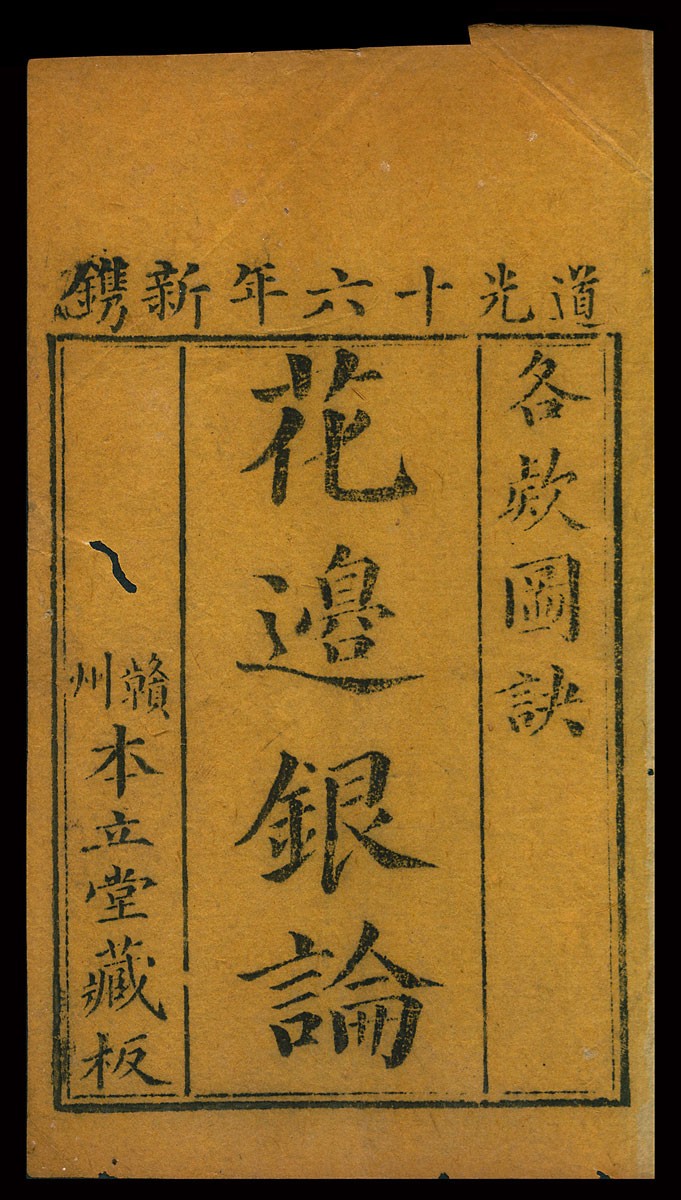
Details to come.