Production of Goods
Three commodities that defined the Canton trade were tea, silk, and porcelain. Each was the product of centuries of accumulated skill, rooted in geography and raw materials that gave China a commanding advantage in their production. Western merchants who arrived at Canton could purchase these goods in enormous quantities, but the processes behind them remained largely hidden, carried out in distant provinces by artisans whose techniques were closely guarded. Chinese export paintings, produced in the workshops of Canton for foreign buyers, offered a rare window into these industries. Rendered in the traditional Chinese style with careful attention to each stage of production, the paintings served as visual records of a world that most Westerners would never see firsthand.
Growing and Processing Tea
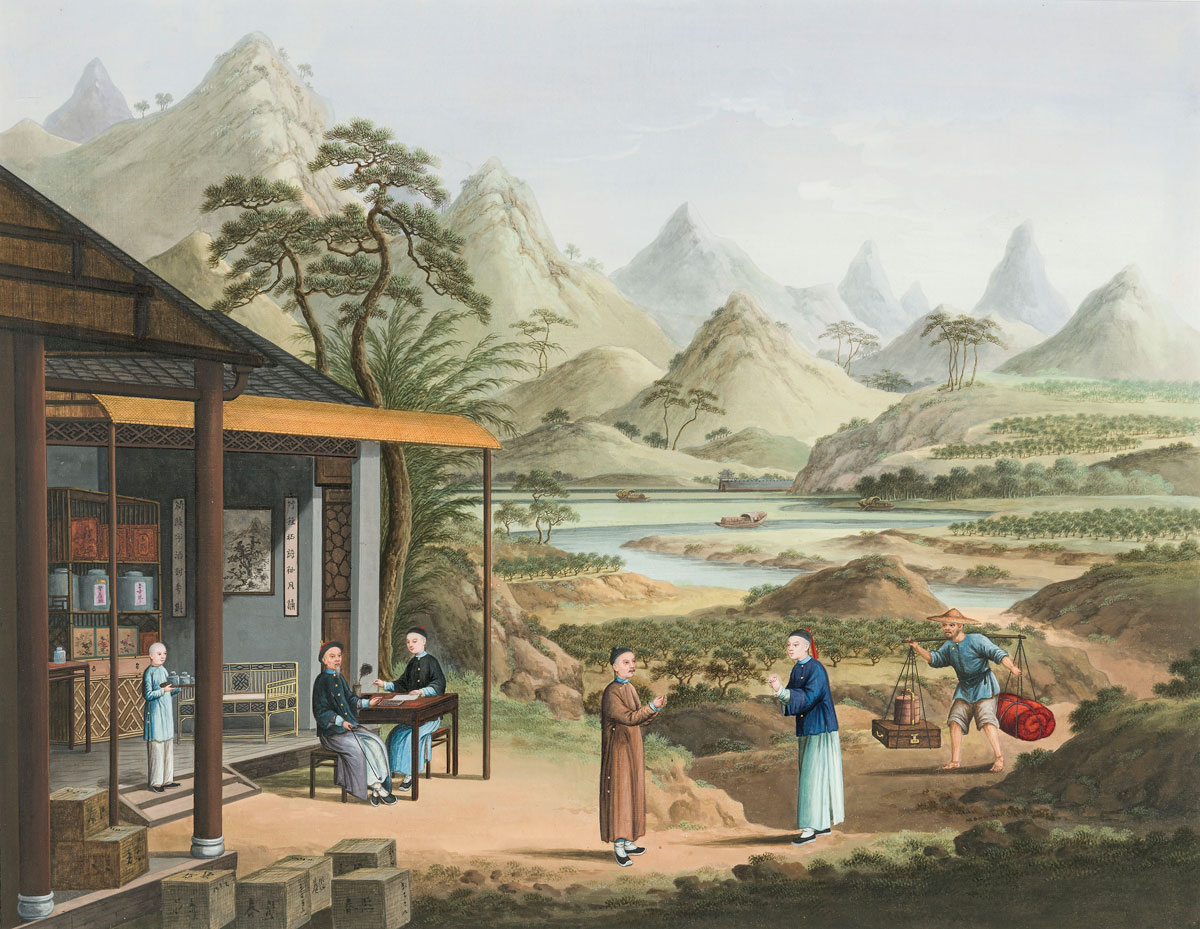
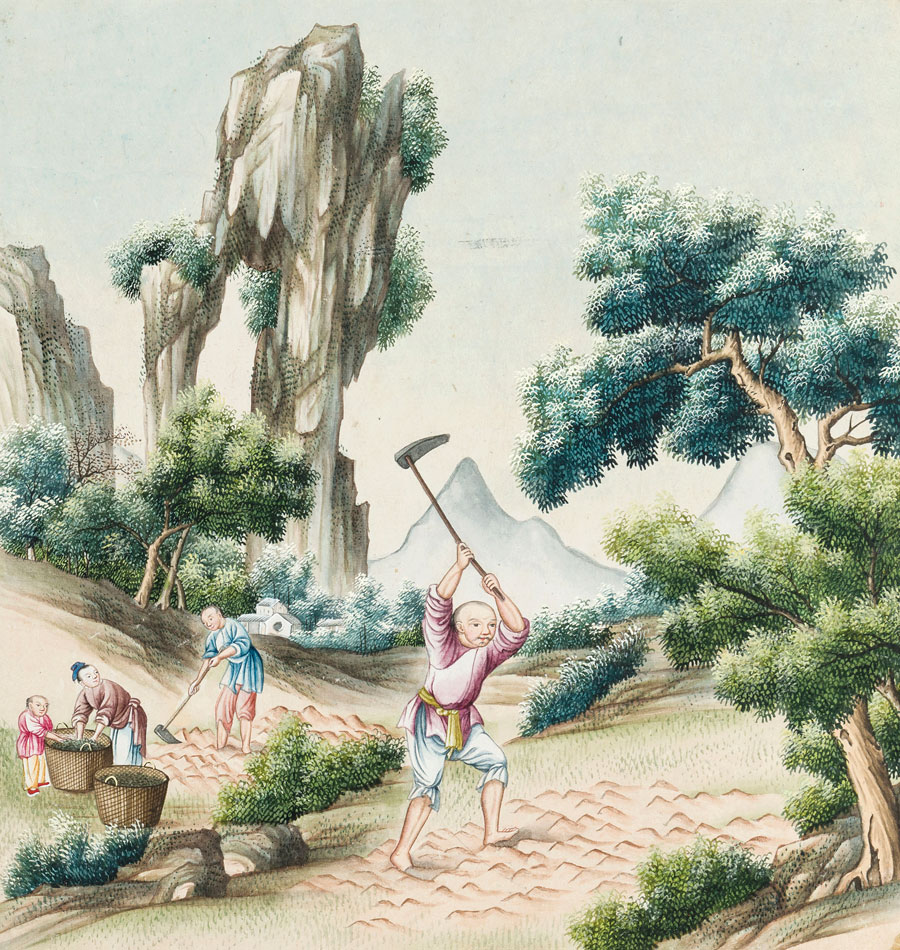
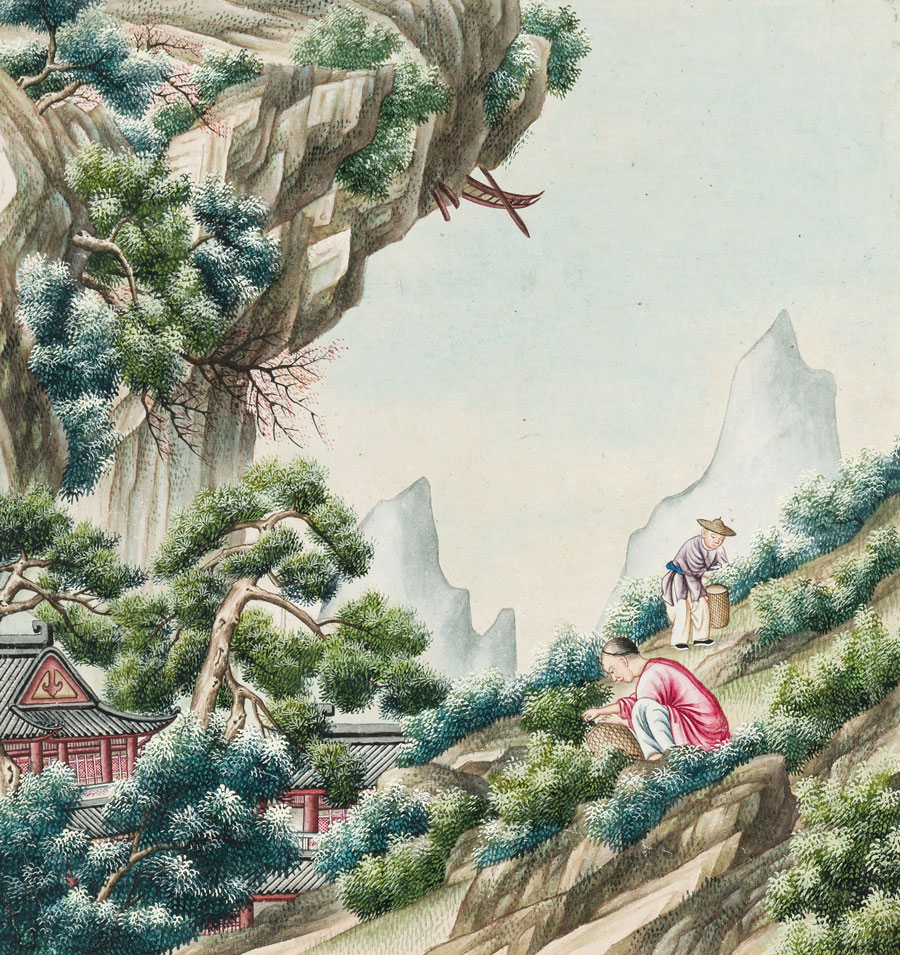
For centuries before any European ship reached Canton, the tea plant Camellia sinensis had been cultivated across the misty highlands of southern China. It grew on steep mountain slopes where monsoon rains soaked acidic soils and cool elevations slowed the leaves into producing concentrated, complex flavors. The provinces of Fujian, Anhui, and Zhejiang formed the geographic heart of tea country, with the Wuyi Mountains of northern Fujian earning particular renown as the source of Bohea, the dark, full-bodied tea that would come to dominate British imports.
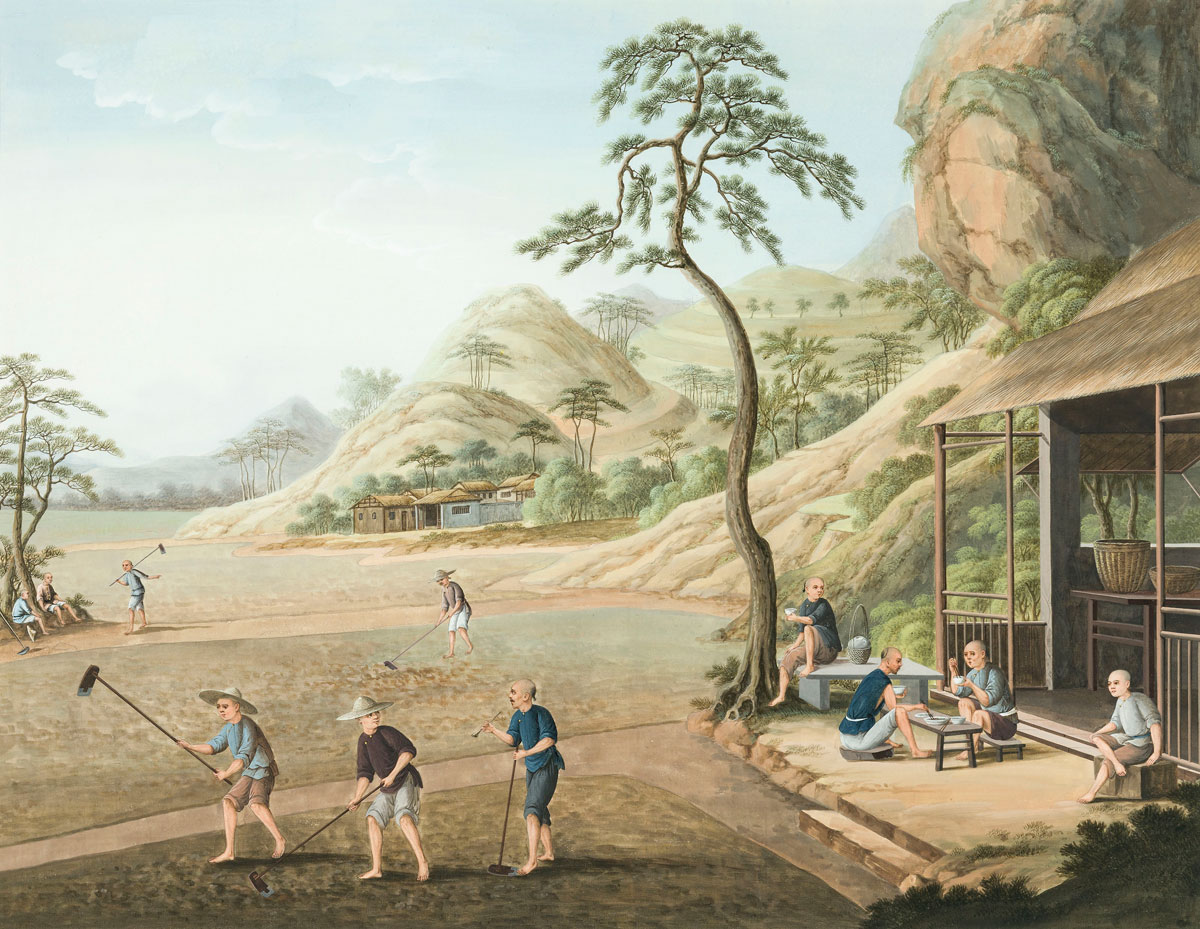
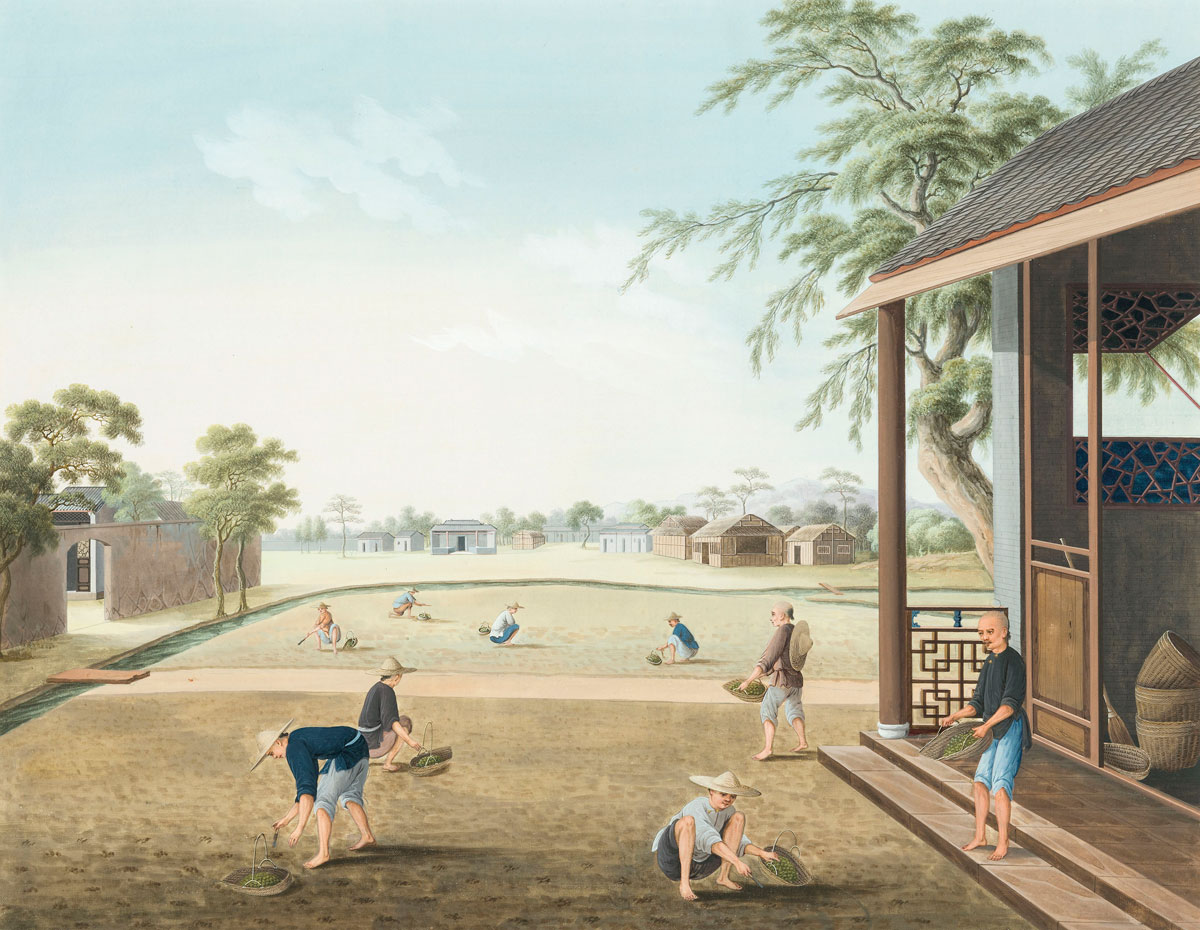
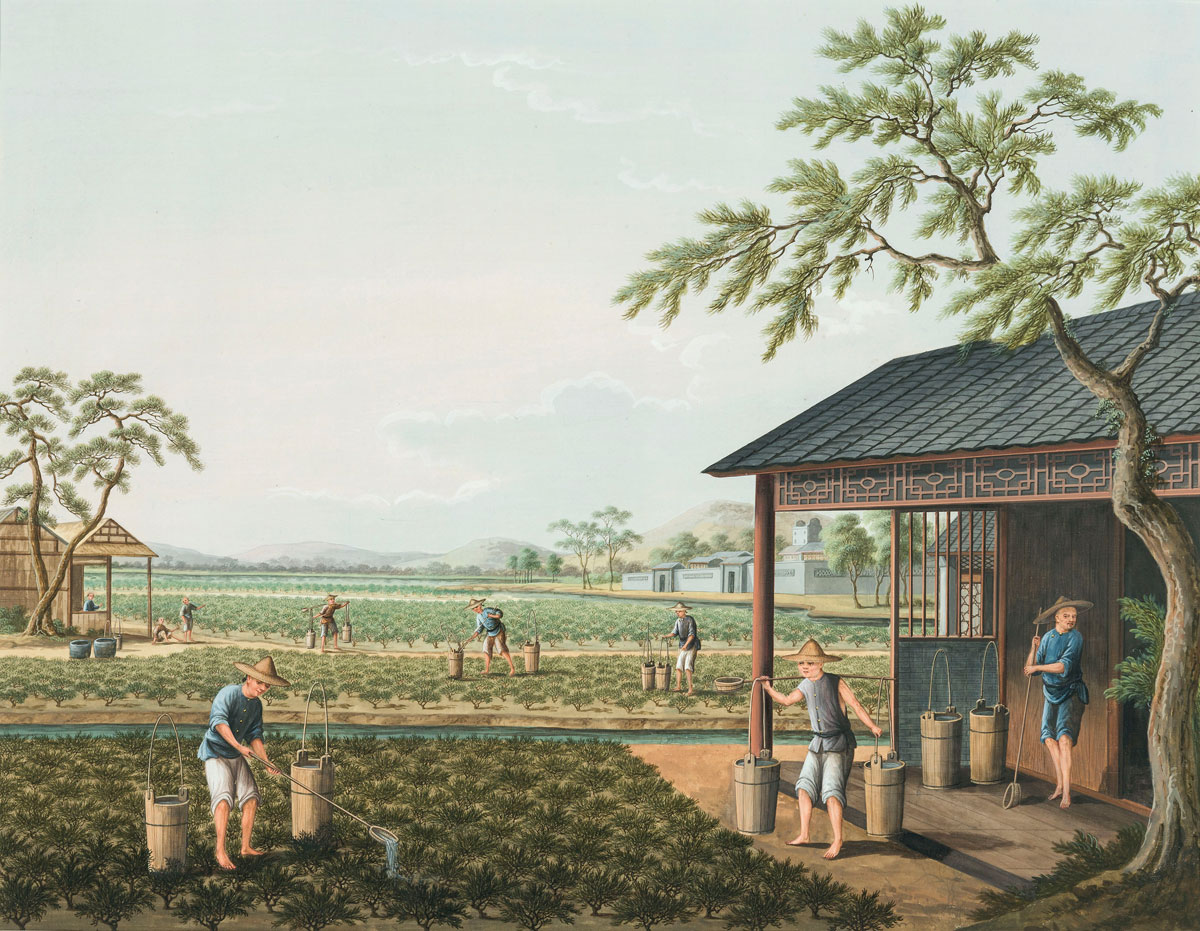
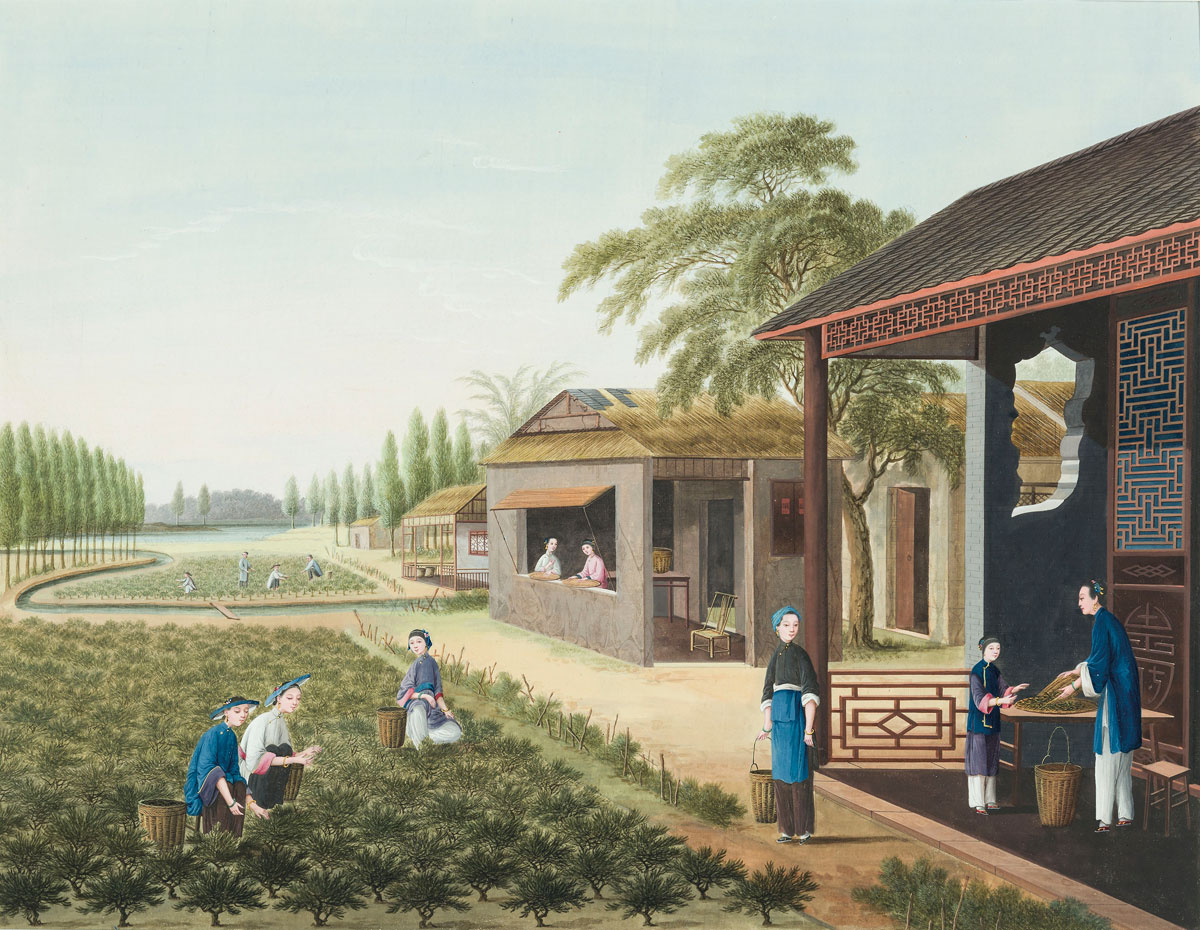
Small family operations tended the plants on terraced hillsides, picking by hand and passing their methods down through generations. China's hold on the global tea supply lasted into the middle of the nineteenth century, sustained not only by favorable geography but by centuries of accumulated knowledge that outsiders could neither observe nor replicate. The Qing government forbade the export of living tea plants, and the closely held techniques of processing remained the domain of artisans in the interior, far from the reach of foreign merchants confined to the warehouses of Canton.
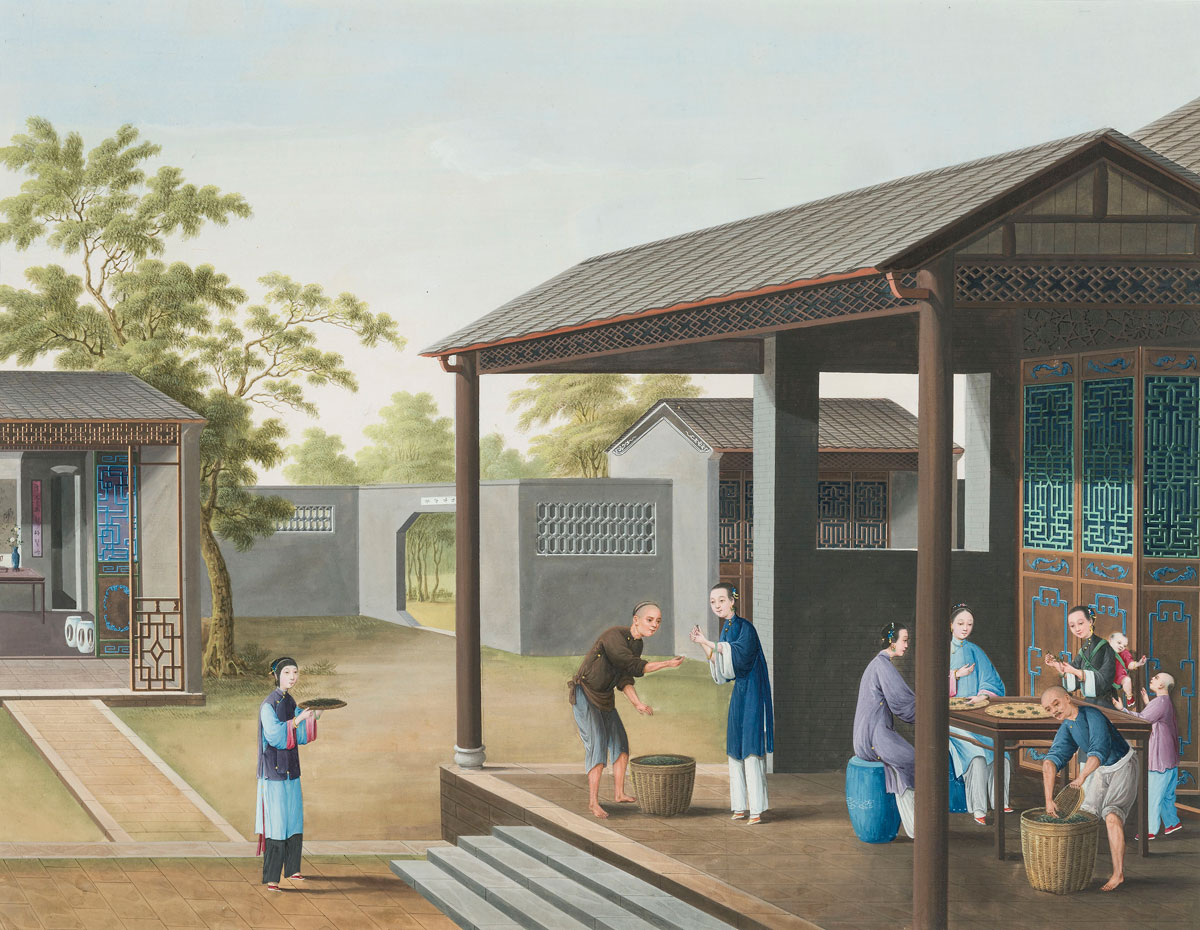
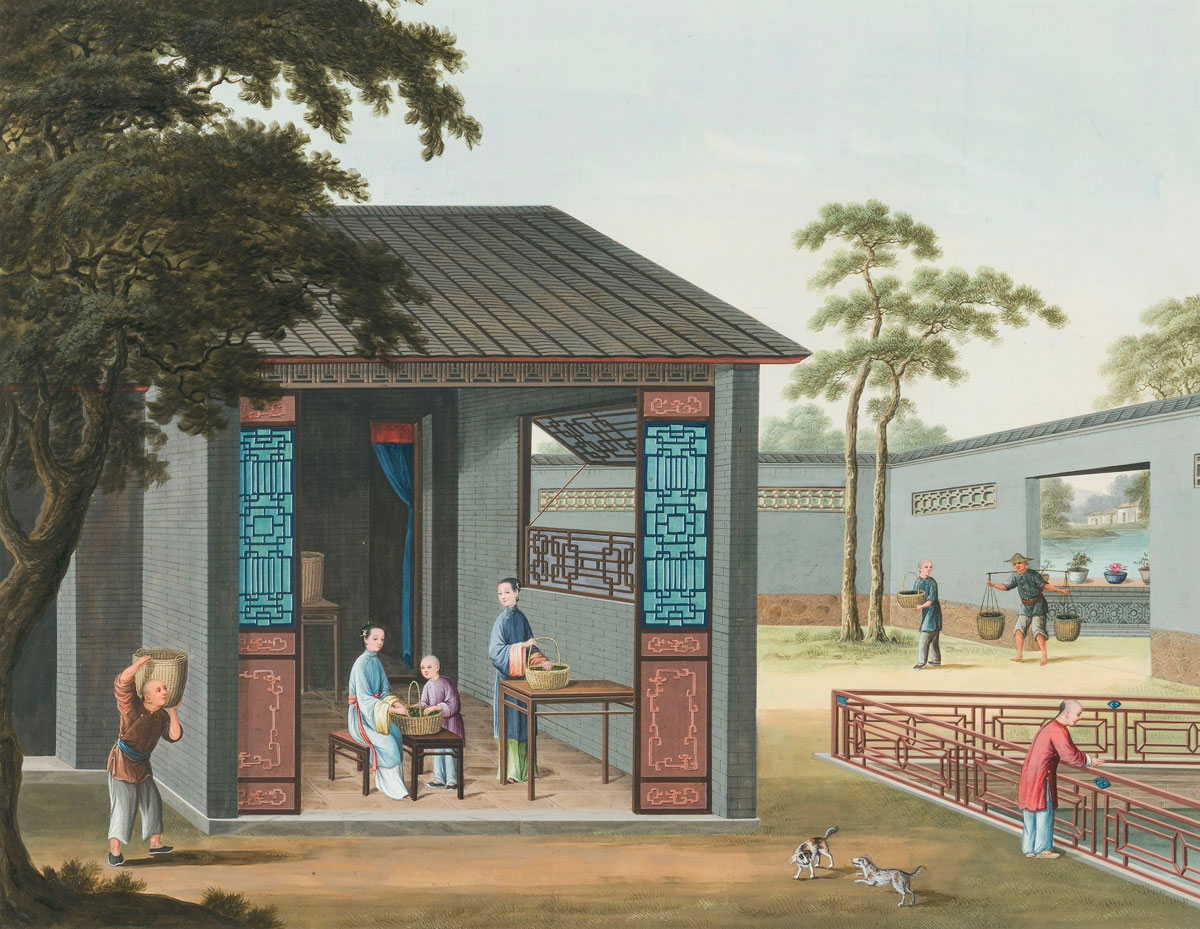
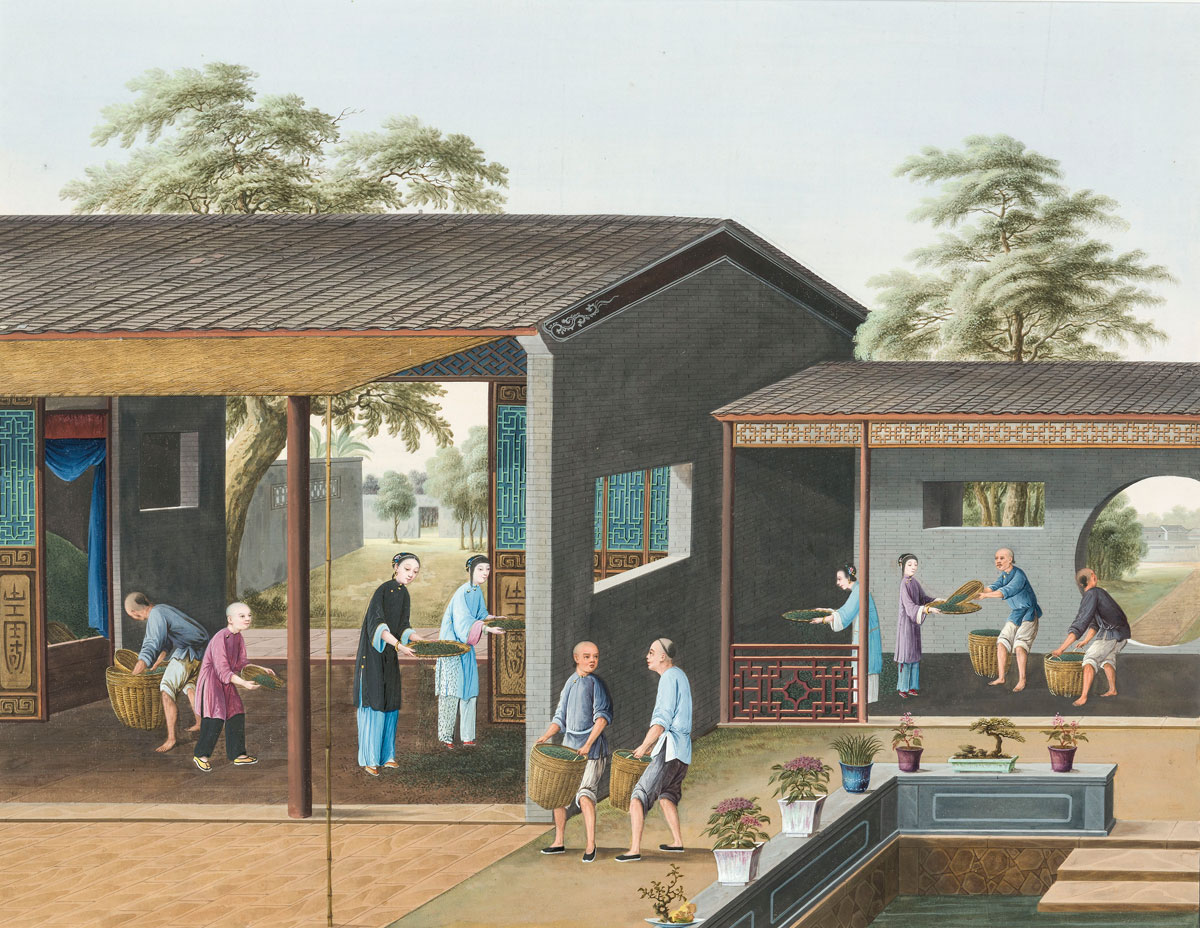
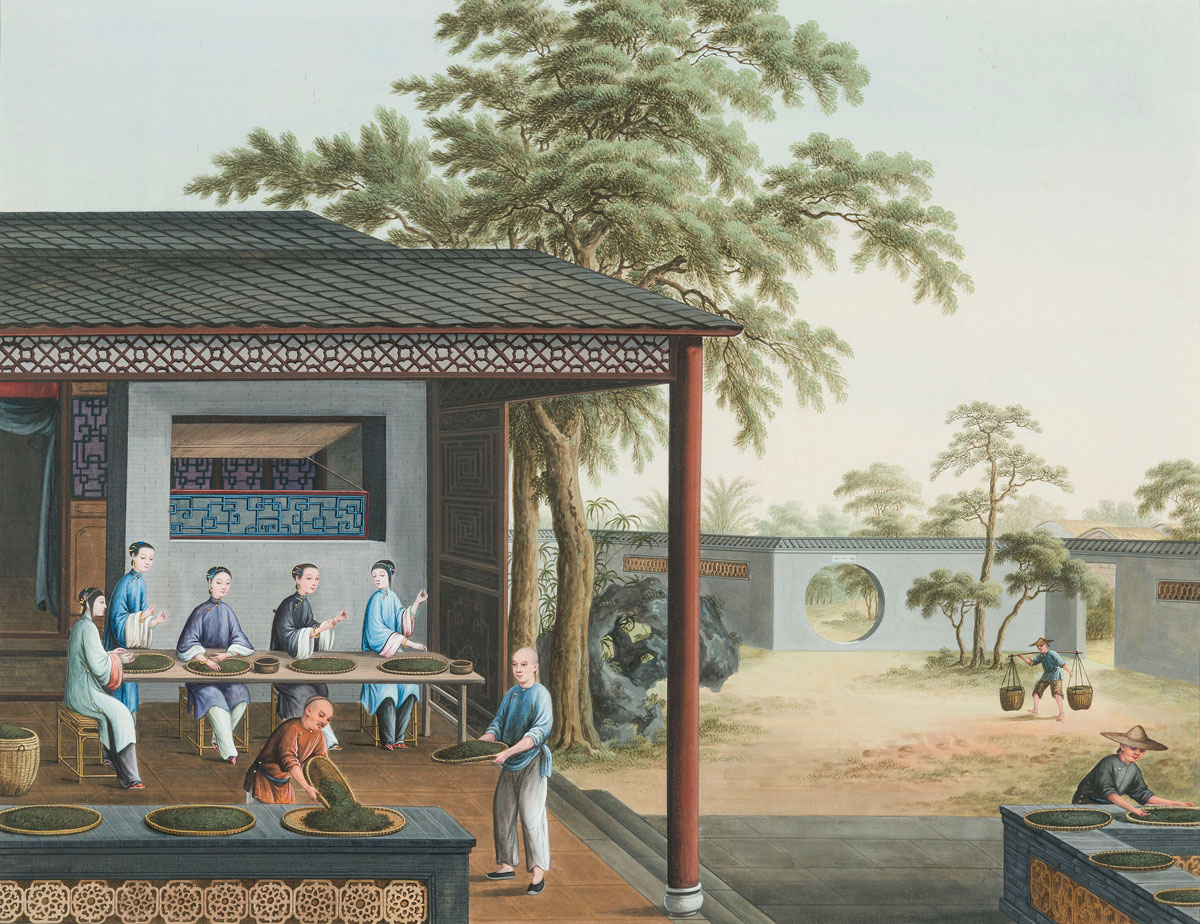
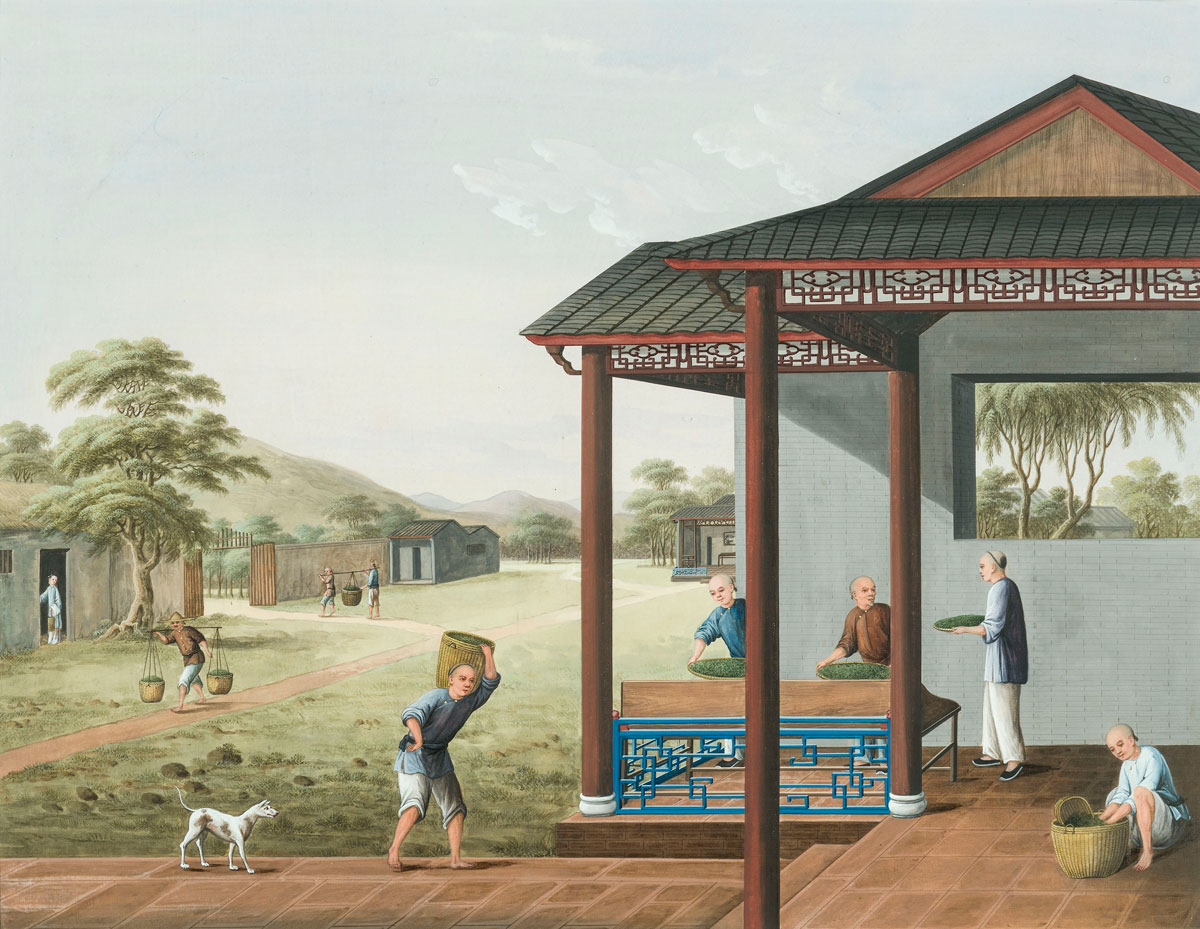
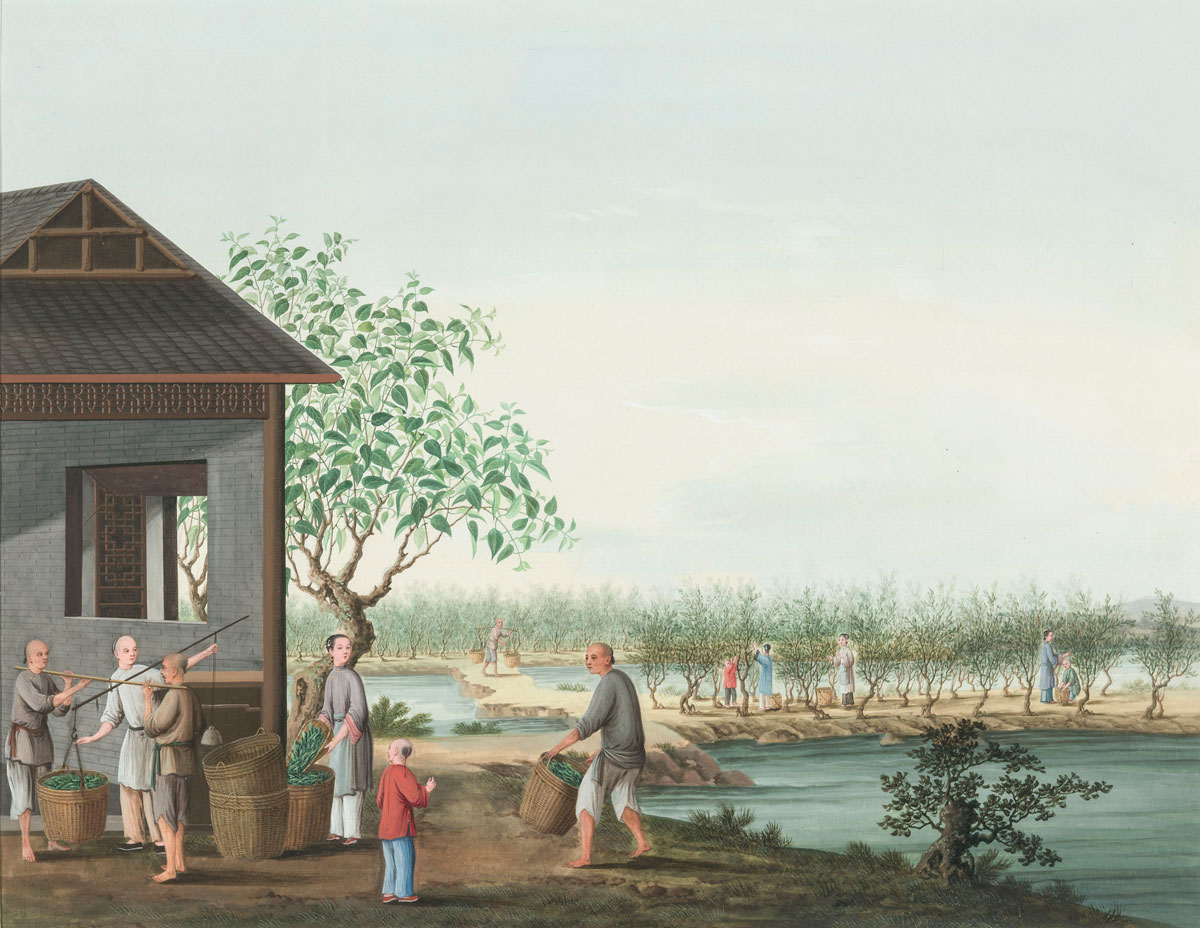
Turning a freshly picked leaf into exportable tea was a sequence of transformations, each guided by experience and timing. Workers spread the young shoots out to wither in the open air until the leaves lost enough moisture to become pliable. They were then rolled and pressed by hand, rupturing the cell walls to release the oils and juices that would give the finished tea its fragrance and depth.
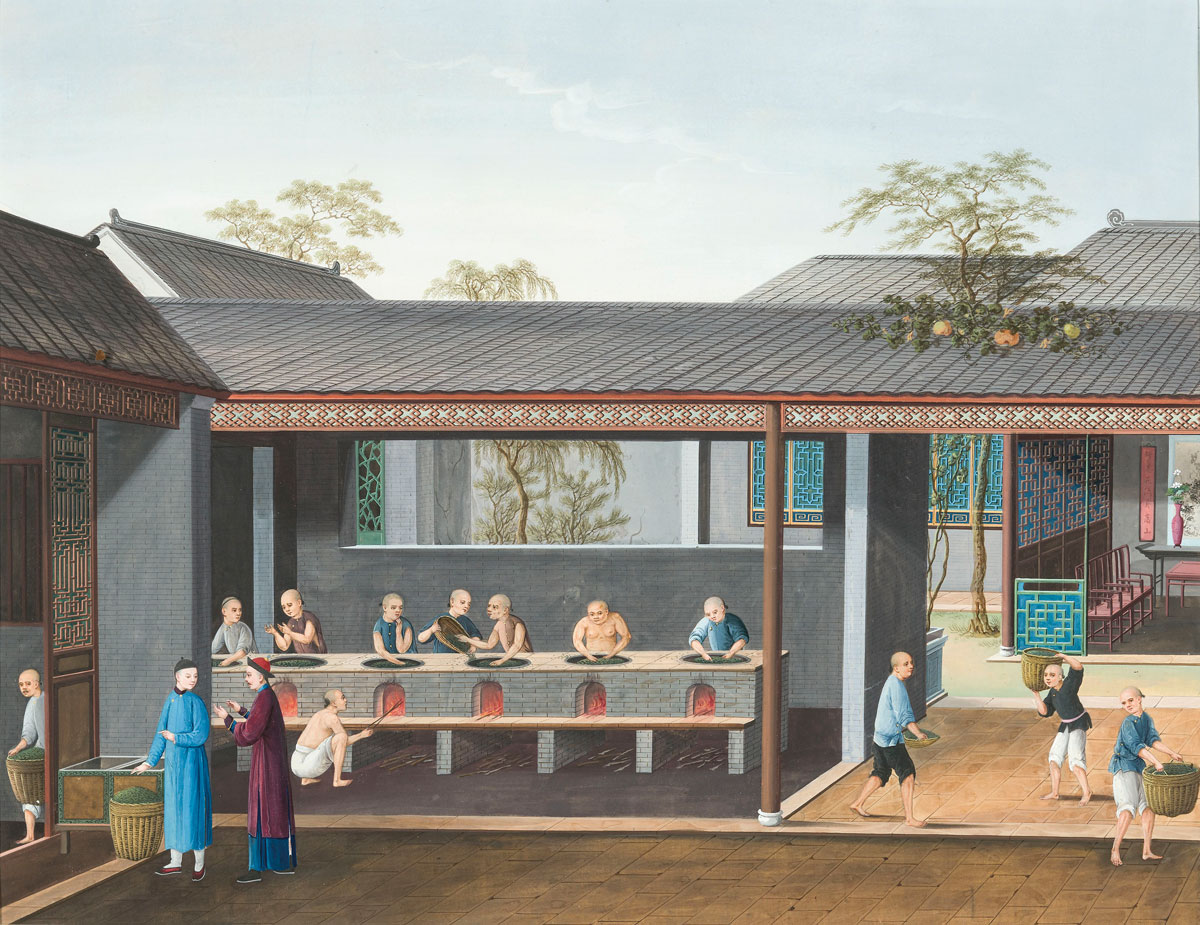
For the black teas that European markets favored, the rolled leaves were left to oxidize under careful watch, darkening in color and developing a richer body, before being fired over charcoal to arrest the process and lock in flavor. The difference between a prized Bohea and an ordinary leaf came down to the expert timing and judgment of the workers at every stage.
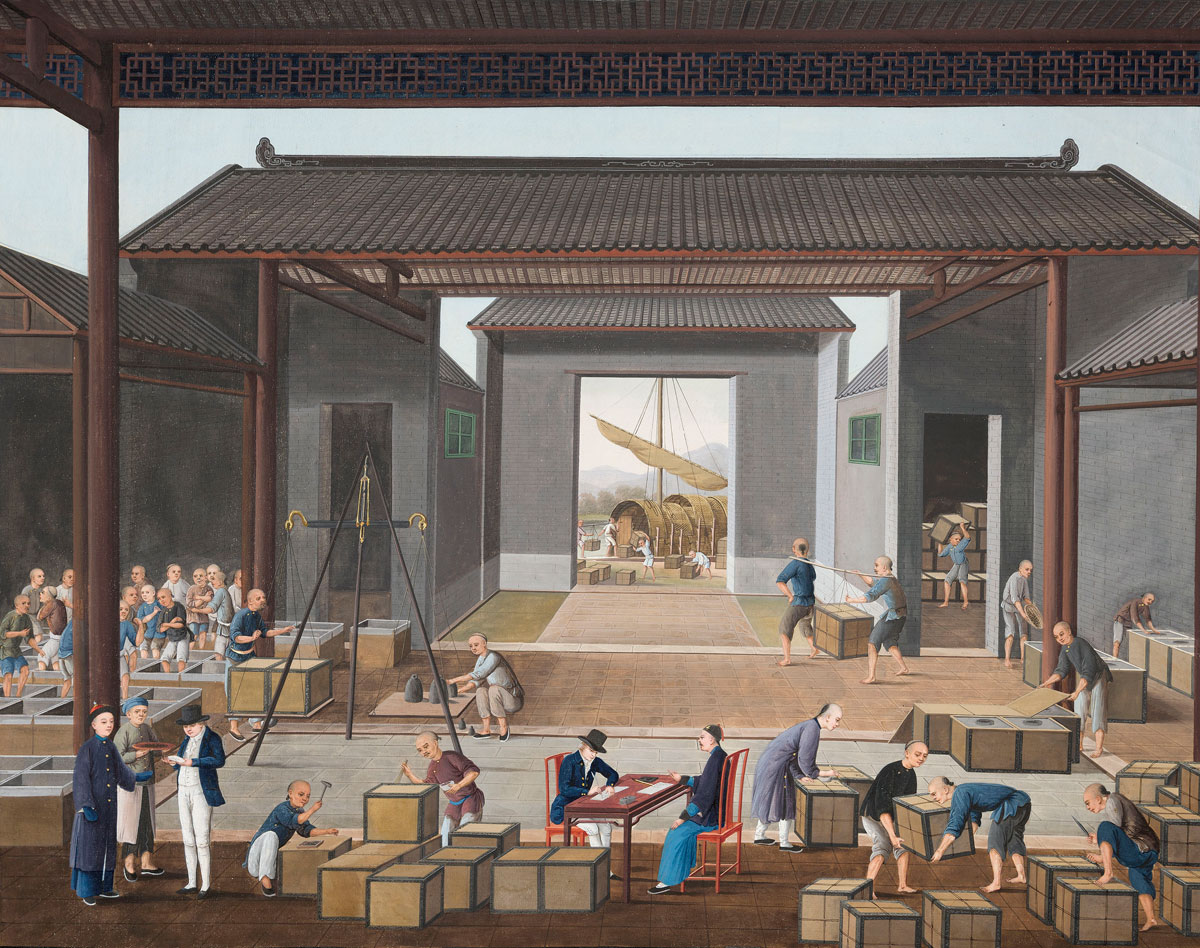
Europeans paid for all of it in silver, the only currency the Qing empire would reliably accept, having little use for Western manufactured goods. By the 1780s, the British East India Company alone was shipping more than fifteen million pounds of tea a year, and the revenue from taxing it filled roughly a tenth of the British Crown's treasury.
Set of tea production images above attributed to Chinese School, c.1820Silk Production
Long before it became one of the great commodities of the Canton trade, silk had already shaped the identity of Chinese civilization for thousands of years. The production of silk depended on a single species of domesticated moth, Bombyx mori, whose caterpillars fed exclusively on the leaves of the mulberry tree. The warm, humid lowlands of the Yangtze River delta and the Pearl River region of Guangdong provided ideal conditions for both the trees and the worms, and sericulture took root there as a household industry carried on primarily by women. Successive dynasties treated the knowledge of silk production as a state secret, and for centuries imperial law threatened death to anyone who attempted to smuggle silkworm eggs or cocoons beyond China's borders.
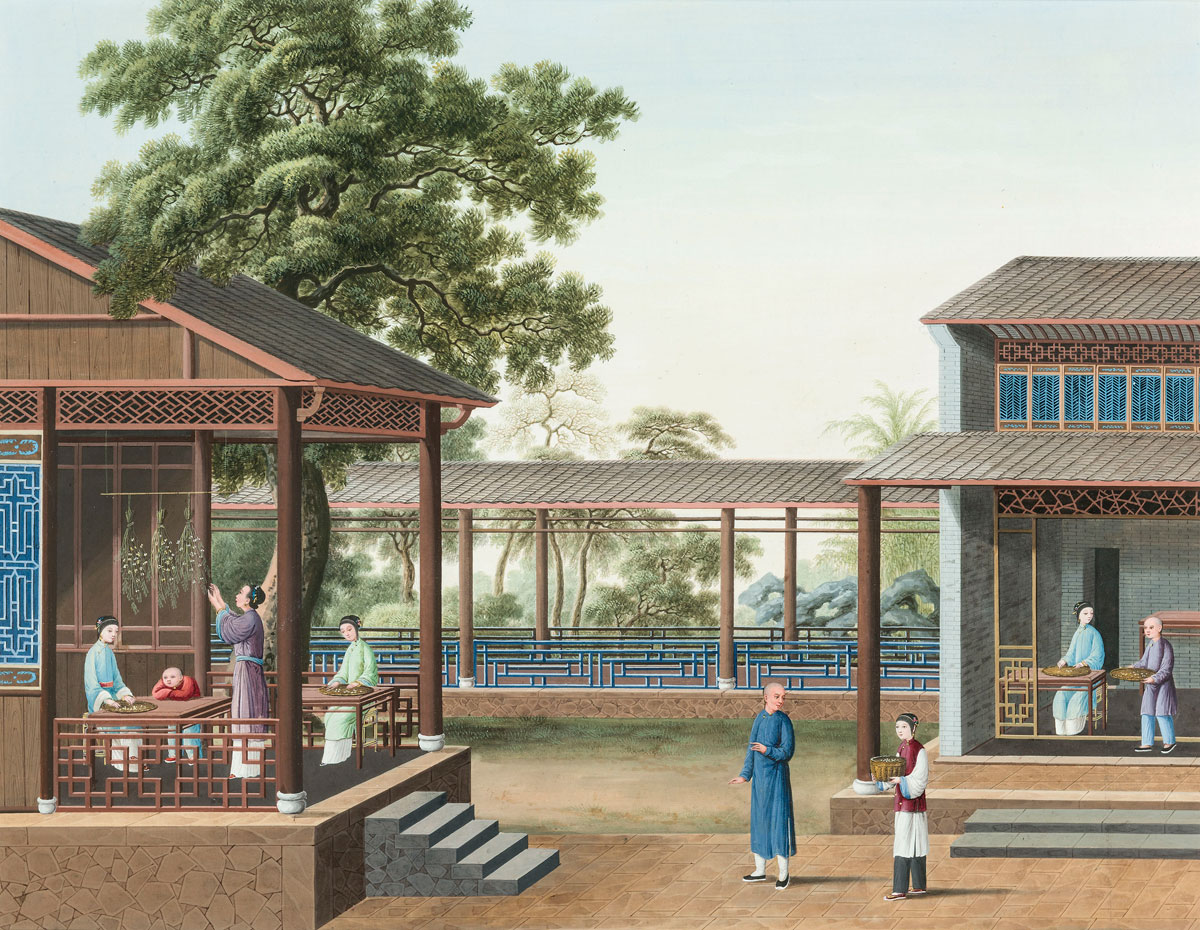
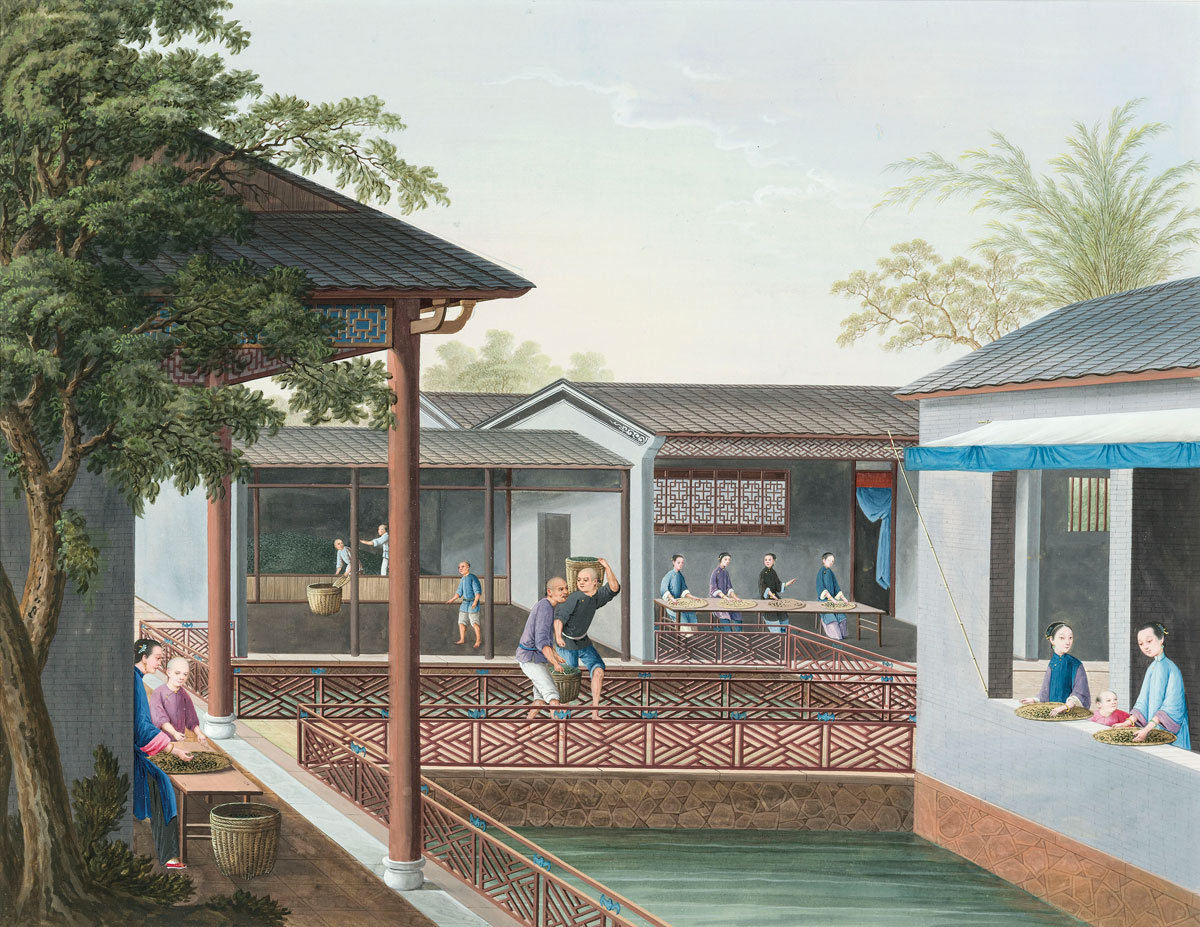
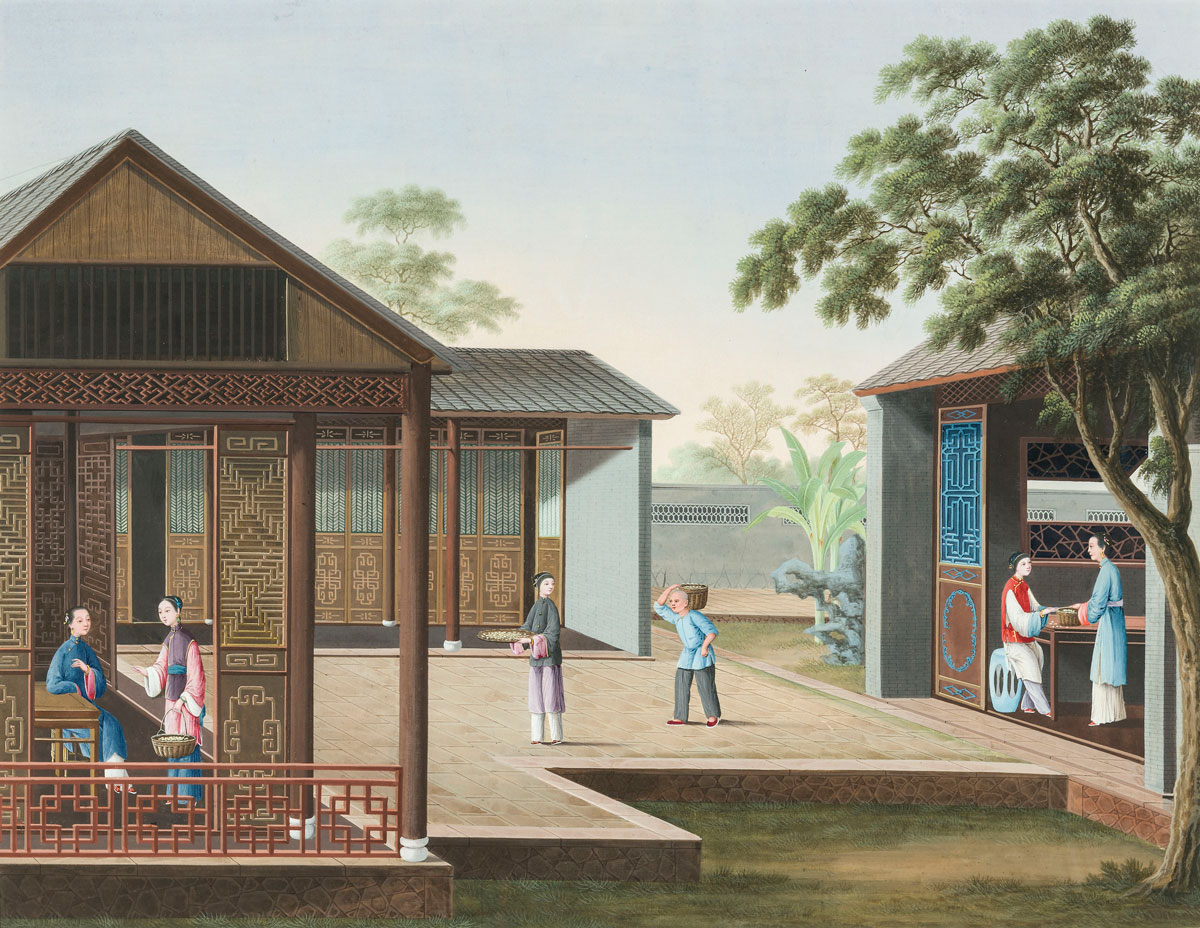
The work itself followed the life cycle of the silkworm and demanded constant attention. Eggs were kept at carefully controlled temperatures until they hatched, and the emerging caterpillars were fed fresh mulberry leaves around the clock for roughly twenty-five days until they began to spin. Each cocoon was formed from a single continuous filament that could stretch six hundred meters or more when unwound.
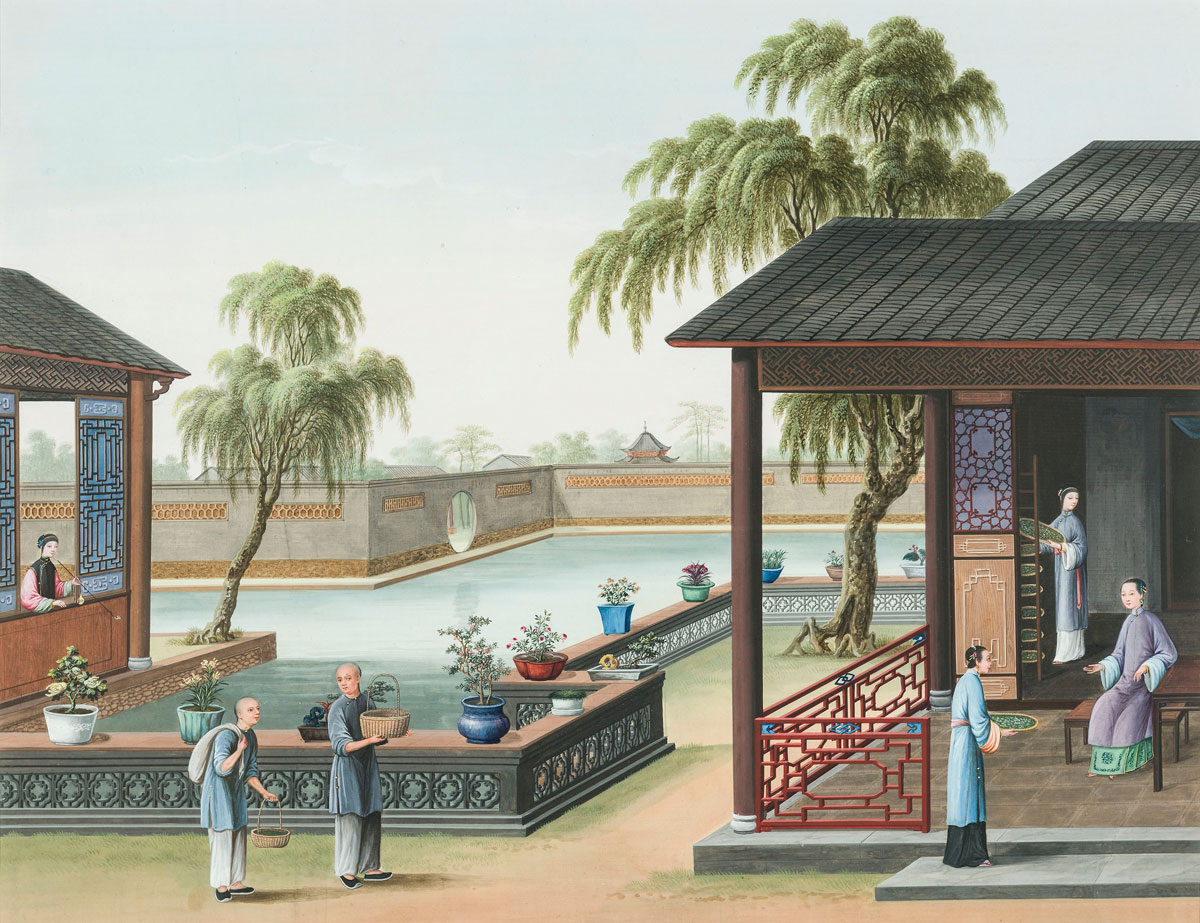
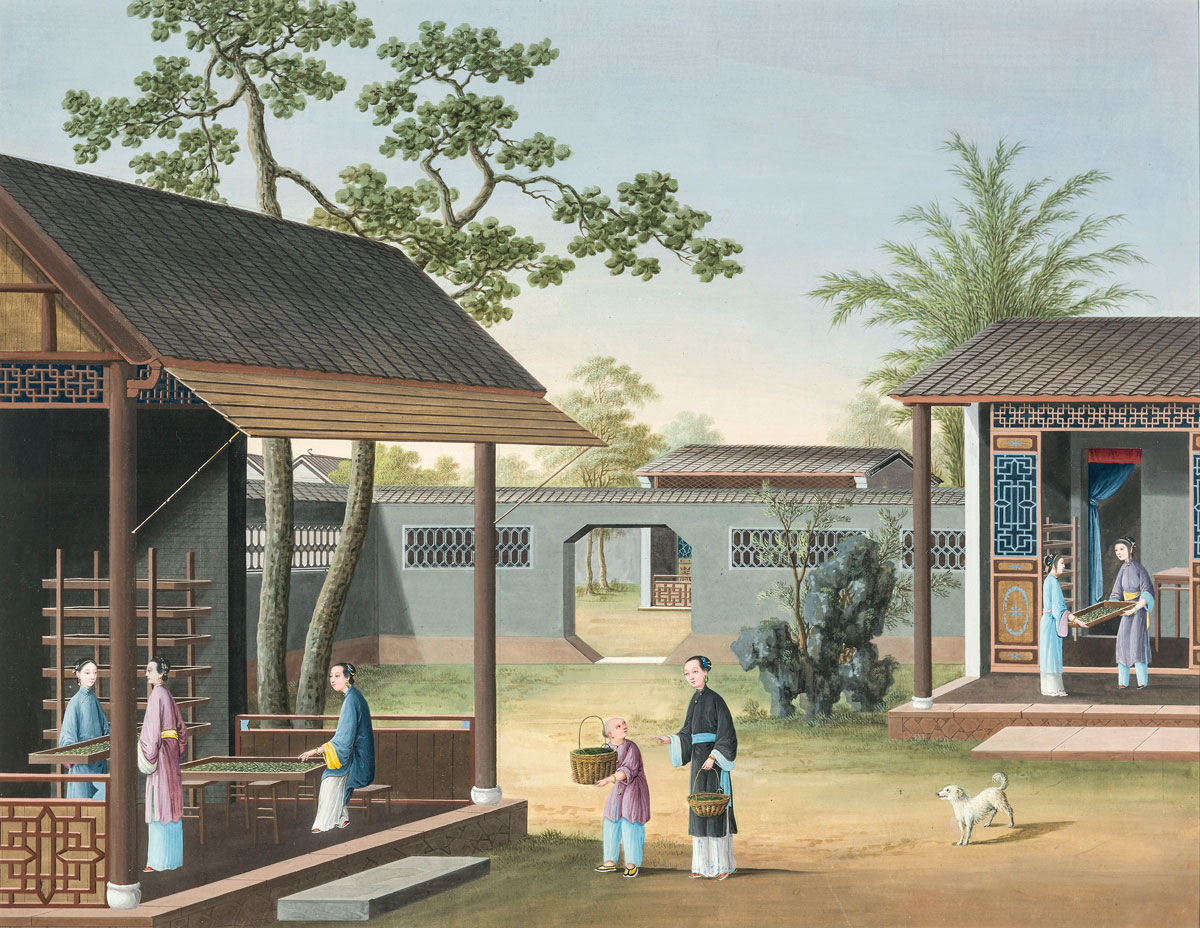
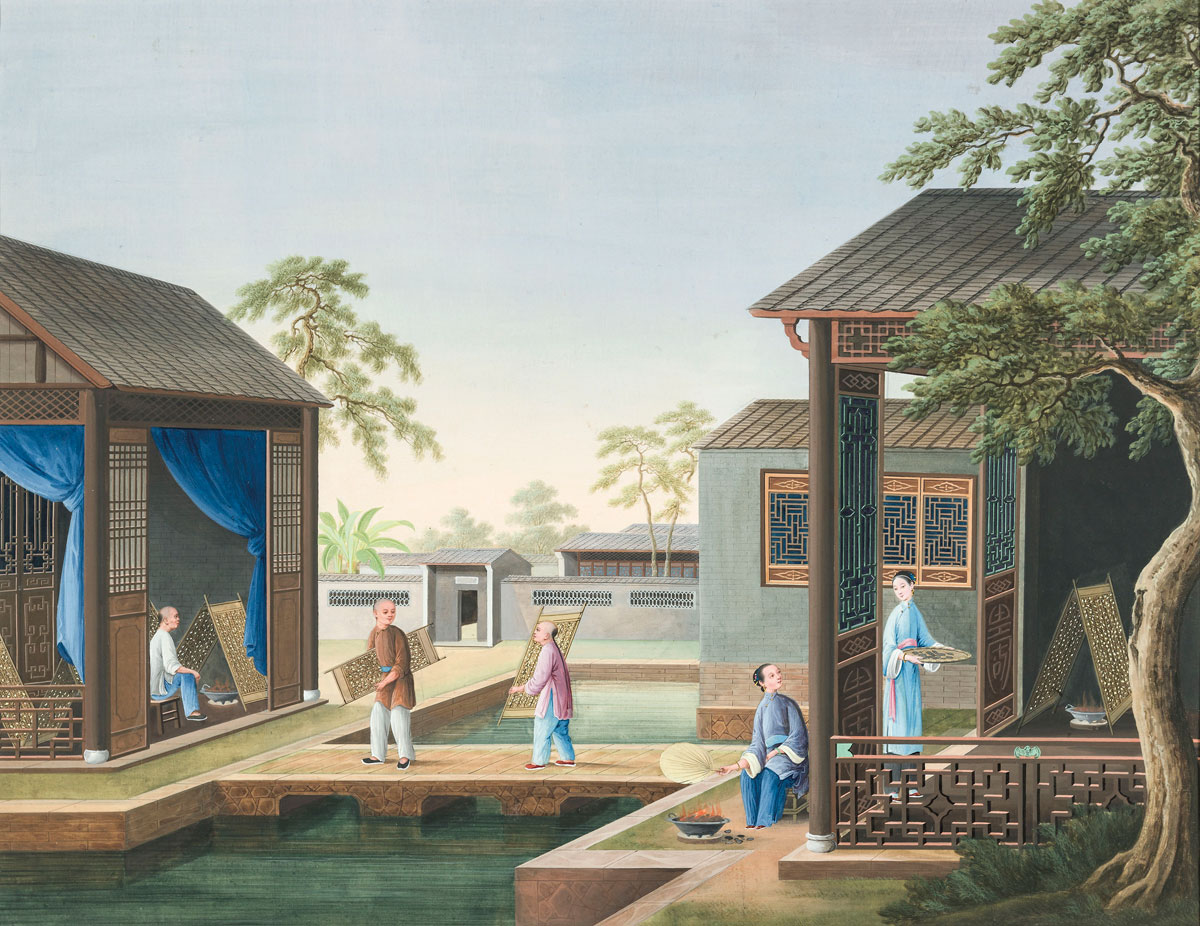
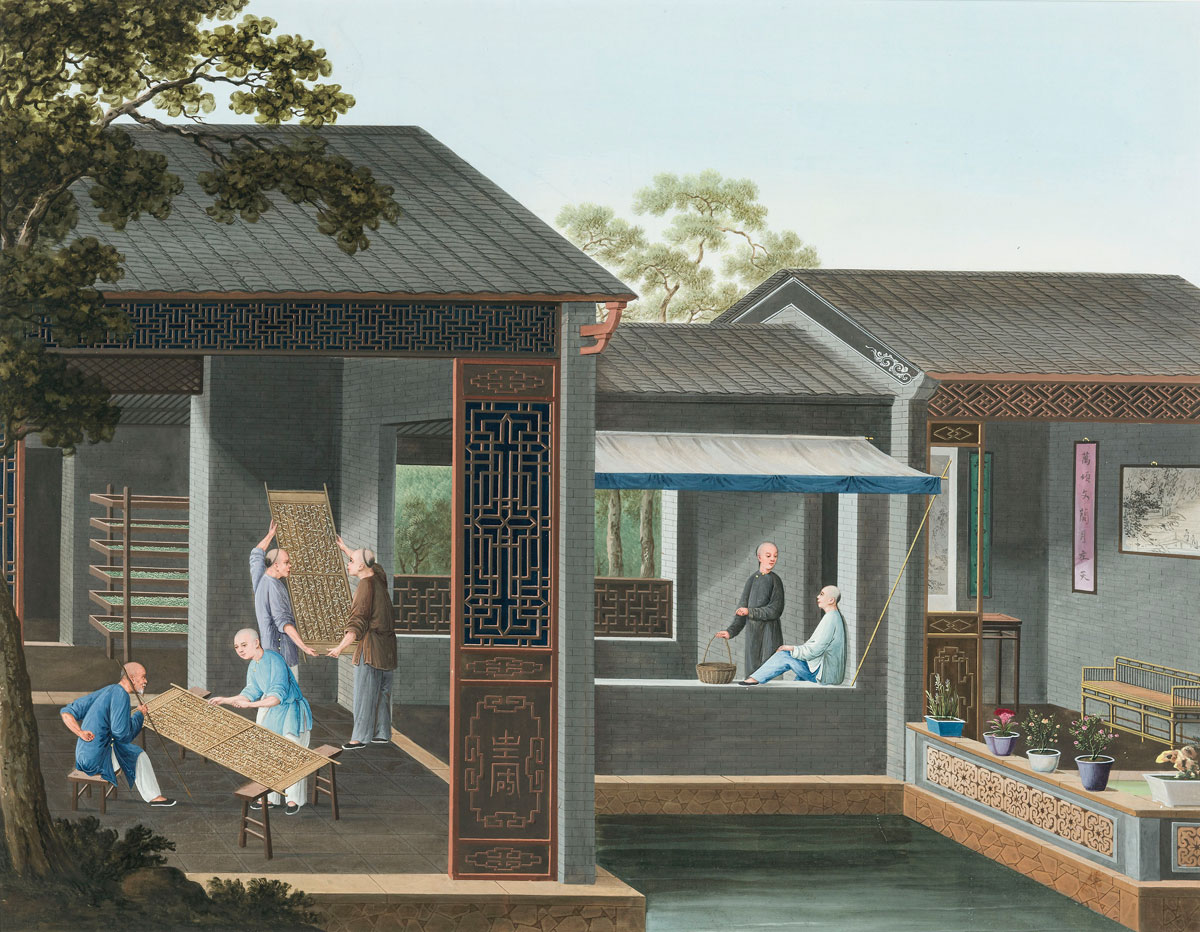
To harvest this thread, workers killed the pupae with steam or boiling water, then carefully reeled the filaments from several cocoons at once, combining them into a stronger yarn. The reeled silk was then prepared for dyeing, warped onto looms, and woven into fabric by specialized artisans working in urban workshops, many of them clustered in the streets around Canton.
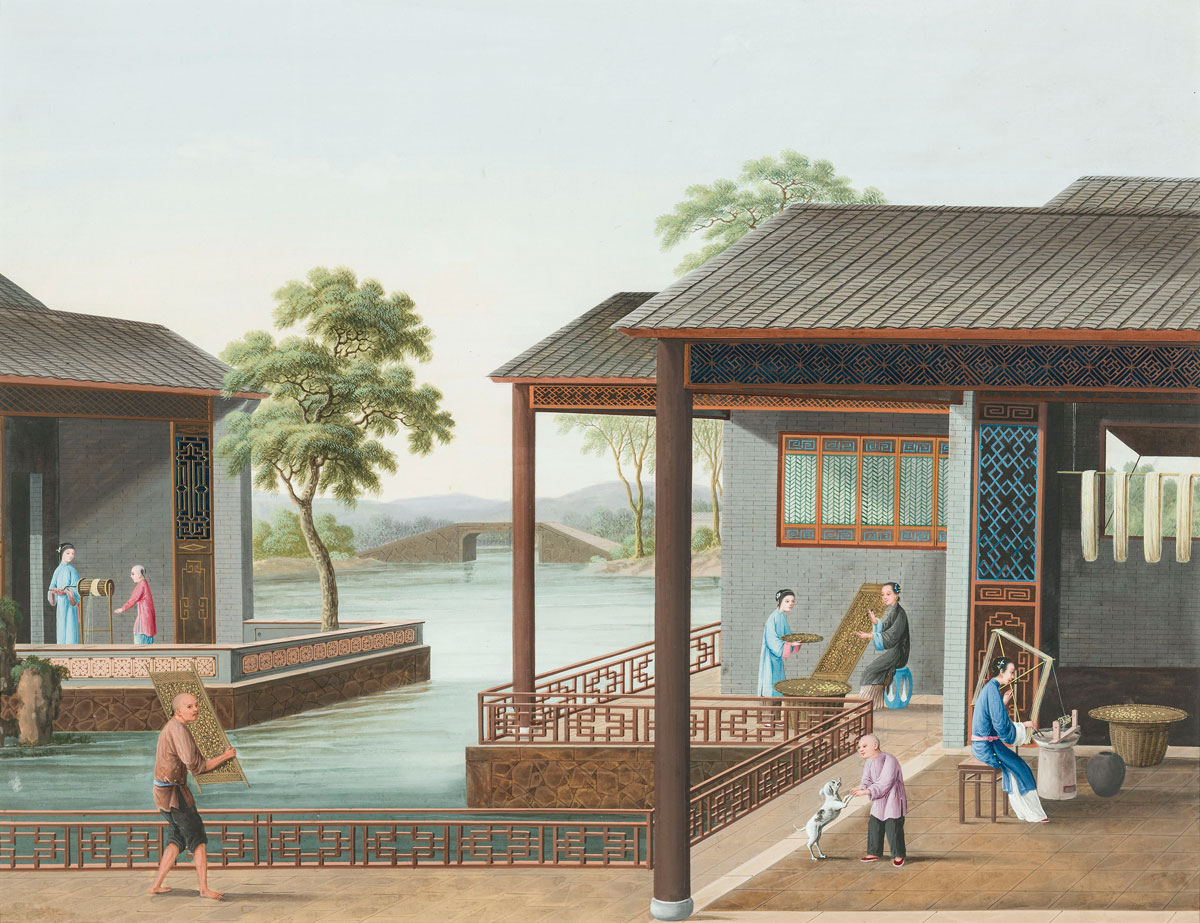
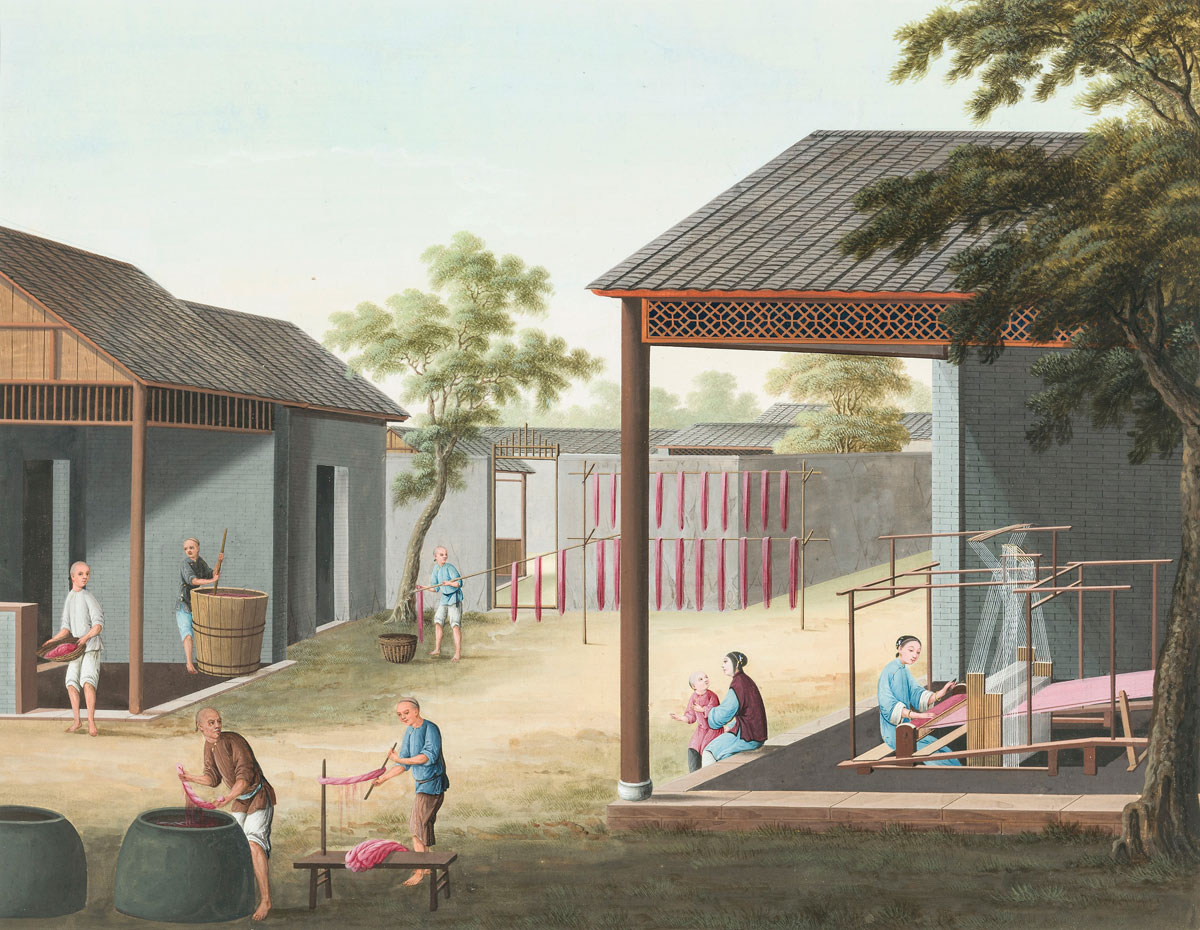
By the eighteenth century, silk had become China's second most valuable export after tea, and European demand for it seemed limitless. Chinese weavers produced everything from heavy brocades and satins to light gauzes, and the workshops at Canton learned to blend Western neoclassical motifs with traditional Chinese designs to suit foreign tastes.
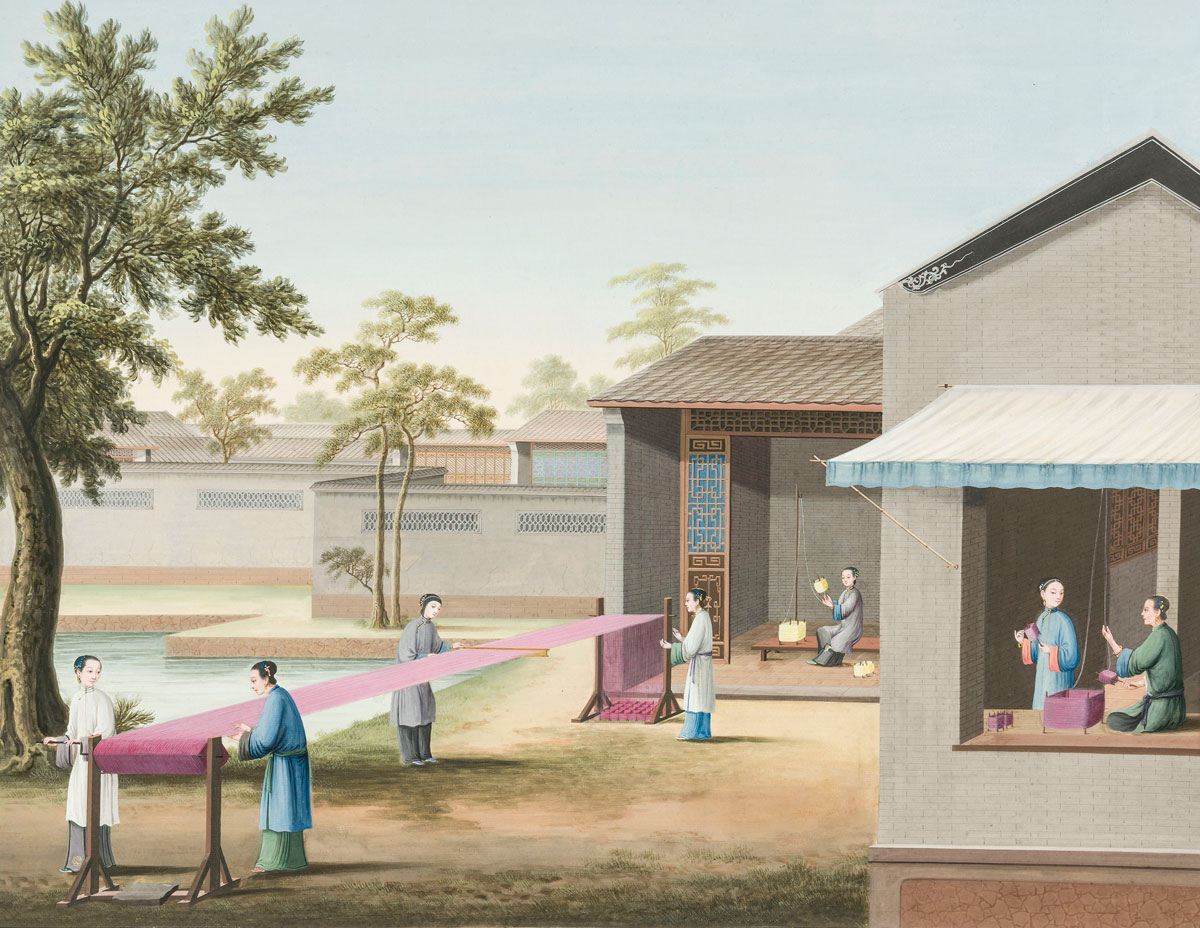
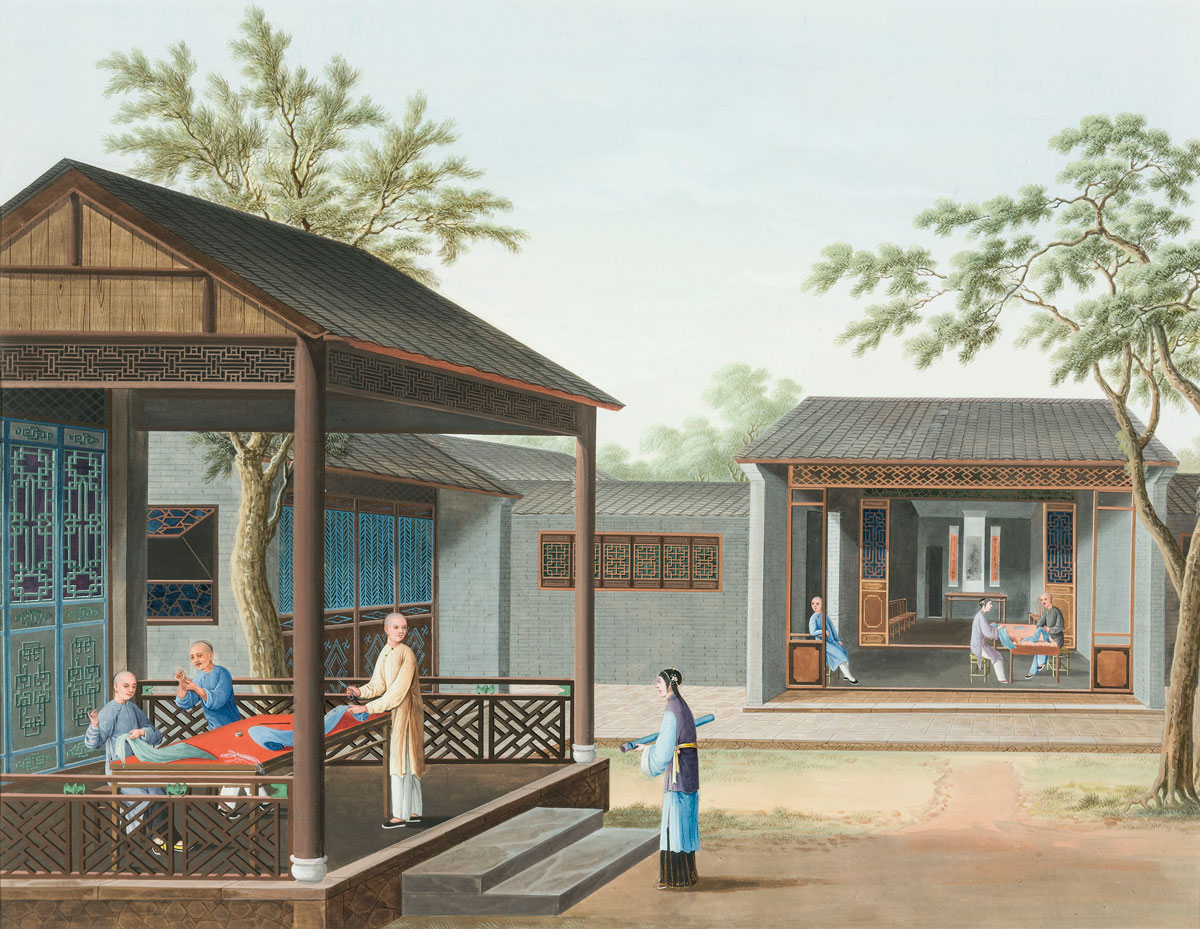
Other silk-producing regions existed in the world by this time, notably in Italy and France, but Chinese silk maintained its reputation for superior quality and luster. The sheer scale of production, sustained by cheap and abundant labor across thousands of small family operations, kept prices competitive. Like tea and porcelain, silk flowed out of Canton in exchange for silver, reinforcing the trade imbalance that would define the economic relationship between China and the West for generations.
Set of silk production images above attributed to Chinese School, c.1820Manufacture of Porcelain
Of the three great exports that flowed through Canton, porcelain was the one that Europeans had spent the longest trying and failing to reproduce. Chinese potters had been refining the material for well over a thousand years, and the center of production was the city of Jingdezhen in Jiangxi province, where abundant deposits of kaolin clay and porcelain stone, favorable fuel supplies, and a vast network of rivers and canals for transport had sustained an enormous ceramics industry since the Song dynasty (960–1279). By the Ming period (1368–1644), Jingdezhen had become, in effect, one of the earliest industrial cities in the world, with hundreds of kilns operating simultaneously and as many as seventy specialized workers involved in the creation of a single piece.
The process began with the raw materials. Kaolin, a fine white clay named after the village of Gaoling near Jingdezhen, was mixed with porcelain stone to create a paste that was both strong enough to hold its shape and plastic enough to be worked on a wheel. The proportions of the two ingredients determined the grade of the finished ware. Once formed, the pieces were dried, glazed, and loaded into kilns where they were fired at temperatures exceeding 1,300 degrees Celsius for days at a time. At that heat, the paste vitrified into a material that was hard, translucent, and resonant when struck. Controlling the temperature within the kiln was an art in itself, and the kiln master judged readiness by watching the color of the saggars, the protective clay boxes that shielded each piece during firing.
The glazes and pigments that gave the finished porcelain its character were drawn from sources both local and distant. Traditional Jingdezhen glazes were produced by burning layers of limestone together with a fern found in the surrounding mountains, and the resulting ash was mixed with porcelain stone in carefully controlled ratios to achieve a smooth, lustrous finish. For the iconic blue-and-white wares that came to define Chinese export porcelain, painters applied cobalt oxide beneath a clear glaze before firing. The cobalt was originally imported from Persia beginning in the Tang dynasty (618–907), and its iron-rich composition produced a deep, slightly purplish blue with a tendency to bleed into the glaze. By the Ming period, domestic cobalt sources from Yunnan and other provinces offered a softer, clearer blue, and potters sometimes blended imported and local pigments to achieve particular effects.
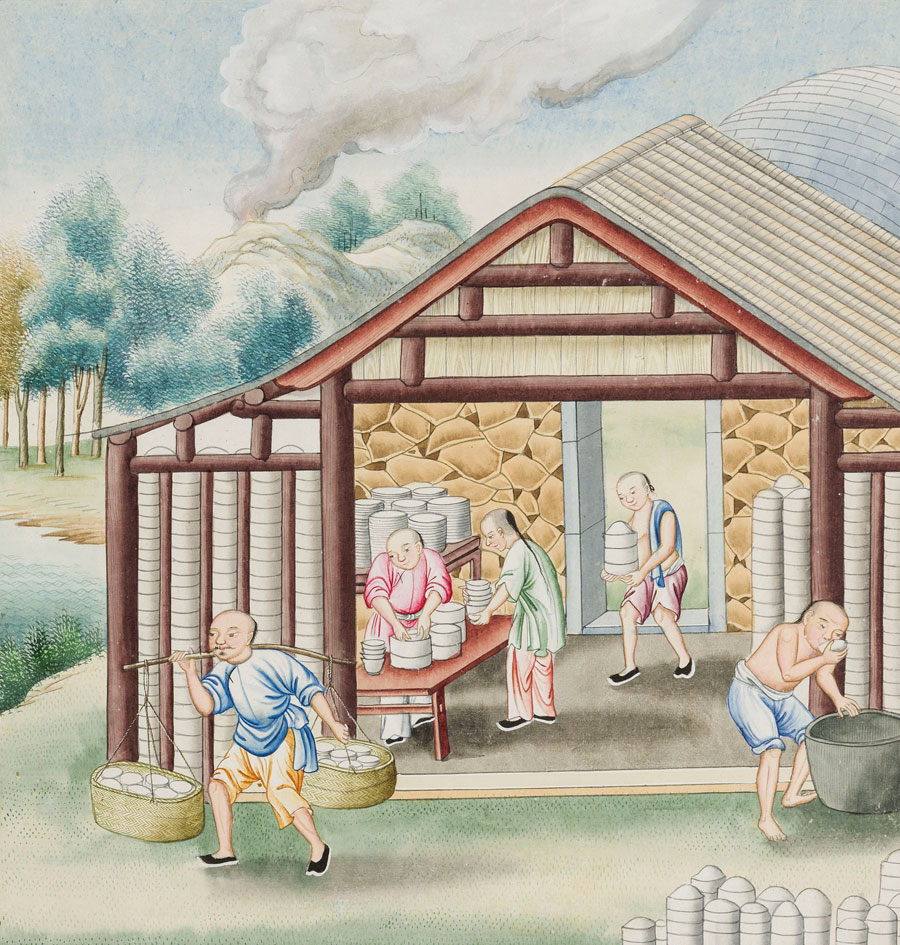
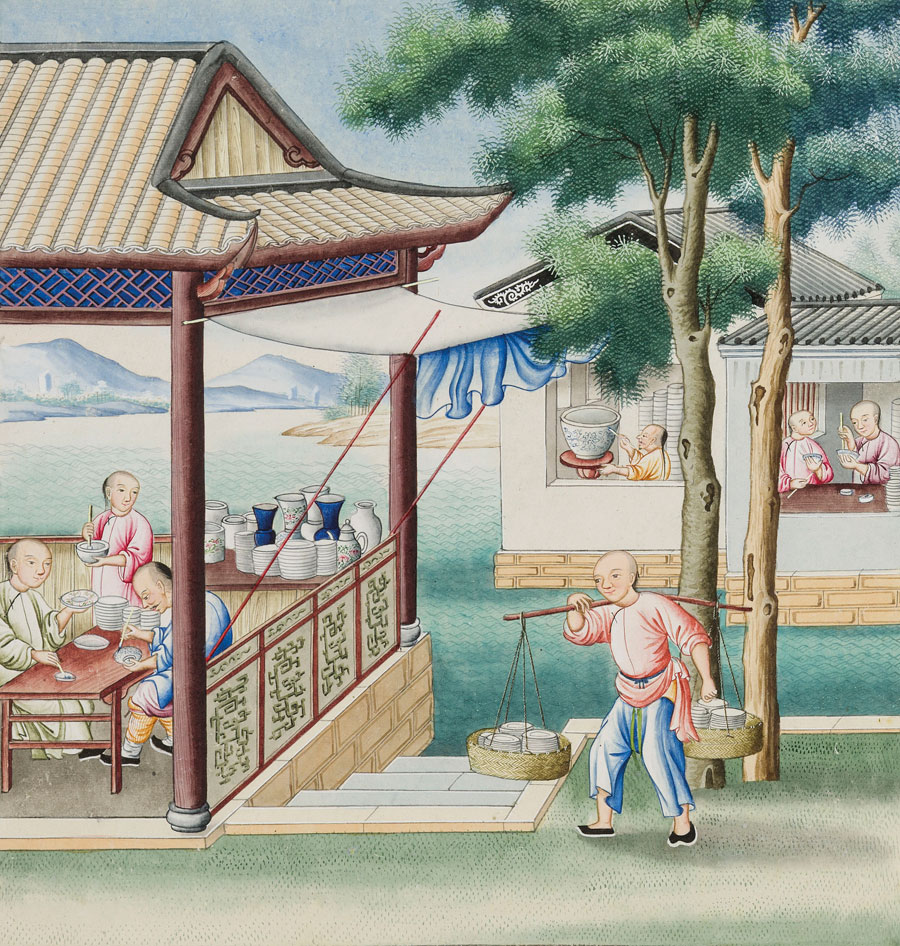
For the export market, much of the porcelain followed a two-stage journey. Undecorated blanks were fired at Jingdezhen, then transported hundreds of miles overland and by river to Canton, where painters in specialized workshops applied enamel designs suited to Western tastes. European and American merchants sent drawings of family coats of arms, monograms, and fashionable patterns to be copied onto dinner services, punch bowls, and tea sets. The workshops at Canton grew adept at blending Chinese decorative traditions with the preferences of foreign buyers, producing wares that occupied a space between two visual worlds.
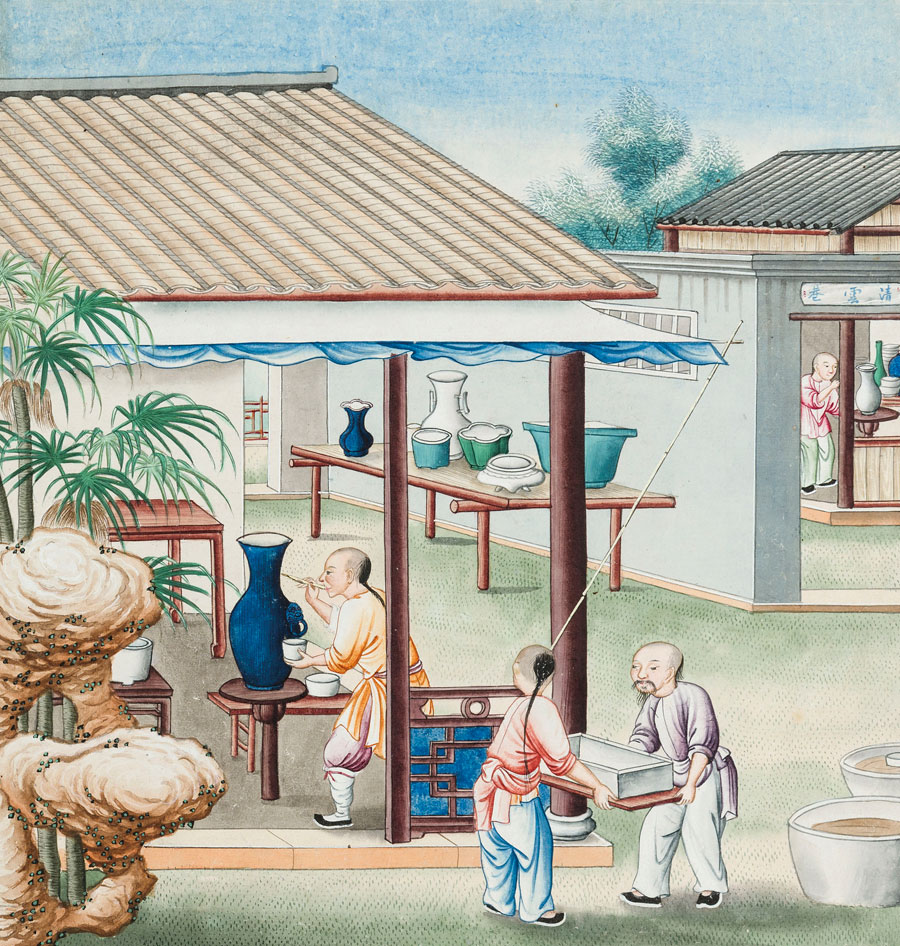
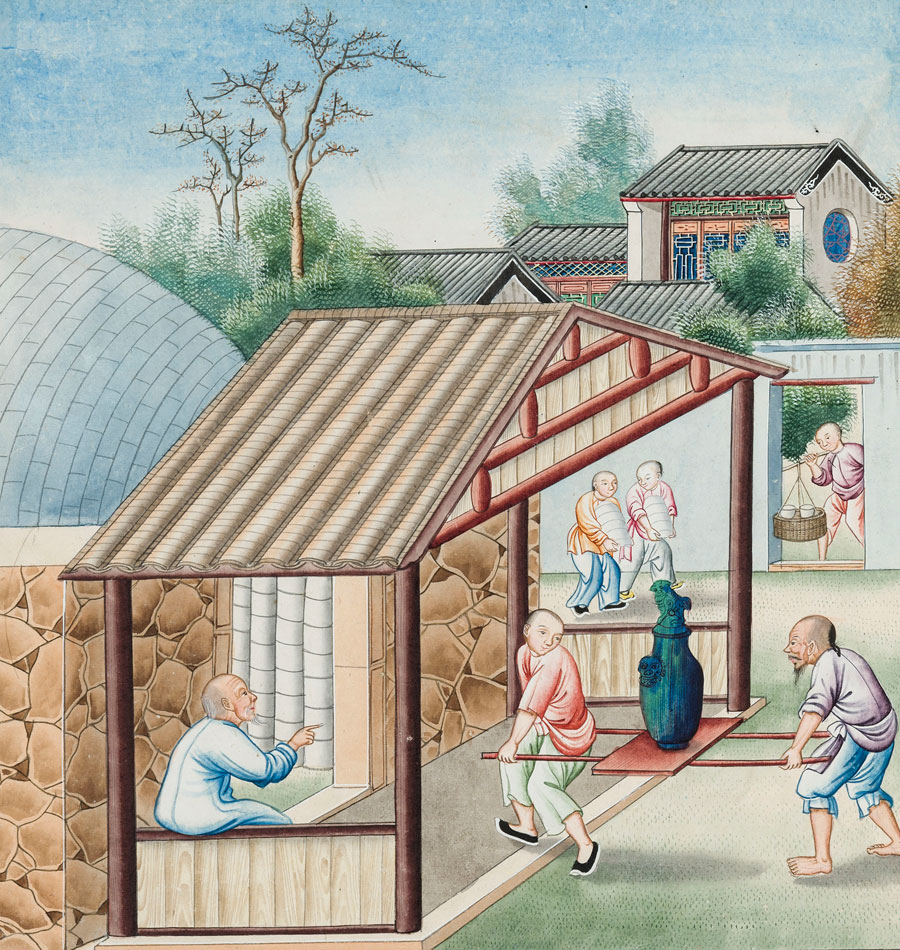
The composition of Chinese porcelain and the techniques used to fire it remained a mystery to Europeans for generations, and more than sixty million pieces are estimated to have reached the West during the height of the trade. The scale of production at Jingdezhen, the skill of its workforce, and the relatively low cost of labor allowed Chinese wares to remain competitive even after European factories began producing their own porcelain in the eighteenth century. Like tea and silk, porcelain was paid for overwhelmingly in silver, and together the three commodities formed the economic engine of the Canton trade.
Set of porcelain manufacture images above attributed to Chinese School, c.1800