Japanese Edo Period Bar Money
During Japan's Edo period (1601-1868), a variety of uniquely shaped, non-standard coinage circulated, valued by weight and fineness. Many of these coins picked up chopmarks, likely applied by merchants and money changers to validate metal content. The marks are distinctly Japanese in character and style, suggesting they were applied domestically rather than in overseas trade ports. Documentation remains scarce, but at a coin show in Osaka I attended in October 2024, the majority of Edo period coins on display bore chopmarks. We even see chopmarks on gold coins, a curiosity unique to Japanese coins of this period.
1601-1695 Ichibu - Keichō era
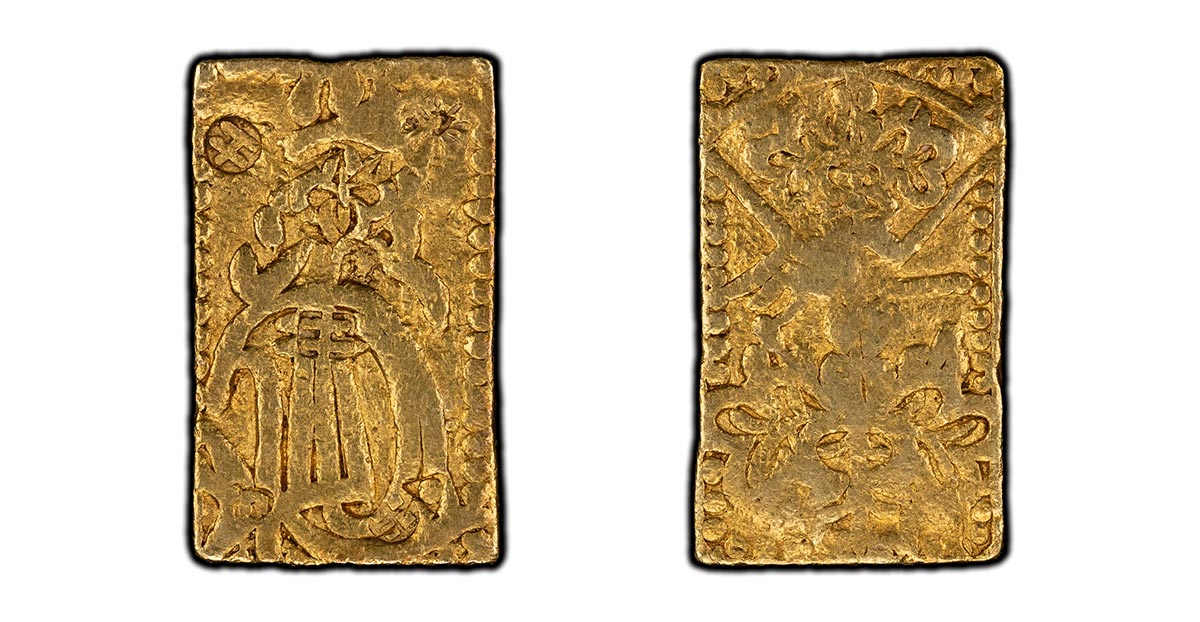
Specifications:
Specification: 4.39 g, .857 gold and .143 silver (measured at 4.41g)
Recorded mintage: Unknown
Catalog reference: PCGS 361961, Hartill 8.36a, JNDA 09-31
Details:
The Keichō ichibu kin was issued beginning in 1601 under Tokugawa Ieyasu, who unified Japan's fragmented currency system after centuries of reliance on Chinese bronze
coins and established standardized gold and silver minting facilities known as kinza and ginza. This rectangular gold coin, valued at one-quarter ryō and weighing
approximately 4.4g with 85-86% gold content, represented the only ichibu denomination struck during the nearly century-long span before the devastating Genroku recoinage
of 1695, which debased Japanese gold coinage from 84% to 56% fineness to address fiscal shortfalls and expand money supply, triggering immediate hoarding of pre-debasement
coins and runaway inflation. The Keichō era coincided with Japan's peak influence as a silver exporter to China, when Japanese mines provided an estimated 40-75 tons of
silver annually to Chinese markets in exchange for silk, rivaling and possibly surpassing Mexican silver imports during the late Ming period. However, this commercial
prominence was cut short by the implementation of sakoku isolationist foreign policies beginning in 1636, which confined Chinese and Dutch merchants to Nagasaki under
direct shogunal supervision and eventually led to export restrictions on silver (1668-72) as the Tokugawa shogunate grew alarmed at bullion outflow and the success of
Jesuit missionaries accompanying Portuguese traders. The 1695 debasement that ended the Keichō monetary standard effectively halted Japanese silver exports, shifting global
silver trade dependency almost entirely to Latin American sources and isolating Japan's domestic currency from international commerce until forced reopening by the Perry
Expedition in 1853-54.
Notable chopmarks:
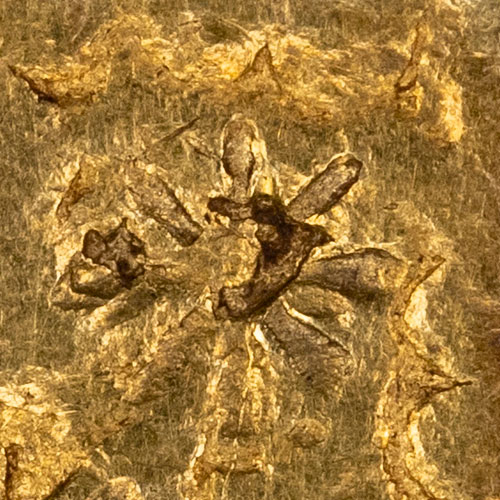 Small starburst shaped chopmark
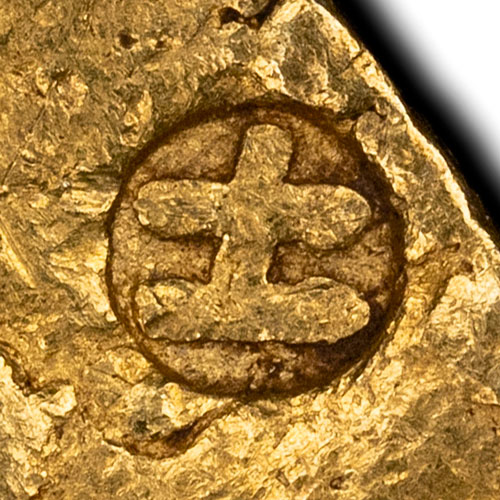 土 - ド・ト / つち - soil, earth, ground, Turkey
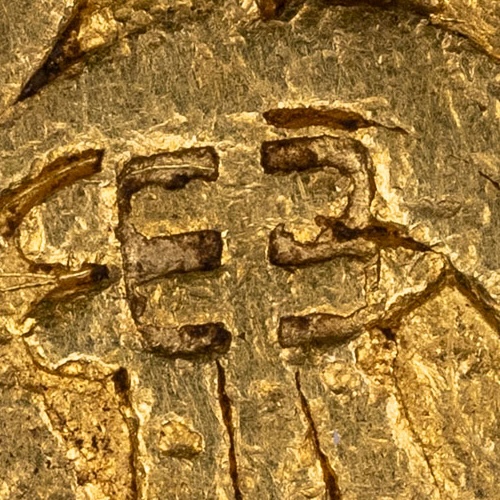 キ - ki - katakana
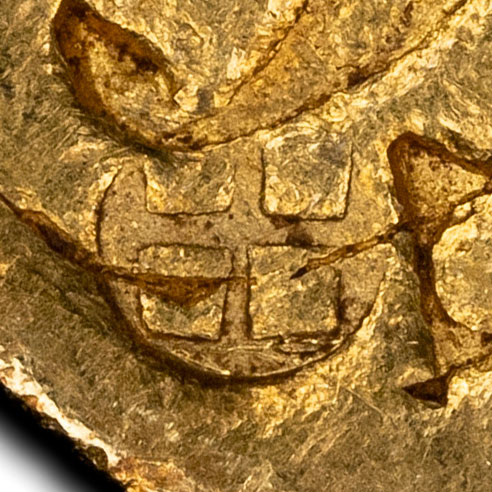 Four dots in a circle, possibly 田 - デン / た - rice field, rice paddy
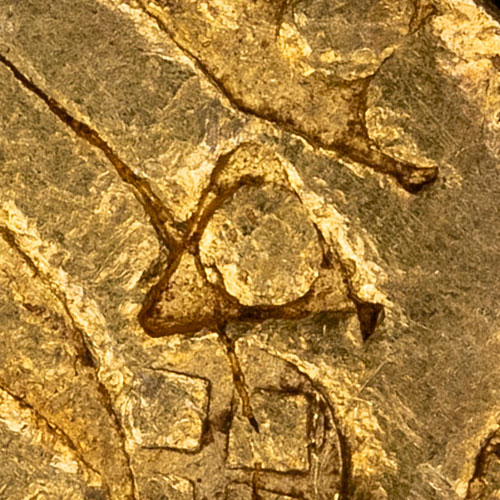 Circle dot in a triangle
1601-95 Koban - Keichō era
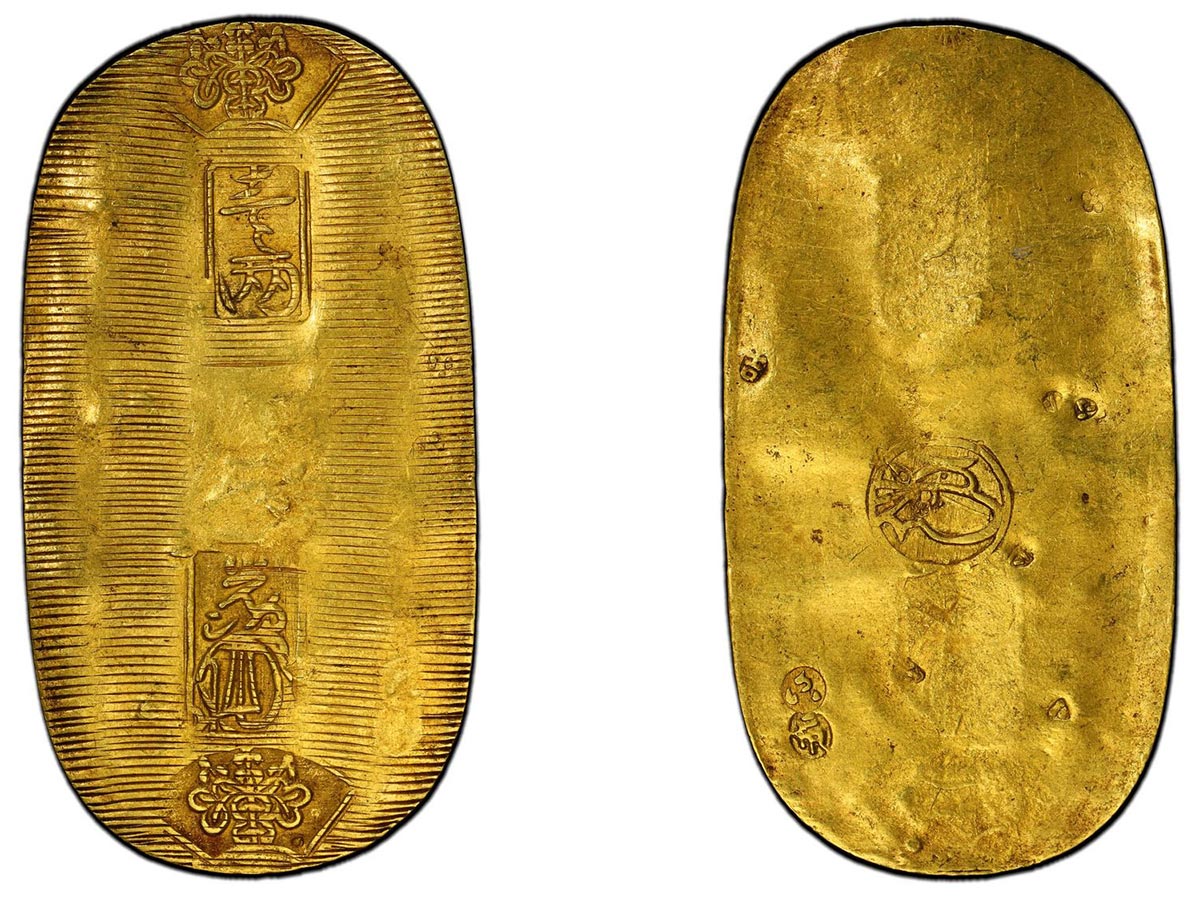
Specifications:
17.72 g, .857 gold and .143 silver
Recorded mintage: unknown
Catalog reference: Fr-9.1; JNDA-09-13; JC-03-1-1, PCGS# 524061
Details:
The Keichō koban, introduced in 1601 as the cornerstone of Tokugawa Ieyasu's tri-metallic monetary system, was an oval gold coin valued at one ryō and weighing
approximately 17.7-18.2g with 85-86% gold fineness (862 parts gold to 138 parts silver by assay). Tokugawa Ieyasu conceived the koban as a downsized, practical
version of Toyotomi Hideyoshi's massive Ōban plate currency, deliberately creating a denomination suited for commercial transactions rather than ceremonial display,
a strategic move intended to attract merchants to Edo and establish economic dominance away from the traditional capital of Kyoto. The koban featured distinctive
chisel marks in five columns (fine crenulations closely spaced together), fan-shaped paulownia crests, the designation "Ichi Ryō," and signatures of mint officials from
facilities in Kyoto, Suruga, and Edo, establishing standardized specifications that replaced centuries of fragmented regional currencies and foreign Chinese bronze coins.
The denomination circulated primarily in the Kanto region around Edo where samurai residences concentrated, giving rise to the term "financial habit of Edo" as
high-ranking warriors conducted large-amount transactions in koban gold while silver predominated in commercial centers like Osaka. The Keichō koban's 94-year production
run ended with the catastrophic Genroku recoinage of 1695, which retained the coin's weight at approximately 17.8g but slashed gold fineness from 84% to 56%, stretching
reserves to expand money supply by 34% while triggering immediate hoarding of pre-debasement issues and necessitating the 1696 revaluation to address runaway inflation
that would plague Japanese monetary policy throughout the 18th century.
In the December 2012 issue of "The Chopmark News", on page 154 Chien I-Hsiung states the following:
"Japanese gold oban, koban, and silver chogin were also chopped in China as they were exchanged by Dutch traders in Japan for Dutch Rijksdaalder in trade. I believe these small chops
on these Japanese gold ingots were done in China, not in Japan." Mr. Chien I-Hsiung is a collector of Taiwanese coins and is best known for his book "World Currencies in Taiwan". The
book deals with the entire history of coins which circulated in Taiwan from ancient times [Chinese cash], the period of Dutch and later Spanish occupation [1624-62], the period of
Koxinga rule [1661-83], Ching dynasty rule [1683-1895], the very brief five months of the Republic of Formosa [1895], Japanese rule [1895-1945] and the period of the Republic of China
[1945-date].
The question remains, why were these gold coins chopmarked? We know the Chinese preferred silver, so why chopmark the gold?
Notable chopmarks:
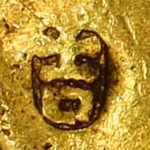 吉 - キチ・キツ / よし - good luck, joy, congratulations
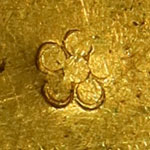 Symbol chop
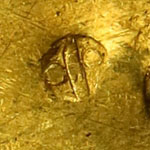 忄 - xīn - heart radical
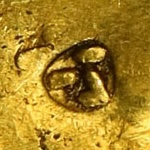 Unknown character
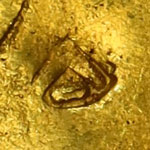 亼 - (simplified form of 集) jí - to collect, collection, market, fair
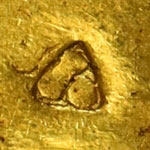 Unknown character
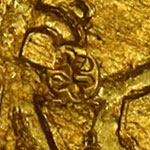 キ - ki - katakana
1601-1695 Mameita-gin - Keichō era

Specifications:
xx.xx g actual weight, approximately .800 fine silver
Recorded mintage: Unknown
Catalog reference: JNDA 09-59
Details:
The Keichō Mameita-gin, produced from 1601 to 1695, was the small-denomination companion piece to the much larger chogin, the sea-cucumber-shaped silver ingots
that served as the primary commercial currency of western Japan, and the two circulated as a pair, valued by weight rather than by any fixed denomination. Where
the chogin handled bulk transactions, the mameita-gin filled the gap for smaller purchases, and the pairing was so integral that the two were often sealed together
by money changers into hogin, paper bags of combined chogin and mameita-gin weighted to a precise monme value and used to simplify transactions without the need to
re-weigh individual pieces each time. The Keichō issues were struck at approximately 80% silver fineness, the highest standard any mameita-gin would ever achieve,
and one that would not be seen again after the Genroku debasement of 1695 dropped fineness to 64%. Notably, the mameita-gin in its current form was not part of the
original 1601 coinage; early chogin were simply cut by chisel when smaller amounts were needed, a practice the shogunate moved to suppress, with mameita-gin emerging
as a standardized small silver unit from around the Genna era onward to replace the ad hoc cutting. Attribution of Keichō mameita-gin relies on subtle details in the
Daikoku stamp (the god of wealth appears slightly tilted on Keichō pieces, distinguishing them from later issues where the figure faces more directly forward)
alongside the ginza hallmarks reading "jōze" and "hō." Like all mameita-gin, each piece is entirely unique in shape: the manufacturing process of melting, pouring,
and hand-hammering the alloy meant that finished pieces ranged from loosely oval to dramatically irregular, and the Keichō issues are particularly noted for their
deformed and varied forms, a quality that paradoxically served as authentication, since the organic imperfections of genuine hand-work were nearly impossible to
replicate convincingly.
Notable chopmarks:
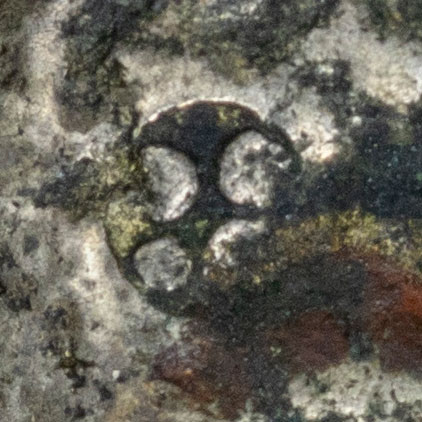 Four dots in a circle
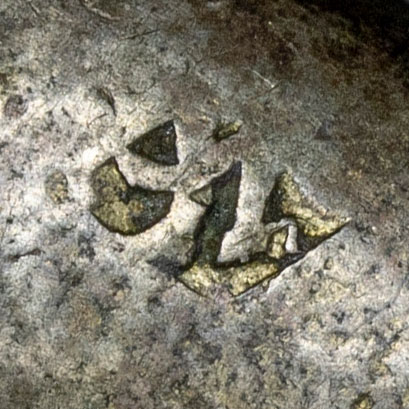 力 - lì - strength, force
Provenance:
Purchased from the
1695-1706 Mameita-gin - Genroku era
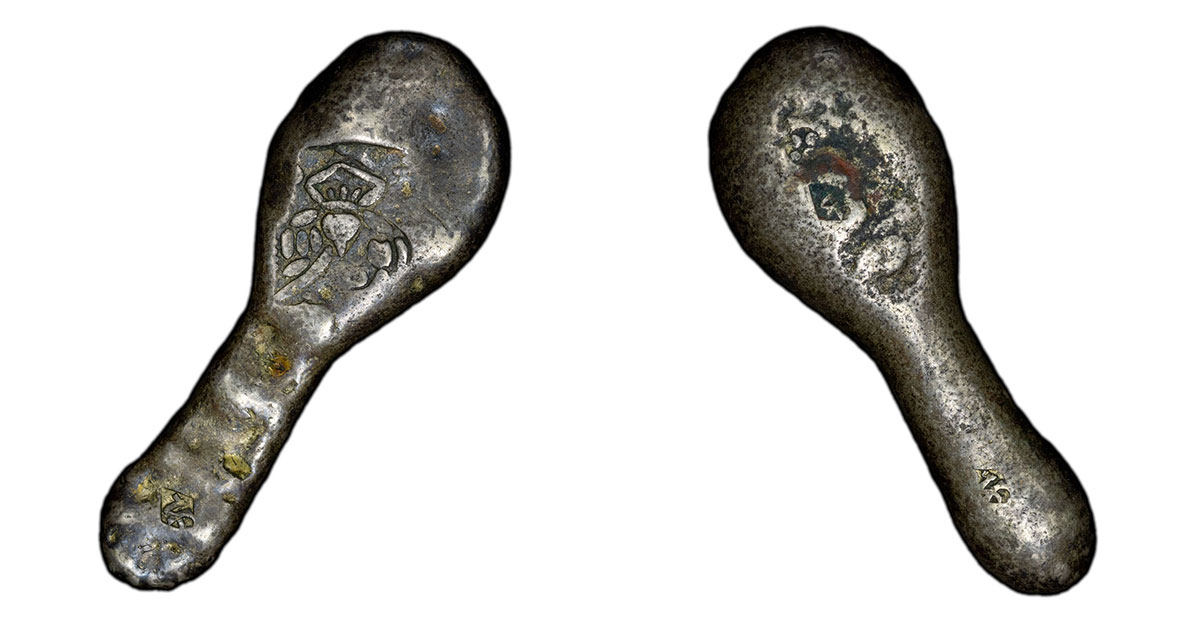
Specifications:
15.4 g actual weight, approximately .640 fine silver
Recorded mintage: Unknown
Catalog reference: JNDA 09-xx
Details:
The Genroku Mameita-gin, issued from 1695 to 1706, was a hand-struck bean-money silver coin, part of the broader chogin and mameita-gin weight-based silver system
that had served as Japan's everyday transactional currency since the early Edo period. Its production was driven by the Genroku Recoinage of 1695, itself a symptom
of the shogunate's deteriorating finances under the fifth shogun Tokugawa Tsunayoshi, whose reign combined genuine cultural flourishing with spectacular fiscal
mismanagement, lavish spending on ceremony, temple construction, and the notorious Edicts on Compassion for Living Things, which famously mandated the care of stray
dogs at government expense. To replenish depleted reserves, the shogunate debased both the gold koban and the silver coinage simultaneously, dropping silver fineness
from the approximately 80% of the Keichō standard to around 64%, triggering the inflation and hoarding that would haunt his successors for decades. The Genroku
mameita-gin bears the era character 元 (gen) alongside the image of Daikoku, the god of wealth, an irony that would not have been lost on the merchants who handled
them. Each piece was produced by hand: silver alloy was melted, poured, cut, and hammered into shape before official stamps were applied, meaning no two examples are
alike. The resulting forms range from roughly oval to wildly irregular, and some, like the piece at hand, take on a double-lobed shape narrowed at the center, a
product of how the metal was worked and trimmed rather than any intentional design. Far from being a defect, this irregularity was itself a mark of authenticity;
counterfeiters rarely replicated the precise textures and organic imperfections of genuine hand-worked pieces. The Genroku issues were replaced by the Hōei recoinage
beginning in 1706, which debased the silver further still, setting a grim precedent that the Shōtoku reforms of 1714 would ultimately attempt, with only partial
success, to reverse.
Notable chopmarks:
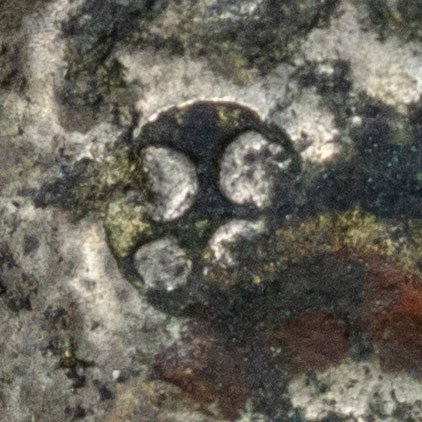 Four dots in a circle
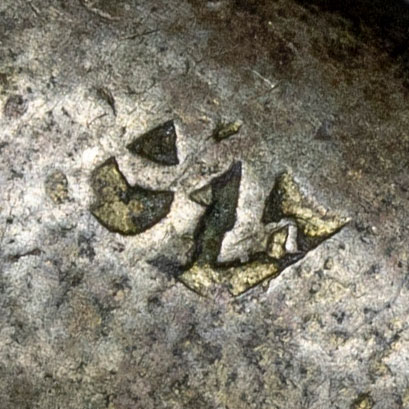 九 - キュウ・ク / ここの・ここの.つ - nine
Provenance:
Purchased at the Osaka Coin Show in October 2024.
1714-1736 Chogin - Kyōhō era
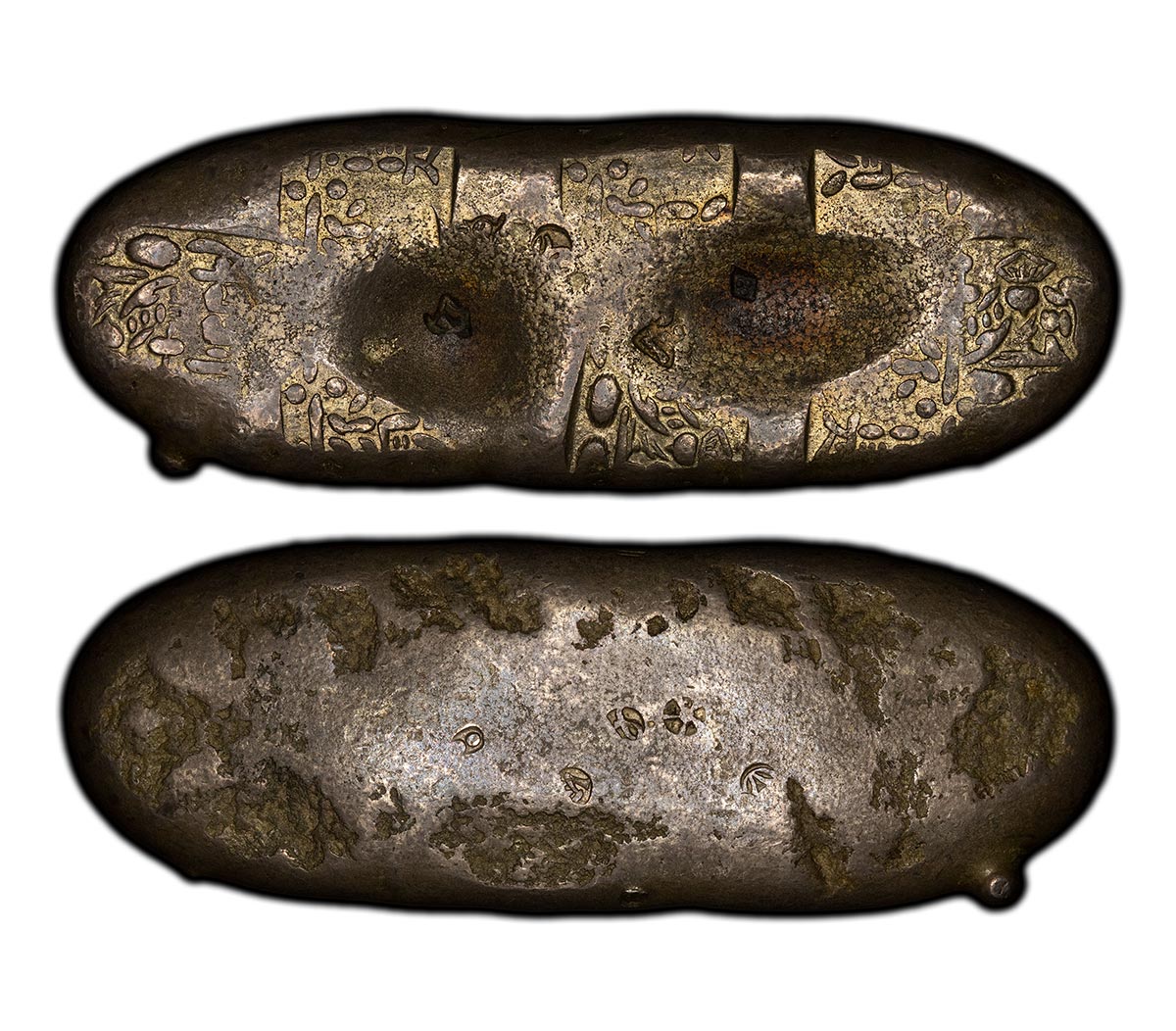
Specifications:
126 g actual weight, approximately .800 fine silver
Recorded mintage: Unknown
Catalog reference: KM 63 JNDA 09-65
Details:
The Kyōhō chogin, issued during the Kyōhō era (1716-1736) following the initial Shōtoku chogin of 1714, was a sea cucumber-shaped silver ingot with varying weights
(typically ranging from under 100g to over 200g, though most clustered around 160g) and 80% silver fineness. Unlike denominated gold coinage, these ingots circulated
by weight rather than face value, a fundamental distinction that reflected silver's role in commercial transactions, particularly in Osaka's sophisticated cashless
payment system where merchants settled accounts through checks issued by ryogae-sho money changers rather than physical metal exchange. The Kyōhō chogin bore
hallmarks including images of Daikokuten (god of wealth) and characters reading "joze" and "joze ho," with the Kyōhō type distinguished from the earlier Shōtoku
chogin by having fewer than nine hallmarks (while Shōtoku pieces featured ten or more). The Kyōhō issue emerged from Confucian adviser Arai Hakuseki's desperate attempt
to reverse the catastrophic inflation caused by the 1695 Genroku debasement; the 1714 Shōtoku recoinage restored silver fineness to Keichō-era levels, followed by the
1715 Kyōhō recoinage which increased quality even further, making it one of only two recoinages in the entire Edo period that raised rather than lowered precious metal
content. However, Hakuseki's well-intentioned reforms triggered crippling deflation as money supply plummeted: economic activity ground to a standstill, commodity prices
crashed, rice prices collapsed, and both the samurai class and their tenant farmers faced impoverishment, a crisis so severe that in 1736, the eighth Tokugawa Shogun
Yoshimune was forced to abandon the quality-money experiment entirely with the Genbun recoinage, debasing silver again to increase circulation and stimulate the moribund
economy. The Kyōhō era reforms coincided with Hakuseki's 1715 export ban on monetary specie and the 1714 "Shōtoku no chi" political purge of corrupt ginza officials,
ending a century during which an estimated 4,125 tons of Japanese silver had flowed to China and Korea in exchange for silk and ginseng.
Notable chopmarks:
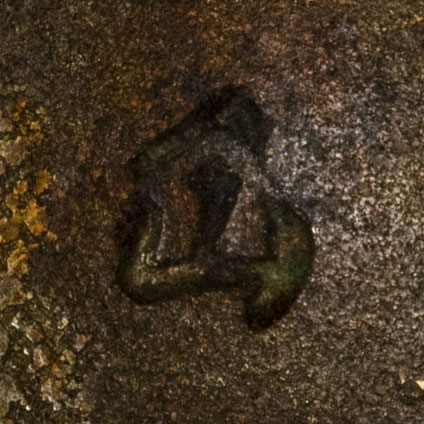 仚 - xiān - to fly, immortal
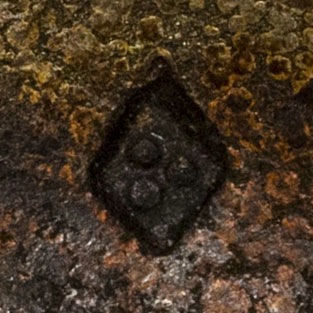 Small symbol chop, diamond with 3 dots
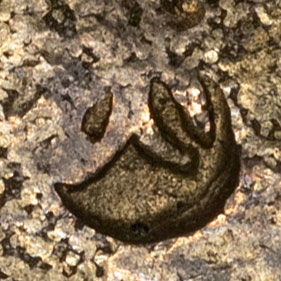 Small chop, possibly an old version of 大 - ダイ・タイ / おお-・おお.きい・-おお.いに - large, big
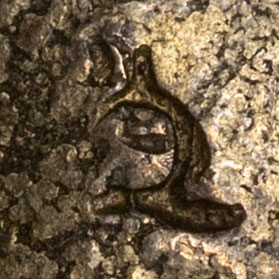 Small symbol chop
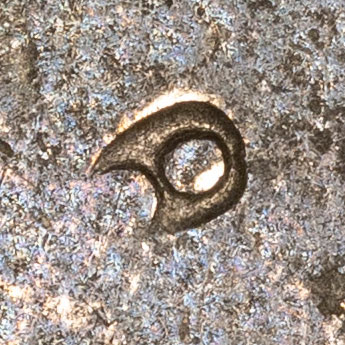 Small symbol chop
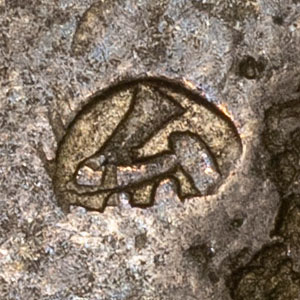 厶 - sī - private, secret; Kangxi radical 28
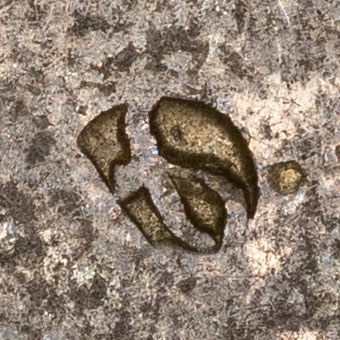 Small symbol chop
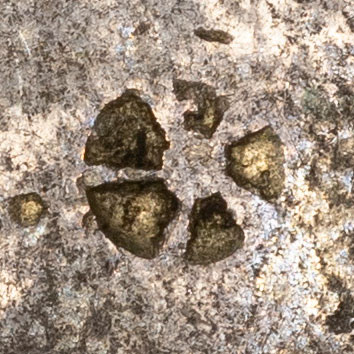 Small symbol chop
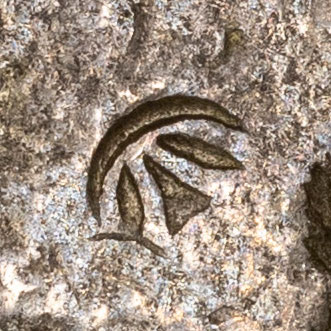 Small chop, possibly an old version of 大 - ダイ・タイ / おお-・おお.きい・-おお.いに - large, big
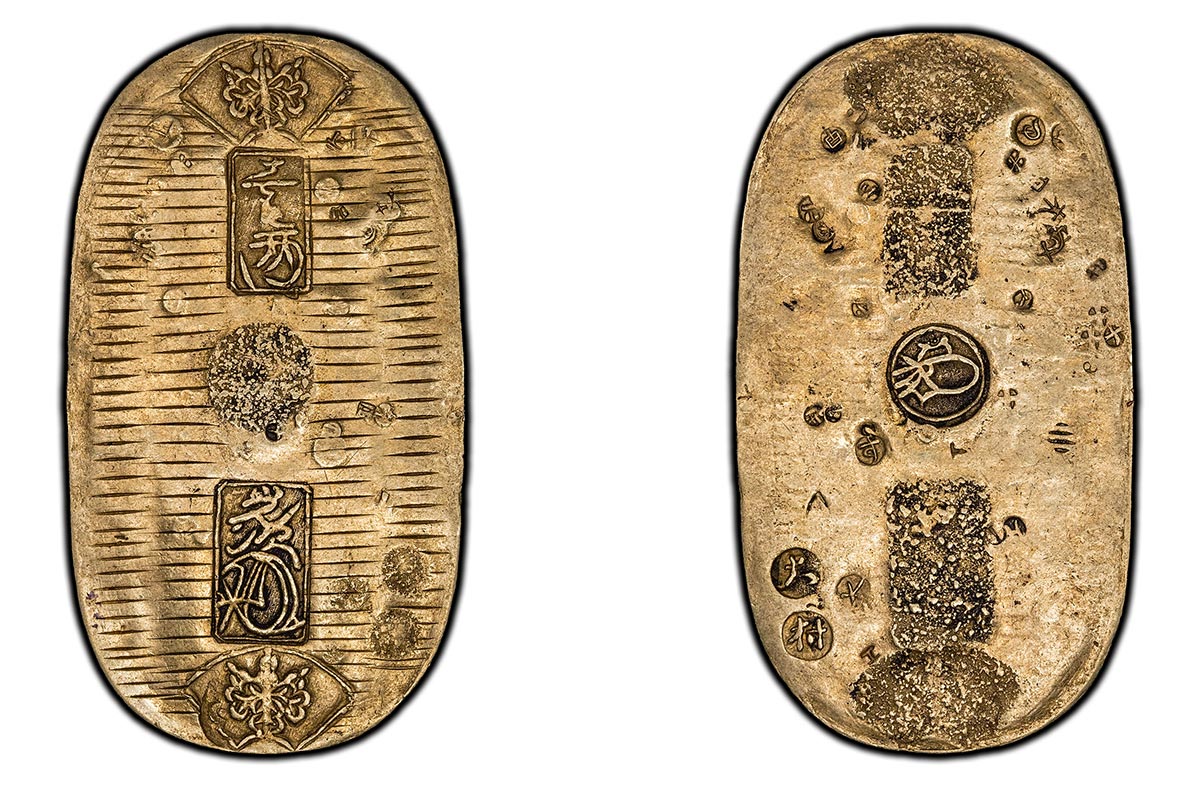
1714-1736 Koban - Kyōhō era
Specifications:
17.7-17.8 g, approximately .861 fine silver
Recorded mintage: Unknown
Catalog reference: JNDA 09-17
Details:
The Kyōhō koban, issued from 1714-1736, represented the final high-quality gold standard of the Edo period, weighing approximately 17.7-17.8g with 86.1% gold fineness.
Following the 1714 Shōtoku koban that restored quality to original Keichō levels after the catastrophic 1695 Genroku debasement, the 1715 Kyōhō issue increased fineness
slightly further to 86.1%. The reforms emerged from Confucian scholar Arai Hakuseki's conviction that debased currency had caused both monetary chaos and moral decline,
and his attempt to restore the shogunate's fiscal credibility by returning to Tokugawa Ieyasu's original standards. However, the 22-year experiment ended in 1736 when the
deflation crisis forced Shogun Yoshimune to abandon the quality standard entirely: the subsequent Genbun recoinage slashed gold fineness from 86.1% to 65.3% and weight
from 17.8g to 13.1g, establishing the irreversible pattern of debasement that would characterize every subsequent koban issue through the end of the Tokugawa period in 1867.
Notable chopmarks:
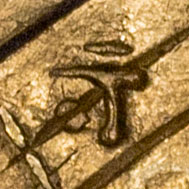 Possibly 寸 - スン - measurement, tenth of a shaku, a little, small
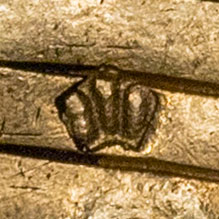 Unknown symbol chopmark
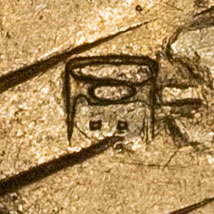 Unknown chopmark
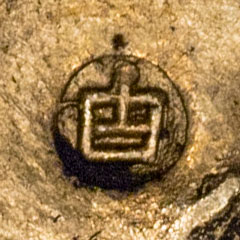 甴 a variant form of 由 - ユ・ユウ・ユイ / よし・よ.る - wherefore, a reason
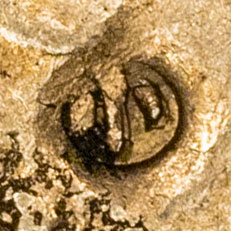 忄 - xīn - heart radical
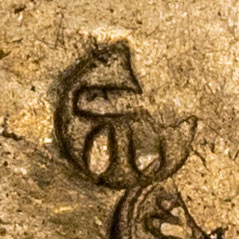 丌 - jī - table
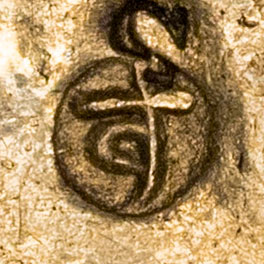 す - su - hiragana
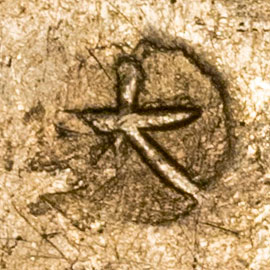 大 - ダイ・タイ / おお-・おお.きい・-おお.いに - large, big
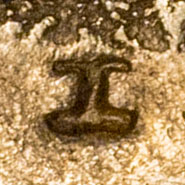 エ - e - katakana
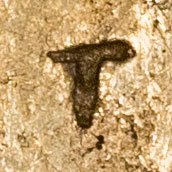 Unknown chopmark
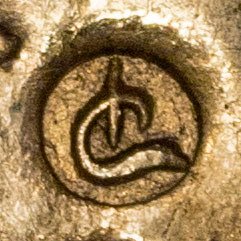 Unknown chopmark
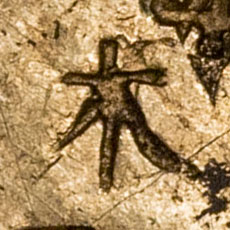 木 - ボク・モク / き・こ- - tree, wood
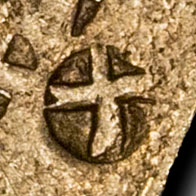 十 - ジュウ・ジッ・ジュッ / とお・と・そ - ten
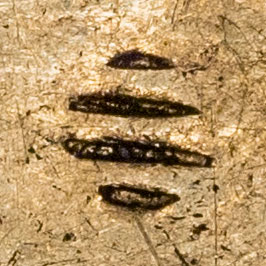 Unknown symbol chopmark
1714-1736 Mameita-gin "bean money" - Kyōhō era
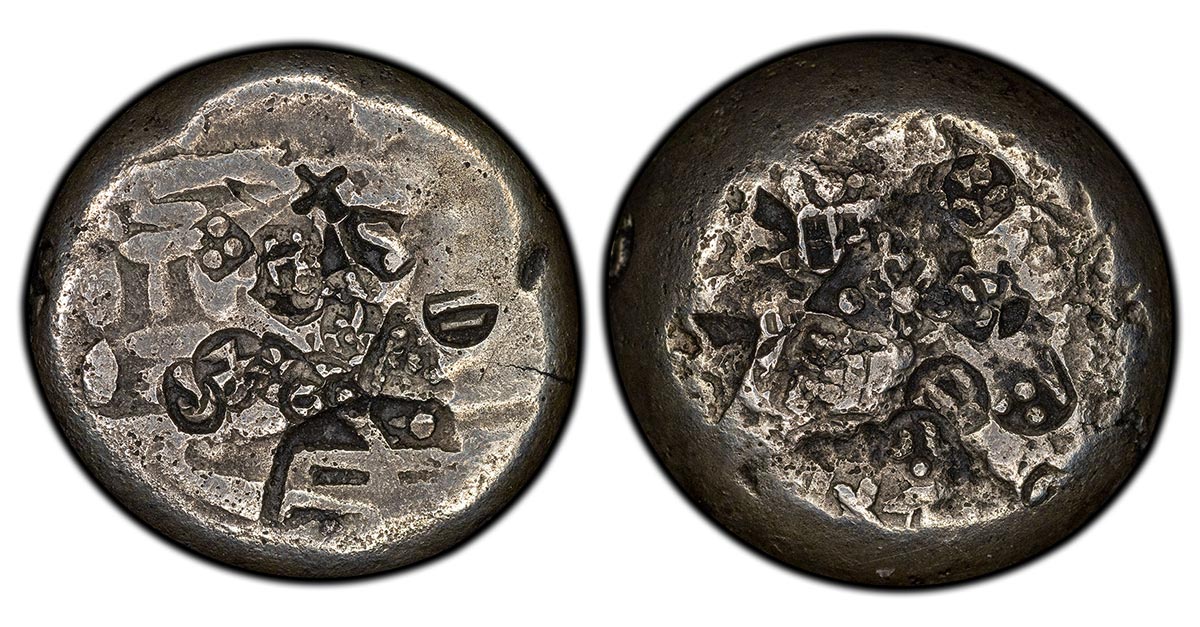
Specifications:
6.68 g actual weight, approximately .800 fine silver
Recorded mintage: Unknown
Catalog reference: JNDA 09-65
Details:
The Kyōhō mameitagin, issued concurrently with the larger chogin ingots from 1714-1736, were small bean-shaped silver pieces with 80% silver fineness and
highly variable weights; examples range from under 3 grams to over 16 grams depending on size. These diminutive pieces were individually handcrafted through a
labor-intensive process: silversmiths poured molten silver alloy into wooden or cloth molds, then hammered and flattened each piece into its distinctive irregular bean
form before hand-stamping hallmarks, most commonly images of Daikokuten (god of plenty) on one or both sides. The deliberate irregularity of form and hand-finishing
served as authentication, allowing merchants to swiftly distinguish legitimate mameitagin from forgeries during the rapid cash transactions of Japan's bustling urban
markets, where these pieces circulated by weight alongside their larger chogin counterparts until the denomination's eventual discontinuation in the mid-19th century.
Unlike the rectangular silver "counting coins" introduced with the Meiwa Go Momme in 1765, mameitagin remained part of the traditional "weighing coin" system throughout
their circulation, requiring merchants to verify both authenticity and weight with each transaction, a cumbersome practice that would ultimately prove incompatible with
the accelerating pace of commercial activity in late Tokugawa Japan.
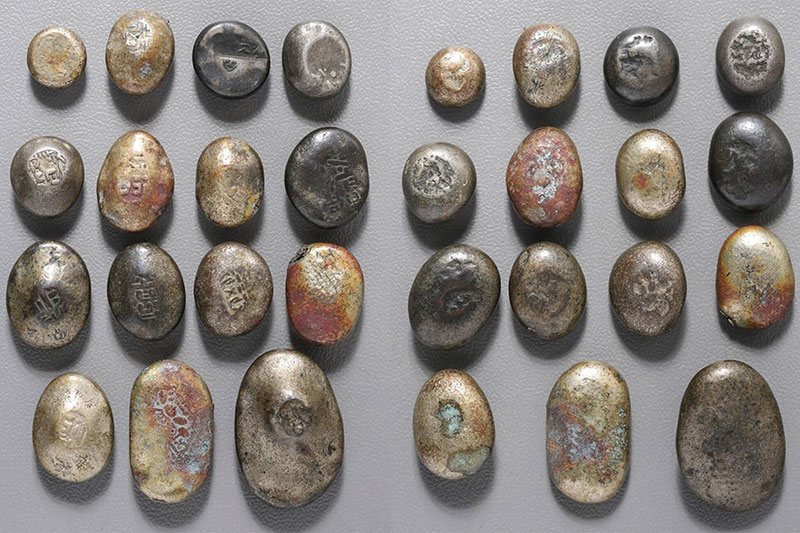
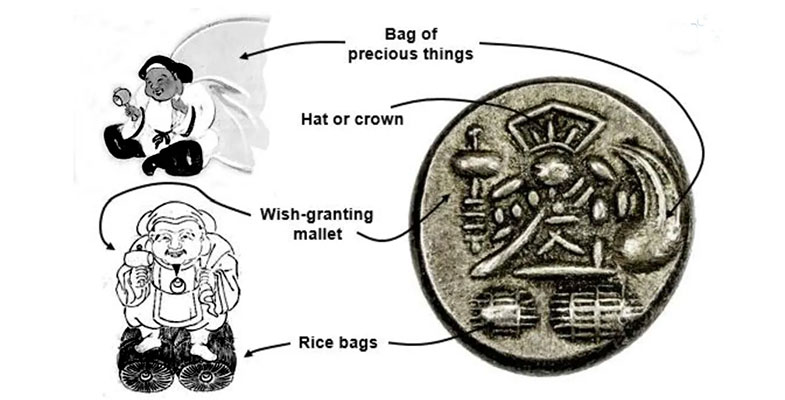
Daikoku, the Japanese god of plenty appears on mameita-gin coinage, but often requires some imagination to see him. He is usually seated on two rice bags, with a wish-granting mallet in his right hand, and a large bag of precious things in his left hand. During the Kyōhō era, different varieties were made including a uniface design, a uniface Daikoku, and a double Daikoku showing the God of Plenty on both sides.
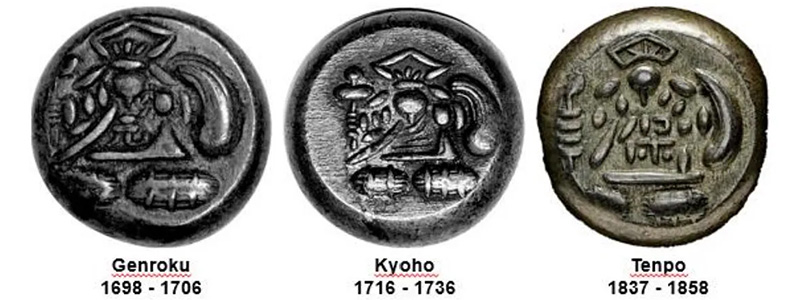
Mamieta-gin can be difficult to identify, especially when chopmarked. Examples from different eras show subtle design differences.
Although heavily chopmarked, this example appears to be from the Kyōhō era. I have not seen many Mamieta-gin with this many chopmarks.
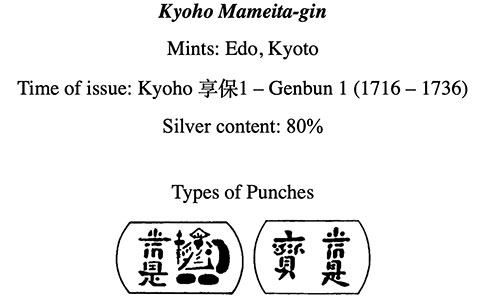
(Some info and pictures from: charm.ru)
Notable chopmarks:
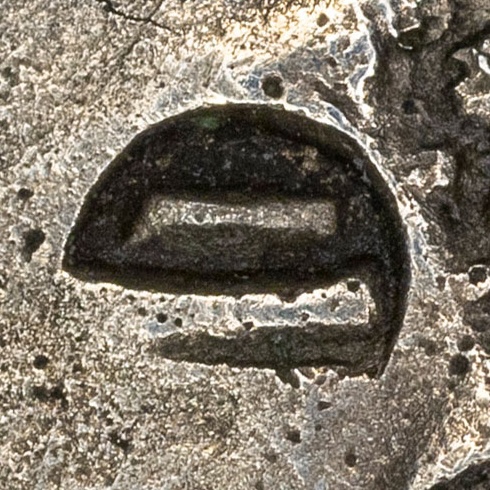 ニ - ni - katakana
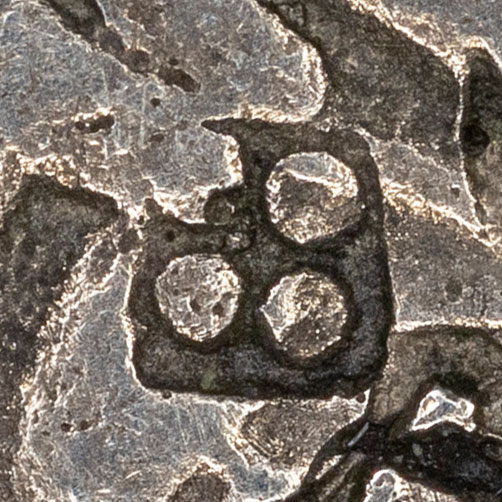 Four dots in a circle, possibly 田 - デン / た - rice field, rice paddy
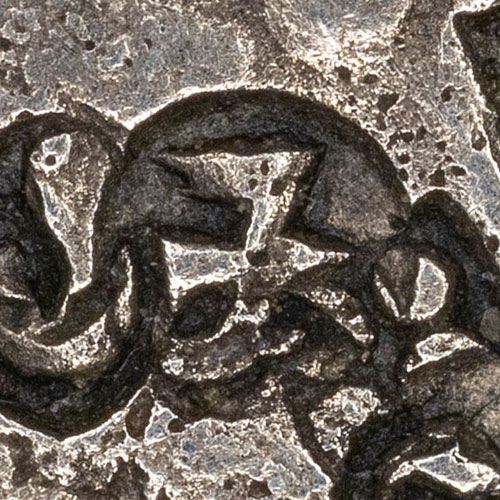 Unknown chopmark
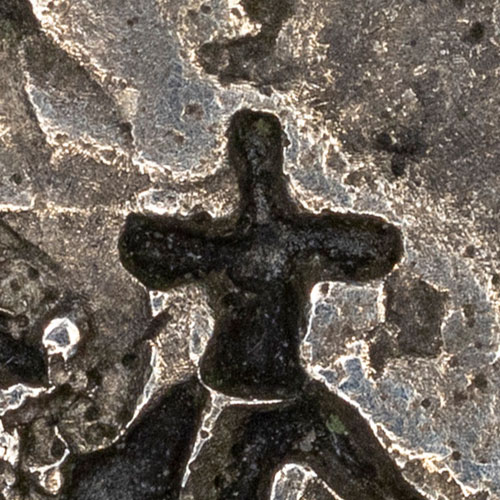 十 - ジュウ・ジッ・ジュッ / とお・と・そ - ten
or
incomplete 士 - シ / さむらい - gentleman, scholar, samurai, samurai radical (no. 33)
Provenance:
From Ben Dalgleish, a collector who finds chopmarked coins in the coin markets of Hong Kong, May 2023
1736-1818 Ichibu - Genbun era
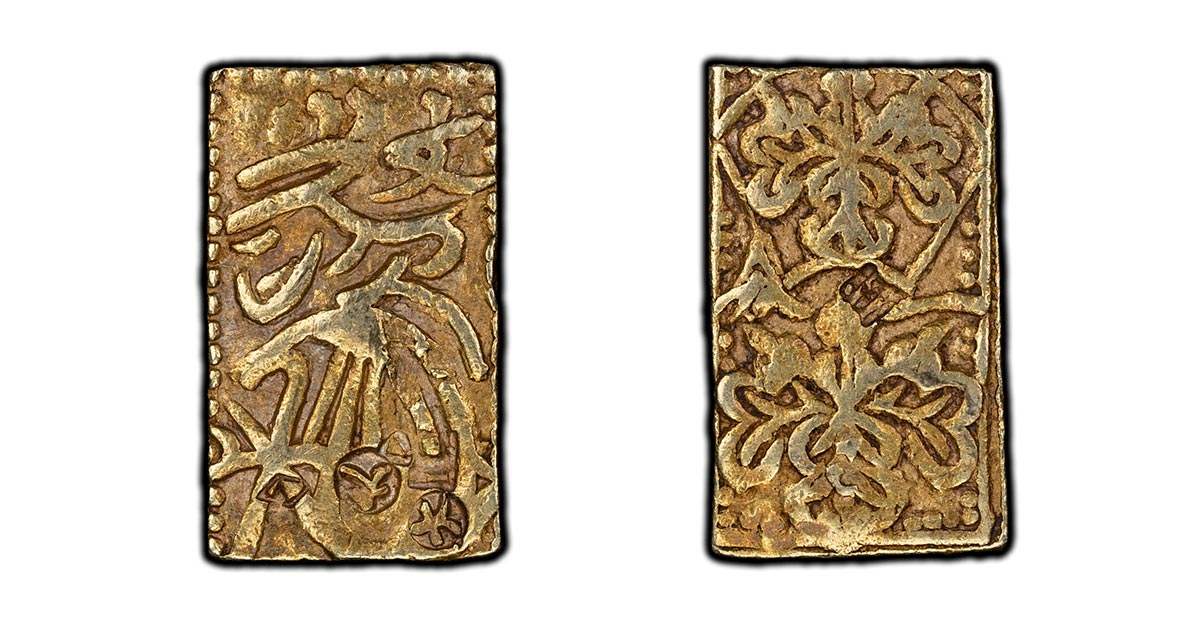
Specifications:
3.23 g, .653 gold and .347 silver
Recorded mintage: Included in 17,435,711 koban minted
Catalog reference: PCGS 412934, Hartill 8.42, JNDA 09-37
Details:
The Genbun ichibu (JNDA 09-37), weighing approximately 3.25g with 65.3% gold fineness, represented a pragmatic solution to an economic crisis that had begun nearly two
decades earlier when rice prices collapsed around 1719, triggering widespread deflation that impoverished both the samurai class dependent on rice-based stipends and
the merchant class unable to sell goods. When the shogunate sought advice from Osaka merchants on how to raise prices and stimulate the stagnant economy, the consensus
recommendation was debasement, deliberately reducing the precious metal content of coinage to increase money supply and generate inflation. However, the Japanese public
proved deeply skeptical of accepting coins containing only 65.3% gold compared to the 86.1% fineness they had grown accustomed to during the brief Kyōhō era, and initial
circulation was slow until confidence gradually built over time. The denomination's eventual success is evidenced by its extraordinary 82-year production run lasting
until 1818, one of the longest-lived coin types in Japanese history, though this extended circulation came at the cost of aesthetic quality, as Genbun ichibu are notoriously
crude and "mushy" in strike compared to earlier issues. The type is exceedingly common with chopmarks, with an estimated 68% of surviving examples bearing these merchant
validation marks, reflecting the coin's extensive use in trade networks, and examples without chopmarks command significant premiums due to their rarity.
Notable chopmarks:
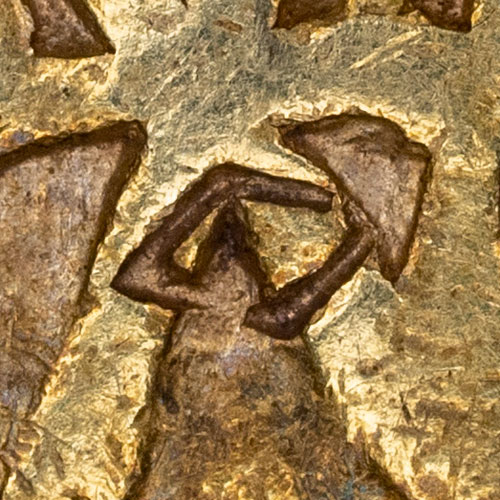 Diamond shaped chopmark
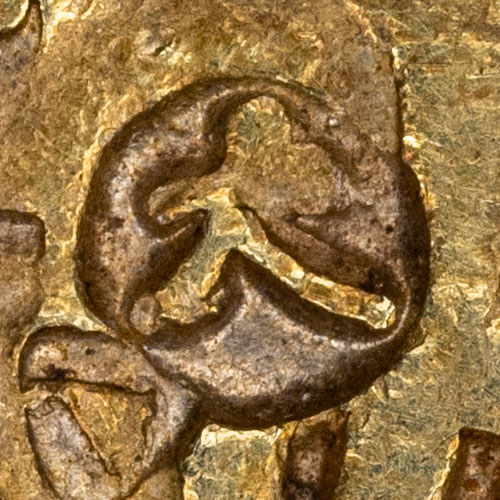 大 - ダイ・タイ / おお-・おお.きい・-おお.いに - large, big
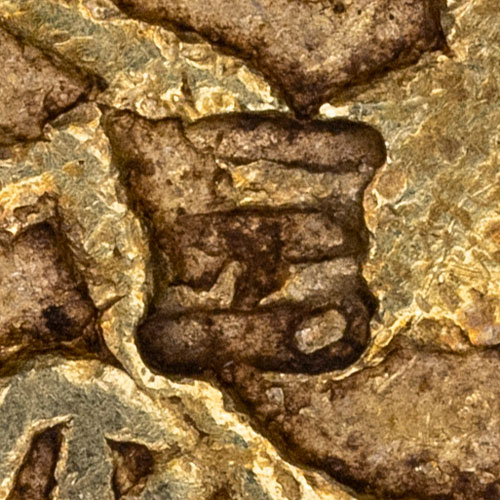 三 - サン・ゾウ / み・み.つ・みっ.つ - three
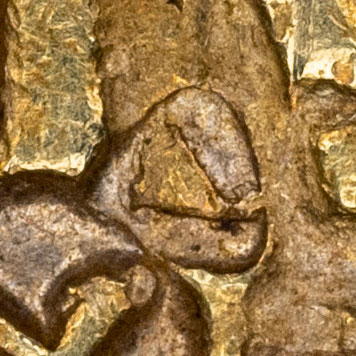 Small triangle shaped chopmark
Provenance:
From Ginza coins of Tokyo, Japan, April 2024
1736-1818 Koban - Genbun era
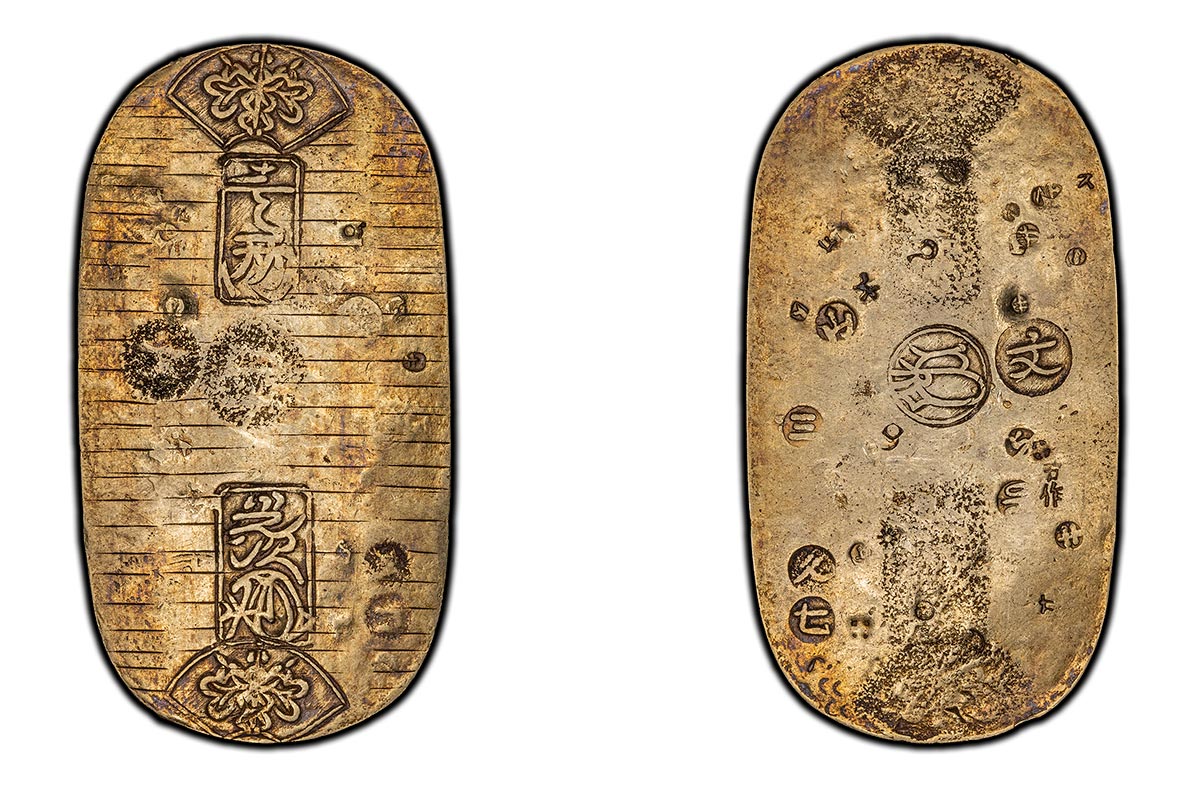
Specifications:
13.1 g actual weight, .653 gold and .347 silver
Recorded mintage: 17,435,711 (including ichibu)
Catalog reference: PCGS #518544 JNDA 09-19
Details:
The Genbun koban (JNDA 09-19), weighing approximately 13.0-13.1g with 65.3% gold fineness, marked an even more severe debasement than the fineness reduction alone suggests;
the shogunate simultaneously slashed both weight (from 17.8g to 13.1g) and purity (from 86.1% to 65.3%), reducing the actual gold content per ryō by more than half
compared to the Kyōhō standard. This dual reduction reflected the shogunate's desperate need to stretch dwindling gold reserves as accessible domestic mines became depleted,
and the strategy proved remarkably successful: the Genbun koban achieved the second-longest production run in Japanese monetary history after only the Keichō koban,
circulating for 82 years until replacement in 1818. However, this extended service came at a cost; koban were notoriously thin by design, and after more than eight decades of
handling, the vast majority of surviving Genbun koban had become heavily worn, damaged, and chopmarked, creating practical difficulties in commerce. The shogunate's 1770
reserves of over 3,000,000 ryō had collapsed to just 723,800 ryō by late 1817, and with domestic gold mines exhausted, the only path to replenishing reserves was further
debasement; the 1818 introduction of the Bunsei nibu specifically enabled merchants to exchange their damaged Genbun koban without fee, clearing the way for the even more
debased Bunsei koban (56.4% gold) that would replace the Genbun standard in 1819.
Notable chopmarks:
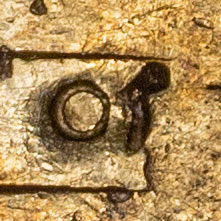 Circle next to イ - i - katakana
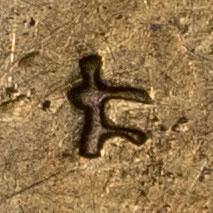 Possibly 仁 - ジン・ニ・ニン - humanity, virtue, benevolence, charity, man, kernel
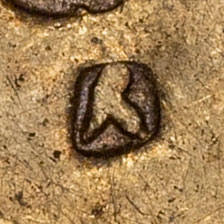 卜 - ボク / うらな.う・うらない - divining, fortune-telling, divination or katakana to radical (no. 25)
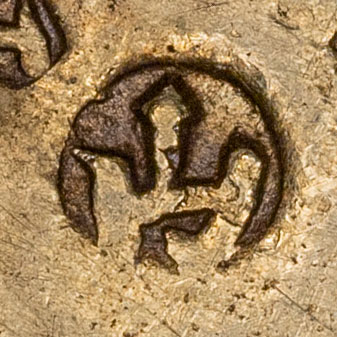 山 - サン・セン / やま - mountain
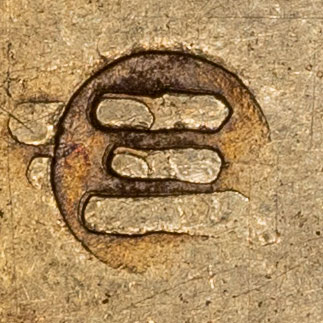 三 - サン・ゾウ / み・み.つ・みっ.つ - three
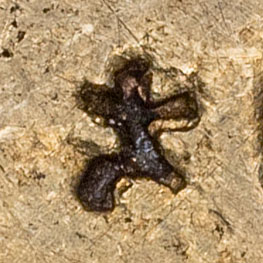 Unknown chop
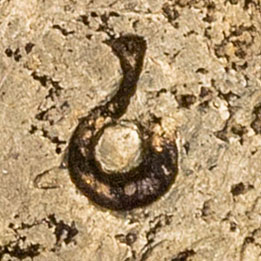 Unknown symbol chop
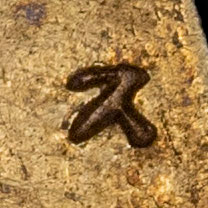 ス - su - katakana
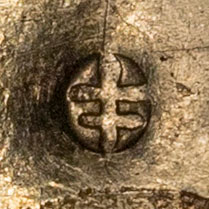 キ - ki - katakana
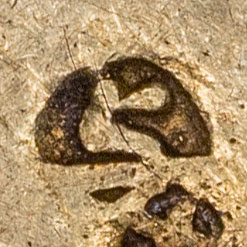 ち - chi - hiragana
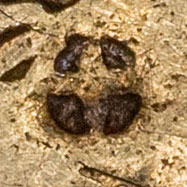 十 - ジュウ・ジッ・ジュッ / とお・と・そ - ten
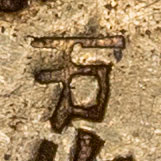 万 - マン・バン / よろず - ten thousand, 10,000
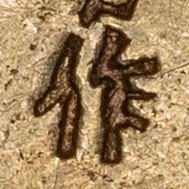 作 - サク・サ / つく.る・つく.り・-づく.り - make, production, prepare, build
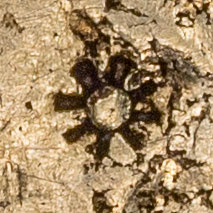 Small sunburst chopmark
Provenance:
From Ginza coins of Tokyo, Japan, January 2024
Listing Description: (translation)
The era of the 8th Shogun Yoshimune. The first koban of the Edo period It was modeled on Keicho Koban, so it is a splendid item with good gold quality and large size
as a koban.
1736-1818 Mamieta gin "bean money"- Genbun era
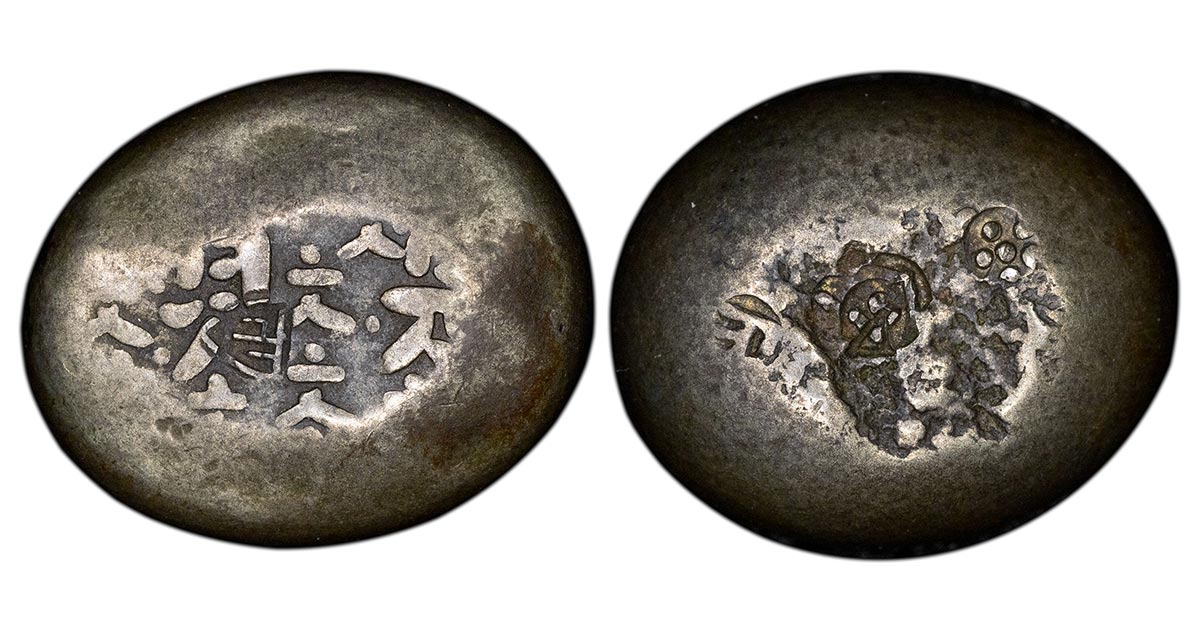
Specifications:
15.25 g actual weight, approximately .460 fine silver
Recorded mintage: unknown
Catalog reference: JNDA 09-66
Details:
The Genbun mameitagin, issued from 1736-1818, suffered an even more dramatic debasement than the concurrent gold coinage, with silver content plummeting from 80% in
the Kyōhō era to approximately 46% in the Genbun issue, a reduction so severe that these pieces are properly classified as billon (debased silver-copper alloy) rather
than true silver currency. Unlike earlier mameitagin that typically bore images of Daikokuten, many Genbun pieces, as this example shows, were stamped simply with
era-identifying characters, most notably 文 (BUN) indicating the Genbun period, sometimes accompanied by 寳 (HO, "treasure"), allowing merchants to distinguish between
the various debased issues circulating simultaneously in the chaotic monetary landscape of mid-18th century Japan. This dramatic debasement reflected the shogunate's
comprehensive strategy to stretch precious metal reserves across all denominations, while the Genbun koban reduced actual gold content per ryō by more than half, the
Genbun mameitagin cut silver content nearly in half, creating a parallel devaluation across both metals. The 1765 introduction of the Meiwa Go Momme, Japan's first
attempt at denominated rectangular silver "counting coins," was specifically designed to match the fineness of circulating Genbun weighing coins in hopes Western Japan
would embrace them as a more convenient form of the mameitagin they already used, though this experiment ultimately failed when moneychangers rejected the fixed exchange
rate that eliminated their profit from fluctuating gold-silver ratios.
Notable chopmarks:
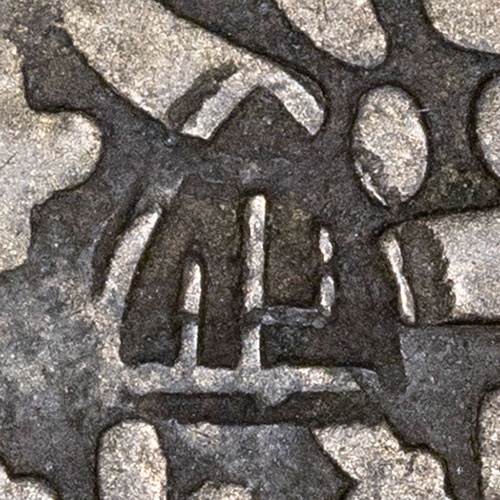 Incuse 止 - シ / と.まる・-ど.まり・と.める・-と.める・-ど.め・とど.める・とど.め・とど.まる・や.める・や.む・-や.む・よ.す・-さ.す・-さ.し - stop, halt
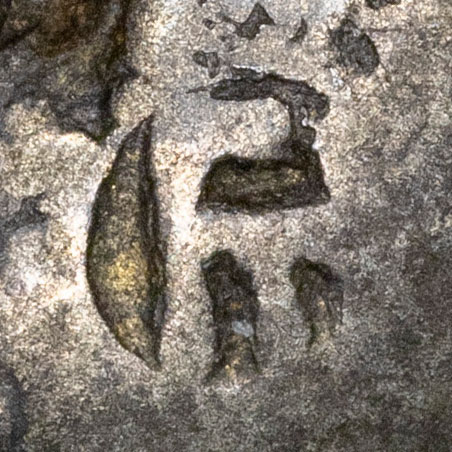 斤 - キン - axe, 1.32 lb, catty, counter for loaves of bread, axe radical (no. 69)
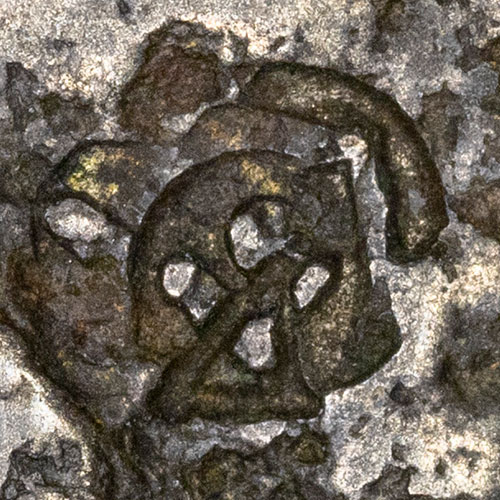 Unknown chopmark(s)
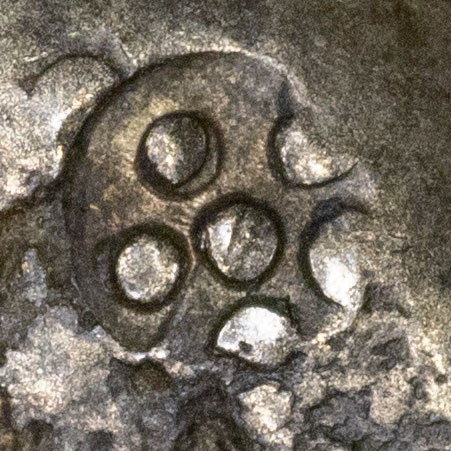 6 dots in a circle
Provenance:
Purchased on eBay in June 2023 from a seller in Tokyo
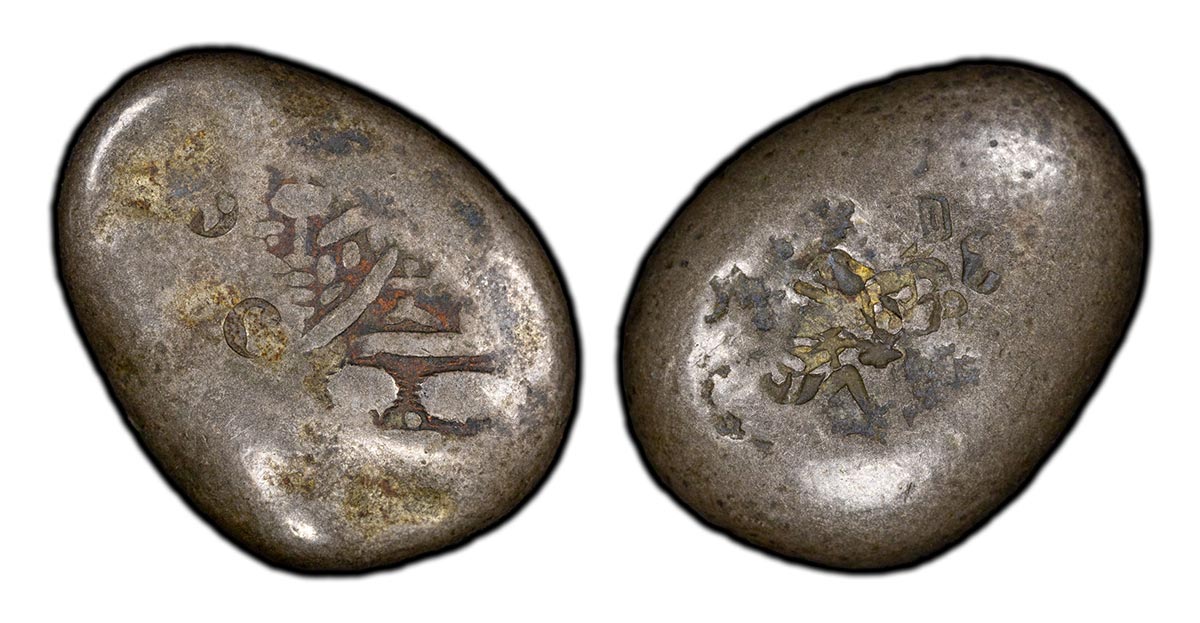
1736-1818 Mamieta gin "bean money"- Genbun era - with partial Daikoku
Specifications:
x.xx g actual weight, approximately .460 fine silver
Recorded mintage: unknown
Catalog reference: JNDA 09-66
Details:
Similar to the above coin, this Genbun mameitagin shows a partial Daikokuten. These pieces show portions of the deity rather than complete renderings, sometimes just
the torso, or a section of the iconic mallet and rice bales, creating a middle ground between the purely character-marked 文 (BUN) pieces and those bearing fully
detailed Daikoku imagery.
Notable chopmarks:
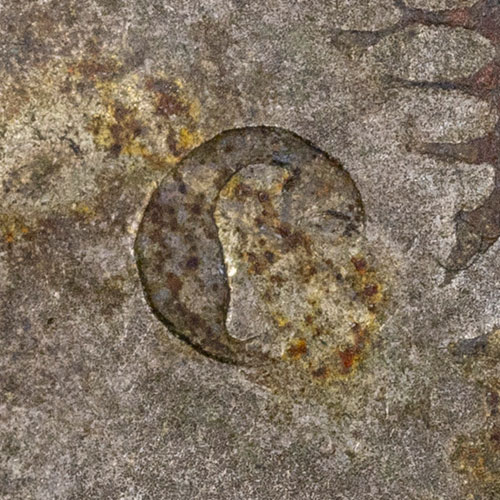 Unclear chop
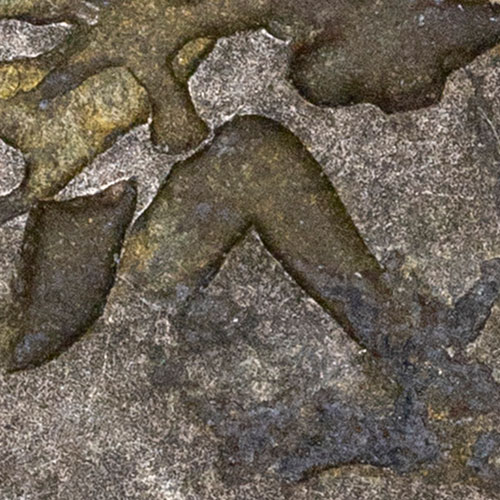 ヘ - he - katakana
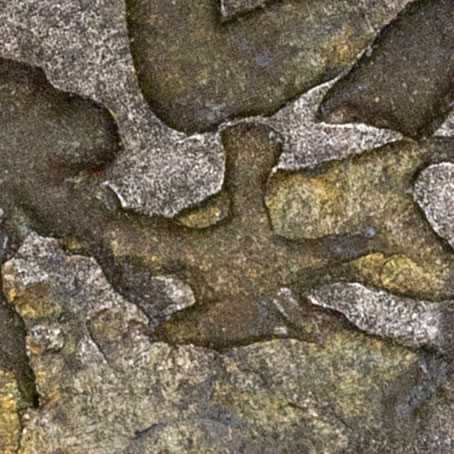 Unclear chop
Provenance:
Purchased from Hong Kong dealer Ben Dalgleish in April 2024.
1772-1824 Ko Nanryo Nishu (2 Shu)
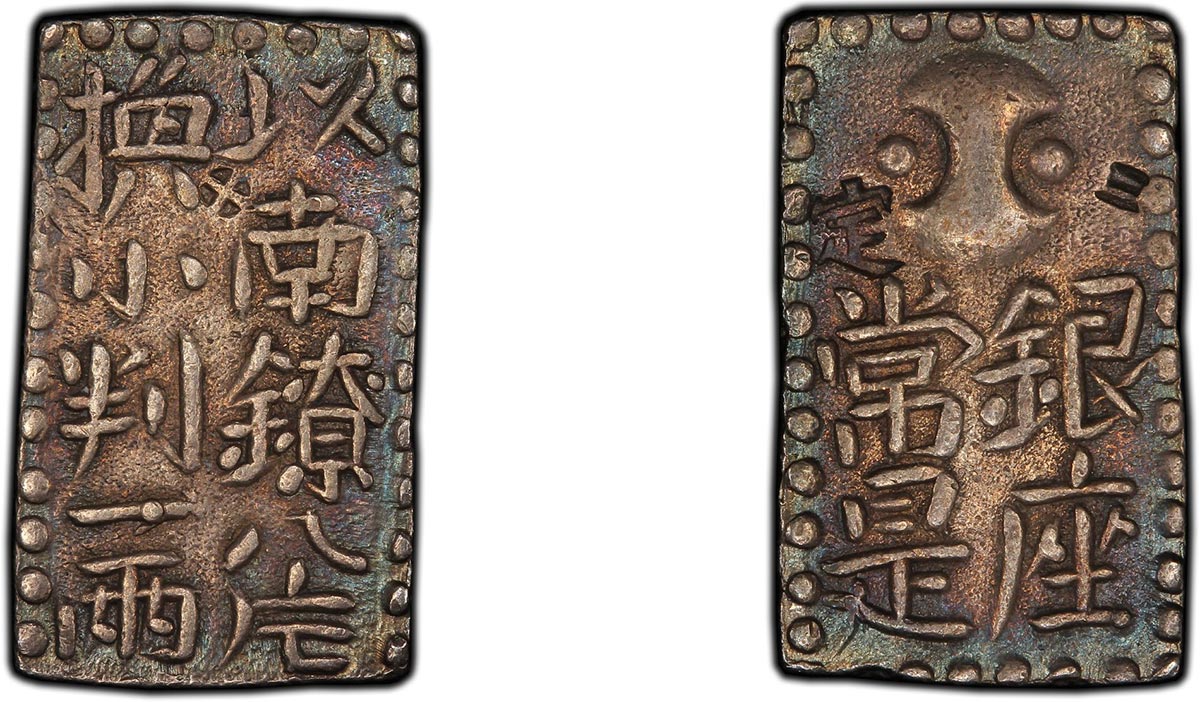
Specifications:
~10.19 g, 0.978 silver
Recorded mintage: 47,464,000 (all years combined, per JNDA)
Catalog reference: JNDA 09-47
Details:
The Ko Nanryo Nishu, issued beginning in 1772 under the direction of finance commissioner Hisataka Kawai on orders from Okitsugu Tanuma, represented the shogunate's
second and far more successful attempt to introduce rectangular silver "counting coins" after the 1765-1768 Meiwa Go Momme had failed to gain acceptance. Weighing
approximately 10.12-10.30g with an exceptional 97.8-98.9% silver purity (the name "Nanryo" literally means "high-quality silver"), these pieces bore the explicit inscription
"Take Nanryo eight pieces to exchange for Koban one Ryō," directly addressing the regional divide where eastern Japan transacted in gold koban while western Japan relied
on weight-based silver ingots with fluctuating exchange rates. Moneychangers, whose livelihoods depended on profiting from those fluctuations, initially demanded a
punitive 25% fee for exchanging Nanryo, yet the denomination gradually achieved widespread acceptance as merchants recognized the convenience of fixed-value silver coins,
allowing moneychangers to charge premium fees precisely because the pieces were in demand. The tumultuous Kansei Reforms of 1787-1793 forced cessation of minting and melting
of existing pieces back into chogin in a conservative reversal of Tanuma's policies, creating two distinct subtypes: the earlier Meiwa Ko Nanryo (1772-1788) typically found
heavily worn and chopmarked, and the post-reform Kansei Ko Nanryo (1800-1824) which restarted production after the reforms ended, marking the period when silver counting coins
finally began to surpass weighing coins in circulation throughout Japan.
Notable chopmarks:
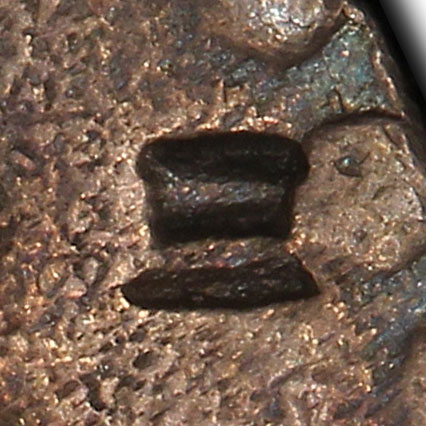 三 - サン・ゾウ / み・み.つ・みっ.つ - three
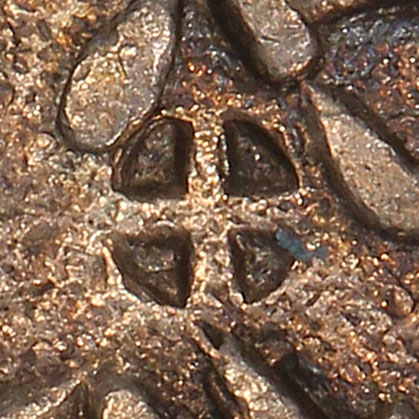 Possibly 十 - ジュウ・ジッ・ジュッ / とお・と・そ - ten
Provenance:
From the Stack's Bowers Winter 2014 Baltimore Lot #11212
Lot #11212
Auction Description:
JAPAN. 2 Shu, ND (1772-1824). PCGS Genuine--Chopmark, EF Details. C-13.
Estimate: $150 - $250.
1820-1837 Mameita-gin "bean money" - Bunsei era
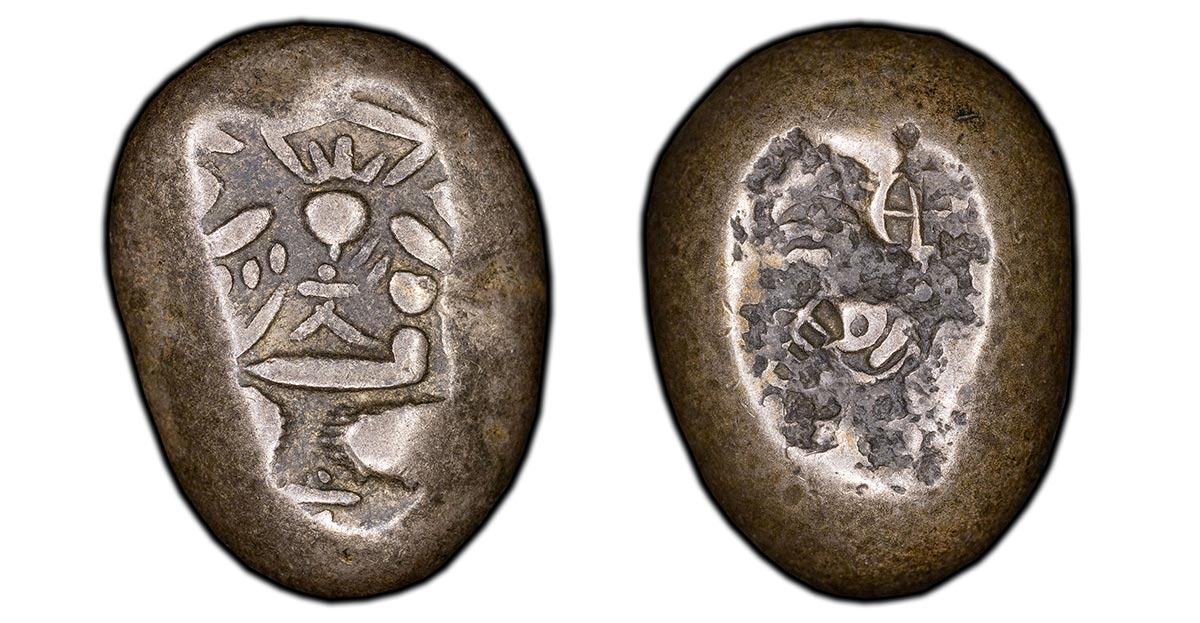
Specifications:
8.62 g actual weight, approximately .3600 fine silver
Recorded mintage: Unknown
Catalog reference: JNDA-09-67
Details:
The Bunsei mameitagin, struck from 1820-1837, emerged from the 1818 Bunsei recoinage, one of the shogunate's most aggressive fiscal interventions, explicitly designed
to debase gold and silver coins to compensate for budget deficits caused by natural disasters and mounting government expenditures. Bean-shaped with highly variable
weights (ranging from under 3g to over 14g depending on individual casting), these pieces contained approximately 36% silver content, continuing the relentless debasement
pattern established after the 1736 Genbun recoinage (which had already reduced mameitagin fineness from 80% to ~46%), representing further deterioration classified as
billon (base silver alloy) rather than true silver coinage. The pieces bear the God of Plenty (Daikokuten) imagery alongside prominent era-identifying characters: 文 (BUN)
stamped both between other hallmarks and directly on the deity's belly, allowing merchants to distinguish this heavily debased issue from earlier weighing coins still
circulating in western Japan's markets. The Bunsei monetary expansion proved catastrophic: between 1818 and 1829, the money supply surged 60%, triggering severe inflation
that nearly doubled commodity prices across Japan and compounded the economic instability that would plague the shogunate through its final decades. By this period, the
once-proud 80% silver mameitagin of the Keichō era (1601-1695) had been degraded through successive recoinages into base metal tokens whose nominal value far exceeded their
intrinsic worth, a monetary fiction sustainable only within Japan's isolated sakoku economy, soon to be shattered by Perry's forced opening in 1853-54 and the subsequent
gold drain that would contribute directly to the Tokugawa regime's collapse.
Notable chopmarks:
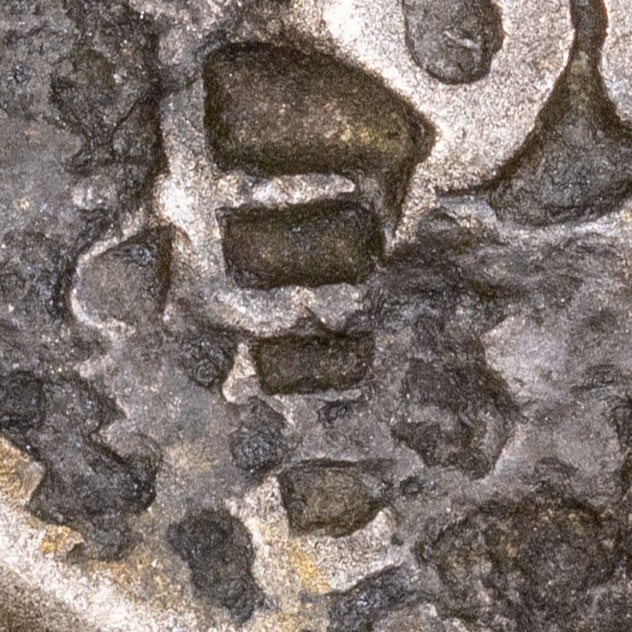 Unknown symbol chopmark
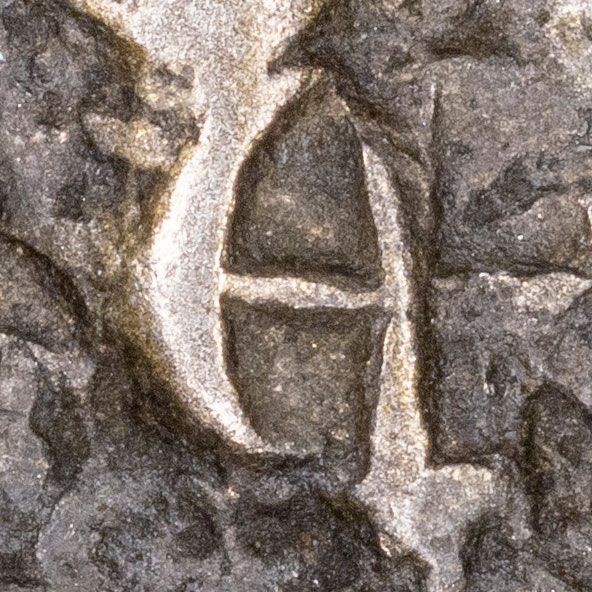 Unknown symbol chopmark
Provenance:
Purchased on eBay in September 2023 from a seller in Japan.
1824-30 Shin Nanryo Nisshu (2 Shu) - Bunsei era
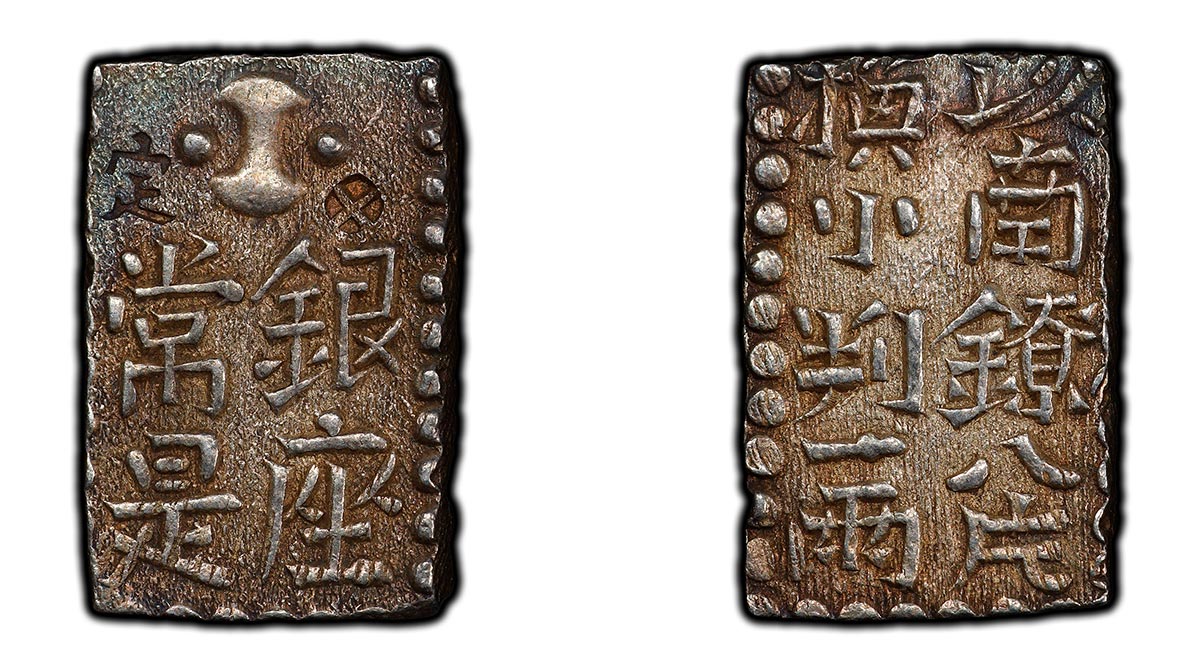
Specifications:
~7.5 g, 0.978 silver
Recorded mintage: 60,625,280 (all years combined, per JNDA)
Catalog reference: KM C13a JNDA 09-48
Details:
The Shin ("New") Nanryo Nishu, issued from 1824-1830, emerged as the shogunate's ingenious solution to chronic fiscal deficits, maintaining the exceptional 98% silver
purity that had made Nanryo coinage trusted since 1772, while reducing weight from 10.12-10.30g to approximately 7.5g, allowing the mint to extract more coins from the
same quantity of precious metal. Officials publicly justified the downsizing by claiming the smaller pieces were "easier to handle," but internal documents reveal the
true motive: seigniorage profits totaling 1,705,191 ryō generated by melting and re-refining Ko Nanryo and Chogin into these lighter pieces, with the Ginza (mint) taking
3.5% profit per mintage versus 7% on Ko Nanryo production. This represented a more sophisticated form of debasement than the crude fineness reductions plaguing gold and
base silver coinage during the same Bunsei era, by preserving quality while reducing quantity, the shogunate maintained public confidence in rectangular silver counting
coins even as they stretched reserves to finance mounting government expenditures. The issue proved remarkably successful: Shin Nanryo specimens survive in far greater
numbers than Ko Nanryo, typically well-struck with sharp details and seldom bearing chopmarks, suggesting widespread acceptance and limited need for merchant validation, a
stark contrast to the heavily worn, chopmarked Ko Nanryo that circulated for five decades before replacement. Yet this "nominal money" policy, as contemporary officials
acknowledged, could function only within Japan's isolated sakoku economy, creating a monetary fiction that would catastrophically unravel when Perry's 1853-54 forced
opening exposed Japanese silver's inflated exchange value to international arbitrage.
Notable chopmarks:
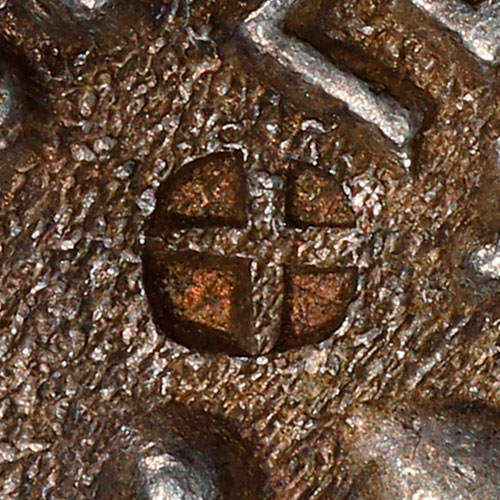 Possibly 十 - ジュウ・ジッ・ジュッ / とお・と・そ - ten
Provenance:
From an eBay seller in Satsuma, Alabama, January 2024.
1832-58 Tenpo Nisshu (2 Shu) - Edo Mint
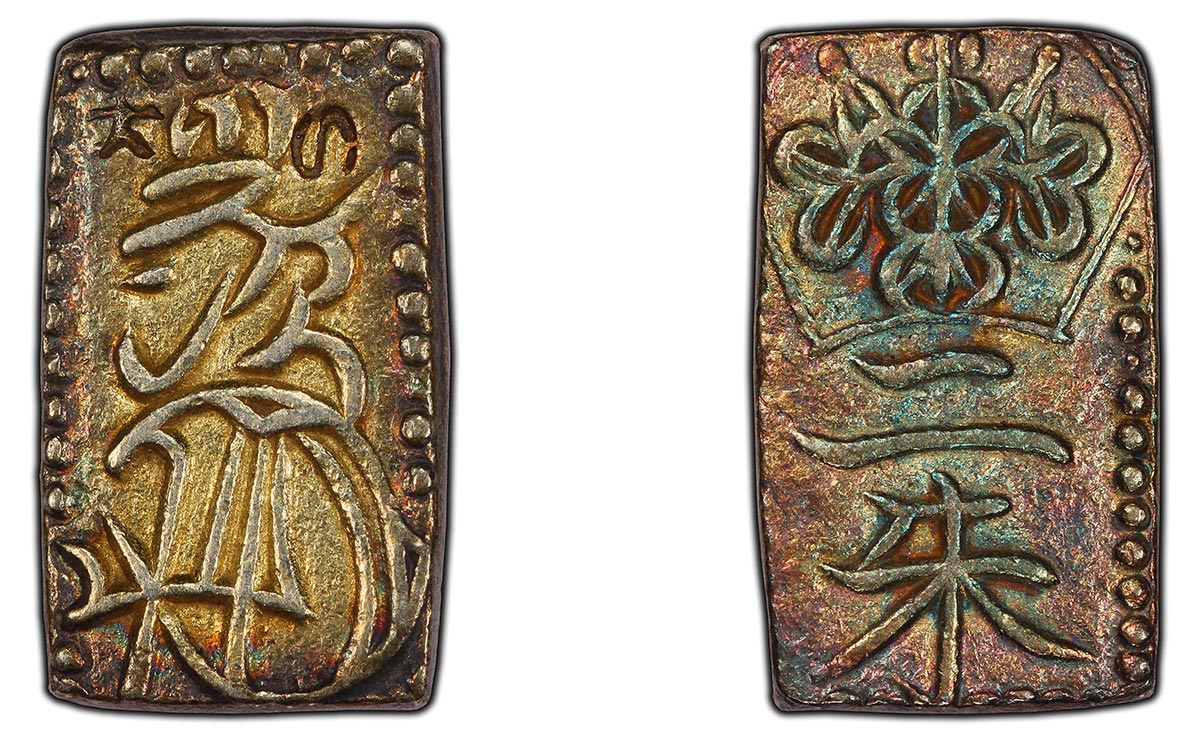
Specifications:
Weight: 1.6200 g .298 Gold, .700 Silver
Recorded mintage: 103,069,600 (all years combined)
Catalog reference: KM C18 JNDA 09-43
Details:
The Tenpo Nishu, issued from 1832-1858, marked the shogunate's revival of the nishu denomination after a 122-year hiatus since the Genroku era (1695-1710), an electrum
bar coin weighing approximately 1.62g and measuring 13 x 7.5 mm, composed of 29.8% gold and 70% silver, representing a radical departure from both the high-purity gold
issues of earlier centuries and the pure silver counting coins like Nanryo. Introduced during the 1832 Tenpo recoinage as part of the shogunate's desperate attempt to
finance mounting fiscal deficits through seigniorage (the money supply surged 20% from 1832-1837), this denomination coincided with the catastrophic Great Tenpo Famine
(1833-1837) that killed over 100,000 people in 1836 alone and triggered widespread uchikowashi ("smashing") riots against rice-hoarding elites. Despite, or perhaps because
of, its heavily debased electrum composition, the Tenpo nishu proved remarkably successful: with 103,069,600 pieces minted according to JNDA records, it became the most
widely circulated gold nishu in Japanese history, typically well-struck with crisp detail and surviving in far greater numbers than earlier high-purity issues. The
denomination belonged to the same "family" as the Bunsei ichibu and late Bunsei nibu in terms of weight and purity relationships, though the mysterious 1832 decision to
resurrect this long-abandoned denomination remains unexplained in English-language sources, possibly representing an attempt to provide practical small-denomination "gold"
currency for daily transactions while conserving actual precious metal reserves as Japan faced increasing pressure from foreign trade that threatened to drain the country's
gold supply. The pale gold color characteristic of these pieces, a consequence of the 70% silver dilution, would earn them the evocative nickname "samurai money," though by
this late Tokugawa period they represented not the martial splendor of feudal Japan but rather the pragmatic compromises of a regime struggling to maintain monetary stability
amid famine, inflation, and the looming foreign encroachment that would culminate in Perry's 1853-54 expedition.
Notable chopmarks:
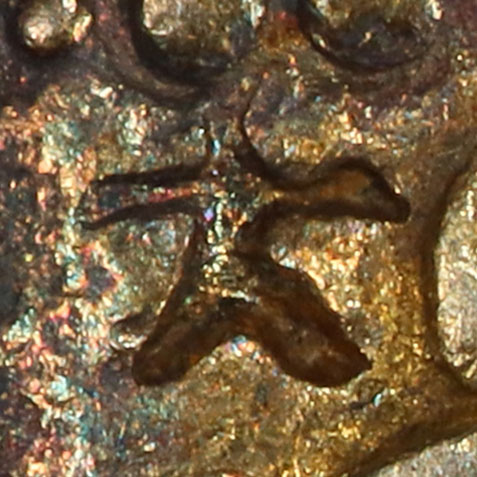 大 - ダイ・タイ / おお-・おお.きい・-おお.いに - large, big
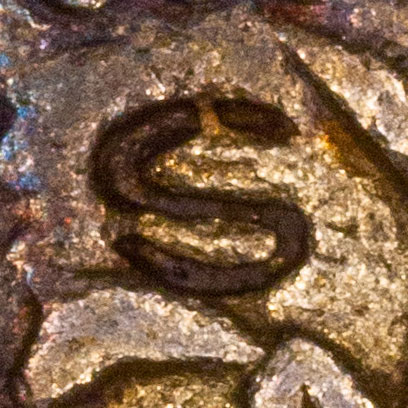 Possibly ら - ra - hiragana
Provenance:
From Ben Dalgleish, a collector who finds chopmarked coins in the coin markets of Hong Kong, May 2021
1837-58 Tenpo silver chogin - Edo Mint
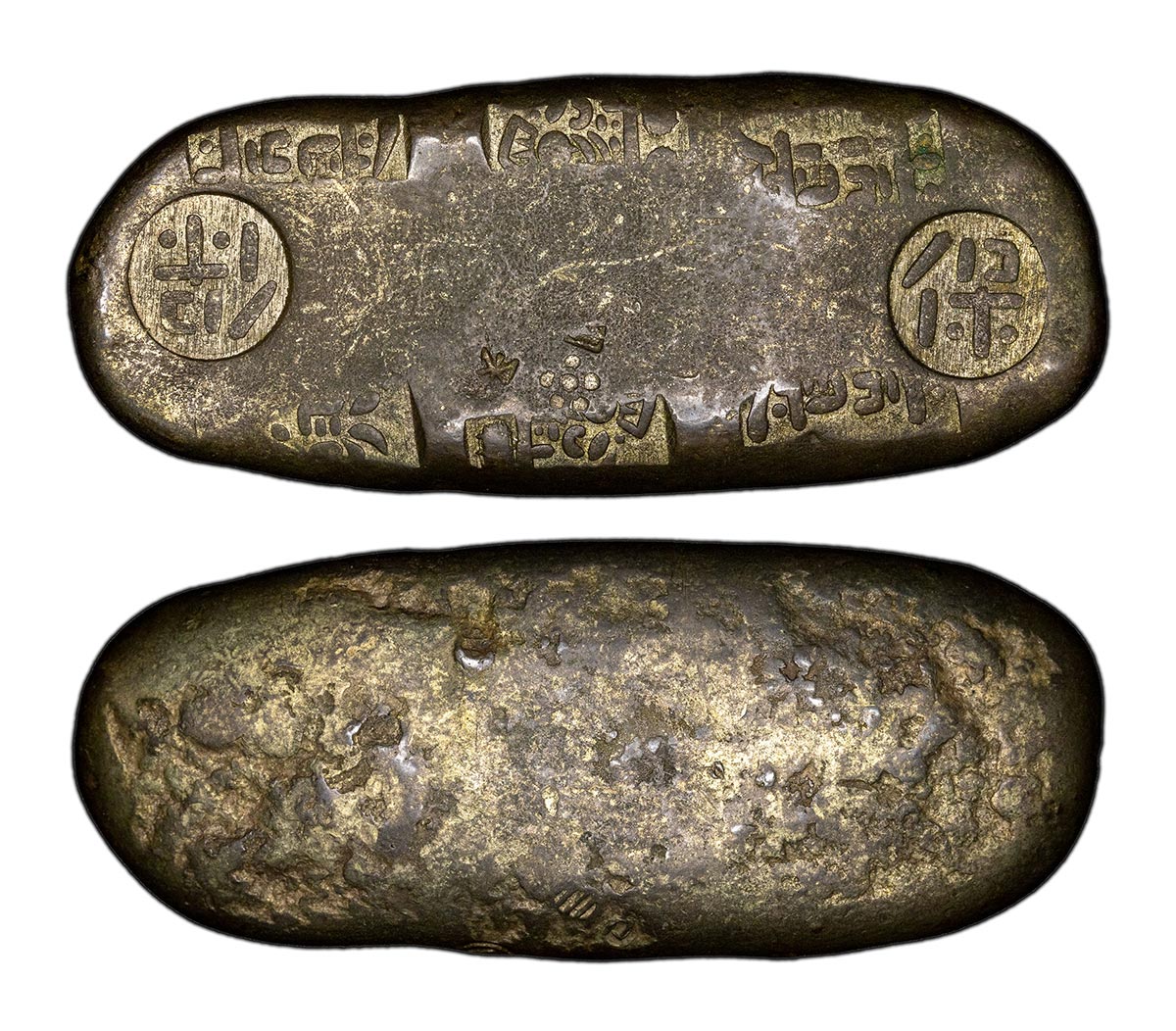
Specifications:
Weight: 127.61 g, 0.261 fine silver
Recorded mintage: 683 tael
Catalog reference: C#9b, H-9.50, JNDA-09-68
Details:
The Tenpo chogin (1837-1858) weighed approximately 140-145g with only 26% silver content (.261 fineness), classified as billon rather than true silver. This
represented the final stage in a 236-year debasement cycle that had reduced chogin fineness from 80% under Keichō (1601-1695) to 46% under Genbun (1736-1818),
36% under Bunsei (1820-1837), and ultimately to this copper-heavy alloy. Era-designating hallmarks including the character 保 (po/ho) for Tenpo stamped at both
ends, alongside traditional Daikokuten imagery (some specimens displaying twelve Daikoku seals arranged around the ingot's surface), these pieces circulated by
weight in western Japan even as their intrinsic value plummeted to barely one-third of their Genbun predecessors. The profound irony of the Tenpo era lies in this
monetary schizophrenia: precisely when the shogunate introduced high-quality rectangular counting coins, the Tenpo ichibu at 98.86% silver purity, which rapidly
became the primary circulating silver denomination, weighing coins like chogin and mameitagin were simultaneously debased to token status, suggesting deliberate
policy to phase out weight-based commerce in favor of denominated currency. This 1837 inflection point accelerated during the catastrophic Great Tenpo Famine
(1833-1837), when the desperate shogunate expanded the money supply 20% through debasement-driven seigniorage while 100,000 people starved in 1836 alone, exposing
the hollowness of "silver by weight" when the metal itself had been reduced to copper-heavy alloy. By 1853, when Perry's expedition forced Japan's reopening,
weighing coins had effectively ceased meaningful circulation; foreigners exchanged Mexican eight reales exclusively for rectangular ichibu, not for ancient chogin
that merchants themselves no longer trusted without constant testing and weighing. The Tenpo chogin thus marks not merely extreme debasement but the final
obsolescence of the two-century weighing coin system, replaced by a modern denominated currency that would itself prove vulnerable when exposed to international
silver arbitrage in 1859-1860.
Notable chopmarks:
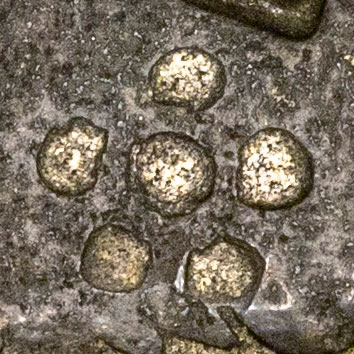 Unknown symbol, also seen on Keichō era Koban.
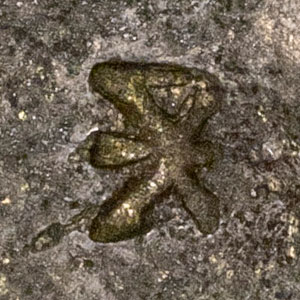 Unknown symbol
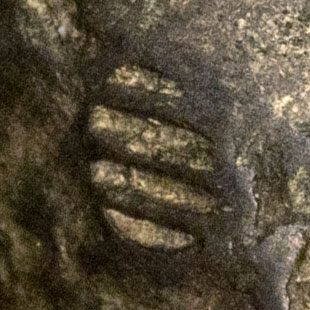 Unknown symbol
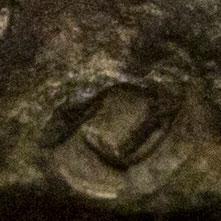 Unknown symbol
Provenance:
Purchased from the Stephen Album Sale 47 September 2023
Lot #1111
Auction Description:
JAPAN: Tenpo, 1830-1844, AR chogin (127.61g), Edo Mint, H-9.50, JNDA-09-68, with character po stamped at both ends, 0.260 fine silver, struck 1837-58, several small
merchant chopmarks, AU.
1837-54 Tenpo Ichibu (One Bu)
Specifications:
8.660 g, .986 fine silver
Recorded mintage: 78,916,556
Catalog reference: KM 16 JNDA 09-50
Details:
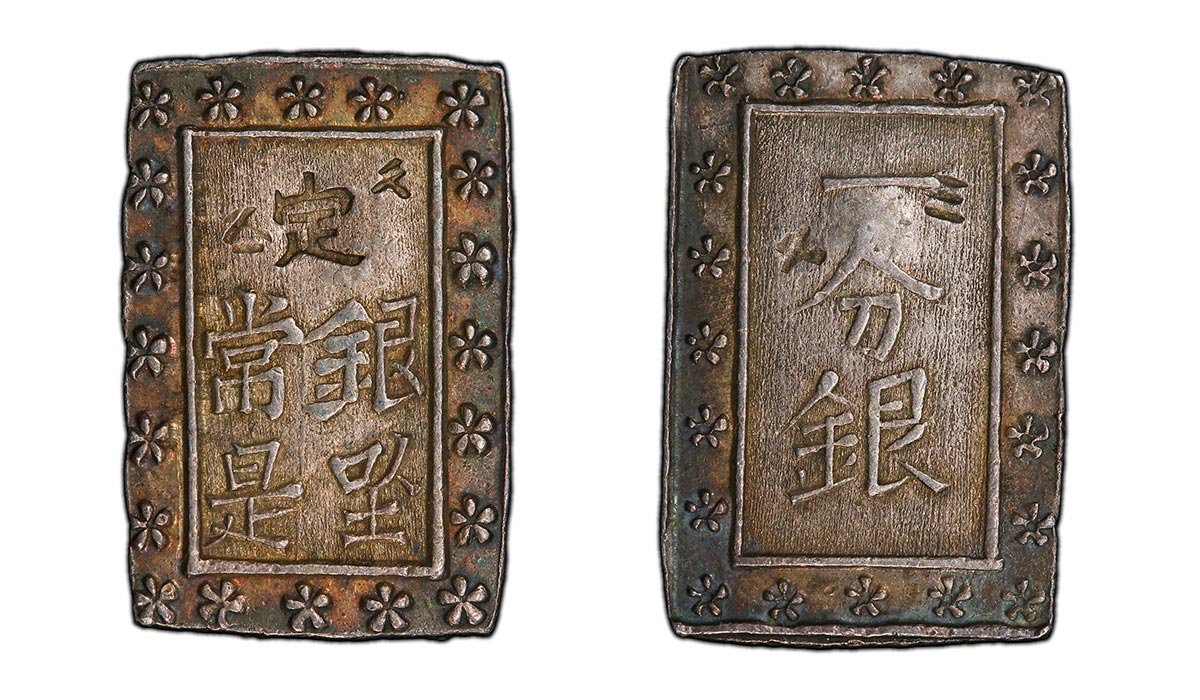
The Tenpo Ichibu-gin, issued from 1837 to 1854, was a rectangular silver one-bu coin (one-quarter of a ryō) weighing approximately 8.7g at 98.86% silver fineness,
making it one of the purest silver issues of the late Edo period. It arrived in the shadow of the debased Bunsei Ichibu-gin of the 1820s, which had quietly eroded
confidence in the shogunate's silver coinage, and its introduction aligned broadly with the Tenpo Reforms, the sweeping austerity program championed by Senior
Councilor Mizuno Tadakuni beginning in 1841. Like so many Tokugawa monetary interventions, it reflected the shogunate's recurring instinct to restore credibility
through purity rather than address the deeper fiscal pressures driving debasement in the first place. For nearly two decades the coin held its own, its high silver
content keeping it stable in everyday trade. What ultimately undid it had nothing to do with domestic policy; it was Commodore Perry's arrival in 1853–54 that
exposed a structural vulnerability the shogunate had no good answer for: Japan's gold-to-silver ratio of roughly 5:1 was dramatically out of step with the
international ratio of approximately 15:1, making it immediately profitable for foreign merchants to exchange silver for Japanese gold and ship it abroad. The
resulting outflow was staggering. In desperation, the shogunate issued the Ansei Ichibu-gin in 1859, deliberately reducing silver fineness from 98.86% to approximately
90%, calibrated to match the fineness of incoming foreign coins and stem the arbitrage, triggering domestic inflation and marking the end of the high-purity silver
ichibu tradition that had defined the Tenpo era.
Notable chopmarks:
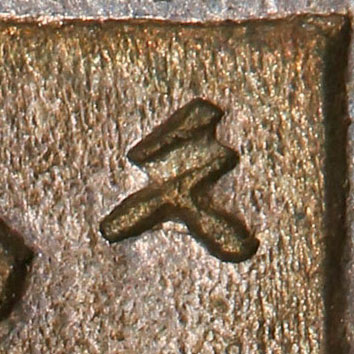 久 - キュウ・ク / ひさ.しい - long time, old story
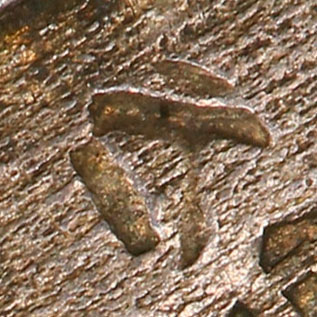 寸 - スン - measurement, tenth of a shaku, a little, small
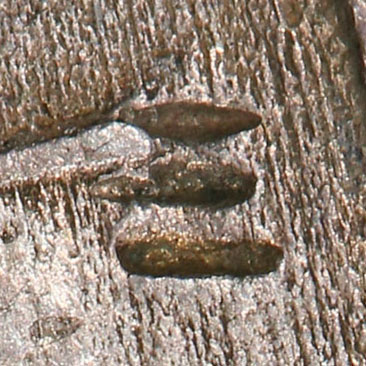 三 - サン・ゾウ / み・み.つ・みっ.つ - three
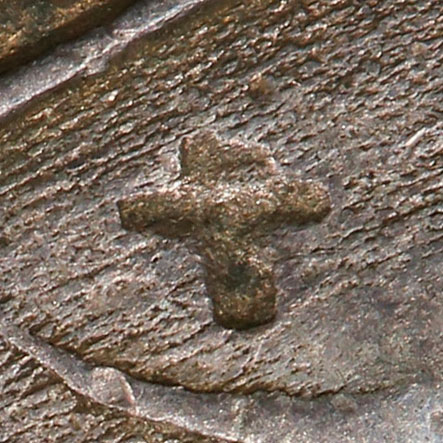 十 - ジュウ・ジッ・ジュッ / とお・と・そ - ten
Provenance:
Purchased on eBay in February 2021 from a seller in Florida.
1853-65 Japan 1 Shu, Kaei era
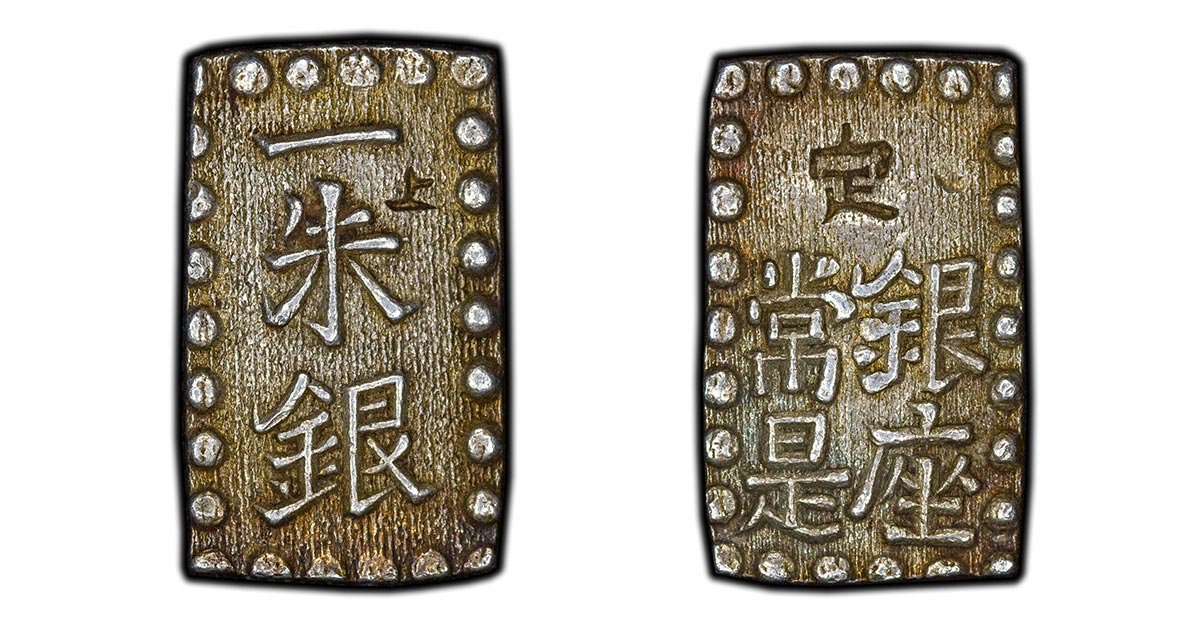
Specifications:
1.8900 g, .9680 fine silver
Recorded mintage: 159,244,800 (total run)
Catalog reference: KM C12 JNDA 09-53
Details:
The Kaei Isshu-gin, issued from 1853 to 1865, was a rectangular silver one-shu coin (one-sixteenth of a ryō) weighing approximately 1.88g with an alloy of 98.7%
silver, 1.7% gold, and 1.12% copper, making it the smallest denomination in the Edo period's silver bar money series. Its origins were inseparable from the crisis
that defined its era: the coin was issued beginning in January 1854 in direct conjunction with the construction of the Odaiba battery, a coastal fortification
built at the entrance to Edo Bay in response to Commodore Perry's arrival the previous July. A day's wage for one of the Odaiba construction workers was one shu,
and the coin was sometimes called the "Odaiba gin" at the time, a detail that captures just how tightly this small piece of silver was woven into the anxiety and
upheaval of the moment. It succeeded the Nanryo Isshu-gin of 1829, which had itself been the lowest-denomination silver coin in circulation, and like its
predecessor it maintained a high silver purity even as the shogunate's fiscal position steadily worsened around it. The coin continued to circulate through the
Ansei, Man'en, Bunkyu, and Genji eras (some specialists, including Hartill, subdivide issues by subtle calligraphy variations into Kaei and Ansei subtypes)
before being retired in 1865 as the Tokugawa monetary system entered its final, chaotic unraveling. Unlike the ichibu, which was debased almost immediately after
the ports opened in 1859, the isshu was simply discontinued rather than replaced with a debased successor, a quiet end for a coin that had been born in one of the
most turbulent moments in Japanese history.
Notable chopmarks:
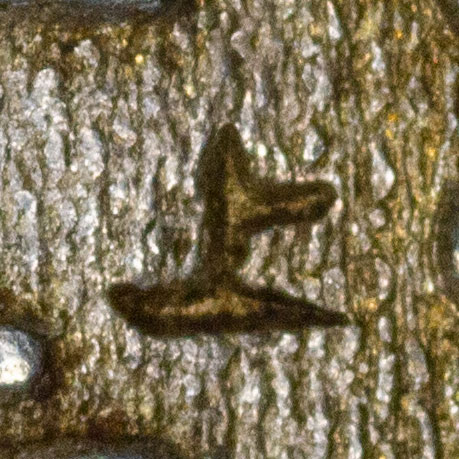 上 - ジョウ・ショウ・シャン / うえ・-うえ・うわ-・かみ・あ.げる・-あ.げる・あ.がる・-あ.がる・あ.がり・-あ.がり・のぼ.る・のぼ.り・のぼ.せる・のぼ.す・たてまつ.る - above, up
Provenance:
From Ben Dalgleish, a collector who finds chopmarked coins in the coin markets of Hong Kong, November 2020
1859-1868 Japan 1 Bu, Ansei era
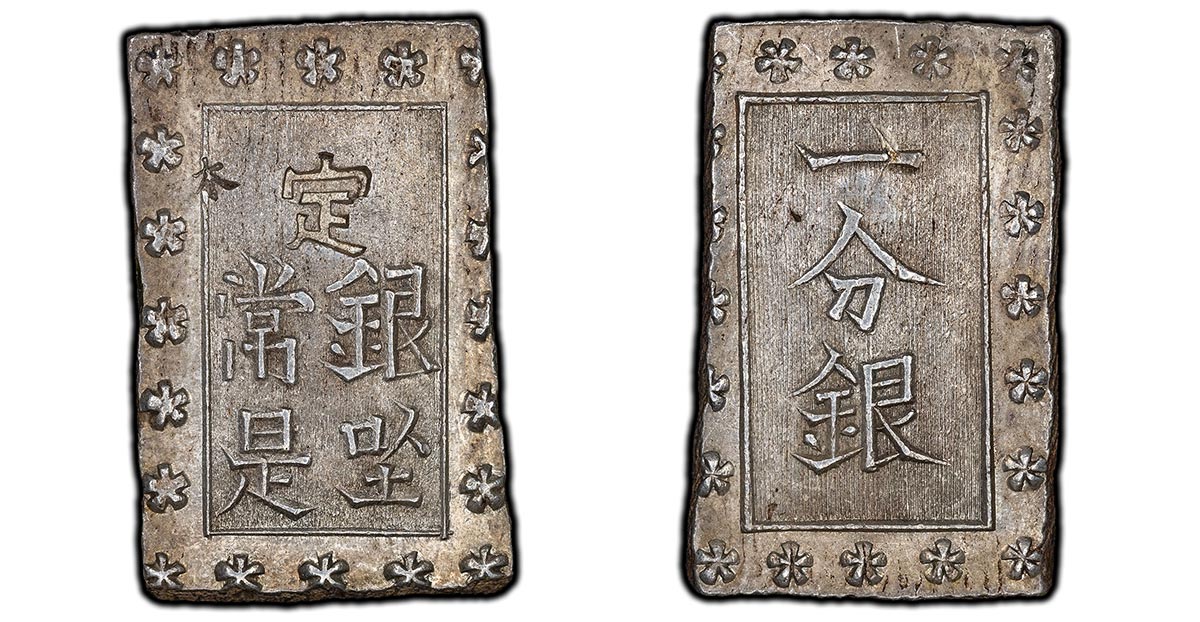
Specifications:
8.630 g, .8730 fine silver
Recorded mintage: 11,398,600
Catalog reference: C# 16a, PCGS 390892 JNDA 09-52
Details:
The Ansei Ichibu-gin, issued from 1859 to 1868, was in many ways the Tenpo Ichibu-gin's twin, same rectangular form, same cherry blossom border, same dimensions,
and that was entirely by design. The shogunate's strategy was to make the transition as invisible as possible while slashing silver fineness from 98.86% to
approximately 90%, a level chosen specifically to match incoming foreign coins like the Mexican eight reales so that they could be melted down and recast without
significant additional refining. The practical effect was a coin the public could barely distinguish from its predecessor by sight, yet one that represented a
fundamental break from the purity standards the Tenpo era had upheld. Paradoxically, the Ansei Ichibu-gin became the most widely circulated silver bar coin in
Japanese history precisely because of the crisis that created it; demand from foreign traders hungry for bu to exchange for gold drove mintage into the hundreds
of millions, flooding the domestic economy and fueling the inflation the shogunate had hoped to manage. One of the more remarkable numismatic details of the type is
that dating it requires close examination of the sakura border: on genuine examples, one cherry blossom on each side is inverted, and the specific position of those
inverted flowers serves as the primary means of attributing a coin to the Tenpo, Ansei, or Meiji period. The Ansei name is itself something of a misnomer, as the era
it references ended in 1860, yet production continued under successive era names through 1868, when the Meiji Restoration transferred control of the Ginza to the new
government, which promptly debased the ichibu further still, bringing the curtain down on over two centuries of Tokugawa silver coinage.
Notable chopmarks:
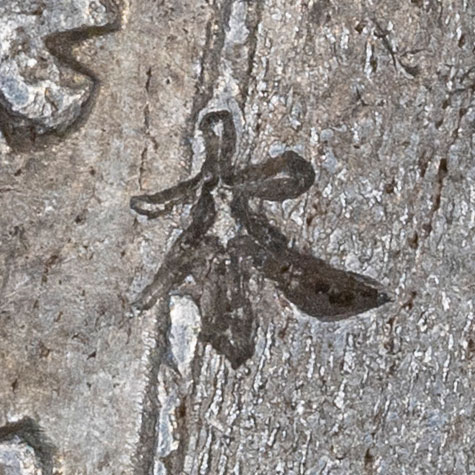 木 - ボク・モク / き・こ- - tree, wood
Provenance:
From the March, 2023 Río De La Plata Compañía (Uruguay & Argentina) Numismatica Subasta Online #13 Session 3
Lot #1802
Auction Description:
Japan. Tokugawa Shogunate, 1 Bu Gin (1859-1868) Ansei. Chopmark. Ginza mint. AG.873; 16x23mm; 8.60g. A: 定 | 常銀 | 是座, R: 一 分 銀 (1 Bu of silver). KMC16a; JNDA 9-25;
Hartill 9.82. Extremely Fine
1868 Shonai Ichi Bu Gin
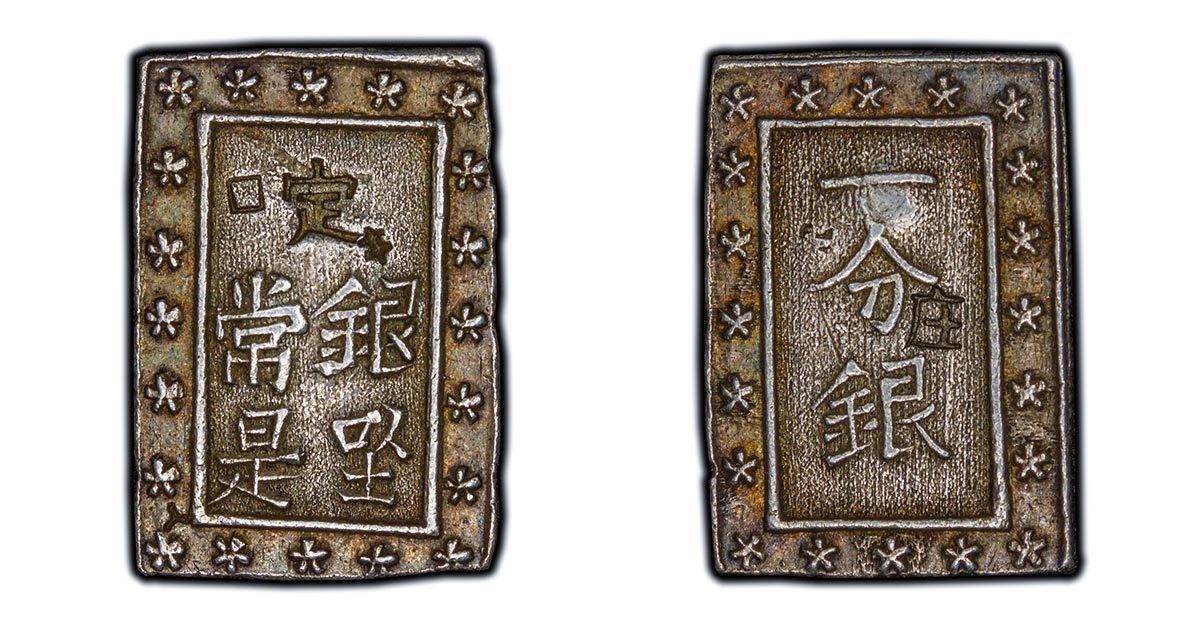
Specifications:
8.660 g, .9910 fine silver
Recorded mintage: Unknown how many Tenpo ichibu were stamped with the Shonai mark
Catalog reference: KM 16, PCGS 714420
Details:
The Shonai Ichibu-gin, a Tenpo Ichibu-gin counterstamped with the character 庄 (shō), occupies a singular place in the history of Japanese coinage as much for
what it represents politically as for what it says about monetary trust. The stamps were applied between July 9 and August 3 of 1868, when the Sakai clan of
the Shonai domain in Yamagata Prefecture set up two temporary mints to pull higher-purity Tenpo ichibu from circulation, mark them, and return them to trade,
all while actively fighting Imperial forces as one of the last Tokugawa-aligned domains still holding out in the Boshin War. The 庄 stamp on the obverse was
accompanied by a small Y-shaped mark applied to one of the bottom corners of the reverse, a second counterstamp so briefly documented in the JNDA that its full
significance went largely unrecognized for years; it is theorized that the position of this mark may indicate which of the two Shonai mints processed a given coin.
The practical purpose was straightforward: to distinguish the nearly pure 98.86% silver Tenpo coins from the debased Ansei ichibu that had flooded the market after
1859, giving merchants and citizens a reliable means of identifying higher-quality silver in a monetary environment they no longer trusted. But the timing gives the
act a deeper dimension; the Shonai domain, renowned for its military discipline and staunchly loyal to the old order, was essentially conducting monetary policy as
a form of defiance, asserting Tokugawa standards of quality at the very moment the Tokugawa world was collapsing around them. The clan surrendered without a final
battle later that year and was ultimately treated with notable leniency, in part through the intercession of Saigō Takamori, but the brief window of those stamped
coins stands as one of the more quietly remarkable episodes at the intersection of numismatics and the end of samurai Japan.
Notable chopmarks:
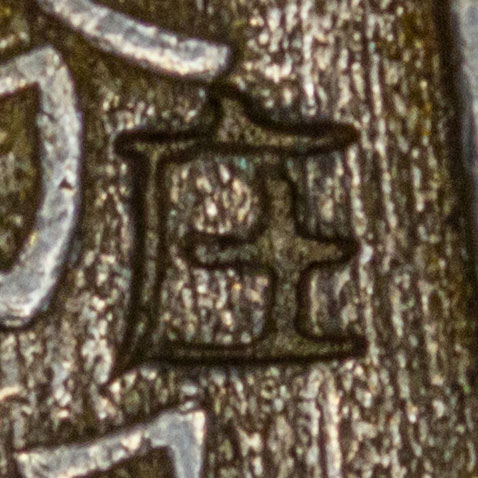 庄 (countermark) - Shō - Japanese surname, derived from the Chinese surname Zhuāng (traditional 莊, simplified 庄)
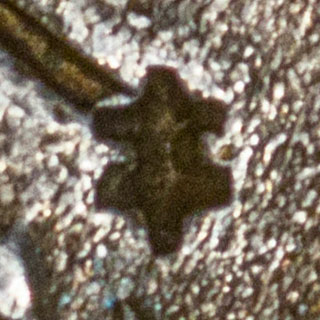 キ - ki - katakana
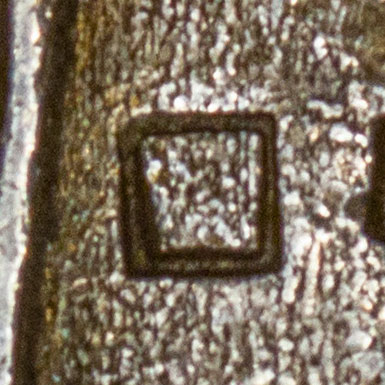 ロ - ro - katakana
Provenance:
From Ben Dalgleish, a collector who finds chopmarked coins in the coin markets of Hong Kong, March 2020