East Meets West Collection - 1821 to 1871
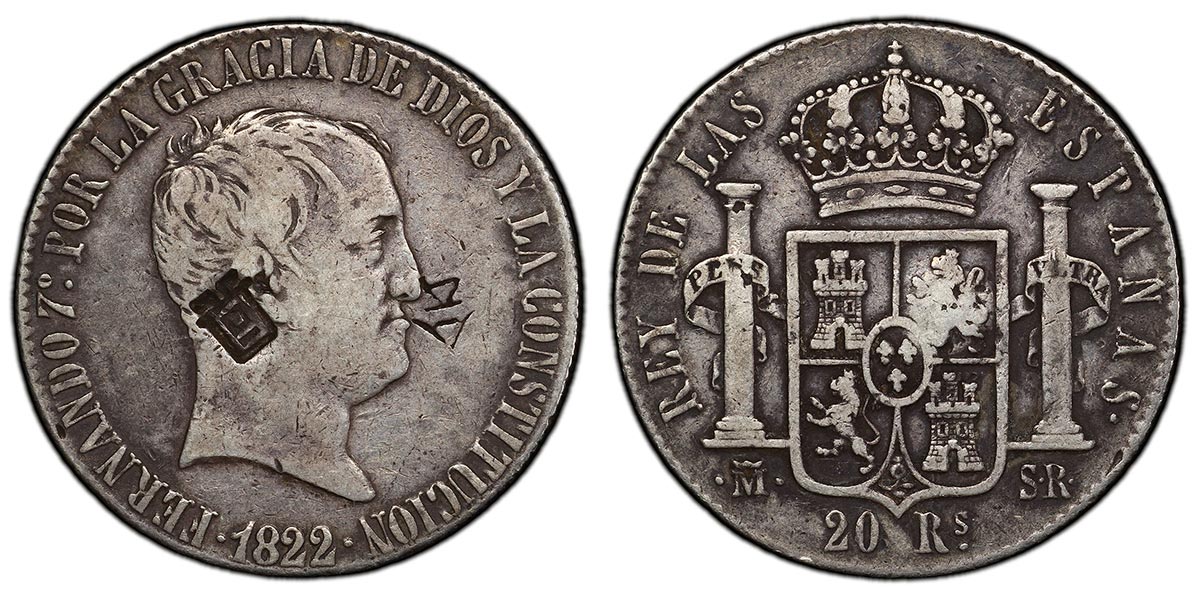
1822-M SR Fernando 7 Spain 20 Reales
Specifications:
27.08 g, .903 fine silver, .786 troy oz (actual silver weight)
Recorded mintage: unknown
Catalog reference: KM 561
Details:
The 1822-M SR (José Sánchez Delgado / Isidoro Ramos del Manzano) Spanish 20 reales de vellón (KM 561) is a Madrid-mint silver piece from the short constitutional coinage of
Ferdinand VII, struck during the Liberal Triennium when the 1812 Constitution was restored, hence the obverse legend “FERNANDO 7º … Y LA CONSTITUCIÓN”. The “de vellón” system,
adopted under Joseph Bonaparte in 1808, treated the 20 reales de vellón as the crown-sized counterpart equivalent in value to the 8 reales de plata. In practice it’s
essentially a “Spanish crown” of the period: about 27.07 g of .903 silver, i.e., very close to the familiar 8-reales standard, but with the value “20 RS.” on the reverse.
The date range for this Madrid SR issue is 1821–1823, making it a tight, well-defined type that is historically anchored to the 1820–23 constitutional interlude.
With chopmarks, this becomes a notably atypical survivor: Gullberg explicitly notes that chopmarked Spanish (i.e., metropolitan) coins are far rarer than the usual Mexican/Peruvian/Bolivian pillars and portraits, and that only a small number of mainland Spanish coins are known to have reached China’s silver markets. This 20 reales likely arrived indirectly, moving through European trade channels as a convenient crown-weight silver piece (easy to value by weight and fineness), before entering China-facing circulation where it was tested and accepted in the normal way.
Notable chopmarks:
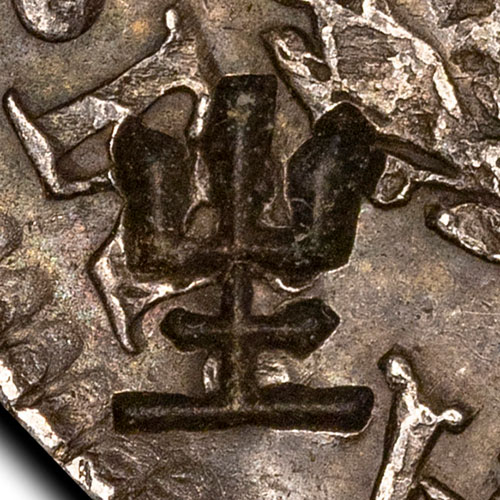
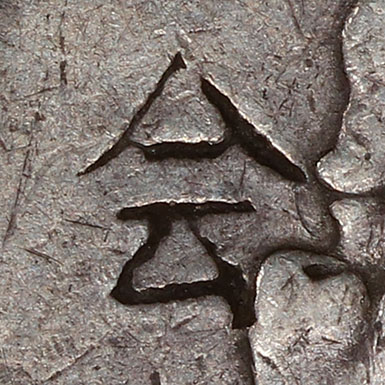 会 - huì - meet, gather, can
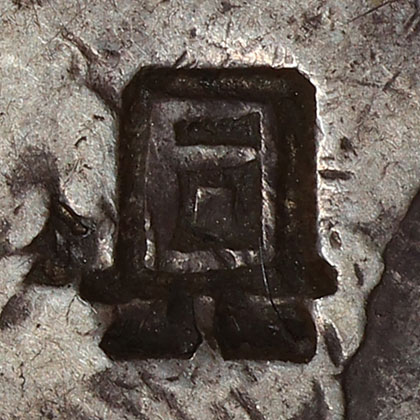 Similar to 同 - tóng - same, together, with
Provenance:
Purchased on eBay in October 2018 from a seller in Monterey, California.
1823-Mo JM Iturbide 8 Reales
Specifications:
27.07 g, .903 fine silver, .786 troy oz (actual silver weight)
Recorded mintage: unknown
Catalog reference: KM 310
Details:
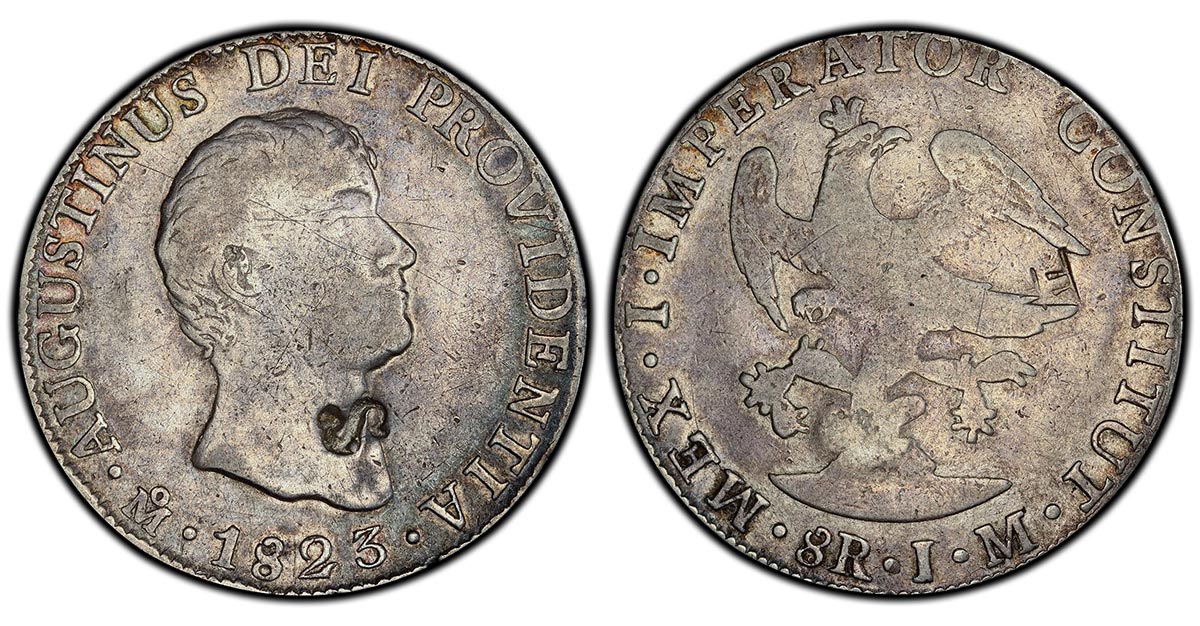
1823-Mo JM (Joaquín Dávila Madrid) 8 Reales, Iturbide Empire, KM 310, one of the short two-year imperial crown issues of 1822–1823 struck at Mexico City. On the reverse, the
coin abandons the familiar Bourbon arms-and-pillars format in favor of a distinctly Mexican imperial emblem: a crowned eagle on a cactus, paired with the empire legend “MEX.
I. IMPERATOR. CONSTITUT.”; the denomination “8R” and assayer initials “J.M.” appear below the device, with multiple recognized reverse styles differing mainly in eagle
size/arrangement and legend placement.
The historical setting is unusually tight: Iturbide’s imperial regime lasted less than a year (May 19, 1822 – March 19, 1823), and the associated coinage was produced for only a short two-year window before Mexico moved on to republican types. In other words, KM-310 is a product of Mexico’s immediate post-independence instability; coinage used not just as money, but as statecraft, branding, and legitimacy during a rapidly changing political order.
With Chinese chopmarks, this type becomes materially scarcer: Gullberg notes that the Iturbide coinage saw few pieces reach China, with even fewer surviving today. He also records that on China’s east coast the Iturbide 8 reales was nicknamed “chicken money” (雞錢), a shroff-market sobriquet tied to the eagle’s head profile, and that examples appear in shroff reference material, underscoring that at least some entered Chinese commercial channels despite initial conservatism toward new Mexican designs.
One Chinese chopmark on the reverse, with another stamp, a letter 'S' probably also stamped in China. One of the truly rare types in the chopmark type set, Gullberg estimates somewhere between 2-10 of these exist with chopmarks, on par with the Maximilian Pesos of the same country.
Notable chopmarks:
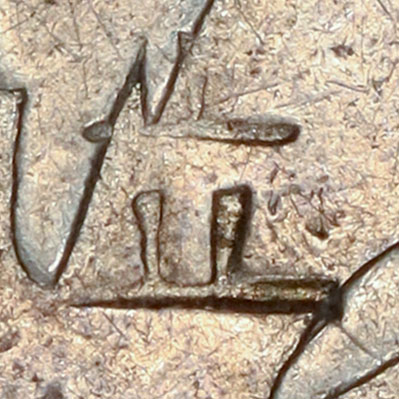 立 - lì - stand, establish
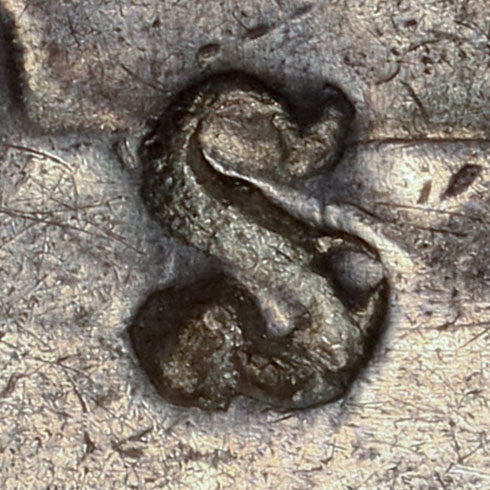 S - Latin-letter chopmark
Provenance:
From the Stack's Bowers April 2023 Hong Kong Auction
Lot #46277
Auction Description:
MEXICO. 8 Reales, 1823-Mo JM. Mexico City Mint. Agustin I Iturbide. PCGS Genuine--Chopmark, VF Details.
KM-310. Bust with short, uneven truncation (type V).
Estimate: $300 - $500.
1826-M AJ Spain 2 Reales Ferdinand VII draped bust type
Specifications:
6.77 g, .812 fine silver, .1767 troy oz (actual silver weight)
Recorded mintage: unknown
Catalog reference: KM 460.2
Details:
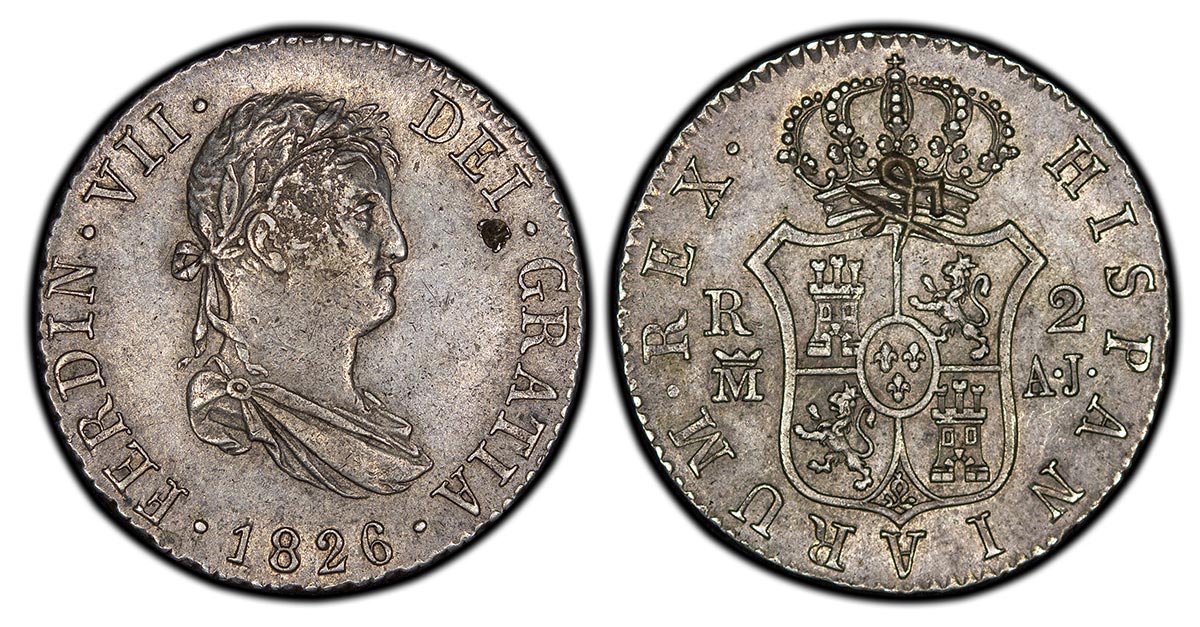
The 1826-M AJ (Antonio Rafael Narváez / José Duro Garcés) Spain 2 reales, KM-460.2, is a Madrid issue of Ferdinand VII’s laureate-bust type generally cataloged for 1814–1833.
These were struck to a lower standard for the time, in .812 fine silver at a standard of about 6.77 g. This date sits in the late, turbulent phase of Ferdinand’s reign, after
the Peninsular War and, more immediately, after the collapse of the 1820–1823 constitutional period and the restoration of hardline absolutism under French-backed intervention,
when Spain was also contending with the accelerating loss of its American dominions. The obverse drill mark and reverse Chinese chopmark point to later, secondary circulation
in Asia: the drill mark is a classic “test” injury, while the chopmark indicates that, despite being a metropolitan Spanish minor vs. a colonial trade crown, it nonetheless found
its way into the China trade.
Notable chopmarks:
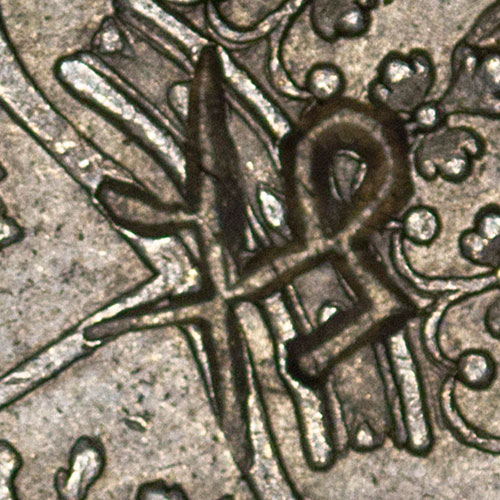 柺 - guǎi - cane, crutch
Provenance:
From Martí Hervera in cooperation with Soler y Llach Subasta Numismática 1103 Part I, July 2018 (Barcelona, Spain) Lot #365
Auction Description:
SPANISH MONARCHY: FERDINAND VII
2 Reales. 1826. MADRID. A.J. 5,92 grs. Resello en anverso. (Golpe de punzón en anverso). Cal-929. MBC+.
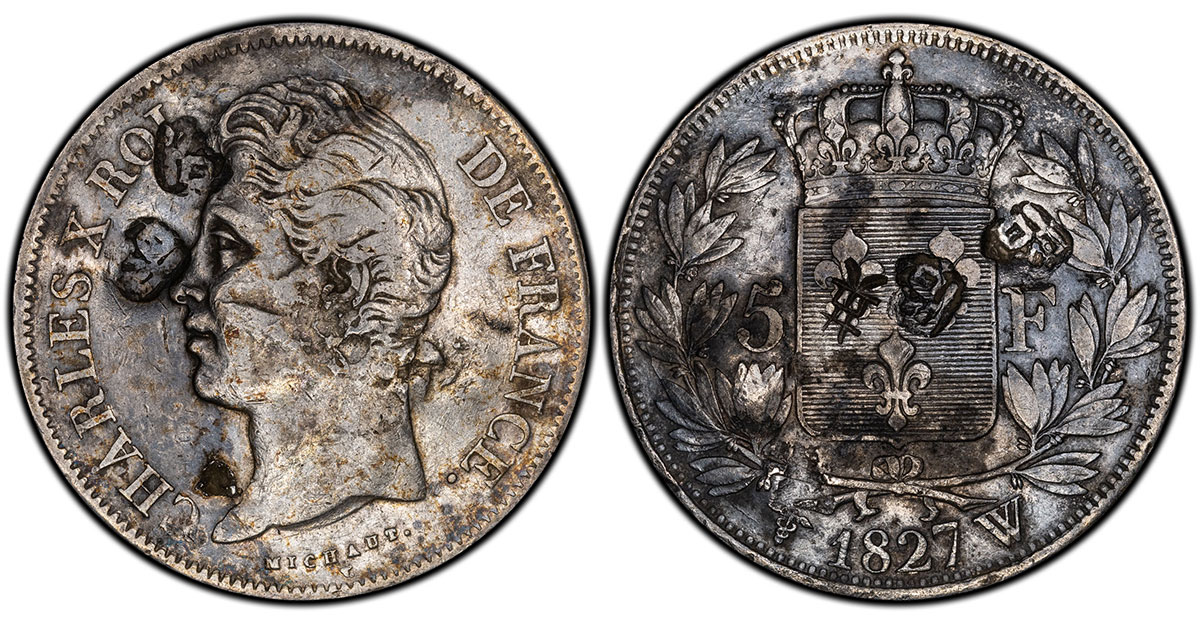
1827-W France 5 Francs, Lille mint, Charles X head left
Specifications:
25.0 g, .900 fine silver, .7234 troy oz (actual silver weight)
Recorded mintage: 11,522,313
Catalog reference: KM 728.13
Details:
The 1827-W France 5 Francs (Lille), Charles X head-left type (KM-728.13) is a standard Restoration-era silver écu struck to the French 0.900 fine, 25.00 g standard
(~37 mm diameter). The obverse carries the bust of Charles X left with the legend CHARLES X ROI DE FRANCE (engraver MICHAUT), while the reverse shows the crowned royal
arms with fleurs-de-lis between olive branches, with 5 F, date, and W mintmark identifying Lille. The edge is lettered ♣ DOMINE SALVUM FAC REGEM (Lord Save The King),
an anti-clipping measure used on French crown-sized silver. Fun fact: this coin was legal tender in the United States until 1857 at a value of 93 cents.
Historically, this coin belongs to the Bourbon Restoration (1814–1830) and the reign of Charles X (1824–1830), a period marked by an increasingly hard conservative turn and growing political friction. By 1827, tensions were high enough that Charles famously disbanded the National Guard, and the regime’s clash with the liberal opposition continued to intensify into the final crisis of July 1830 (the July Ordinances and the July Revolution). Against that backdrop, the 5-franc piece itself is a workhorse unit of the French silver system, struck in large quantities across multiple mints for domestic circulation and state payments.
The chopmarks on this coin are unusual. Gullberg notes that French francs are “exceedingly rare” with chops, which fits the practical obstacle that most French crown-sized silver did not naturally flow into the same channels as Spanish-American or later Mexican dollars. When one does turn up chopmarked, it usually signals secondary movement, a coin that first circulated (or was accumulated) in Europe or a European trading sphere, then was carried east as bullion/settlement silver and validated in China-facing trade by private testing rather than by any expectation that “5 francs” would be a recognized unit there.
Notable chopmarks:
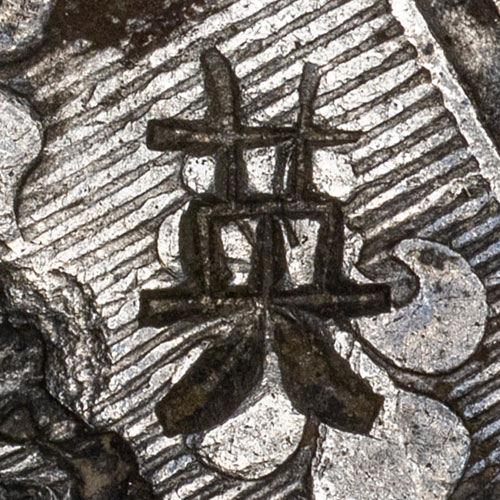 英 - yīng - flower, hero, Britain
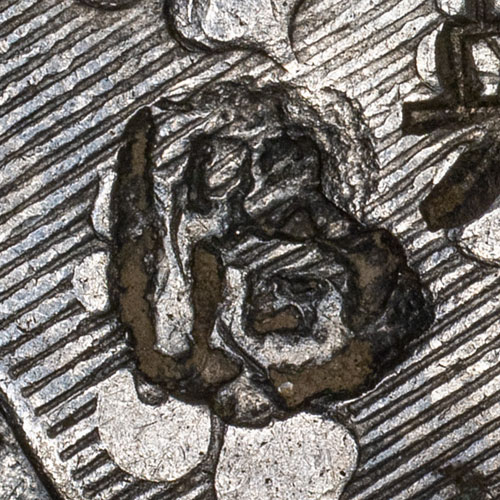 Unknown partial chopmark, possibly 䄑. What's interesting about this mark, is it appears a corner of the punch tool has broken off.
Provenance:
Purchased via private sale from Brandon Ge, a California dealer who sources coins directly from China, May 2025
1828/7-Cuz G Peru 8 Reales (Ex. Goodman)
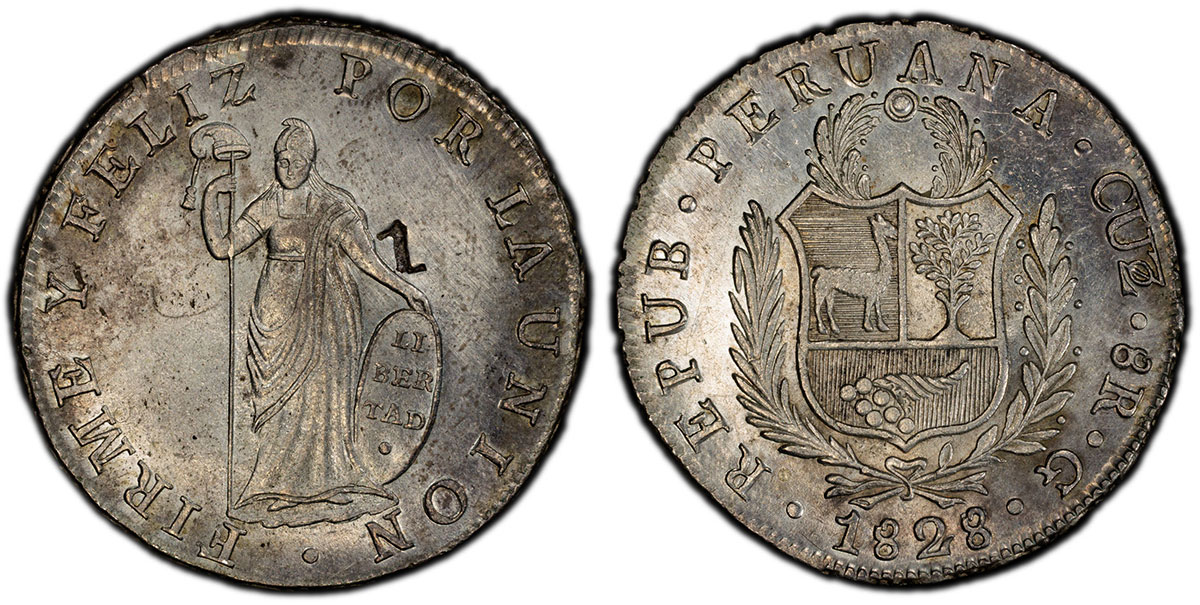
Specifications:
27.07 g, .903 fine silver, .7859 troy oz (actual silver weight)
Recorded mintage: unknown
Catalog reference: KM 142.2
Details:
text
Notable chopmarks:
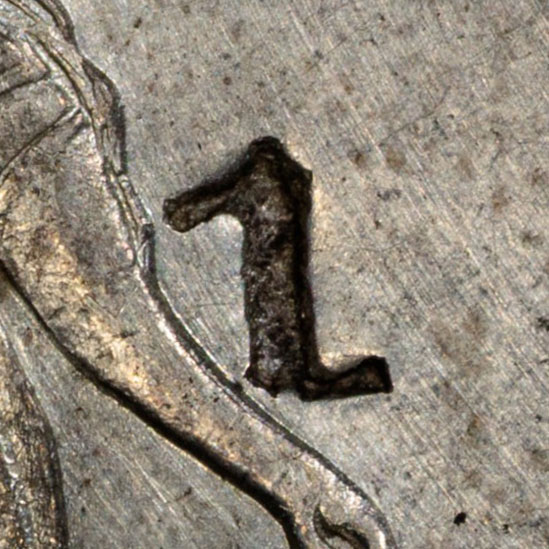 Chopmark resembling 1 - number chopmark
Provenance:
Acquired as part of a trade with a coin buddy in May 2026.
Previously sales:
From the Heritage Auctions May 2024 Spotlight: Latin America World Coins Showcase Auction #61374 Lot #22264
Auction Description:
Republic 8 Reales 1828/7 CUZCO-G UNC Details (Private Countermark) NGC,
Cuzco mint, KM142.2. Despite the noted countermark, the piece displays ample remnant detail.
Ex. Superior Auctions June 1996 "The Irving Goodman Collection of World Coins and Medals, Including Antiquities and Coins of the Ancient World", Beverly Hills, CA, lot 802.
Auction Description:
PERU. 8 Reales, 1828-G (Cuzco). Eliz-108. Possible overdate 8 over 7. "I" countermark in obverse field is unlisted. Superb strike. About Uncirculated.
(1828) Spanish Philippines 8 Reales with MANILA counterstamp on 1828-LM JM Peru host (Ex. Murphy / Rose / Farouk)
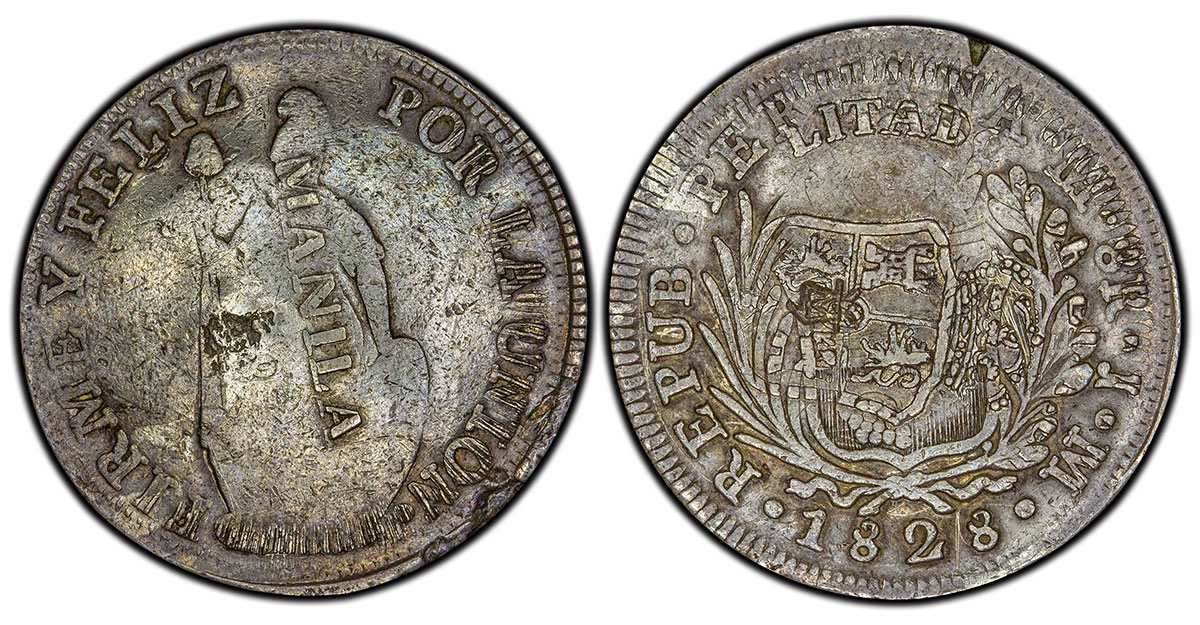
Specifications:
27.07 g, .903 fine silver, .786 troy oz (actual silver weight)
Recorded mintage: unknown
Catalog reference: KM 25
Details:
The MANILA counterstamp dated 1828 was the first of Spain's attempts to bring order to the flow of rebel-inflected silver arriving in the Philippines from the
newly independent republics of South America. On October 13, 1828, Mariano Ricafort, Captain General of the Philippine Islands, issued an edict directing that
coins struck by the "insurgent provinces and revolutionary governments" be overstamped to obliterate the offending legends: the words REPUBLICA, INDEPENDENCIA,
and LIBRE appearing on Peruvian, Mexican, Colombian, and Bolivian issues were all considered politically dangerous in a colony that Madrid was determined not to
lose. The dies were prepared locally at the Manila foundry by Benito de los Reyes, with the 1828 overstrike applied using a screw press to drive a full obverse
and reverse design over the original coin: MANILA 1828 within a serrated border on one side, and HABILITADO POR EL REY N.S.D. FERN. VII, "authorized by the King,
Our Lord Don Fernando VII," surrounding the Spanish arms on the other.
The operation proved costly and mechanically troublesome almost immediately. The screw presses used at the foundry were not robust enough to fully obliterate the underlying design, and the 1828 overstrikes typically show remnants of the original Peruvian or Mexican coin visible beneath the new dies. Production was sporadic, with large gaps between runs, and the program was effectively abandoned by the early 1830s in favor of the simpler F.7o and later Y.II punch countermarks that replaced the full overstrike system. Surviving 1828 MANILA pieces are scarce, and the 1828-LM JM Lima sol is among the more commonly encountered host coins within that already limited population, a Peruvian republican 8 reales struck in the same year the Manila program began and presumably swept into it soon after arriving in the islands.
Incredibly rare with chopmarks, it's not hard to imagine the coin traveling between China and the Philippines, but this is the first and only example I've seen with the combination of Chinese chopmark and this counterstamp.
Notable chopmarks:
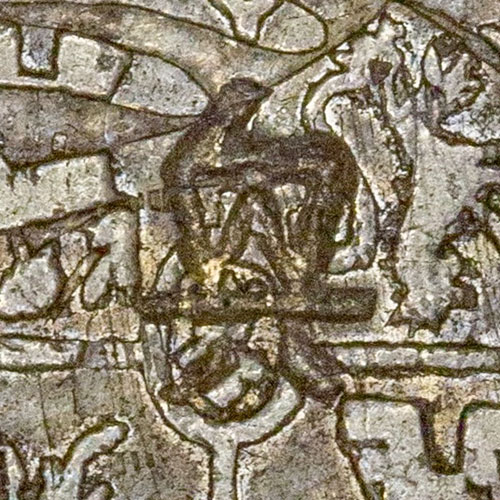 㒷 - (variant form of 興) xìng - to prosper, to rise, to flourish
Provenance:
Purchased from the Stack's Bowers April 2026 Hong Kong Showcase Auction
Lot #49792
Auction Description:
Highly Unusual Chopmarked Philippines 8 Reales
PHILIPPINES. Philippines - Peru. 8 Reales, 1828. Manila Mint. Ferdinand VII. PCGS Genuine--Chopmark, VF Details.
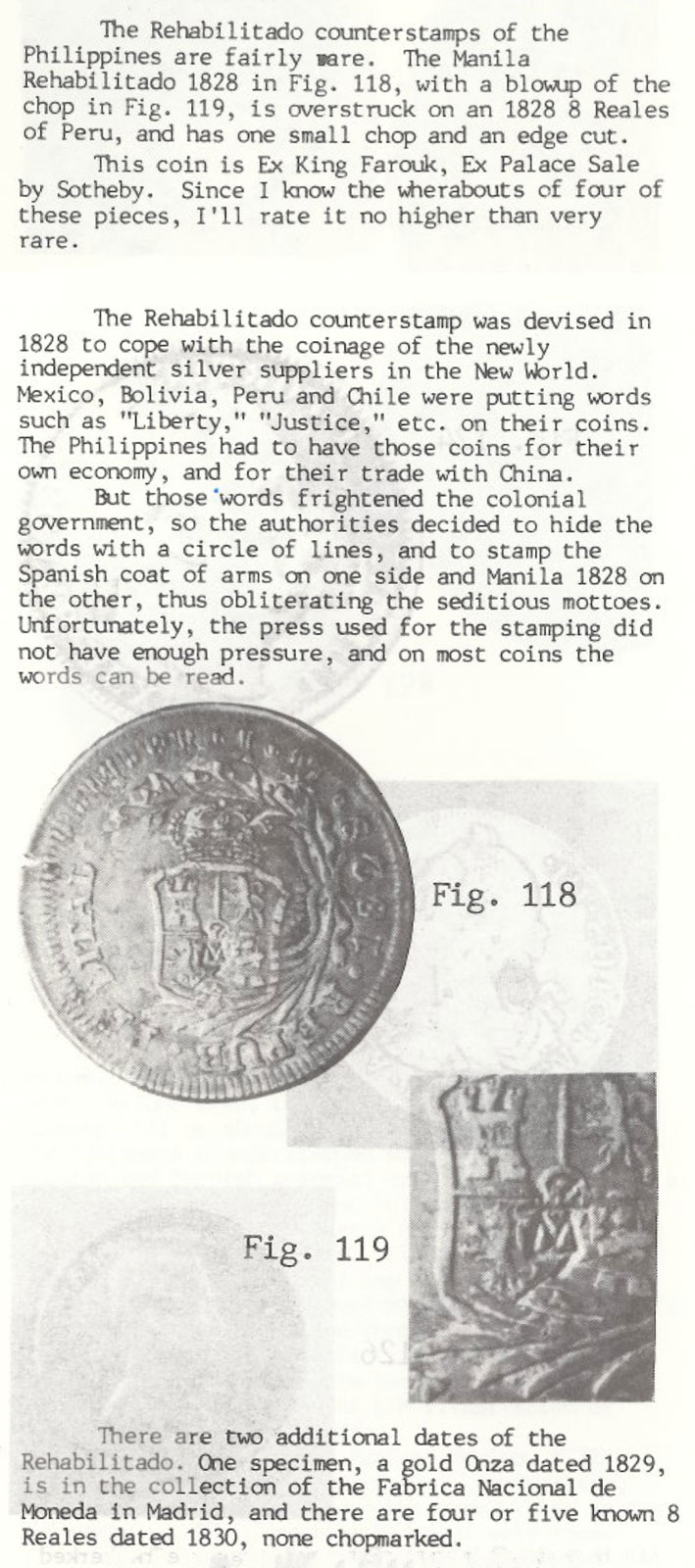
KM-25; Basso-52; PNM#6-20; PNM#16-30; PNM#21-I-20; Cacho-CS-015; Murphy-Fig. 405 (Plate Coin); Rose-Fig. 118/119 (Plate Coin). Issued by decree of 13 October 1828. Type I Manila Overstrike, with serrated borders and reverse legend; dies prepared by Don Benito de los Reyes. A single medium size incuse pseudo-Chinese chop on the reverse, "突" (meaning unknown). This pleasing example displays light attractive gray tone with a slight iridescent sheen that pops out when tilted in the light. The chop is bold, but somewhat obscured by the host design making identification difficult. Close inspection reveals a small edge file on the reverse mentioned for accuracy. Overall a pleasing piece that should be considered EXTREMELY RARE and unusual when found with a chops. A neat and interesting piece that is sure to add depth to the next collection it enters.
Provenance: From the Edgar Murphy Collection.
Ex: F. M. Rose Collection, featured as figure 118-119 on page 30-31 in his book "Chopmarks".
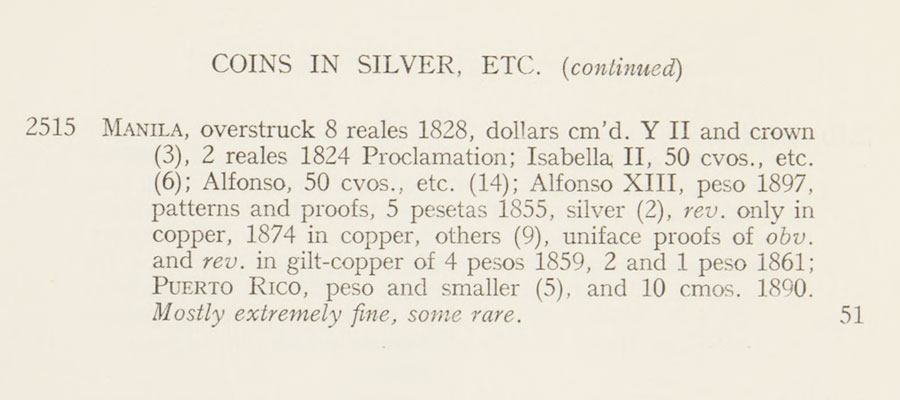
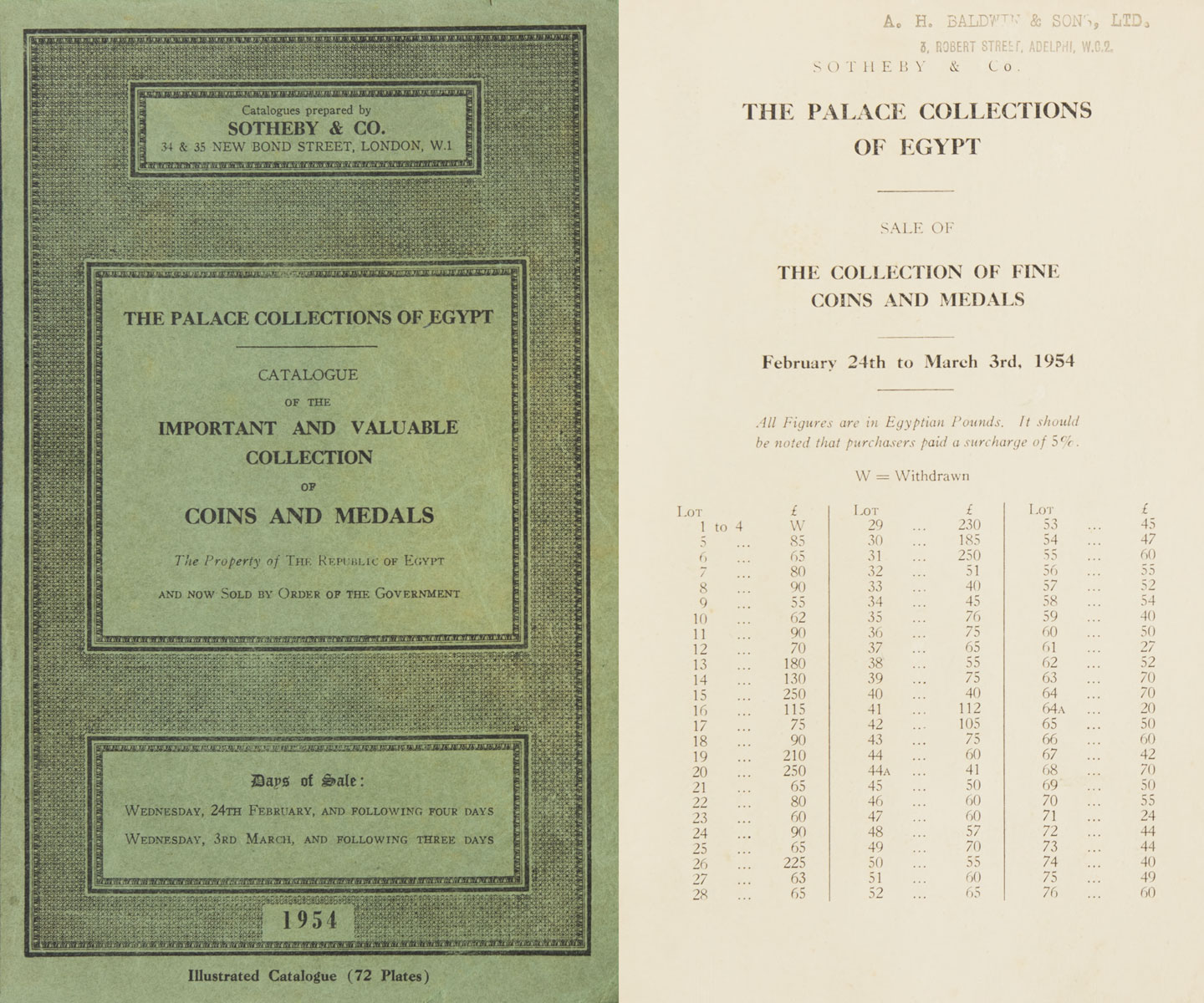
Ex: King Farouk of Egypt, sold in a group as lot 2515 in the February 1954 Palace sale by Sotheby & Co.
1831-PTS JF Bolivia 8 Soles
Specifications:
27 g, .903 fine silver, .7838 troy oz (actual silver weight)
Recorded mintage: unknown
Catalog reference: KM 97
Details:
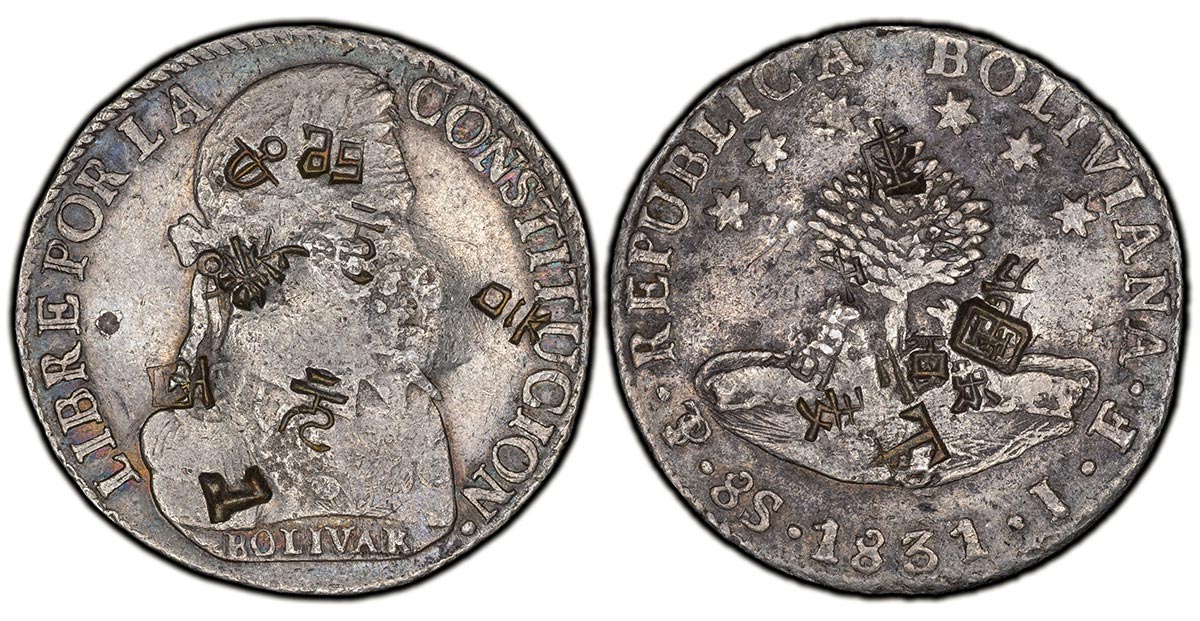
The 1831-PTS JF Bolivia 8 Soles (KM 97) is an early-republic crown struck at the Casa de la Moneda de Potosí on the post-independence standard of 0.903 fine silver at 27.0 g,
essentially matching the familiar intrinsic “dollar” class of the Spanish 8 reales. The type pairs a laureate, uniformed right-facing bust of Bolívar with the national emblem
side showing alpacas beneath a tree with stars above, and it carries the patriotic edge legend “AYACUCHO SUCRE 1824” commemorating the independence victory and its commander.
At auction, The JF assayer appears less often than the more frequently cataloged 1831-PTS JL. This type was struck in substantial quantities 1827-40 after Bolivian independence,
and often comes poorly struck on bad planchets. Later eight soles (or sueldos; the sources do not agree) were struck to the same weight standard until 1859, when the weight was
lowered to 20 grams. Bolivia converted to decimal coinage in 1864.
In historical context, KM 97 belongs to the first generation of Bolivian national silver after independence (1825), when the new state leaned on Potosí’s long-established minting infrastructure while building legitimacy through explicitly patriotic coinage; Bolívar’s portrait on the face and Ayacucho/Sucre on the edge are not subtle choices. Politically, 1831 falls within the presidency of Andrés de Santa Cruz (1829–1839), a period associated with efforts to stabilize a war-torn fiscal system and reorganize state finances, exactly the sort of environment in which a reliable, exportable crown-sized piece mattered.
As a China-trade chop host, Bolivian republican crowns are documented but not routine: Early republic issues are scarce in general, political instability in Spanish America reduced the flow of such dollars into Chinese markets compared with earlier, more dominant streams of Spanish colonial coins. Still, chopmarked examples of the Bolivia 8 soles series are seen now and then, Gullberg notes that this 8 soles type and its close successors are seen with chops, and records Taiwan-based shroff nicknames for the tree/alpaca reverse (“tree money,” “banana money”), which implies recognizability despite limited volume. In practical terms: an 1831 Potosí 8 soles could reach China through secondary commercial circuits (Pacific ports, re-export, and treaty-port bullion markets), but the likelihood of chopmarking is meaningfully lower than for Mexican or Lima crowns simply because far fewer of these pieces ever arrived to be tested.
Notable chopmarks:
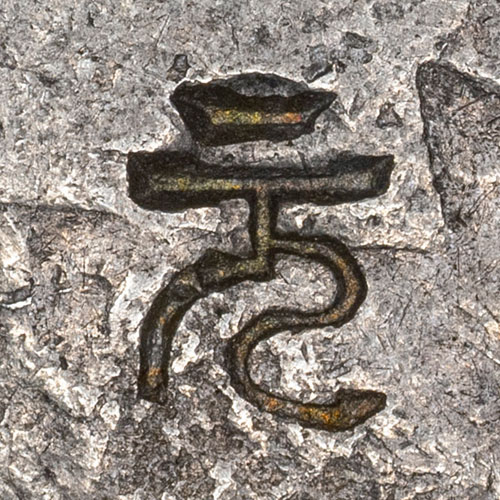
 - Liushutong script variant of 元 - yuán - dollar, unit of currency, basic, primary
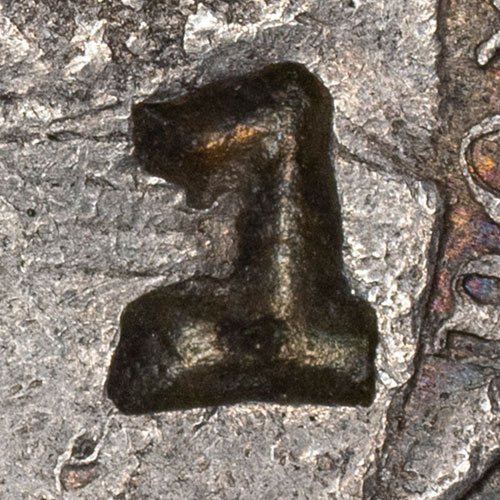 1 - number chopmark
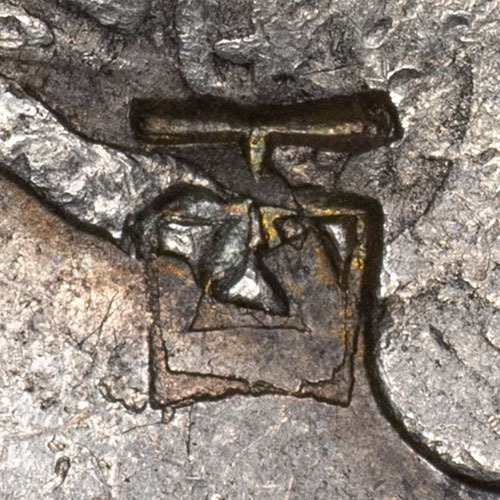 丙 - bǐng - 3rd heavenly stem
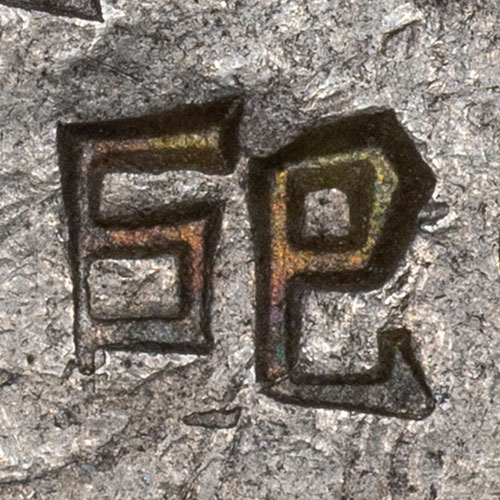 Unknown chopmark combination
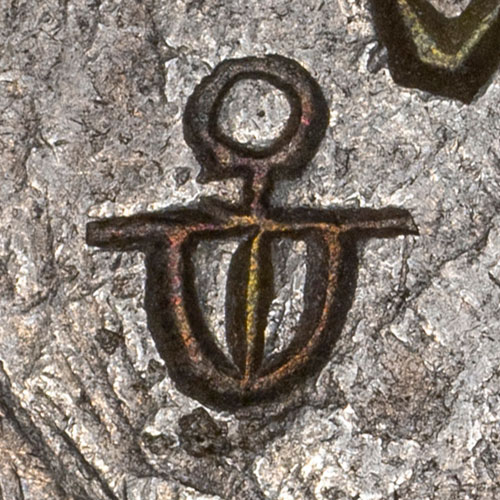 Unknown symbol, or possibly seal script chopmark
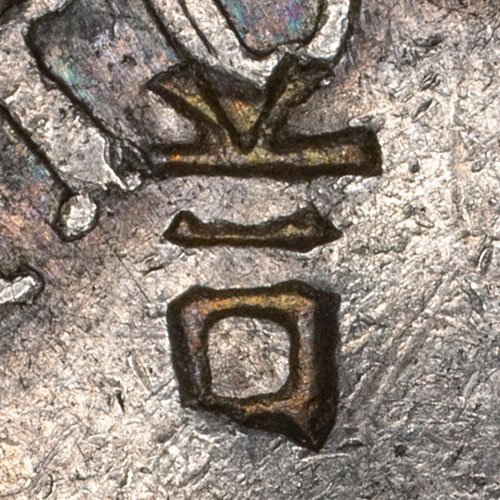 Unknown chopmark
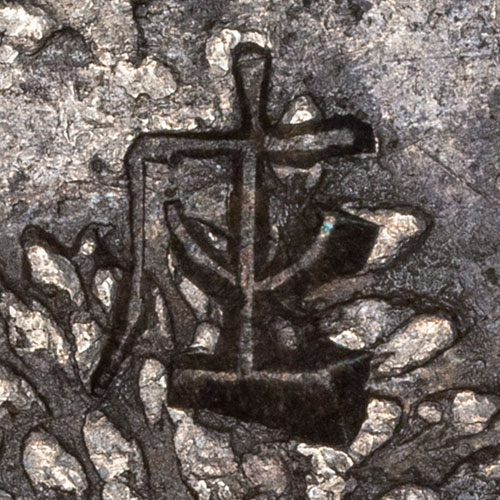 Probably a calligraphy or Liushutong variant of 庄 - zhuāng - village, manor
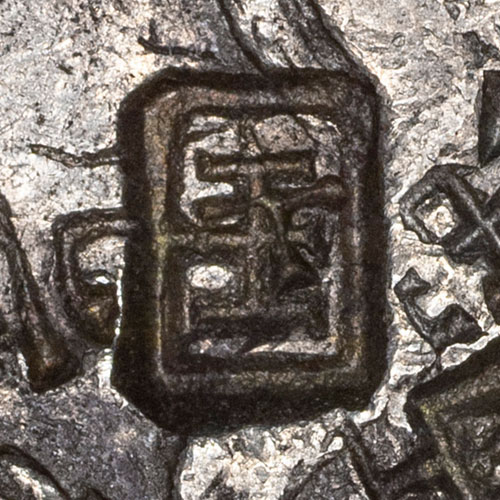 囯 or 国 - guó - nation, country
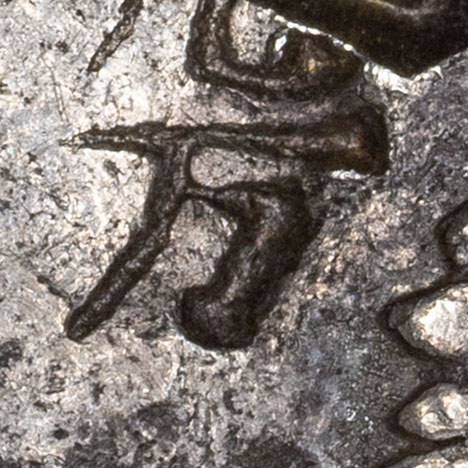 万 - wàn - ten thousand, a great number
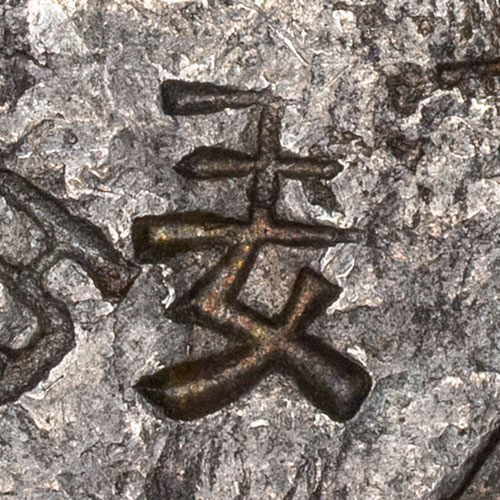 Unknown chopmark, the lower part is 女 - nǚ - woman, female, daughter
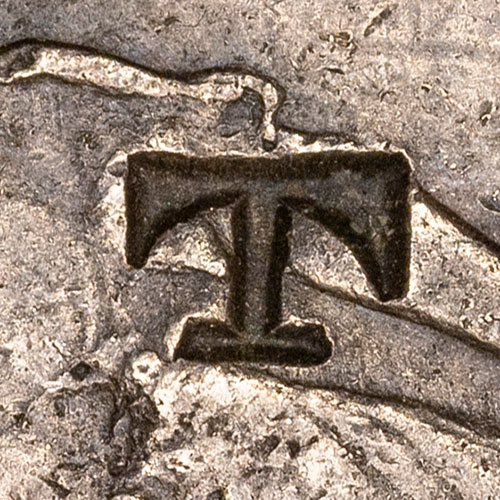
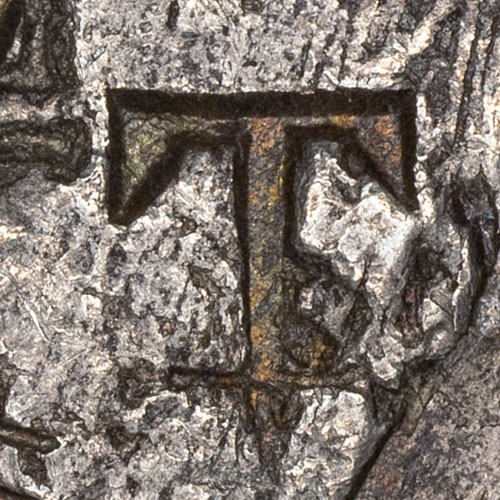 丅 - (ancient version of 下) xià - below, down, under
Provenance:
Purchased from the Al Sur del Mundo Online Auction #5 Session 2, March 2025,
Lot #566
Auction Description:
Bolivia, Potosi. 8 Soles. 1831. JL. Nota: Chopmarks.
Bolivia, Potosi. 8 Soles. 1831. Ensayadores: JL. Chopmarks (Juan Palomo y Luis Lopez). Anverso: Busto de Simon Bolivar mirando hacia la derecha; leyenda alrededor. Reverso: Dos
alpacas recostadas bajo un arbol coronado por seis estrellas; leyendas alrededor. Plata 903; 26,79 g.; 38 mm. (VF)
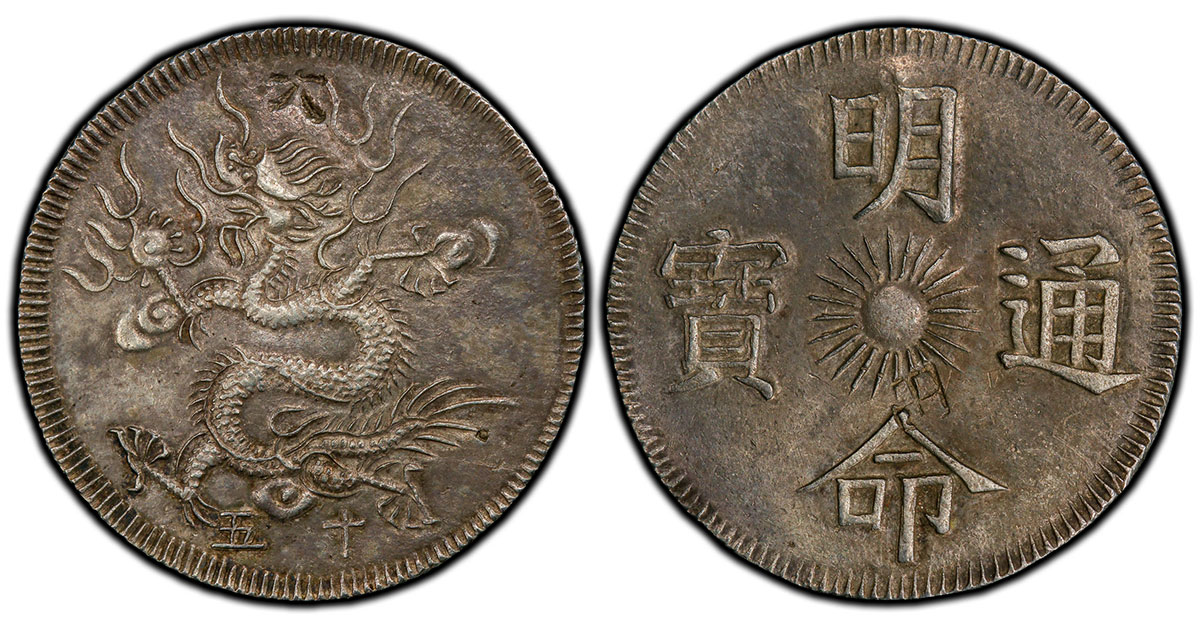
Year 15 (1834) Annam (Empire of Vietnam) 7 Tiền
Specifications:
27.27 g, actual weight 28.13 g
Recorded mintage: unknown
Catalog reference: KM 195
Details:
The 7 tiền is a large, crown-sized silver coin of Annam (Vietnam) struck under Emperor Minh Mạng, whose reign title gives the issue its name. One side carries the
four-character legend Minh Mạng Thông Bảo (明命通寶), "the circulating currency of Minh Mạng," arranged around a central sun. The other side shows a dragon facing
left amid clouds, the imperial emblem of the Nguyễn court, with two characters below recording the regnal year, Year 15 (五十) which corresponds to 1834. Which face
is properly the obverse and which is the reverse is commonly debated, so the two are described here simply as the legend side and the dragon side.
Minh Mạng was the second emperor of the Nguyễn Dynasty, reigning from 1820 to 1841, and is remembered for centralizing the Vietnamese state along Confucian lines and for an ambitious program of large silver coinage. Pieces of this size were not everyday small change but high-value silver used for presentation, reward, and major transactions, and they were struck in modest numbers beside the base-metal cash that served ordinary trade.
Vietnamese silver of this period rarely entered the China trade, so chopmarked examples are seldom encountered. This coin nonetheless carries a single clear chopmark on each side, evidence that it passed at some point through Chinese commercial hands, where a merchant tested its silver and stamped it as verified.
Notable chopmarks:
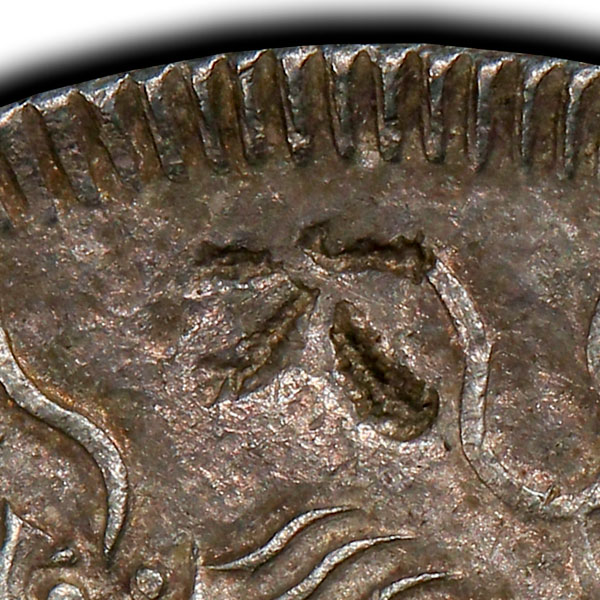 大 - dà - big, great, large
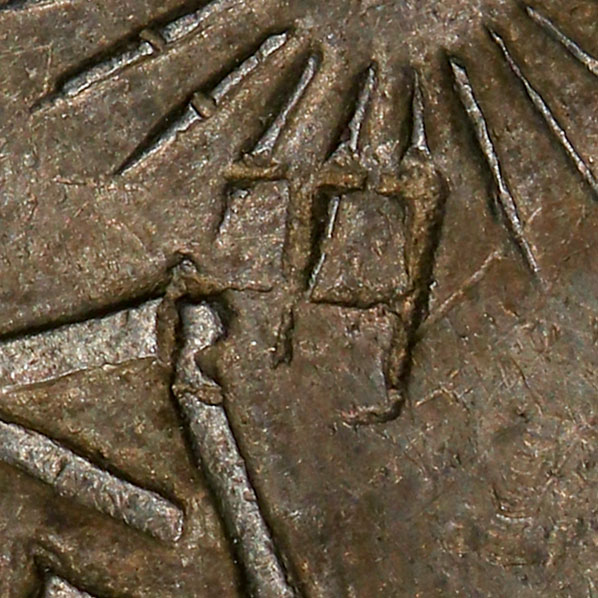 田 - tián - field, farmland
Provenance:
From the Stack's Bowers June 2026 Hong Kong Premier Collectors Choice Auction - Session 2
Lot #41492
Auction Description:
ANNAM. 7 Tien, Year 15 (1834). Minh Mang. PCGS Genuine--Chopmark, AU Details.
KM-195; Sch-183. Weight: 28.13 gms. Obverse: Dragon in clouds, date below; Reverse: "Minh Mang Thong Bao". A sharply struck beauty enriched by a mottled charcoal
tone with some underlying luster throughout. One distinct chopmark on each side, otherwise a gracefully preserved example.
Estimate: $2,000 - $3,000.
Previously from the Stack's Bowers May 2022 Hong Kong Auction Lot #55047
Auction Description:
ANNAM. 7 Tien, Year 15 (1834). Minh Mang. PCGS Genuine--Chopmark, AU Details.
KM-195; Sch-183. Weight: 28.13 gms. This enticing specimen exhibits little in the way of actual handling along with a charming darker gray tone, with the noted
chopmarks occurring above the head of the dragon, behind its tail, and above "mang".
Estimate: $1,000 - $2,000.
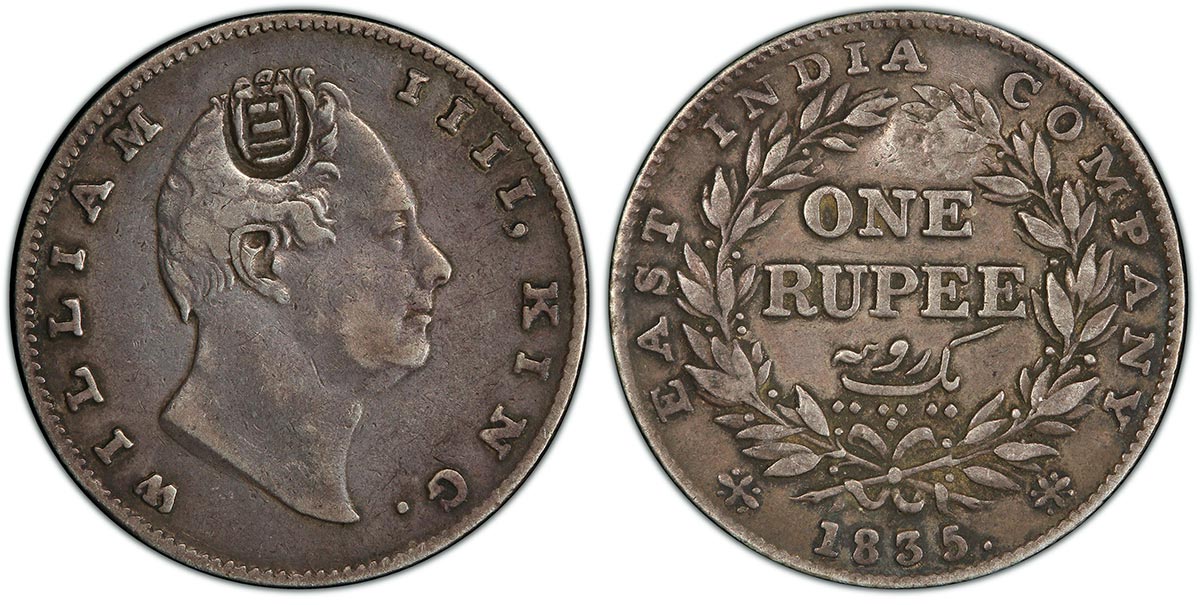
1835 British East India Company Rupee, King William IIII
Specifications:
11.6600 g, .9170 fine silver, .3438 troy oz (actual silver weight)
Recorded mintage: 15,759,000
Catalog reference: KM 450.2
Details:
The 1835 British East India Company rupee of William IV (KM 450.2) belongs to the first truly uniform Company rupee coinage mandated by the Coinage Act of 1835, a deliberate
break from the earlier patchwork of local rupee standards. This type carries William IV’s portrait, the denomination in English and Persian (“Yek Rupiya”), and a frozen date
of 1835, with production continuing through 1840 even after Victoria’s accession in 1837.
In the China-trade context, a chopmarked example is notably scarcer than the coin’s familiarity might suggest. Chopmarked examples are not common and must have been only lightly exported or unpopular in the China trade.
Notable chopmarks:
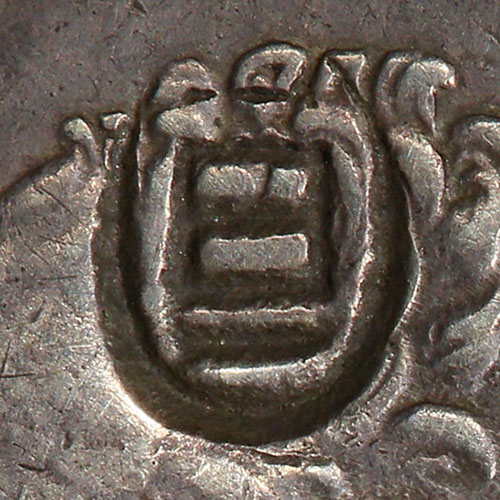 旦 - dàn - dawn, morning
Provenance:
Purchased from the Stephen Album Sale 36 January 2020 Lot #1454
Auction Description:
CHINESE CHOPMARKS: BRITISH INDIA: William IV, 1830-1837, AR rupee, 1835, KM-450.1, East India Company issue, with single large Chinese merchant chopmark within circle, VF.
1838-L MB North Peru 8 Reales - Est. Nor-Peruano type (Ex. Waddell)
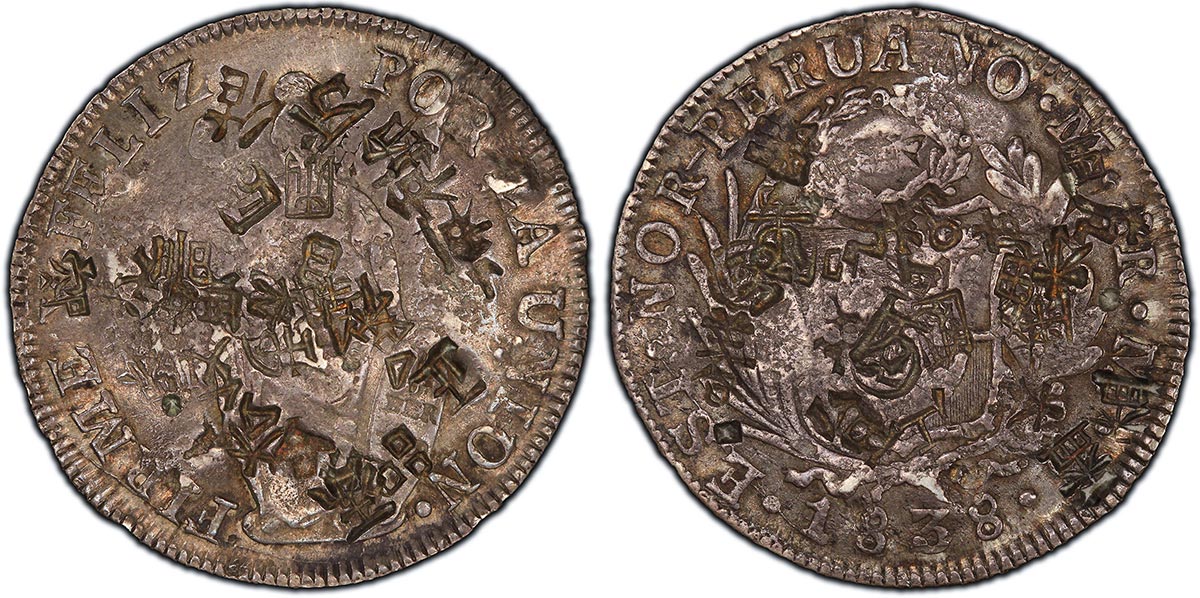
Specifications:
27.07 g, .903 fine silver, .786 troy oz (actual silver weight)
Recorded mintage: unknown
Catalog reference: KM 155
Details:
The 1838-L MB (Manuel Carassa y Jaramillo & Bernardo Aguilar) 8 Reales is a peso sized coin struck during the Peru–Bolivian Confederation period, using the standard 0.903 fine silver
and 27.07 g weight, essentially the late “Spanish dollar” standard. Design wise, the 'obverse' places the arms within a wreath/sprigs arrangement with the date, while the 'reverse'
uses a standing Liberty motif with the North Peru legend - EST. NOR-PERUANO - and a union-slogan reverse legend - FIRME Y FELIZ. There is common confusion about what is actually the
obverse and reverse with this type.
Historically, these pieces belong to the short window when Andrés de Santa Cruz imposed a political re-ordering of the central Andes, dividing Peru into North and South states and joining them with Bolivia as the Peruvian–Bolivian Confederation (1836–1839). That experiment immediately drew regional opposition (most notably Chile, aligned with Peruvian “restorationist” forces), culminating in the War of the Confederation (1836–1839) and the confederation’s collapse in 1839.
Very rare with chopmarks, Gullberg estimates less than 10 known. Featured in the December 2012 Chopmark News, volume 16 issue 4.
Notable chopmarks:
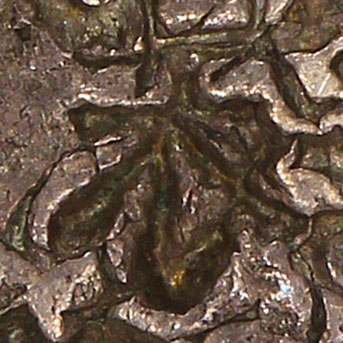 衣 - yī - clothing, garment
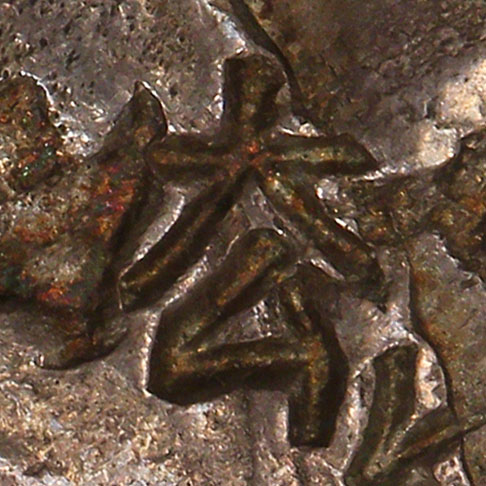 厺 - qù - depart
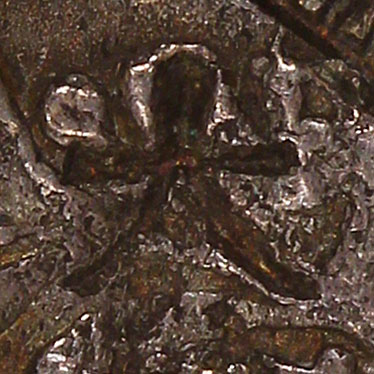 大 - dà - big, great, large
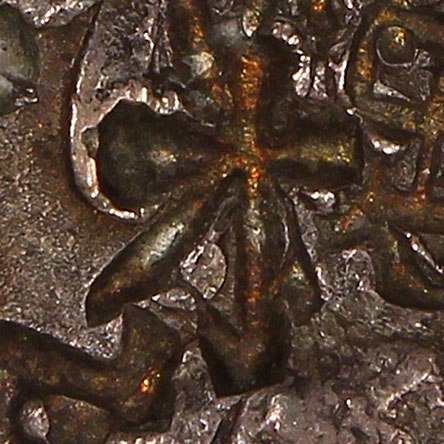 才 - cái - talent, ability, just
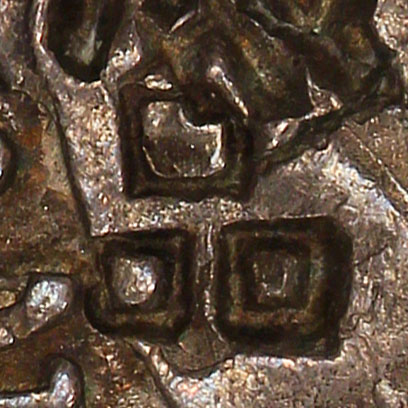 品 - pǐn - article, product, grade
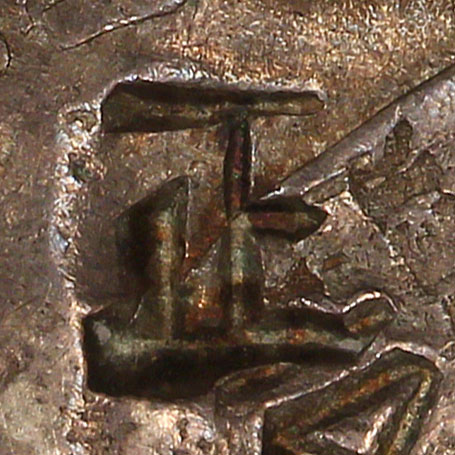 正 - zhèng - correct, straight, upright
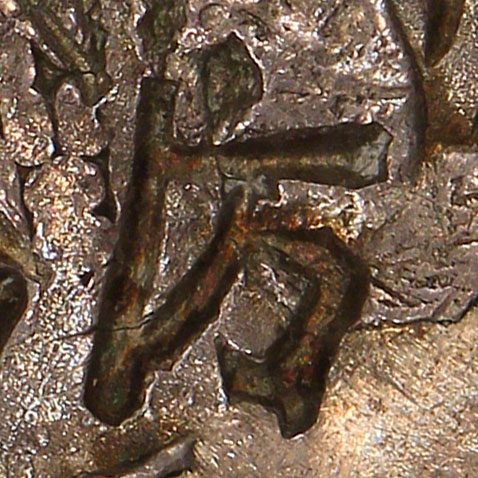 仿 - fǎng - imitate, copy
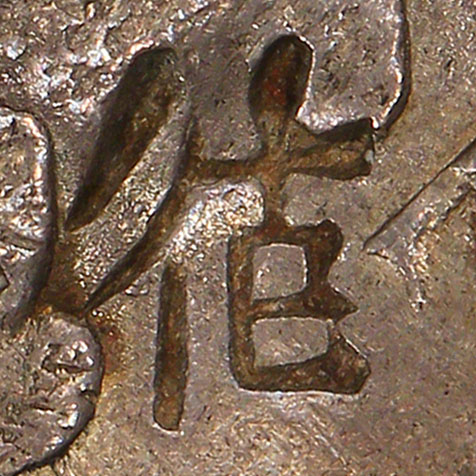 佗 - tuó - he, she, other
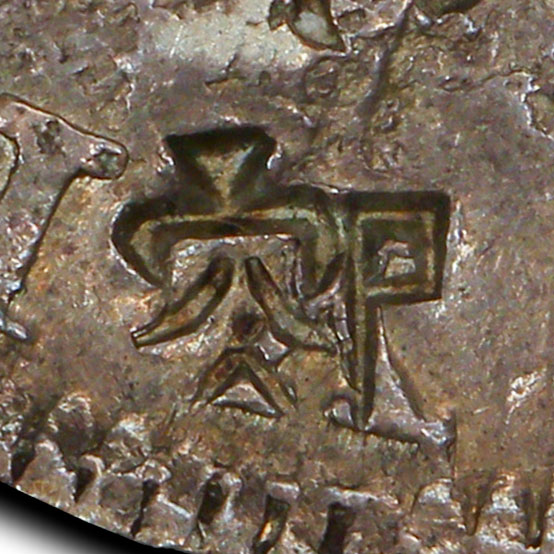 Unknown chopmark
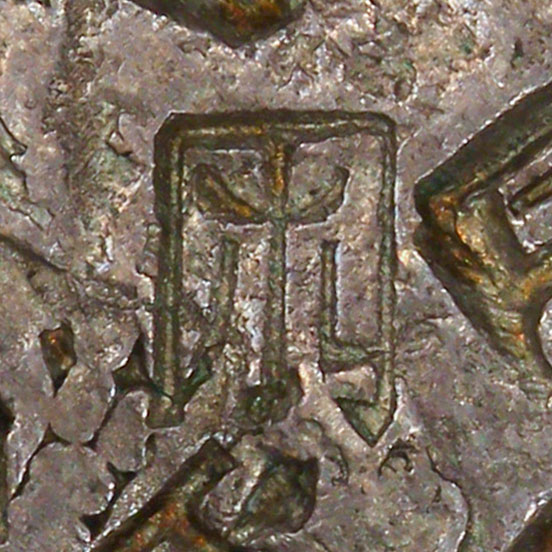 凩 - mù - wintry wind
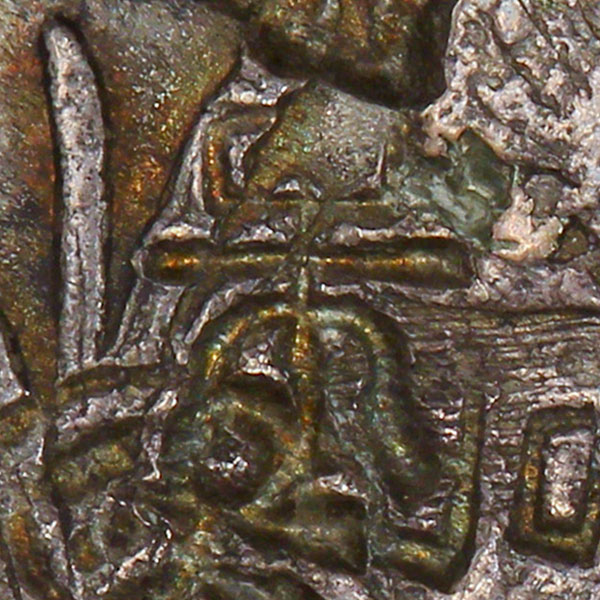 呆 - dāi - dull, wooden, stupid, dull-minted, simple
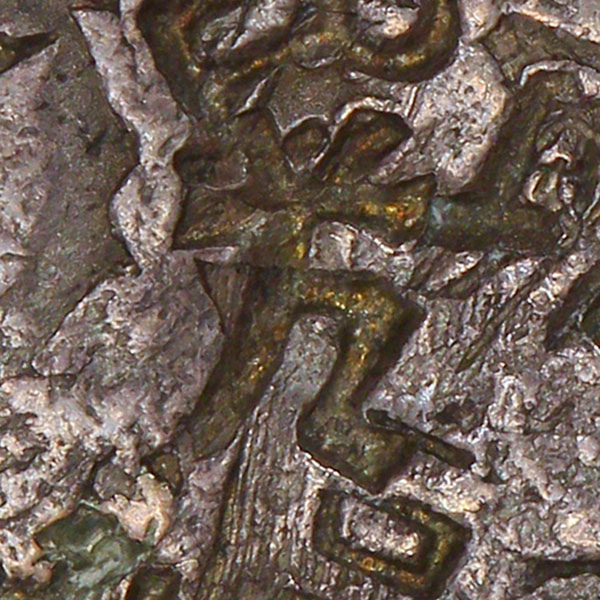 芳 - fāng - fragrant
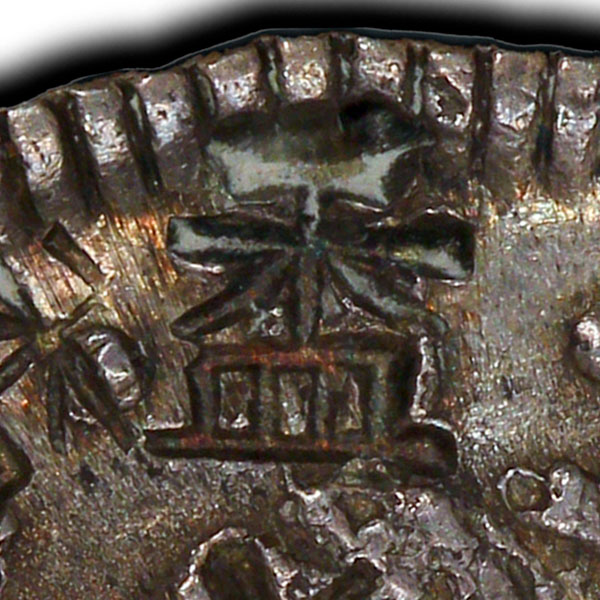 Unknown chopmark
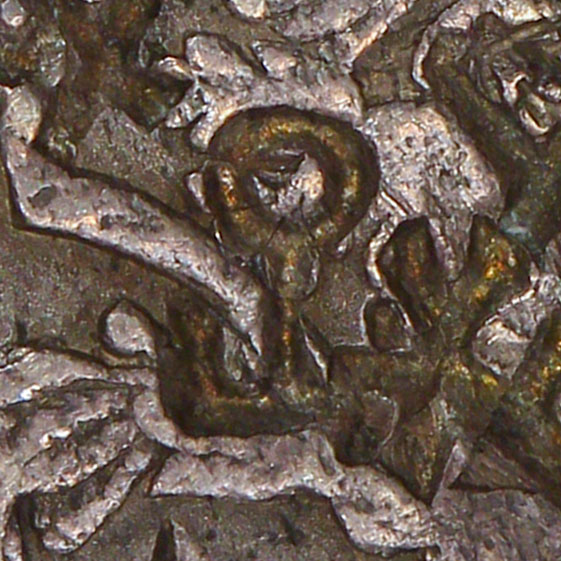 旵 - chǎn - sunrise
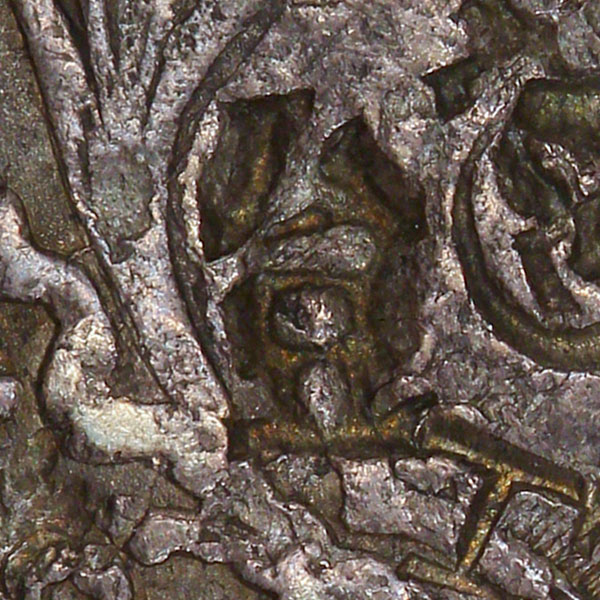 Unknown chopmark
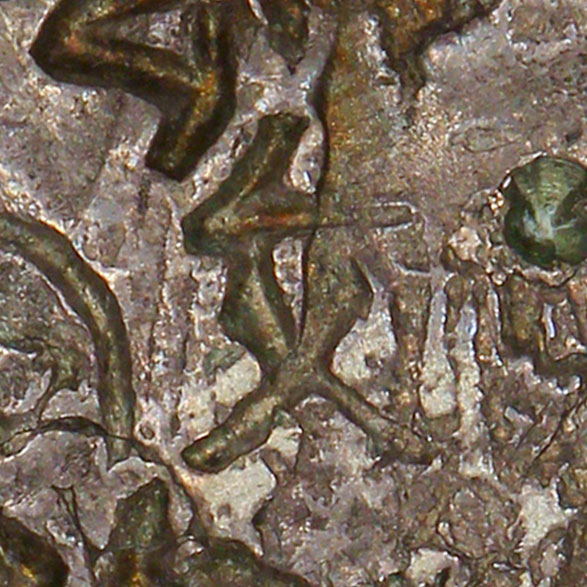 女 - nǚ - woman, female, daughter
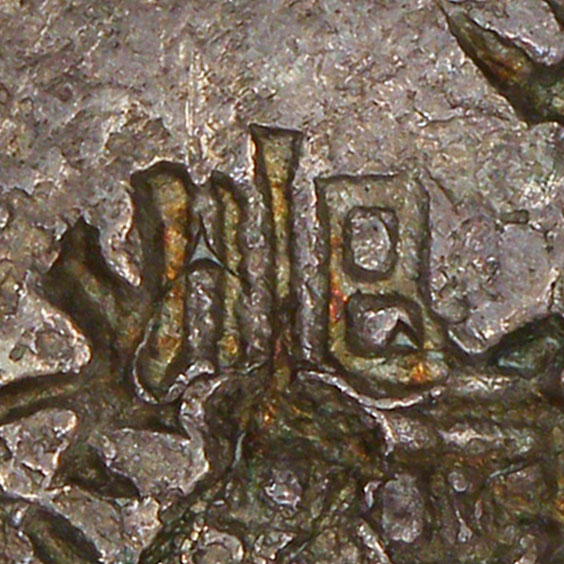 Unknown combination of 川 and 巳
Provenance:
From the Ron Waddell Collection
Purchased from Ron via private sale in June 2016
Ron purchased this coin at a show in Illinois in Feb. 1990
Featured as the plate coin in Gullberg's Chopmarked Coins - A History, p.56
1838-C MS South Peru "Sunface" 8 Reales, Cuzco mint
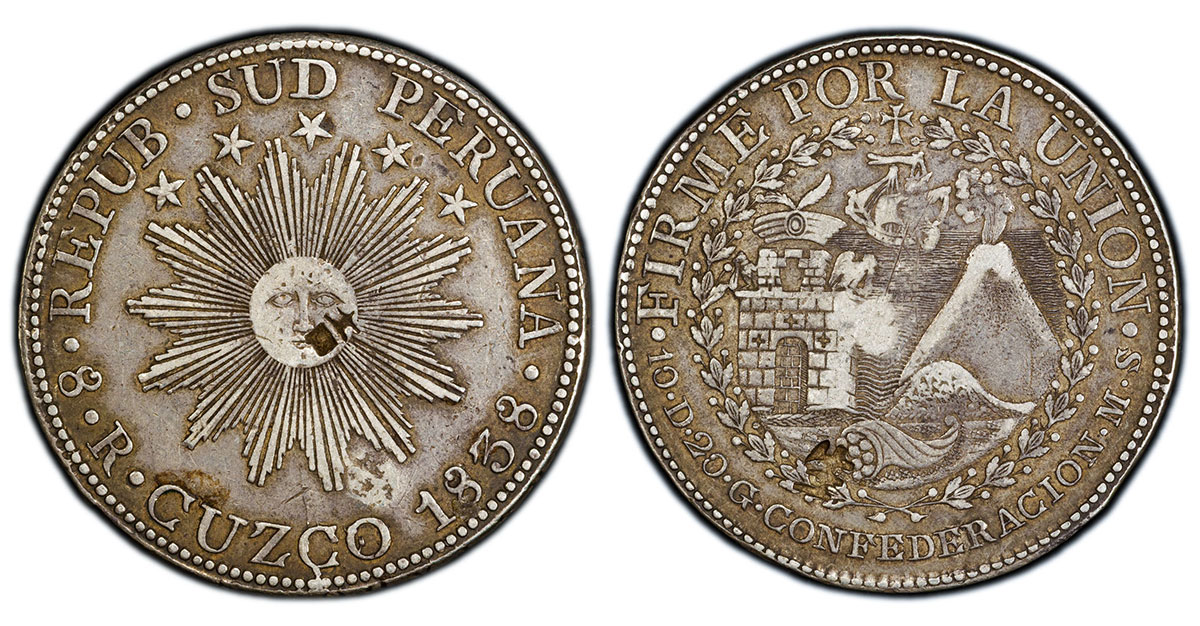
Specifications:
27.07 g, .903 fine silver, .786 troy oz (actual silver weight)
Recorded mintage: unknown
Catalog reference: KM 170.4
Details:
The 1837–1839 South Peru “sunface” 8 reales from Cuzco belongs to the short-lived Peru–Bolivian Confederation era (1836–1839), when “South Peru” issued its own coinage as
part of that political experiment. In the 1830s, Peru remained one of the Andes’ core silver economies, with major output coming from districts like Cerro de Pasco, while
neighboring Bolivia still loomed large historically thanks to the long legacy of Potosí, and Chile was beginning its 1830–1850 silver boom after major finds like Chañarcillo
(1832).
The coin’s design is what makes the type famous - the obverse shows a radiant “sun face” with five stars above and the legend “REPUB · SUD PERUANA” with 8 R, CUZCO, and the date below. The reverse shows a collage of volcano, tower, ship, and cornucopia within a wreath, with legends including “FIRME POR LA UNION” and “CONFEDERACION”.
As a crown-sized trade piece, it fit the familiar large-silver format used across the Americas and widely recognized in international commerce - exactly the kind of coin that could move through Pacific and Atlantic trade channels as merchants and shippers treated big silver as a practical settlement medium. Chopmarks do exist on this type, as shown here, but they are not commonly encountered.
Notable chopmarks:
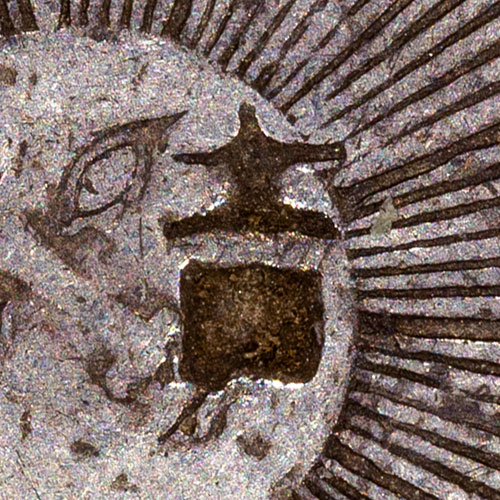 吉 - jí - auspicious, lucky
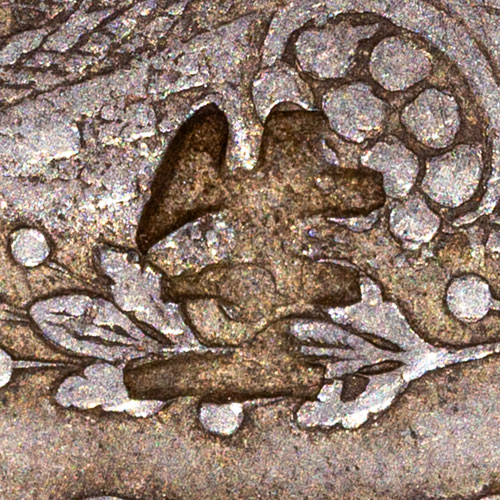 生 - shēng - life, birth, grow
Provenance:
From Ben Dalgleish, a collector who finds chopmarked coins in the coin markets of Hong Kong, in December 2025.
Ben found this coin at the December 2025 Hong Kong International Numismatic Fair (HKINF).
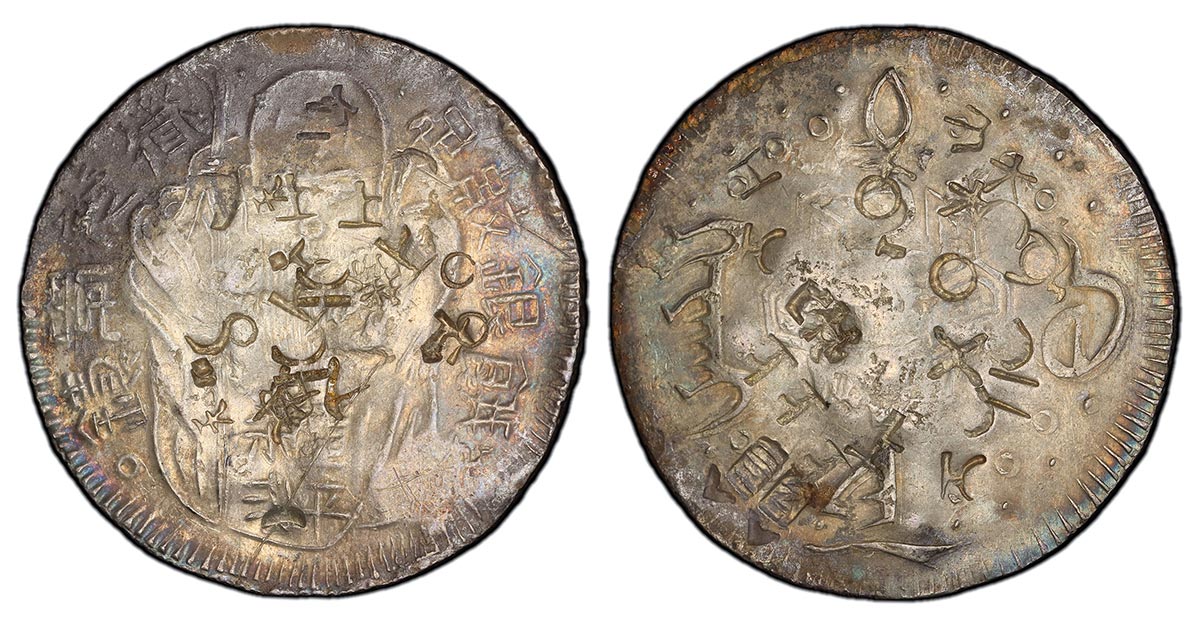
1838-1850 Taiwan Tao Kuang "Old Man dollar" (Ex. Wahlstedt)
Specifications:
.72 tael, approx 98% fine silver
Recorded mintage: unknown
Catalog reference: L&M-319, K-1b
Details:
It has long been told that in 1837 a rebellious general named Zhang Wen staged a revolution in Taiwan. Like any good revolutionary coup, you have to pay the soldiers, and
due to Taiwan’s isolation Zhang Wen decreed a silver coin of dollar size be struck similar to the Spanish 8 Reales. However, this story isn't widely accepted, and details
around the motivation and creation of this coin remain a mystery. The July 2023 issue of the Journal of East Asian Numismatics (JEAN) contains a good summary of recent
thinking on this coin, by author Che-lu Tseng of the USA:
In 1939, Chiang Chung-chuan's ( 蔣 仲 川 ) book Illustrations of Chinese Gold, Silver and Nickel Coins ( 中國金銀鎳幣圖 ) said: "In the seventeenth year of the Daoguang's reign (1837), Zhang Wen ( 張溫 ) rose up in Du Bai Kou, Xin Zhen County, Tainan State, calling himself the Xingming Grand Marshal. He ordered the minting of the silver cake featuring the longevity god, weighing 7 mace and 2 candareens, and this kind of coin is commonly known as Old Man Dollar in Taiwan."
Since then, almost all numismatic books and journals have agreed with this statement, including the article about the Daoguang silver cakes in the first issue of the Chuan Pi ( 泉 幣 ), Peng Xinwei's ( 彭 信 威 ) Chinese Currency History ( 中 國貨幣史 ), Chang Huang's ( 張璜 ) Chinese Silver Dollar and Tael Catalog (中國銀圓及銀兩幣), Zhang Huixin's (張信 惠)Illustrated Catalog of Chinese Coins (中國貨幣史話目 錄 ), Eduard Kann's Chinese Currency, and Chinese Currency Through the Ages ( 中國歷代貨幣 ) by the People's Bank of China. All reference books have said so, so this has become accepted knowledge.
I have no idea which historical document Chiang Chung-chuan's conclusions are based on. I have searched many historical materials about the history of Taiwan and that of people fighting against the Qing government, but I could not find anyone named Zhang Wen in the historical records, and I do not know where Du Bai Kou, Xin Zhen County, Tainan State is which is referred to in the literature. It is also said that the silver cake was struck when Zhang Wen rose up against the Qing. Do you think it is possible? Since Zhang Wen called himself the Great Marshal of Ming, why did he still use Manchu script and the reign title of Daoguang of the Qing dynasty? The people in Taiwan fought against the Qing dynasty due to the oppression of the government. It was a momentary impulsive action, and it lasted only a year. Given the numerous varieties of the Old Man Dollar, it must have been produced for more than a year. Also, given there is a number of chopmarks, which means they were not in circulation for a short time, Zhang Wen could not have minted so many silver cakes within a year. Therefore, Chiang's claim is not credible.
On page 270 of the fifth edition of A Chinese Commercial Guide by S. Wells William, it says: "The provincial treasurer of Fuhkien issued a local coin in 1838, about the size of a Spanish dollar. The obverse bore a portrait of the god of longevity, with an inscription showing that it was cast in the reign Taukwang, and by the treasure scales weighed 7 mace 2 cand., and was struck with ying ping , i.e., 'a cake of pure sycee silver.' The reverse exhibited a tripod, denoting that it was a government coin struck for the army, with the legend Taiwan in Manchu, to show that it was cast in Formosa. The workmanship of this coin was very crude. In 1842, this piece had already depreciated in weight, and in 1845, it was 5 percent underweight."
From the historical records about Taiwan in the Ming and Qing dynasties, it can also be deduced that it is plausible that the silver cake was minted in the 18th year of Daoguang (1838) by the official mint bureau of the Taiwan treasurer rather than being minted by the Zhang Wen during the uprising.
Although the existing Old Man Dollars feature various chopmarks, the smiley face of the god of Longevity is still the same. The chopmarks make the coin even more quaint and lovely, as an art of chopmarking!
Scarcity combined with the title as China’s first silver dollar makes this a highly sought after issue. What’s really fascinating is that almost every single example carries chopmarks, typically large sized marks that likely clue us in on the style of the day in Taiwan (Formosa).
Coin Imagery:
The “Old Man” Dollar earned its moniker from the portraiture of the coin, depicting Shou-hsin, the god of longevity. Naturally, he is well advanced in age, and appears standing, clothed in a robe and holding a staff. The left inscription reads: “Cast in the time of Tao Kwang.” The weight (and by association to the Tael, its value) is depicted on the right side: “Seven Two by the Treasury scales.” This weight corresponded to .72 of a Tael, and later became the standard for the Imperial Dragon silver dollar coinage with a value of 7 Mace 2 Candareen. The final obverse inscription, located on the bottom of Shou-hsin’s robe, reads: “Silver cake of the standard purity.” This last inscription attests to the purity of the silver, an attribute that helped establish its credibility with local merchants and the general populace.
The reverse shows a “tsu” or sacrificial urn. Four Manchu characters surround this item, the top and bottom signify “Formosa (Taiwan)”. The left and right indicate the town and treasury. Nearly every example contains a pair of rectangular marks stamped on the lower part of the reverse, which is widely interpreted as the maker’s mark.
Notable chopmarks:
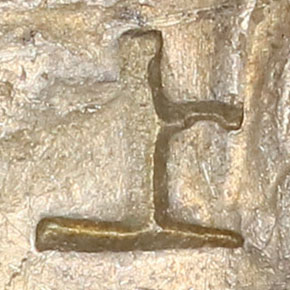 上 - shàng - above, up, top
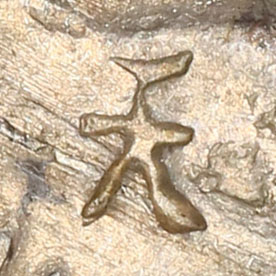 夭 - yāo - young, die young
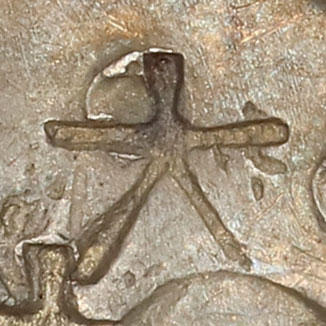 大 - dà - big, great, large
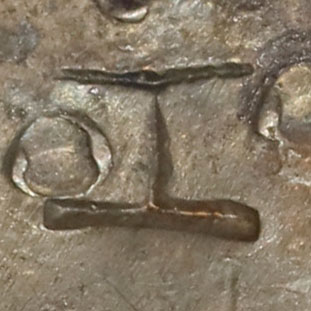 工 - gōng - work, labor, skill
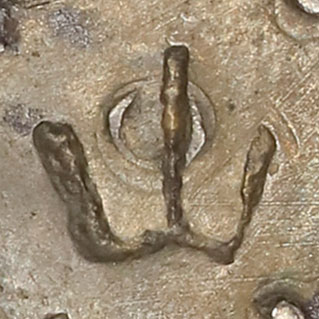
 - Liushutong script variant of 山 - shān - mountain, hill
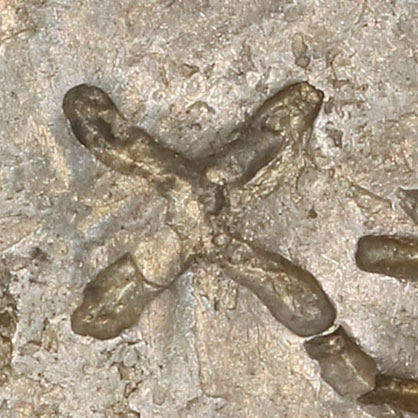 possibly 乂 - yì - govern, mow
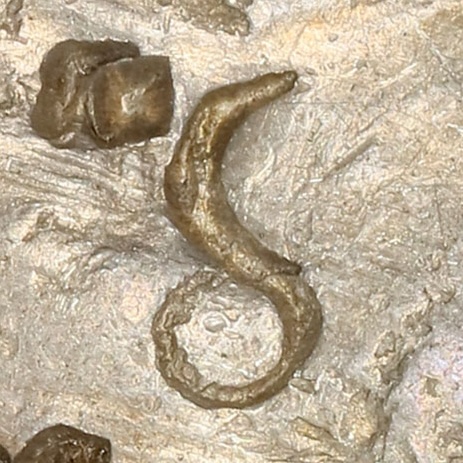
 - Seal script variant of 了 - le - to finish; particle of completed action
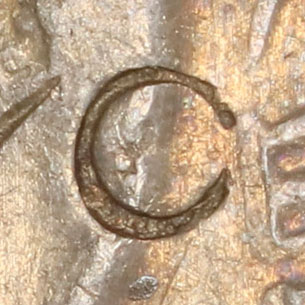 Unknown chopmark symbol
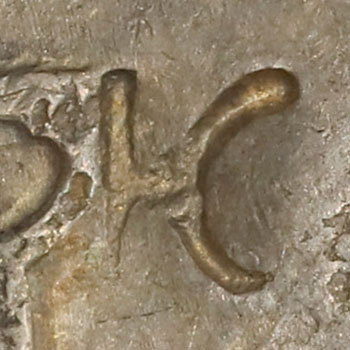 Unknown chopmark symbol
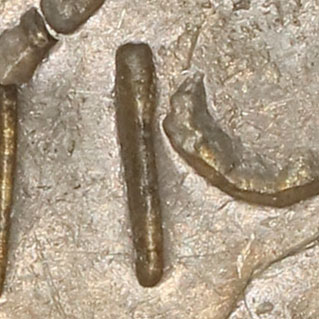
 - Liushutong script variant of 丨 - gǔn - (same as 〡 HANGZHOU NUMERAL ONE) number one; line
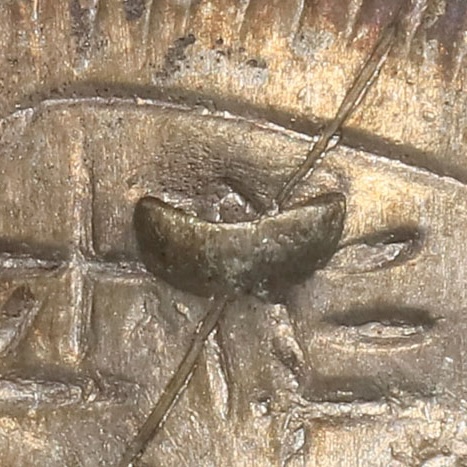
 - Liushutong script variant of 月 - yuè - moon, month
Provenance:
Ex-Axel Wahlstedt
The coin was acquired by John Pedersen as part of the Axel Wahlstedt collection, which he purchased in its entirety in 1942.
Consigned by Peter Österlund (who now runs J Pedersen Mynthandel, and is John Pedersen's grandson), in 2023 to Stephen Album Auctions
Purchased from the Stephen Album Sale 47 September 2023 Lot #738
Auction Description:
TAIWAN: Tao Kuang, 1820-1850, AR dollar, Jiayi Mint, ND (1838-50), Cr-25-3, L&M-319, K-1b
So-called "Old Man Dollar", God of Longevity with kùpíng qi èr (treasury standard 7 [mace] 2 [candareens]) below, dàoguang nián zhù (cast during reign of Daoguang) to left, zú wényín bing (pure [fine] silver coin)
to right // large tripod cauldron (ding) with a swastika on each side, Manchu legend tai wan above and below, kyagi ku on the sides, two rectangular official stamps of approval at reverse 7h, several merchant's chopmarks
on both sides, PCGS graded VF details (chopmark), ex SARC Auction 46, Lot 1179, we are re-listing because unfortunately the winning bidder did not pay for it. This type is said to have been issued in the 17th year of
Daoguang's reign by the local government in order to pay troops to suppress a rebellion led by Zhang Wen. Its high purity (ca. 98%) and greater silver content than contemporary Western crowns made it a popular currency,
as it is often found with numerous chopmarks. But this also led to many examples being melted down, which further contributes to its great scarcity today.
This coin was auctioned alongside the The Axel Wahlstedt Collection of Indian & East-Asian Coins. Unfortunately, SARC lost the paper flip that this coin was held in for many decades.
Axel Johan Gabriel Wahlstedt, was born January 11, 1867 in Kristianstad, Sweden and died December 15, 1943. He was a Swedish doctor and numismatist. Wahlstedt was chairman of the Swedish Numismatic Society from 1916-1934, and chairman of the Djurvännernas nya förening from 1918-1932. Coin dealer John Pedersen (1890 - 1960) owner of J. Pedersen Mynthandel (still in existence today), writes in his 1941 catalog part 1: "Honored collectors! This collection of rare coins, which is offered for sale in this catalog, has most likely not been offered before, in Scandinavia or maybe even in Europe in decades. The majority of these rarities of foreign coins, has been collected over a period of 50 years, by one of our most knowledgeable amateur numismatists, whose knowledge and library was envied by many in the numismatic world."
It's possible that the J. Pedersen Mynthandel catalogs of the early 1940's feature this coin, so I'm working to track them down to try and find out. Even if I can track down the catalogs, I fear it's unlikely this coin was pictured, since this coin was not popular, especially with chopmarks, back then.
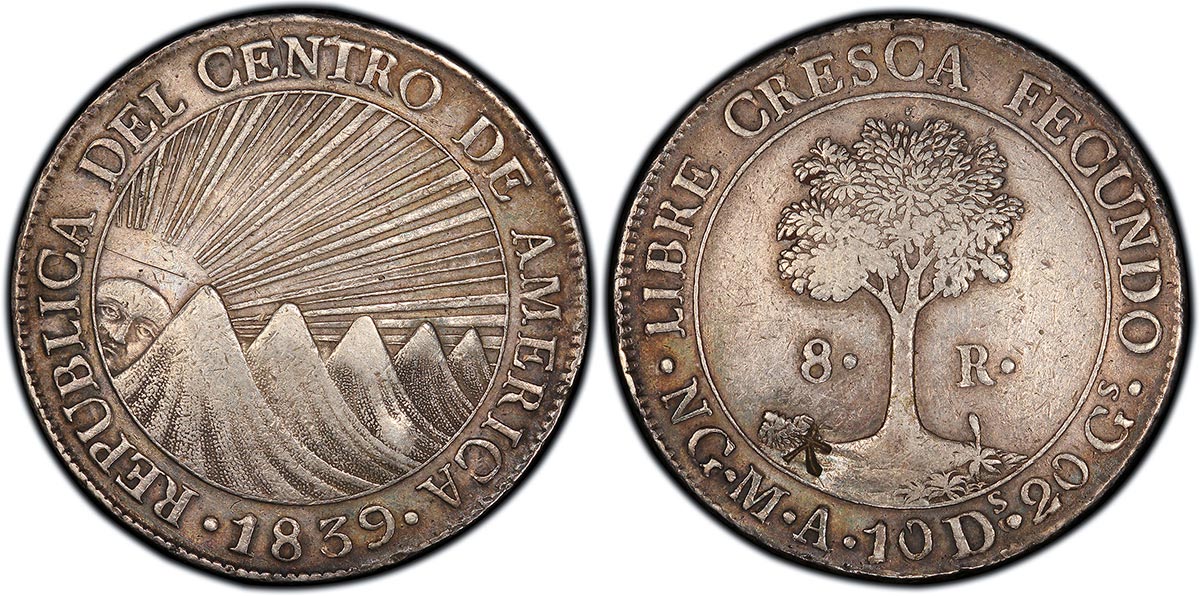
1839/7-NG MA/BA Central American Republic 8 Reales (9/7 overdate, MA/BA over-assayer) (Ex. Waddell)
Specifications:
27.07 g, .903 fine silver, .786 troy oz (actual silver weight)
Recorded mintage: unknown, but not a rare date
Catalog reference: KM 4
Details:
The 1839-NG MA (Manuel Muñoz) Central American Republic 8 Reales (KM-4) is a crown-sized silver piece struck at the Nueva Guatemala mint, part of the long-running 8-reales
series dated 1824–1847. It follows the familiar Spanish-dollar spec, with the fineness expressed in the old colonial style (10 Ds 20 Gs, i.e., 10 dineros 20 granos) and a
weight around 27.07 g, .880 fine. The design is distinctive: a radiant “sun-face” above a range of volcanoes on one side, and a ceiba tree with the denomination and date
on the other, surrounded by the motto LIBRE CRESCA FECUNDO (“Grow Free and Fertile”). The silver feeding the Guatemala mint in this period would have come from a mix of
regional bullion, with some mining activity in Honduras, and the practical recycling/remelting of older Spanish-American silver taken from local circulation.
The Central American Republic, more formally the United Provinces / Federal Republic of Central America, was a short-lived federation formed in 1823 after the former Captaincy General of Guatemala broke away from both Spain (1821) and the First Mexican Empire. It attempted to unite five member states, Guatemala, El Salvador, Honduras, Nicaragua, and Costa Rica, under a federal constitution adopted in 1824, with power divided between state governments and a weak central authority. From the outset the federation was strained by regional rivalries and recurrent conflict between liberal federalists and conservative centralists, culminating in civil wars and successive secessions; by 1838–1841 the member states had effectively withdrawn and the federation collapsed into the separate republics that followed.
Chopmarked examples are uncommon but documented. Gullberg noted: a Taiwan shroff handbook recorded the type with the nickname: “sun’s shadow 88 silver” - likely a reference to the .880 fineness, evidence that at least some pieces did, in fact, enter the China trade. When they did, the route was likely indirect: carried as recognizable crown-silver through Pacific and entrepôt channels rather than as a purpose-made China-trade coin, and then treated on its silver the same way as other “foreign money” once it crossed into those circuits.
Very rare with chopmarks, Gullberg estimates 6-10 known.
Notable chopmarks:
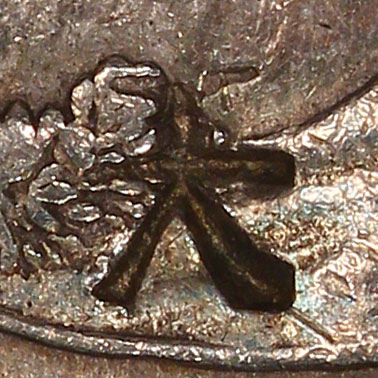 天 - tiān - heaven, sky, day
Provenance:
From the Ron Waddell Collection
Purchased from Ron via private sale in June 2016
Ex: Michigan State Numismatic Society's 46th Anniversary & Spring Convention Public & Mail Bid Sale, Craig A. Whitford Numismatic Auctions May 10-11, 2002 Lot #158
Auction Description:
Central American Republic, 8 Reales, 1839/7-MA/BA. KM-4. aEF,
Trace of adhesive residue, a single oriental chopmark rev, unusual and scarce. ($100-150)
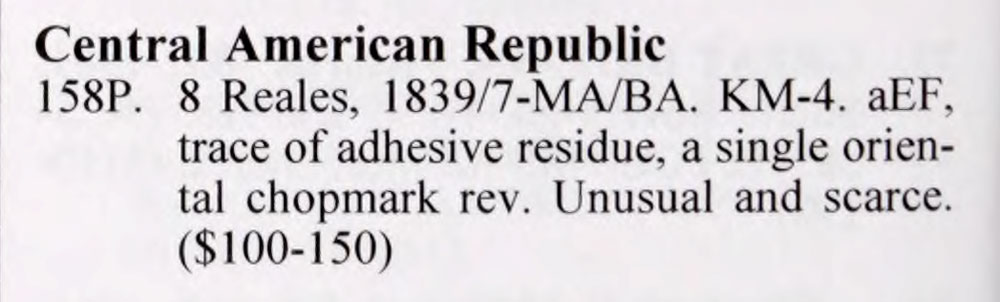
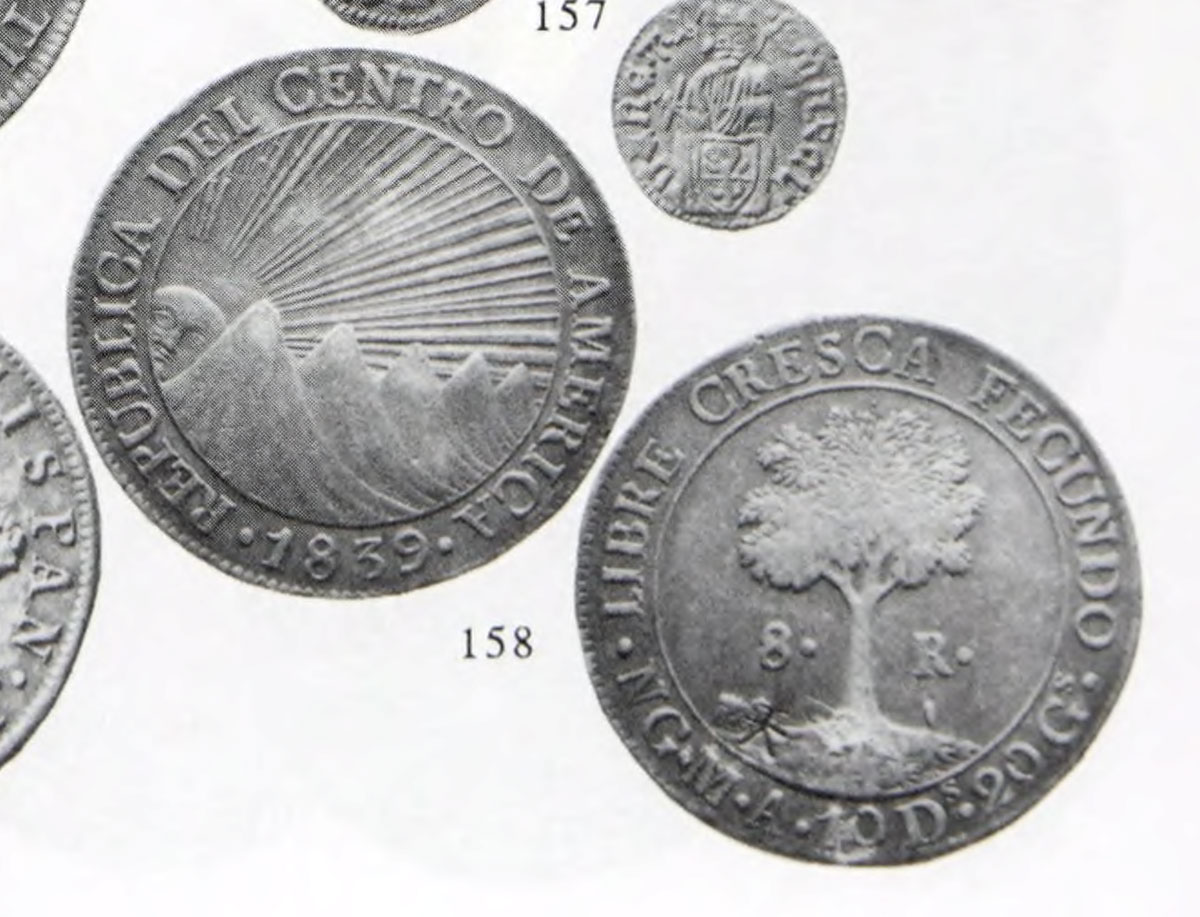
Featured as the plate coin in Gullberg's Chopmarked Coins - A History, p.49
1839-So IJ Chile 8 Reales
Specifications:
26.700 g, .902 fine silver, .7743 troy oz (actual silver weight)
Recorded mintage: 205,000
Catalog reference: KM 96.1
Details:
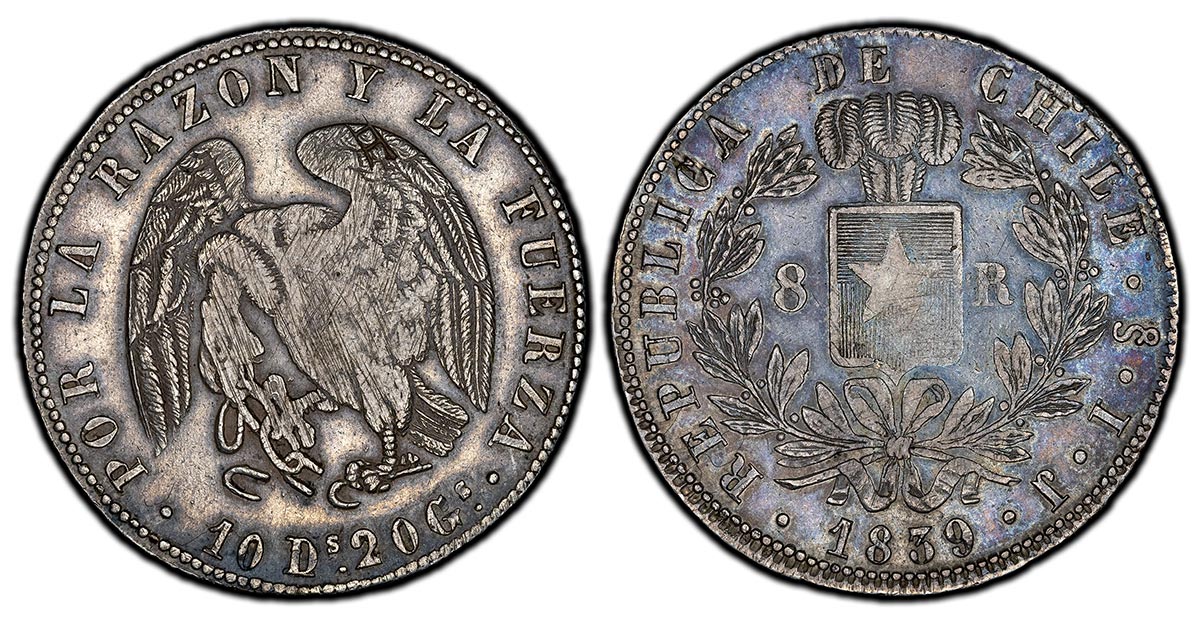
The 1839-So IJ (Ignacio Morán Fuenzalida / José Vicente Larraín) Chile 8 Reales (KM 96.1) is a full crown-sized silver issue of the early Republic, struck at Santiago to
.902 fine, 26.70 g, 39 mm, with a recorded mintage of 205,000 for the date. Its paired national motifs are the Chilean arms within a wreath and the condor breaking a chain
with the patriotic motto “POR LA RAZON Y LA FUERZA” (“By reason and by force”). In terms of metal supply, this is very much a “Norte Chico” era coin: Chile’s northern
mining districts were expanding fast in the 1830s, and the Chañarcillo discovery (1832) near Copiapó helped drive a major silver boom that could feed export and coinage
bullion alike. Striking took place at La Moneda, purpose-built as Santiago’s mint (opened 1805) and still functioning as the coinage works through the 19th century.
In context, this is a product of Chile’s early republican state, confident enough by the 1830s to replace inherited colonial types with an overtly national design program (the condor and arms were adopted for coinage in the mid-1830s, associated with the English artist/designer Charles Wood). The date is also contemporary with Chile’s decisive intervention against the Peru–Bolivian Confederation; the conflict ended in 1839 with the restorationist victory at Yungay, and the dissolution of the Confederation followed soon after, background that helps explain why Chilean coinage of this decade leans into sovereignty, legitimacy, and “strength” in its public messaging.
As to China-trade context, Chopmarks on this type are pretty rare, somewhat due to the short run and low mintage, in combination with Chile’s limited direct commercial dealings in China-facing trade. Chilean crown-sized silver did move through Pacific commercial channels, often indirectly via inter-American and British/American trading networks, yet it was never as routinely encountered in China as the ubiquitous Mexico and Lima issues. A chopmarked example therefore points to a plausible route through Pacific ports (Valparaíso and neighboring entrepôts) into broader “dollar” circulation, where private verification still operated and an unfamiliar-but-correct silver crown could be accepted and marked in the usual way.
Notable chopmarks:
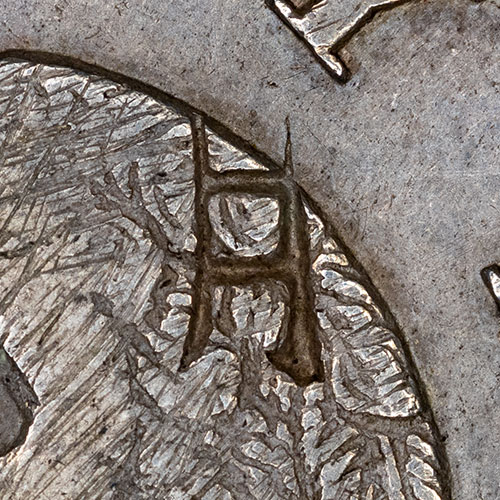 月 - yuè - moon, month
Provenance:
Purchased by private sale from Javier Campos Santander, a collector from Santiago, Chile who is heavily involved with ANUCH, la Asociación Numismática de Chile, in February 2024.
1840-A German States Prussia 2 Thaler, 3-1/2 Gulden
Specifications:
37.12 g, .900 fine silver, 1.074 troy oz (actual silver weight)
Recorded mintage: 789,245
Catalog reference: KM 425
Details:
The First Opium War (1839-42), also known as the Opium War and the Anglo-Chinese War, was fought between the United Kingdom and the Qing dynasty over their conflicting viewpoints
on diplomatic relations, trade, and the administration of justice for foreign nationals in China.
In the 17th and 18th centuries, the demand for Chinese goods (particularly silk, porcelain, and tea) in the European market created a trade imbalance because the market for Western goods in China was virtually non-existent; China was largely self-sufficient and Europeans were not allowed access to China's interior. European silver flowed into China when the Canton System, instituted in the mid-18th century, confined the sea trade to Canton and to the Chinese merchants of the Thirteen Factories. The British East India Company had a matching monopoly of British trade. The British East India Company began to auction opium grown on its plantations in India to independent foreign traders in exchange for silver. The opium was then transported to the Chinese coast and sold to local middlemen who retailed the drug inside China. This reverse flow of silver and the increasing numbers of opium addicts alarmed Chinese officials.
In 1839, the Daoguang Emperor, rejecting proposals to legalise and tax opium, appointed viceroy Lin Zexu to solve the problem by abolishing the trade. Lin confiscated around 20,000 chests of opium (approximately 1210 tons or 2.66 million pounds) without offering compensation, blockaded trade, and confined foreign merchants to their quarters. The British government, although not officially denying China's right to control imports of the drug, objected to this unexpected seizure and used its naval and gunnery power to inflict a quick and decisive defeat, a tactic later referred to as gunboat diplomacy.
In 1842, the Treaty of Nanking - the first of what the Chinese later called the unequal treaties - granted an indemnity and extraterritoriality to Britain, the opening of five treaty ports, and the cession of Hong Kong Island. The failure of the treaty to satisfy British goals of improved trade and diplomatic relations led to the Second Opium War (1856-60). In China, the war is considered the beginning of modern Chinese history.
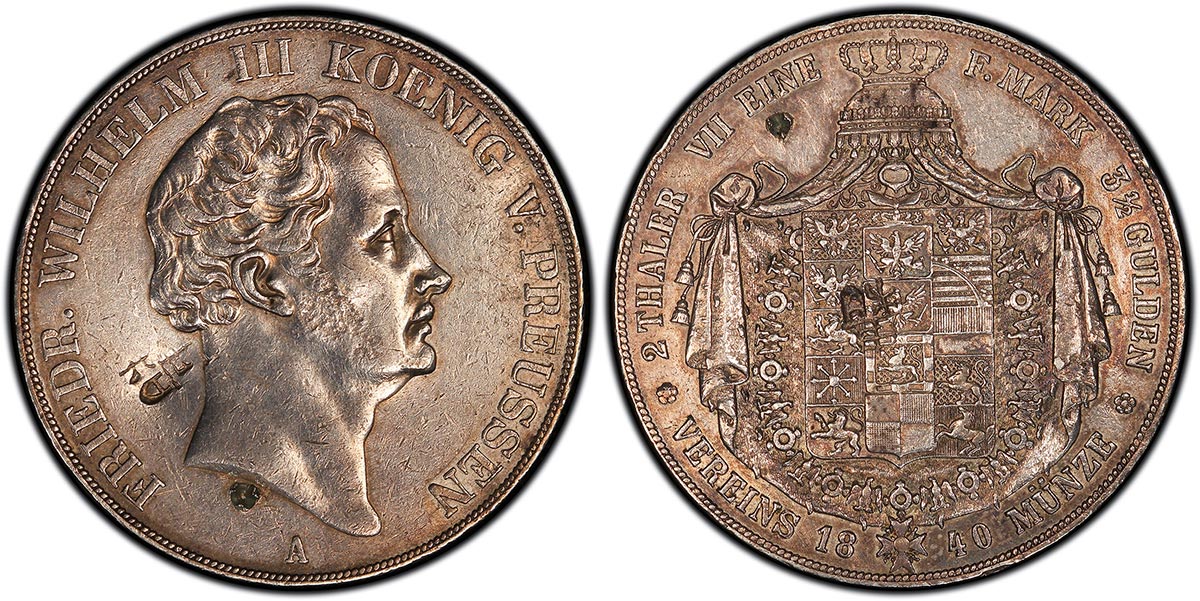
An exquisite coin with a couple chopmarks and drill marks. This coin is larger than the traditional crown size trade coin, with smooth non-reeded edges and fine edge lettering. I was thrilled to find this coin as I think it's exceedingly rare with chopmarks.
Notable chopmarks:
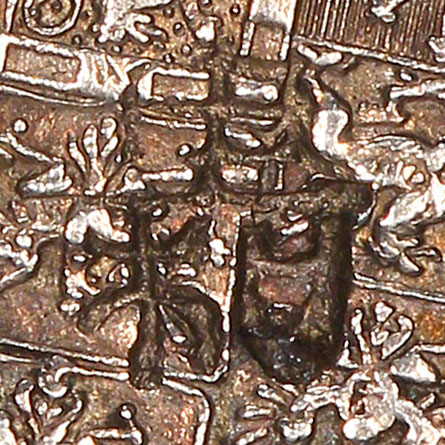 Unknown Chinese character chopmark
Provenance:
Purchased from the Frühwald Auction 119 sale (Germany) April 2016
Lot #51E
Auction Description:
Deutschland vor 1871 Brandenburg-Preussen
Friedrich Wilhelm III. 1840 - 61 Vereins-Doppeltaler 1840 A, Berlin, mit chin. Chopmarks, AKS 9, KM 425, win. Rf. ss/f.ss+
1840 British East India Company Rupee, Queen Victoria continuous legend (KM 457)
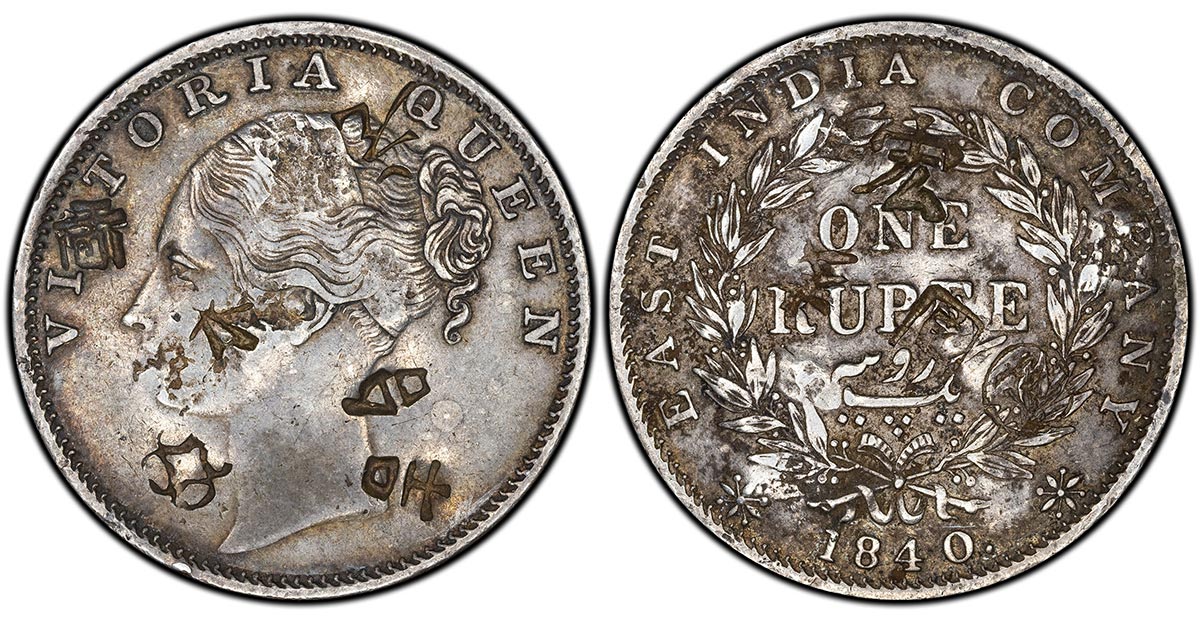
Specifications:
11.66 g, .9170 fine silver, .3438 troy oz (actual silver weight), edge reeded
Recorded mintage: 766,201,000 at Calcutta, Madras and Bombay
Catalog reference: KM 457.1
Details:
This type was struck at Madras, Bombay and Calcutta in numerous varieties for the East India Company with a frozen date until the introduction of the "Victoria Queen" rupee (KM 473)
in 1862. Two major types exist; the first, with "VICTORIA QUEEN" in a continuous legend (KM 457, shown here), and the second, with the legend interrupted by the queen's bust (KM 458).
Many varieties exist from which the specialist can identify the mint of origin.
The East India Company traded mainly in cotton, silk, indigo dye, salt, tea and opium. The company also came to run large parts of India, exercising military power and assuming administrative functions. Company rule in India, which effectively began in 1757, lasted until 1858, when the British Crown assumed direct administration of India in the new British Raj. The company remained a powerful force in India for over 200 years, and was finally dissolved on January 1, 1874.
These coins are scarce with chopmarks, possibly because they mainly circulated in India and not China?
Notable chopmarks:
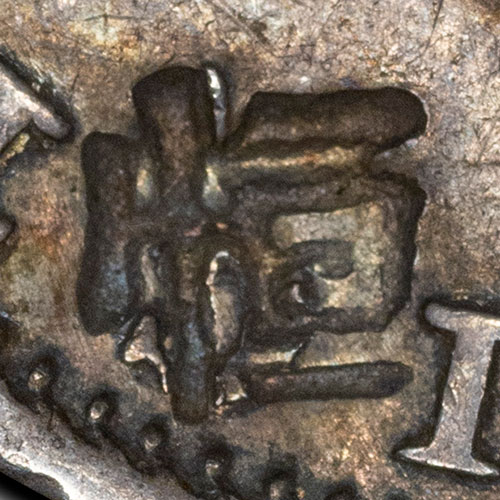 恒 - héng - constant, persistent
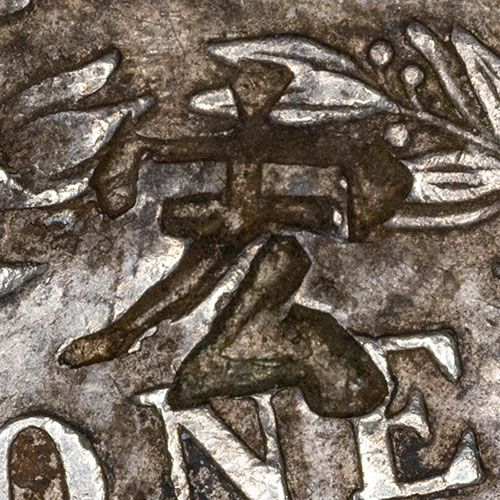 宏 - hóng - vast, great
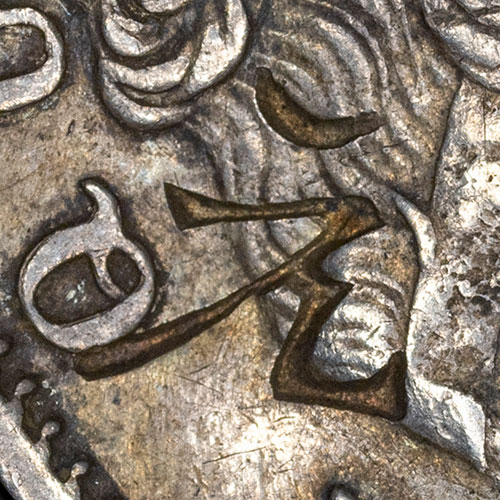
 - Cursive (Caoshu) script variant of 元 - yuán - dollar, unit of currency, basic, primary
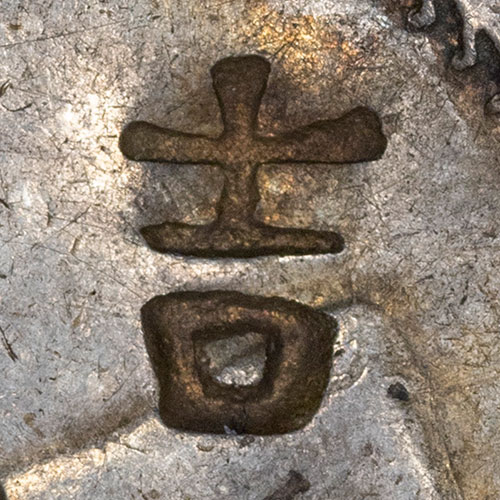 吉 - jí - auspicious, lucky
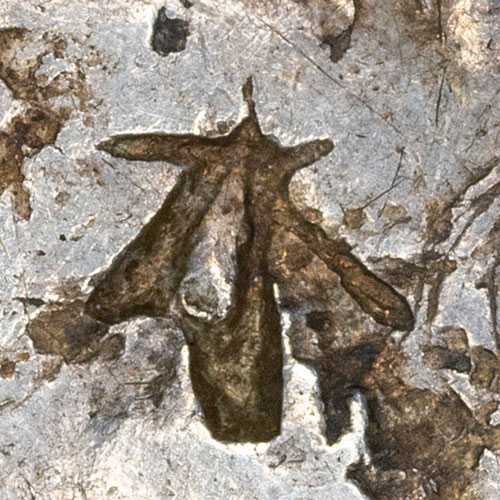 木 - mù - tree, wood, Japanese Kanji radical 75
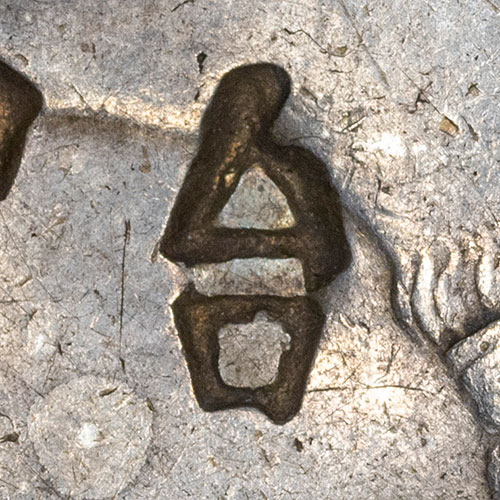 台 - tái - platform, tower, Taiwan
Provenance:
From Ben Dalgleish, a collector who finds chopmarked coins in the coin markets of Hong Kong, January 2023
1840 British East India Company Rupee, Queen Victoria legend apart (KM 458) (Ex. Murphy)
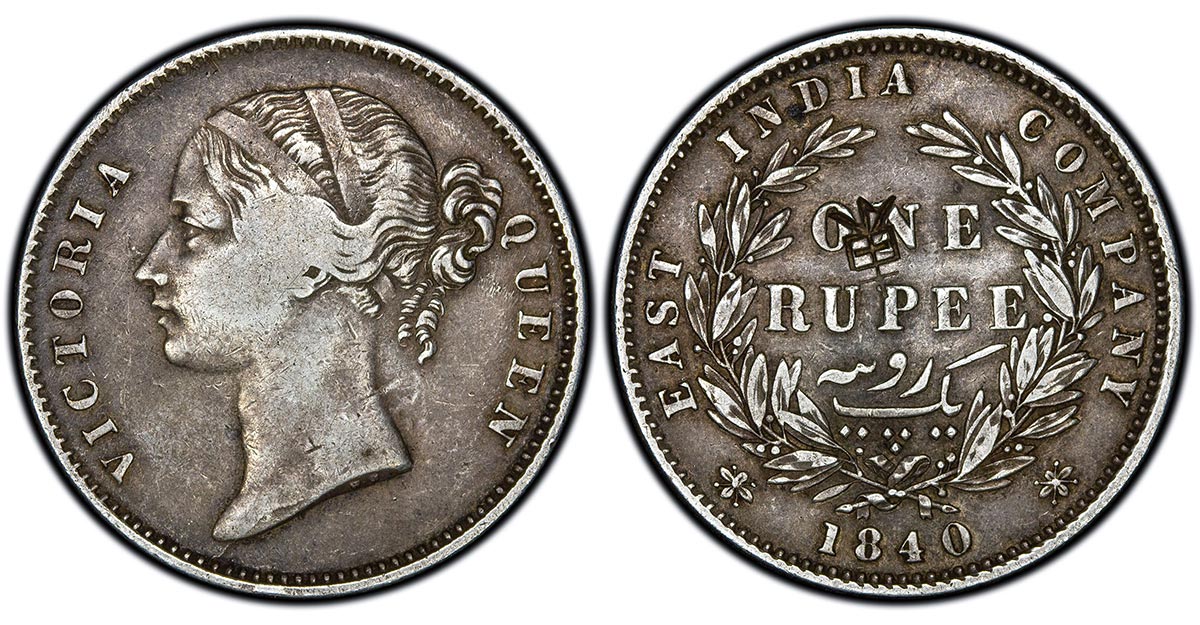
Specifications:
11.66 g, .9170 fine silver, .3438 troy oz (actual silver weight), edge reeded
Recorded mintage: 766,201,000 at Calcutta, Madras and Bombay
Catalog reference: KM 458.1
Details:
This type was struck at Madras, Bombay and Calcutta in numerous varieties for the East India Company with a frozen date until the introduction of the "Victoria Queen" rupee
(KM 473) in 1862. Two major types exist; the first, with "VICTORIA QUEEN" in a continuous legend (KM 457), and the second, with the legend interrupted by the queen's bust
(KM 458, shown here). Many varieties exist from which the specialist can identify the mint of origin. This example was made at the Calcutta mint, identifiable by the raised
"W.W." on the obverse and 28 berries on the reverse.
The East India Company traded mainly in cotton, silk, indigo dye, salt, tea and opium. The company also came to run large parts of India, exercising military power and assuming administrative functions. Company rule in India, which effectively began in 1757, lasted until 1858, when the British Crown assumed direct administration of India in the new British Raj. The company remained a powerful force in India for over 200 years, and was finally dissolved on January 1, 1874.
These coins are scarce with chopmarks, possibly because they mainly circulated in India and not China?
Notable chopmarks:
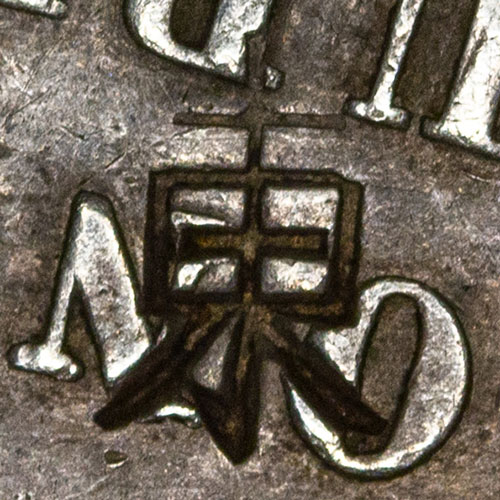 東 - (traditional form of 东) dōng - east
Provenance:
From fellow collector Ed Murphy, who compiled one of the broadest and most complete chopmark collections of all time, March 2020.
(1841) Guatemala Type IV countermark on 1828-LM JM Peru 8 Reales (Ex. Bowman / Murphy)
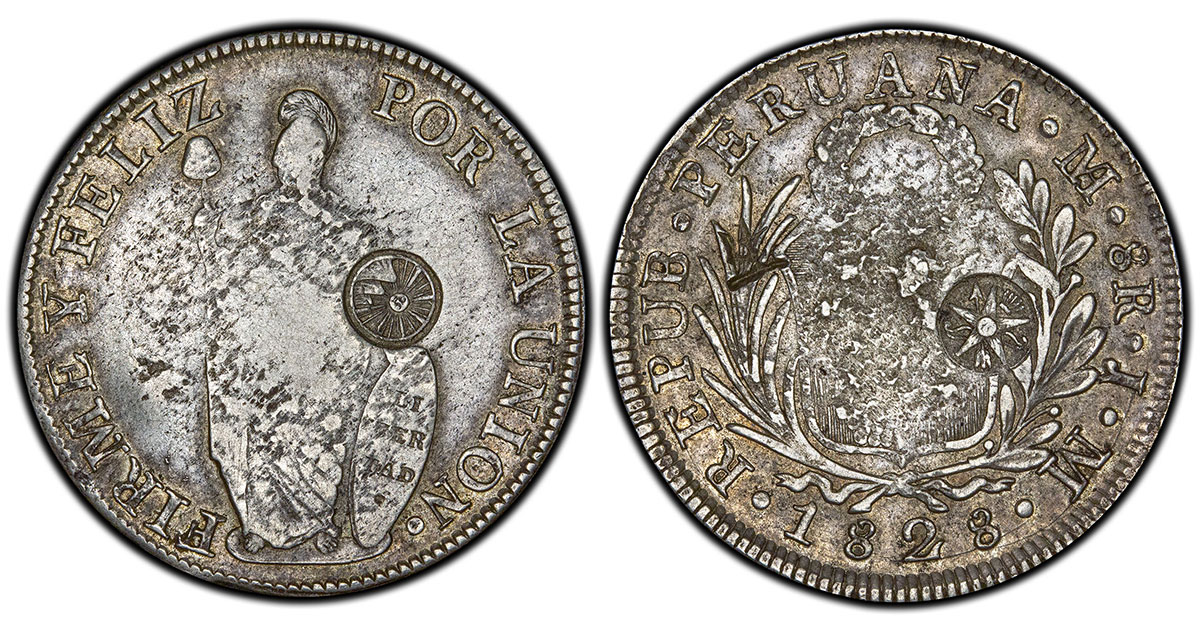
Specifications:
27.07 g, .903 fine silver, .786 troy oz (actual silver weight)
Recorded mintage: unknown
Catalog reference: KM 118.1
Details:
The Federal Republic of Central America, formed in 1823 from the five former Spanish colonial provinces of Guatemala, El Salvador, Honduras, Nicaragua, and Costa
Rica, had effectively dissolved by 1838 under chronic internal conflict. Guatemala declared full independence in 1841. The market in the years surrounding that break
was flooded with silver from mints across Latin America, in varying states of wear and of uncertain fineness, with no reliable mechanism to standardize it.
A decree of October 31, 1840 authorized the countermarking of foreign crown-sized silver circulating in Guatemala, issued by the Guatemalan state government then operating under the strong influence of Rafael Carrera, the conservative military caudillo who had taken Guatemala City in 1838 and effectively controlled the government through a series of nominal civilian leaders. The countermarking itself was carried out at the Nueva Guatemala mint by the mint's assayers, with the program running from December 1840 into early 1841. The host coin here, an 1828 Lima 8 reales, is a Peruvian republican issue that had traveled north, likely through Pacific trade routes before taking on this new role.
The Type IV is the most technically refined of the Guatemalan countermark types, applied with hinged dies that struck both faces of the coin simultaneously, avoiding the flattening on the opposite side that earlier types produced. The obverse mark shows a radiant sun rising above three volcanoes, drawn directly from the Central American Republic's own coinage, while the reverse carries a sun atop a five-pointed star above a bow, quiver, and arrows within a circular incuse. The program operated for only a matter of weeks before Guatemala's full independence brought the federation's shared monetary framework to a close, which accounts for the relative scarcity of Type IV pieces compared to the earlier types in the sequence.
The chopmark on this piece makes it a genuinely rare survivor, likely a unique specimin. Guatemala had little direct trade with China, but the coin could plausibly have moved through any number of intermediary hands, south through Pacific ports to Valparaiso or Callao, where it might have joined the broader flow of Latin American silver making its way westward into Chinese commerce.
Notable chopmarks:
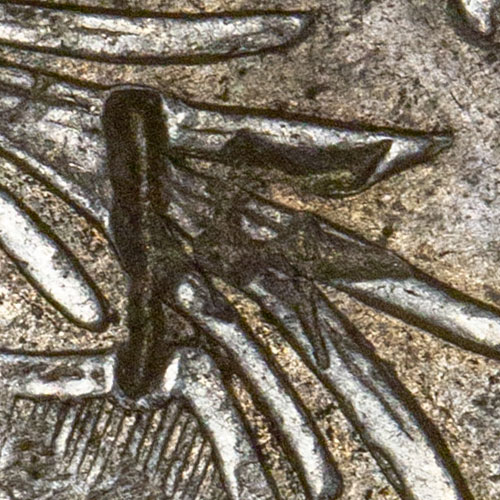 Incomplete chopmark
Provenance:
Purchased from the Stack's Bowers April 2026 Hong Kong Showcase Auction
Lot #49666
Auction Description:
GUATEMALA. Guatemala - Peru. 8 Reales, ND (1841). PCGS Genuine--Damage, VF Details.
KM-118.1; Jovel-VII countermark; Murphy-Fig. 210 (Plate coin); Leverage-Fig. 99 (Plate coin). Issued by decree of 31 October, instituted December to Early 1841. Countermark: Type IV (Hinged Dies). Obverse: Sun over mountains; Reverse: Five-pointed star superimposed on bow, arrow and quiver on reverse. A single medium size incuse Chinese chop on the reverse that is unfortunately unevenly applied and obscured by the host designs. This highly interesting and well-traveled issue displays light attractive mottled gray patina with richer coloration in the protected areas. The initial countermark is deeply impressed as usual on a decently preserved host with a weak central strike. A highly unusual and extremely interesting piece of the highest caliber rarity and as such is probably UNIQUE. A real treat for the sophisticated world countermark specialist seeking exotic well-traveled numismatic treasures.
Provenance: From the Edgar Murphy Collection.
Ex: J.D. Bowman Collection.
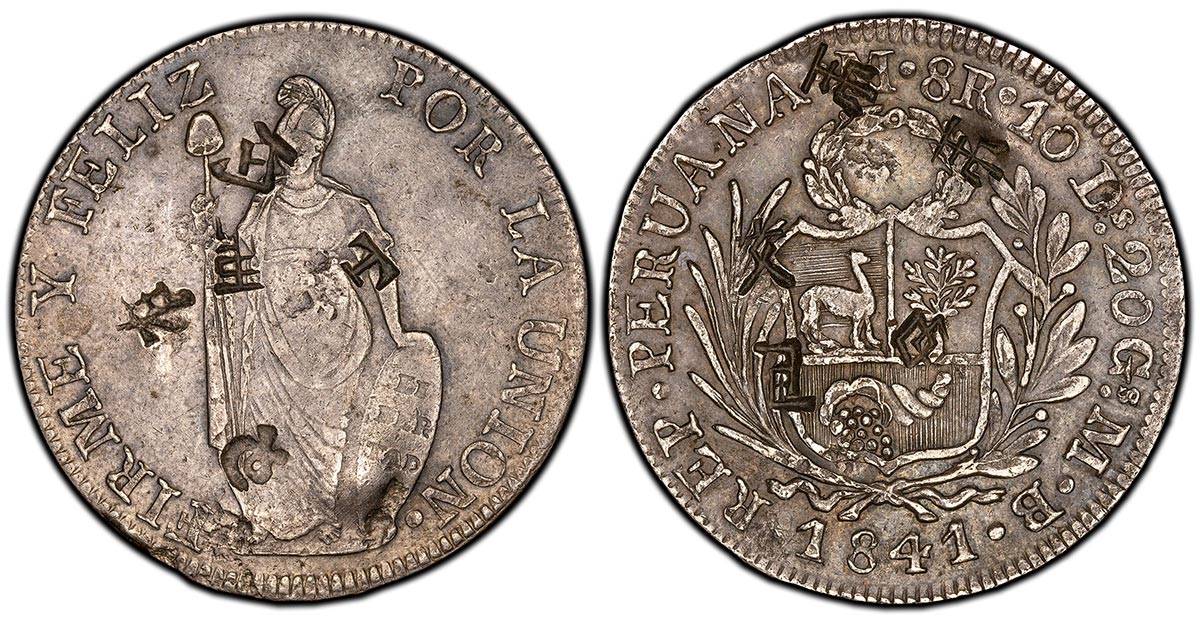
1841-L MB Peru 8 Reales - Rep. Peruana type
Specifications:
27.07 g, .903 fine silver, .7859 troy oz (actual silver weight)
Recorded mintage: unknown
Catalog reference: KM 142.8
Details:
1841-L MB (Manuel Carassa y Jaramillo / Bernardo Aguilar), Peru 8 Reales (KM-142.8), is a crown-size milled silver coin struck at Lima on the standard .903 fine / 27.07 g
weight. The obverse carries the Peruvian arms within sprigs, with a wreath above and the date below; the Lima mintmark is incorporated in a monogram (often read in the LIMAE
style on this series). The reverse shows the familiar Standing Liberty motif with the national motto FIRME Y FELIZ. By this point Peru’s branch-mint crown coinage was
tapering off: Cuzco’s last 8 reales is generally cited as 1840, and Arequipa’s last 8 reales as 1841, the latter regarded as an extreme rarity, leaving Lima as the practical
center for silver coinage production.
This issue sits in Peru’s early-republican decade after the defeat of the Peru-Bolivian Confederation (1839) and amid renewed regional conflict: in 1841 President Agustín Gamarra led a Peruvian invasion of Bolivia that culminated in the Battle of Ingavi (18 Nov 1841), where he was killed, an event that fed the political instability that followed. In the same period, bullion feeding Lima’s coinage largely came from the major Andean mining districts; Cerro de Pasco in particular dominated output in the first decades after independence, making it a plausible primary source stream for silver arriving at the capital mint.
Peruvian (and Bolivian) crowns are encountered with chopmarks far less often than Mexican issues. However, Chinese shroff handbooks treated Peruvian Standing Liberty 8 reales as a recognizable category, reinforcing that the type was known in the testing culture of the southern-China trade.
Notable chopmarks:
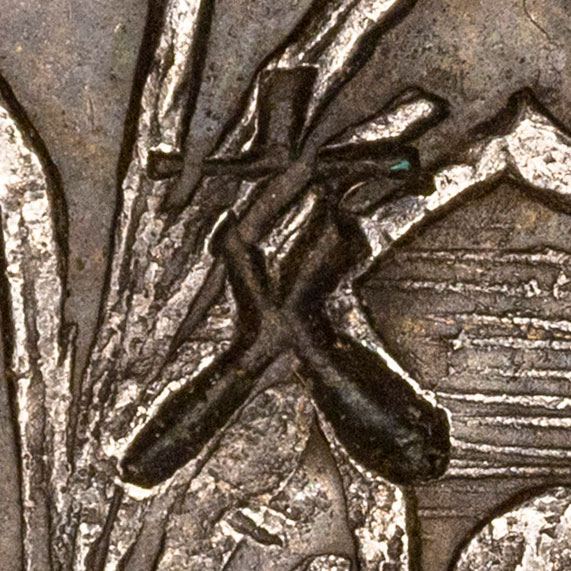 女 - nǚ - woman, female, daughter
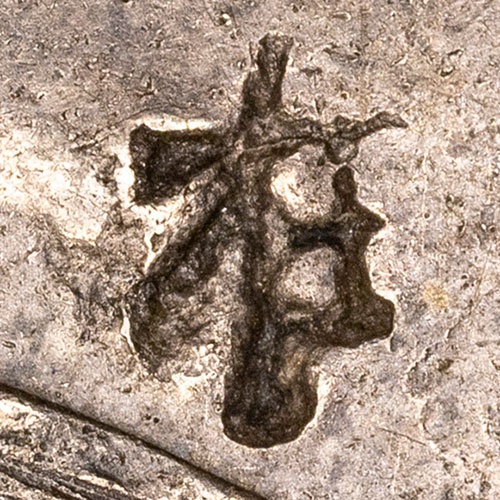 杜 - dù - block, prevent
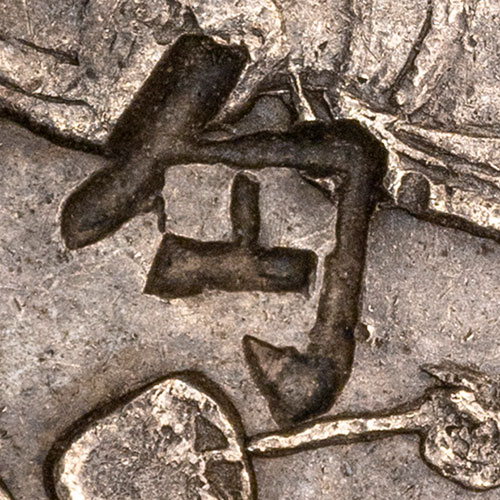 Probably 勽 - bào - wrap
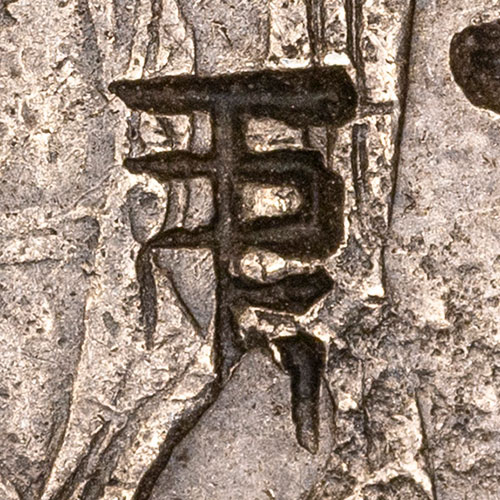
 Stylized 禾 - hé - grain, cereal
 Unknown chopmark
 Unknown chopmark
 Unknown chopmark
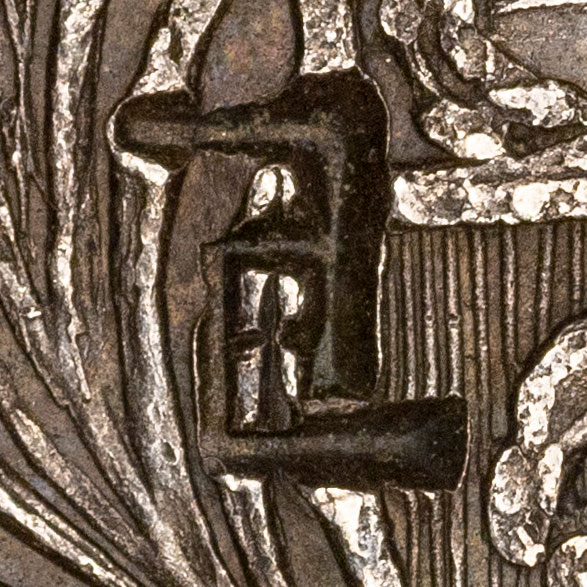 已 - yǐ - already; finished; stop
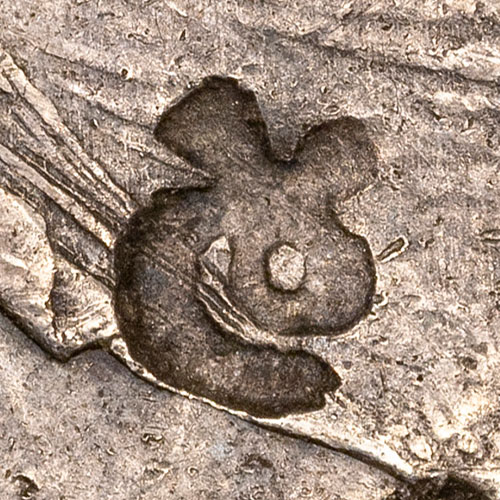
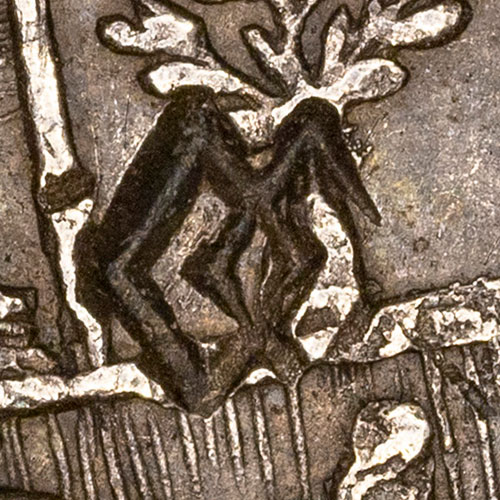 Double lozengeCommonly seen chopmarked on trade coins; significance not firmly identified.
Provenance:
Purchased from IG dealer Joe Walker (panda_numismatics) in July 2023. Joe works with dealers directly in China to save chopmarked coins from the melting pot.
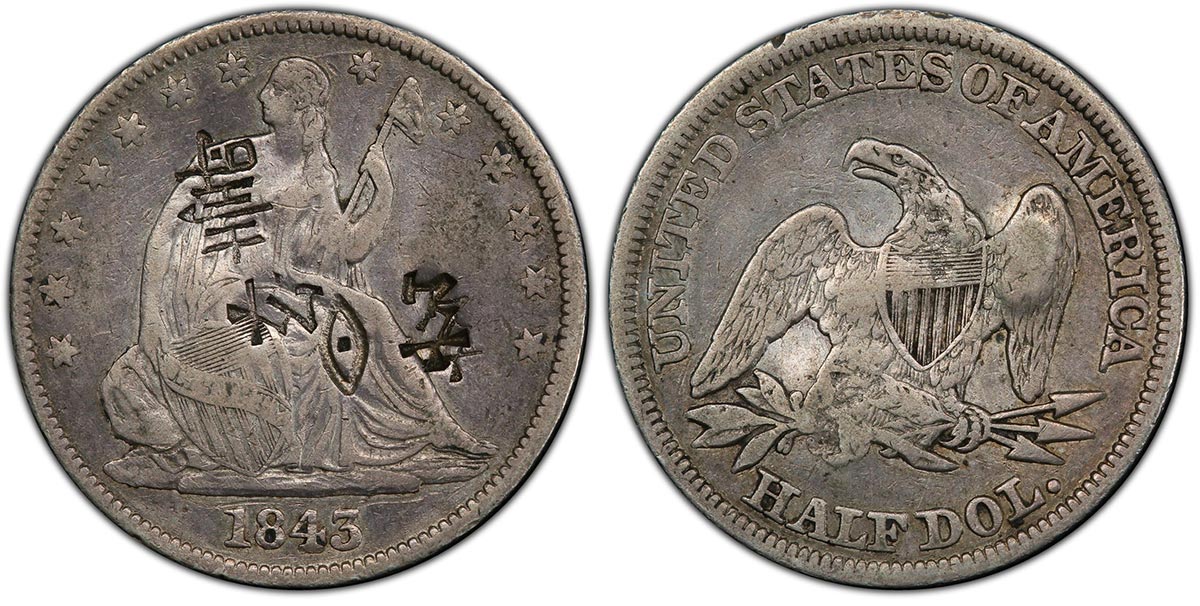
1843 United States Seated No Motto Half-Dollar from the main, Eastern mint in Philadelphia (Ex. Leverage)
Specifications:
13.36 g, .900 fine silver, .3866 troy oz (actual silver weight), edge reeded
Recorded mintage: 3,844,000
Catalog reference: PCGS 6243
Details:
The 1843 Philadelphia Seated Liberty half dollar (No Motto) is an early, bread-and-butter issue of the long Seated half series (1839–1891), struck before the “IN GOD WE
TRUST” motto was added to the reverse in 1866. In this early phase the type is defined by the classic Seated Liberty obverse paired with the simple eagle reverse, and
Philadelphia, by far the principal producer, supplied the bulk of circulating halves used in daily commerce. The date sits in the pre–mid-century design landscape that would
soon see major weight and design adjustments (notably the 1853 arrows and rays change), making 1843 a nice representative example of the original No-Motto format before
the series’ later technical and political-era modifications.
United States half dollar from the main, Eastern mint in Philadelphia. This coin began life on the Atlantic side, so its China path didn't take the most common San Francisco route. Options noted by Kann include: (1) export from New York directly to Hong Kong/Shanghai, (2) export via London, or (3) export via northern Pacific ports (Vancouver/Victoria/Seattle) for speed—routes, and he also notes that routing New York → (down to) San Francisco → Far East is generally uneconomic except in special contract situations. That doesn’t mean a Philadelphia coin couldn’t reach China via San Francisco (coins and bullion did move internally to the Pacific) but the default commercial geography made San Francisco-origin pieces far more likely to reach the China trade, while Philadelphia pieces more commonly required an Atlantic export chain first.
As can be expected based on the geographical difficulties, chopmarked silver from the Philadelphia mint is far more scarce than coins from the western U.S. mints.
Pictured on page 47 in the May 2023 issue of The Numismatist, in an article by Eric Brothers titled "Blood Money, America's Role in the Opium Trade". The article discusses how U.S. silver exports fueled parts of the opium trade between Great Britain, India and China.
Notable chopmarks:
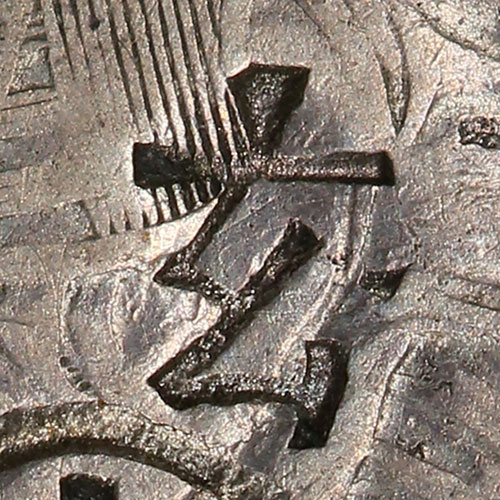 厷 - gōng - arm
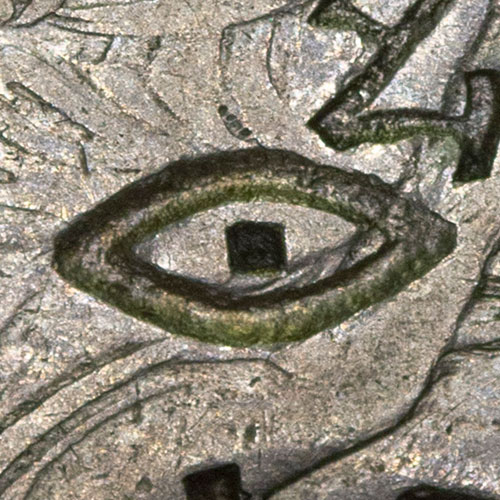 Unknown symbol
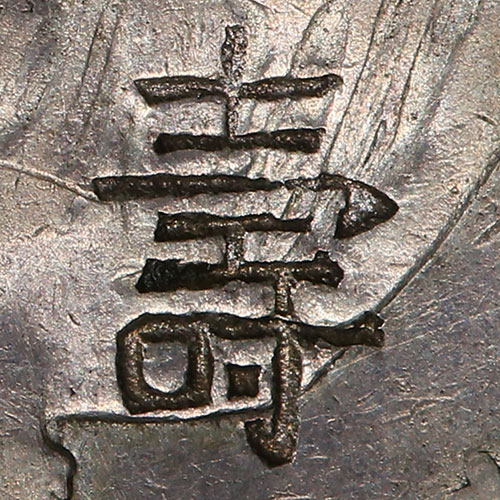 壽 - (old variant of 寿)shòu - longevity, life
Provenance:
From fellow chopmark collector and author Taylor Leverage, April 2019. Possibly from the Superior Auctions Irving Goodman Sale May 27-28 1996, Lot #1000, where it stated that Irving
purchased a group of chopmarked seated halves in Hong Kong. It's possible the 1843 mentioned in that lot is a different coin, but odds are they are one and the same.
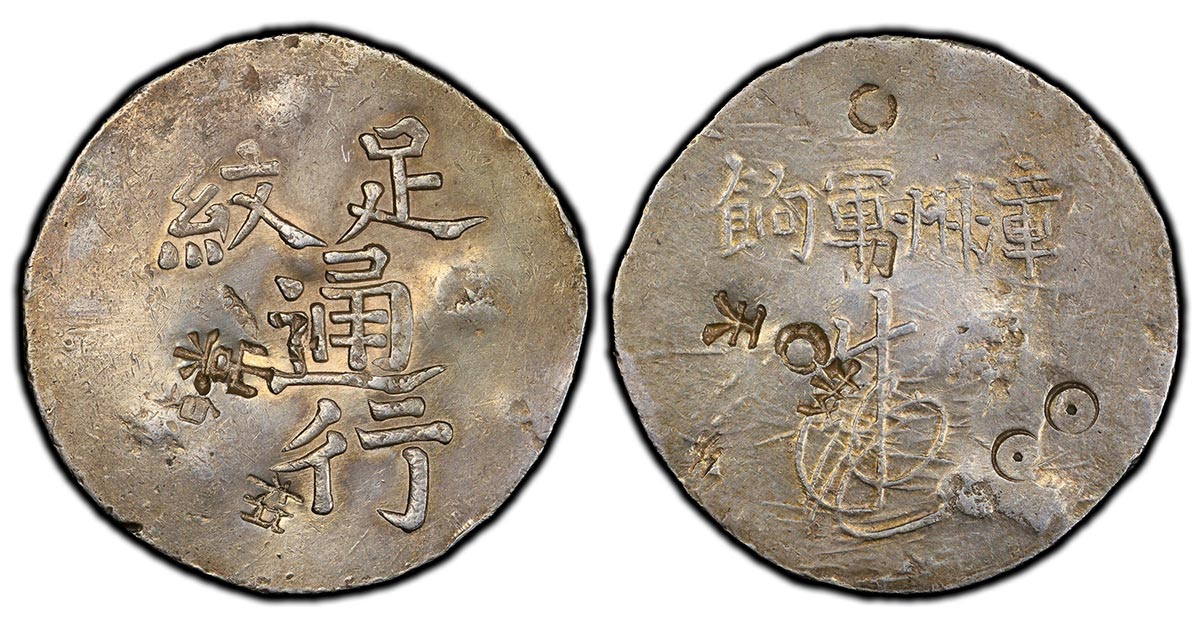
1844 China Changchow Military Dollar, Fukien Province (Ex. Kann)
Specifications:
27.2 g, .900 fine silver, .3866 troy oz (actual silver weight), edge reeded
Recorded mintage: unknown
Catalog reference: L&M-291, K-6, WS-1029, Wenchao-200
Details:
From Fukien province, under emperor Daoguang (道光帝) (1820-1850)
Obverse:
Four Chinese ideograms above a monogram-like signature (of Zhu Chenggong).
Lettering: 餉軍州漳
Translation: "Zhangzhou military pay"
Reverse:
Two Chinese ideograms side-by-side with two more below.
Lettering:
纹足
通
行
Translation: "Full standard, for general circulation"
Milled edge of circles and squares in "european style", as one might see on a Spanish colonial portrait 8 Reales.
The Changchow (Zhangzhou), Fukien “Military Ration” dollar of the Daoguang era is one of the least comprehensively understood of the early Chinese silver types. On the obverse, there are four characters translating to "Changchow Commissiariat", under which is a signature in handwriting style. On the reverse are four additional characters translating to "pure pattern, generally current." The history of the coin is not well documented but according to some important catalogs (Kann, H. Chang, Dr. Tseng, Chang Foundation), it may have been issued in 1836 or 1866, but a date of 1844 is commonly applied. Despite the lack of available information, the type is still considered a very important historical coin of China in that it represents one of the earliest attempts at a dollar denomination which was the value of the majority of foreign coins circulating in China at that time."
Some believe these Military Ration Dollars were issued during one of the frequent rebellions seeking to sever the Qing dynasty control of Taiwan. This particular rebellion was quelled in 1840 at a very high cost.
Notable chopmarks:
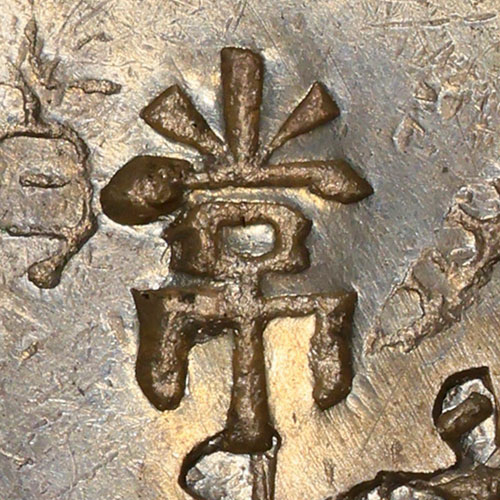 常 - cháng - common, often, constant
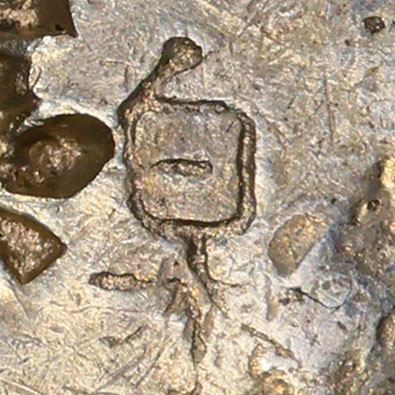 泉 - quán - spring, fountain
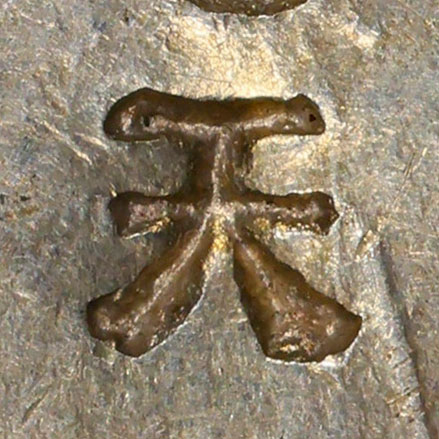 天 - tiān - heaven, sky, day
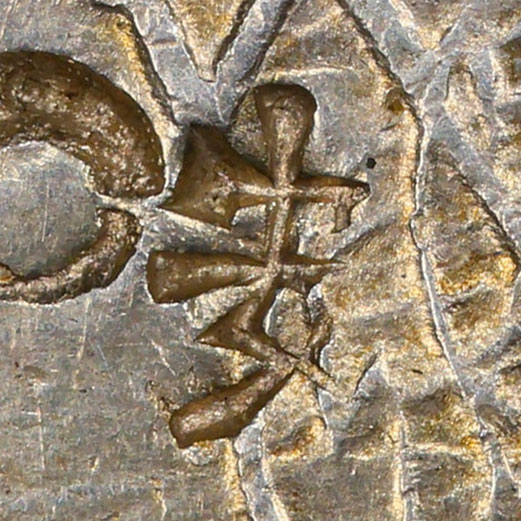 安 - ān - peace, safe, calm
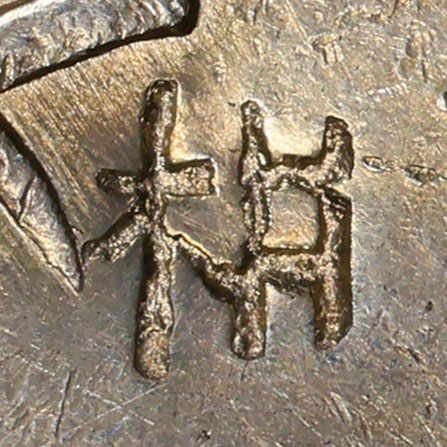 枂 - yuè - tree knot
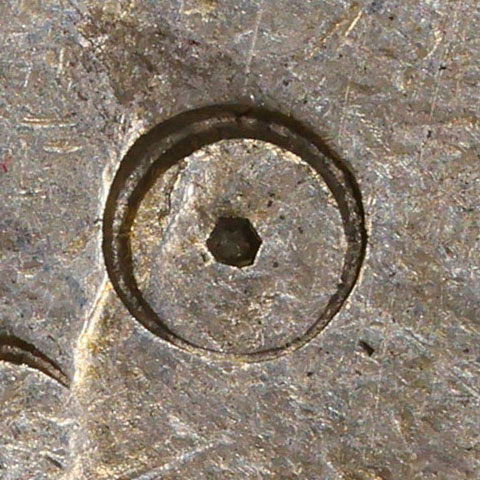
 - Liushutong script variant of 日 - rì - sun, day
Provenance:
From the Stack's Bowers April 2024 Hong Kong (SAR) Auction - Session 1 - Rarities Night at The Mira Hong Kong Hotel
Lot #40026
Auction Description:
Very Rare Changchow Military Dollar -- Ex Kann Collection
CHINA. Fukien. Dollar, ND (1844). Tao-kuang (Daoguang). PCGS Genuine--Chopmark, AU Details.
Changchow Military Ration issue. A type that is fairly RARE, as indicated by the fact that this is the first such example that we have offered since 2016. Adding even more intrigue is the overall condition of the present example. Though some contemporary chopmarks are noted upon each side, these aspects are wholly consistent with the issue, and are rather easily discounted. The level of circulation is very minimal, with a good deal of lustrous brilliance remaining in the fields. Following up its impressive status is the fact that it emanates from one of the most renowned collections known to the vintage Chinese series--that of Eduard Kann.
Estimate: $10,000 - $20,000.
Previously from the Nine Dragons Collection
Previously acquired from Steve Eyer on 11/11/1975
Previously a part of the Eduard Kann Collection
I have found evidence that suggests this coin was acquired in the early 1950's by Kann from dealer Hans M.F. Schulman, as part of the A. M. Tracey Woodward collection. The April 2024 issues of JEAN, the Journal of East Asian Numismatics reprints correspondence between Howard F. Bowker and Eduard Kann, in the form of handwritten letters. Kann wrote to Bowkers that "I believe you know that I handled a large portion (except gold coins) of the ex-Woodward collection, sent to me by Schulman". Later Kann catalogs the coins he had recently acquired, including 7(!) examples of the Changchow dollar, Kann-6 variety. It seems highly likely that the coin featured above was part of this acquisition. The timing also lines up with the fact that this example was not plated in Kann's "Illustrated Catalog of Chinese Coins". Kann wrote in separate correspondence that he had the photographs already prepared for the books by 1949, prior to the acquisition of the Woodward collection coins.
If this is indeed a coin from the A. M. Tracey Woodward collection, it means we can trace the history of this coin all the way back to the early 1900's when Woodward assembled his coin collection. Woodward spent much of his life living in Shanghai, wrote numerous articles about the coins of China, a reference book focused on the stamps of Japan, and he eventually died in 1938 on board a ship on his way home from Shanghai to Great Britain.
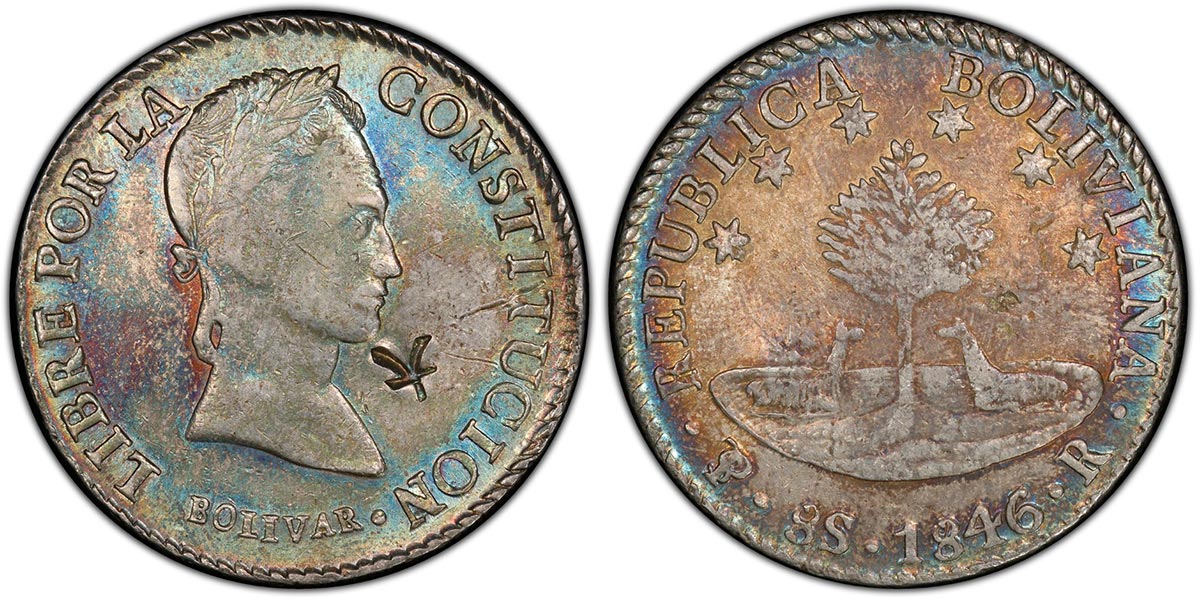
1846/5-PTS R Bolivia 8 Soles
Specifications:
27 g, .903 fine silver, .7838 troy oz (actual silver weight), edge reeded
Recorded mintage: unknown, but common
Catalog reference: KM 103
Details:
The 1846/5-PTS R 8 soles of Bolivia was struck at the Potosí mint and represents a republican continuation of the traditional Spanish-American crown-size silver coinage.
Despite the change in denomination from reales to soles, the issue was struck to a full crown spec at 27.0 grams / .903 fine. The date side shows a tree between two llamas
with stars above and the legend “REPUBLICA BOLIVIANA”, while the opposite side bears a right-facing laureate portrait of “BOLIVAR” with “LIBRE POR LA CONSTITUCION” (Free
by the Constitution). Silver for these issues came from the historic Cerro Rico of Potosí, whose output had supplied international silver markets since the 16th century.
By the mid-1840s, Bolivia, like other post-independence Andean states, remained politically unstable and continued to rely heavily on silver exports as a cornerstone of its economy. Unlike some neighboring republics that adopted significantly debased standards for domestic convenience, Bolivia largely preserved the intrinsic quality of its principal silver denomination in order to maintain access to international trade networks. The Potosí mint, despite periodic technical and administrative challenges, retained global recognition because of the long association between Potosí silver and reliable bullion content. These factors allowed Bolivian crown-standard coinage to circulate beyond regional markets and enter broader transoceanic trade flows.
Bolivian 8 soles were semi-regular participants in the China trade, although I wouldn't call them common. Their weight and fineness closely matched the silver dollars already familiar in southern China, allowing them to be accepted as bullion once assayed alongside Mexican and earlier Spanish issues. Entry into China would have occurred indirectly, primarily through European and global commercial networks rather than direct Bolivian-Asian trade, but once present these coins met the technical requirements for circulation within China’s weight-based silver economy. Chopmarks on examples of this type are therefore consistent with routine merchant or money-changer verification rather than exceptional handling. While Bolivian issues are less common with chops than Mexican dollars, their appearance in China is structurally credible and reflects bullion equivalence rather than nominal denomination. As Gullberg discusses in his book "The Taiwanese called this coin "tree money" because of the tree on the reverse below six stars."
Notable chopmarks:
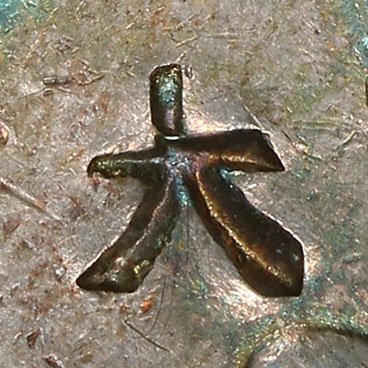 大 - dà - big, great, large
Provenance:
Purchased from the Stephen Album Sale 27 January 2017 Lot #1640
Auction Description:
BOLIVIA: Republic, AR 8 soles, 1846/5-PTS. KM-103. A couple scratches in reverse field, with prominent chopmark on reverse, beautiful rainbow tone, EF.
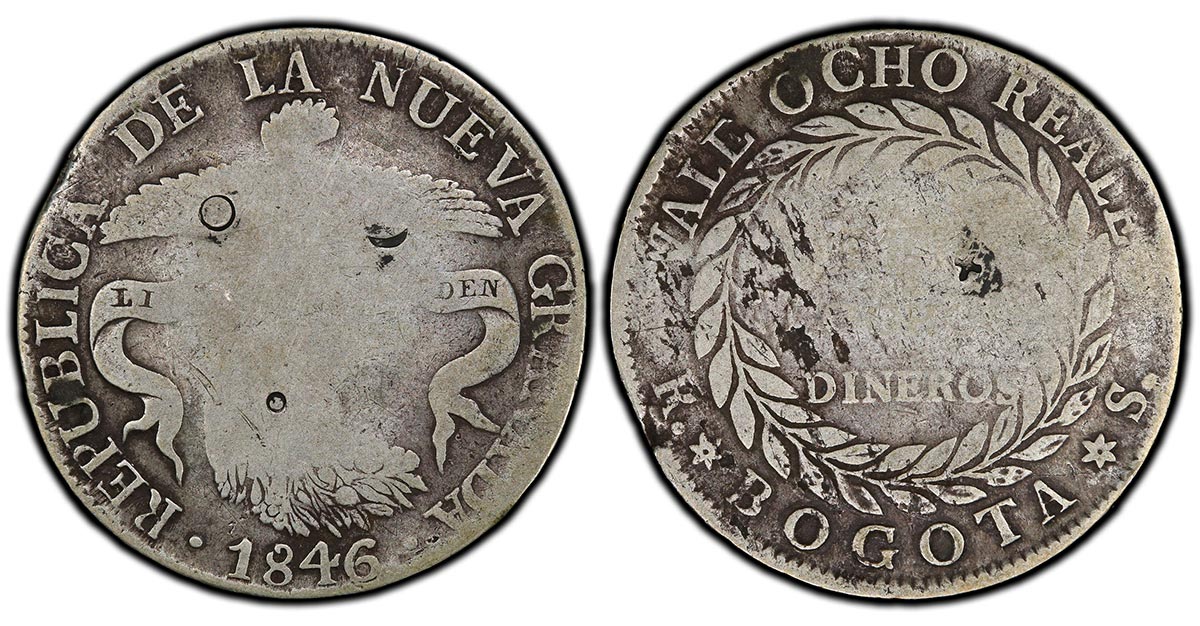
1846-B Colombia "Republica De La Nueva Granada" Ocho Reales (Ex. Waddell)
Specifications:
22.93 g, .666 silver, .491 troy oz (actual silver weight)
Recorded mintage: unknown
Catalog reference: KM 98
Details:
The 1846-B 8 reales of Colombia was struck at the Bogotá mint and belongs to the debased republican silver coinage issued after the dissolution of Gran Colombia. Despite
retaining the traditional “8 reales” denomination, the coin was struck to a reduced standard of approximately 22.9–23.0 grams with fineness at .666, representing a
substantial deviation from the classic Spanish-American crown standard. The dated side bears the national arms with a condor above a shield and the inscriptions “REPUBLICA
DE LA NUEVA GRANADA” (Republic of New Granada) and “LIBERTAD I ORDEN” (Liberty and Order), while the opposite side shows a wreath enclosing “LEI OCHO DINEROS”, with “VALE
OCHO REALES” (Worth Eight Reales) running around the outside of the wreath. The Bogotá mint, operating with inherited colonial infrastructure under persistent fiscal strain,
produced silver coinage of uneven reliability during this period. Silver for these issues was sourced primarily from regional Andean mining districts. Precise mintage figures
for the 1846-B issue are not recorded, but the type was struck intermittently during the 1840s amid political instability and efforts to sustain a viable national currency in
Colombia’s early post-independence period.
By the mid-1840s, Colombia remained politically fragmented and economically constrained, with limited central authority and ongoing regional tensions, following decades of independence struggles. Like many newly independent Latin American states, Colombia faced chronic silver shortages and fiscal pressure, which led to deliberate reductions in weight and fineness while preserving familiar denominations for domestic use. Across the region, such debased silver issues circulated locally but were poorly positioned for international acceptance, particularly in markets that valued intrinsic silver content over nominal designation.
Colombian 8 reales of this reduced standard are rarely encountered with Chinese chopmarks. Given their substantially lower silver content relative to crown-standard dollars favored in southern China, these coins would have been disadvantaged in the China trade and subject to heavy discounting if encountered at all. Any appearance in China would have been indirect and opportunistic, most plausibly via secondary circulation through European or Caribbean trade networks rather than systematic export. Within China’s weight-based silver economy, such pieces would have required close assaying and were more likely to be rejected or melted than widely accepted. There is no direct documentary evidence linking the 1846-B issue to the China trade, and the coin has no credible systematic China-trade pathway. This example might have visited China, but looking at the marks I'd lean more towards India, where it may have picked up a few shroff marks.
Notable chopmarks:
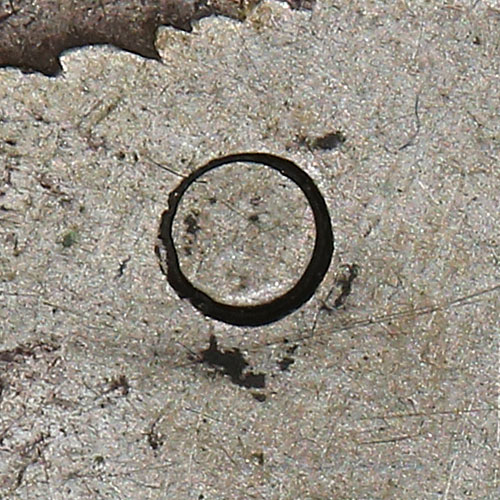 Medium sized circular chopmark
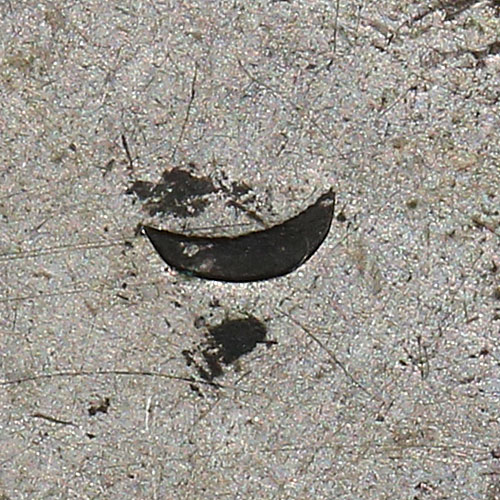 - Liushutong script variant of 月 - yuè - moon, month
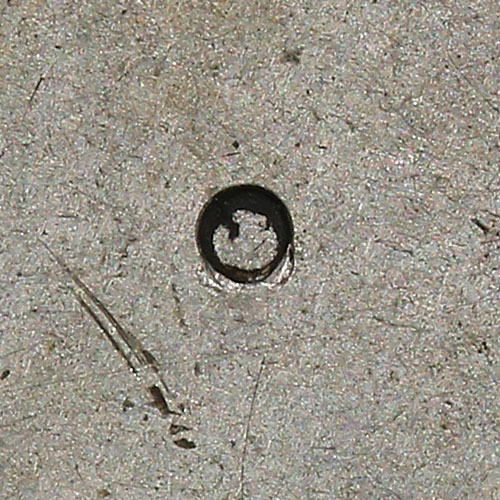 Small sized circular chopmark
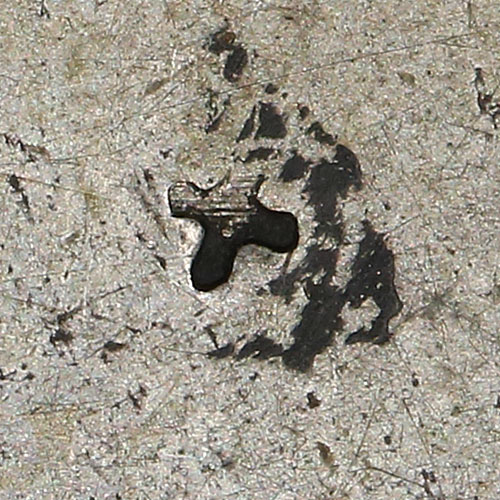 Upright crossReads as an upright cross. It most closely resembles the Chinese numeral 十 (shí, 'ten'), itself written as a simple cross, so a cross-shaped chopmark is commonly a 十 tally or numeral mark; it may alternatively be a maker's or simple counter mark.
Provenance:
From the Ron Waddell Collection
Purchased from Ron via private sale in September 2016
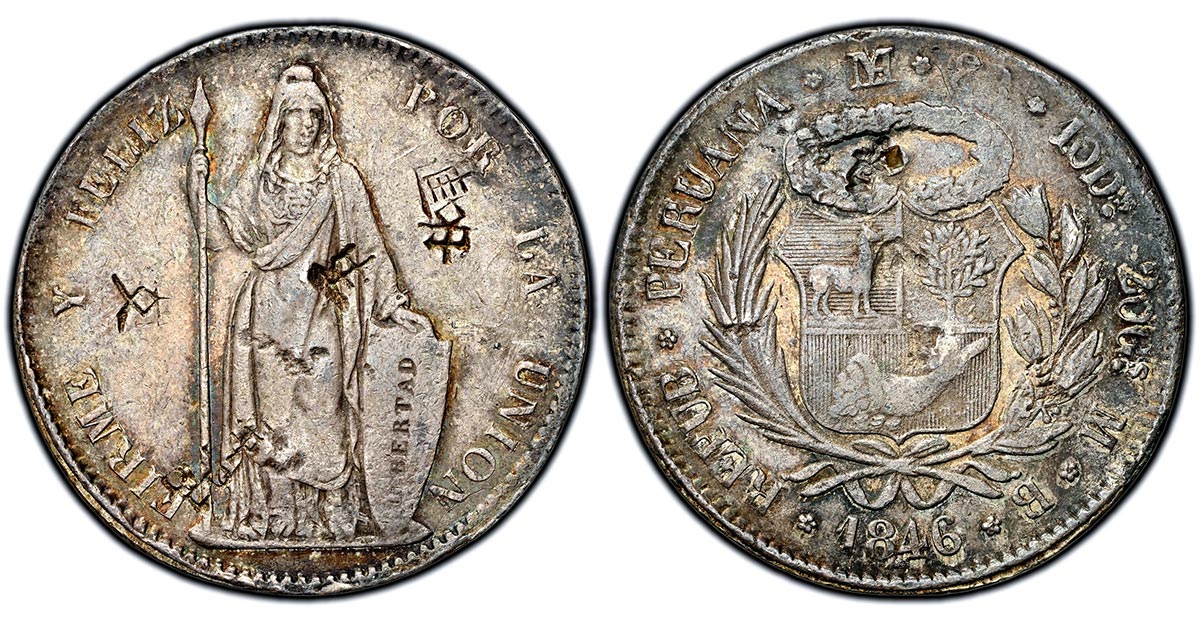
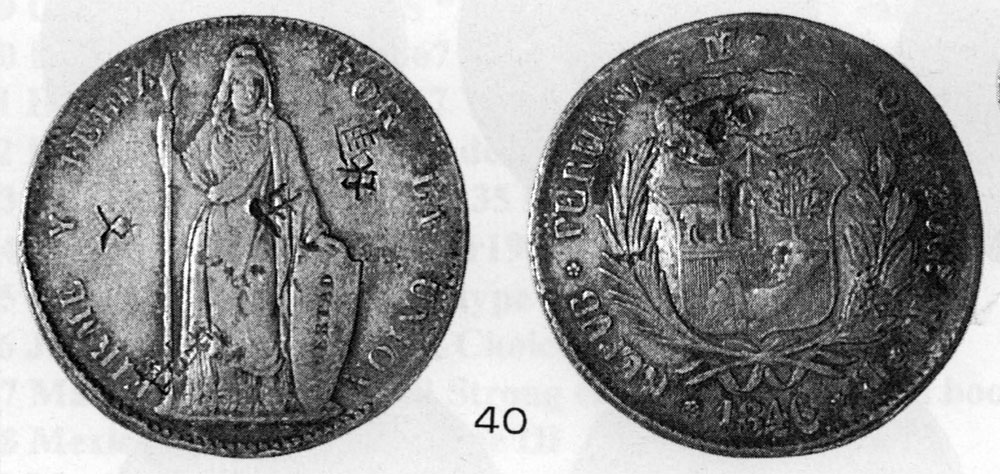
1846-L MB Peru 8 Reales - Repub. Peruana type (Ex. Rose)
Specifications:
27.07 g, .903 fine silver, .786 troy oz (actual silver weight)
Recorded mintage: unknown
Catalog reference: KM 142.10
Details:
The 1846-L MB (Manuel de la Barrera) 8 reales of Peru was struck at the Lima mint and represents Peru’s continuation of crown-standard silver coinage during the early republican
period. The issue was struck right around the standard spec at 27.0 g / .903 fine. The date side shows the Peruvian coat of arms with a wreath above, the arms surrounded by
branches, and the legend “REPUB. PERUANA” (Peruvian Republic), while the opposite side depicts standing Liberty with the surrounding legends “FIRME Y FELIZ” (Stable and
Prosperous) and “POR LA UNION” (For the Union). The Lima mint, one of the most established and technically capable mints in South America, continued to enjoy broad international
confidence in its silver output during this period.
By the mid-1840s, Peru occupied a relatively strong position among post-independence Andean republics, benefiting from political consolidation and sustained silver production. Unlike some neighboring states that adopted materially reduced standards for domestic convenience, Peru largely preserved the intrinsic quality of its principal silver denomination, enabling its coinage to function effectively beyond local circulation. The Lima mint inherited centuries of institutional continuity from the colonial period, and its silver coins remained familiar to international merchants accustomed to Spanish-American crown-standard issues.
Standing Liberty 8 reales of this period are available, but not common with Chinese chopmarks. Their weight and fineness closely matched the silver dollars long accepted in southern China, allowing them to circulate as bullion once assayed alongside Mexican and earlier Spanish issues. Entry into China would have occurred indirectly, primarily through European and global commercial networks rather than direct Peruvian–Asian trade, but once present these coins met the technical requirements of China’s weight-based silver economy.
An attractively toned, well preserved example with nicely placed chopmarks and a nearly unbeatable provenance.
Notable chopmarks:
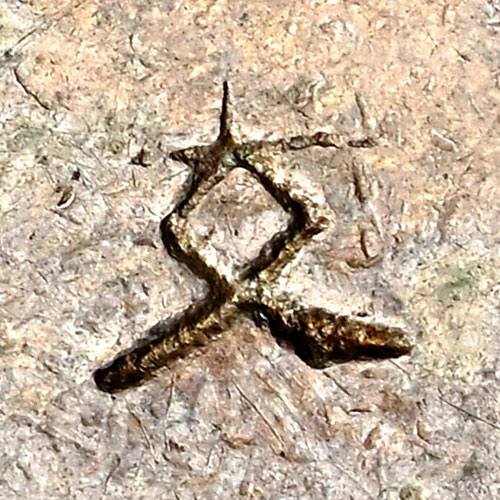 Similar to 女 - nǚ - woman, female, daughter
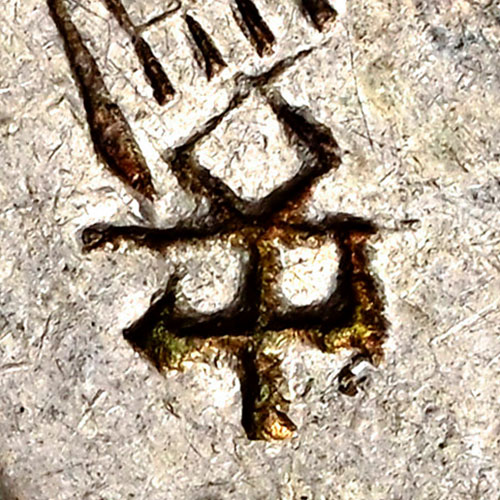 Unknown chopmark
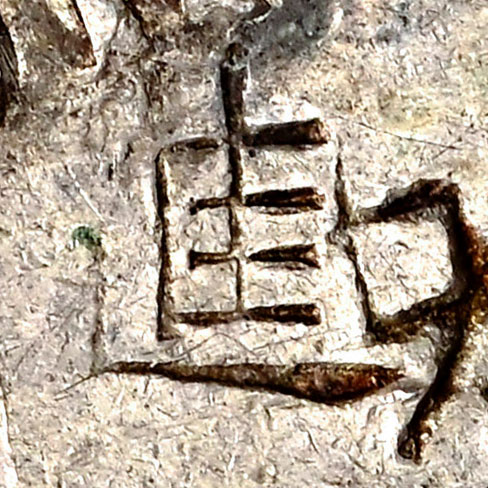 Similar to 進 - jìn - advance, enter
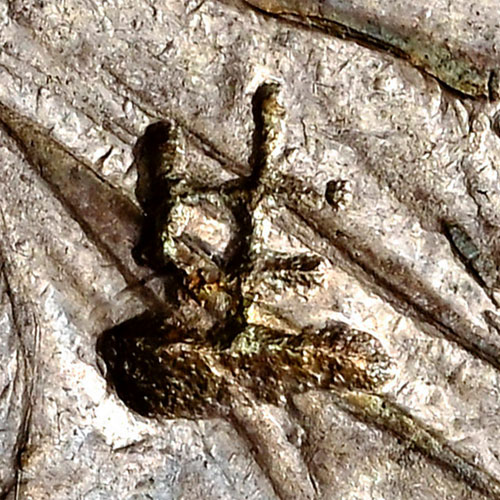 生 - shēng - life, birth, grow
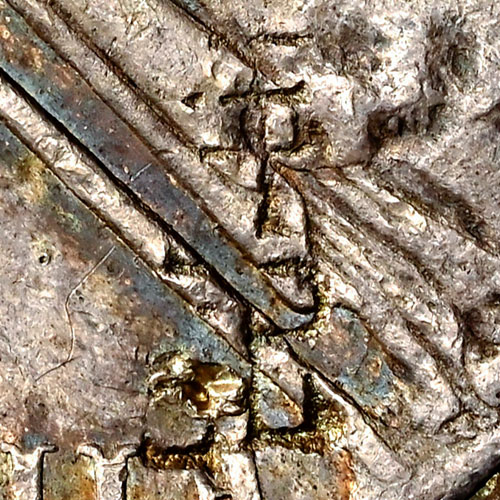 Large, complex partial chopmark
Provenance:
Purchased from the Champion Macau Winter Auction November 30, 2024
Lot #0202
Auction Description:
PERU 1846-LIMA MB 8 Reales Silver, NGC XF DETAILS, Chopmarked, F.M. Rose Collection, Extremely Rare
Previously from the JEAN (Journal of East Asian Numismatics) Mail Bid Sale #5, November 8, 1997, lot 40.
The above mail bid sale was one of the 4 JEAN mail bid sales to feature coins from the collection of Frank Rose.
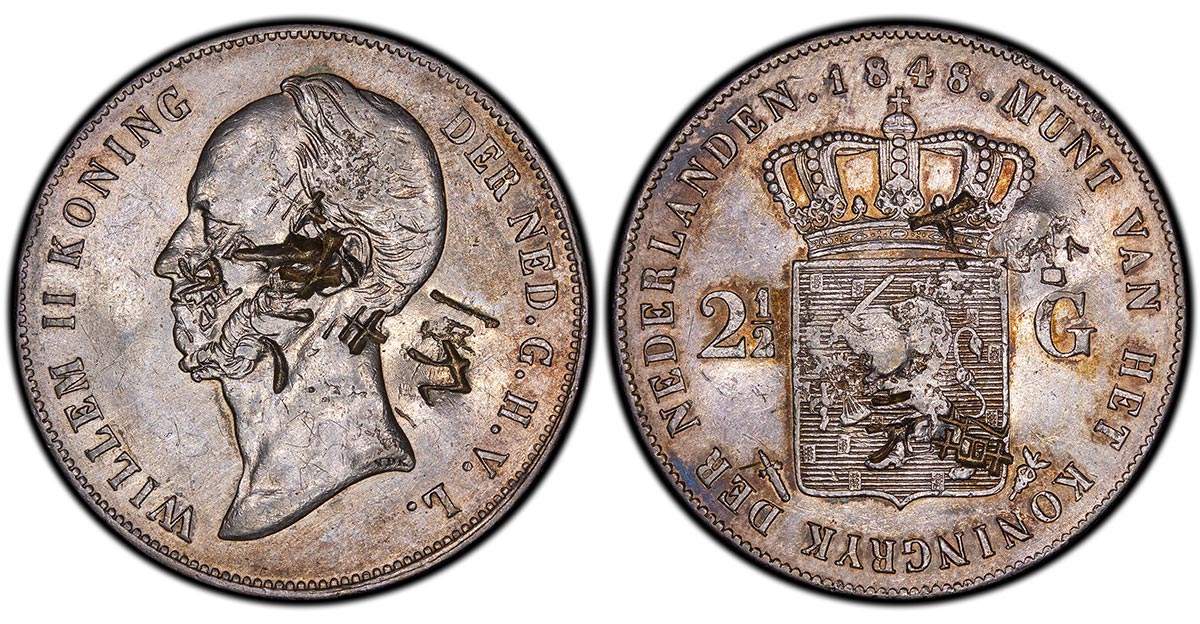
1848 Netherlands 2 1/2 Gulden
Specifications:
25.0 g, .945 fine silver, .7595 troy oz (actual silver weight), 38 mm diameter
Recorded mintage: 8,339,330
Catalog reference: KM 69, Dav 235
Design: Smooth lettered edge
Details:
The 1848 2½ gulden of the Netherlands was struck at the Utrecht mint during the reign of King Willem II and represents a high-quality silver denomination within the
mid-19th-century Dutch monetary system. The issue was struck to a unique standard of 25 grams / .945 fine, yielding an intrinsic silver content comparable to crown-sized
trade coins. The obverse bears a left-facing bust of Willem II with the legend “WILLEM II KONING DER NED. G.H.V.L.” (William II, King of the Netherlands, Grand Duke of
Luxembourg), while the reverse displays the crowned Dutch coat of arms above the denomination “2½ G”, with surrounding legends identifying the issuing state. The Netherlands
mints were among the most technically reliable in Europe, and Dutch silver coinage of this period enjoyed strong confidence for both domestic use and international settlement.
The year 1848 was a moment of political upheaval across Europe, and in the Netherlands it marked the adoption of a new constitution that significantly expanded parliamentary authority while preserving the monarchy. Economically, the Netherlands remained a major commercial and financial power with long-standing global trading connections, including deep historical ties to Asia through earlier centuries of maritime commerce. By the mid-19th century, however, Dutch trade with East Asia operated within a changed global environment dominated by British, American, and Spanish-Mexican silver flows. Dutch silver coinage was primarily intended for domestic circulation and European trade, even as its high fineness made it suitable for international bullion use when circumstances required.
Netherlands 2½ gulden pieces of this period are only occasionally encountered with Chinese chopmarks. Although their weight and fineness rendered them technically acceptable within China’s weight-based silver economy, they were not among the silver types most commonly remitted to China in the mid-19th century, when Mexican and other Spanish-American dollars overwhelmingly dominated trade silver flows. Any appearance of this type in China would likely have been incidental and opportunistic rather than systematic, possibly arriving via European commercial channels rather than direct remittance for the China trade. In such cases, acceptance would have depended on local assaying rather than familiarity. The scarcity of chopmarked examples reflects limited exposure rather than intrinsic unsuitability, and there is no evidence for sustained circulation of this type within China’s commercial silver system.
Notable chopmarks:
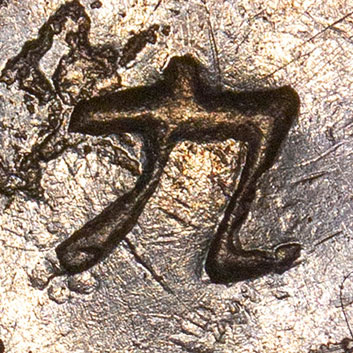 九 - jiǔ - nine
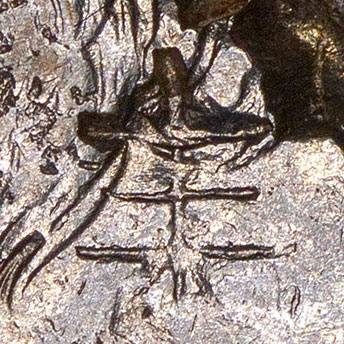 耒 - lěi - plow, plow handle
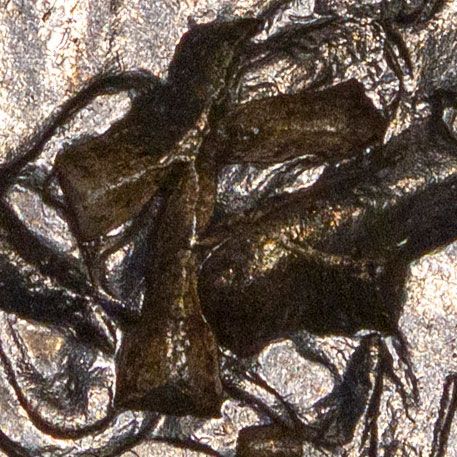 仁 - rén - benevolence, humanity, kernel
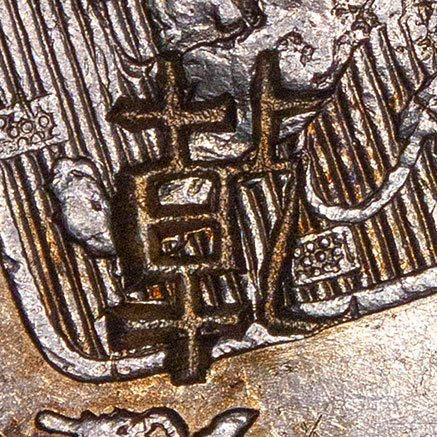 乾 - (traditional variant of 干) qián - dried, heaven, male
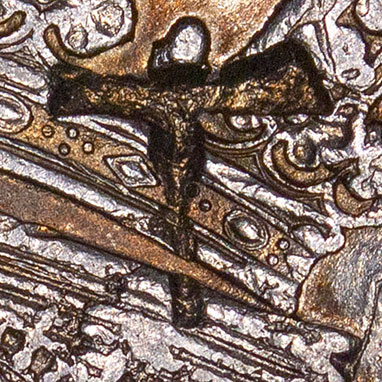 丅 - (ancient version of 下) xià - below, down, under
Provenance:
Purchased on eBay in September 2015 from a seller in San Antonio, Texas.
1849-O United States Seated Half-Dollar
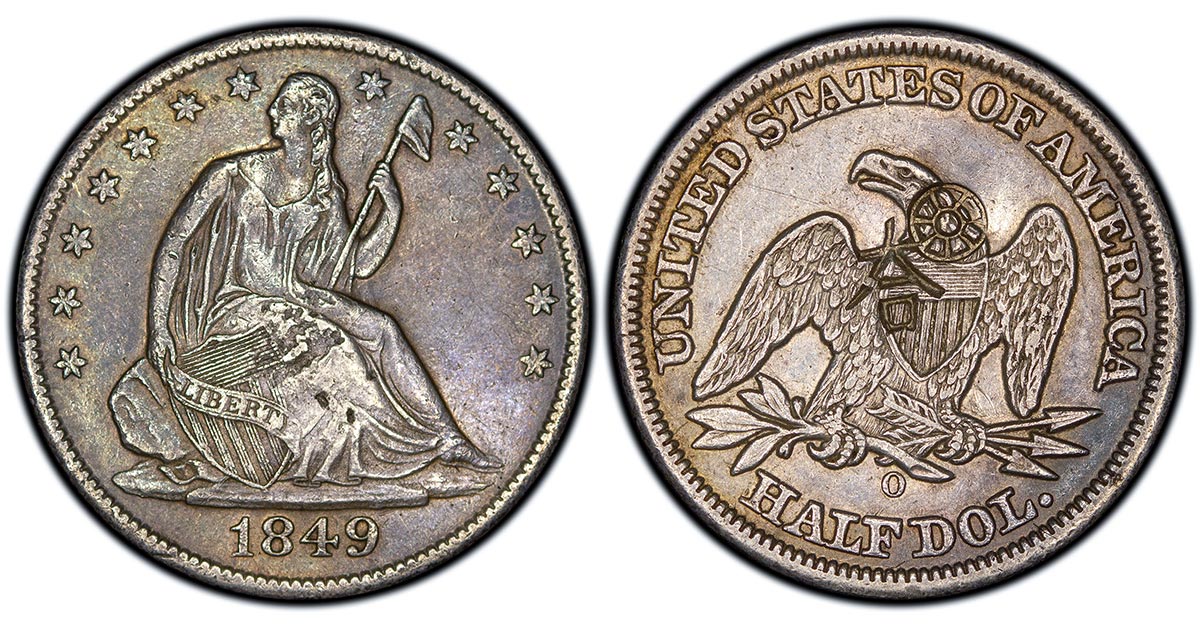
Specifications:
13.36 g, .900 fine silver, .3866 troy oz (actual silver weight), edge reeded
Recorded mintage: 2,310,000
Catalog reference: PCGS 6263
Details:
The 1849-O Seated Liberty half-dollar of the United States was struck at the New Orleans Mint and belongs to the No-Motto type (1839–1853), preceding the weight reduction
that came in 1853. The issue was produced to the original spec at 12.44 grams / .900 fine. With a recorded mintage of 2,310,000 million pieces, the 1849-O ranks among the
more heavily produced New Orleans half-dollars, far more available than several earlier or later branch-mint dates. As with many late 1840's New Orleans half-dollars, surviving
examples commonly exhibit soft or uneven strikes, particularly at the stars and central obverse, along with flatness in the eagle’s breast and legs.
The year 1849 coincides with the onset of the California Gold Rush, a development that rapidly altered the metallic balance of the United States monetary system and intensified pressures already present within its bimetallic framework. Although the immediate effects were felt first in gold circulation and bullion flows, the influx of gold soon contributed to valuation imbalances that encouraged the hoarding, export, or melting of full-weight silver coins. In this environment, silver half-dollars continued to function primarily as domestic circulating currency, particularly in commercial regions served by the New Orleans Mint, even as larger silver denominations became increasingly vulnerable to displacement. The 1849-O half-dollar came during a transitional time, struck just before weight reduction in 1853 for subsidiary silver and a redefinition of silver’s role within the U.S. monetary system.
United States Seated Liberty half-dollars are encountered with Chinese chopmarks more frequently than their weight and denomination alone would suggest. The appearance of Chinese chopmarks on United States Seated Liberty half-dollars, including New Orleans issues, likely suggests a circulation pathway that was indirect rather than intentional. A plausible route begins with the New Orleans Mint’s role in supplying silver coinage to the Gulf Coast and Mississippi Valley, where half-dollars circulated heavily in commercial exchange and port-related activity. From there, such coins could have entered broader Atlantic trade networks, moving through merchant houses engaged in transshipment between American, Caribbean, and European ports. Silver arriving in Europe as mixed U.S. coinage was not always segregated by denomination before being forwarded onward, and small American silver could plausibly have been bundled with larger coins or bullion consignments destined for Asia. Once introduced into Chinese commercial circulation, likely in port cities rather than deep inland, half-dollars would have functioned as fractional bullion, subject to assaying and verification despite their inefficiency relative to crown-standard dollars. Chopmarks on these pieces therefore need not imply formal export or sustained circulation, but rather episodic acceptance within a complex, layered trade system in which silver moved through multiple hands, currencies, and valuation regimes before reaching its final users.
This one shows what look like 3 chopmarks. 2 of them (one on top of the other) are commonly seen on chopmarked coins. The third, a wheel shaped chopmark is more unique.
Notable chopmarks:
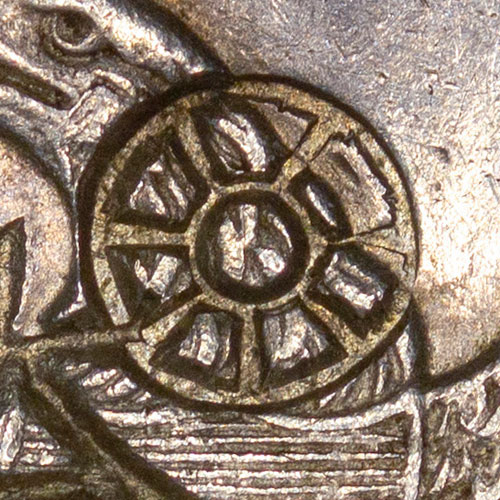 Spoked wheel (車輪)Not firmly identified. A spoked wheel reads as a cartwheel or sun and most readily evokes the Buddhist 法輪 (fǎlún, the Dharma wheel), an emblem of the turning of the law and of continual motion and good fortune; the canonical Dharma wheel has eight spokes, so a seven-spoke form may instead be a maker's or decorative mark, or loosely echo the auspicious 七星 (qīxīng, the Seven Stars). Wheel and sunburst marks are among the more common abstract chopmarks.
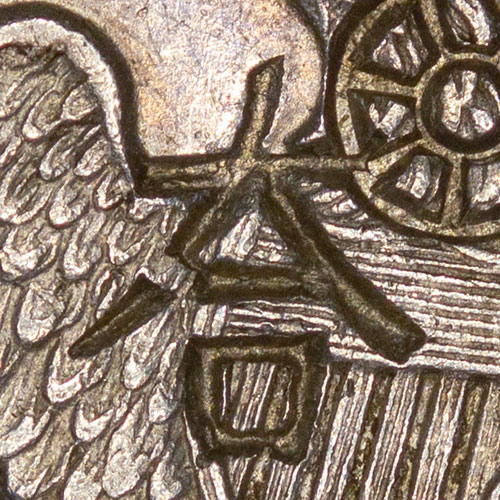 㝓 - kè - corresponding, equivalent, considerable, appropriate, concave
Provenance:
Purchased on eBay in May 2018 from a seller in Port Hadlock, Washington. The seller is handling the estate of Alexandr Potebnia, the Russian ambassador to China in the 1960's.
Apparently Alexandr purchased this coin in Hong Kong in the 1960's and his collection included other chopmarked coins as well.
I am always grateful to add coins to this collection with a story that can be traced back to China.
1850 Bolivia 8 Soles
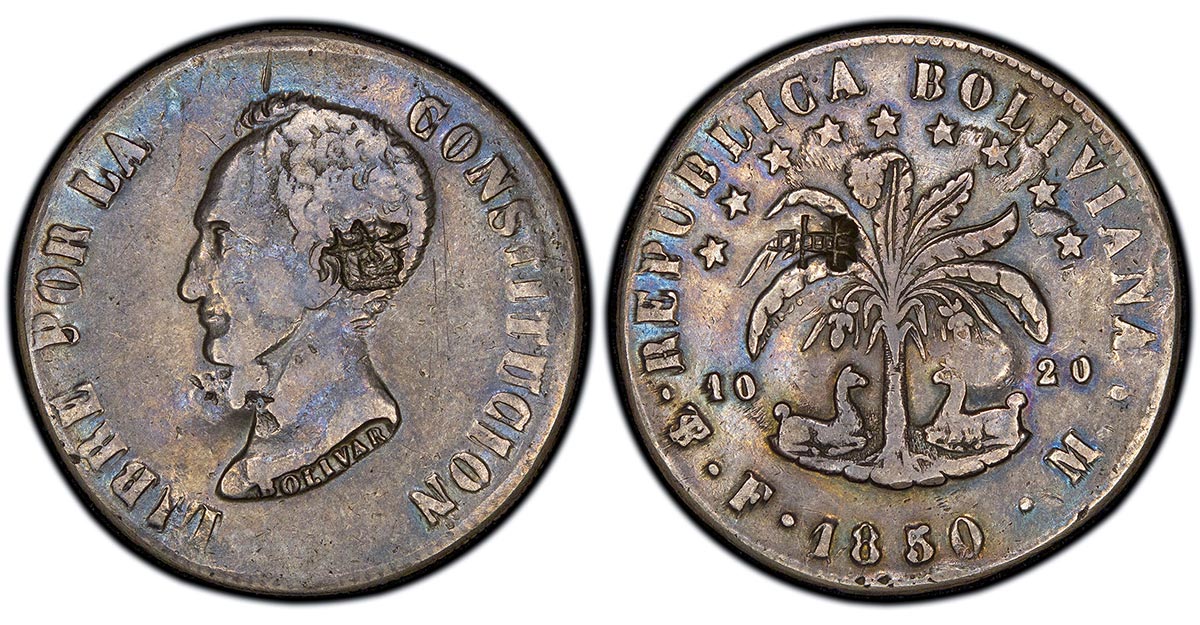
Specifications:
27 g, .903 fine silver, .784 troy oz (actual silver weight), edge reeded
Recorded mintage: unknown, but common
Catalog reference: KM 109
Details:
This type was struck in substantial quantities 1848-51 after Bolivian independence. It is slightly less common than the earlier laureate head designs (KM 97 and KM 103) but it
is not rare. Later eight soles (or sueldos; the sources do not agree) were struck to the same weight standard until 1859, when the weight was lowered to 20 grams. Bolivia
converted to decimal coinage in 1864.
As stated by Gullberg "The following Bolivian 8 soles was known to Taiwanese shroffs as "banana money" due to the similarity of the tree pictured on the reverse to a banana tree."
Notable chopmarks:
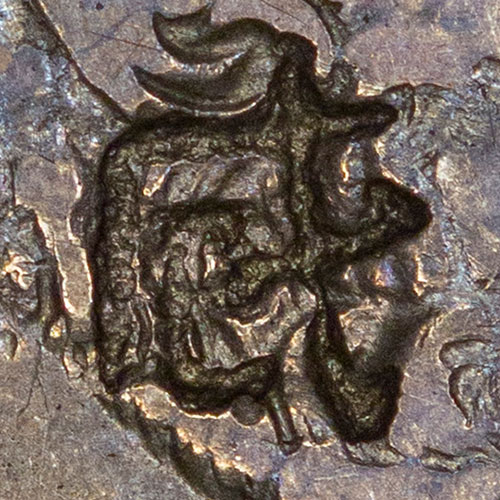 Probably 咸 - xián - all, salted
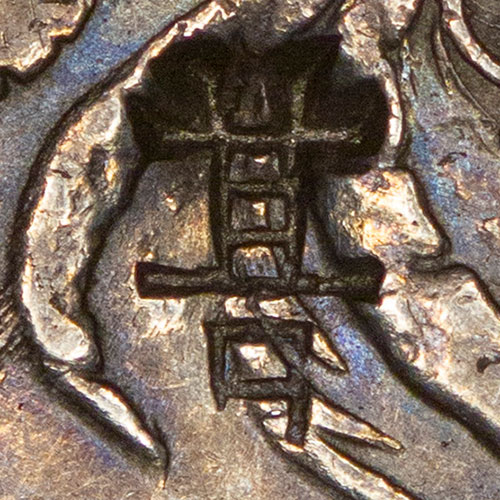 Unknown character
Provenance:
Purchased on eBay in February 2019 from a seller in New York City, New York.
1850 Spain 20 Reales Isabel II type, struck at the Madrid mint (Ex. Bowman)
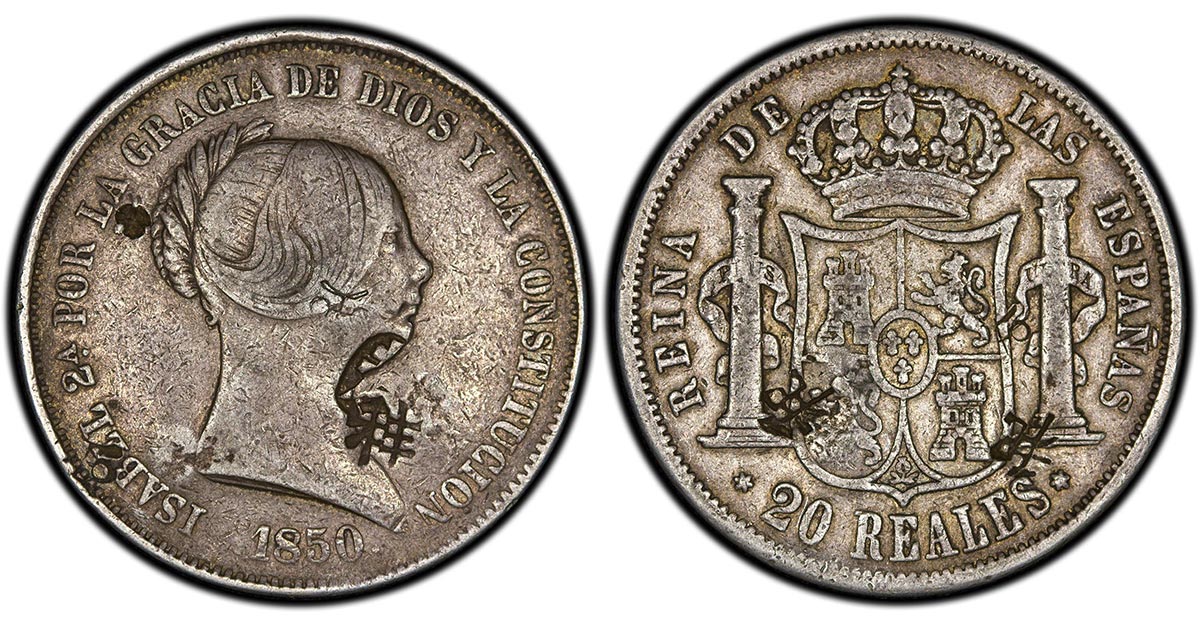
Specifications:
26.29 g, .900 fine silver, .761 troy oz (actual silver weight)
Recorded mintage: 500,000
Catalog reference: KM 593.2
Details:
The 1850 Madrid-mint 20 reales of Spain was struck under Queen Isabel II, a type running from 1850–1855, issued within Spain’s de vellón based monetary framework. Although
denominated as 20 reales, the coin functioned conceptually as a successor to the traditional 8 reales crown, preserving a large-silver format while aligning with reformed
accounting conventions. The issue was struck to a standard of 26.291 g / .900 fine, representing a measurable reduction from earlier Spanish colonial crown standards and placing
it below the tight specs of contemporary Mexican trade dollars. The obverse bears a right-facing bust of Isabel II with the legend “ISABEL II POR LA GRACIA DE DIOS Y LA CONSTITUCION”
(Isabel II, by the Grace of God and the Constitution), while the reverse displays the crowned Spanish coat of arms with “REINA DE LAS ESPAÑAS” (Queen of the Spains). Reported
mintage for the 1850 issue is 500,000 pieces, lowest recorded for the type. Instead of the traditional "M" and "S" mintmarks the issues are distinguished by six, seven or eight
pointed stars on the reverse (for Madrid, Seville and Barcelona), the present coin showing 6 pointed stars for Madrid.
By mid-century, Spain was attempting to modernize its monetary system while contending with diminished influence in global silver markets. The adoption of denominations such as the 20 reales reflects an effort to rationalize the currency without abandoning the prestige and familiarity of large-silver coinage that had long underpinned Spanish monetary credibility. However, by the 1840s and 1850s, global silver flows, particularly those bound for East Asia, were increasingly dominated by Mexican Cap-and-Rays 8 reales, whose consistency, scale of production, and entrenched acceptance narrowed the effective definition of a “trade dollar.”
The Spanish 20 reales is more of an outlier in terms of silver content. Although broadly similar in size to crown-standard dollars, its reduced weight and slightly lower fineness placed it at a disadvantage relative to contemporary Mexican Cap-and-Rays 8 reales, which had become the overwhelmingly dominant silver dollar in the China trade. Any entry of this type into China would have been opportunistic, most plausibly occurring within mixed silver shipments or secondary bullion flows rather than as a preferred remittance coin. Within China’s weight-based silver economy, such pieces would have required assaying and would have been subject to discounting, accounting for their occasional but uncommon appearance with chopmarks.
Notable chopmarks:
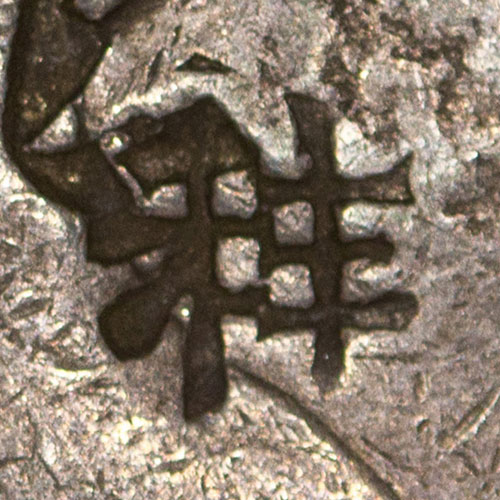 Combination of 禾 and 丰
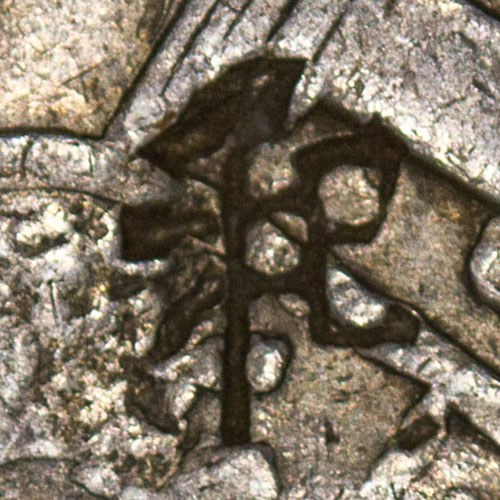 Similar to 䄫 - qǐ - an ancient word with no known meaning
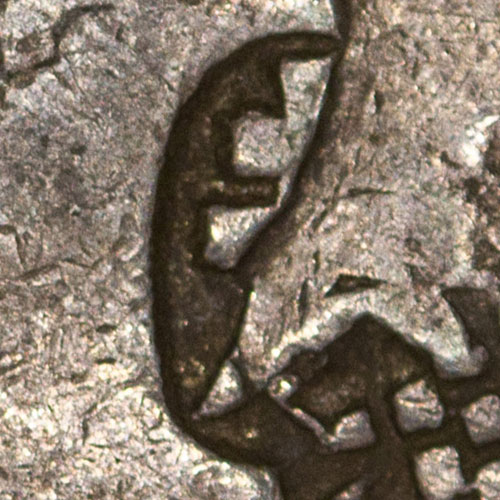 Unknown partial chopmark
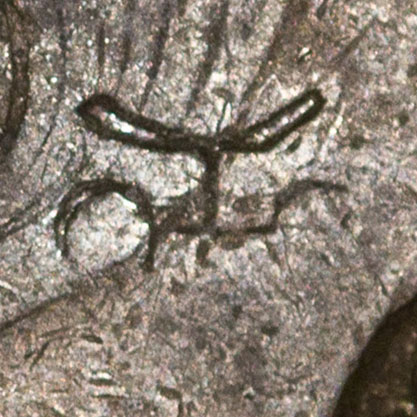 Unknown partial chopmark
Provenance:
Purchased from dealer Paul Brombal (Santa Barbara, CA) in November 2016
Ex J.D. Bowman, as described in the Chopmarked Collectors Club newsletter, Volume 3, Issue 3, July 1993, page 3-52. Bowman was an original contributor to the Chopmark Collectors Club newsletters, and assembled one of the finest chopmark collections of all time. Bowman worked closely with Santa Barbara coin dealer Paul Brombal, in fact J.D. credits Paul with "most all of my chops he got for me in Singapore, Hong Kong & Manilla over the years."
1852 (CS 1214) Burma Kyat
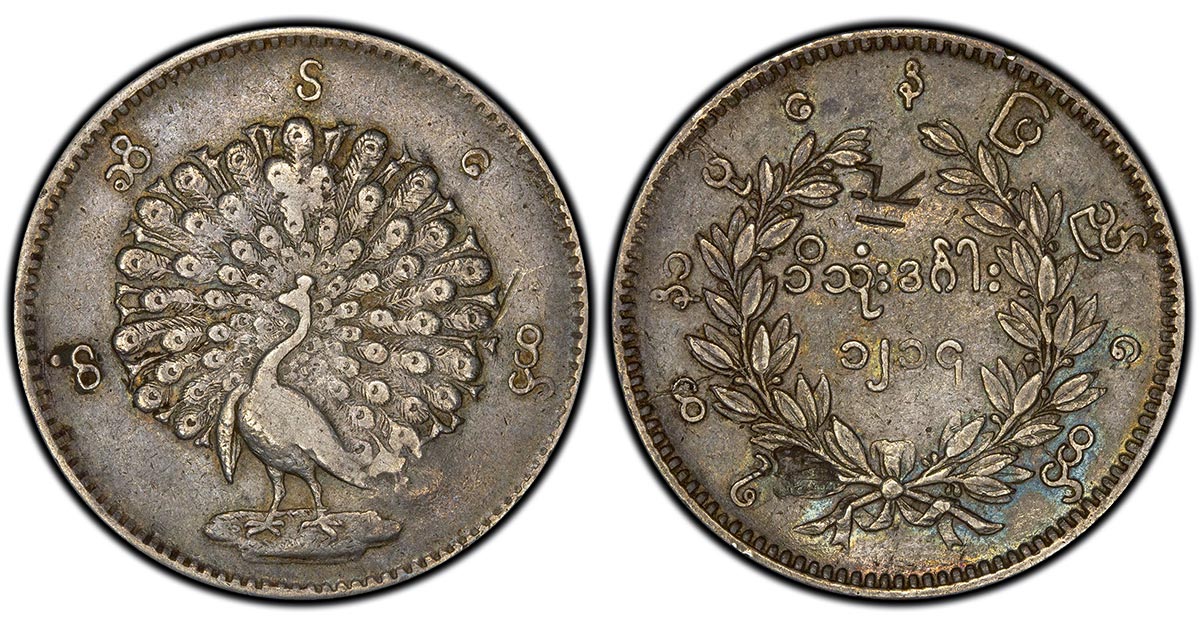
Specifications:
11.66 g, .917 fine silver, .3439 troy oz (actual silver weight), edge reeded
Recorded mintage: 30,000,000 (est)
Catalog reference: KM 10
Details:
The CS 1214 (1852) “Peacock” kyat of Burma (now Myanmar)is a silver issue of the Konbaung Dynasty struck to a regional standard of 11.66 g / .917 fine. The obverse bears a
handsome peacock, the Royal Seal of Burma, from which the coins got their name, while the reverse presents the denomination within a wreath, surrounded by Burmese-script
legends identifying the issuing authority and era, which starts from AD 638. In 1852, Mindon - the second to last king of Burma established the Royal Mint in Mandalay, and
the dies for this issue were brought in from Paris. Production was executed using traditional methods, resulting in irregular flans and variable strike quality that are
characteristic of the type.
The year 1852 coincides with the Second Anglo-Burmese War, which resulted in the British annexation of Lower Burma, while the Konbaung court retained control over Upper Burma. Throughout this period, Burmese monetary practice remained focused on regional circulation and court finance rather than alignment with European or global bullion standards. The kyat is frequently referred to in contemporary and later sources as a “rupee,” reflecting its functional equivalence in weight and value within a rupee-based regional accounting environment, rather than any formal adoption of Indian monetary terminology.
Despite Burma’s long-standing overland and regional trade connections with southwestern China, the Peacock kyat is rarely encountered with Chinese chopmarks and was not a regular participant in the mainstream China-trade. At 11.66 g, it falls well below the preferred crown-size. Any Burmese kyat entering Chinese commercial contexts would have been treated as small bullion, subject to weighing and discounting or conversion rather than routine verification through chopmarking.
Notable chopmarks:
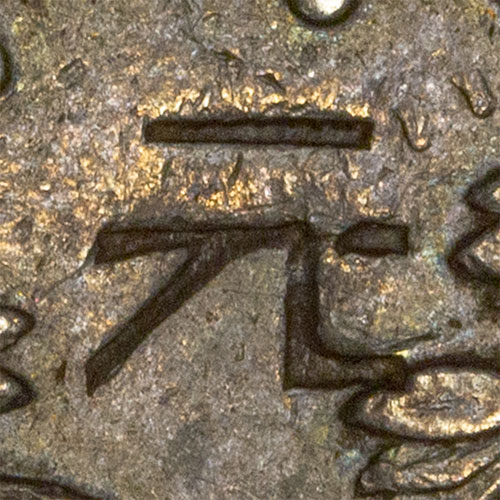 元 - yuán - dollar, unit of currency, basic, primary
Provenance:
Purchased via private sale from a fellow collector in May 2021.
1853 Culiacán mint, Mexico 8 Reales - Sonoran Cap / "MEXIGANA" variety
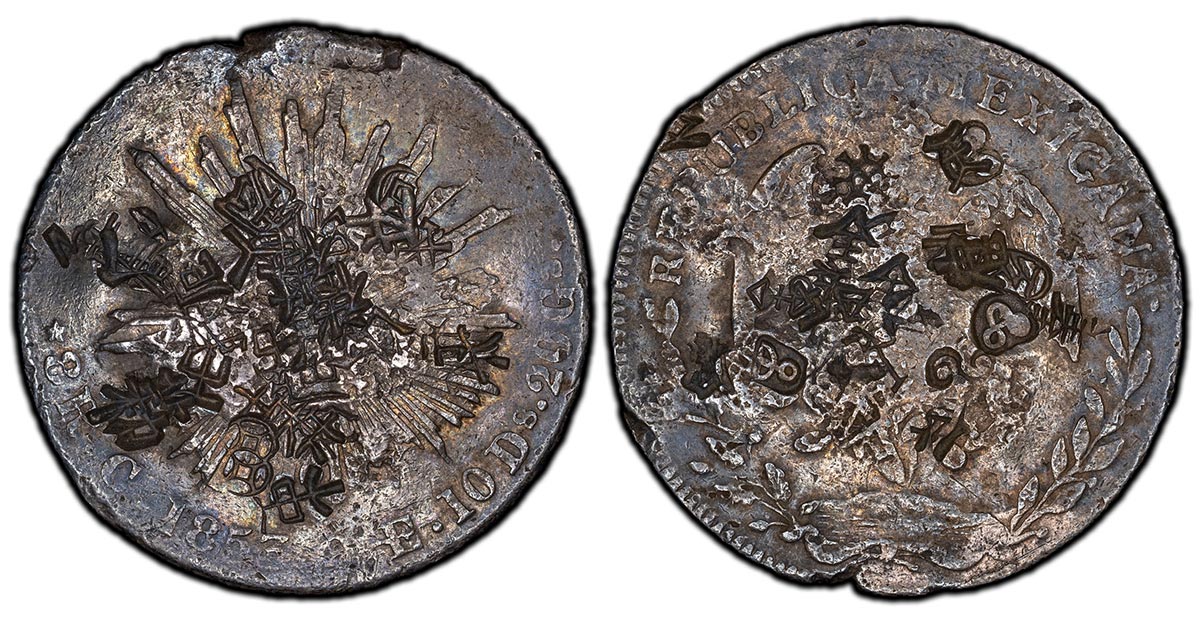
Specifications:
27.2 g, .903 fine silver, .7859 troy oz (actual silver weight)
Recorded mintage: unknown
Catalog reference: KM 377.3
Details:
This 1853 Culiacán-mint 8 reales of Mexico is distinguished by the prominent “MEXIGANA” blundered legend, a rare variety, possibly created when the engraver pulled the wrong punch
off the shelf.
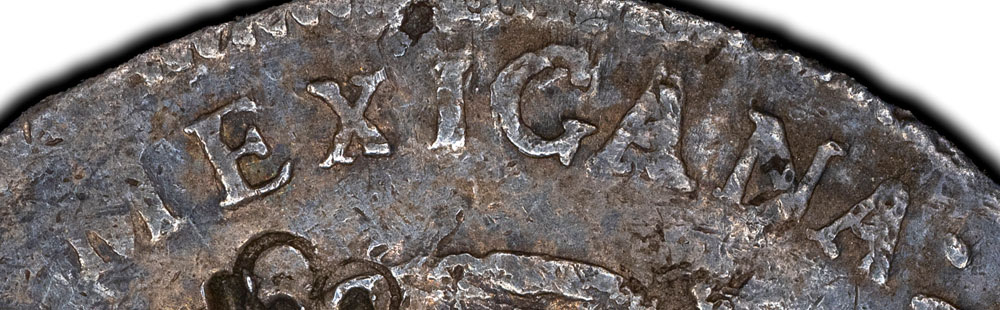
Although it is difficult to see under the chopmarks, this coin features the handsome 'Sonoran Cap' style, only issued for 1853-54 at Culiacán mint. The shape of the cap is noticeably different, with the top being more rounded and leaning right. It is is understood as regional die-engraving practice. provincial mints such as Culiacán operated with locally cut dies, often without access to current master hubs or official design models from Mexico City.
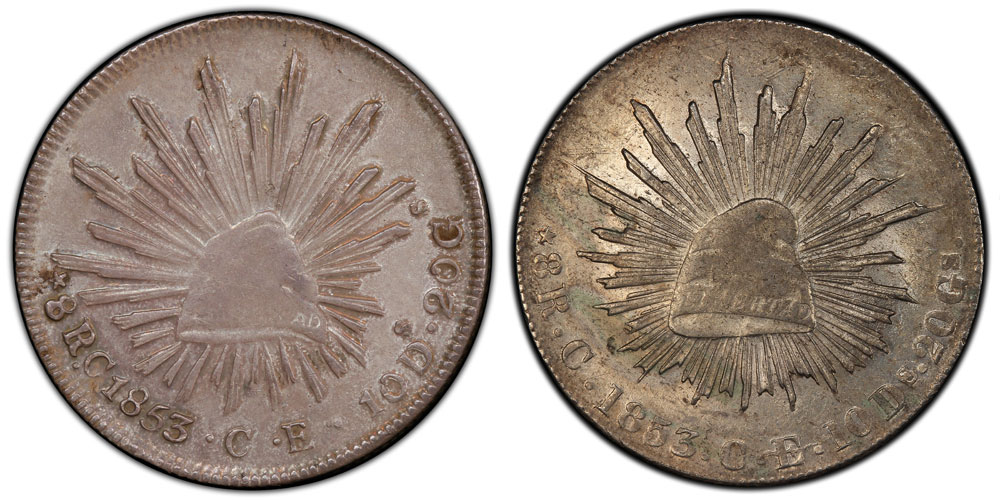
Also notable is the very rough, irregular shaped planchet used for this coin.
Notable chopmarks:
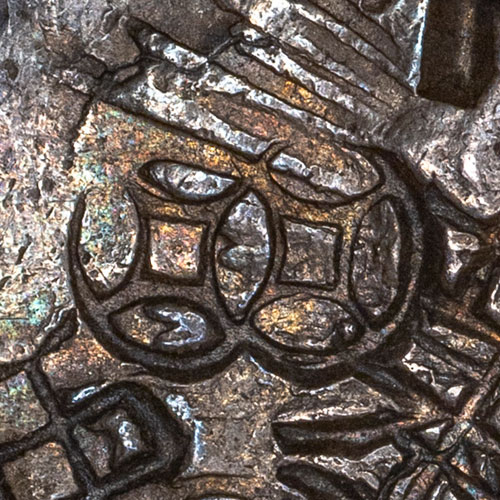 Double cash coins (雙錢)The double coins (雙錢, shuāngqián), one of the Eight Treasures (八寶) of Chinese decorative art. Doubling the single cash coin's wish for wealth, it stands for abundance and unbroken prosperity; the interlinked pair also reads as connectedness and good fortune arriving in twos.
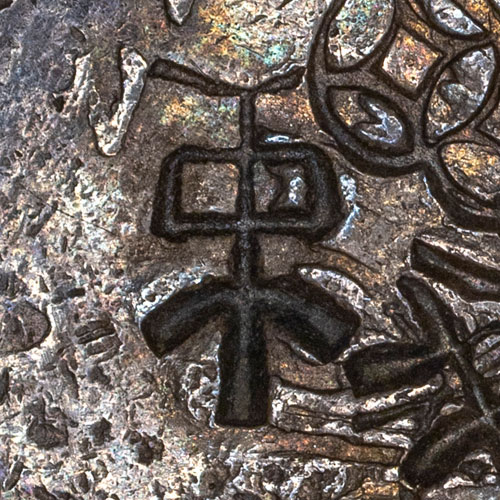
 - Seal script variant of 束 - shù - bundle, bind, restrain
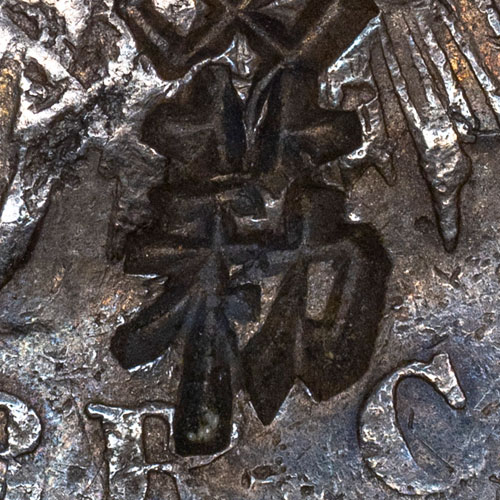 Similar to 菞 - lí - wild rice
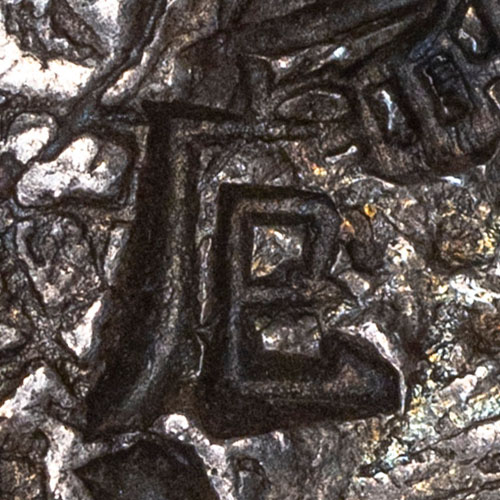 Similar to 庀 - pǐ - to prepare, to manage
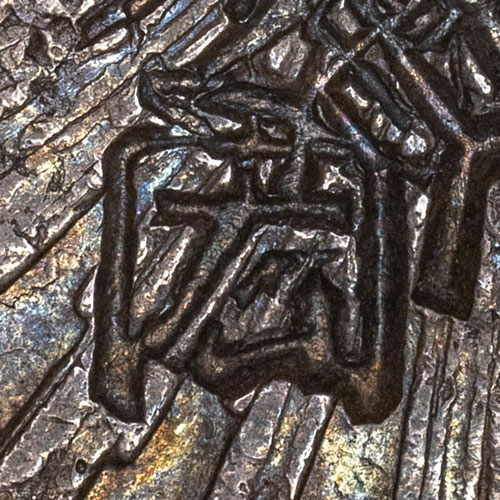 Unknown character
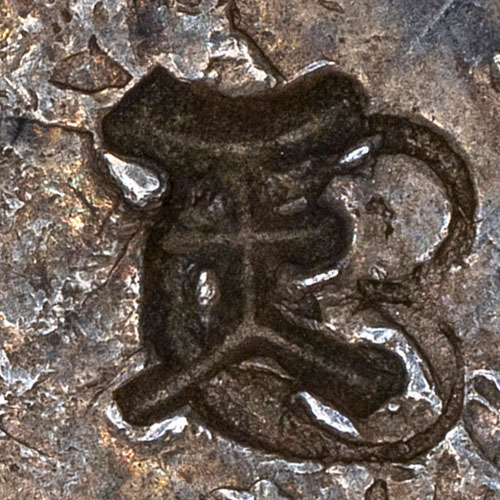
 - Liushutong script variant of 天 - tiān - heaven, sky, day
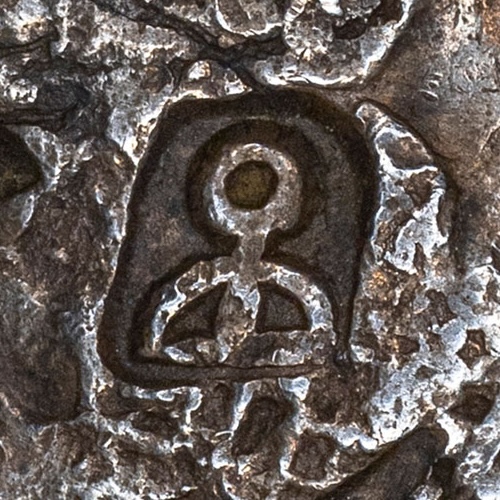 Appears to be an early variant, possibly seal script, but unclear what it means
*Note: this same chopmark character is seen on the 1831 Bolivia 8 Soles pictured above
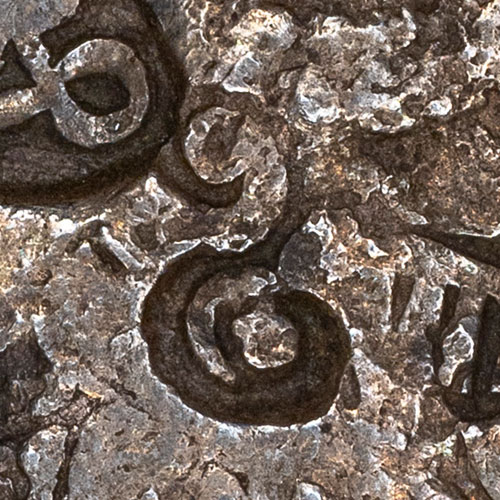
 - Liushutong script variant of 申 - shēn - extend, 9th earthly branch
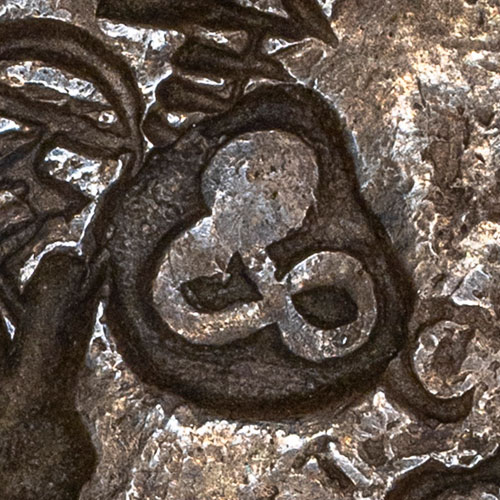 Unknown symbol chop
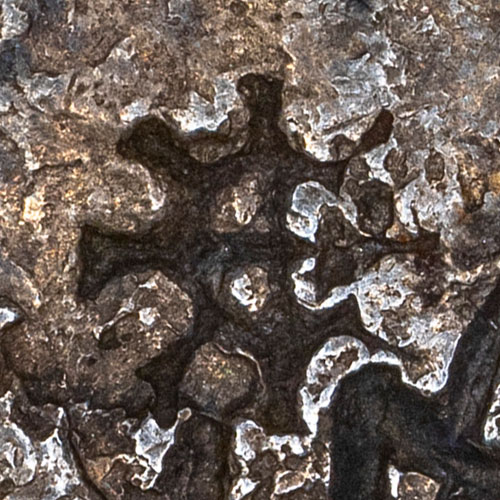 Crossed wheelNot firmly identified. An eight-spoked wheel evokes the Buddhist 法輪 (fǎlún, the Dharma wheel), whose eight spokes are read as the Noble Eightfold Path, one of the Eight Auspicious Symbols (八吉祥) of the turning Buddhist law. The quartered ring also reads as a sun, a compass rose, or the four directions, and circle-and-cross marks recur as abstract chopmarks; it may equally be a maker's or decorative mark.
Provenance:
Purchased on eBay in June 2025 from a seller in Roseville, Illinois.
1853 Arrows & Rays US Half Dollar
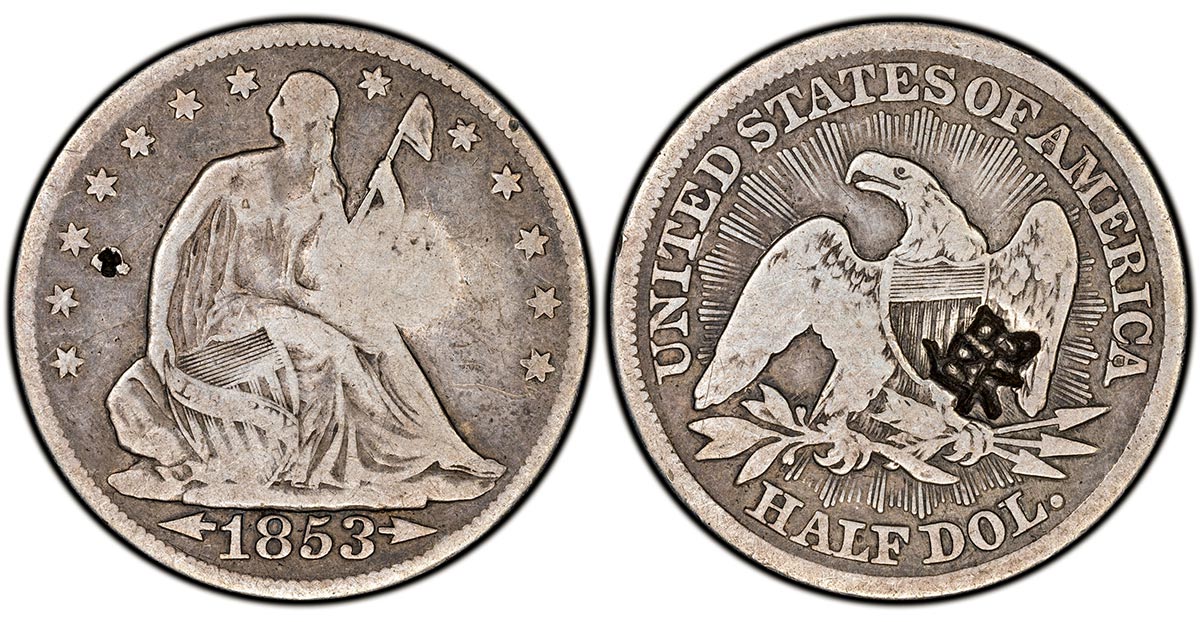
Specifications:
12.44 g, .900 fine silver, .36 troy oz (actual silver weight)
Recorded mintage: 3,532,708
Catalog reference: KM 79
Details:
In 1853, the American Congress passed a Coinage Act that reduced the weights of the Half Dimes, Dimes, Quarter Dollars, and Half Dollars to correct the imbalance in the prices
of gold and silver. To make the change obvious, arrowheads were placed on either side of the date and rays were placed throughout the reverse. Production of the new Half Dollars
ballooned in 1853 to over 3.5 million coins -- a level unseen since ten years earlier. The New Orleans mint contributed another 1.3+ million coins. With the rays on the reverse,
this became a one-year type coin (from 1854 to 1855, the rays were removed but the arrowheads remained).
Notable chopmarks:
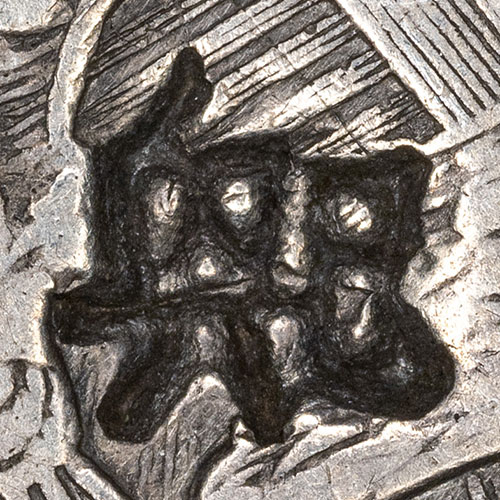 㒷巳 - sì xīng - likely a merchant or shop mark (reading uncertain) - Horizontal marks of this period were read right-to-left, so although the chops are shown here as written (㒷巳), the mark reads 巳 (sì) then 㒷 (xīng). 巳 is the sixth of the twelve earthly branches; 㒷 is an old form of 興 (xīng, to flourish or prosper), a common auspicious shop-name character. Most likely a merchant or shop mark, but the reading and identity are best-effort and unverified.
Provenance:
Purchased through a collector named Emilio Rodriguez who resides in Isabela, Puerto Rico, December 2022.
1854-PTS MJ Bolivia 8 Soles
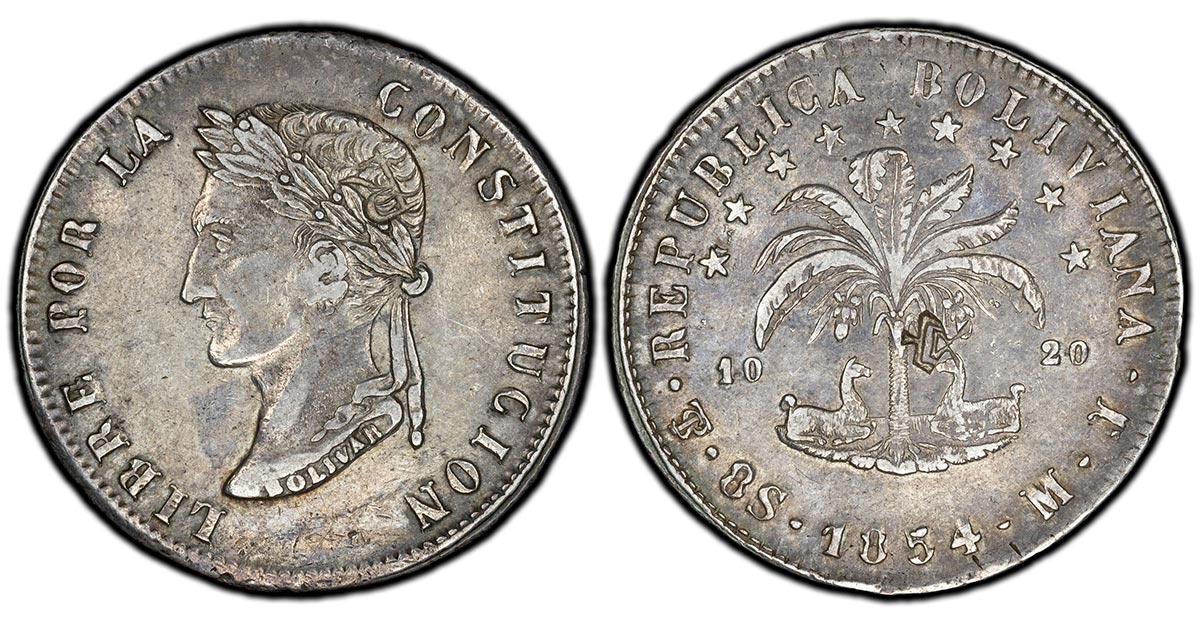
Specifications:
27 g, .903 fine silver, .7839 troy oz (actual silver weight), edge reeded
Recorded mintage: unknown
Catalog reference: KM 112.2
Details:
The 1854-PTS MJ Bolivia 8 soles (KM 112.2) was struck at the Potosí mint during the presidency of Manuel Isidoro Belzu, a period marked by political populism, social reform
efforts, and recurring military unrest. This issue belongs to the broader KM 112 series (1852–1856), but the MJ assayer combination is confined to the 1854–1855 dates, giving
it a clearly defined and relatively short production window within that type. The design reflects mid-19th-century Bolivian national symbolism rather than a new denomination:
the obverse shows the palm tree flanked by two alpacas beneath a starry arc, emblematic of natural abundance and national identity, while the reverse bears the left-facing bust
of Simón Bolívar with the legend LIBRE POR LA CONSTITUCIÓN. Compared to the earlier KM 109 type, the Bolívar portrait on KM 112.2 is more stylized and compact, with sharper
facial features and a simplified uniform, signaling a shift away from the more classical, medallic bust used on the earlier issues.
Notable chopmarks:
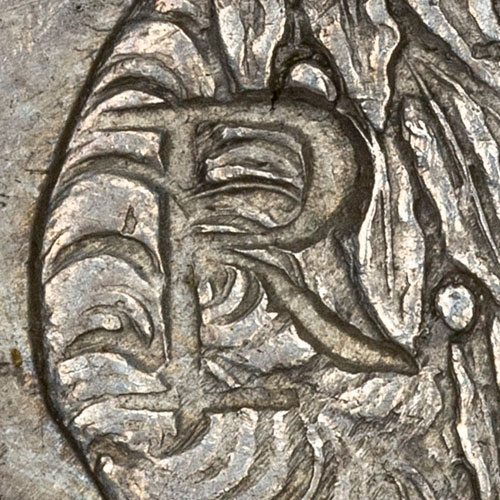 R - Latin-letter chopmark
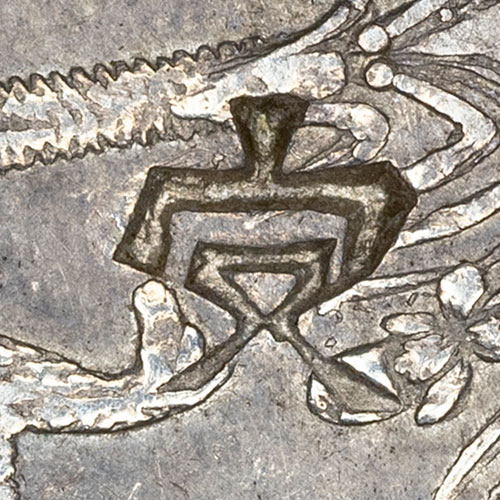 㝊 - (an old variant of 守) shǒu - to defend, guard, protect, to conserve, to wait
Provenance:
Purchased from the Aureo & Calicó online Auction 435 - 11 July 2024 Lot #997
Auction Description:
Bolivia. 1854. Potosí. MJ. 8 soles. (KM. 112.2). Resello oriental. AG. 26,70 g. MBC+.
1855-PTS MJ Bolivia 4 Soles
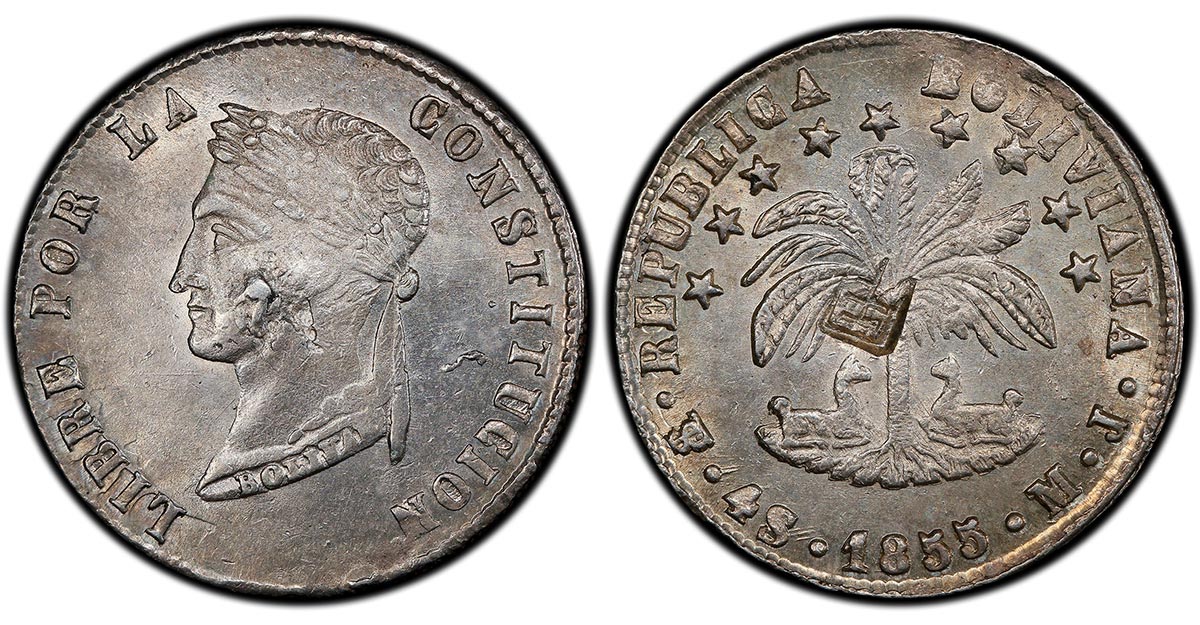
Specifications:
13.50 g, .6670 fine silver, .2895 troy oz (actual silver weight), edge reeded
Recorded mintage: unknown
Catalog reference: KM 123.2
Details:
The Potosí mint produced standard weight four reales (13.54 g, .896 fine) of the colonial type until 1825. After independence, the weight was lowered to 13.5 grams (KM 96,
struck 1827-29). In the 1830's and 1840's, Bolivia issued an enormous quantity of four soles debased to .667 fine, all dated 1830 (KM 96a). These coins flooded South America
and were denounced by Bolivia's neighbors, to no avail. Later types struck at Potosi and La Paz are also to this standard (KM 124 thru 130, struck 1853-59). The last four soles,
struck 1860, was 13.5 g, .903 fine silver (KM 135.2).
This example is the only Bolivian 4 soles of this type I know of, with a chopmark. It should be considered very rare as such.
Notable chopmarks:
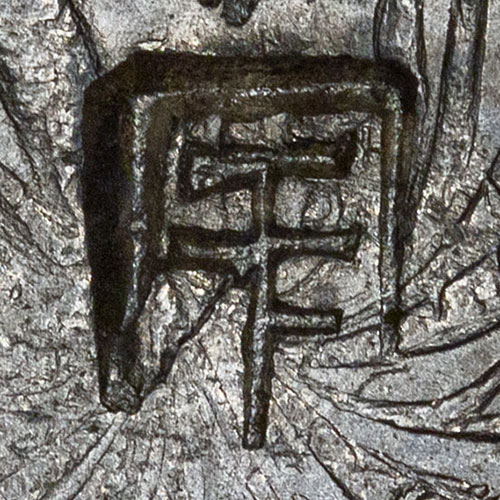 Unknown character
Provenance:
Purchased from the Mowbray Collectables Auction #24, Wellington New Zealand, March 6 2020
Lot #13
Auction Description: (for all coins in group lot)
BOLIVIA (7), 4 Soles 1855 PTS MJ, km123.2, chop mark Obv; 8 Soles (4), 1831 PTS JL & 1840 PTS LR, km97; 1846 PTS R, kmA103; & 1861 PTS FJ, km138.6; & Boliviano (2), 1868 PTS FE,
km152.2 & 1870 PTS ER, km155.2. Toning to coins, particularly 1831 & 1868. VF - EF
1855-S United States Seated Half-Dollar (with arrows)
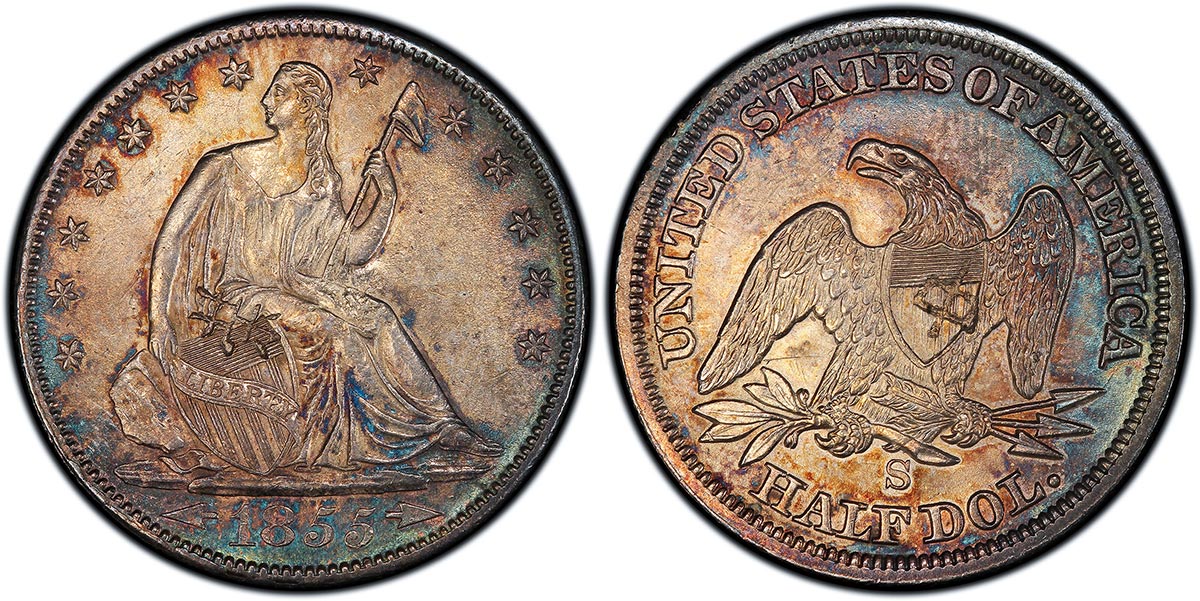
Specifications:
12.44 g, .900 fine silver, .3599 troy oz (actual silver weight), edge reeded
Recorded mintage: 129,950
Catalog reference: PCGS 6284
Details:
US Liberty Seated half dollar, with Arrows from the mint in San Francisco California. The US Liberty Seated half dollar series was issued from 1839-1891. The centerpiece of
my chopmark collection. This coin stands on its own, at the same time it epitomizes what I set out to find for this collection - attractive and well-preserved pieces with
chopmarks to signify their usage in commerce.
This example is a key date within the seated half series, with only 4 true uncirculated examples known to collectors. This example shows convincing uncirculated details and luster, with only the chopmarks keeping it from joining the elite group of 4 uncirculated examples.
One obverse chopmark is weakly impressed with one reverse chopmark, both centered. My first thought was to confirm the chopmarks are legitimate and I am convinced they are. The first and possibly most convincing factor is that adding chops to this coin greatly diminishes the value. Second, the single, centered chopmarks are consistent with many other chopmarked examples of seated halves from this period. Something that initially concerned me about the coin is an apparent lack of reciprocal damage from the chopmarks. However, after viewing the coin in hand I can see the damage is present, although faint.
How this coin survived the voyage to China, going through the hands of a shroff, picking up two chopmarks and then another 150 years in this condition is mind boggling.
Notable chopmarks:
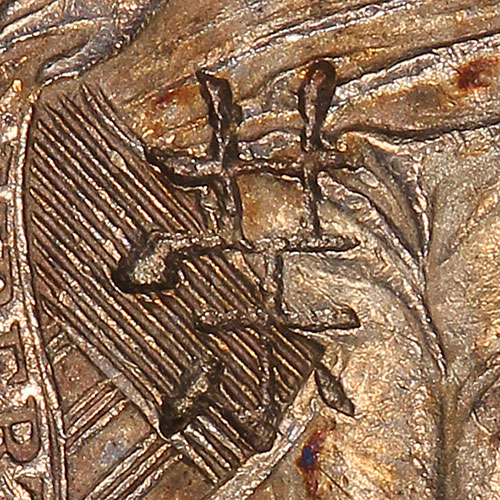 荣 - róng - glory, honor
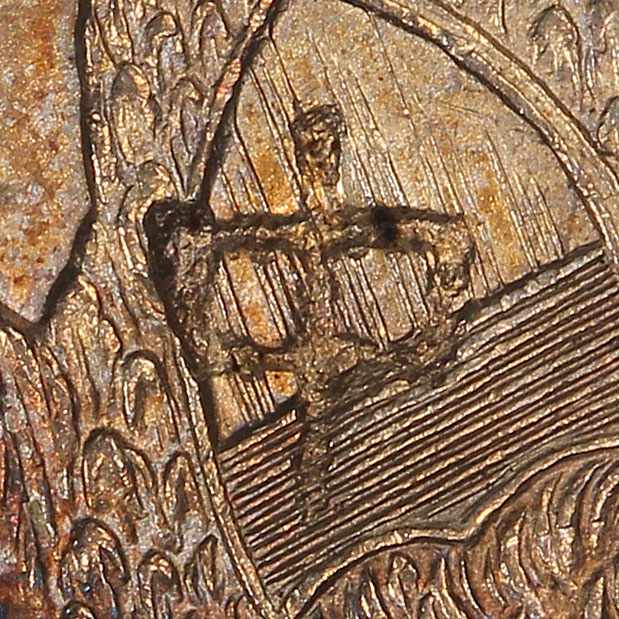 中 - zhōng - center, middle, China
Provenance:
Purchased via private sale from a fellow collector (to whom I am very grateful) in September, 2014.
Previously from the March 7th, 1968 Lester Merkin Public Auction Sale, Session 2, Lot #606
Auction Description:
1855 S No drapery. Virtually Unc., but one Chinese chopmark (not very deep) on either side. Without the chopmarks this would be one of the three or four finest known. RR. PLATE

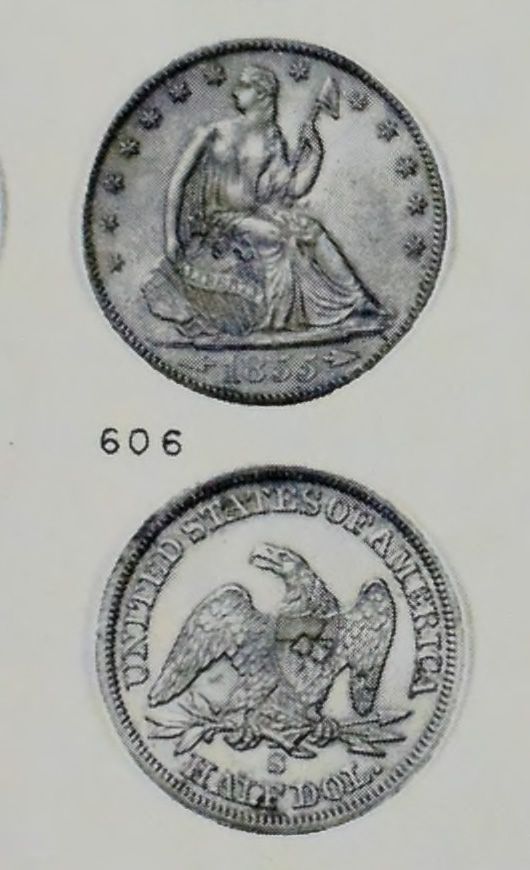
1857 United States Seated Liberty Quarter - Philadelphia mint (Ex. Rose / Kriz)
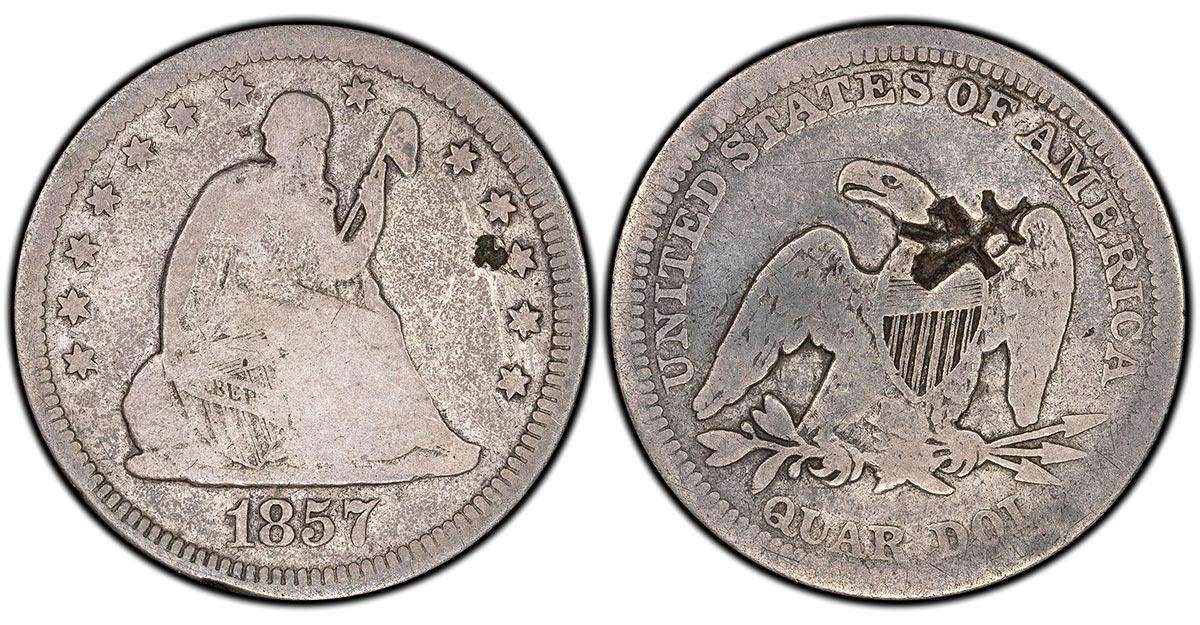
Specifications:
6.22 g, .900 fine silver, .18 troy oz (actual silver weight)
Recorded mintage: 9,644,000
Catalog reference: KM A64.2, PCGS# 5442
Details:
The 1857 Quarter Dollar has the third largest mintage of the entire Seated Liberty Quarter Dollar type (only the 1853 With Arrows & Rays and the 1854 have larger mintages).
The mid-1850s marked a period of monetary adjustment in the United States following the discovery of gold in California and the resulting imbalance between gold and silver.
By 1857, Congress had already enacted the 1853 Coinage Act, reducing the weight of subsidiary silver denominations to discourage melting and export, although quarters dated
1857 continued to circulate alongside earlier, heavier issues. Silver quarters functioned primarily as domestic circulating currency, facilitating everyday commerce.
A chopmarked Seated Liberty quarter is a scarce find, this being one of the most convincing I've seen. The obverse drill mark only helps lend confidence to the reverse Chinese chopmark. From a bullion perspective, the quarter’s limited silver content made it inefficient within China’s weight-based silver economy, which strongly favored larger silver units for accounting and settlement.
Notable chopmarks:
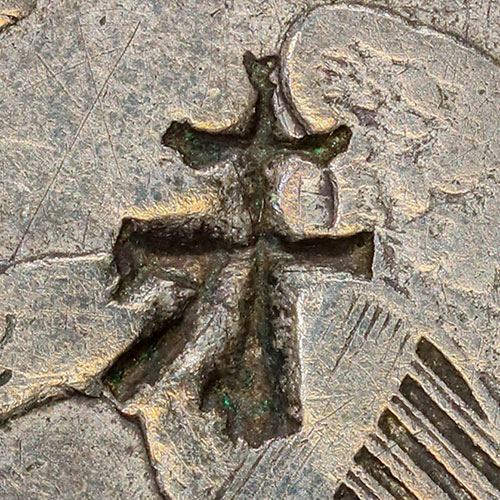 Incomplete 未 - wèi - not yet, 8th earthly branch
Provenance: From the Stack's Bowers October 2023 Hong Kong Foreign Coins Part 2, Internet Only, Session P Lot #47007
Auction Description:
UNITED STATES OF AMERICA. Chopmarked 25 Cents, 1857. Philadelphia Mint. PCGS Genuine--Tooled, VG Details.
KM-A64.2.
Estimate: $100 - $200.
Provenance: From a New York Gentleman’s Collection.
According to the Stack's Bowers auction listing, this coin is "From a New York Gentleman's Collection."
One can speculate that this is likely a coin out of the Frank Rose collection. Stated by Rose in his book "Chopmarks", Quarters are rarely found with chopmarks. The 1839 in Fig. 99, with one large chop, must be rated extremely rare. There are two other dates represented in my collection, 1857 and 1947. I cannot explain the 1947. (p. 26)
We know that the same collection this quarter was found in also contained at least one other Rose coin, and with the extreme scarcity of chopmarked quarters extent, this is almost certainly the coin Rose refers to in his book.
July 2024 update: I have found more evidence that this coin is ex-Frank Rose, in fact it now appears this coin was purchased by Frank Rose from Robert Kriz, who supplied the photographs for Rose's groundbreaking book on chopmarks. Recently I was going through old Chopmark Collectors Club newsletters and I found an old list of what was described as Frank Rose's collection, later proven to be a list of coins that Rose bought from Kriz. Within this list, I found an entry for an 1857 US quarter, described as:
"1857 Libert Seated. F. Tost(sic) obv; 1 lg rev"
As you can see, the "test mark" on the obverse, and "1 large reverse chopmark" match the coin pictured here.

1857 Great Britain Florin (Ex. Leverage)
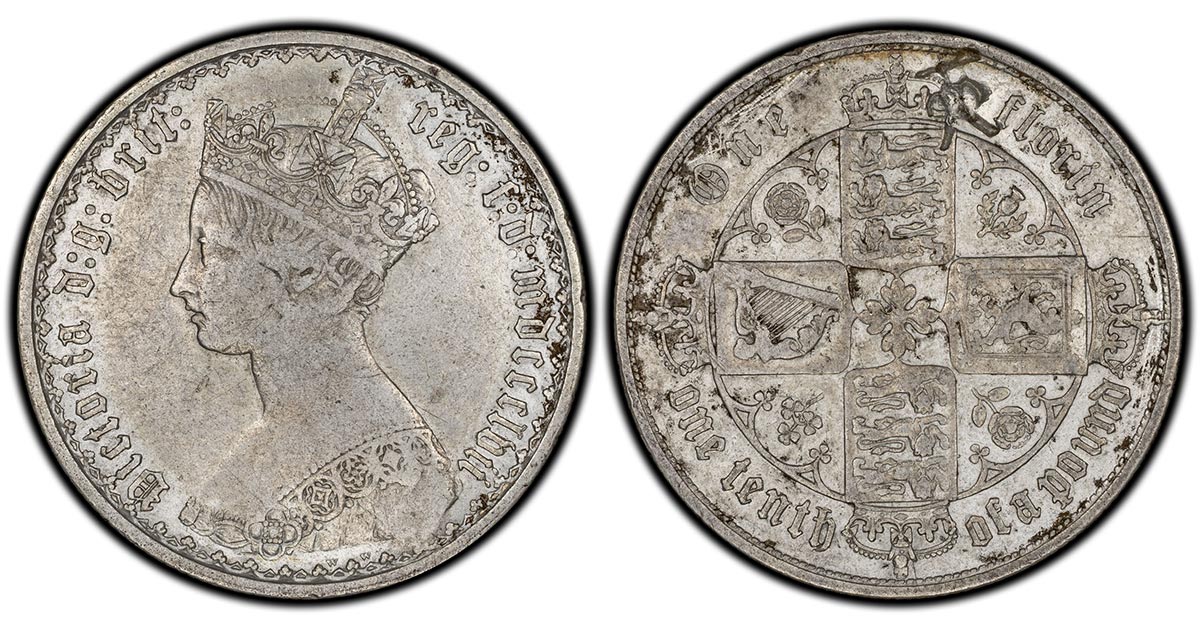
Specifications:
11.3104 g, .925 fine silver, 0.3364 troy oz (actual silver weight)
Recorded mintage: 1,671,000
Catalog reference: KM 746.1
Details:
1857 Great Britain Florin, Royal Mint, struck in silver of 11.31 g weight and .925 fineness, with a recorded mintage of 1,671,000. The obverse bears the youthful head of
Victoria facing left, with the legend VICTORIA D:G: BRITANNIAR: REG: F:D: (Victoria, by the Grace of God, Queen of the Britains, Defender of the Faith); the date appears
on the obverse in Roman numerals MDCCCLVII. The reverse shows crowned cruciform shields bearing the arms of England (three lions), Scotland (lion rampant), and Ireland (harp),
arranged around a central cross and separated by floral emblems, with surrounding legend ONE FLORIN ONE TENTH OF A POUND. This Gothic-inspired reverse, introduced with the
florin in 1849, emphasized the unity of the United Kingdom through heraldry rather than a single central emblem.
The florin was introduced as part of a deliberate mid-19th-century effort to test decimalization within Britain’s long-standing sterling system. Valued at one-tenth of a pound, it was intended to circulate alongside existing silver denominations rather than replace them, allowing the public to become accustomed to decimal relationships without a full monetary overhaul. By 1857, the florin was well established in domestic use, and its clear statement of value, spelled out directly on the coin, was meant to avoid confusion at a time when British silver circulated strictly by official denomination rather than by weight. Unlike later trade-oriented silver issues, the florin was struck exclusively for use within Britain and its monetary framework.
This type is rare with chopmarks. British florins were not intended for overseas trade and saw little export to China, unlike crown-sized silver dollars produced specifically for international trade.
Notable chopmarks:
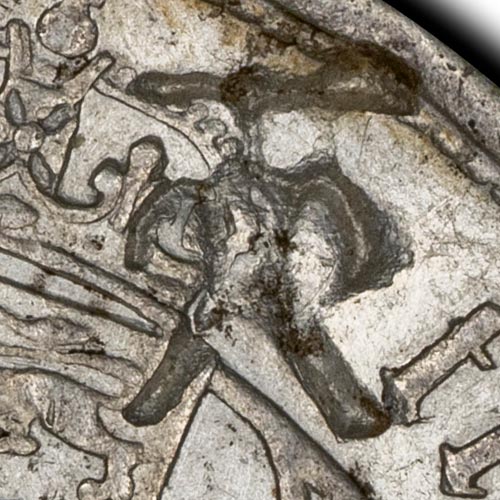
 - Liushutong script variant of 天 - tiān - heaven, sky, day
Provenance:
From fellow chopmark collector and author Taylor Leverage, February 2025.
1859-S United States Seated Dollar, early days of the San Francisco Mint
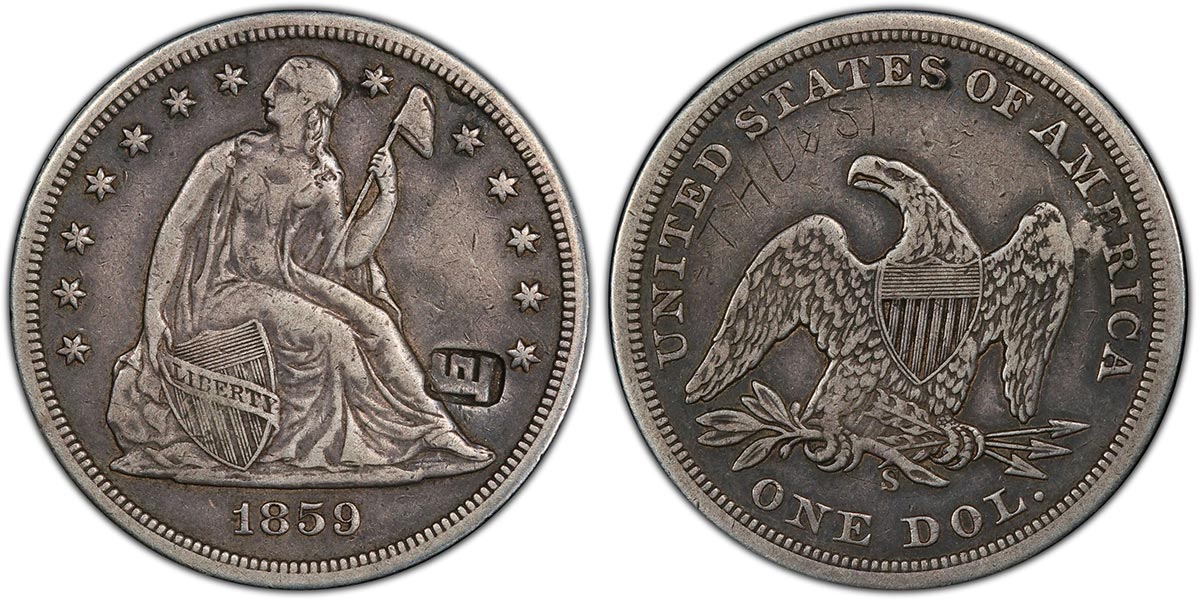
Specifications:
26.73 g (412.5 grains), .900 fine silver, .77344 troy oz (actual silver weight), reeded edge
Recorded mintage: 20,000
Catalog reference: PCGS 6925
Details:
The U.S. Seated Dollar was initially devised as a coin for circulation at home. It was not initially designed for foreign trade, and ultimately failed at this purpose. It
can however lay claim to it's place in numismatic history as the pre-cursor to my favorite series - the U.S. Trade Dollar. At 0.77344 oz. of silver, the U.S. Seated Dollar
is of lower silver content than the Mexican Carolus dollar's 0.7858 oz., the
preferred trade dollar of Chinese merchants at the time.
Because the Chinese merchants favored Mexican Carolus dollars the Mexican coins traded at a premium. In the western U.S., merchants and bankers paid a percentage to convert their silver into the Mexican coinage, in effect making the Chinese goods they were importing more expensive. At some point in the late 1850's, a group of merchants organized and approached San Francisco Mint officials about producing a U.S. silver dollar at the western mint. In 1859 the San Francisco mint produced the modest sum of 20,000 Seated Dollars, the first silver dollar produced out west. It is believed that nearly all of the 20,000 mintage was exported to China.This 1859-S seated dollar is historically significant as, in my opinion, the first U.S. trade dollar albeit in an unofficial capacity.
From Silver Dollars & Trade Dollars of the United States by Q. David Bowers:
Neil Carothers, in Fractional Money (pp. 149-150), noted the following (Carothers obtained this information from Bankers Magazine, Vol. 8, p. 932.) "In 1859 local [San Francisco] merchants presented bullion for coinage into silver dollars for export. When Director Snowden refused the superintendent's request for dies, that official insisted, saying there was a great excess of subsidiary silver in California which might possibly be relieved by the coinage of silver dollars. Snowden yielded to this absurd suggestion." (But see the following quoted passages, which tell a different story.)
The silver trade situation:
John M. Willem, in The United States Trade Dollar, quotes a letter from Charles H. Hempstead, superintendent of the San Francisco Mint, dated November 18, 1858, writing to Director James Ross Snowden that in San Francisco:
We are now attracting to our shores large quantities of silver, in bars, from Mexico, for which we pay in silver coins. By reference to your letter of the fourth of August last, I find that you say that single "silver deposits may be received, but they are only payable in silver dollars or in fine silver bars." We have never received any dies for silver dollars, nor am I aware of the reason why this branch has never made that denomination of coin. I would, therefore, suggest that the coinage of silver dollars (if it be not contrary to the policy of government) would relieve us of just one-half of the labor now necessary in the coinage of large quantities of Mexican silver. (This is in reference to the coining in San Francisco of silver dimes, quarters, and half dollars. It cost nearly twice as much to coin a given amount of silver into two half dollars as it did to make one single dollar, and several times as much to coin 10 dimes.)
On February 19, 1859 Snowden sent this reply:
As the facts stated by you indicate the propriety of coinage of silver dollars at your branch of the mint, I have caused four pairs of dies of that denomination to be prepared and forwarded to you per express. A weight for the adjustment of the coin (from which others can be made) will be found in the box containing the dies.
The San Francisco Bulletin, as quoted by Willem, commented:
The authority to coin silver dollars, received by mail yesterday, is quite an object to the commerce of the Pacific Coast. Crude silver has today been deposited for coinage to the amount of upward of $7,000 by one house in the Mexican trade.
The same source noted that on August 1859 Merchants Magazine related that "every vessel leaving San Francisco for Chinese ports takes a large amount of Mexican dollars."
It's worth noting that silver dollars were not popular for circulation out west, where Gold dollars had much higher demand and usage. This adds support to the idea that these silver dollars were produced with the sole intent to ship them east. Today there are approximately 10 known Seated Dollars with chopmarks, and I believe that approximately 15-25 have survived. As Gullberg states in his book, the reason for this low survivorship is a mystery. Despite the low mintages of Seated Dollars in San Francisco, virtually all of them were shipped east so one would assume the survivorship (with chopmarks) would be higher. When one considers that U.S. Seated Dollars were a massive failure in China, the picture becomes more clear. It is almost certainly true that the vast majority of U.S. Seated Dollars shipped to China were melted.
It's also worth noting that the Hal Walls Collection of World Trade Coins, sold by Paul J. Bosco in August 1997 had a chopmarked 1859-S Seated Dollar, and a couple others have been discovered over the past 5 years.
The description for lot 25 in that sale read as follows:
1859 S. Liberty Seated Dollar. Scarce Date. Large but light chopmark on eagle's right wing. Otherwise VF-30.
The Hal Walls coin sold for $650. Numerous other important coins sold in this same auction, such as a chopmarked 1799 Dollar as well as a chopmarked, uncirculated condition 1878-CC Trade Dollar. I really wish I could have attended this sale and bid on the collection!
An interesting question to consider is how many of the original 1859-S $1 mintage of 20k were melted. I'm not sure the catalogers source, but a 2018 Stack's Bowers auction stated "Alone among San Francisco Mint Liberty Seated dollars of the No Motto type, the 1859-S is an isolated issue most examples of which were produced for a single purpose. Of the 20,000 pieces struck in total, the first 15,000 coins delivered were intended solely for export. Indeed, the San Francisco-based firm of Bolton, Barren & Co. acquired 8,985 of these coins for use in the China trade. Those examples that went overseas -- 75% of the mintage -- were invariably lost through melting. Fortunately for today's collectors, the additional 5,000 pieces making up the total mintage were retained stateside and released into circulation on the West Coast. Survivors of that delivery -- and they are few -- are usually well worn, often impaired, and constitute the majority of 1859-S silver dollars obtainable by today's collectors." (source:Stack's Bowers)
Notable chopmarks:
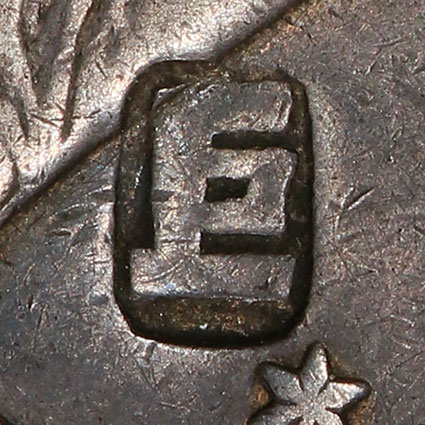 巨 - jù - huge, great
Provenance:
Purchased on eBay in May 2019 from a dealer in Rochester, New York.
(1860) Thailand One Baht
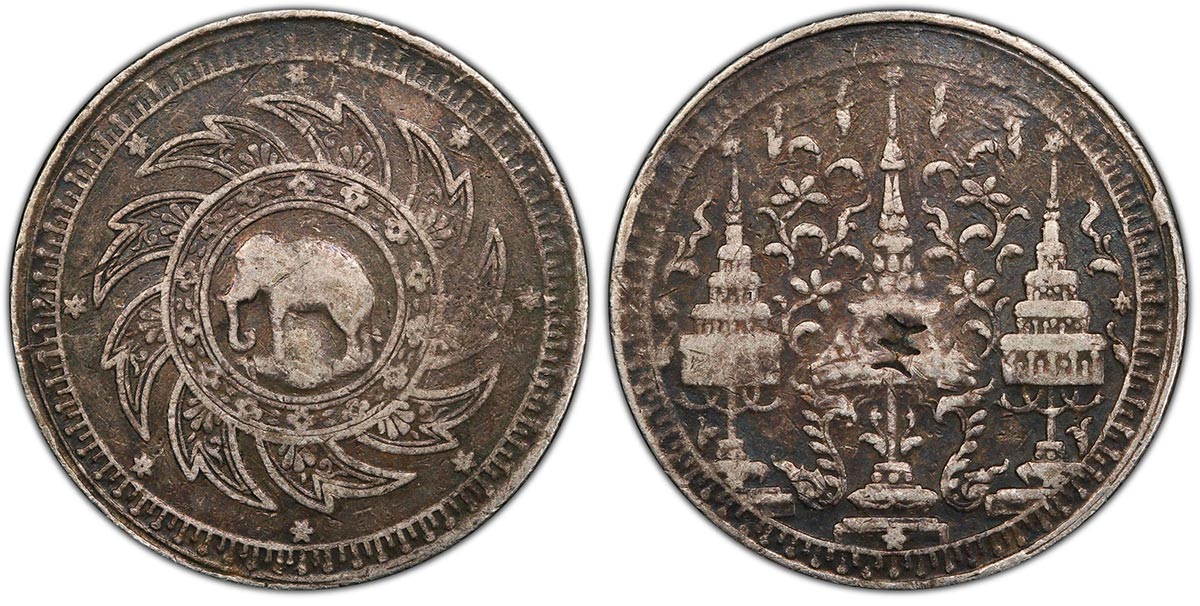
Specifications:
15.4500 g, .9000 fine silver, .4471 troy oz (actual silver weight)
Design: Anepigraphic, with elephant obverse and temple reverse
Recorded mintage: unknown
Catalog reference: KM Y11
Details:
This one baht coin from Thailand represents the first Siamese silver coinage struck using modern, machine-based minting methods, replacing the long-standing indigenous
"bullet coins". Introduced in 1860 and struck over a short period of years, the type reflects a transitional issue rather than a single-year emission. The coin was produced
to a standard of approximately 15.2 or 15.45 grams (depending who you ask) and .900 fine. The obverse depicts a standing elephant facing left, a long-established emblem of
Siamese state authority, while the reverse features a stylized temple structure surrounded by Thai inscriptions identifying the issuing authority and denomination.
The introduction of modern silver coinage in 1860 occurred under the reign of King Mongkut and reflects Siam’s deliberate response to increasing Western diplomatic and commercial pressure in Southeast Asia. Rather than resist external influence, the Siamese court pursued selective modernization aimed at strengthening state institutions and preserving sovereignty. Monetary reform formed a key component of this effort, replacing locally variable bullet silver with standardized coinage that aligned with international expectations of uniformity and legibility while retaining control over weight, fineness, and denominations.
This type is somewhat common with chopmarks, almost always just a single, simple chopmark as seen on this example.
Notable chopmarks:
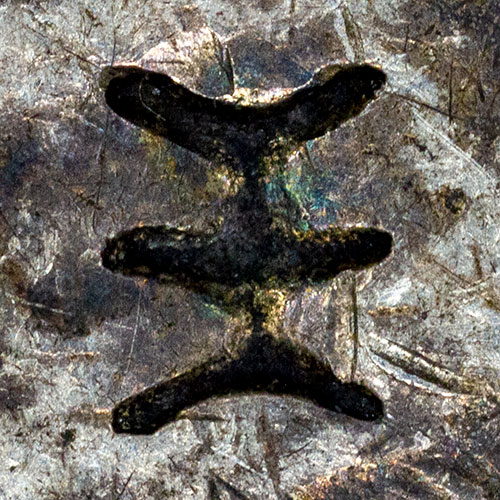 王 - wáng - king, ruler
Provenance:
Purchased on eBay in August 2022 from a seller in West Sussex, United Kingdom.
1862 Spain 20 Reales, Isabel II, Madrid mint (Ex. Rose)
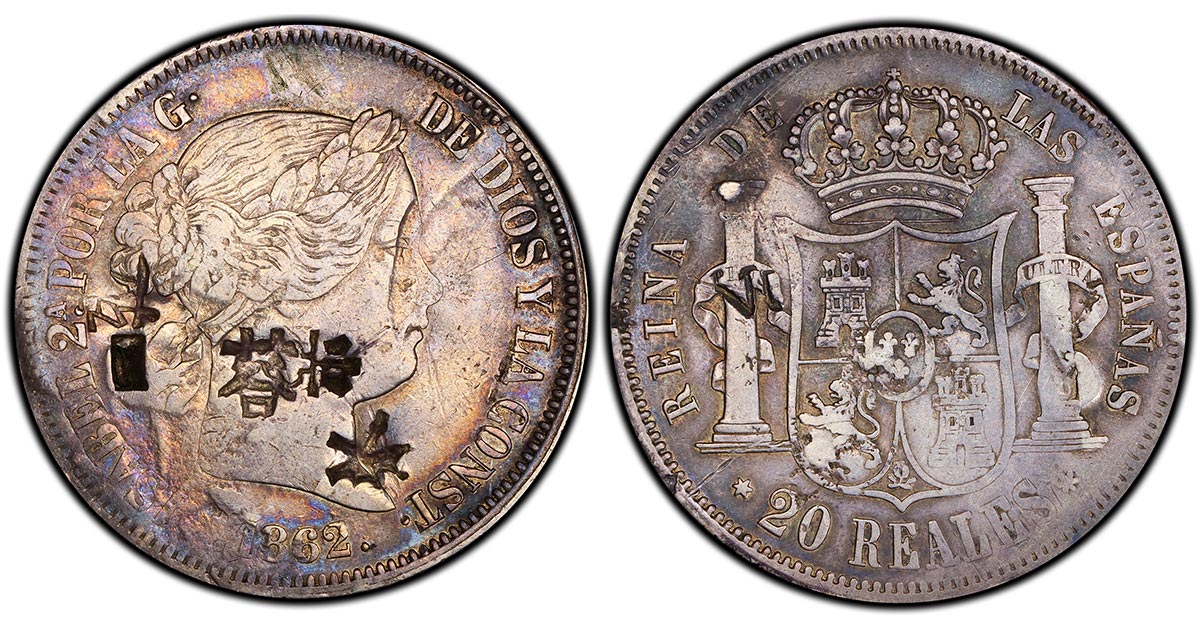
Specifications:
26.291 g, .900 fine silver, .7607 troy oz (actual silver weight)
Recorded mintage: unknown
Catalog reference: KM 609.2
Details:
The 1862 20 reales of Spain, struck under Isabel II, forms part of the mid-19th-century silver series issued at Madrid, Seville, and Barcelona between 1857 and 1864.
Rather than using traditional mintmarks, these coins are distinguished by six, seven, or eight-pointed stars on the reverse, with the six-pointed star identifying the
Madrid mint. Following a monetary adjustment enacted in 1850, the 20 reales was struck to a reduced standard of approximately 26.91 grams, .900 fine, placing it below
the traditional Spanish-American standard. The obverse bears a left-facing bust of Queen Isabel II with surrounding legend, while the reverse displays the Spanish coat
of arms encircled by denomination and mint-identifier stars, executed in a modernized but still recognizably Bourbon style.
The 1850 reform that defined this issue formed part of Spain’s ongoing attempt to rationalize its currency within a vellón-based accounting system, replacing copper maravedís with fractional silver denominations of 1/20, 1/10, and 1/5 real while redefining the large silver unit as the 20 reales. These reforms were undertaken against a backdrop of chronic fiscal weakness, political instability, and mounting public debt. Although the new standard formally reduced the weight of the 20 reales, the Spanish government lacked the resources to withdraw or remint older issues, resulting in the continued circulation of mixed-standard silver alongside the new coinage. This coexistence of legacy and reformed issues undermined the effectiveness of the reform and foreshadowed the further restructuring of Spain’s monetary system in 1866, when more comprehensive changes were again attempted.
This type is fairly rare with chopmarks, I've only seen a few after many years of searching.
Notable chopmarks:
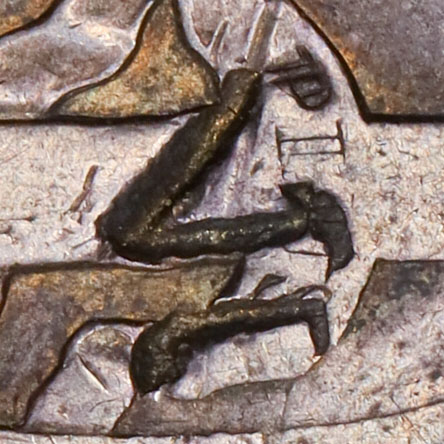 Partial 台 - tái - platform, tower, Taiwan
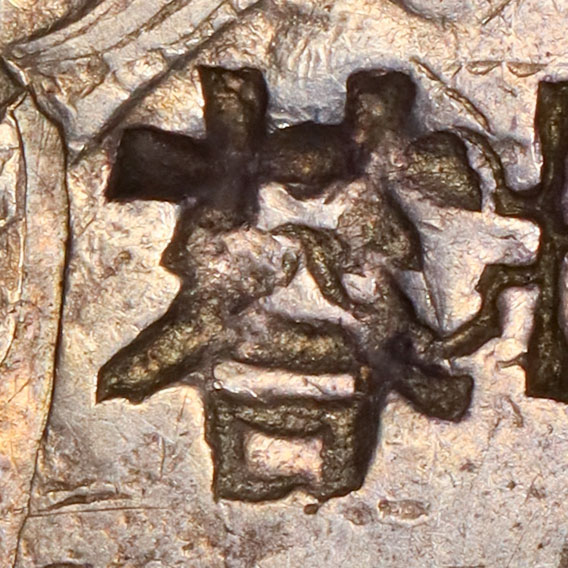 荅 - dá - answer, pea
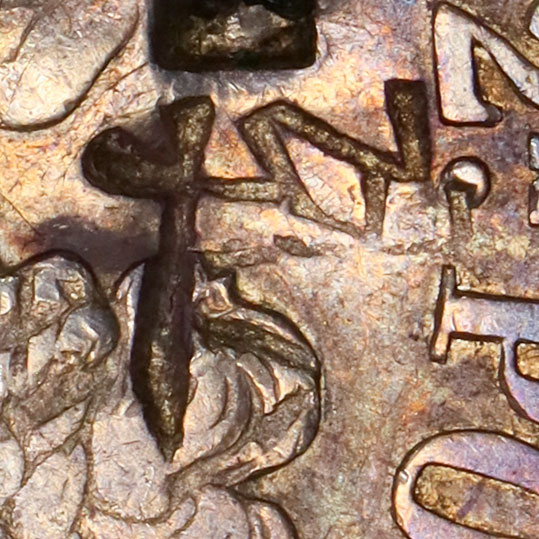 Unknown partial chopmark
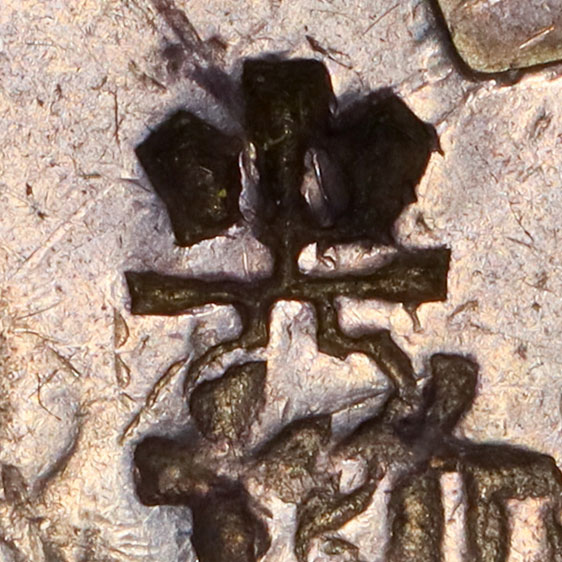 Unknown symbol
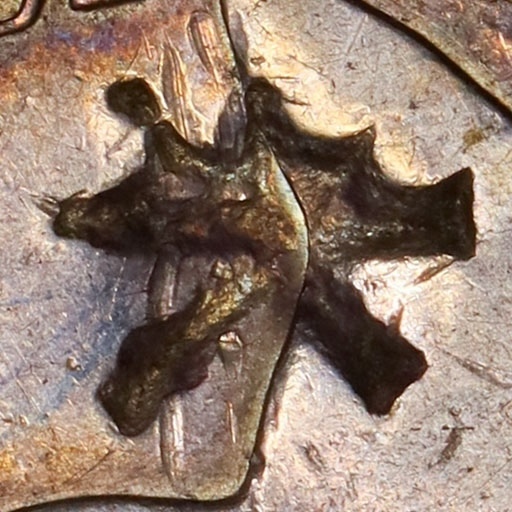 Possibly 兴 - xīng - rise, prosper
or
水 - shuǐ - water
Provenance:
From the Stack's Bowers October 2023 Hong Kong Foreign Coins Part 2, Session K
Lot #34500
Auction Description:
SPAIN. 20 Reales, 1862. Madrid Mint; mm: 6-pointed star. Isabell II. PCGS Genuine--Damage, VF Details.
KM-609.2. An interesting and relatively late Spanish emission to have chopmarks, this piece has several boldly impressed characters on the obverse, with an additional few
on the reverse. Good luster is retained on the 20 Reales, with alternate deep and golden tone interspersed throughout the flan. An impressive example for the connoisseur of
chopmarked coinage.
Estimate: $500 - $1,000.
Provenance: From a New York Gentleman's Collection.
Previously from the Journal of East Asian Numismatics Mail Bid Sale #8, August 18, 1998, lot 36.
Auction Description:
Spain. 20R. (1862) Rare coin (Cat $425/2000) Extremely rare as host coin. Ex. Krueger Auction. (#33. 6/11/1981) Estimate 300-400
Previously from the Kurt R. Krueger 1981 G.S.N.A. Auction, June 11, 1981 (lot 1531) where we can assume Frank Rose originally purchased this coin.
Ex. Frank Rose Collection, plated as figure 33, page 12 in his groundbreaking book "Chopmarks".
1863 Real de Catorce Mexican 8 Reales
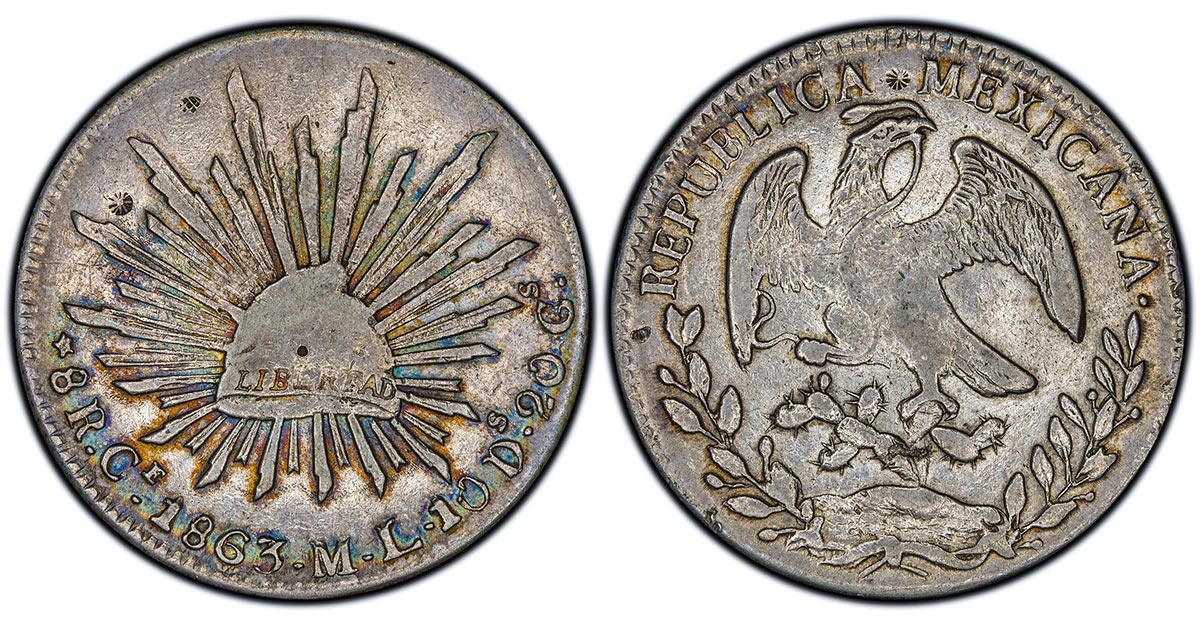
Specifications:
27.07 g, 0.903 fine silver, 0.7859 troy oz (actual silver weight)
Recorded mintage: unknown
Catalog reference: KM 377.1
Details:
An enigmatic issue that appears to be a one year type, although it is recorded that the mint operated until 1869. However, all known coins produced - 2, 4 and 8 reales
are dated 1863. Minting activity at Real de Catorce was irregular as political control shifted and fiscal pressures intensified. While the coin is scarce in general
numismatic contexts, it's clear that many, if not most of these coins were exported to China. It seems more common to see one with chopmarks than without, but this means collectors of the
Cap & Rays series are typically ok with chopmarks on this issue, when otherwise they might not be.
Notable chopmarks:
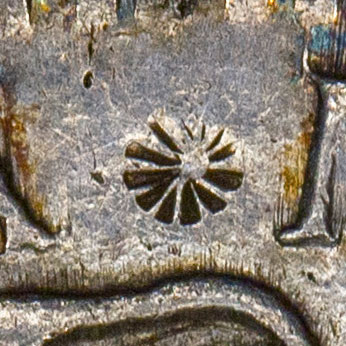 Chrysanthemum (菊花)A radiating chrysanthemum or sunburst. The chrysanthemum (菊花, júhuā), one of the Four Noble Plants, is an emblem of longevity and noble endurance (菊 jú echoes 久 jiǔ, 'long-enduring'); read as a sunburst it carries connotations of brightness and vitality. Sunburst marks are among the more common abstract chopmarks.
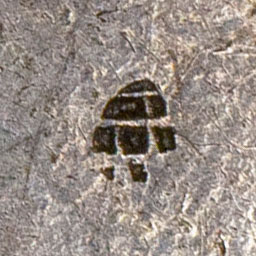 Small unknown chopmark
Provenance:
From the Stack's Bowers June 2021 World Collector's Choice Online Auction
Lot #72281
Auction Description:
MEXICO. 8 Reales, 1863-Ce ML. Real de Catorce Mint. NGC VF Details--Chopmarked.
KM-377.3; DP-Ce01. A well struck and nicely detailed example of this RARE issue, with a few unobtrusive chopmarks and colorful toning in a few of the protected areas.
Estimate: $400 - $600.
1867 British Hong Kong Dollar
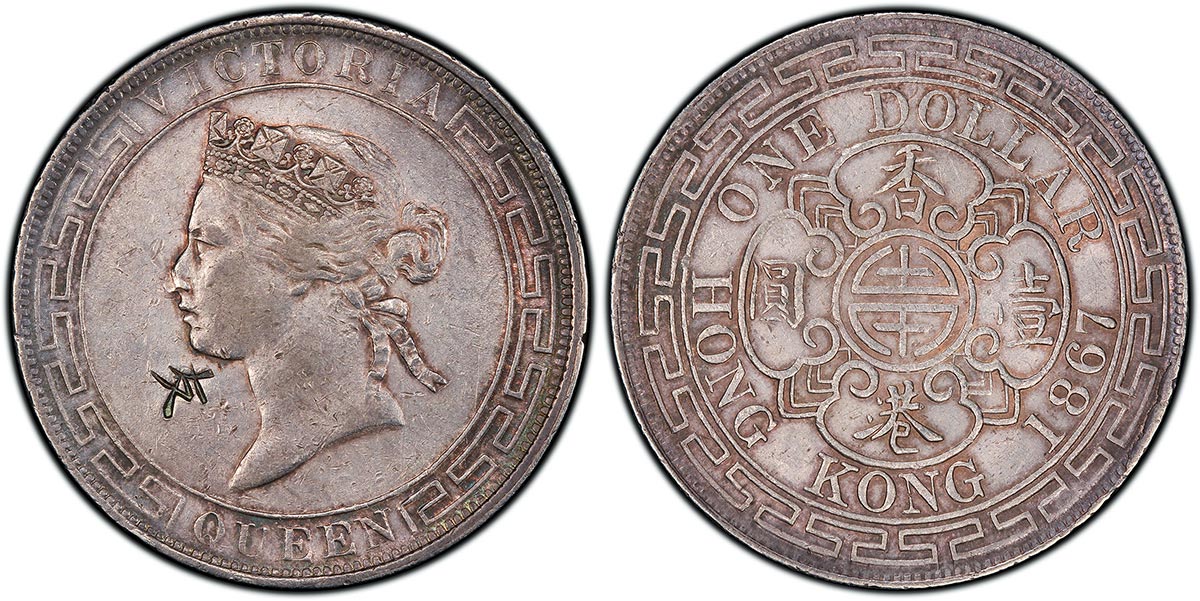
Specifications:
26.96-27.25 g, 0.900 fine silver, 0.780-0.788 troy oz (actual silver weight)
Recorded mintage: 2,109,000 for 1866-68
Catalog reference: KM 10
Details:
The 1867 dollar of Hong Kong was struck for circulation under the authority of the British Crown and bears a left-facing portrait of Queen Victoria on the obverse.
The reverse features a Chinese meander pattern surrounding the four characters 香 (Hong), 圓 (dollar), 壹 (one), and 港 (Kong), conveying “Hong Kong One Dollar”
in Chinese for local recognition, in addition to ONE DOLLAR and HONG KONG written in plain English, along with the date.
The Hong Kong dollar was one of several mid-19th-century British attempts to introduce an imperial silver coin capable of competing with the entrenched Mexican 8 reales in the China trade. The type was struck only briefly, from 1866 to 1868, with a total recorded mintage around 2.1 million pieces, reflecting both limited demand and limited confidence in the experiment. Beyond technical inconsistency, acceptance was further hindered by cultural factors: Chinese merchants were accustomed to verifying silver through chopmarking, and contemporary accounts suggest that uncertainty over whether defacing the Queen’s portrait would be considered offensive discouraged routine use. This is of course difficult to confirm - either way, the result was a coin that failed to displace established trade silver and was quietly abandoned after only three years.
Despite its commercial failure, the Hong Kong dollar is not difficult to find with Chinese chopmarks, indicating that a portion of the mintage did enter circulation and undergo verification.
Notable chopmarks:
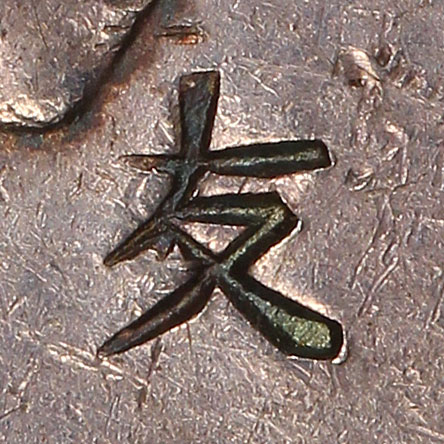 友 - yǒu - friend, friendliness
Provenance:
From the Stack's Bowers November 2015 Baltimore sale Lot #39254
Auction Description:
HONG KONG. Dollar, 1867. PCGS Genuine--Chopmark, AU Details Secure Holder.
KM-10; Mars-C41. Highly sought after in any condition. A single chop beneath the queen's chin results in the net details assignment, otherwise fully original with pleasant gray
surfaces and abundant detail for the assigned grade.
Estimate: $400 - $600.
1867-Mo Maximilian Peso - Mexico
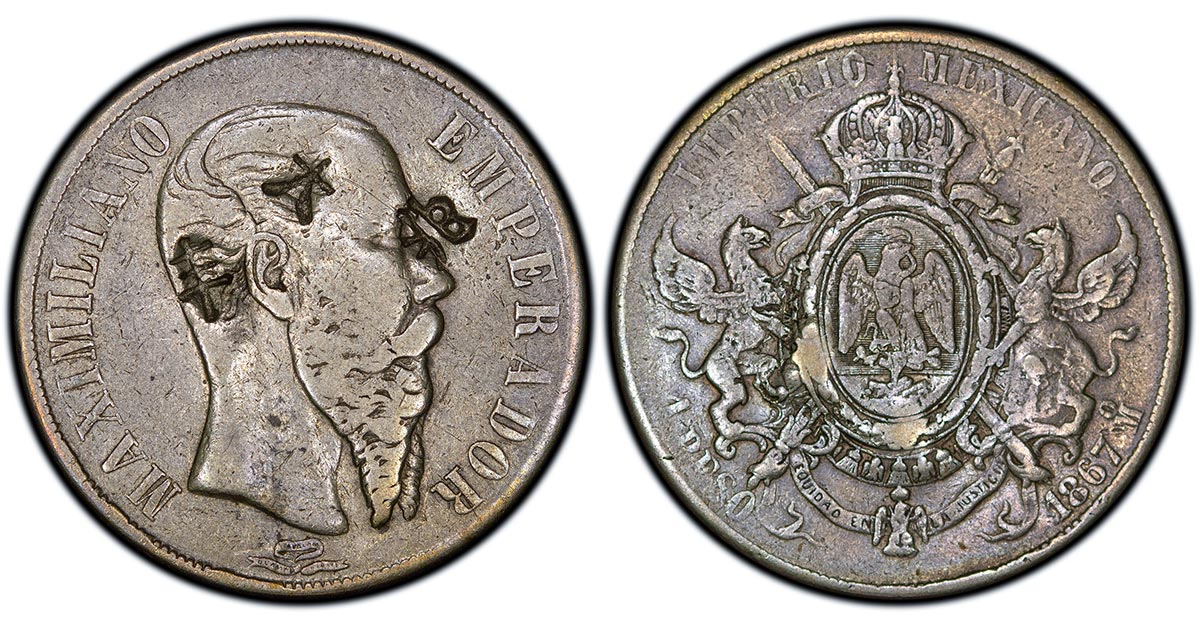
Specifications:
27.07 g, .903 fine silver, .786 troy oz (actual silver weight)
Recorded mintage: 1,238,000
Catalog reference: KM 388.1
Details:
In 1861, growing Mexican debt held by countries such as Spain, the United Kingdom, and France began to cause strained relations between the fledgling New World democracy
and the longstanding monarchies of the Old World. Financing the recent Mexican-American War, in particular, was a chief contributor, with Mexican President Benito Juárez
suspending payment of foreign debts in order to stabilize the treasury. The trio of monarchies used this default as a pretext for more pointed demands, namely, they sent naval
forces to bolster their call for repayment. While Spain and the United Kingdom reached amicable terms with Mexico, France had an ulterior motive, in that she wished to use
the financial dispute as the pretense for an invasion in hopes of establishing a client empire in Mexico.
Though the outnumbered Mexican forces were surprisingly successful in one of the conflict’s earlier skirmishes, the well-known Battle of Puebla on the fifth of May (Cinco de Mayo), the might of the French forces proved too strong. The resulting victory brought about the installation of Emperor Maximilian, an Austrian archduke and the younger brother of the Austro-Hungarian Emperor, Franz Joseph. While the United States did not play a role in the conflict and subsequent transfer of power, the position of Washington was that Juárez’s government was still, in fact, legitimate, and that this incursion of French influence in the New World was in direct violation of the Monroe Doctrine. However, Washington had bigger issues at hand, as the American Civil War prevented any resources from being provided.
Maximilian’s reign was rather brief and seemingly doomed from the start, as his imperial forces never fully defeated the republicans under Juárez; the emperor’s grasp on power always needed the support provided by France. Following America’s emergence from the Civil War, attention was focused upon assisting the republican forces and lessening France’s influence in the region. These factors spelled the end for Maximilian, as he was forced to flee Mexico City, and was ultimately captured during a siege in Querétaro City. Maximilian was tried and executed in June 1867, ending a rule that lasted just over three years. (source: Stacks)
Another short-lived issue, just like the British Hong Kong Dollar above. The Maximilian Peso from Mexico was issued from just 1866-1867. Of note, this Peso is the first Mexican coin to abandon the 8 Reales denomination. Quite rare with chopmarks, it is estimated that just 10-20 exist. It is my understanding that all known are from the Mexico City mint.
Notable chopmarks:
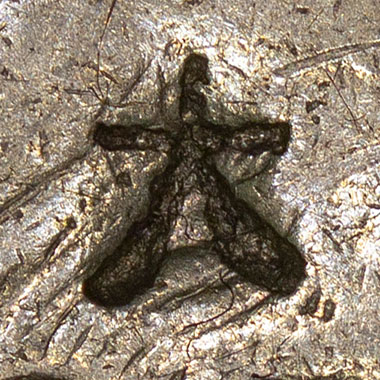 大 - dà - big, great, large
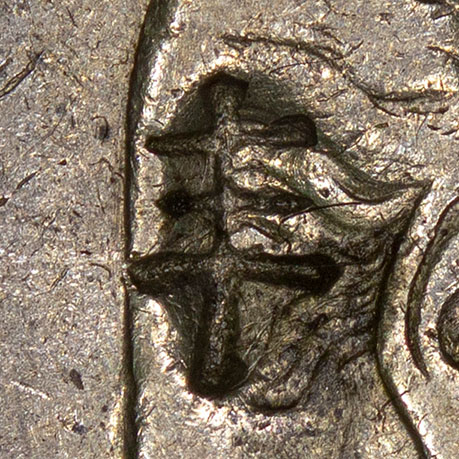 丰 - fēng - abundant, plentiful
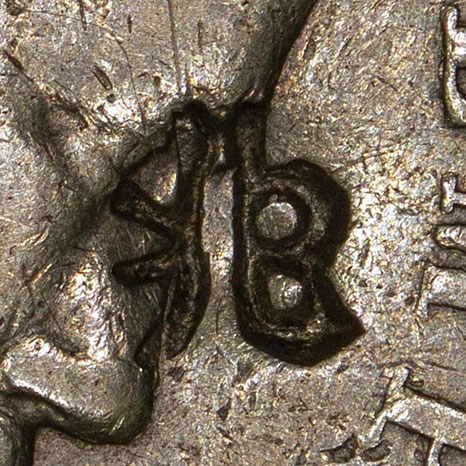 possibly 北 - běi - north
Provenance:
From the Frühwald Auction 117 sale (Germany) December 2015
Lot #1576
Auction Description:
Maximilian von Österreich 1864 - 1867 Peso 1867 Mo, Mexico City, mit Chinesischen Chopmarks, KM 388.1 f.ss
1867 Netherlands 2 1/2 Gulden (Rijksdaalder) William III (Ex. Bowman)
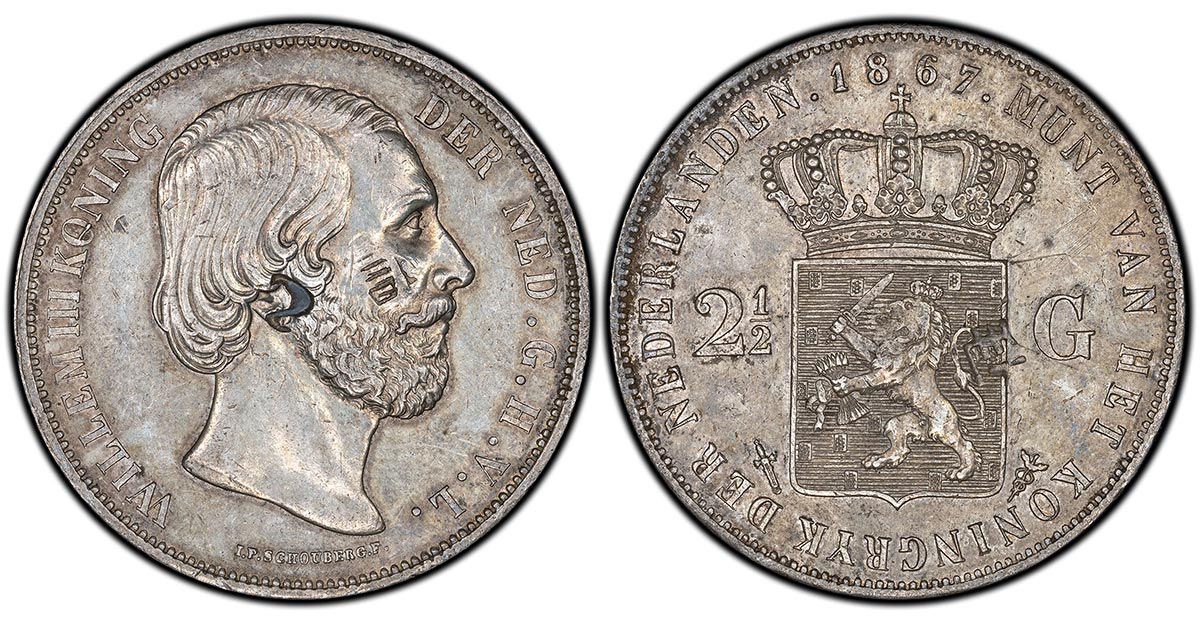
Specifications:
25.0 g, .945 fine silver, .7596 troy oz (actual silver weight), 38 mm diameter
Recorded mintage: 4,948,886
Catalog reference: KM 82
Design: 38mm, smooth with lettered edge "GOD ZY MET ONS "
Details:
This 1867 Netherlands 2 1/2 Gulden, or Rijksdaalder, was struck at the Utrecht mint and belongs to a type minted between 1849 and 1874. This coin is composed of 25.00g silver
with an uncommonly high fineness of .945, significantly more pure than the .903 fineness of the Spanish 8 Reales, although containing 3% less fine silver overall. The design
features the profile of King William III with the legend "WILLEM III KONING DER NED. G.H.V.L." (William III King of the Netherlands, Grand Duke of Luxembourg), while the reverse
shows the crowned national arms flanked by the denomination and the legend "MUNT VAN HET KONINGRIJK DER NEDERLANDEN" (Coin of the Kingdom of the Netherlands). A unique design
choice is the relief edge lettering "GOD ZIJ MET ONS" (God Be With Us), which served as a security measure to prevent silver from being shaved from the rim.
The political context of this coin is defined by the Netherlands' role as a veteran maritime power navigating the shifting bullion markets of the 19th century. Numismatically, the Gulden was the backbone of a Dutch monetary system that remained influential in the East Indies even after the decline of the Dutch East India Company (VOC). While most silver flowing into China consisted of coins like the Spanish 8 Reales that were minted specifically for export, the Rijksdaalder was a domestic issue. Its presence in the East was typically the result of Dutch merchant houses or sailors carrying personal funds from Amsterdam to the trade hubs of Batavia and eventually the China coast.
This type isn't rare or common with chopmarks, I usually come across 3-5 of them a year. Clearly it wasn't exported in large quantities, but enough made it to China that this type can be found with chopmarks with a little patience.
Notable chopmarks:
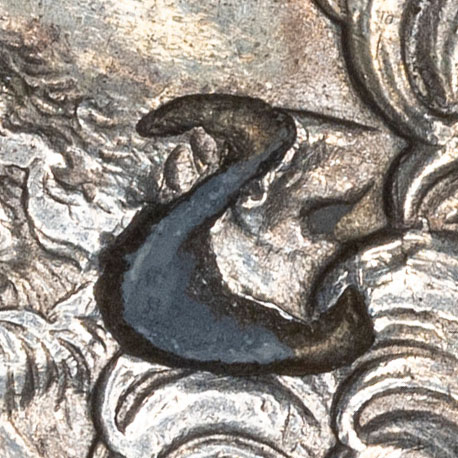
 - Cursive (Caoshu) script variant of 乙 - yǐ - second, 2nd heavenly stem
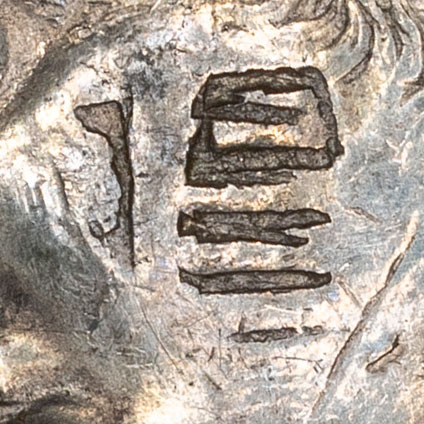 Unknown chopmark
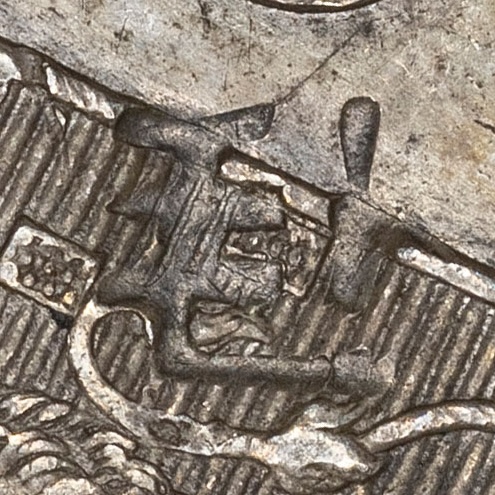 Appears to be a mirror image of 迋 - wàng - fear, deceive
Provenance:
Purchased on eBay in March 2024 from a seller in Spring, Texas.
Ex J.D. Bowman, one of the original contributors to the Chopmark Collectors Club newsletters, who assembled one of the finest chopmark collections of all time. Bowman worked closely with Santa Barbara coin dealer Paul Brombal, in fact J.D. credits Paul with "most all of my chops he got for me in Singapore, Hong Kong & Manilla over the years."
1868 France 2 Francs (Paris mint)
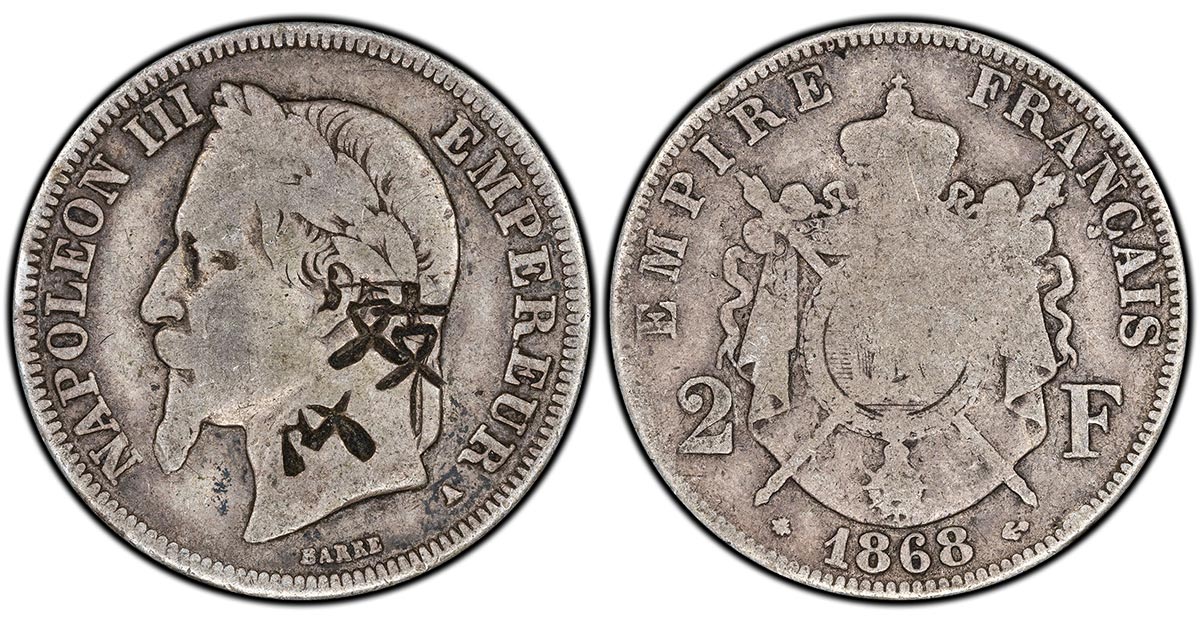
Specifications:
10.00 g, .835 fine silver, .2685 troy oz (actual silver weight)
Recorded mintage: 2,564,453
Catalog reference: KM 807.1
Details:
The 1868 French 2 Francs was struck at the Paris mint, denoted by the "A" mintmark, and belongs to a type minted between 1866 and 1870. This coin is composed of 10.00g silver,
.835 fine, a standard recently lowered from the previous .900 fineness to prevent hoarding and melting of subsidiary coinage. The mintage for this date/mint was 2,564,453
pieces. The obverse features the laureate head of Emperor Napoleon III with the legend "NAPOLEON III EMPEREUR," while the reverse displays the imperial coat of arms surrounded
by the legend "EMPIRE FRANÇAIS" (French Empire) and the denomination "2 FRANCS." The edge is reeded, a standard security feature for the era's milled coinage.
The political context of this coin is defined by the height of the Second French Empire and the establishment of the Latin Monetary Union (LMU) in 1865. The LMU was an ambitious attempt to unify several European currencies, including those of France, Belgium, Italy, and Switzerland, under a single bimetallic standard. While the Spanish 8 Reales and Mexican pesos were the dominant "large" silver of international trade, the French Franc system provided the essential "small change" for colonial administration and merchant transactions. This period also saw French influence expanding deeply into Indochina, which created a formal bridge for French currency to enter the wider East Asian maritime economy.
This type is rare with chopmarks, as the 2 Francs was a subsidiary coin rather than a primary trade bullion piece like the 5 Francs or the 8 Reales. While larger denominations were favored for major commerce, smaller French silver often entered China through the French Concession in Shanghai or via trade with French Indochina. The presence of a chopmark on a fractional coin of .835 fineness is a good example of the bullion based system that approved good silver, not familiar types. This coin might have reached the China coast in the pocket of a merchant or sailor, eventually being accepted into local circulation as a verified fractional unit of silver.
Notable chopmarks:
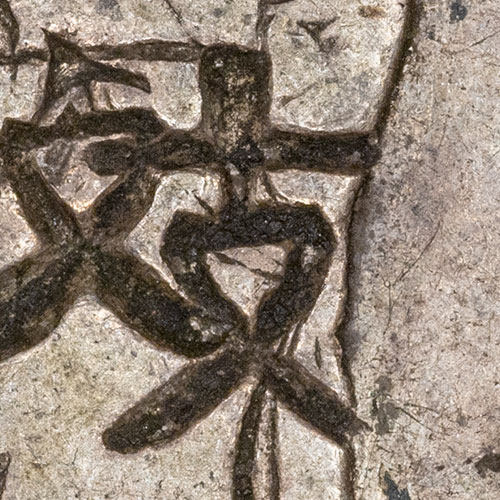 支 - zhī - branch, support, pay
Provenance:
Purchased from a dealer in Hong Kong through Ben Dalgleish in May 2023.
1870-CC United States Seated Dollar, Carson City, Nevada Mint
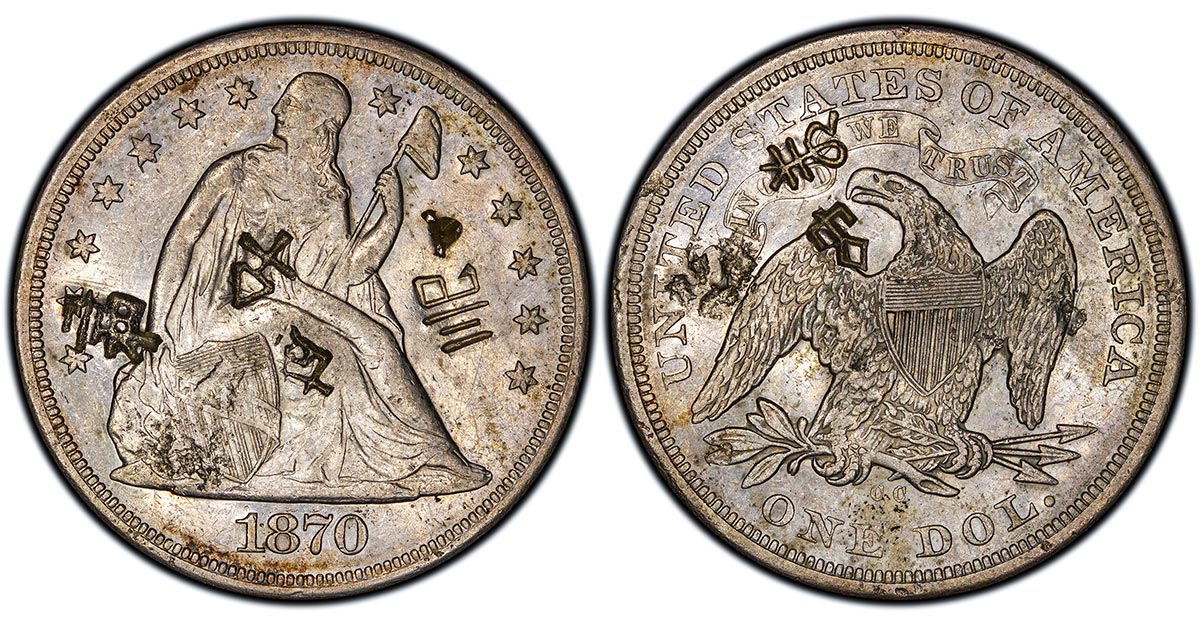
Specifications:
26.73 g, 0.900 fine silver, 0.7734 troy oz (actual silver weight)
Recorded mintage: 12,462
Catalog reference: PCGS #6964
Details:
The 1870-CC Seated Liberty Dollar was struck at the newly established Carson City Mint in Nevada and belongs to a type minted from 1840 to 1873. The coin contains 26.7g,
.900 fine silver, approximately 98.4% of the standard Spanish 8 Reales. The mintage for this specific date and mint was 12,462 pieces, marking it as a significant rarity
within the series. The obverse features the Christian Gobrecht design of Liberty seated on a rock, holding a staff topped with a Phrygian cap, while the reverse depicts
an eagle clutching an olive branch and arrows. The legend "UNITED STATES OF AMERICA" and the denomination "ONE DOL." surround the eagle, with the distinctive "CC" mintmark
positioned below.
The political and economic context of this coin is inextricably linked to the American "Wild West" and the discovery of the Comstock Lode. The Carson City Mint was established specifically to convert Nevada’s massive silver deposits into coinage, reducing the need to transport bullion over the Sierra Nevada mountains to San Francisco. At the time of mintage, the United States was navigating the post-Civil War Reconstruction era and debating the future of the silver standard. Numismatically, the Seated Dollar was a "heavy" unit intended for domestic use and international settlement, though much of the silver from the Comstock would eventually be diverted to the production of the Trade Dollar in 1873 intended to compete in the markets of East Asia.
This type is rare with chopmarks. The Seated Liberty Dollar did not reach the Far East in nearly the same quantities as the US Trade Dollar. Most 1870-CC dollars remained in the American West or were lost to the melting pot following the Specie Payment Resumption Act. This coin likely reached the China coast via the port of San Francisco, perhaps carried by a merchant or a returning laborer involved in the burgeoning trans-Pacific trade between the American West and the Pearl River Delta.
Notable chopmarks:
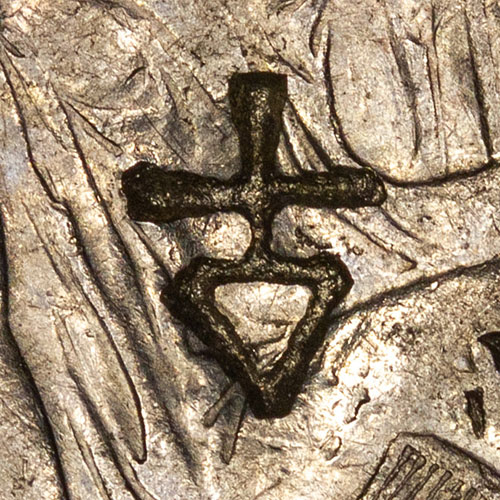 古 - gǔ - ancient, old
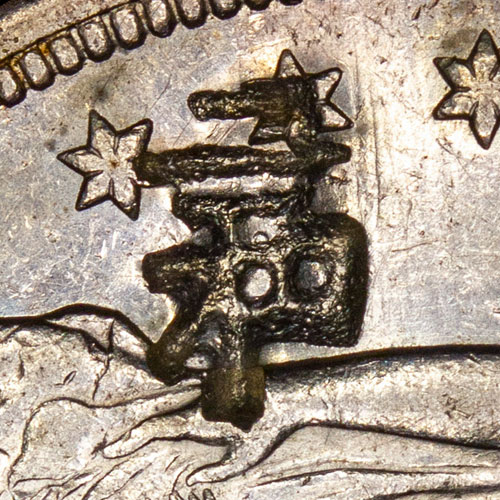 和 - hé - harmony, peace, and
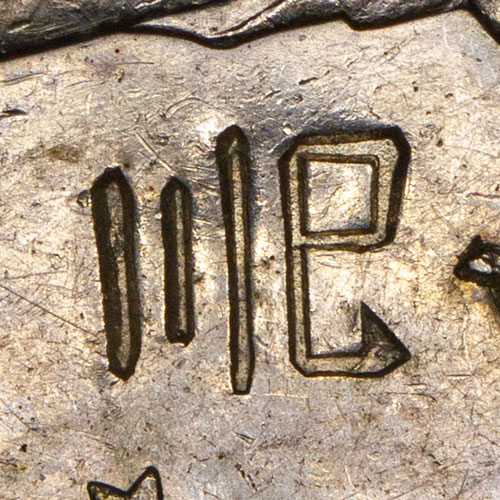 Combination of 川 and 巳 - unknown meaning
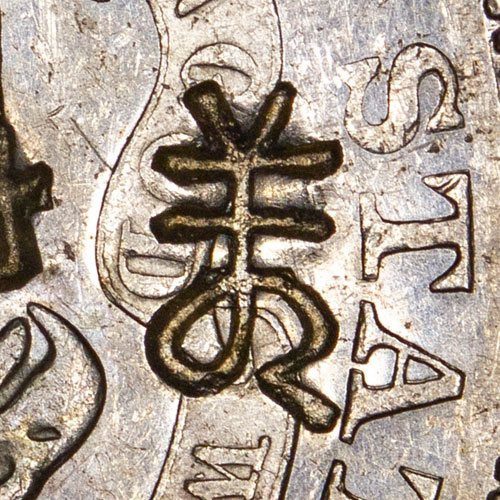
 - Cursive (Caoshu) script variant of 羊 - yáng - a sheep, surname Yang
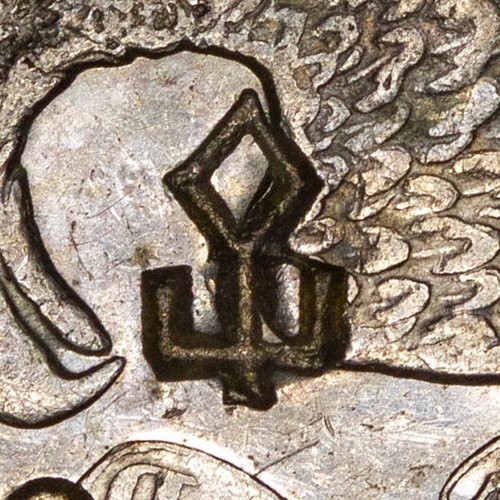 Possibly 旵 or 仚 or 屳
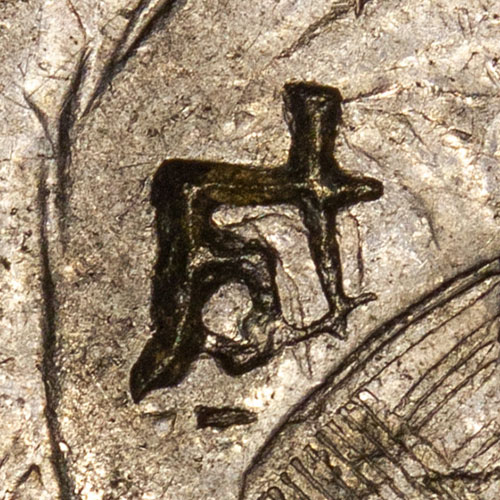 成 - chéng - accomplish, become, complete
Provenance:
Purchased from New York dealer Andy Lustig in November 2019
Meiji 3 (1870) Type 1 Japan Yen (Ex. Waddell)
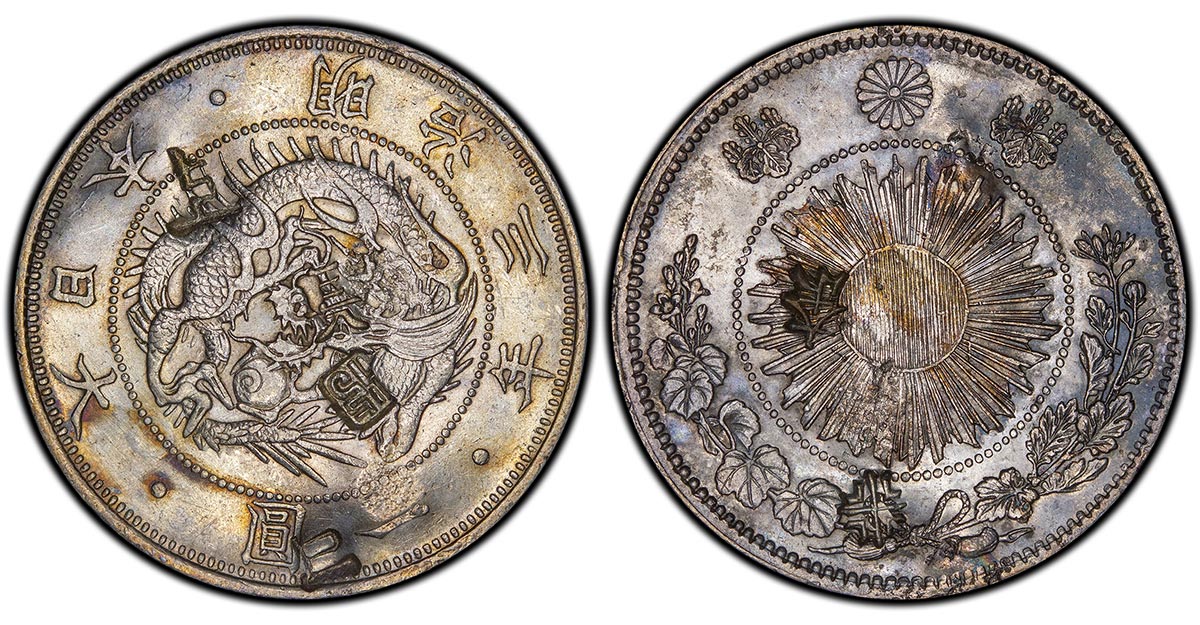
Specifications:
26.9568 g, 0.900 fine silver, 0.780 troy oz (actual silver weight)
Recorded mintage: 3,685,049
Catalog reference: KM Y5.1
Details:
The Meiji 3 (1870) Japan Yen was struck at the Osaka Mint and represents the inaugural year of Japan’s modern milled silver coinage. This coin belongs to a design type minted
only in 1870. The coin contains 26.96g, .900 fine silver, approximately 99.4% of the standard Spanish 8 Reales, with a mintage of 3,685,049 pieces. The design features a
powerful coiled dragon on the obverse surrounded by the legends 明治三年 (Meiji Year 3) and 大日本 (Great Japan). The reverse depicts a central Rising Sun sunburst surrounded by
a wreath of paulownia and chrysanthemum, symbolizing Imperial authority.
Politically, this coin emerged during the early Meiji Restoration, a period of radical modernization as Japan transitioned from a feudal shogunate to a centralized imperial state. Numismatically, the New Coinage Act of 1871 officially established the Yen as the decimal unit, intending to replace the older system of rectangular "bu" and "shu" coins with a currency that could compete in international trade. The Osaka Mint was outfitted with machinery purchased from the former British mint in Hong Kong, emphasizing Japan's desire for global parity. While Japan utilized domestic silver, the metal for these early issues was also sourced from imported bullion and the melting of older Japanese coinage.
This type is relatively common with chopmarks, as the Japanese Yen was specifically designed to compete with the Mexican Peso and the Spanish 8 Reales in East Asian markets. Because it adhered so closely to the weight and fineness of the established trade dollars, it was readily accepted by Chinese merchants. This coin likely traveled to China through the flourishing trade routes between Nagasaki, Kobe, and treaty ports like Shanghai or Canton. Its presence with chopmarks illustrates the success of the Meiji government’s ambition to have their currency recognized as reliable bullion in the broader regional economy.
Notable chopmarks:
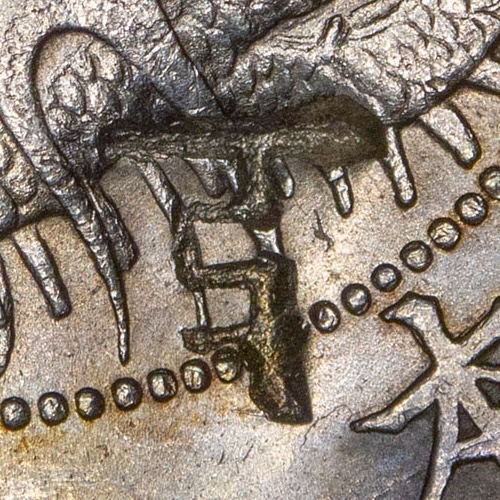 Unsure about this one, possibly 与 - yǔ - and, with, give
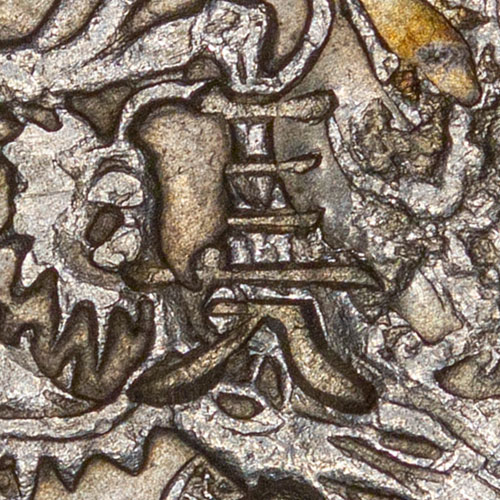 Unknown Japanese chopmark
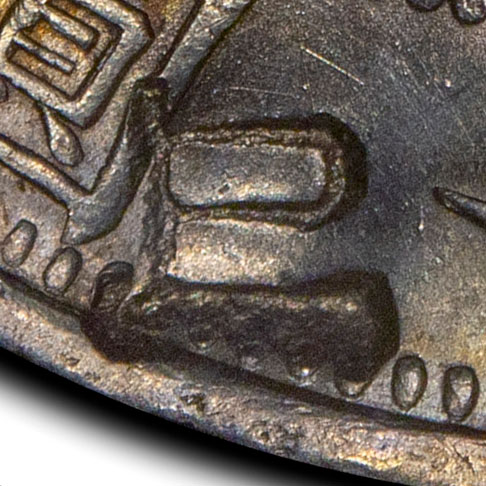 Unknown chopmark
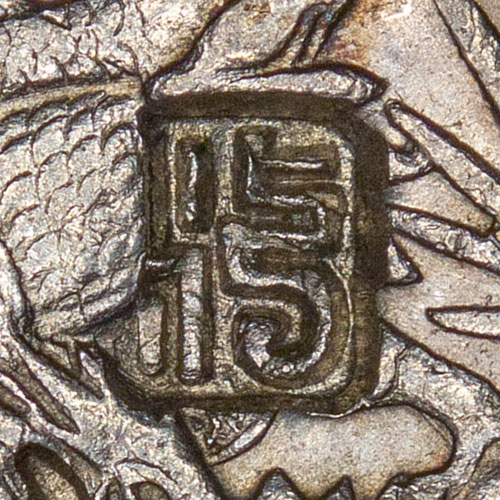
 - Liushutong script variant of 江 - jiāng - river, Yangtze
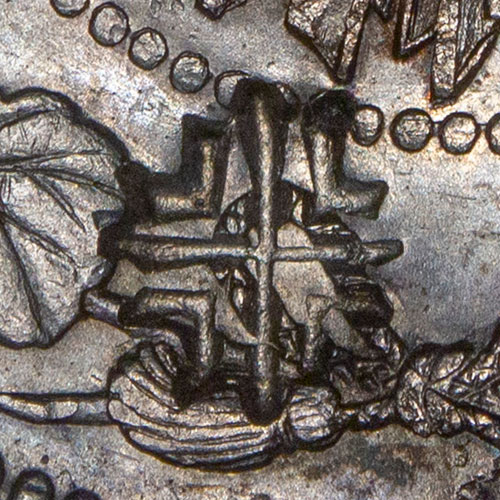 Symbol chopmark often seen on coins
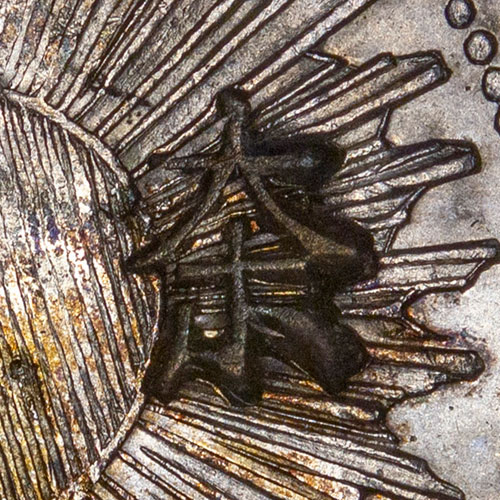 Possibly 㚓 - lǎi - tie-beams of a small boat
Provenance:
From the Ron Waddell Collection
Purchased from Ron via private sale in September 2016
1870 Spain 5 Peseta
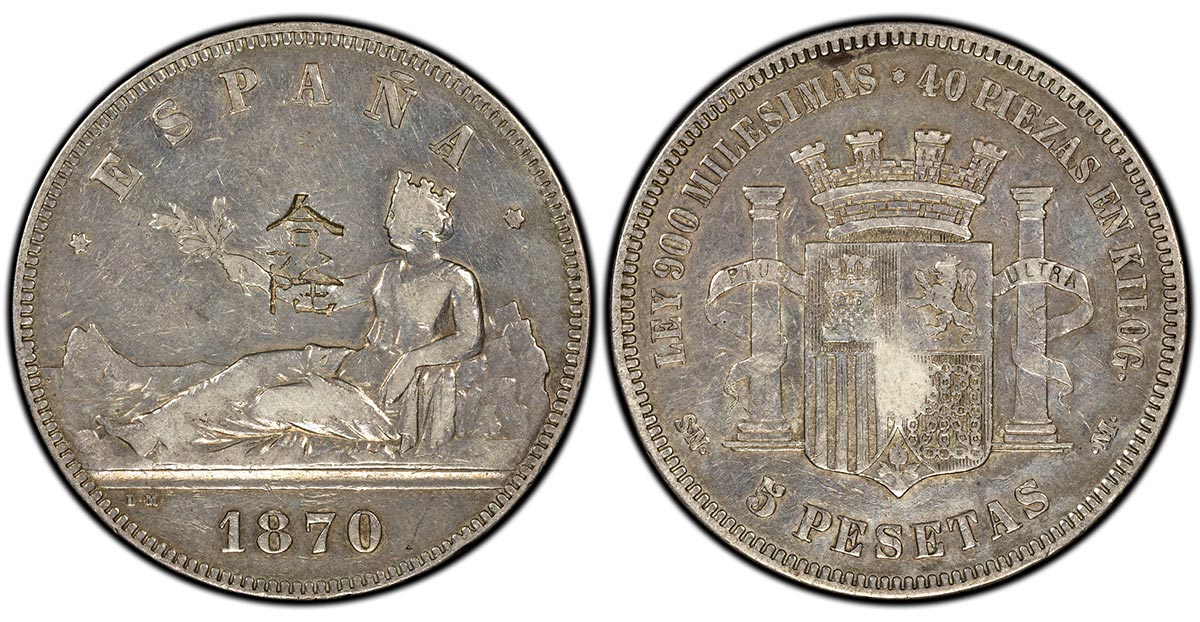
Specifications:
25.000 g, 0.900 fine silver, 0.7234 troy oz (actual silver weight)
Recorded mintage: 5,923,455
Catalog reference: KM 655
Details:
The 1870 Spain 5 Pesetas was struck at the Madrid mint and belongs to a type minted only in 1870, though some were restruck in later years. The coin contains 25.0g, .900
fine silver, approximately 92.6% of the standard Spanish 8 Reales, with a mintage of 5,923,455 pieces. The design features a personification of Hispania reclining against
the Pyrenees mountains on the obverse, with the legend "ESPAÑA" and the date. The reverse displays the crowned national arms flanked by pillars and the legend "LEY 900
MILESIMAS 40 PIEZAS EN KILOG." (900 Thousandths Fineness 40 Pieces per Kilogram) above the denomination "5 PESETAS." The edge is decorated with relief stars, a distinctive
security feature of the era's Spanish milled coinage.
Politically, this coin was issued by the Provisional Government following the Glorious Revolution of 1868, which saw the deposition of Queen Isabella II. This period of transition was marked by a shift toward modernization and European integration, specifically through the adoption of the decimal Peseta to align Spain with the standards of the Latin Monetary Union (LMU). The 5 Peseta piece was designed to be the Spanish equivalent of the French 5 Francs, facilitating easier trade across the Mediterranean and with LMU member nations. The silver for these coins was largely sourced from Spain's own historic domestic mines, such as those in the Rio Tinto and Cartagena regions, which saw a resurgence in production during the mid-19th century.
This type is pretty rare with chopmarks, in fact I'm not even sure this chopmark is a legitimate mark placed by a shroff in Qing era China. While it was a domestic European issue, Spanish merchant houses and maritime interests maintained active connections with the Philippines and the China coast. This coin likely reached China via Spanish colonial trade routes through Manila or by way of European commercial vessels docking at major treaty ports like Hong Kong and Shanghai.
Notable chopmarks:
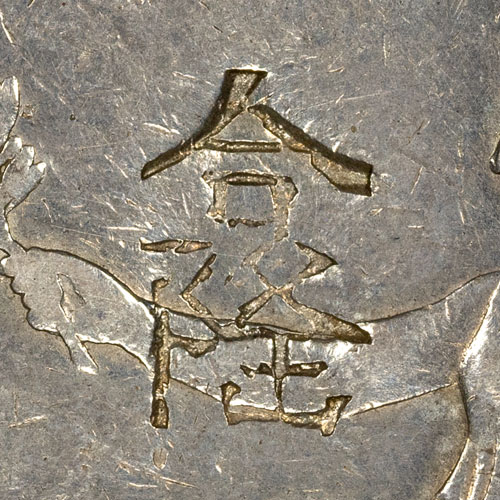 合隆 - hé lóng - Helong, 'united prosperity' (a common auspicious merchant or shop name); 合 ('unite, combine, partnership') with 隆 ('prosperous, abundant') - Read top-to-bottom on this vertical stamp as 合 (hé, 'to unite, combine, join'; the partnership sense seen in 合伙, 'partnership') over 隆 (lóng, 'prosperous, plentiful, abundant'). Together 合隆 reads as 'united prosperity' or 'joined abundance', a textbook auspicious trade name (商號): 隆 is one of the stock high-frequency prosperity characters in Chinese shop names (compare 興隆, 昌隆, 永隆), and 合 is a common partnership element, so the pair names a firm or money shop rather than describing the coin. 合隆 is a genuinely recurring business name, still carried by firms in Hong Kong and Taiwan today (romanized Hop Lung or Ho Lung in Cantonese areas), though those are later namesakes and the specific 19th-century shop behind this chop cannot be identified. As a chopmark it most likely identifies the merchant house, partnership or money shop that tested the coin and accepted it as genuine silver; fittingly, the Manila auction that sold this coin noted that chopmark experts read the mark as a shop or bank name. The piece is a Spanish home-issue 5 pesetas rather than a Spanish-American 8 reales, which makes a Chinese chopmark unusual on it, so it most likely reached Chinese hands through the Manila trade or a treaty port such as Hong Kong.
Provenance:
From the León Exchange 33rd Online Auction, November 2024 (Manila, Philppines)
Lot #104
Auction Description:
An Interesting Spanish Silver Coin With A Chinese Chopmark
An 1870 5 peseta Spanish coin with the design of a reclining crowned Hispania leaning on the Pyrenees with Gibraltar at her feet and olive branch in her right hand on the
obverse and the crowned coat of arms of Spain on the reverse. What makes this coin interesting is the Chinese chopmark found on the obverse, which is uncommon for issues
like this. Chopmark experts described the mark as depicting the name of a shop or a bank’s name.
Diameter: 37mm Weight: 25 grams
1871 Colombia Peso, Medellin mint
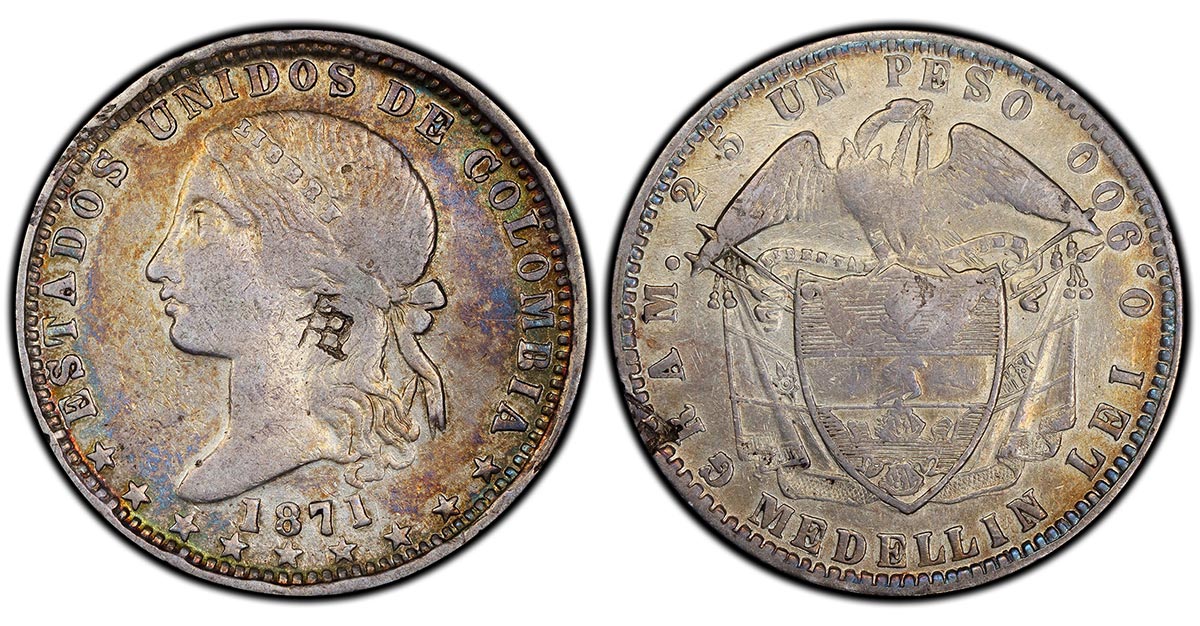
Specifications:
25.0 g, .900 fine silver, .7234 troy oz (actual silver weight)
Recorded mintage: 40,000
Catalog reference: KM 154.1
Details:
The 1871 Colombia Peso was struck at the Medellín mint and belongs to a type minted between 1862 and 1871. The coin contains 25.0g, .900 fine silver, approximately 92.6% of
the standard Spanish 8 Reales, with a mintage of 40,000 pieces. The obverse features a female profile personifying Liberty with the legend "ESTADOS UNIDOS DE COLOMBIA"
(United States of Colombia) and the date, while the reverse displays the national coat of arms flanked by the denomination "UN PESO" and the fineness "LEI 0,900." The Medellín
issues are identified by the "MEDELLIN" or "M" mark and are often noted for their distinct strike characteristics compared to the higher-volume issues from the Bogotá mint.
Politically, this coin was minted during the era of the United States of Colombia, a federal republic characterized by a highly decentralized government and frequent internal conflict between liberal and conservative factions. Numismatically, this Peso represented Colombia’s attempt to align its currency with the decimal standards of the Latin Monetary Union, mirroring the French 5 Francs in weight and purity. The silver for these coins was primarily sourced from the rich local mines of the Antioquia region, where Medellín served as the industrial and commercial heart of the mining industry. Despite the domestic focus of these coins, Colombia’s participation in the global silver market ensured that its currency occasionally entered the streams of international maritime commerce.
This type is very rare with chopmarks. While Colombian silver was a major product of South America, the "Un Peso" coins were generally intended for internal circulation or regional trade within the Caribbean and South America. The few that reached East Asia likely arrived as part of miscellaneous bullion shipments or in the possession of merchants trading in exotic goods from the Americas. This coin presumably reached the China coast through indirect routes, likely via trans-shipment points in Panama or New York before crossing the Pacific to reach the treaty ports of the Pearl River Delta.
Notable chopmarks:
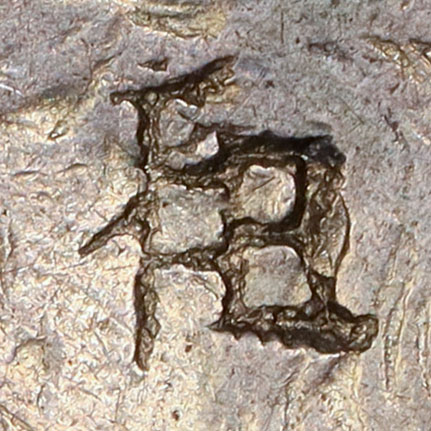 䄫 - qǐ - an ancient word with no known meaning
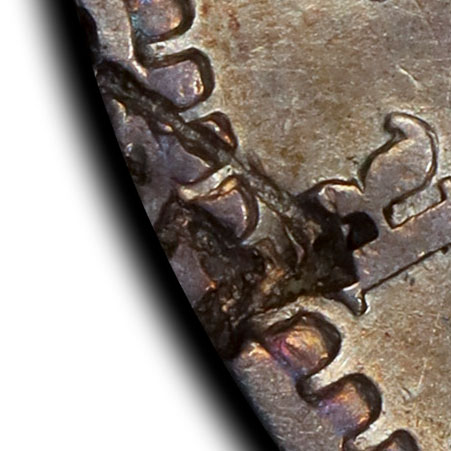 Partial chopmark on the edge of reverse
Provenance:
From the Stack's Bowers October 2023 Hong Kong Ancient & Modern Chinese Coins & Foreign Coins Part 1, Session J
Lot #33483
Auction Description:
COLOMBIA. Peso, 1871. Medellin Mint. PCGS Genuine--Chopmark, AU Details.
KM-154.2; Restrepo-318.5. An intriguing example that is VERY RARE with a chopmark, the present specimen delivers good retained details and lustrous color. An example that
is certain to please many collectors in the series.
Estimate: $500 - $750.
Provenance: From a New York Gentleman's Collection.
According to the Stack's Bowers auction listing, this coin is "From a New York Gentleman's Collection."
It is unclear who this "New York Gentleman" is, but through Stack's representatives we have learned that this collector has now passed away, and he had a very extensive collection. The collection looks to have been built primarily in the 1990's and previous. Some of the coins are from important chop mark collections such as Frank Rose and Hal Walls.
1871-R Guatemala Peso
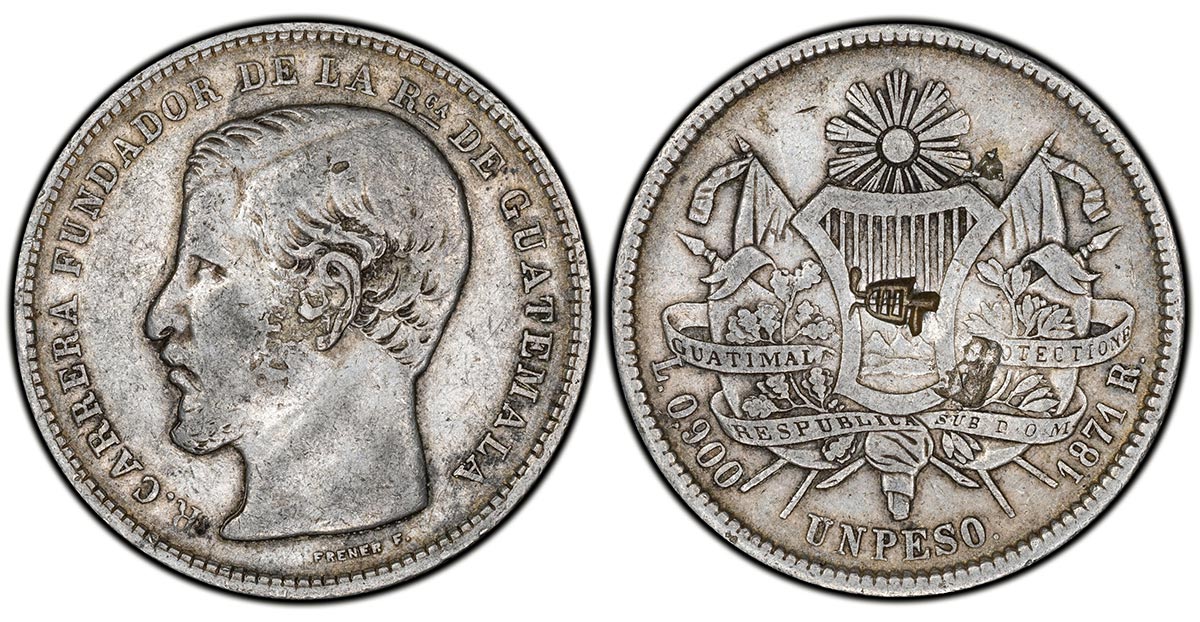
Specifications:
25.00 g, .900 fine silver, .723 troy oz (actual silver weight)
Recorded mintage: 72,616
Catalog reference: KM 190.1
Details:
The 1871-R Guatemala Peso was struck at the Casa de Moneda de Guatemala and belongs to a type minted from 1869 to 1871. The coin contains 25.0g, .900 fine silver, approximately
92.6% of the standard Spanish 8 Reales, with a mintage of 72,616 pieces. The obverse features a left-facing bust of Rafael Carrera with the legend "R. CARRERA FUNDADOR DE LA
RCA. DE GUATEMALA" (R. Carrera, Founder of the Republic of Guatemala). Below the bust, the engraver's name "FRENER F." (Johann-Baptist Frener) is visible. The reverse displays
the national coat of arms with the legend "L. 0.900 UN PESO. 1871 R.", where the "R" denotes the assayer, Rafael Romaña.
This issue coincided with the collapse of the conservative era during the Liberal Revolution of 1871. As documented in Brian Stickney’s A Monetary History of Central America, the regime of Rafael Carrera, whose likeness remained on the coinage for six years following his death, was finally ousted by liberal forces under Miguel García Granados and Justo Rufino Barrios. This Peso represented an ambitious attempt to align Guatemala with the Latin Monetary Union (LMU) by adopting the 25-gram standard. However, the subsequent political reorganization led the new government to abandon these international standards, eventually reverting to the traditional, heavier "Real" system and making these LMU-standard pesos a short-lived numismatic experiment.
This type is rare with chopmarks, in fact this is the only chopmarked example of this type I know of. While Central American silver was frequently exported as bullion, the 1871 pesos were produced in relatively small quantities and many were withdrawn or melted during the subsequent monetary reforms following the revolution. The presence of a chopmarked 1871-R indicates that the coin managed to exit the volatile Central American political landscape, likely through the Pacific port of San José. From there, it would have been carried by merchant vessels to San Francisco or directly across the Pacific to the treaty ports of China, where it circulated alongside the more dominant Mexican and Spanish trade dollars.
The coin shows one drill mark and two large chopmarks on the dated side of the coin.
Notable chopmarks:
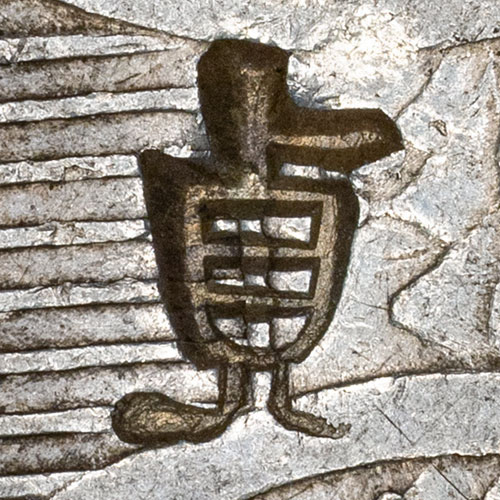
 - Liushutong script variant of 貞 - zhēn - virtuous, chaste
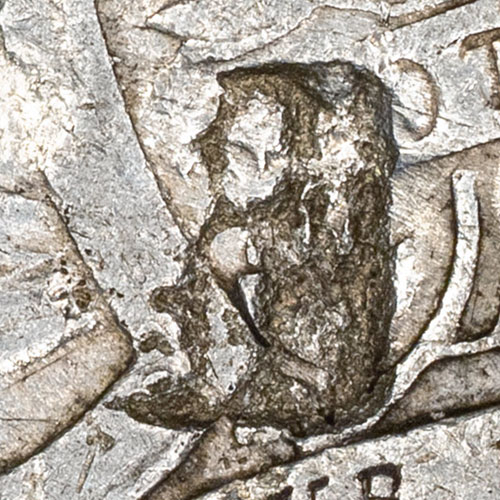 Partial chop
Provenance:
Purchased via private sale from Brandon Ge, a California dealer who sources coins directly from China, September 2025
1871-Ga C Balance Scale Peso, Guadalajara, Mexico mint (Ex. Murphy)
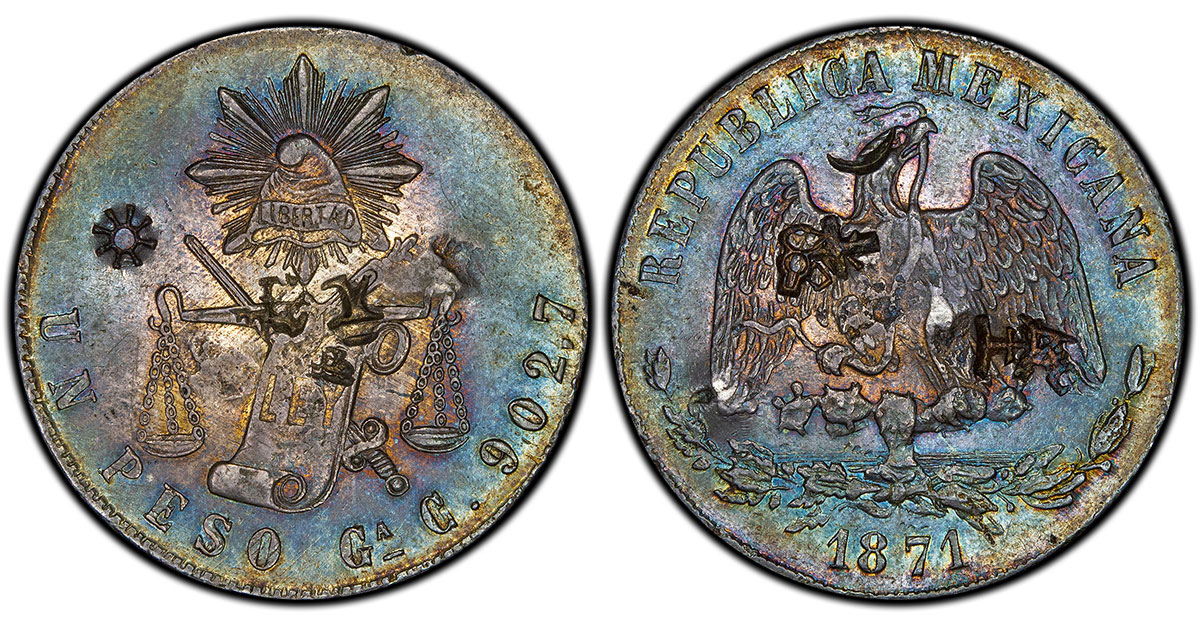
Specifications:
27.07 g, .903 fine silver, .786 troy oz (actual silver weight)
Recorded mintage: 829,000
Catalog reference: KM 408.3
Details:
The 1871-Ga C Mexico Balance Scale Peso was struck at the Guadalajara Mint and belongs to a type minted from 1869 to 1873. The obverse features the Mexican national arms,
an eagle perched on a cactus devouring a snake, surrounded by the legend "REPUBLICA MEXICANA." The reverse displays a central set of balance scales overlaying a scroll
inscribed with "LEY" (Law); together, these elements represent the equilibrium of the three branches of government under the rule of law. This central motif is positioned
beneath a radiating Liberty cap, a classic symbol of freedom and enlightenment. The legend includes the denomination "UN PESO," the "Ga" mintmark, the date, and the "C"
assayer mark, with the fineness expressed as "902,7."
This decimal issue appeared during a period of significant monetary reform as Mexico attempted to transition away from the iconic "Cap and Rays" 8 Reales and toward a modernized Peso system. This shift was largely championed by the administration of Benito Juárez, who sought to align Mexico’s currency with international decimal standards and the requirements of the Latin Monetary Union. Despite the government's push for modernization, the "Balance Scale" design was famously unpopular in the Far East. Chinese merchants, accustomed to the traditional 8 Reales, viewed the new design with deep suspicion, often discounting it or refusing it entirely in favor of the older, familiar type.
This type is relatively common with chopmarks, though notably less frequent than the Cap and Rays issues of the same era. Because the Balance Scale Peso met with such resistance in Chinese markets, many were eventually returned to Mexico or sent elsewhere as bullion. This coin likely reached China through the established Pacific trade route from Acapulco to Manila, or via San Francisco, as merchants attempted to introduce the new decimal units into the regional economy.
Notable chopmarks:
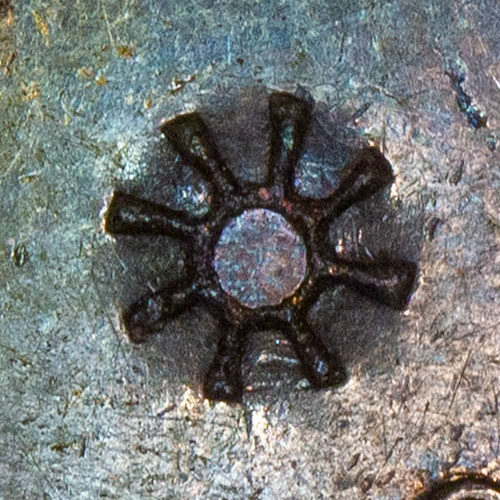 Eight-ray sunburstNot firmly identified. A radiating sunburst; stars and sunbursts are among the more common abstract chopmarks. The eight straight rays may evoke a sun or star, the eight directions (八方, bāfāng), the 八卦 (bāguà, the Eight Trigrams), or the eight-spoked 法輪 (fǎlún, the Dharma wheel). It is the straight-rayed counterpart of the curved saw-blade sym018 and may equally be a maker's or decorative mark.
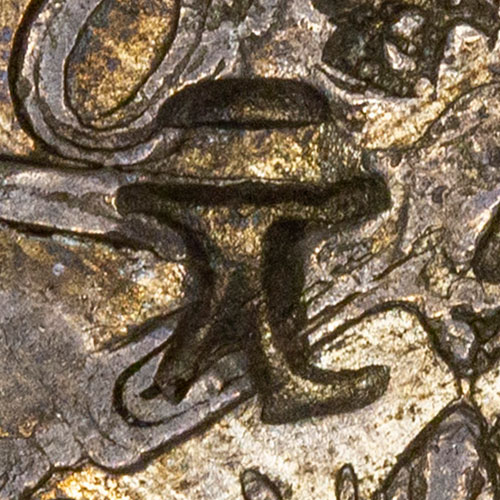 元 - yuán - dollar, unit of currency, basic, primary
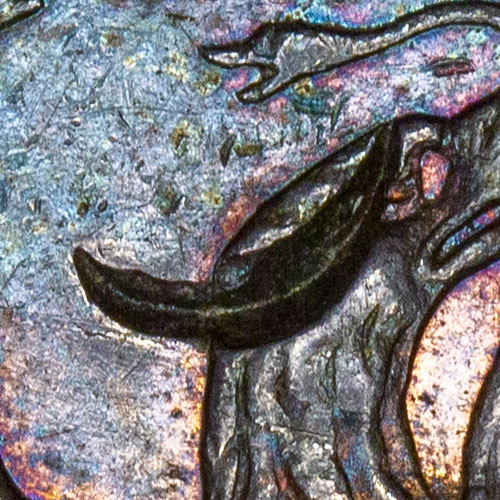
 - Liushutong script variant of 月 - yuè - moon, month
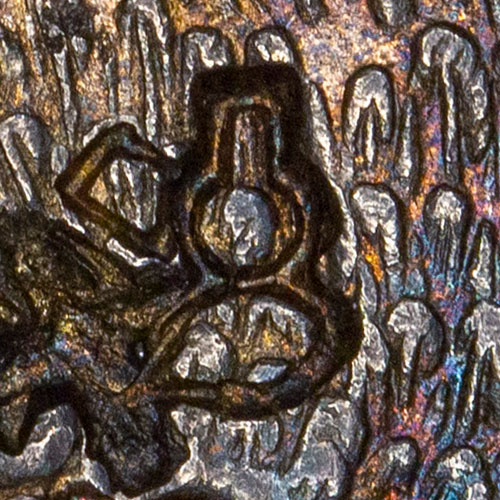 Bottle gourd (葫蘆)The gourd (葫蘆, húlu) is one of the most auspicious Chinese motifs: húlu echoes 福祿 (fúlù, 'blessings and prosperity'), and its many seeds wish for abundant descendants. It is a Daoist emblem of healing and immortality, the vessel of the immortal Li Tieguai (李鐵拐) and one of the hidden Eight Immortals' attributes (暗八仙), and is hung to ward off illness and evil.
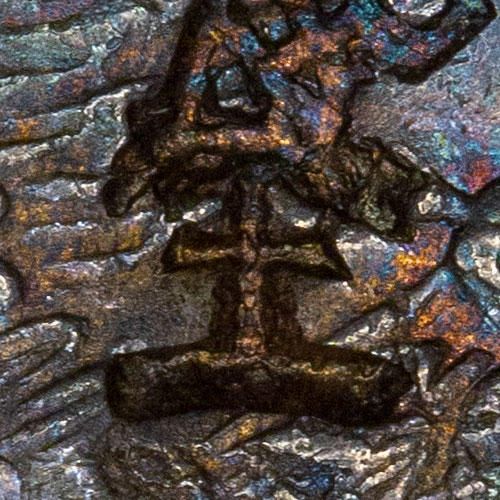 王 - wáng - king, ruler
Provenance:
Purchased from the Stack's Bowers April 2026 Hong Kong Showcase Auction
Lot #49744
Auction Description:
MEXICO. Peso, 1871-Ga C. Guadalajara Mint. PCGS Genuine--Chopmark, AU Details.
KM-408.3; Murphy-Fig. 348 (Plate Coin). Several medium size incuse Chinese chops and punches on both sides including, "元" (Yuan), "王" (Wang), "☼" (Sun), ")" as well as several unidentified chops. Beautifully preserved and very attractive, this lustrous example displays colorful iridescent patina that accentuates the bold design features. Several of the chops are clear, while the others are obscured by the original host design and overlapping making identification quite difficult. Overall a pleasing and wholly original looking piece offering an eye catching appearance.
Provenance: From the Edgar Murphy Collection.