Chopmarks along with other marks
Some chopmarked coins also picked up other marks from governments, businesses and political movements.
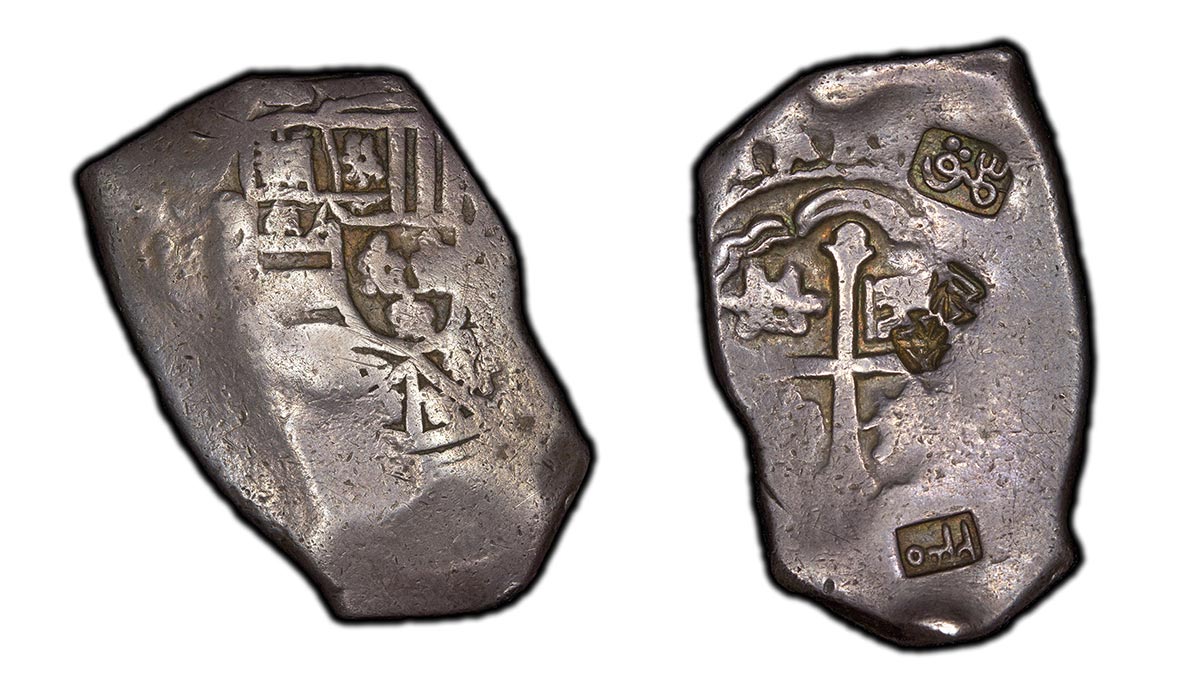
(1814) Netherlands East Indies (Indonesia) 1 Real Batu with Sumenep Counterstamp on Mexico Philip V Cob 8 Reales (1711 or 1712)
Specifications:
27.07 g, 0.917 fine, .798 troy oz (actual silver weight)
Recorded mintage: unknown
Catalog reference: KM 197 (KM 47a host coin)
Details:
Madura is a small island lying just off the northeastern tip of Java, and Sumenep its easternmost and most culturally significant sultanate. From the early
nineteenth century until the Japanese invasion of 1942, both fell under Dutch colonial administration as part of the Netherlands East Indies, though the
degree of that control, and the autonomy local rulers could exercise within it, varied considerably across the period.
In the early nineteenth century, the island of Madura faced a problem familiar across much of Southeast Asia: an acute shortage of reliable silver currency. The Dutch colonial financial system that had structured monetary life in the region for generations had been thrown into disarray by the Napoleonic Wars, and Raffles's British occupation of Java beginning in 1811 did little to stabilize it. Into this environment came Sultan Paku Nata Ningrat, who had assumed rule of the Sultanate of Sumenep, the easternmost region on Madura, just north of Surabaya, that same year, and who responded with a countermark program of considerable practical ingenuity. Sumenep struck no coins of its own, depending entirely on the eclectic mix of foreign silver moving through regional trade: Dutch ducatons, Indian rupees, Maria Theresa talers, and Spanish colonial cobs that had been circulating since the previous century. By impressing the sultanate's mark on approved foreign silver, the court authenticated that coinage, fixed denominations, and asserted monetary authority without a mint. The host coin here, a Philip V cob 8 reales of 1711 or 1712, struck at Mexico City in the irregular cob style and worn smooth by decades of trade, was reclassified as a 1 Real Batu, batu meaning "stone," the local term distinguishing old hand-struck cobs from milled coinage.
The countermark struck on this piece bears "Sumenep" in Arabic script within a square surround, accompanied by the Hijri date AH 1230, corresponding to late 1814 or early 1815. Sultan Paku Nata Ningrat was simultaneously among Raffles's most valued Madurese collaborators, serving as a key informant for The History of Java (1817), while conducting diplomacy, Islamic scholarship, and monetary reform within the same court. The square Arabic-script type is found almost exclusively on cob 8 reales, suggesting the court deliberately paired this stamp with the older cob-style silver it was most concerned with authenticating; later oval-surround variants migrated onto Dutch coins and Maria Theresa talers as the program matured. The undated flower or "Madura Star" countermarks also associated with Sumenep remain harder to sequence precisely, but the presence of firmly dated Arabic-script examples like this one establishes that the sultanate's monetary program was already operating in fully legible, date-recorded form within three years of Paku Nata Ningrat assuming power, a striking assertion of institutional confidence amid the political turbulence of the British occupation.
Notable chopmarks:
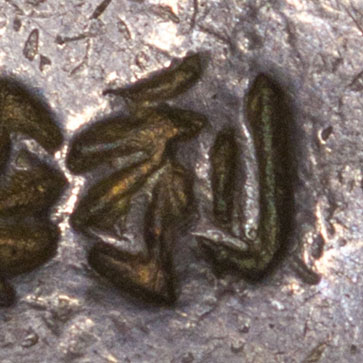 利 - lì - profit, benefit, advantage
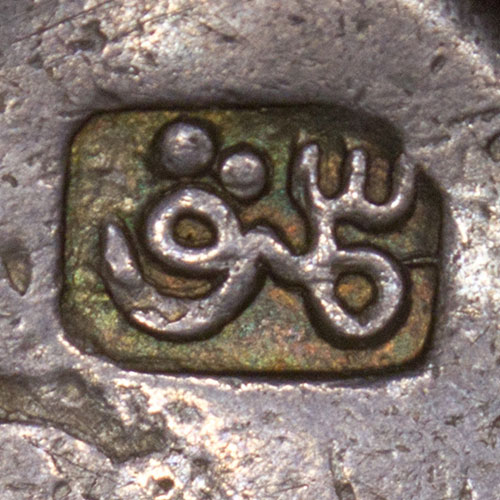 Sumenep countermark - This countermark is found on Spanish-American 8 Reales and minor denominations, dated 1729 - 1732. Other countermarks such as a flower and/or the Arabic number
(1)230 (below) are sometimes seen with the Sumenep countermark and thus also attributed to Sumenep
Sumenep countermark - This countermark is found on Spanish-American 8 Reales and minor denominations, dated 1729 - 1732. Other countermarks such as a flower and/or the Arabic number
(1)230 (below) are sometimes seen with the Sumenep countermark and thus also attributed to Sumenep
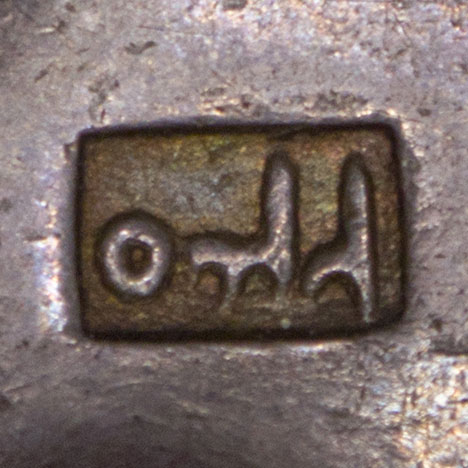 Hijri date (1)230 countermark, sometimes seen alongside Sumenep countermark above
Provenance:
Daniel Sedwick World, U.S. Coin and Paper Money Treasure Auction, November 1-3 2017 Auction 22,
Lot #572
Auction Description:
Mexico City, Mexico, cob 8 reales, Philip V, assayer not visible, with "Sumenep" in Malay Arabic script and Hijri date "230" countermarks (Madura Island, Indonesia, 1 real batu, 1814)
plus two chopmarks on cross side, rare. KM-47a. 26.76 grams. Toned Fine with nice, smooth surfaces, nearly full shield and some cross but no peripheral details, both countermarks and
both chopmarks very deeply impressed and legible, exceptional quality for this fascinating issue.
A similar example with counterstamps but no chopmarks sold in the Stephen Album auction 25, Lot #1727, in May 2016.
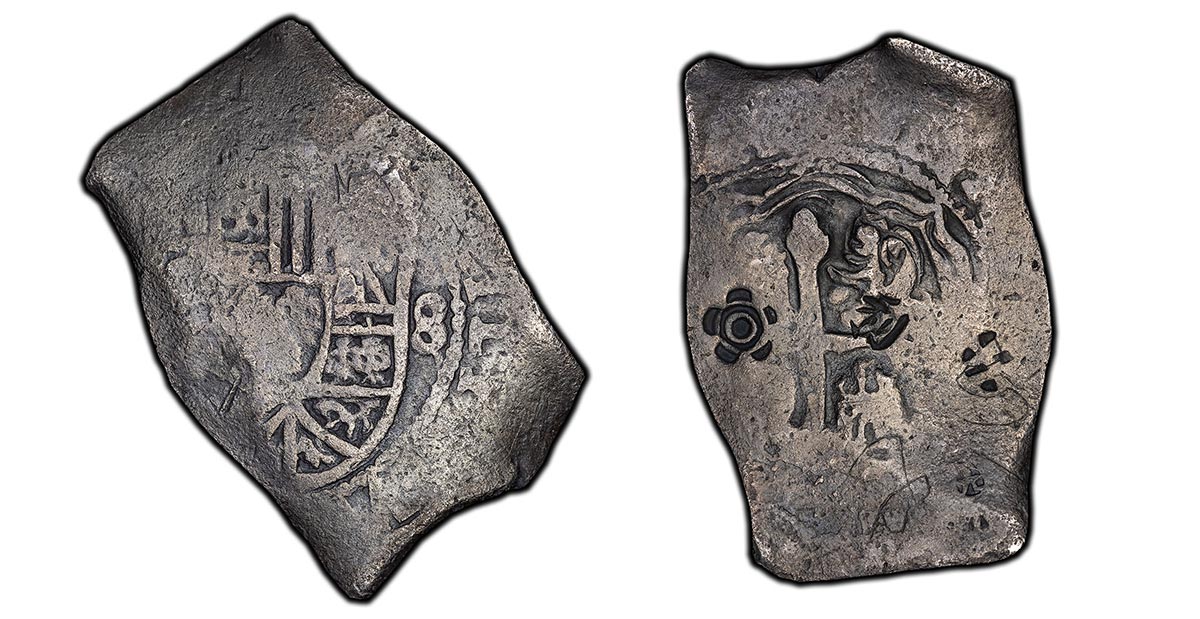
(1814) Netherlands East Indies (Indonesia) 1 Real Batu with Sumenep 5 Petal Counterstamp on Mexico Philip V Cob 8 Reales (1702-1728)
Specifications:
27.07 g, 0.917 fine, .798 troy oz (actual silver weight), 26.04 g weight on scale
Recorded mintage: unknown
Catalog reference: KM 197 (KM 47 host coin)
Details: This example presents a second variation among the Sumenep countermark types: the five-petaled flower with a circular center, a motif distinct from both the shield-like Madura Star applied to larger milled coins and the Arabic-script stamps seen on the previous piece. The flower types are among the more visually immediate of the Sumenep marks, less legible as official text, but unmistakable as a deliberate stamp, and their appearance on cob hosts in conjunction with or alongside the Arabic "Sumenep" inscription suggests the court used multiple die types in parallel, perhaps at different points in the authentication process or from different issuing hands. The host coin here, a Philip V cob 8 reales of 1702–1728, carries an additional layer of history beyond its Madurese countermarking practice: its lightly porous surfaces and darkened patina are consistent with an extended period of saltwater immersion, and the coin is almost certainly a shipwreck salvage, recovered from a vessel lost somewhere in the China Sea or Philippine waters
Notable chopmarks:
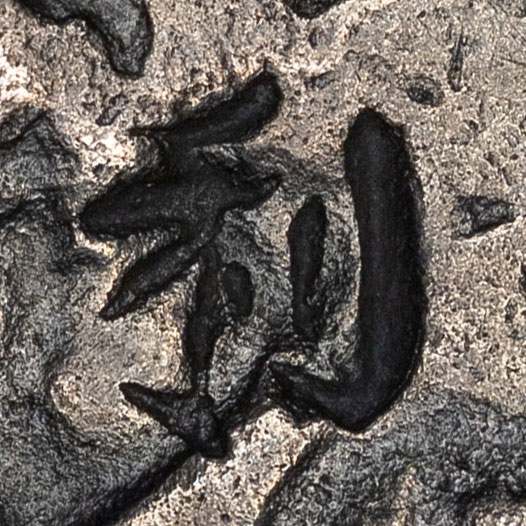 利 - lì - profit, benefit, advantage
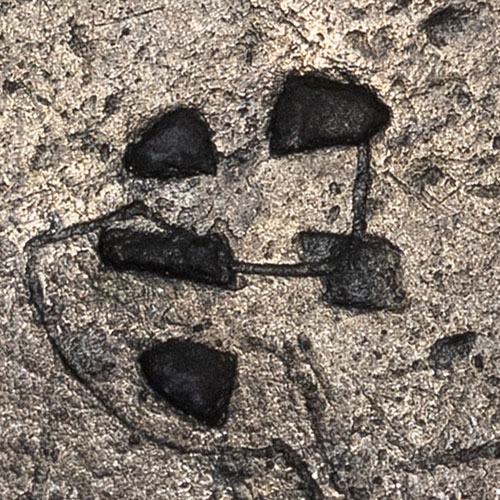 Unknown chopmark
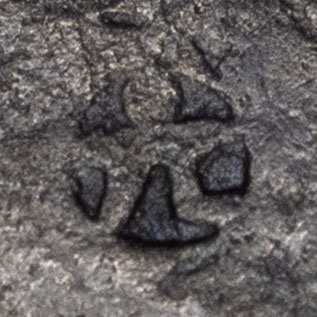 Unknown chopmark
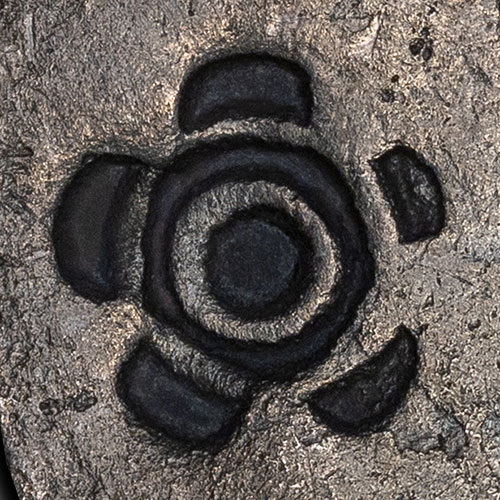 Sumenep 5-petal countermark
Provenance: From the Heritage Wednesday & Thursday World & Ancient Coins Select Auction #232238 September 21-22 2022 Lot #64584
Auction Description: Madura Island. Sumenep Counterstamped Real Batu ND (c. 1814) VG Details (Chopmarked, Environmental Damage) NGC, KM197. 5-Petal flower Countersta on Mexico Philip V Cob 8 Reales ND (1702-1728) Mexico City mint, KM47. Minimally affected from it's years lost underwater, bearing the coveted Madura stamp a couple chops from circulation in the Orient.
Previously from The Gonzaga Collection (I don't have more info on this collection).
(1828) Spanish Philippines 8 Reales with MANILA counterstamp on 1828-LM JM Peru host (Ex. Murphy / Rose / Farouk)
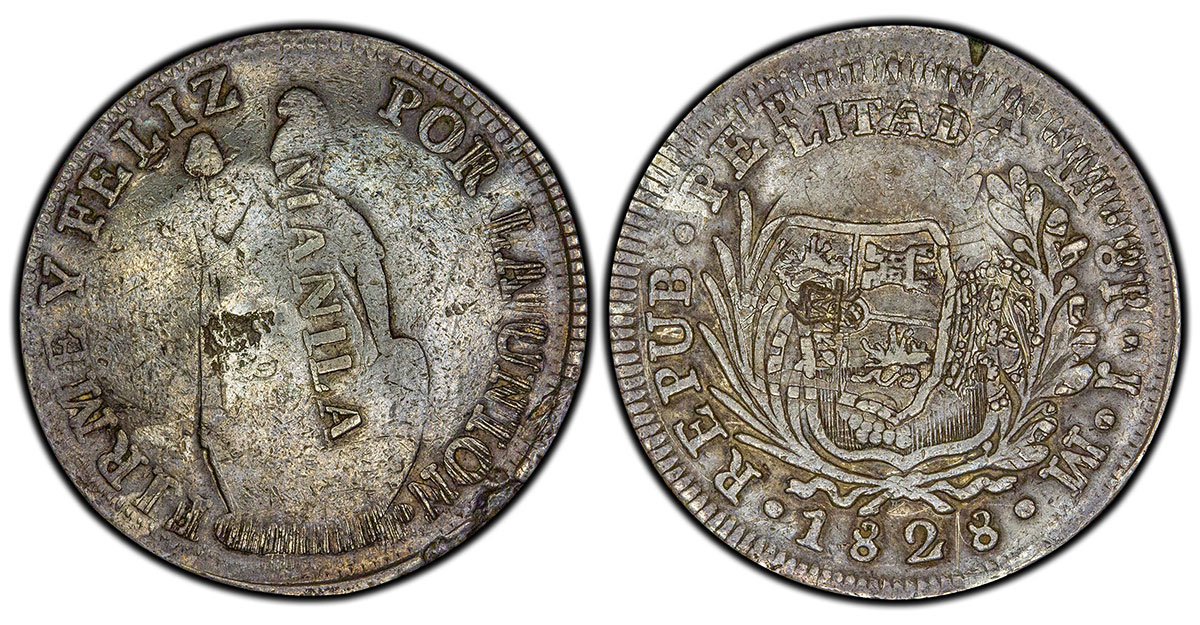
Specifications:
27.07 g, .903 fine silver, .786 troy oz (actual silver weight)
Recorded mintage: unknown
Catalog reference: KM 25
Details:
The MANILA counterstamp dated 1828 was the first of Spain's attempts to bring order to the flow of rebel-inflected silver arriving in the Philippines from the
newly independent republics of South America. On October 13, 1828, Mariano Ricafort, Captain General of the Philippine Islands, issued an edict directing that
coins struck by the "insurgent provinces and revolutionary governments" be overstamped to obliterate the offending legends: the words REPUBLICA, INDEPENDENCIA,
and LIBRE appearing on Peruvian, Mexican, Colombian, and Bolivian issues were all considered politically dangerous in a colony that Madrid was determined not to
lose. The dies were prepared locally at the Manila foundry by Benito de los Reyes, with the 1828 overstrike applied using a screw press to drive a full obverse
and reverse design over the original coin: MANILA 1828 within a serrated border on one side, and HABILITADO POR EL REY N.S.D. FERN. VII, "authorized by the King,
Our Lord Don Fernando VII," surrounding the Spanish arms on the other.
The operation proved costly and mechanically troublesome almost immediately. The screw presses used at the foundry were not robust enough to fully obliterate the underlying design, and the 1828 overstrikes typically show remnants of the original Peruvian or Mexican coin visible beneath the new dies. Production was sporadic, with large gaps between runs, and the program was effectively abandoned by the early 1830s in favor of the simpler F.7o and later Y.II punch countermarks that replaced the full overstrike system. Surviving 1828 MANILA pieces are scarce, and the 1828-LM JM Lima sol is among the more commonly encountered host coins within that already limited population, a Peruvian republican 8 reales struck in the same year the Manila program began and presumably swept into it soon after arriving in the islands.
Incredibly rare with chopmarks, it's not hard to imagine the coin traveling between China and the Philippines, but this is the first and only example I've seen with the combination of Chinese chopmark and this counterstamp.
Notable chopmarks:
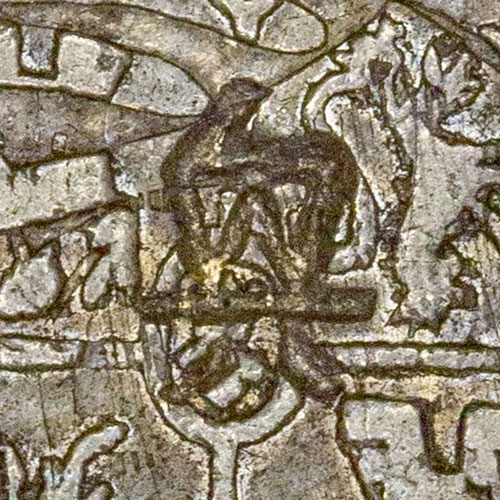 㒷 - (variant form of 興) xìng - to prosper, to rise, to flourish
Provenance:
Purchased from the Stack's Bowers April 2026 Hong Kong Showcase Auction
Lot #49792
Auction Description:
Highly Unusual Chopmarked Philippines 8 Reales
PHILIPPINES. Philippines - Peru. 8 Reales, 1828. Manila Mint. Ferdinand VII. PCGS Genuine--Chopmark, VF Details.
KM-25; Basso-52; PNM#6-20; PNM#16-30; PNM#21-I-20; Cacho-CS-015; Murphy-Fig. 405 (Plate Coin); Rose-Fig. 118/119 (Plate Coin). Issued by decree of 13 October 1828. Type I Manila Overstrike, with serrated borders and reverse legend; dies prepared by Don Benito de los Reyes. A single medium size incuse pseudo-Chinese chop on the reverse, "突" (meaning unknown). This pleasing example displays light attractive gray tone with a slight iridescent sheen that pops out when tilted in the light. The chop is bold, but somewhat obscured by the host design making identification difficult. Close inspection reveals a small edge file on the reverse mentioned for accuracy. Overall a pleasing piece that should be considered EXTREMELY RARE and unusual when found with a chops. A neat and interesting piece that is sure to add depth to the next collection it enters.
Provenance: From the Edgar Murphy Collection.
Ex: F. M. Rose Collection, featured as figure 118-119 on page 30-31 in his book "Chopmarks".
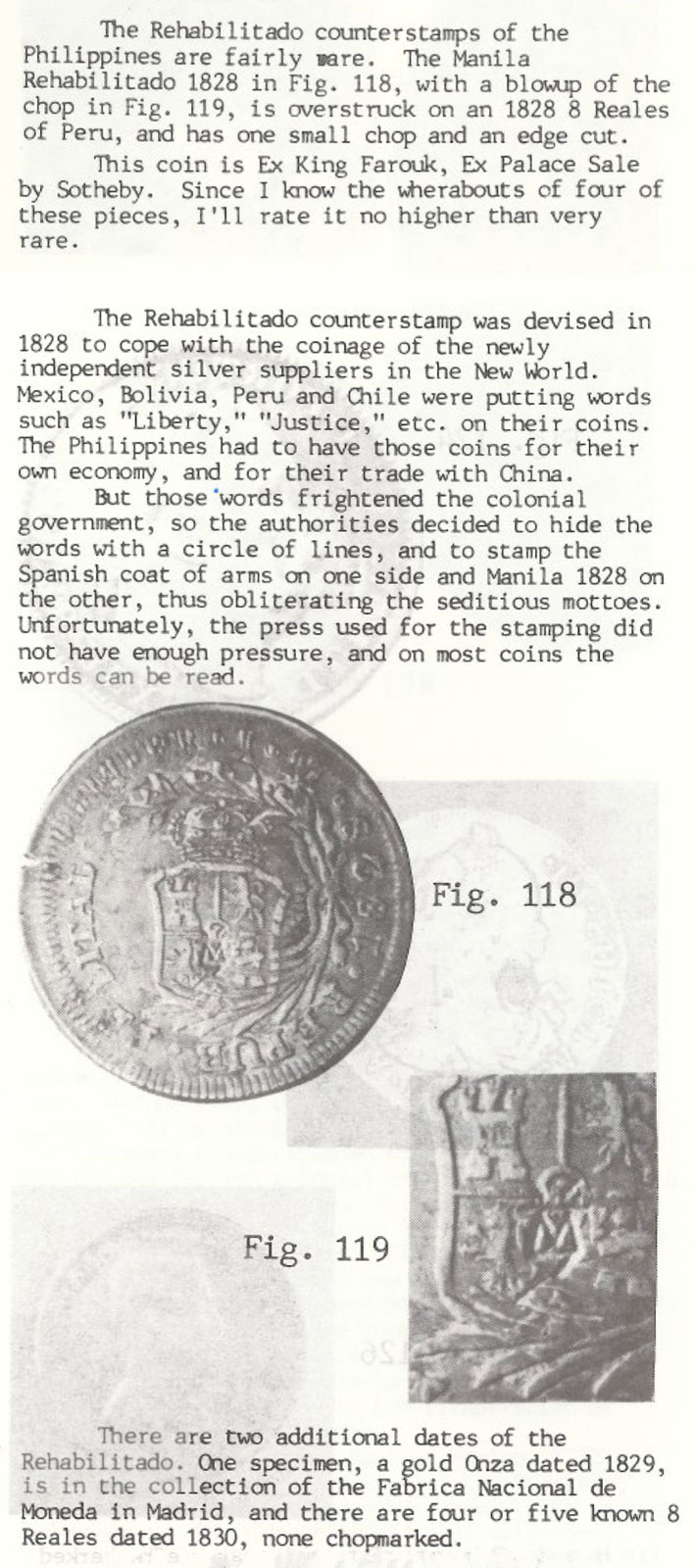
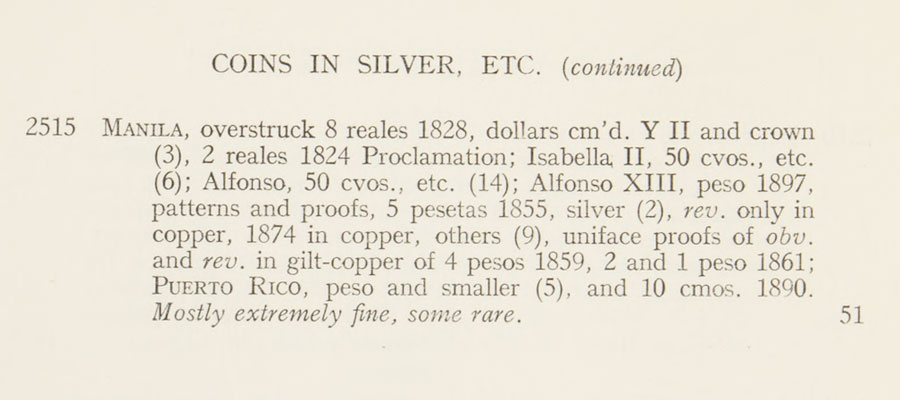
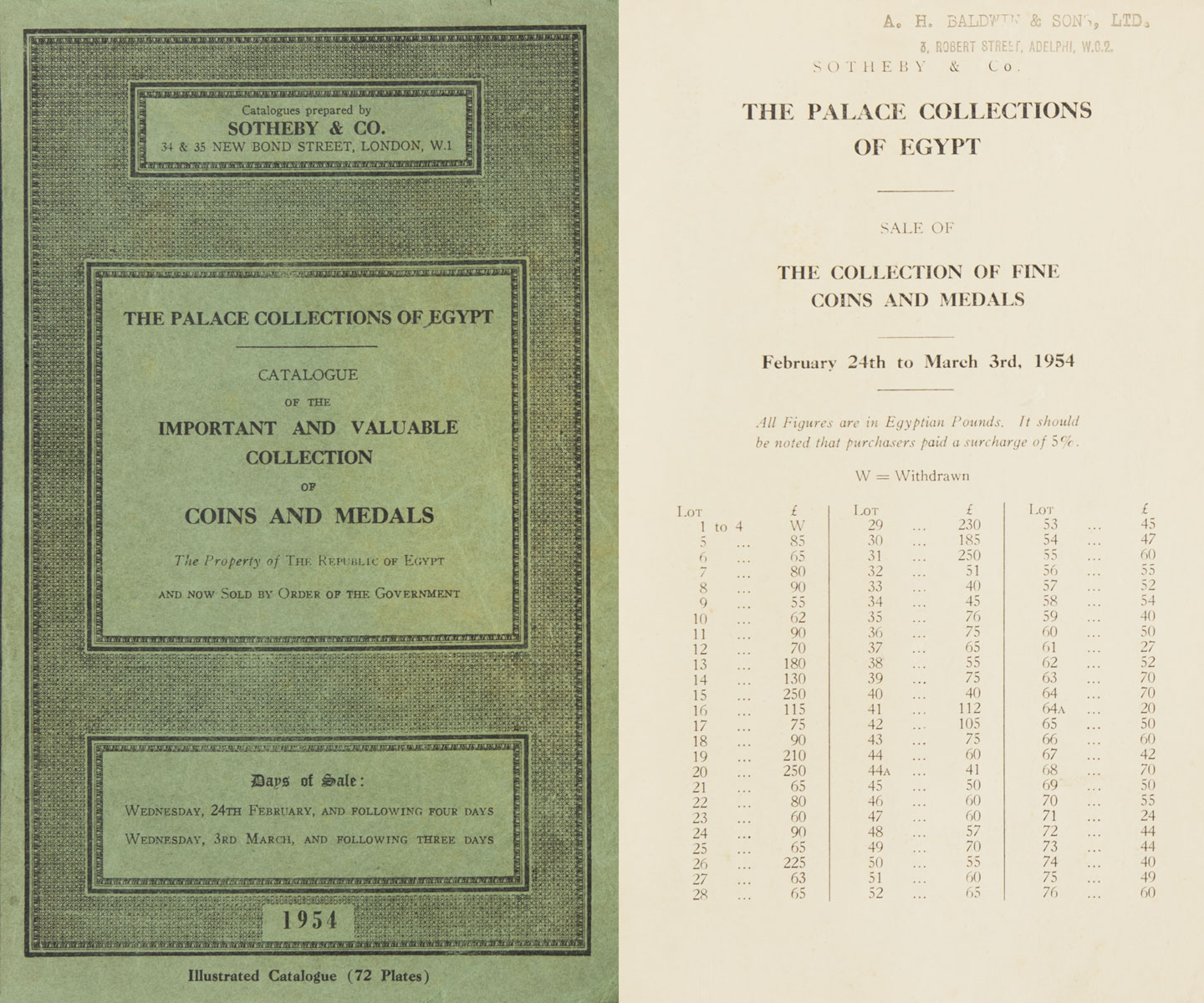
Ex: King Farouk of Egypt, sold in a group as lot 2515 in the February 1954 Palace sale by Sotheby & Co.
Spanish Philippines Ferdinand 7 Countermark on 1833-LM MM Peru 8R host coin (Ex. Murphy)
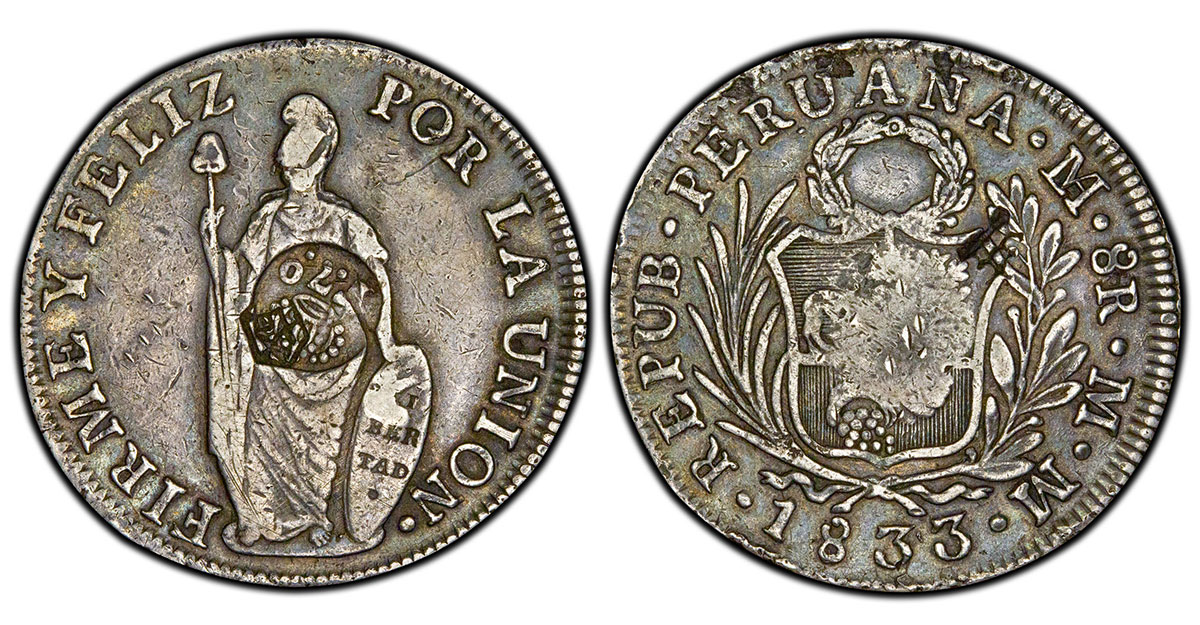
Specifications:
27.07 g, .903 fine silver, .786 troy oz (actual silver weight)
Recorded mintage: unknown
Catalog reference: KM 83
Details:
The Manila overstrike program of 1828-1830 had proven too mechanically troublesome to sustain, and by late 1832 Spanish authorities in the Philippines had moved
to a simpler approach. A decree of October 27, 1832 replaced the full-coverage screw-press overstrike with a small circular punch countermark, roughly 9-10
millimeters in diameter, bearing a crown worked in pearls with a small cross at the top and the initials F.7o beneath, for Ferdinand VII. Die preparation shifted
to Diego de los Reyes, and the punches were applied by hammering rather than screw press, a simpler process that allowed Manila to keep pace with the steady
arrival of republican silver from Mexico, Peru, Colombia, Bolivia, and Chile. The political logic remained the same as it had been under the MANILA overstrike:
to validate foreign silver for circulation while asserting continued royal authority in an increasingly isolated colonial outpost.
The host coin here, an 1833-LM MM Lima sol, was struck in Peru just months or perhaps a year before it received its Manila countermark. The F.7o punch remained in use until Ferdinand's death on December 20, 1834, after which the initials were replaced with Y.II for his daughter Isabel II. That relatively short window of active F.7o countermarking, combined with the program's continuation through the remaining stock of coins already in transit or circulation, accounts for the examples that appear on host coins dated through 1834. The countermarks were applied indiscriminately to coins in any condition, including heavily worn, holed, or chopmarked pieces.
Notable chopmarks:
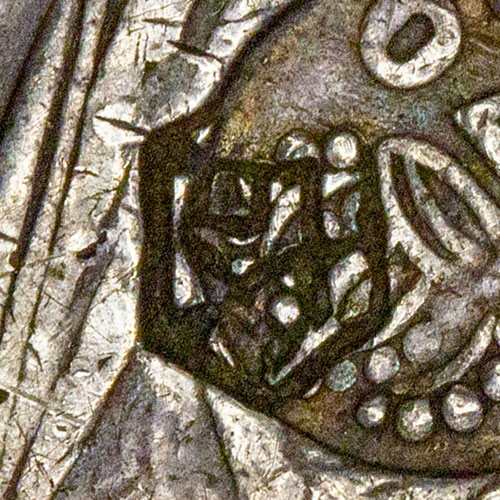 Unknown or incomplete chopmark
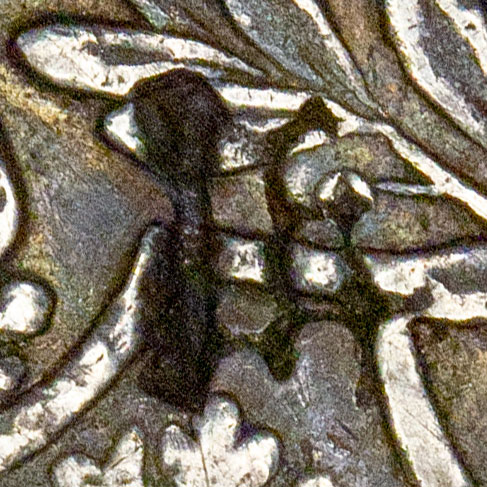 Unknown or incomplete chopmark
Provenance:
Purchased from the Stack's Bowers April 2026 Hong Kong Showcase Auction
Lot #49798
Auction Description:
PHILIPPINES. Philippines - Peru. 8 Reales, ND (1832-34). Manila Mint. Ferdinand VII. PCGS Genuine--Chopmark, VF Details.
KM-83; Basso-55; PNM#6-72; PNM#16-163; Cacho-VIII-CS-029; Gil-5-4-1-C; Murphy-Fig. 414 (Plate Coin); Leverage-Fig. 184 (Plate Coin). Issued by decree of 2 October 1832, commencing 5 October 1832 until 20 December 1834. Countermark: Type V, crowned F.7.o within circular indent. Two medium size incuse Chinese chops. This wholesome and attractive example displays rich slate patina with brighter coloration on the high points. The countermark is boldly applied, though somewhat obscured by the host designs and a single chop that was on the coin prior to countermarking. An interesting example with a pleasing appearance that is sure to be welcome addition to the next collection it enters.
Provenance: From the Edgar Murphy Collection.
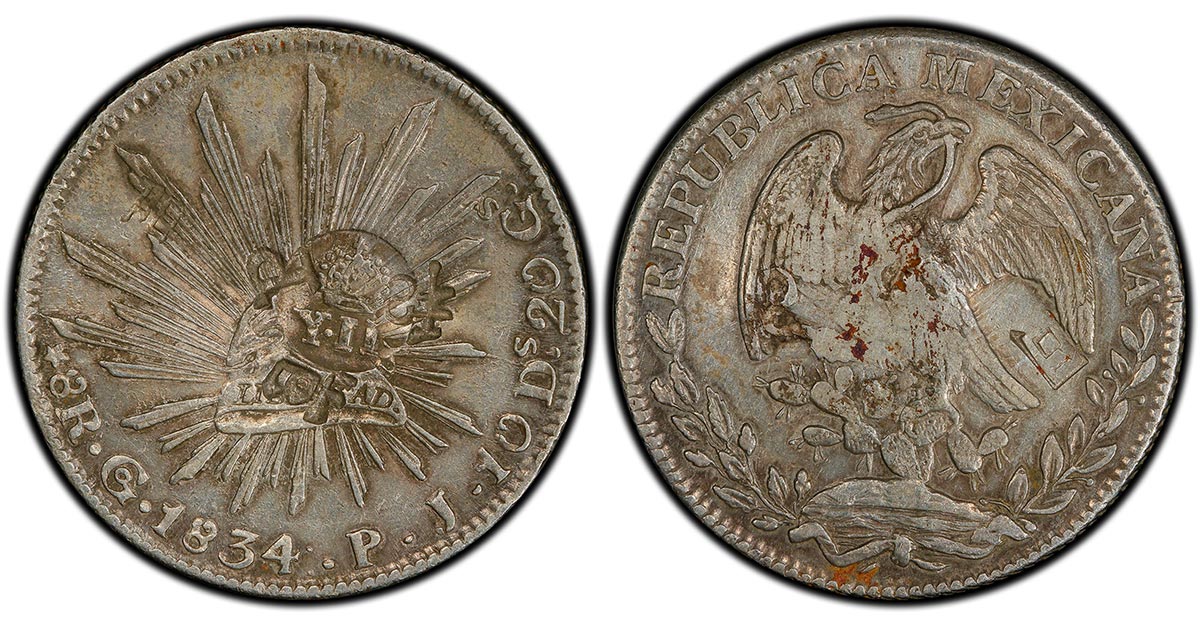
Spanish Philippines Isabella II Countermark on 1834-Go PJ Mexico 8 R host coin
Specifications:
27.07 g, .903 fine silver, .786 troy oz (actual silver weight)
Recorded mintage: unknown
Catalog reference: KM 129
Details:
The crowned "Y.II." countermark struck on this 1834 Guanajuato 8 reales is the product of a specific administrative crisis: the collapse of Spain's Latin American
empire and the flood of newly republican silver it sent into the islands. The Manila galleon trade had long made the Philippines a natural terminus for Mexican
silver, and when Mexico and the other mainland colonies broke from Spain in the 1820s, their coins, bearing liberty caps, eagles, and republican legends, continued
to arrive in quantity, carrying imagery that colonial authorities regarded as potentially inflammatory. Manila's response unfolded in stages. Beginning in 1828,
officials applied full "MANILA" overstrikes intended to obliterate offending designs entirely, a labor-intensive approach abandoned by 1830. A simpler "F.7o" punch
for Ferdinand VII followed in late 1832, and when Ferdinand died on 29 September 1833, that punch became obsolete almost immediately. The "Y.II.", for Isabel II,
who acceded as a three-year-old under her mother's regency, replaced it, with examples generally attributed to 1834–1837. The countermark's purpose was as much
political as monetary: it revalidated familiar crown-sized silver already circulating locally while converting republican coinage into an explicit expression of
continued Spanish sovereignty.
The chopmarks on this coin add a further dimension. Philippine-countermarked 8 reales bearing Chinese merchant chopmarks are common enough that numismatists have examined the sequence carefully, and the weight of evidence (documented by Gullberg in his book on Chopmarks) suggests the chopping often preceded the Manila stamp rather than following it. This matters because Manila's countermarking fees were explicitly scaled to account for the degree of chopping already present on a coin, acknowledging that heavily chopmarked dollars were simply part of the circulating mix the authorities were trying to bring to order.
Notable chopmarks:
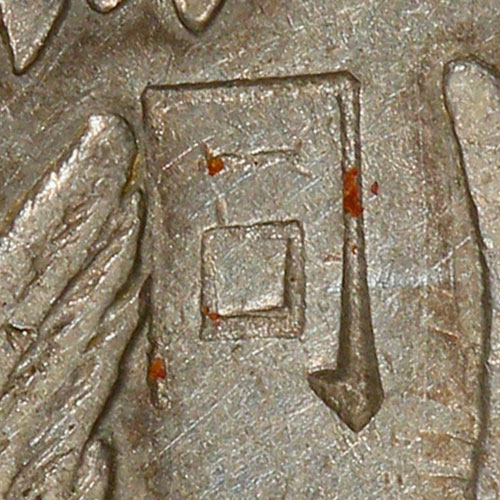 同 - tóng - same, together, with
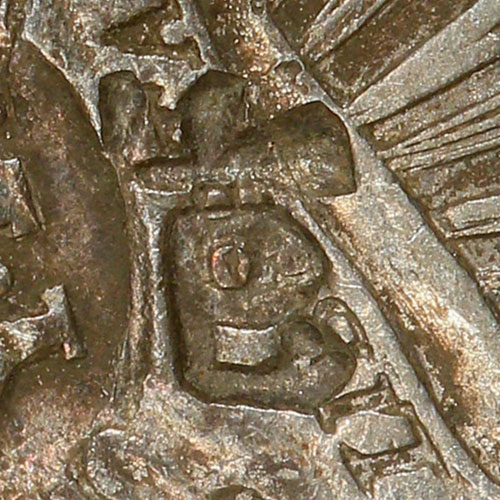 Possibly 它 - tā - it
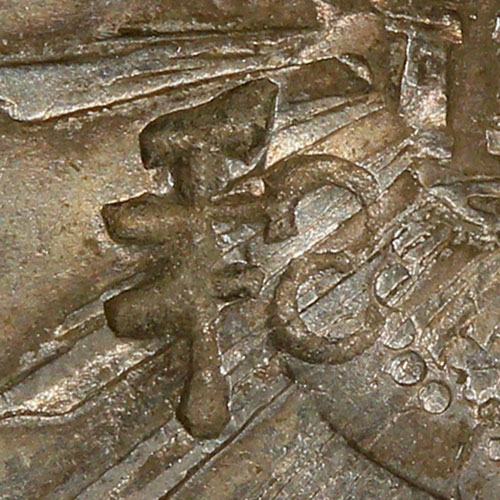 Possibly a stylized version of 䄸 - pò - grains producing no fruit
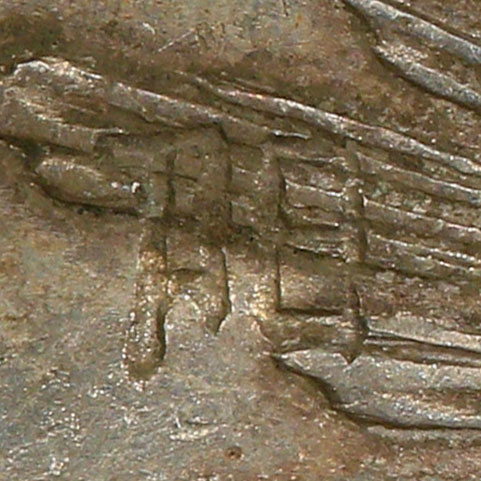 Unknown combination of characters
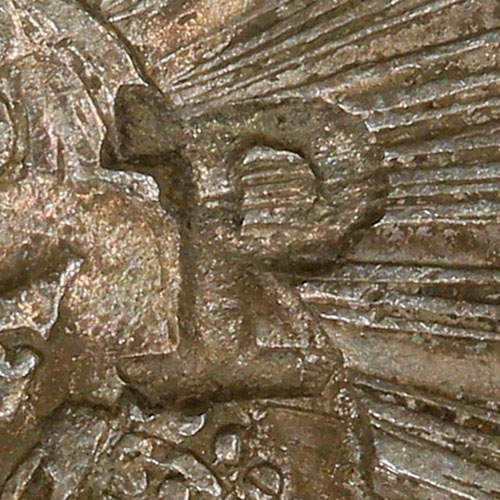 P - Latin-letter chopmark
Provenance:
Purchased from the November 16, 2017 Heritage World and Ancient Coin Auction #231746
Lot #63341
Auction Description:
Isabella II of Spain Counterstamped 8 Reales ND (1834-37) AU Details (Chopmark) PCGS, KM129. Host coin is Mexico 8 Reales 1834 Go-PJ.
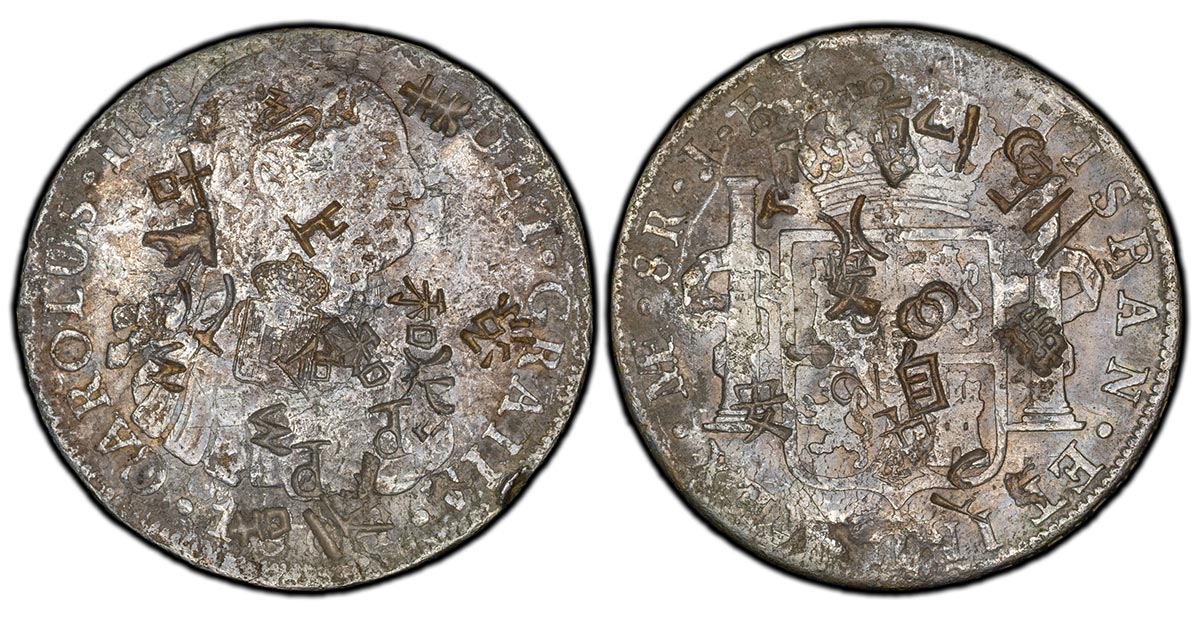
(1834) Portugal Maria II 870 Reis countermark on 1804-LM JP Peru 8 Reales
Specifications:
Host coin: 27.07 g, .896 fine silver, .780 troy oz (actual silver weight)
Recorded mintage: unknown
Catalog reference: Countermark: KM-440.21 Host Coin: KM-97
Details:
The crowned Portuguese arms countermark on this 1804 Lima 8 reales was applied by decree on 1 September 1834, in the immediate aftermath of one of the more
turbulent passages in Portuguese history. The Liberal Wars, six years of civil conflict between constitutionalists loyal to Dom Pedro IV and absolutists backing
his brother Miguel I, had ended in May 1834 with a liberal victory, but left the country's finances badly depleted. The new constitutional government, now
formally under the fifteen-year-old Maria II following Pedro's death in September, faced an acute silver shortage; the mint lacked the capacity to produce
sufficient new coinage quickly enough to meet demand. The solution was practical and rapid: all Spanish and Spanish-colonial 8 reales still in circulation were to
be presented for countermarking and officially revalued at 870 reis, their crown-sized silver weight making them a natural equivalent to Portugal's 960 reis
standard. The range of host coins that received this stamp is extraordinary; over 150 distinct varieties are documented, spanning colonial mints from Mexico City
to Potosí to Lima across more than a century of production, a breadth that reflects just how widely and indiscriminately Iberian silver had spread through Atlantic
trade networks by the 1830s.
This coin also carries Chinese merchant chopmarks, likely acquired after its time in Portuguese circulation as the coin continued moving through trade networks to the east.
Notable chopmarks:
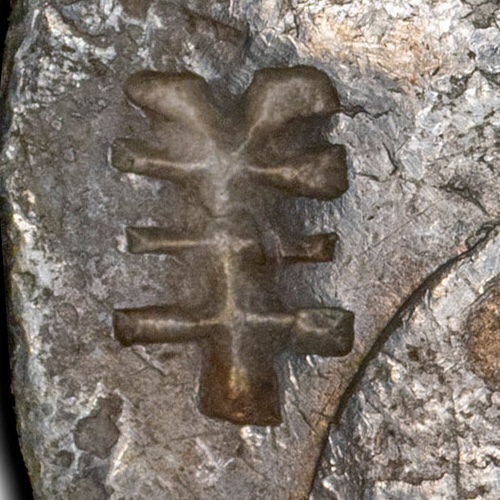 羊 - yáng - a sheep, surname Yang
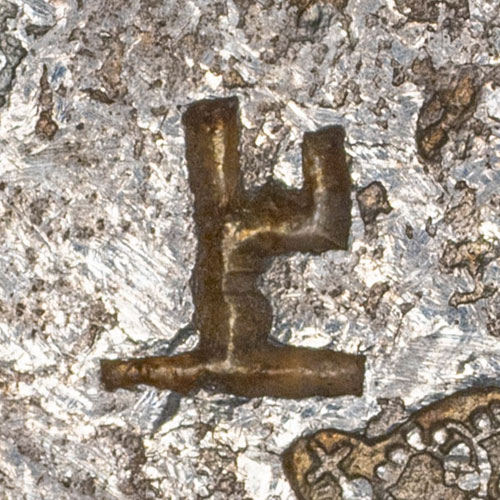 Old variant of 上 - shàng - above, up, top
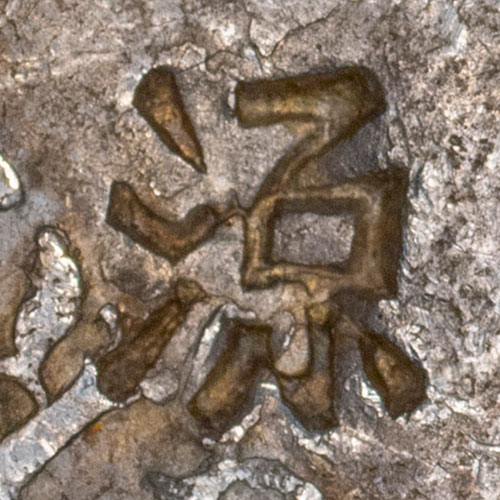 Variant of 涼 - liáng - cool, cold, discouraged, disheartened, forlorn
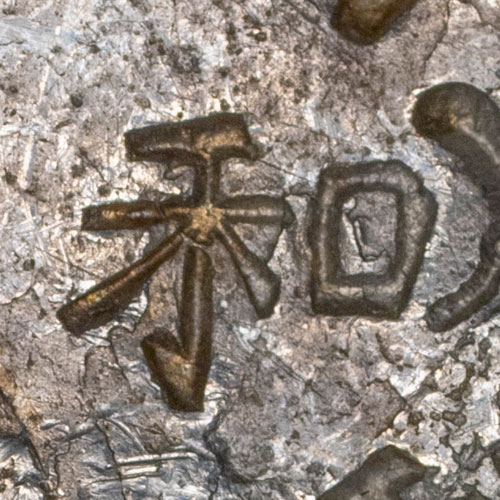 和 - hé - harmony, peace, and
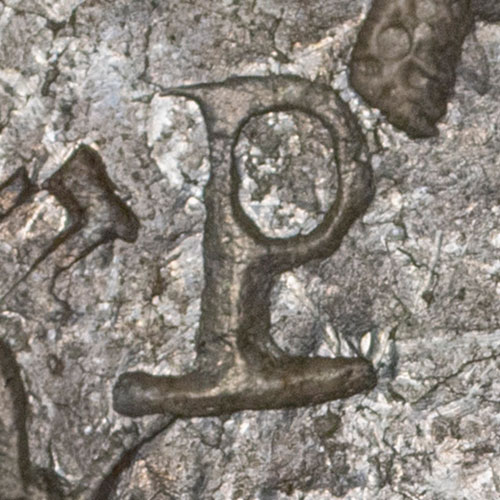 Similar to English letter 'P'
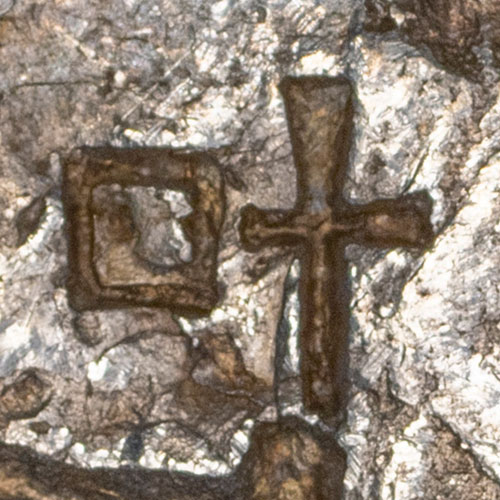 叶 - (traditional: 葉) yè - leaf, page, lobe, (historical) period, classifier for small boats
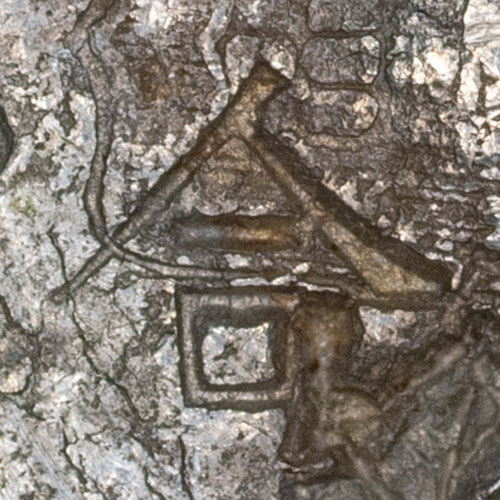 合 - hé - combine, join, close, suit
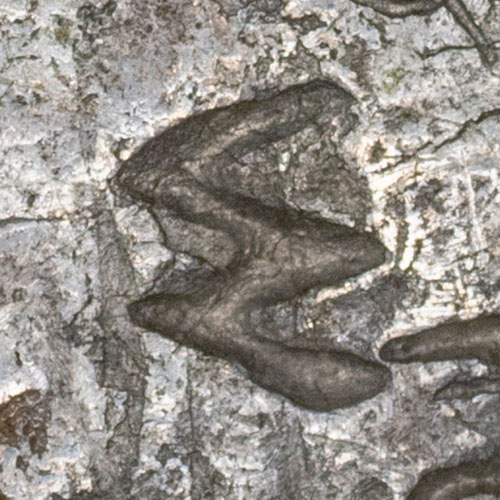 Unknown chopmark
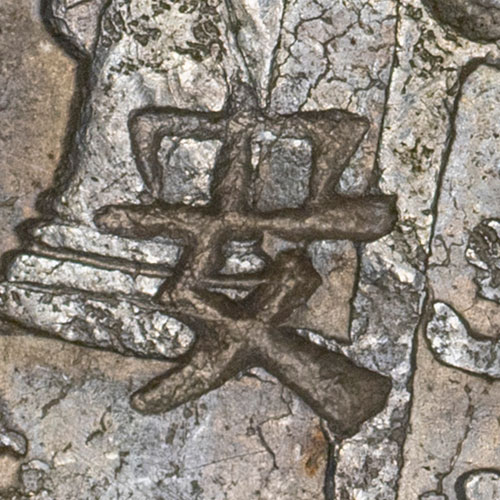 安 - ān - peace, safe, calm
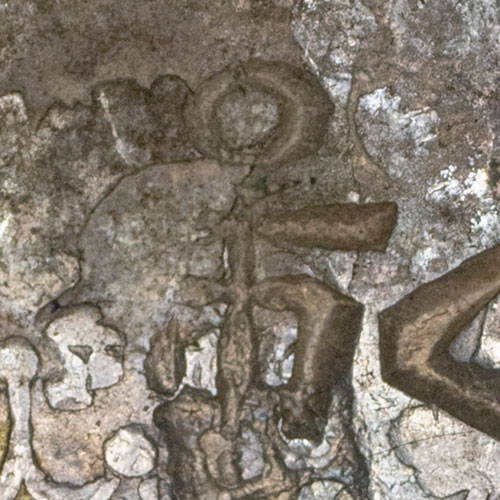 呆 - dāi - dull, wooden, stupid, dull-minted, simple
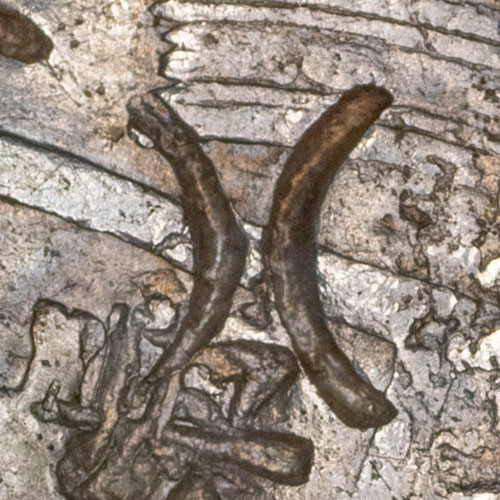
 - Liushutong script variant of 八 - bā - eight
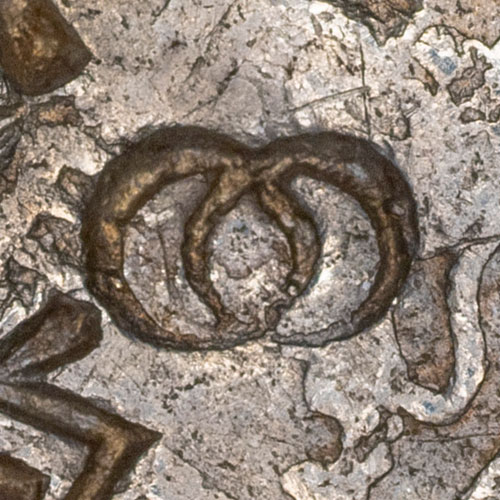
 - Liushutong script variant of 環 - huán - jade ring or bracelet; ring
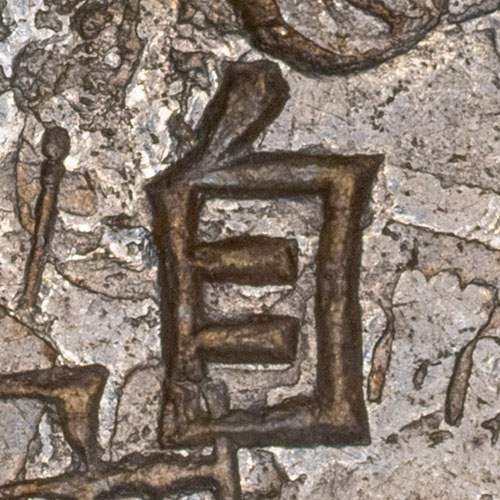 自 - zì - self, certainly, of course, personally, from
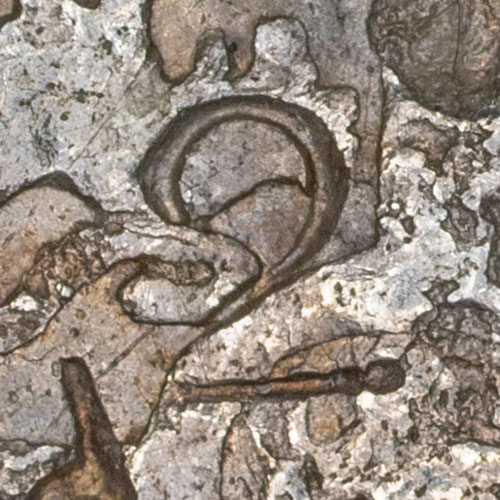 2 - number chopmark
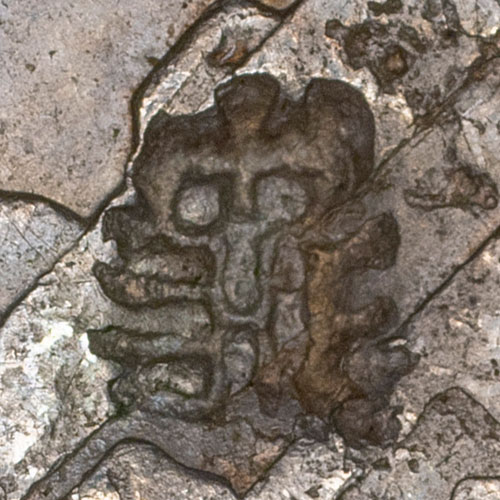 Unknown chopmark
Provenance:
Purchased from fellow collector Adam Bickford in May 2025. Note: I had previously purchased this coin on eBay not noticing the Portugal countermark. Taylor later pointed it out
to me, and at some point I had sold the coin to Adam. Happy to have it back.
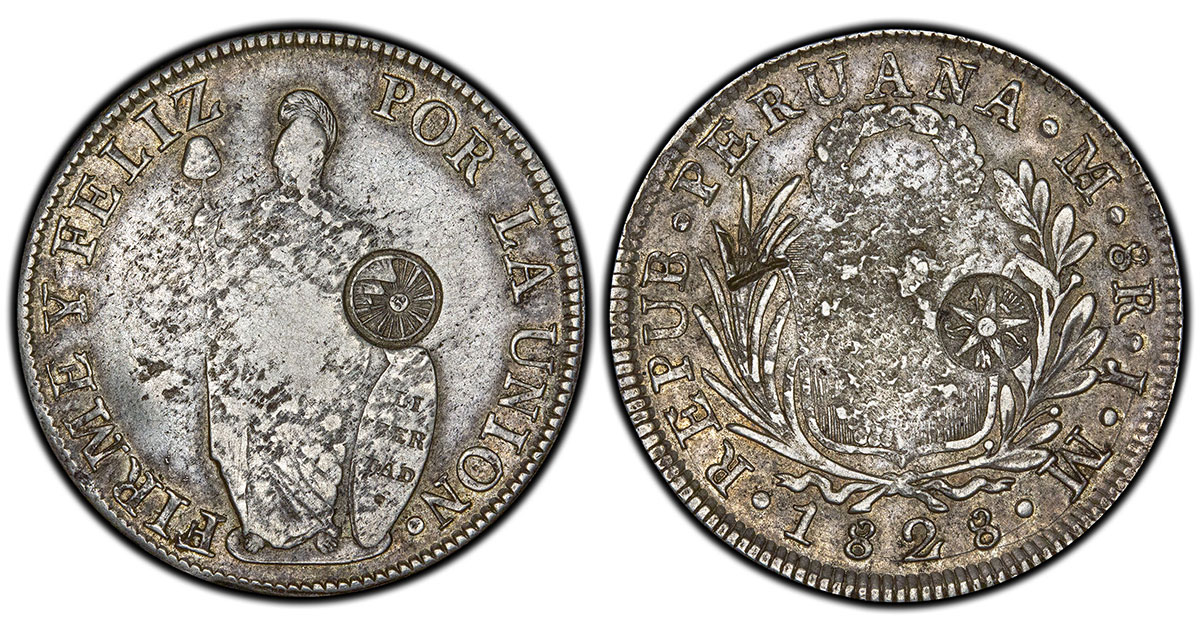
(1841) Guatemala Type IV countermark on 1828-LM JM Peru 8 Reales (Ex. Bowman / Murphy)
Specifications:
27.07 g, .903 fine silver, .786 troy oz (actual silver weight)
Recorded mintage: unknown
Catalog reference: KM 118.1
Details:
The Federal Republic of Central America, formed in 1823 from the five former Spanish colonial provinces of Guatemala, El Salvador, Honduras, Nicaragua, and Costa
Rica, had effectively dissolved by 1838 under chronic internal conflict. Guatemala declared full independence in 1841. The market in the years surrounding that break
was flooded with silver from mints across Latin America, in varying states of wear and of uncertain fineness, with no reliable mechanism to standardize it.
A decree of October 31, 1840 authorized the countermarking of foreign crown-sized silver circulating in Guatemala, issued by the Guatemalan state government then operating under the strong influence of Rafael Carrera, the conservative military caudillo who had taken Guatemala City in 1838 and effectively controlled the government through a series of nominal civilian leaders. The countermarking itself was carried out at the Nueva Guatemala mint by the mint's assayers, with the program running from December 1840 into early 1841. The host coin here, an 1828 Lima 8 reales, is a Peruvian republican issue that had traveled north, likely through Pacific trade routes before taking on this new role.
The Type IV is the most technically refined of the Guatemalan countermark types, applied with hinged dies that struck both faces of the coin simultaneously, avoiding the flattening on the opposite side that earlier types produced. The obverse mark shows a radiant sun rising above three volcanoes, drawn directly from the Central American Republic's own coinage, while the reverse carries a sun atop a five-pointed star above a bow, quiver, and arrows within a circular incuse. The program operated for only a matter of weeks before Guatemala's full independence brought the federation's shared monetary framework to a close, which accounts for the relative scarcity of Type IV pieces compared to the earlier types in the sequence.
The chopmark on this piece makes it a genuinely rare survivor, likely a unique specimin. Guatemala had little direct trade with China, but the coin could plausibly have moved through any number of intermediary hands, south through Pacific ports to Valparaiso or Callao, where it might have joined the broader flow of Latin American silver making its way westward into Chinese commerce.
Notable chopmarks:
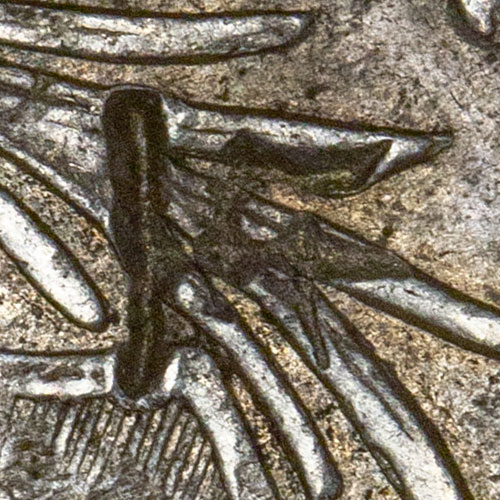 Incomplete chopmark
Provenance:
Purchased from the Stack's Bowers April 2026 Hong Kong Showcase Auction
Lot #49666
Auction Description:
GUATEMALA. Guatemala - Peru. 8 Reales, ND (1841). PCGS Genuine--Damage, VF Details.
KM-118.1; Jovel-VII countermark; Murphy-Fig. 210 (Plate coin); Leverage-Fig. 99 (Plate coin). Issued by decree of 31 October, instituted December to Early 1841. Countermark: Type IV (Hinged Dies). Obverse: Sun over mountains; Reverse: Five-pointed star superimposed on bow, arrow and quiver on reverse. A single medium size incuse Chinese chop on the reverse that is unfortunately unevenly applied and obscured by the host designs. This highly interesting and well-traveled issue displays light attractive mottled gray patina with richer coloration in the protected areas. The initial countermark is deeply impressed as usual on a decently preserved host with a weak central strike. A highly unusual and extremely interesting piece of the highest caliber rarity and as such is probably UNIQUE. A real treat for the sophisticated world countermark specialist seeking exotic well-traveled numismatic treasures.
Provenance: From the Edgar Murphy Collection.
Ex: J.D. Bowman Collection.
(ca. 1856-57) "J.L. Polhemus Sacramento, CA Druggist" counterstamp on 1856-S US Seated Half Dollar
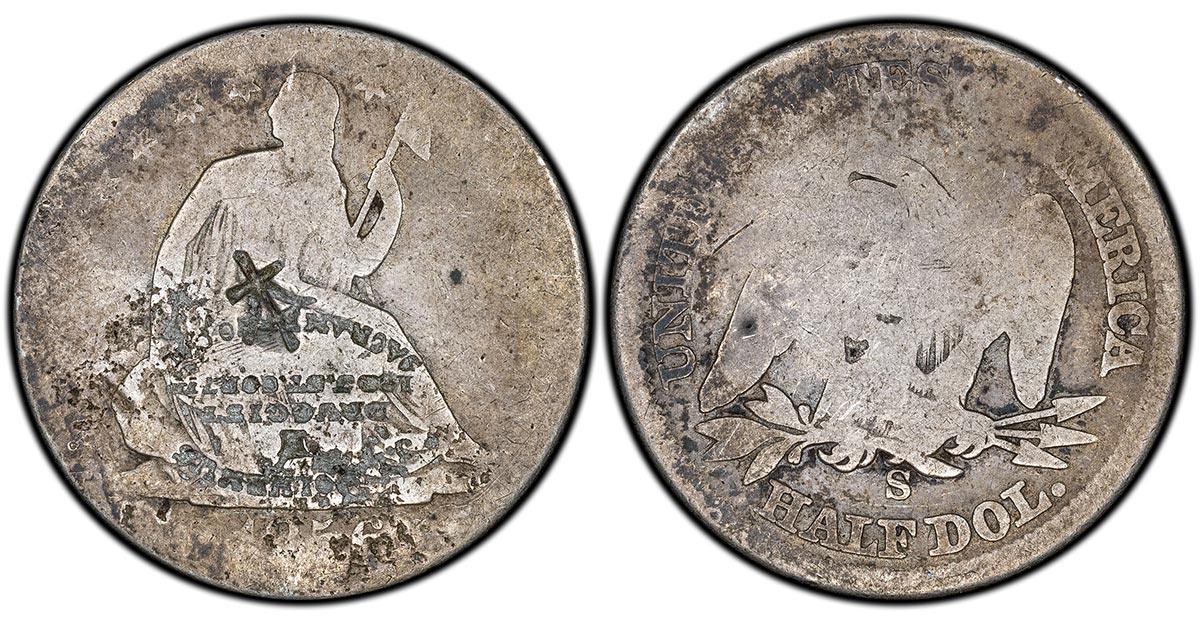
Specifications:
12.44 g, .900 fine silver, .3599 troy oz (actual silver weight), edge reeded
Recorded mintage: 211,000
Catalog reference: KM A68
Details:
The 1856-S Seated Liberty half dollar, struck at the San Francisco Mint, is a product of the Gold Rush economy that transformed California after 1848. Silver coinage was in
constant demand during this period, as gold dust dominated everyday transactions and reliable fractional silver was scarce. The San Francisco Mint, still relatively new in the
mid-1850s, struck these halves to circulate locally in a fast-growing economy centered on mining camps, supply towns, and commercial hubs like Sacramento and San Francisco. As
a result, many 1856-S halves saw hard use in frontier commerce, making them natural candidates for later alterations such as counterstamps.
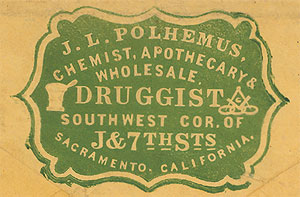
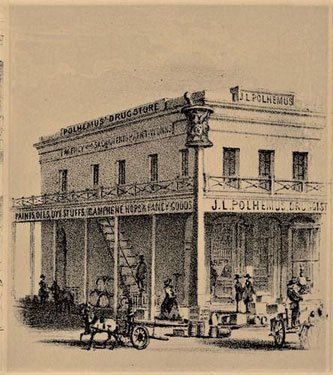
The counterstamp “J. L. POLHEMUS / DRUGGIST / SACRAMENTO CAL.” is attributed to James L. Polhemus, a well-documented Sacramento pharmacist active during the Gold Rush era. Like many Western merchants of the 1850s, Polhemus counterstamped circulating silver coins as a form of advertising and informal validation, ensuring his name traveled hand-to-hand with everyday money. In a fluid cash economy where private gold issues, worn federal coins, and foreign silver circulated side by side, counterstamping also signaled trust and local acceptance. Polhemus is known to have applied his stamp to half dollars and other silver coins, likely at his shop, turning both local and foreign coinage into a portable business card tied directly to Gold Rush–era Sacramento.
What makes this coin exceptional is the combination of a Gold Rush merchant counterstamp and a Chinese chopmark, linking two distinct monetary worlds on a single piece of silver. The most plausible path begins with the coin’s striking in San Francisco, followed by circulation inland to Sacramento, where it received the Polhemus counterstamp in local commerce. From there, the coin likely returned to San Francisco, the primary Pacific gateway for silver exports, before it was shipped across the Pacific to China, where it was tested and accepted by a Chinese shroff and marked with a chop. Few coins so clearly document the journey from gold rush California to China, making the coexistence of a Sacramento counterstamp and a Chinese chopmark a tangible record of California’s role between gold rush America and the global silver trade.
Notable chopmarks:
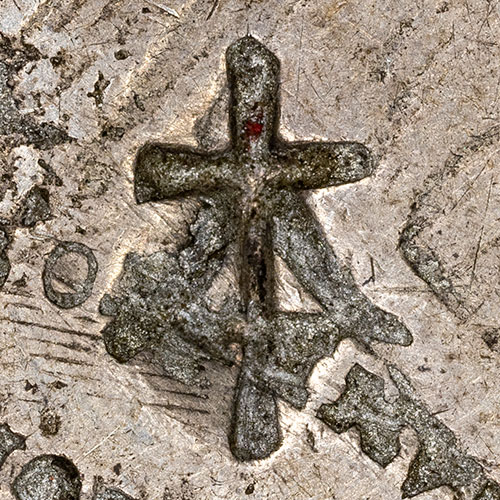 本 - běn - root, origin, this
Provenance:
Purchased via private sale from fellow collector Daniel Tsai (to whom I am very grateful) in February, 2024.
Dan purchased the coin off eBay from seller "goldandcointraders", a seller who runs a pawn shop in Florence Kentucky.
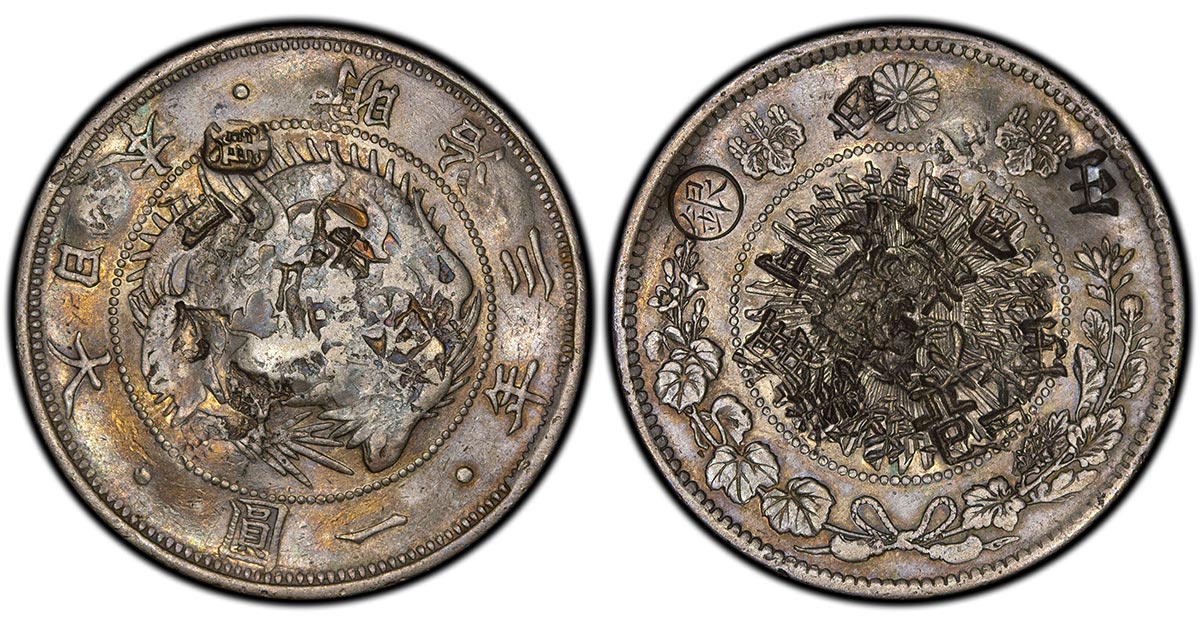
Meiji 3 (1870) Type 1 Japan Yen - Gin left countermark
Specifications:
26.9568 g, 0.900 fine silver, 0.780 troy oz (actual silver weight)
Recorded mintage: 3,685,049
Catalog reference: KM Y28
Details:
In October 1897, Japan adopted an exclusively gold standard, revaluing the gold yen and effectively demonetizing the existing silver yen. For a six-month window, the public
could exchange silver yen for gold, after which the remaining silver stocks were either melted for subsidiary coinage or shipped to Taiwan and other East Asian markets for
use as bullion. To prevent these exported coins from being re-imported and presented for a second exchange into gold, the Japanese authorities applied a circular countermark
containing the character 銀 (Gin, meaning "silver"). This mark served as a formal cancellation of the coin's legal tender status within Japan proper, while simultaneously
certifying its metallurgical integrity for the regional trade markets.
The Gin countermark is traditionally found in a specific position relative to the 一 (Ichi, meaning "one") character on the reverse. While standard commercial chopmarks appear randomly across the coin's surfaces, the official countermark was applied with precision. According to some numismatic authorities, the Osaka Mint applied the mark to the left of the denomination, while the Tokyo Mint applied it to the right, though Japanese scholars remain cautious about this absolute distinction. This somewhat scarce with chopmarks in addition to the Gin mark; while the official countermark was intended to facilitate trade, the dual presence of an imperial stamp and a private shroff's mark represents a neat intersection of official Japanese monetary policy and the skeptical, decentralized verification system of the Chinese mainland.
Notable chopmarks:
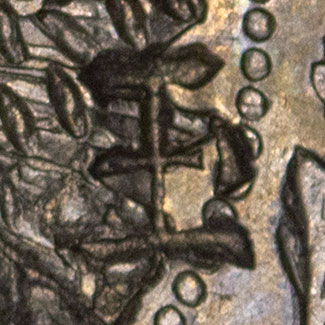 玉 - yù - jade, pure, beautiful, a surname
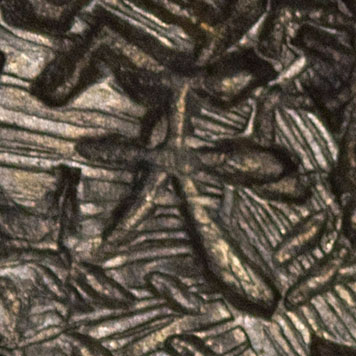 天 - tiān - heaven, sky, day
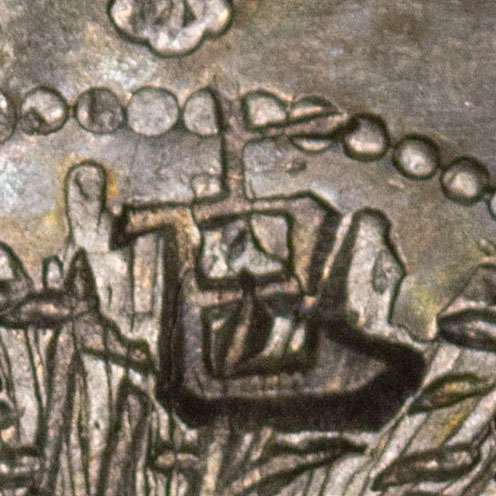 Looks like 上 - shàng - above, up, top
on top of
巳 - sì - 6th earthly branch, snake
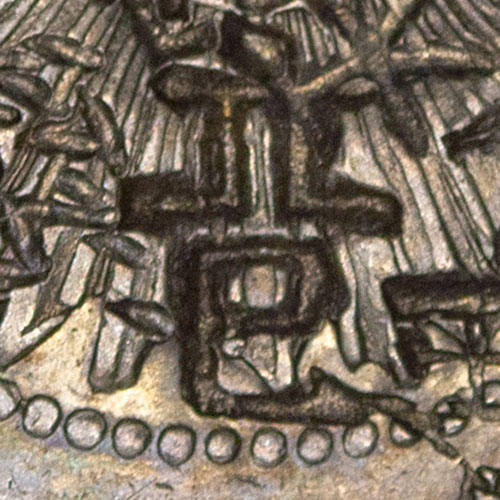 Possibly 芑 - qǐ - white millet, a grain crop
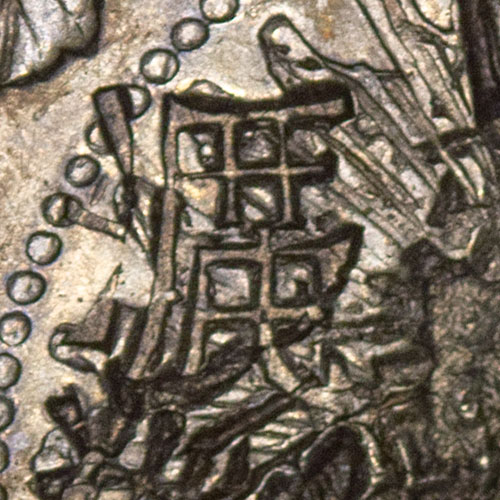 An extra part on top of 茂 - mào - luxuriant, dense
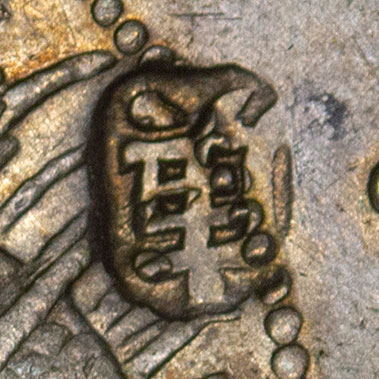 Unknown Japanese chopmark
Provenance:
From the Ron Waddell Collection
Purchased from Ron via private sale in September 2016
Meiji 3 (1870) Type 1 Japan Yen - Gin right countermark
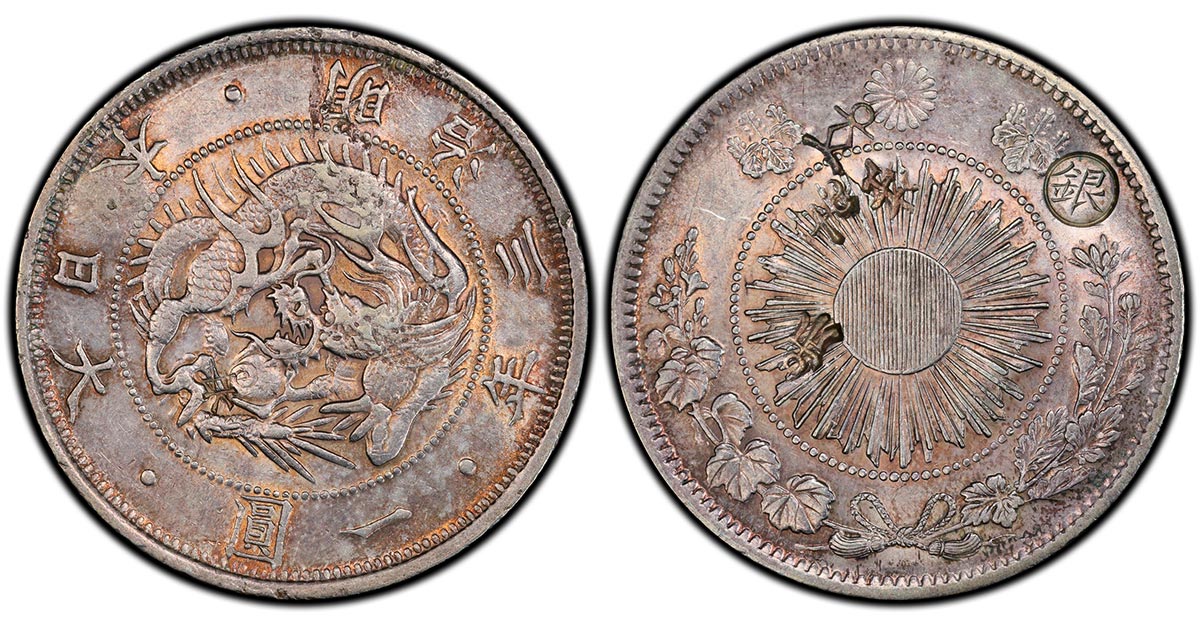
Specifications:
26.9568 g, 0.900 fine silver, 0.780 troy oz (actual silver weight)
Recorded mintage: 3,685,049
Catalog reference: KM Y28
Details:
In October 1897, Japan adopted an exclusively gold standard, revaluing the gold yen and effectively demonetizing the existing silver yen. For a six-month window, the public
could exchange silver yen for gold, after which the remaining silver stocks were either melted for subsidiary coinage or shipped to Taiwan and other East Asian markets for
use as bullion. To prevent these exported coins from being re-imported and presented for a second exchange into gold, the Japanese authorities applied a circular countermark
containing the character 銀 (Gin, meaning "silver"). This mark served as a formal cancellation of the coin's legal tender status within Japan proper, while simultaneously
certifying its metallurgical integrity for the regional trade markets.
The Gin countermark is traditionally found in a specific position relative to the 一 (Ichi, meaning "one") character on the reverse. While standard commercial chopmarks appear randomly across the coin's surfaces, the official countermark was applied with precision. According to some numismatic authorities, the Osaka Mint applied the mark to the left of the denomination, while the Tokyo Mint applied it to the right, though Japanese scholars remain cautious about this absolute distinction. This somewhat scarce with chopmarks in addition to the Gin mark; while the official countermark was intended to facilitate trade, the dual presence of an imperial stamp and a private shroff's mark represents a neat intersection of official Japanese monetary policy and the skeptical, decentralized verification system of the Chinese mainland.
This example is the scarcer "Type 1, No Border" variety.
Notable chopmarks:
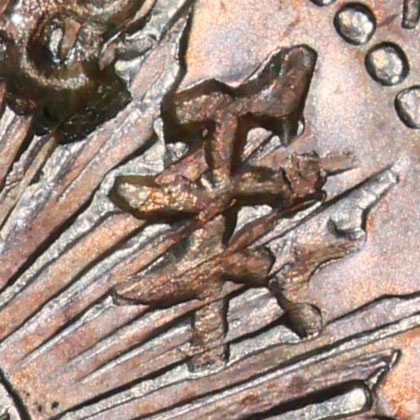 禾 - hé - grain, cereal
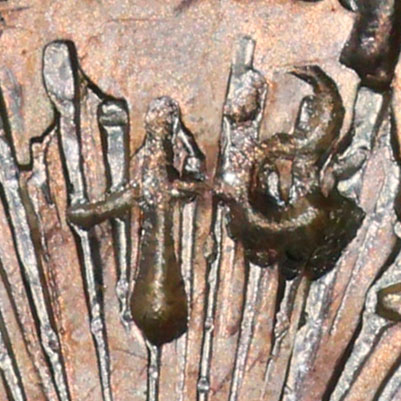 Possibly 忋 - gǎi - to rely on, look up to
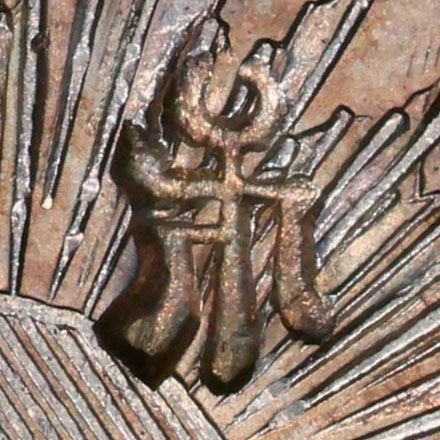
 - Liushutong script variant of 吴 - (variant of 吳) wú - to shout (obsolete), the region comprising southern Jiangsu and northern Zhejiang, a surname
 Unknown chopmark, possibly seal script
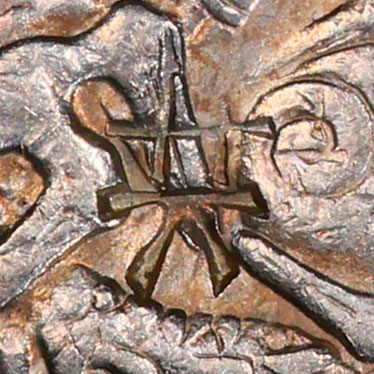 共 - gòng - common, together, to share
Provenance: From Great Collections Online Auction ending October 20, 2024 Lot #1677805
Auction Description:
Japan ND (1897) Silver Yen Gin Countermark to Right on Type 1 Year 3 (1870) Yen Y-28.1 PCGS Genuine AU Details
JNDA-01-9A
Previously from Auction World Japan 37th Auction, July 13-14 2024 Lot #5102
Auction Description:
NGC-AU Details “Chopmarked”
日本 旧一圓銀貨 丸銀打 Old type 1Yen Silver Counterstamp 明治3年(1870) トーン 荘印複数 EF
JNDA01-9A KM-Y28.1 普通圓 Type1 無輪 右丸銀
トーン 荘印複数 EF
1870 (1874) Spain 2 Pesetas with religious diety marks
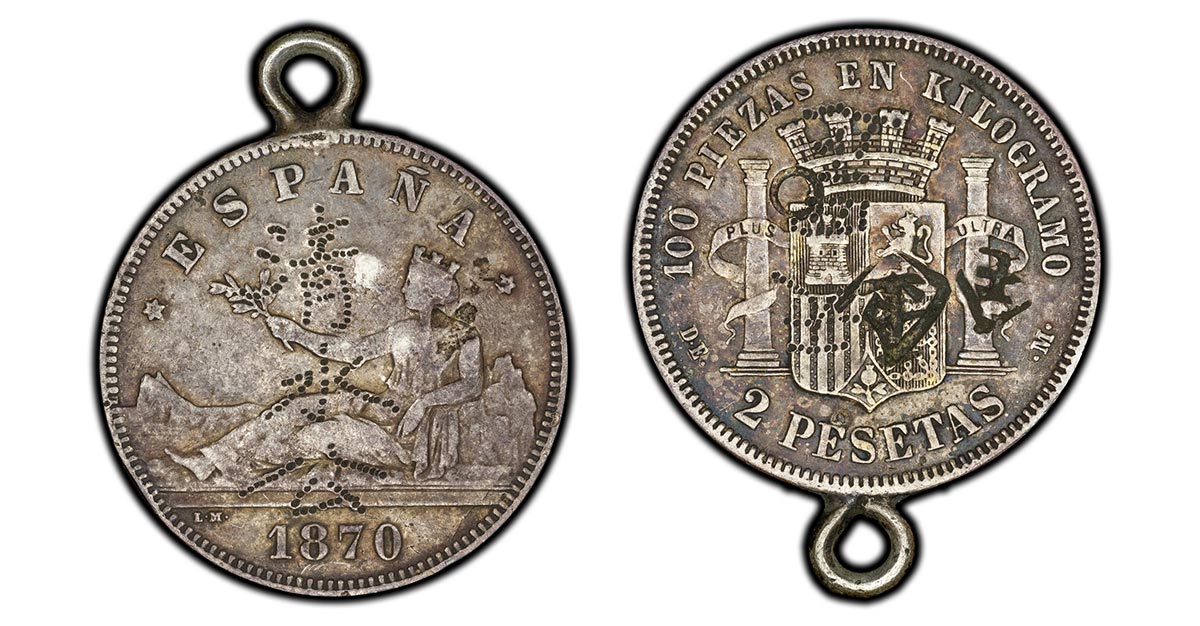
Specifications:
10.000 g, .8350 fine silver, .2685 troy oz (actual silver weight)
Recorded mintage: 14,893,000
Catalog reference: KM 654
Details:
Struck at the Madrid Mint, the "1870" Spain 2 Pesetas features a dual-dating system common to Spanish issues of the era; while the main legend displays the "1870" series date,
the actual year of production, 1874, is incused in the small six-pointed stars on the reverse.
This example is modified with an integrated metal loop, a characteristic adaptation that allowed the coin to be suspended as part of a larger ritual assembly dedicated to localized deities. In this context, the coin’s physical presence served as a tangible expression of devotion, likely draped alongside other foreign silver issues around a ritual figure to invoke protection or good fortune. Most such ritual objects were eventually stripped of their value and returned to private hands as temple officials often reclaimed high-purity silver for reuse after the conclusion of ceremonies. See the 1806 US Half Dollar shown earlier for more information about these talisman offerings made with silver coins.
Notable chopmarks:
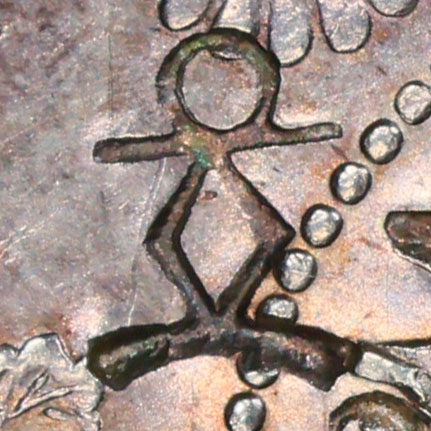
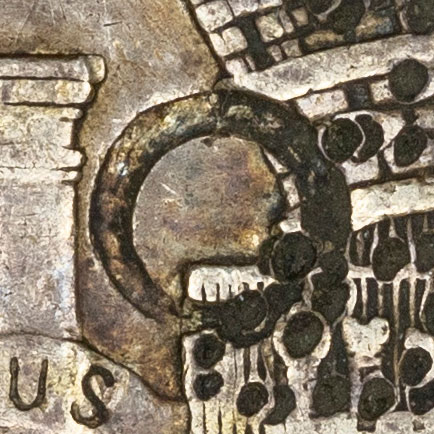 Circle shaped chopmark
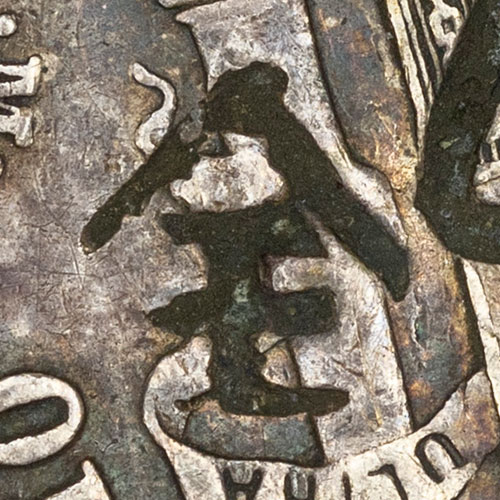 全 - quán - whole, complete, all
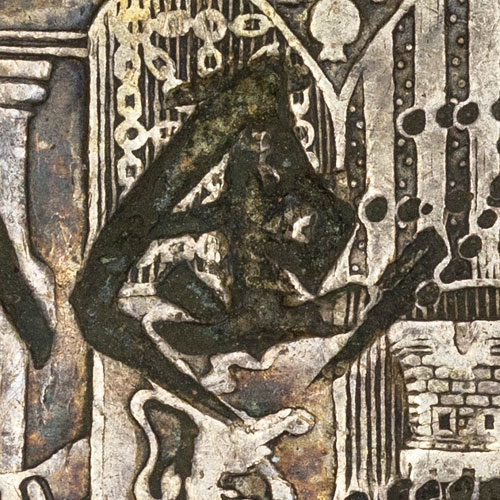 Similar to 金 - jīn - gold, metal, money
Provenance:
From Ben Dalgleish, a collector who finds chopmarked coins in the coin markets of Hong Kong, July 2024.
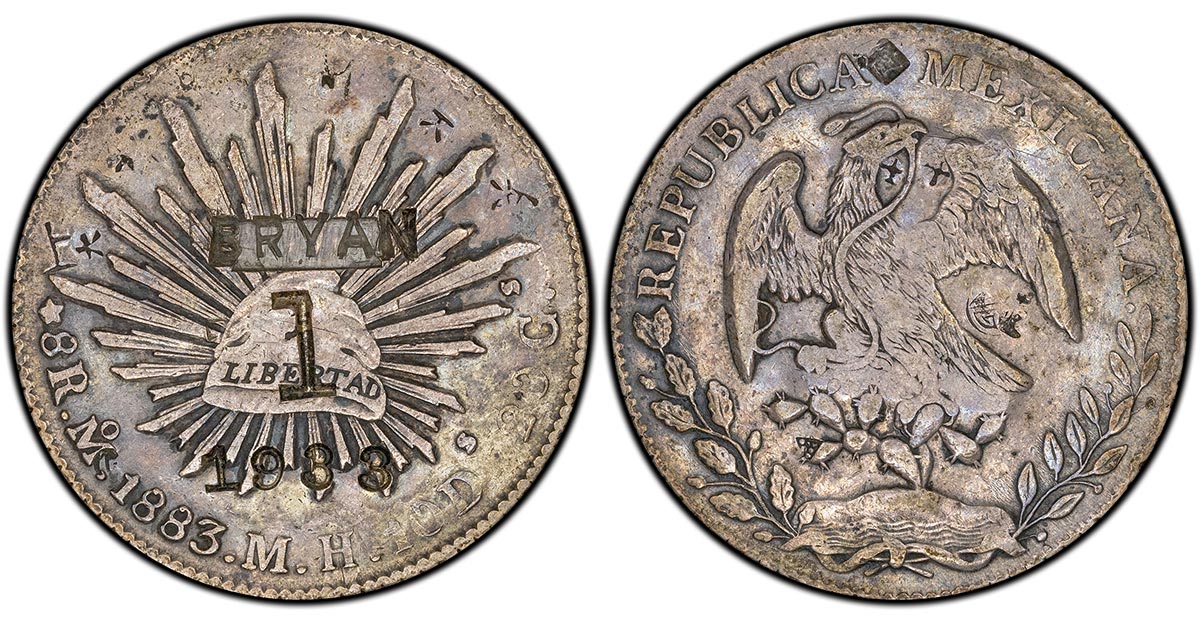
1883-Mo MH Mexico 8 Reales with Brunk B-1237 "BRYAN 1 1933" countermark & small chopmarks
Specifications:
27.07 g, .903 fine silver, .786 troy oz (actual silver weight)
Recorded mintage: 2,726,000
Catalog reference: KM 377.10
Details:
This "BRYAN 1 1933" countermark (Brunk B-1237) is struck on an 1883 Mexico City 8 Reales host coin, also bearing several small Chinese chopmarks. This specific countermark
is part of a series of political and economic tokens that reference the bimetallic advocacy of William Jennings Bryan. While Bryan’s primary influence peaked during his
1896 presidential campaign, where he championed the "free coinage" of silver to assist debtors and farmers against the constraints of the gold standard, this particular stamp
belongs to a secondary period of silver agitation. The "1933" dating aligns with the silver speculation surrounding the Great Depression (1929–1939) and the issuance of
"so-called dollars," such as the Pedley-Ryan pieces, as the public reacted to the United States' transition away from gold.
The presence of the countermark on this specific host coin documents a definitive three-country trajectory. The coin originated in Mexico at the Mexico City mint, struck to the traditional 8 Reales standard for international commerce. It then traveled via trans-Pacific trade routes to China, where it was accepted by local merchants and shroffs who applied small chopmarks to verify the silver's weight and fineness. Following significant circulation in China, the coin was transported to the United States. There, it was pulled from bullion or numismatic channels in the early 1930s to serve as a planchet for the Bryan political stamp, physically linking 19th-century global trade with a 20th-century American monetary populist movement.
The host coin is very common with chopmarks, though the application of the Bryan countermark significantly increases its rarity. The intersection of Chinese merchant marks and an American political stamp creates a unique historical record of a coin that facilitated trade in the Pearl River Delta before returning to the Americas to play a role in domestic silver speculation. The coin represents a physical confluence of the Mexican mining industry, western trade with China, and the American "Free Silver" debate.
Notable chopmarks:
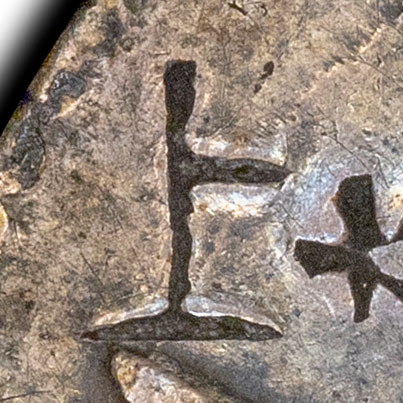 上 - shàng - above, up, top
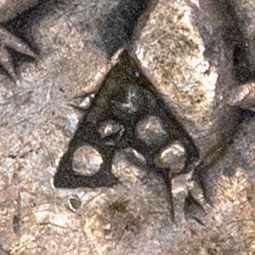 Six-dot triangleNot firmly identified. A triangular heap of round dots reads as a pile of pearls or coins, evoking gathered wealth in the 聚寶 (jùbǎo, 'amassed treasure') tradition; the count of six is itself auspicious (六六大順, liùliù dàshùn, 'may all go smoothly'). It may equally be a simple tally or cluster mark.
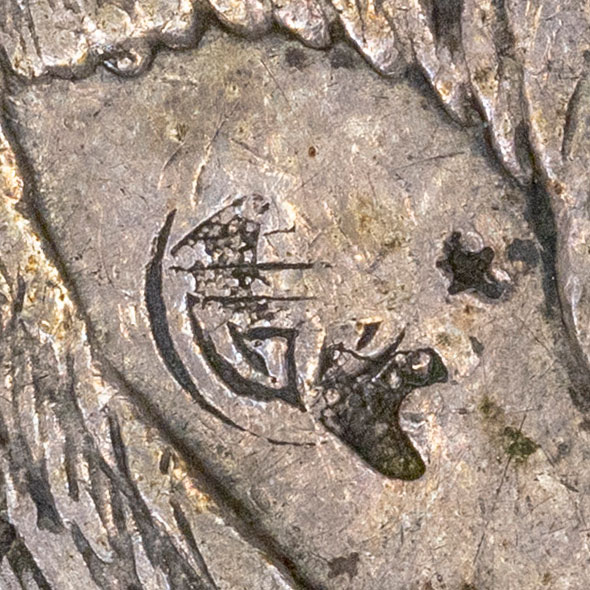 Longevity (壽)Shòu (壽), 'longevity / long life'; a traditional auspicious symbol.
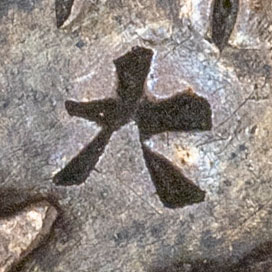 大 - dà - big, great, large
Provenance:
Purchased on eBay in April, 2023 from Jacob Lipson Rare Coins, Ottowa, Ontario Canada.
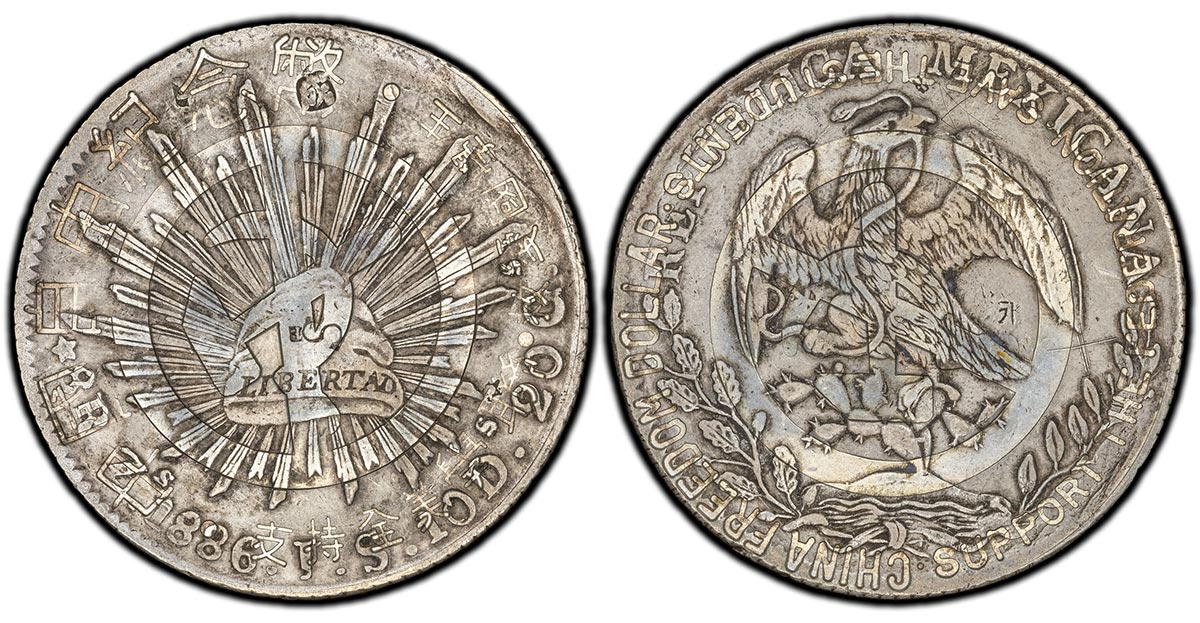
1886-Zs JS Mexican 8 Reales with 1989 Freedom Dollar counterstamp
Specifications:
27.07 g, .903 fine silver, .786 troy oz (actual silver weight)
Recorded mintage: 5,303,000
Catalog reference: KM 377.13
Details:
The 1886 Mexico 8 Reales, Zacatecas (Zs) mint, serves as the host for a large, politically significant counterstamp known as the "China Freedom Dollar." This mark features
a central symbol of a crossed-out hammer and sickle, surrounded by the English legends "CHINA FREEDOM DOLLAR" and "SUPPORT THE FEDERATION SAVE THE STUDENTS." The opposing
side of the stamp mirrors these sentiments in Chinese characters. These counterstamped pieces were issued in 1989 as part of a fundraising effort to assist members of the
Berkeley Chinese Students & Scholars Association (B.C.S.S.A.) who were left stranded in the United States following the political upheaval in China.
The application of this counterstamp followed the Tiananmen Square protests and subsequent massacre (1989), an event that triggered widespread international condemnation and the formation of various support organizations for Chinese nationals abroad. By selecting silver coins that had historically circulated within China, such as the Mexican 8 Reales, the organizers created a physical medium that bridged 19th-century trade history with 20th-century political protest. This specific project utilized the coins as "freedom dollars," sold in commemorative envelopes to raise capital for students who could no longer safely return to their home country or access funds due to the turmoil in Beijing.
This type represents a unique intersection of two distinct periods of Chinese history, as a small proportion of the host coins used for the project bear authentic 19th-century Chinese chopmarks. The presence of these original shroff marks indicates that the type had traveled to the Chinese mainland during the Qing Dynasty, only to be repatriated to the West and eventually stamped with an anti-communist symbol a century later. The juxtaposition of the traditional mercantile chopmarks and the modern political counterstamp creates a layered narrative of China's shifting economic and social landscape. While the host coin is a common issue, the type appears to be somewhat scarce with chopmarks in conjunction with the 1989 stamp.
Notable chopmarks:
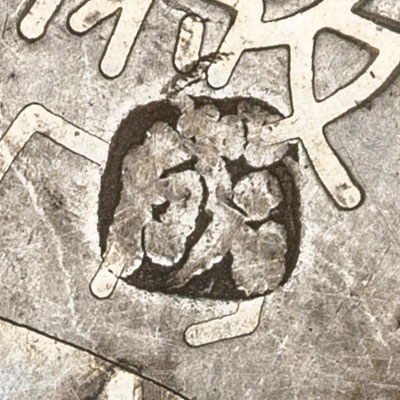 成 - chéng - accomplish, become, complete
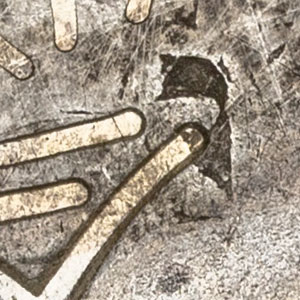 Partial chopmark
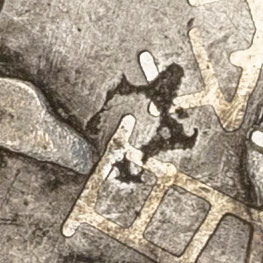 Small sun shaped symbol chopmark
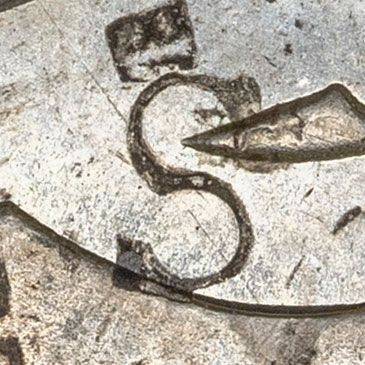 S - Latin-letter chopmark
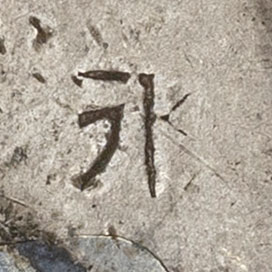 永 - yǒng - eternal, forever
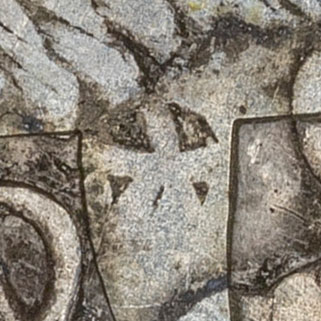 大 - dà - big, great, large
Provenance:
Purchased on eBay in September, 2023 from a seller in Florence, Wisconsin.
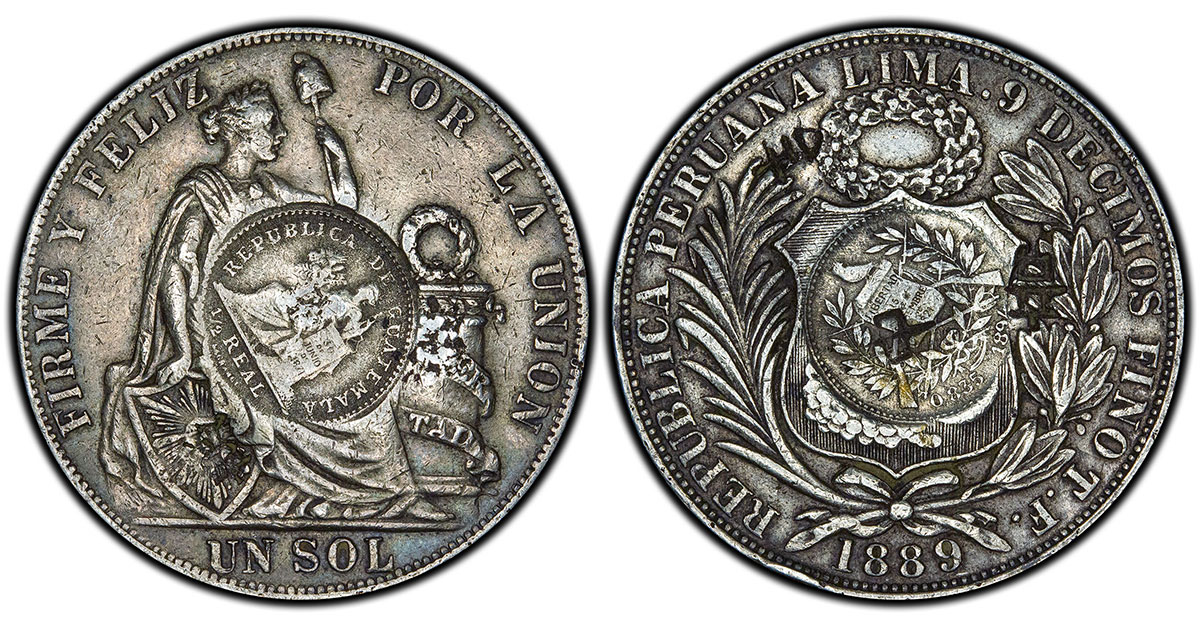
(1894) Guatemala Peso countermark on 1889 Peru Sol host (Ex. Murphy)
Specifications:
25.000 g, .900 fine silver, .7234 troy oz (actual silver weight)
Recorded mintage: Unknown
Catalog reference: KM 224
Details:
By 1894, Guatemala had undertaken a broader monetary reform, contracting the British firm The Mint, Birmingham, Limited to strike new domestic coinage and addressing
the long-standing problem of foreign silver of varying fineness saturating the local market. A decree issued in July 1894 authorized the countermarking of foreign
crown-sized silver at the Guatemalan mint, with the program beginning August 10 and running into early 1895. Coins meeting the required silver standard were brought
in, tested, and struck with the obverse and reverse dies of the newly issued 1894 half real, applied within a peso collar that fixed the denomination. The result was a
coin that carried Guatemalan imagery on both faces while preserving the host coin's design beneath.
The countermark itself uses the dies of the 1894 half real: the Guatemalan coat of arms on one side, and on the other the seated figure of Justice with the legend of the Republic, all within the larger peso collar that distinguished these pieces from the smaller denomination they referenced. The host coin here, an 1889 Lima sol, is one of the more common foreign silver types that circulated in Guatemala during this period, the Peruvian sol having tracked closely enough to Spanish colonial weight standards to remain trusted in Central American trade through the latter half of the nineteenth century.
Notable chopmarks:
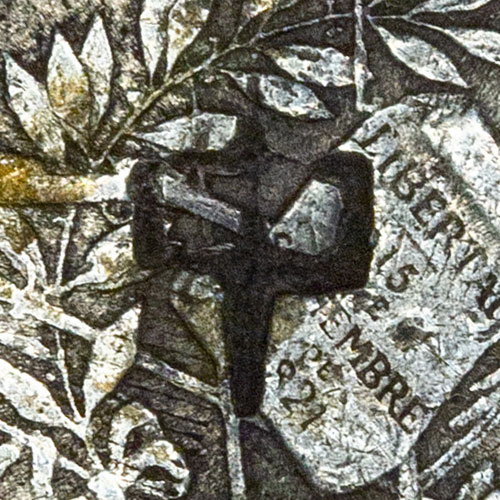 中 - zhōng - center, middle, China
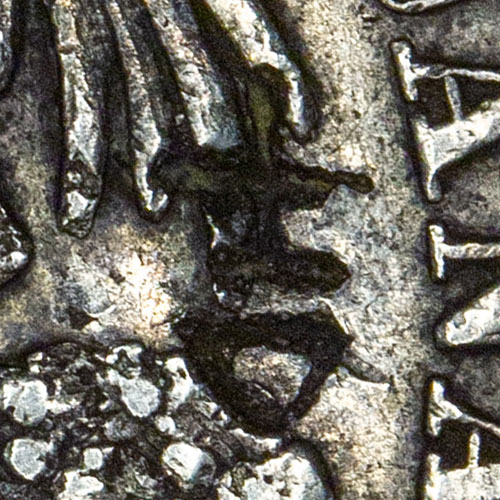 吉 - jí - auspicious, lucky
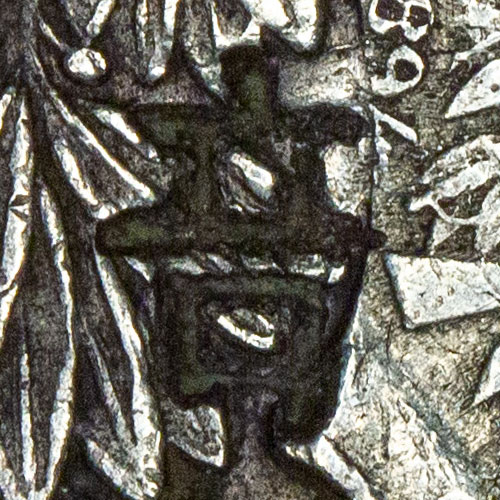 咅 - tòu - A sound used to indicate refusal, to curse at, to scold
Provenance:
Purchased from the Stack's Bowers April 2026 Hong Kong Showcase Auction
Lot #49668
Auction Description:
GUATEMALA. Guatemala - Peru. Peso, 1894. Guatemala City Mint. PCGS Genuine--Chopmark, EF Details.
KM-224; Jovel-Type VIII; Murphy-Fig. 212 (Plate Coin); Leverage-Fig. 100. Issued by decree of July 1894, commencing 10 August 1894 until early 1895. Countermark: 1/2 Real currency dies with Peso collar. Applied to an 1889-LIMA TF Peru Republic Sol (KM-196.24). Several medium size Chinese and pseudo-Chinese chops on both sides, "中" (Zhong), "音" (meaning unknown), "◁⊢⊢" (meaning unknown) as well as a couple that are obscured. This handsome example displays light attractive gray tone with areas of richer coloration amongst the devices. A pleasing example of the type offering good eye appeal.
Provenance: From the Edgar Murphy Collection.