East Meets West Collection - Up to 1821
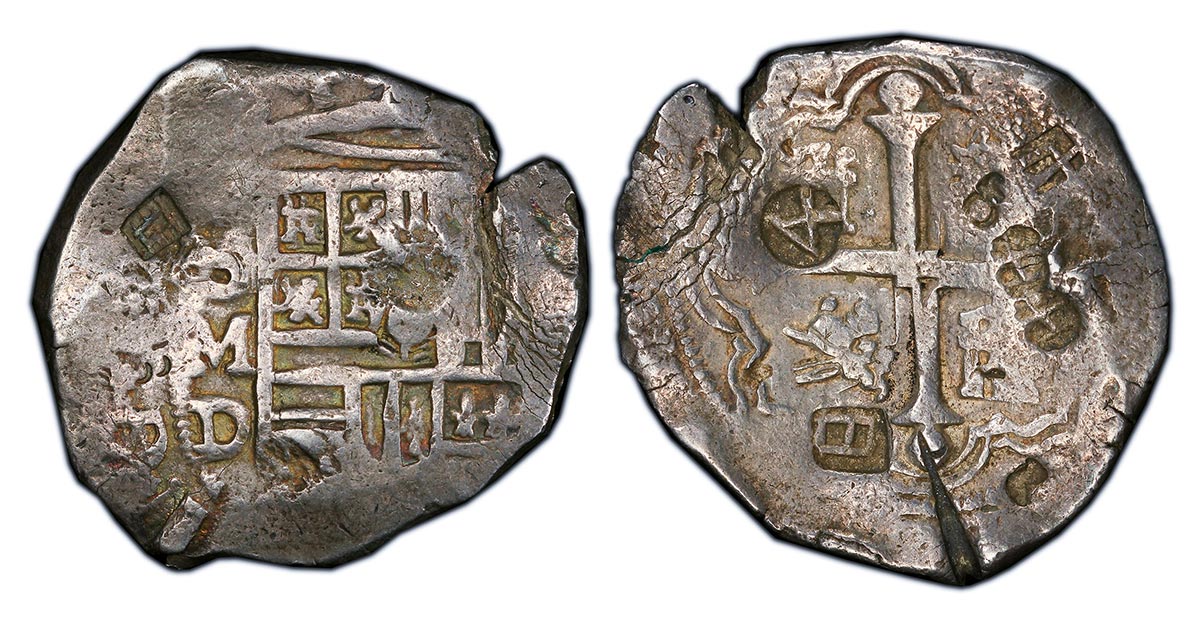
1624 or 1625/4 Mexico 4 Reales cob Philip IV type
Specifications:
13.53 g, .931 fine silver, .4053 troy oz (actual silver weight), this specimen 13.50 g
Recorded mintage: unknown, rare assayer 'D' for 4 reales denomination
Catalog reference: KM-38
Details:
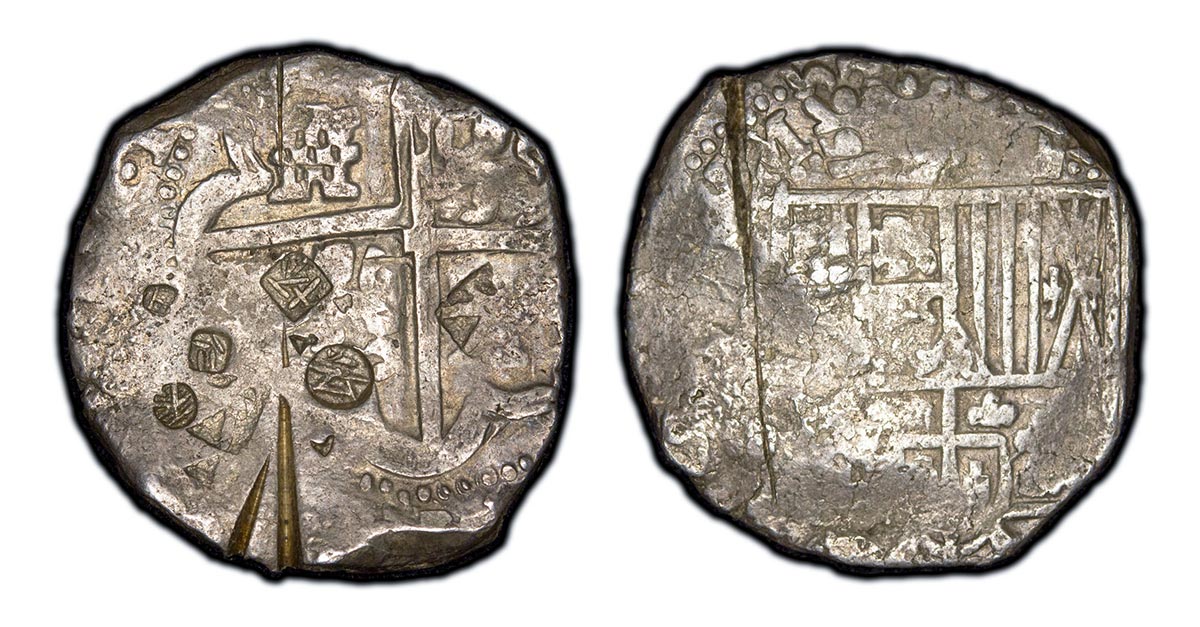
1625/4 Mexico 4 Reales cob, Mexico City mint, struck in silver weighing 13.53 g and about .930 fineness. The obverse shows a partial Jerusalem cross with lions and castles
representing the Spanish royal arms, while the reverse bears a crowned shield with elements of the Habsburg arms, the mintmark Mo, and the assayer initial D, for Diego de Godoy,
an assayer at the Mexico City mint from 1618 through 1634. As with most hand-cut, hammer-struck cobs, the flan is irregular and the design incomplete. While assayer D is relatively
well represented on Mexico City 8 reales of the 1620s, his mark is distinctly scarce on the 4 reales denomination. This general 4 reales cob type was produced throughout the reign
of Philip IV (1621–1665), with overdates such as 1625/4 reflecting routine die reuse.
The 4 reales denomination occupied a practical middle ground in Spain’s colonial silver system, circulating alongside 8 reales for large payments and smaller fractional silver for everyday transactions. By the mid-1620s, the Mexico City mint was operating under sustained pressure to convert New World silver into coin for both local circulation and export, drawing heavily on silver from central Mexican mining districts. Coinage from this period reflects a production environment focused on volume and expediency rather than uniform appearance, with irregular weights and crude strikes accepted as normal so long as the silver itself was good.
Seen with chopmarks typical of the period, crudely formed but well defined, in relief surrounded by ovals, circles or rectangles. This example is particularly nice for a cob of this era, chopmarks or not
Notable chopmarks:
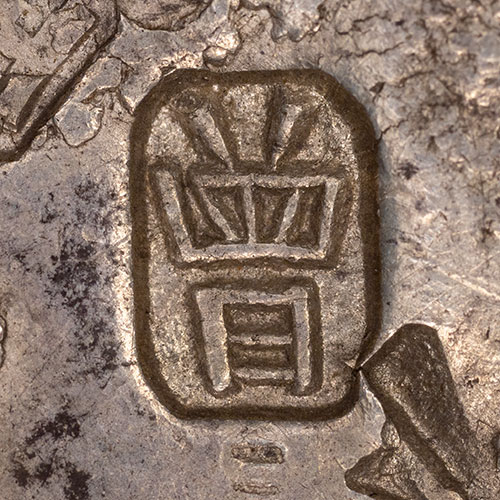
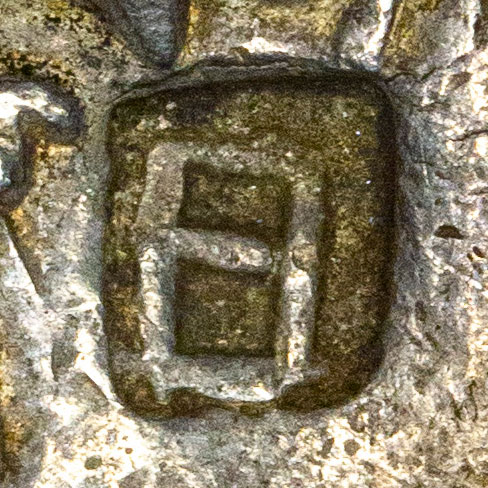 日 - rì - sun, day
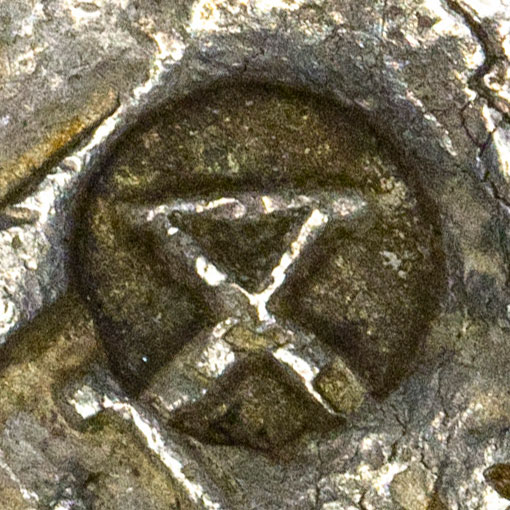 又 - yòu - again, also, right hand
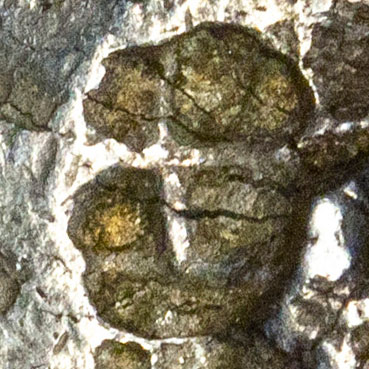 Likely 士 - shì - scholar, gentleman, soldier
Provenance:
Purchased in March 2022 from fellow collector Gerardo Martinez of Mexico.
Early-to-mid 1600's Potosi, Bolivia 8 Reales cob, probably Philip IV type
Specifications:
Measured weight: 27.21 g
Recorded mintage: unknown, plentiful
Catalog reference: KM-10
Details:
By the early to mid-17th century, Potosí stood at the heart of Spain’s silver supply, drawing on the immense output of Cerro Rico, the mountain towering over Potosí, to
support an empire under growing fiscal strain. During the reign of Philip IV, silver from Upper Peru underwrote prolonged military commitments in Europe and the Mediterranean,
even as Spain faced mounting debt, internal revolts, and declining political leverage. The pressure to move silver quickly into circulation meant that coinage at Potosí
prioritized speed and quantity over appearance, resulting in cobs that were acceptable but quite often crude.
Potosí 8 reales entered the China trade primarily via the Manila galleon route, moving first north and west from Upper Peru to Pacific ports such as Acapulco, where silver from Potosí was consolidated with Mexican issues before being shipped across the Pacific to Manila. From Manila, Spanish American silver flowed steadily into Chinese commercial networks through Fujian, Guangdong, and other coastal entry points, where it circulated alongside Mexican and Peruvian cobs by weight rather than by type.
This type is relatively scarce with chopmarks, this one showing multiple relief chopmarks, several smaller chops, and medium to large test cuts.
Notable chopmarks:
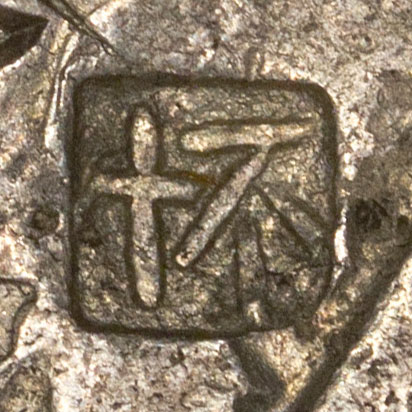 坏 - huài - bad, broken, spoil
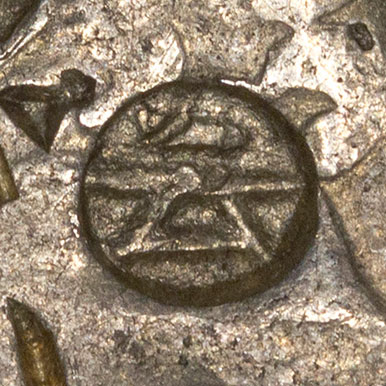 云 - yún - cloud, say
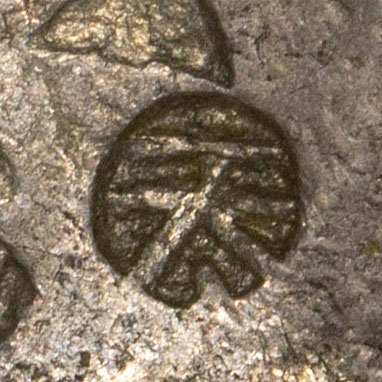 天 - tiān - heaven, sky, day
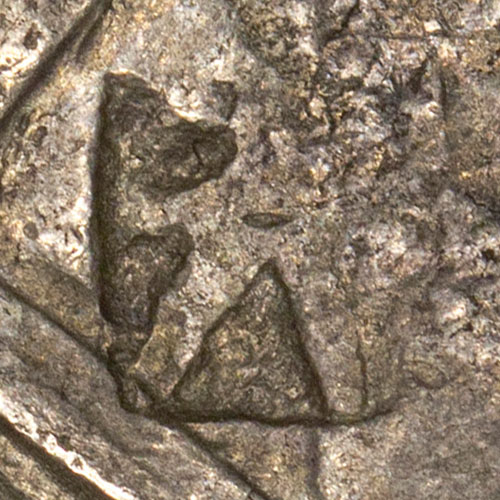 天 - tiān - heaven, sky, day
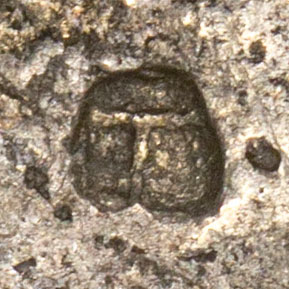 丅 - (ancient version of 下) xià - below, down, under
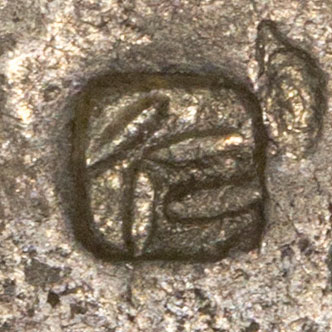 仁 - rén - benevolence, humanity, kernel
Provenance:
Purchased on eBay in February 2018 from a seller in Barcelona, Spain.
1621-1635 Mexico 1 Real cob Philip IV type
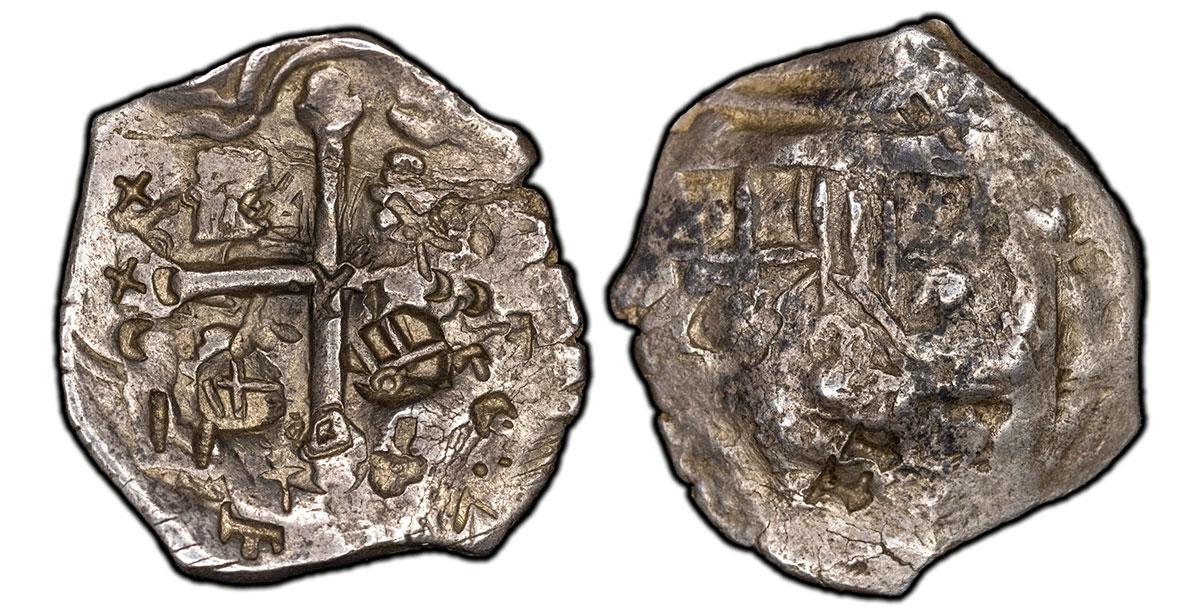
Specifications:
3.38 g, .931 fine silver, .1012 troy oz (actual silver weight), this specimen 3.58 g
Recorded mintage: unknown
Catalog reference: KM-28
Details:
The Mexico City mint had been producing silver coinage since 1536, and the 1 real was among the workhorse denominations of that output, small enough for everyday
commerce but struck to the same .931 fine standard that made Spanish colonial silver trusted across three continents. Philip IV came to the throne in 1621
inheriting both the largest silver-producing empire in the world and the administrative machinery to move that silver into circulation, and Mexico City cobs of his
reign represent that system at its most routine and most essential. At roughly 3.4 grams, the 1 real occupied the lower end of daily trade, filling transactions where
the full 8 reales was simply too large a unit. Partly for that reason, small-denomination cobs survive in lower numbers than their larger counterparts, they were spent
rather than hoarded, and their modest size made them easy to lose and difficult to recover. The date is almost always off the flan, so the date range is typically
arrived at by recognizing the crown style above the shield, the character of the castle and lion punches, or whatever fragment of the assayer's initial the flan
preserves.
This denomination is scarce or even rare with chopmarks, although that may be more due to the reasons mentioned above such as size, rather than low export or usage in China.
Notable chopmarks:
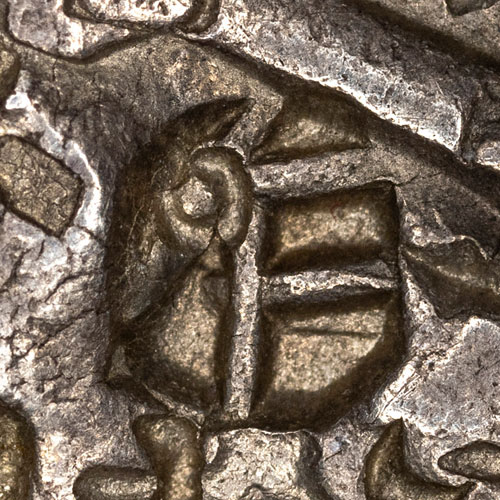 仁 - rén - benevolence, humanity, kernel
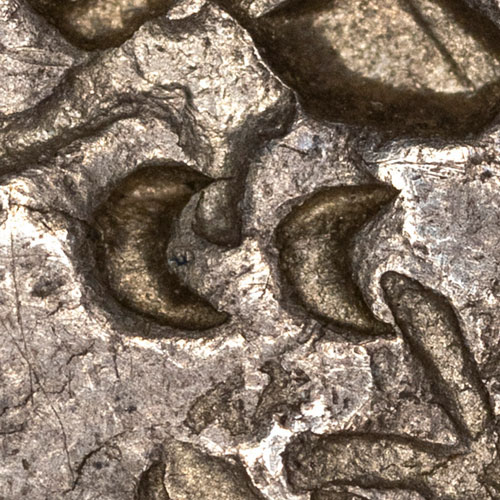
 - Liushutong script variant of 月 - yuè - moon, month
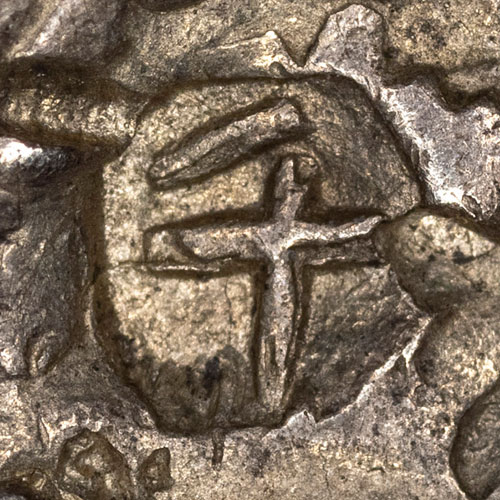 千 - qiān - thousand
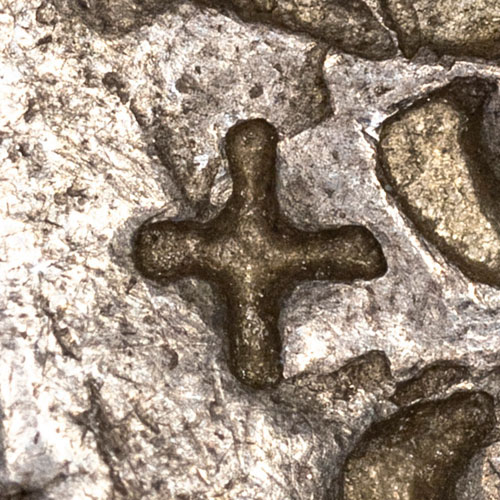 十 - Japanese kangxi radical #24 - ten, complete, perfect
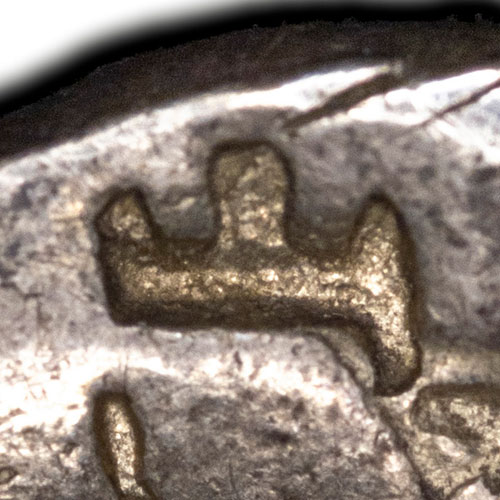 山 - shān - mountain, hill
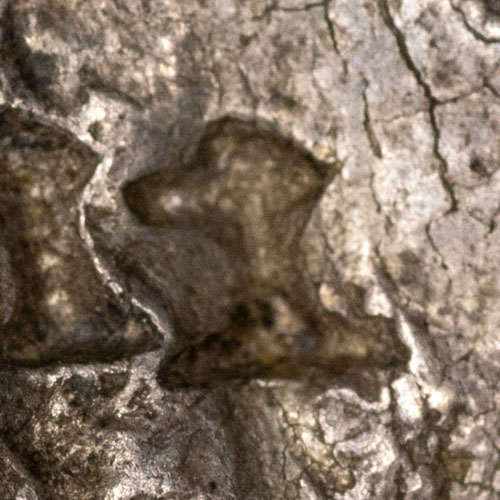 Possibly 土 - tǔ - earth, soil, land, Japanese radical 32
Provenance:
Purchased from the Stephen Album Sale #54 January 22-25 2026
Lot #3981
Auction Description:
CHINA: CHOPMARKED COINS: MEXICO: Felipe IV, 1621-1635, AR 1 real (3.58g), Mexico City, DM, KM-28, cob coinage, date off flan, with many small and medium Chinese
chopmarks on reverse, somewhat dished, VF.
1653-Mo P Mexico 8 Reales cob Philip IV type
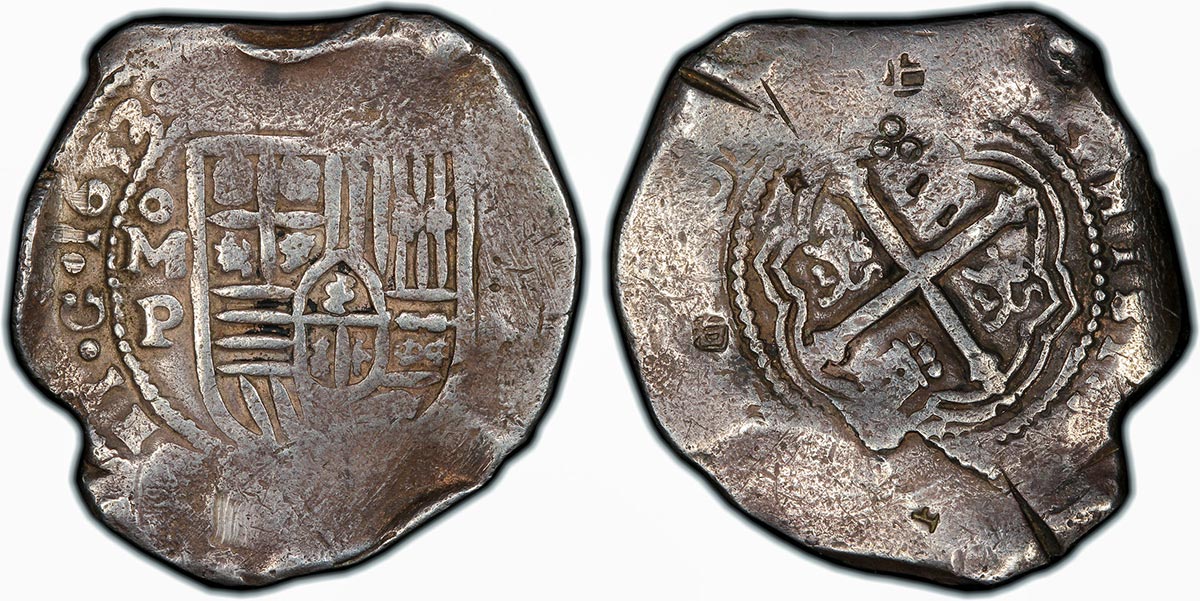
Specifications:
27.07 g, .931 fine silver, .810 troy oz (actual silver weight), this specimen 27.6 g.
Recorded mintage: unknown
Catalog reference: KM 45
Details:
By the early 1650s, the Mexico City mint functioned as a central conduit for Spanish American silver drawn from multiple mining regions, striking coinage for both domestic
circulation and export. Under Philip IV, Spain faced mounting fiscal pressure from prolonged warfare in Europe, internal revolts, and chronic debt, all of which increased
the demand for reliable silver coinage. The Mexico City mint responded by prioritizing quantity over quality, producing large numbers of 8 reales intended to move quickly
into circulation.
This coin is notable for showing a full date, although early 1650s examples of this type are some of the most common cobs to show full dates. The type is also one of the more common types of cobs to find with chopmarks. Mexico City 8 reales reached China through established Pacific routes, particularly via shipment from Acapulco to Manila, where Spanish American silver entered Asian trade networks.
Notable chopmarks:
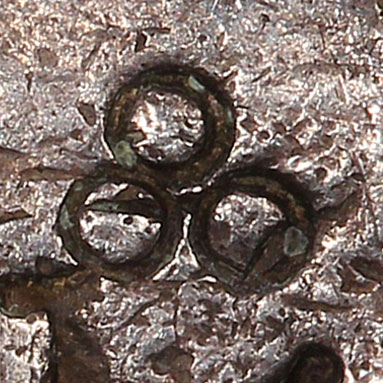 Three circlesSpeculatively a stylized or symbolic form of 品 (pǐn, 'goods / article / quality / rank'); the character is itself three 口 boxes in the same one-over-two arrangement.
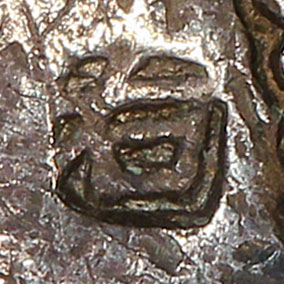 右 - yòu - right, west
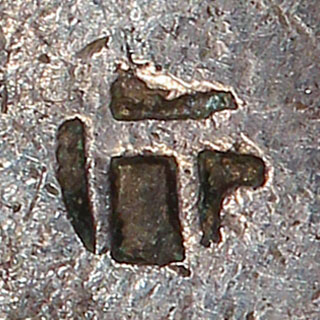 Possibly 仃 - dīng - lonely, alone
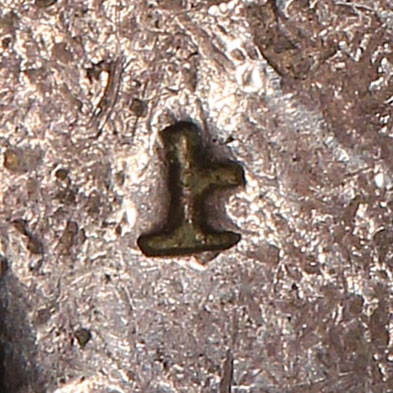 上 - shàng - above, up, top
Provenance:
From the Stack's Bowers November 2015 Baltimore Sale Lot #42506
Auction Description:
MEXICO. 8 Reales, 1653-P. Philip IV (1621-65). NGC Fine Details--Chopmarked.
KM-45. A dramatic representation of the mid 17th century 8 Reales cob coinage. Easily recognizable devices and with jagged edges as made. Housed in an extra thick NGC holder.
Estimate: $175 - $250.
1668-Mo G Mexico 4 Reales cob Carlos II type (Ex. O'Harrow)
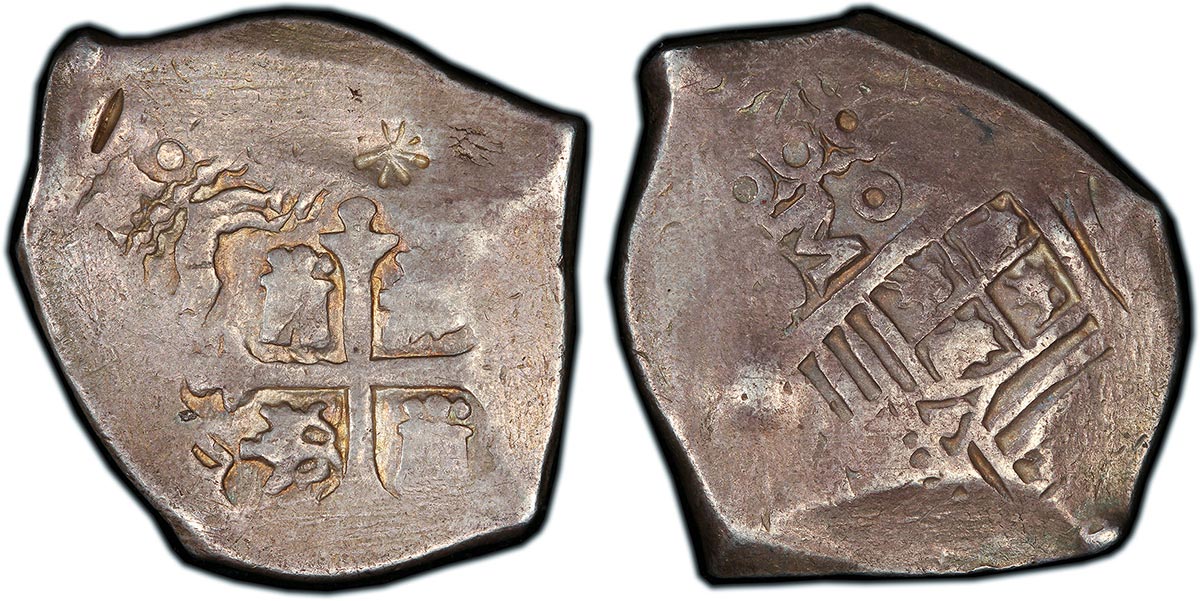
Specifications:
13.54 g, .931 fine silver, .405 troy oz (actual silver weight), this specimen 13.9 g.
Recorded mintage: unknown
Catalog reference: KM 39
Details:
Spanish 4 Reales cob from Mexico City, Carlos II type. Shield obverse, Jerusalem cross quartering Arms of Castile and Leon reverse. 13.9g weight. The date is just clear enough
to identify, and the piece as a whole is nicely preserved and attractive given the life it has lived. Mexican 4R are generally available as cobs, although more challenging than
8R to find with clear dates due to smaller size.
By 1668, Spain was governed in the name of the young Charles II, whose minority was marked by regencies, court factionalism, and continued fiscal strain. Silver coinage remained essential to maintaining imperial finances, and the Mexico City mint continued to strike large quantities of cobs for circulation and export. Production during this period emphasized speed and volume, with little concern for visual uniformity, so long as the silver met accepted standards. Fractional denominations such as the 4 reales played a practical role in everyday commerce alongside the more dominant 8 reales.
Notable chopmarks:
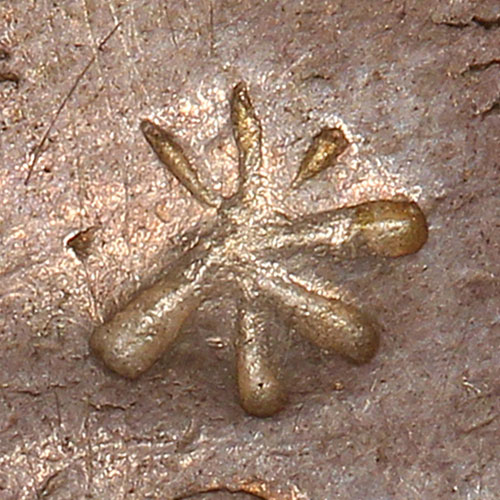 Incomplete 米 - mǐ - rice, meter
Provenance:
From the David O'Harrow Collection of Mexican Coins
Stack's Bowers November 2015 Baltimore Lot #39336
Ex. Ponterio & Associates Sale #58 October 17, 1992, Lot #6
David O'Harrow was a numismatic scholar who, along with Clyde Hubbard, wrote the reference book for Mexican Hookneck Eagle 8 Reales, titled "Hookneck: El Aguila de Perfil", Hardcover, May 17, 1997.
1687-P VR Bolivia 1 Real cob Carlos II type (Ex. Murphy)
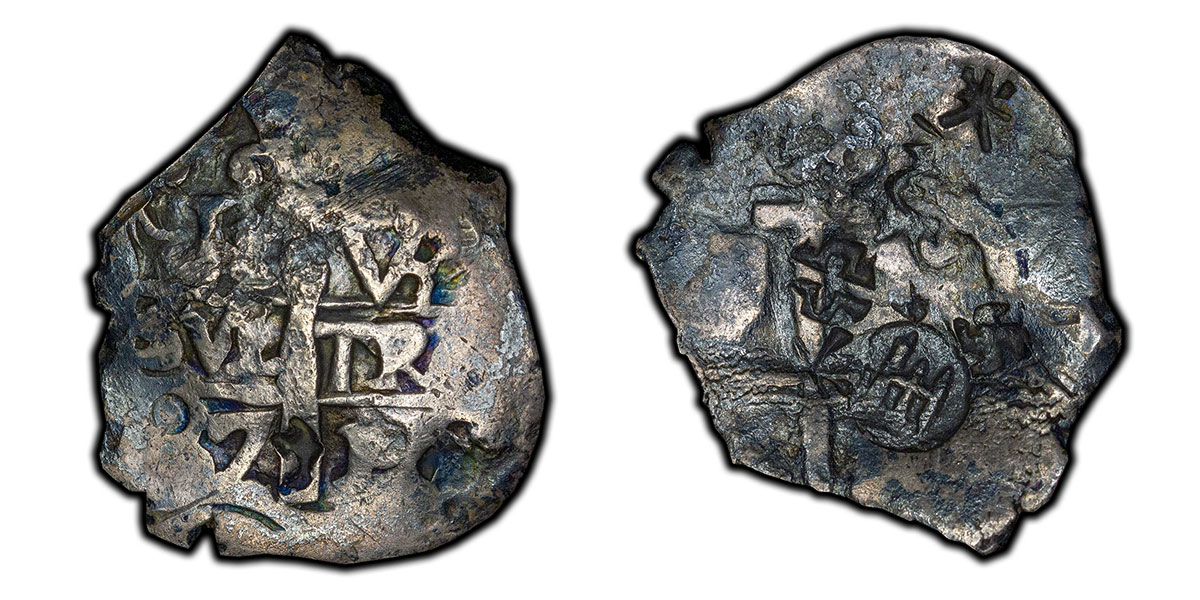
Specifications:
3.38 g, .931 fine silver, .1012 troy oz (actual silver weight), this specimen 2.32 g
Recorded mintage: unknown
Catalog reference: KM-23
Details:
By 1687, the Potosí mint had been operating for well over a century, producing silver at a scale unmatched anywhere in the world, but under conditions that had been
deeply reformed in the decades before this coin was struck. The Great Potosí Mint Fraud, uncovered in 1649, revealed that assayers had been systematically debasing
silver coinage for years, shaking confidence in Potosí silver across Europe and Asia and prompting a redesign that replaced the old Habsburg shield type entirely.
The pillars-and-waves design that replaced it in 1652 became the standard for Potosí coinage through the rest of the colonial period, and this 1 real under Carlos II
belongs to that reformed tradition: the cross with lions and castles on the obverse, the twin pillars flanking PLVS VLTRA on the reverse, and the assayer's initials
VR placing it precisely within the 1684-1689 window.
Carlos II, the last Habsburg king of Spain, was sixteen years old in 1687 and already deep into the reign that would end with the extinction of his line and the War of the Spanish Succession. The political fragility of the court in Madrid stands in some contrast to the industrial reliability of Potosí, which continued producing silver regardless of who sat on the throne. The 1 real was the smallest denomination in regular production at Potosí, roughly 3.4 grams, and survives in lower numbers than the larger denominations partly because it circulated hardest among the population that actually spent it.
You'll notice the weight on this piece is a little under the standard for 1 real cobs at 2.32 g, possibly it was cut down a little, as you can see one edge looks to have been chopped off.
Notable chopmarks:
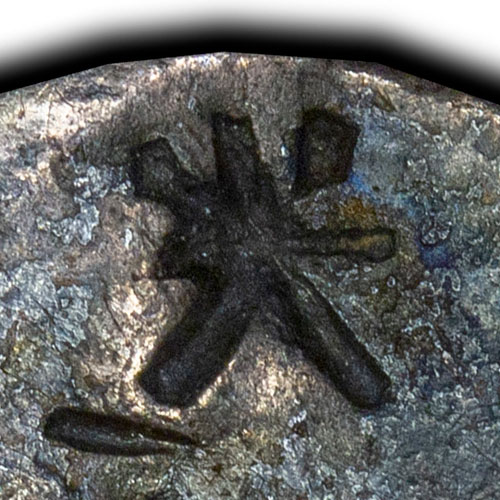 兴 - xīng - rise, prosper
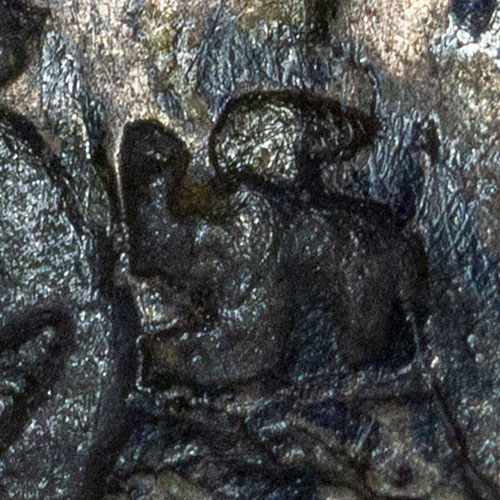 卐 - wàn - swastika, a sacred and auspicious symbol in Hinduism, Buddhism, and Jainism
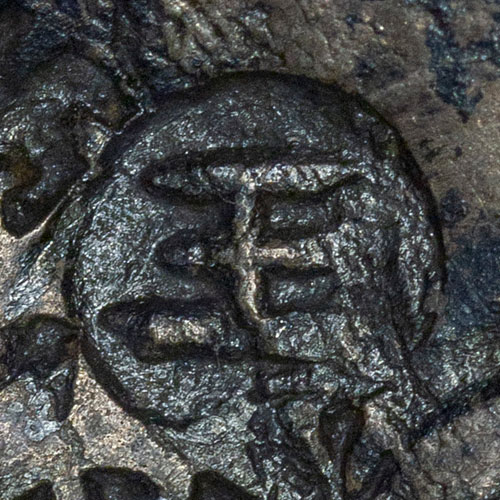 王 - wáng - king, ruler
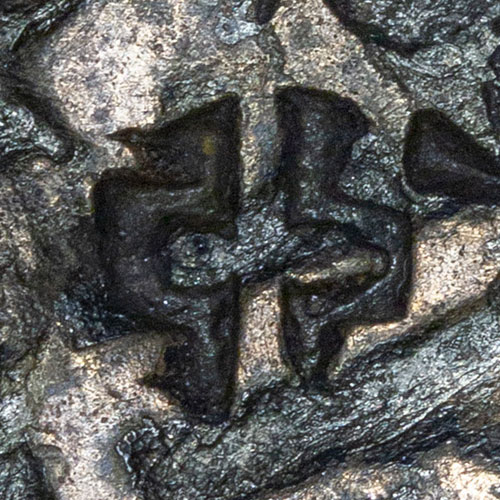 Styled version of 卯 - mǎo - 4th earthly branch
Provenance:
Purchased from the Stack's Bowers April 2026 Hong Kong Showcase Auction
Lot #49549
Auction Description:
BOLIVIA. Cob Real, 1687-P VR. Potosi Mint. Charles II. PCGS Genuine--Chopmark, Fine Details.
KM-23; Murphy-Not listed. Weight: 2.32 gms. Numerous small size incuse and in relief Chinese chops including, "王" (Wang) in relief, "兴" (Xing) incuse, "十" (Shi) incuse, "卐" (Wan) incuse, "山" (Shan) incuse. This handsome little minor displays rich mottled slate patina with brighter coloration on the high points. A charming small silver coin with a wholesome appearance.
Provenance: From the Edgar Murphy Collection.
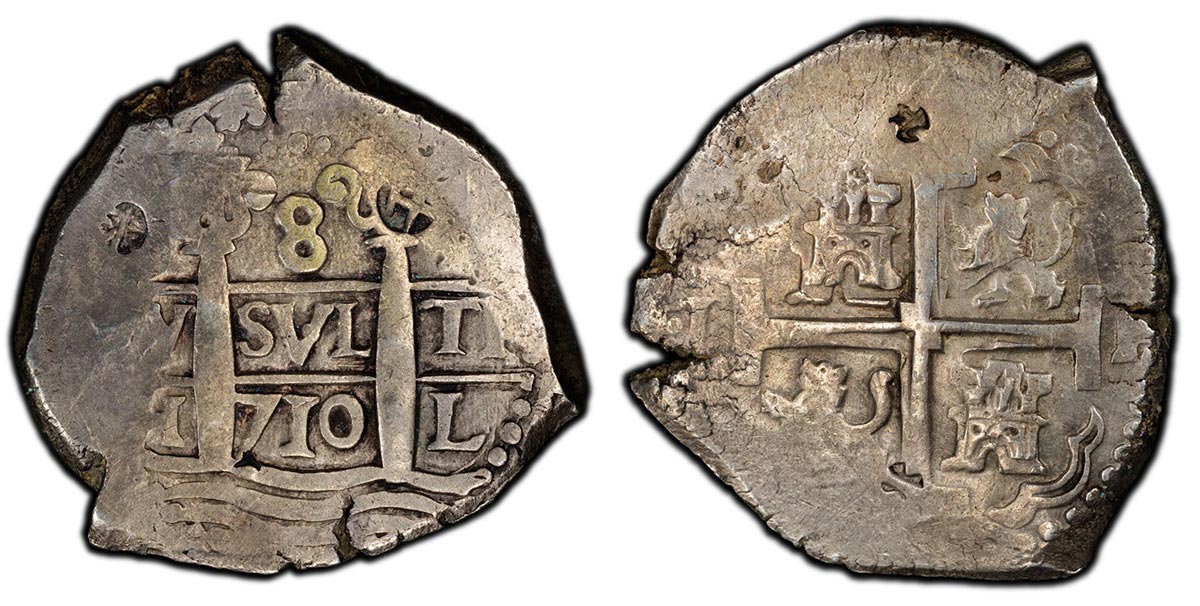
1710-L H Lima, Peru 8 Reales cob, Philip V type (Ex. Richard August)
Specifications:
27.0674 g, .9310 fine silver, .8102 troy oz (actual silver weight), this specimen 27.05 g.
Recorded mintage: unknown
Catalog reference: KM 34, Cal 1283
Details: The 1710 Lima issue was struck during the early years of Philip V’s reign, a period shaped by the War of the Spanish Succession (1701–1714) and the transition from Habsburg to Bourbon rule. Despite political upheaval in Europe, silver production in Peru remained essential to imperial finance, and the Lima mint continued to strike large silver coins for circulation and export.
Design-wise, the type carries the familiar Spanish imperial motifs: one side shows a Jerusalem cross with castles and lions in the quarters (Castile & León), and the other has the Pillars of Hercules with the motto PLV/SVL/TRA (Plus Ultra) between them, usually accompanied somewhere on the flan by the date (1710), value (8), mintmark L, and assayer H, though any given example may only show some of these due to the irregular planchet and strike.
This pillars and waves type is relatively scarce with chopmarks. Lima 8 reales entered Asian circulation through multiple channels, including Atlantic shipment to Europe and re-export, as well as Pacific movement via Panama, Mexico, and onward to Manila and Chinese trade ports.
Notable chopmarks:
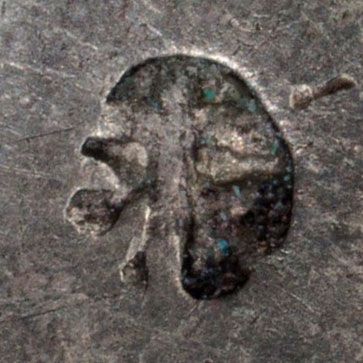 Possibly 木 - mù - tree, wood, Japanese Kanji radical 75
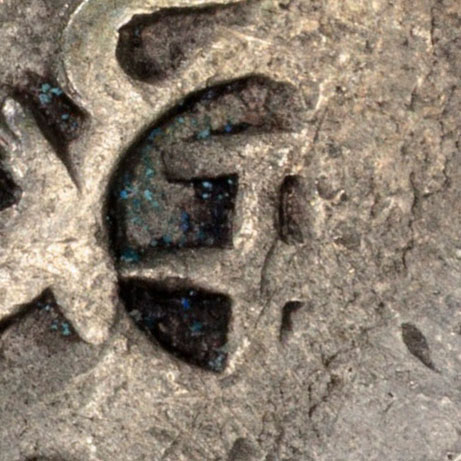 千 - qiān - thousand
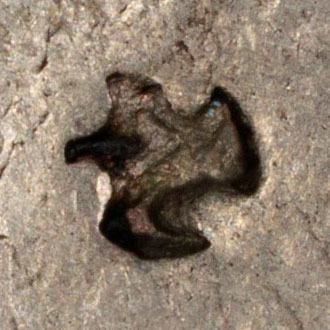 Small unknown chopmark
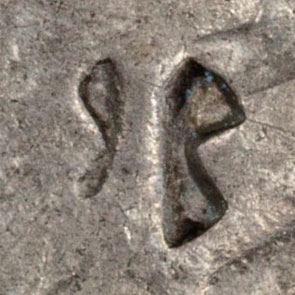
 - Oracle script variant of 八 - bā - eight
Provenance:
Richard August Collection - Stack's Bowers October 2025 World Collectors Choice Online Auction - Session 5 - Latin America Coinage
Lot #74609
Auction Description:
PERU. Cob 8 Reales, 1710-L H. Lima Mint. Philip V. PCGS Genuine--Chopmark, EF Details.
KM-34; Cal-1283. Weight: 27.05 gms.
Estimate: $200 - $300.
Provenance: From the Richard August Collection.
As noted by Stack's: Richard August was well known as a numismatist and was a fixture at shows all over the country for decades, particularly those in his native New England.
Beyond his life in coins (a full-time passion since before he attended the University of Virginia in the late 1950s), Dick was a high-level math teacher and tutor, a distance
runner and running coach, and a passionate practitioner of hobbies ranging from gardening to fish husbandry to shooting (he competed on the rifle team at UVa). His remarkable
memory and knowledge base, as deep as it was broad, impressed his numismatic colleagues, but the collection his expertise allowed him to amass impressed his friends and rivals
as well.
...
His world coin holdings are extensive, with particularly notable collections from Latin America and the British Isles. Focused on the era of American colonization, roughly 1492
to 1830, Dick’s collection comprised impressive date runs of coins in every collectible denomination of copper and silver, with some gold highlights as well. His coins of the
British Isles are notable for their quality; selections focused on 17th century coins of England, Ireland, and Scotland will be offered in the January 2025 NYINC sale.
1731-L N Lima, Peru 4 Reales cob, Philip V type (Ex. Daniel Sedwick / Pat Johnson)
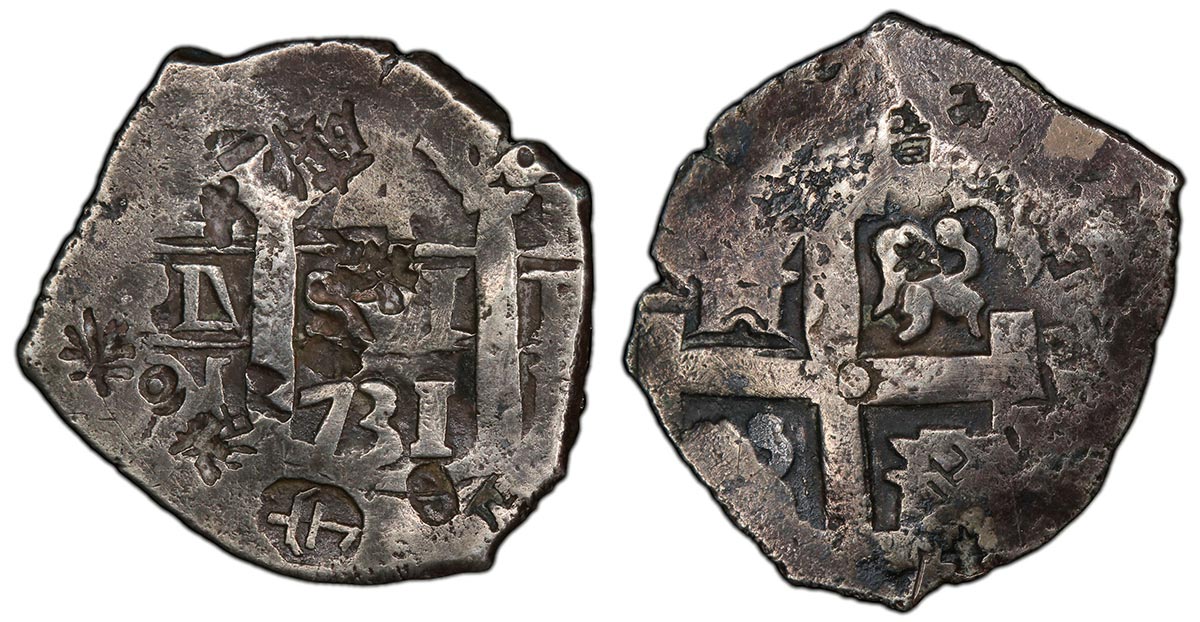
Specifications:
13.54 g, .917 fine silver, .399 troy oz (actual silver weight), this specimen 13.10 g.
Recorded mintage: unknown
Catalog reference: KM 33a, Cal 1044
Details:
This 1731 Peru 4 reales cob is a particularly appealing example from the Lima mint, struck on an irregular hammered planchet, just before the broader Bourbon-era move toward more
standardized coinage. It’s also a very clearly attributable assayer-period coin: the “N” assayer mark on 1731 Lima pieces is commonly recorded as Joaquín Negrón y Colmenares, giving
the coin a documentable place in the mint’s chronology.
In the 1700s, silver struck at Lima reached China through the same Pacific routes used by Mexican coinage. Peruvian silver moved north within the Spanish Empire into New Spain, where it was consolidated and shipped from Acapulco to Manila. From there it entered Chinese commercial networks through South China, particularly Fujian and Guangdong. Although Mexican issues made up the bulk of this trade, Peruvian silver circulated alongside the more pervasive Mexican cobs.
Obverse: Cross of Jerusalem, lions and castles in quarters
Obverse Legend: PHILIPPVS V D • G • HISPANIA
Reverse: Pillars, PLVS VLTRA and date between
Notable chopmarks:
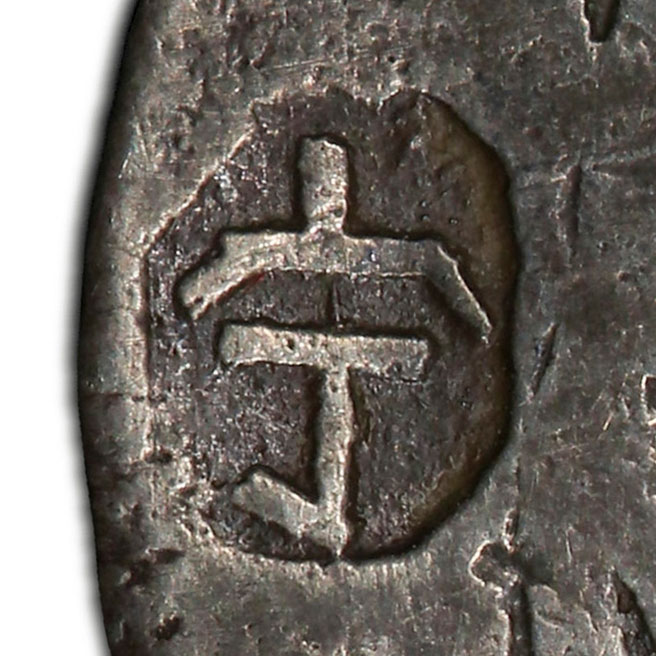 宁 - níng - peaceful, rather
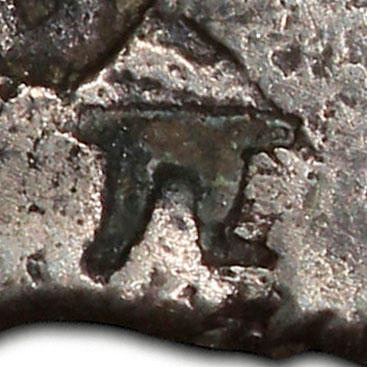 兀 - wù - cut off feet, towering
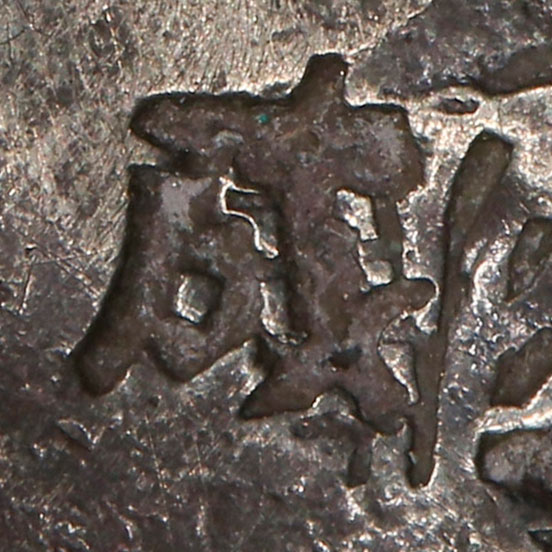 成 - chéng - accomplish, become, complete
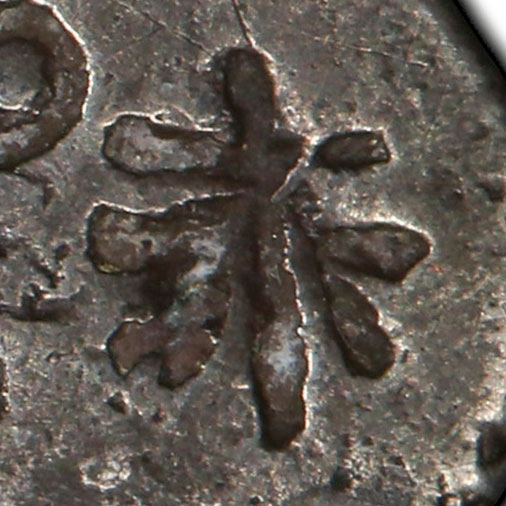 未 - wèi - not yet, 8th earthly branch
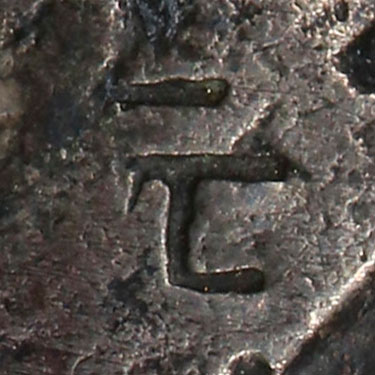 元 - yuán - dollar, unit of currency, basic, primary
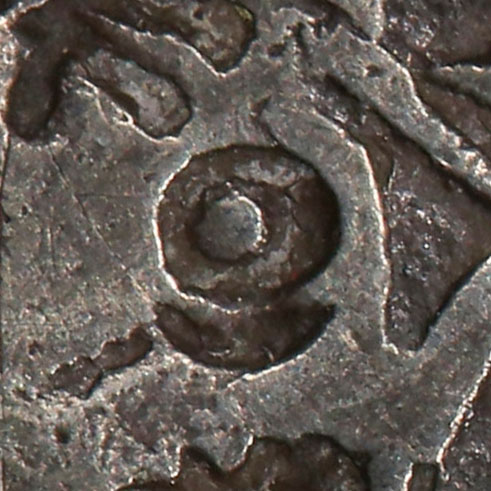
 - Liushutong script variant of 旦 - dàn - dawn, morning
Provenance:
Pat Johnson Collection - Stack's Bowers November 2022 World Collectors Choice Online Auction
Lot #72049
Auction Description:
PERU. Cob 4 Reales, 1731-L. Lima Mint; Assayer Joaquin Negron y Colmenares (N). Philip V.
KM-33A; Cal-1044. Weight: 13.10 gms. This intriguing Lima cob is covered with an array of chop marks, hinting at its circulation in East Asia. Among the wide variety of markings,
the Chinese characters "ning" and "yuan" are quite clear. The merchants were kind enough to leave most of the coin's original details undisturbed, and so the denomination, date,
and portions of the mintmark and assayer's initial are all visible. A handsome piece brimming with historical interest.
Ex. Daniel Sedwick (private purchase noted in above Stack's sale)
Later from the May 2024 Sedwick Treasure, World, U.S. Coin & Paper Money Auction 35 Lot #824
Auction Description:
PERU, Lima, cob 4 reales, 1731 N, with chopmarks from circulation in Asia, rare, PCGS VF details / chop mark, ex-Pat Johnson (stated on label). S-L21; KM-33A; Cal-1044. 13.10 grams.
Full pillars with bold full date and clear assayer despite the presence of as many as a dozen bold chopmarks, including the Chinese characters "yuan" and "ning," the cross nearly full
and sporting several more chops, some black toning and traces of surface oxidation, only the third example we can trace of this rare date that was missing in Sellschopp. Pedigreed to the
Pat Johnson Collection (Stack's Bowers auction of November 2022, lot 72049).
Pat Johnson was a long time coin dealer out of Houston, Texas.
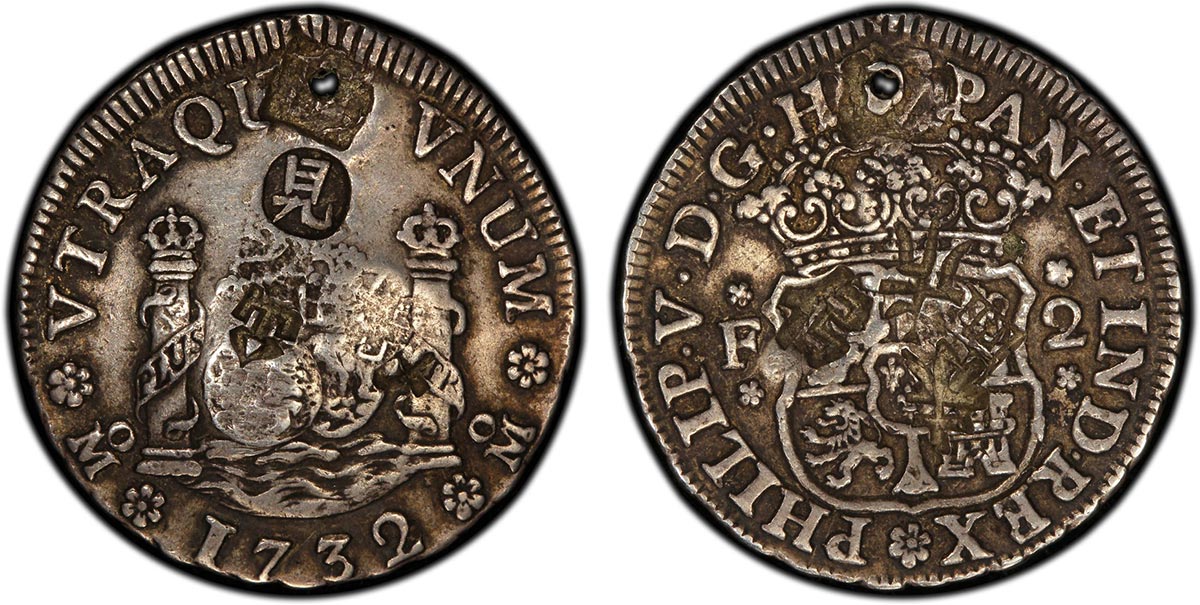
1732-Mo F Mexico 2 Reales Philip V type (Ex. Patterson)
Specifications:
6.77 g, .917 fine silver, .200 troy oz (actual silver weight)
Recorded mintage: unknown, but very rare
Catalog reference: KM 84
Details:
Extremely rare Spanish 2 Reales from Mexico City, Philip V type. A key date, the 1732 date with assayer F is the 2nd rarest issue within the 2 reales series, only the 1732 lacking any
assayer mark being more rare. This date was absent from the generally comprehensive Norweb group, to give some perspective.
Two clear obverse chopmarks, one relief. Multiple reverse chopmarks. Notably this example is holed, possibly to enable transport as silver minors were often carried on a string as an early form of the wallet.
Notable chopmarks:
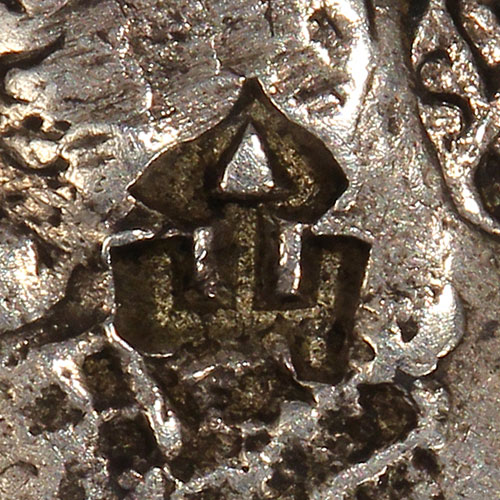 仚 - xiān - to fly, immortal
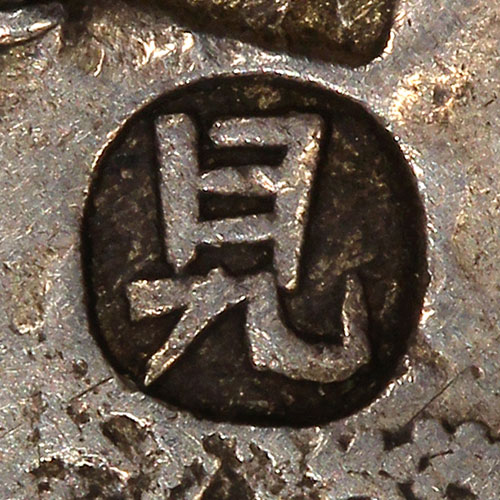 旯 - lá - corner
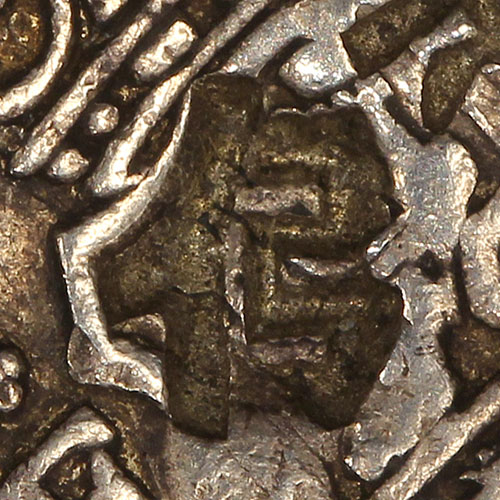 伄 - diào - deceive
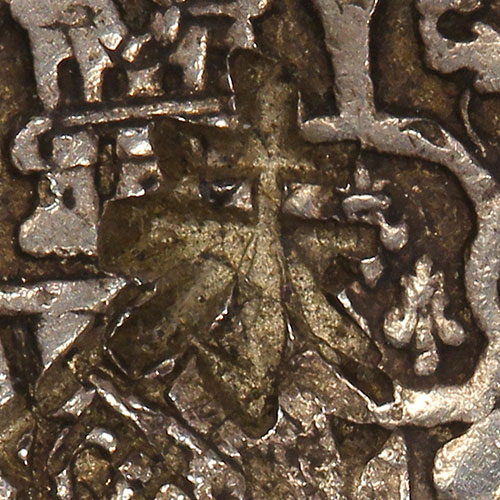 未 - wèi - not yet, 8th earthly branch
Provenance:
Cayón Subastas Live Auction #14 March 31, 2014 Lot #391
Auction Description:
FELIPE V. Méjico. 2 reales. 1732. F. Presenta varios resellos chinos. Cy8815. Agujero. Algo alabeada por la fuerza aplicada en los resellos. MBC+. Rarísima.
Ex: Alexander Patterson specimen from the Bonhams 7/1996 sale of his collection, Lot #79
Auction Description:
1732, F, Mo, similar in style to the 8-, and 4-Reales (Cal. 1124; KM 84). Pierced within square indent, a chop-marked coin, as the result of this the obverse on a slightly
concave, though not unattractive flan, extremely rare.
1734/3-Mo MF Mexico 4 Reales Philip V type (Ex. Long / Gray)
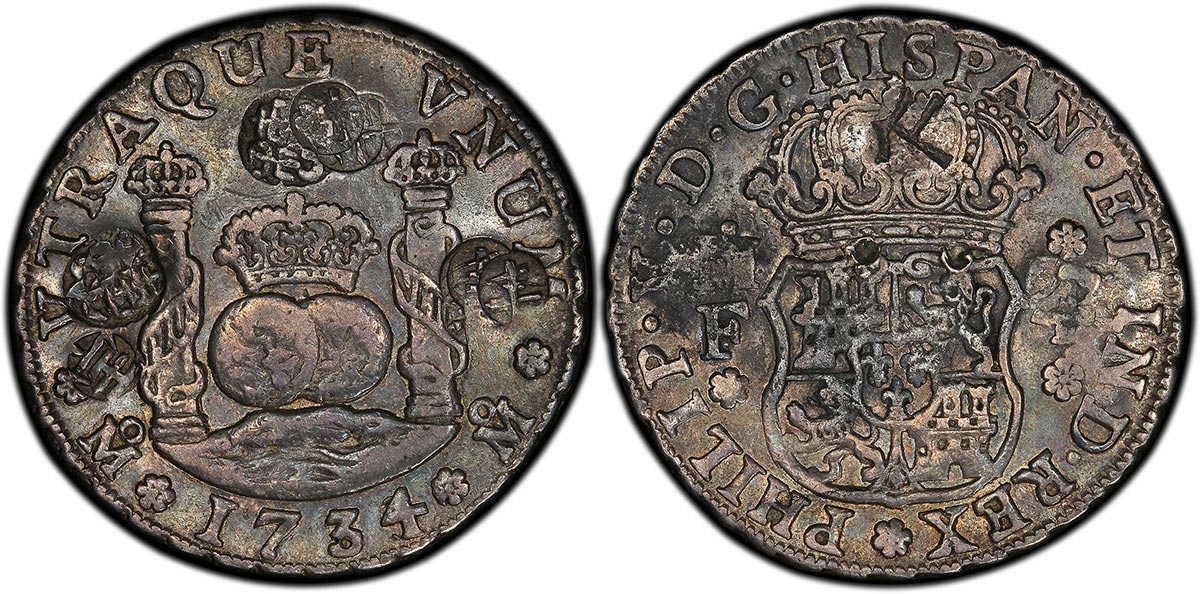
Specifications:
13.54 g, .917 fine silver, .399 troy oz (actual silver weight)
Recorded mintage: unknown
Catalog reference: KM 95
Details:
1734/3 Mexico 4 Reales, Mexico City mint, 13.54g, .917 fine silver, mintage for this mint and date not recorded. This coin is part of the milled “pillar” coinage introduced at the
Mexico City mint in 1732 and struck through 1771. The obverse features the Pillars of Hercules rising from the sea, flanking two hemispheres beneath a crown, with the motto PLUS
ULTRA and the legend VTRAQUE VNUM (“Both Are One”) above. The date and mintmark appear outside the lower portion of the design. The reverse bears the crowned royal coat of arms of
Spain, with the denomination and assayer initials MF in the fields, surrounded by the legend D.G. HISPAN ET IND REX (By the Grace of God, King of Spain and the Indies). The milled
edge with repeating ornamentation reflects the anti-clipping measures adopted with this reform coinage.
Struck during the later reign of Philip V, this issue belongs to Spain’s early eighteenth-century effort to standardize colonial silver production following the War of the Spanish Succession (1701–1714). Beginning in 1732, the introduction of milled pillar coinage at the Mexico City mint replaced irregular hammered cobs with coins of consistent diameter, thickness, and edge treatment. These changes improved uniformity of weight, reduced opportunities for clipping, and made routine visual inspection more reliable in everyday transactions. The reform did not alter the prevailing practice of valuing silver by weight, but it did streamline handling and accounting for Spanish American silver in both domestic circulation and long-distance trade. Silver for this issue was drawn primarily from central New Spain mining districts such as Zacatecas and Guanajuato, which remained the principal sources feeding Spain’s Atlantic remittances and Pacific trade flows.
The pillar 4 reales type is not extremely rare with chopmarks, although minor denomination pillars from Mexico with chopmarks are considered semi-scarce in general. Many millions of this type most plausibly entered southern China through the Manila galleon trade connecting Acapulco and Manila, followed by redistribution through regional Asian trade networks into Canton and other treaty ports.
Notable chopmarks:
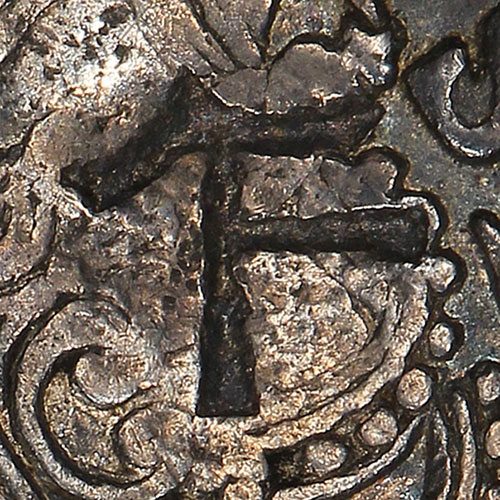 仁 - rén - benevolence, humanity, kernel
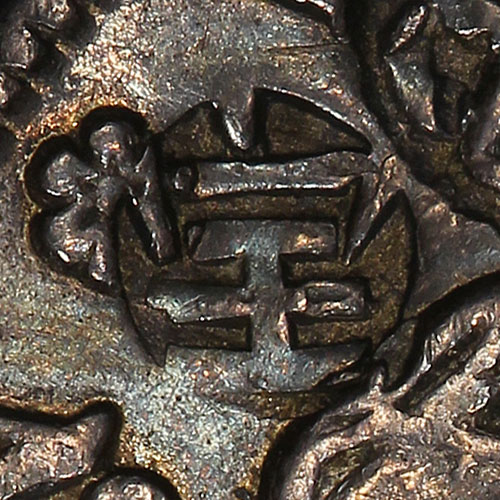 宝 - bǎo - treasure, precious
Provenance:
From the David Gray Collection.
Stack's Bowers Winter 2014 Baltimore Lot #11265
Auction Description:
MEXICO. 4 Reales, 1734/3-MoMF. Philip V (1700-46). NGC VF Details--Chopmarked, Damaged.
KM-94; Cal-type-179#1046; Gil-M-4-6a. Erroneous slab tag attributes this as an 8 Reales.
Multiple chopmarks present, toned.
Estimate: $200 - $300.
NGC VF Details--Chopmarked, Damaged.
Provenance: From the David Gray Collection. Ex: Richard Long Sale #92 Lot #439 May 29, 2003.
Ex: Richard Long Sale #92 Lot #439 May 29, 2003
David Gray was a specialist in Mexican coins who focused primarily on the transitional years of 1732-34, where the coins transitioned from the crude cob types to klippe types, to the famous and popular milled Pillar type.
1734/3-Mo MF Mexico 8 Reales Philip V type (Ex. Gray)
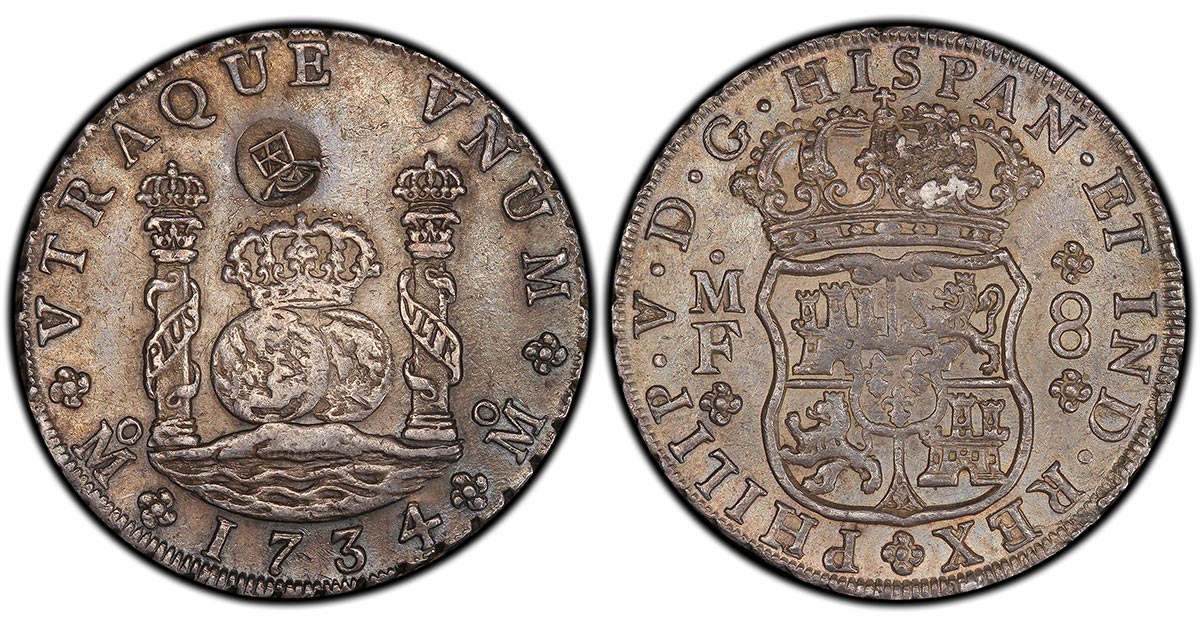
Specifications:
27.07 g, .917 fine silver, .798 troy oz (actual silver weight)
Recorded mintage: unknown
Catalog reference: KM 103
Details:
The pillar 8 reales served as the primary silver unit for interregional and overseas trade throughout much of the eighteenth century. Its size and weight made it especially suitable
for settling large commercial balances, paying customs charges, and financing bulk shipments, roles for which smaller denominations were impractical. In the China trade, the 8 reales
became the dominant foreign silver coin handled by shroffs and merchants, circulating in sustained volume through Manila and onward to Canton and other southern ports. Its long
production run and consistent specifications allowed it to function as the stable reference trade unit. As one of the earliest foreign silver coin types to circulate in China at
scale and the one encountered most consistently over successive generations, the pillar 8 reales became the quintessential host coin for chopmarking.
Notable chopmarks:
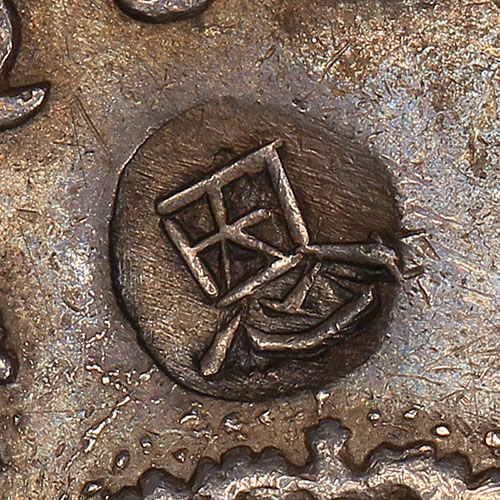 恩 - ēn - kindness, favor
This interesting and complex (for a typical chopmark) character is made up of 因 yīn meaning "cause" or "reason" and 心 xīn meaning "heart", "mind", or "soul"
Provenance:
Stack's Bowers Winter 2014 Baltimore Lot #11267
Auction Description:
MEXICO. 8 Reales, 1734/3-MoMF. Philip V (1700-46). NGC EF Details--Chopmarked.
KM-103; Cal-type-147#777; Gil-M-8-6a; FC-6b. A large unobtrusive chopmark in the obverse field.
Estimate: $200 - $300.
NGC EF Details--Chopmarked.
Provenance: From the David Gray Collection.
David Gray was a specialist in Mexican coins who focused primarily on the transitional years of 1732-34, where the coins transitioned from the crude cob types to klippe types, to the famous and popular milled Pillar type.
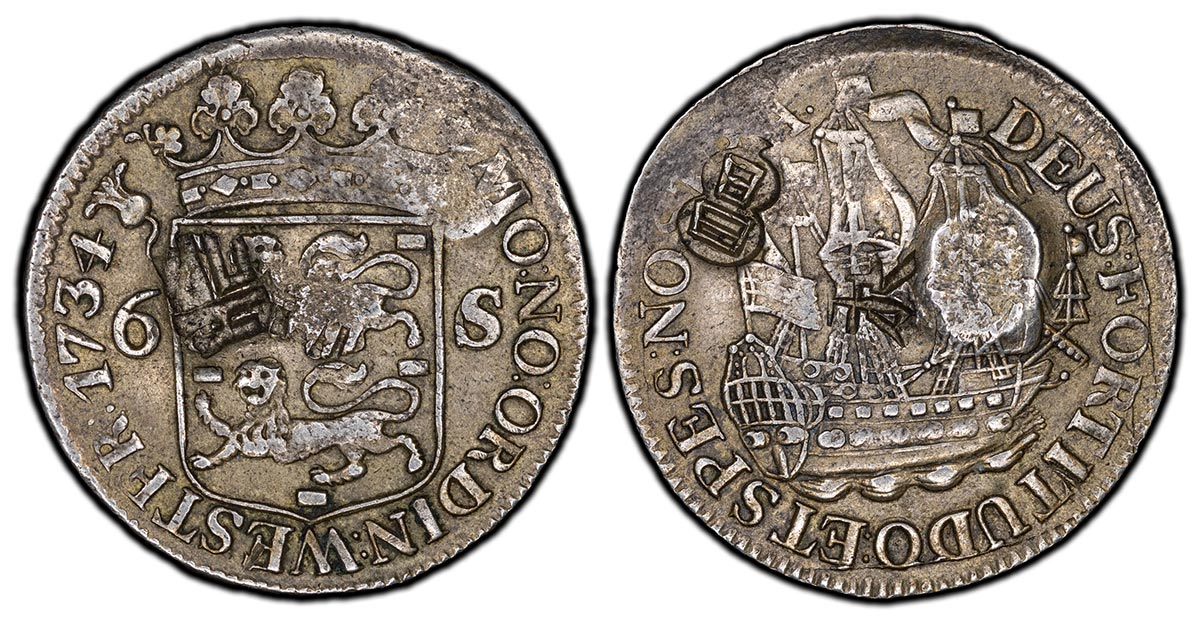
1734 Netherlands West Friesland Scheepjesschelling (6 Stuivers) (Ex. Bridges)
Specifications:
4.9500 g, 0.5830 fine silver, 0.0928 troy oz (actual silver weight)
Recorded mintage: unknown
Catalog reference: KM 102.2
Details:
The 1734 West Friesland Scheepjesschelling (6 stuivers) is a small but historically powerful silver coin from the Dutch Republic’s maritime golden age. Issued by the province
of West Friesland, the coin belongs to the long-running scheepjes (“little ship”) series, named for the sailing ship depicted on the obverse, a deliberate symbol of Dutch
commercial power and seaborne trade. In the early 18th century, these 6-stuiver pieces functioned as practical small change at home, but more importantly they were part of the
export-oriented silver coinage that supported Dutch overseas commerce at a time when the Netherlands was one of the world’s premier trading nations.
The wider historical backdrop is the Dutch East India Company (VOC), whose Asia-centered trade network stretched from the Cape of Good Hope to Batavia, Ceylon, Taiwan, and the Chinese coast. The VOC required enormous quantities of silver to purchase Asian goods, especially textiles, spices, tea, and porcelain, and it drew that silver not only from large crowns and dollars, but also from smaller fractional coins like the scheepjesschelling, which were convenient for everyday transactions in Asian ports. Though modest in value, these coins traveled vast distances aboard VOC ships, circulating far beyond Europe and often remaining in use long after they left Dutch hands.
The obverse design shows the crowned arms of West Friesland, which divide value (6 S). The obverse Legend reads "MO NO ORDIN WESTFR(IESIAE), followed by date and mintmark. Unabridged this is "Moneta nova ordinum Hollandiae et West Friesiae" which translates to "New coinage of the state of Holland and West Friesland". The reverse design shows a sailing ship, and reverse legend reads "DEVS : FORTITUDO : ET : SPES : NOSTRA", which translates to "God is our strength and hope".
It's a bit puzzling that these coins are so rare with chopmarks, one might think they traveled to China and likely were used extensively in trade. Survivors with chopmarks are quite scarce, possibly due to the smaller size and thinness. The combination of Dutch maritime iconography and Chinese merchant stamps makes these pieces especially interesting, illustrating on a single small coin how deeply interconnected global trade had become by the 18th century.
(Update with the shroff handbook "ocean ship" picture and discuss.)
Notable chopmarks:
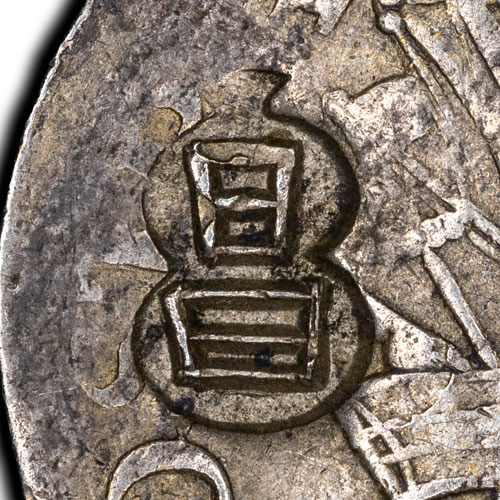 昌 - chāng - prosperous, flourishing
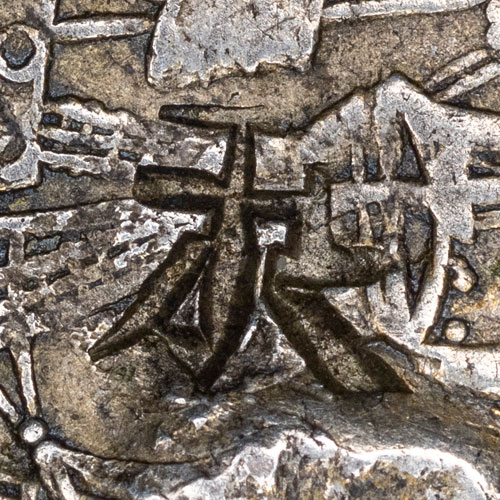 禾 - hé - grain, cereal
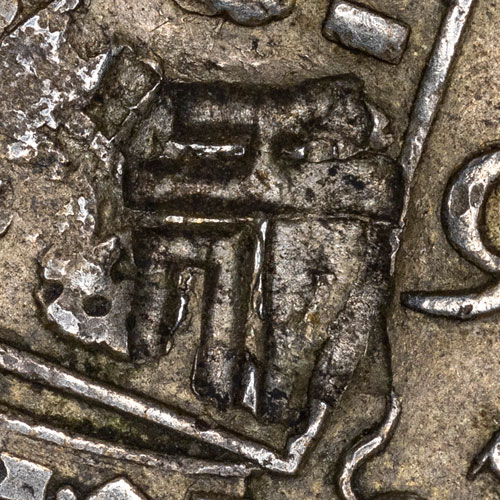 Possibly a fancy version of 币 - bì - currency, coin
Provenance:
Sold as part of a group lot at the 17 April 2024 Noonan's Mayfair World Coin Auction Lot #1114
Auction Description (for 12 coin lot):
Netherlands East Indies, Westfriesland, 6 Stuivers (2), 1678, 1734, latter with Chinese chopmarks; together with other issues from Java, etc, in silver (3), copper (7) [12]. Varied state £40-£60
Previously from the Ivor Bridges Collection.
Ivor Bridges is a British collector who assembled his collection mainly from the 1950's through 1980's. Most of his coins were acquired from fellow members of the Bath & Bristol Numismatic Society, a club that is still active today.
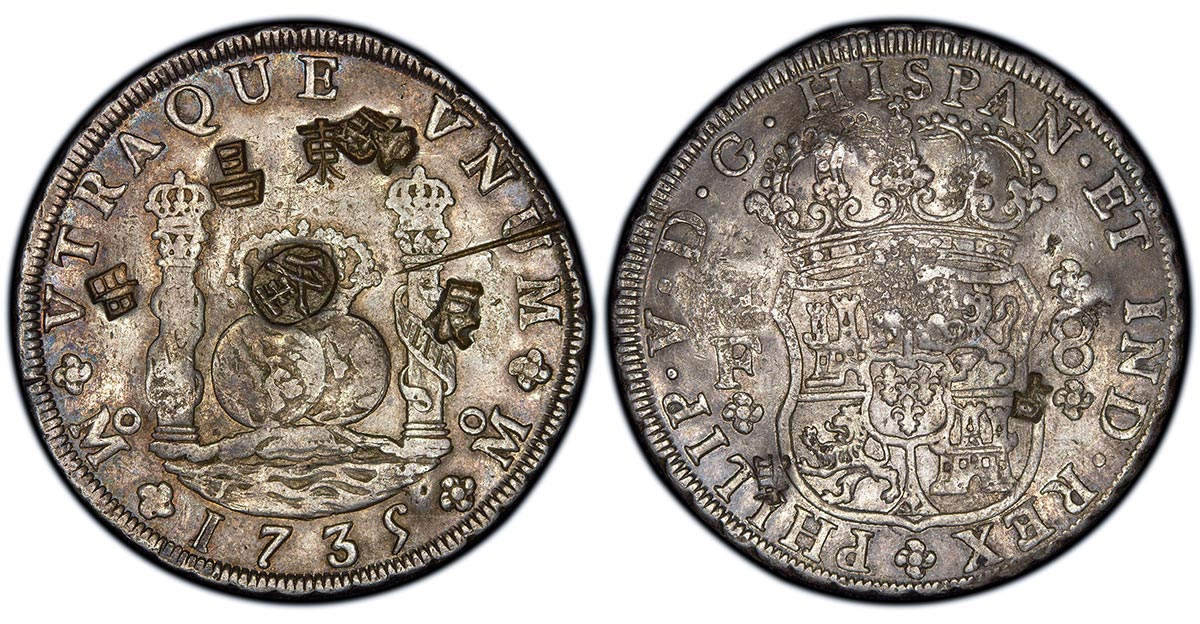
1735-Mo MF Mexico 8 Reales with Edge Cut
Specifications:
27.07 g, .917 fine silver, .798 troy oz (actual silver weight)
Recorded mintage: unknown
Catalog reference: KM 103
Details:
The large edge cut seen on this Pillar 8 reales is a deliberate test cut applied by a shroff searching for base metal such as copper or lead. When applied forcefully, such
cuts would sometimes distort the coin’s shape, producing a dished or slightly concave shape to the coin. Large test cuts like this are most commonly seen on cobs and early
pillar 8 reales like this one. You may still see them on a few of the Spanish portrait 8 reales series, but the practice had mostly disappeared by the 19th century.
Notable chopmarks:
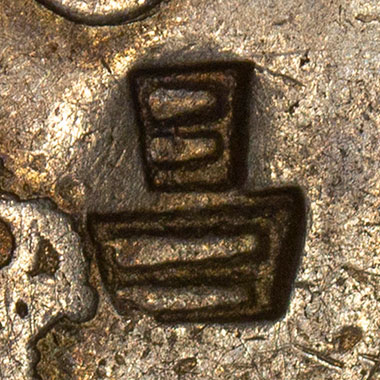 昌 - chāng - prosperous, flourishing
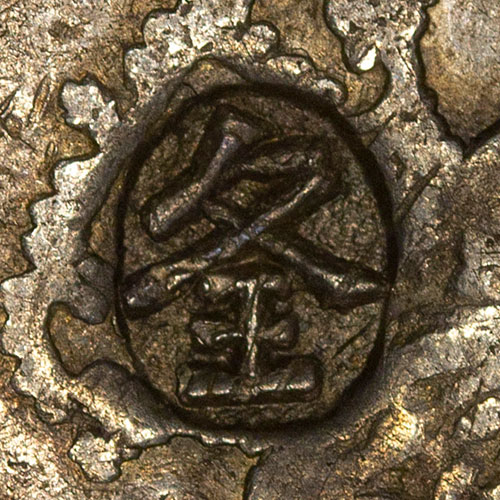 夊王 - suī wáng - likely a merchant or shroff mark (王 is a common surname; the upper element is uncertain) - 王 (wáng) is one of the most common Chinese surnames, so this two-part mark is most plausibly a merchant or shroff house mark built on the family name. The upper character is read here as 夊 (suī, Kangxi radical 35, 'to go slowly'), but 夊 is rare as a standalone word and chopmark engravers often cut non-standard forms, so the exact upper element and the mark's full sense are uncertain.
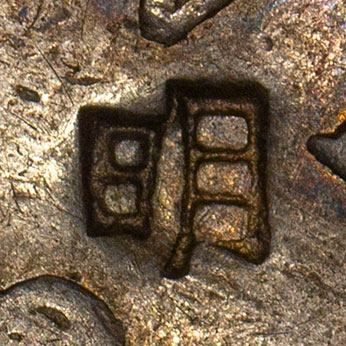 明 - míng - bright, clear, ming
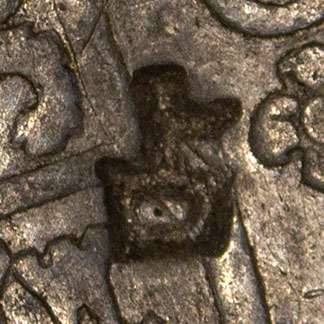 占 - zhàn - divine, occupy, take
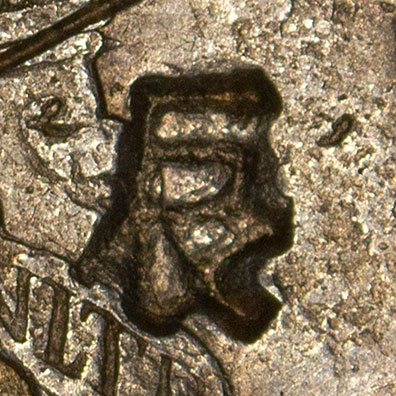 辰 - chén - morning, 5th earthly branch
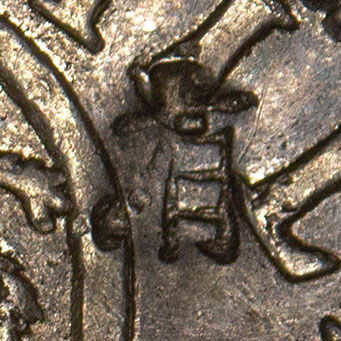 有 - yǒu - have, exist
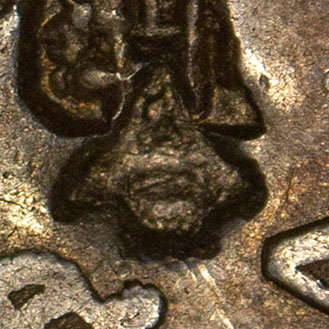 合 - hé - combine, join, close, suit
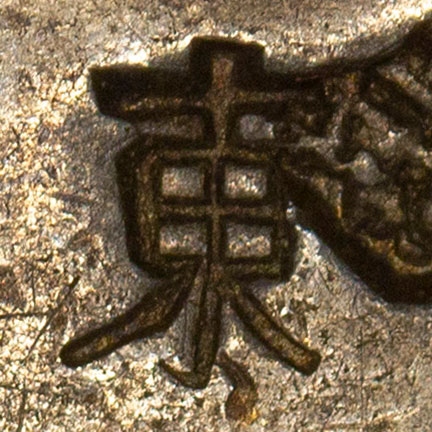 東 - (traditional form of 东) dōng - east
Provenance:
Purchased on eBay in March 2018 from a seller in Dzerzhinsky, Moscow Region, Russian Federation.
Previously purchased from Annaletta Pasamba, a dealer in the city of Manila, Philippines.
1738 Dutch Colony Ducaton, United East India Company, Dordrecht Mint
Specifications:
32.7790 g, .9410 fine silver, .9917 troy oz (actual silver weight)
Recorded mintage: 404,000
Catalog reference: KM 71
Details:
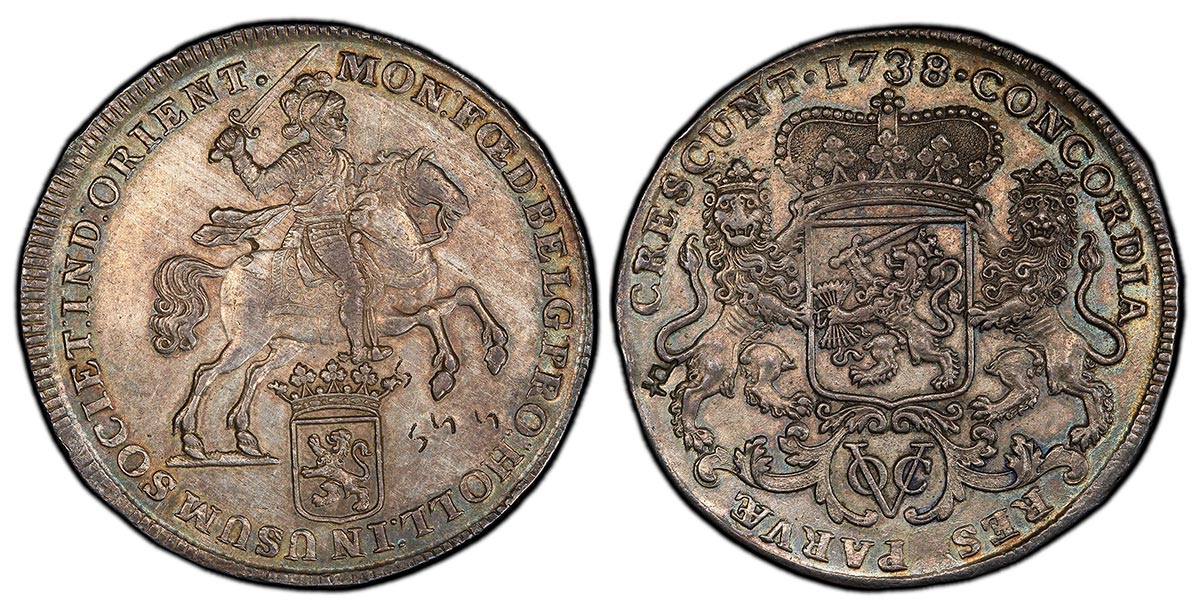
1738 Dutch Colony Ducaton, United East India Company, Dordrecht mint, 32.779g, .941 fine silver, with a smaller mintage of 404,000. The ducaton is a large, heavy silver
denomination struck to a higher fineness than most contemporary trade dollars and belongs to a long-running type issued in the Dutch Republic from the late seventeenth through
the eighteenth century. The “Silver Rider” ducaton features an armored knight on horseback with sword drawn, with a crowned provincial shield below; the reverse shows the
crowned arms of the United Netherlands with lion supporters and the VOC monogram in a cartouche, with the legend CONCORDIA RES PARVAE CRESCUNT (Through unity, small things grow).
The company's monogram logo was possibly the first globally recognized corporate logo. The logo consisted of a large captial V with an O on the left and a C on the right leg.
It appeared on various items, such as cannons and coins.
This ducaton standard (at 32.779g, .941 fine) contained around 124% of the the Spanish pillar 8 reales standard. Rather than being a purely domestic Dutch coin, this VOC-marked ducaton was struck explicitly “for use of the East India Company” (IN USUM SOCIET(atis) IND(iae) ORIENT(alis)), as the legend states, aligning it with company payments and commerce tied to the Dutch overseas network. Within the broader ducaton series (first issued in 1659), the “silver rider” design became a recognizable international format, and VOC-monogram issues fall within a defined mid-18th-century emission window (1726–1751) associated with the Company’s operations.
Chopmarked examples are known, but rare, and the most direct path into southern China would have been through VOC shipping and settlement flows in Asia, particularly via Batavia and other Company ports, where foreign silver circulated alongside Spanish-American dollars in regional trade.
Pop for this coin: 1 at PCGS, 2 at NGC. Exceedingly rare date for this type.
Notable chopmarks:
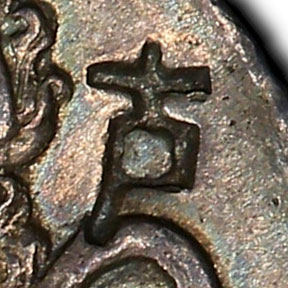 古 - gǔ - ancient, old
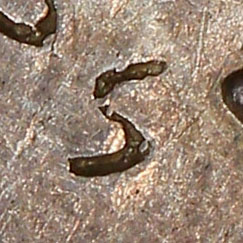 Small, 'S' shaped chopmark, punched multiple times close together
Provenance:
From the Heritage June 2019 HKINF World Coins & Ancient Coins Signature Auction in Hong Kong #3074
Lot #30426
Auction Description:
Dutch Colony. United East India Company Ducaton 1738 AU Details (Chopmarked) NGC
Dordrecht mint, KM71, Dav-417, Scholten-27 (RRRR). Holland issue. Among the rarest dates for the VOC type and incredibly difficult to procure at the AU level, a lightly striated toning pattern
visible around the figure of the rider while pilot-light blue tones cushion the devices on both the obverse and reverse. Only the third example of this year we have handled and the fourth to
appear at auction in the past decade.
From the Seki Collection
I'm currently researching the Seki Collection to learn more about the collector and it's origin. The collection included an incredible number of high grade world trade coins, with potentially the finest selection of Netherland East Indies coinage extant.
Previously the Heritage January 2012 World Coin Non-Floor Session #3017, in Dallas,TX Lot #29437
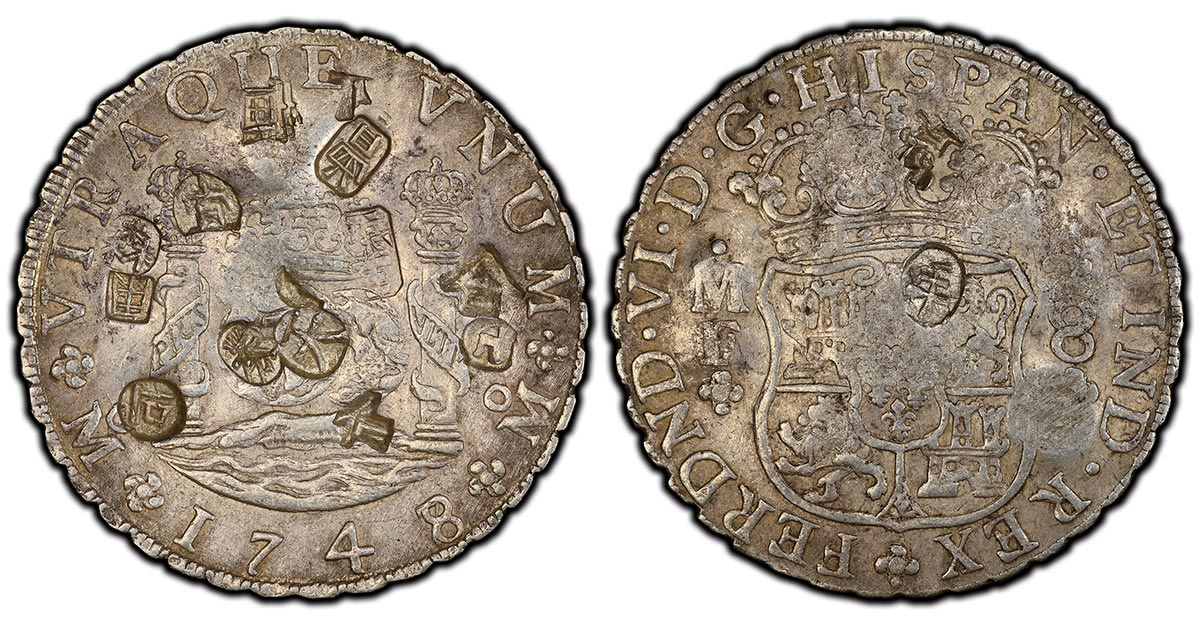
1748/7-Mo MF Mexico 8 Reales Ferdinand VI type
Specifications:
27.07 g, .917 fine silver, .798 troy oz (actual silver weight)
Recorded mintage: unknown
Catalog reference: KM 104.1
Details:
This coin belongs to the pillar (columnario) series struck at Mexico City from 1732 through 1771. The obverse displays the Pillars of Hercules rising from the sea and flanking two
hemispheres beneath a crown, with the motto PLUS ULTRA and the legend VTRAQUE VNUM (“Both Are One”). The date and mintmark appear outside the lower portion of the design. The reverse
bears the crowned royal coat of arms of Spain, with denomination and assayer initials MF in the fields, and the surrounding legend D.G. HISPAN ET IND REX (By the Grace of God, King
of Spain and the Indies). The coin has a milled edge with repeating ornamentation consistent with Mexico City pillar issues of this period.
Struck during the reign of Ferdinand VI, this issue reflects continuity rather than change in Spanish colonial silver policy. Ferdinand VI ascended the throne in 1746, inheriting a stable monetary framework established under Philip V and maintained throughout the mid-eighteenth century. His reign is generally characterized by administrative consolidation and relative peace, allowing silver production in New Spain to proceed without major disruption. The continued striking of pillar coinage under Ferdinand VI underscores the maturity of the system by this date, with established minting practices, consistent specifications, and sustained output from central New Spain mining districts such as Zacatecas and Guanajuato.
By 1748, pillar 8 reales were common with chopmarks, reflecting its entrenched role as the primary foreign silver coin circulating in China during the eighteenth century. Coins of this type continued to flow into southern China via the Manila galleon trade linking Acapulco and Manila, followed by redistribution through regional Asian trade networks into Canton and other ports. The chopmarks on this coin are especially attractive, being well defined and evenly spaced.
Notable chopmarks:
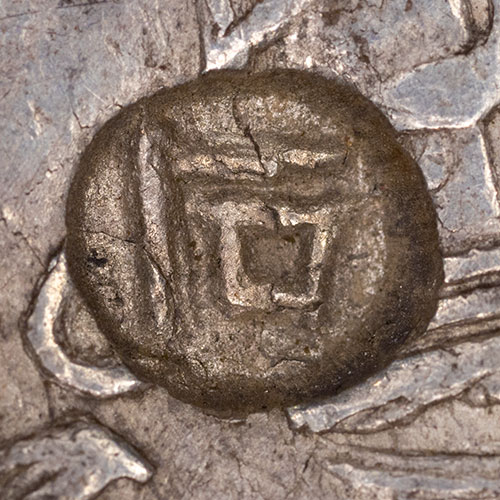 伝 - chuán - transmit, pass on
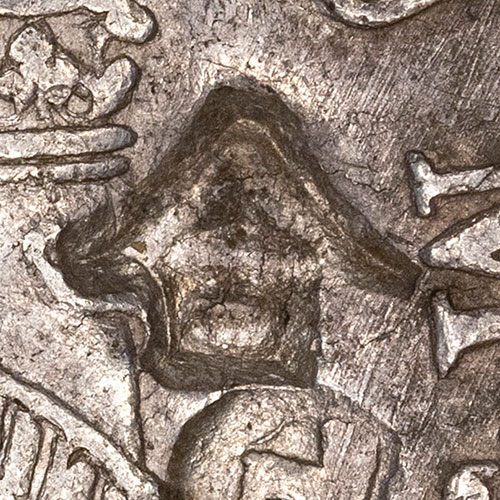 合 - hé - combine, join, close, suit
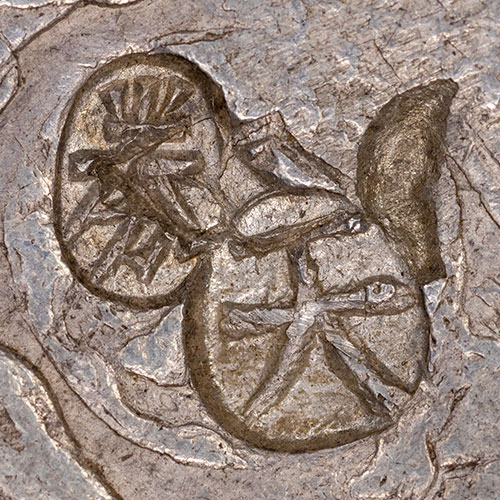 天 - tiān - heaven, sky, day
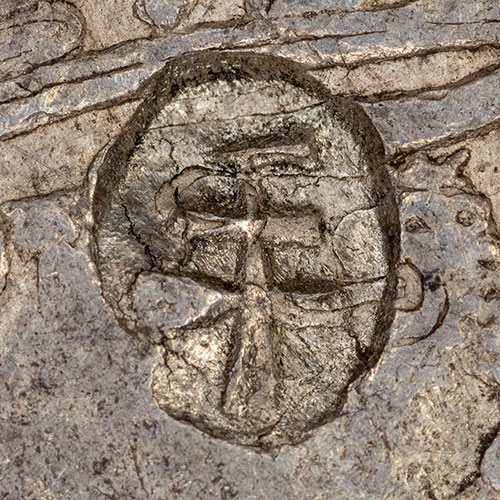 手 - shǒu - hand
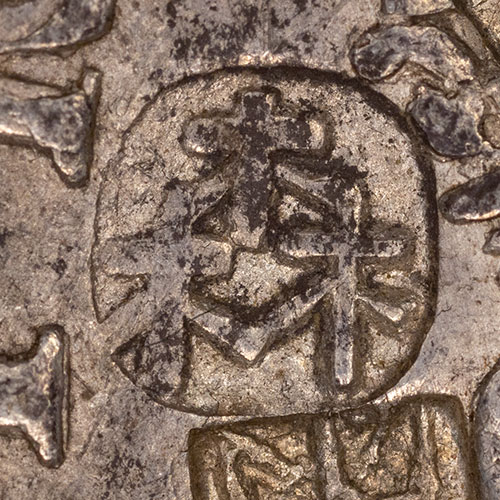 森 - sēn - forest, dense
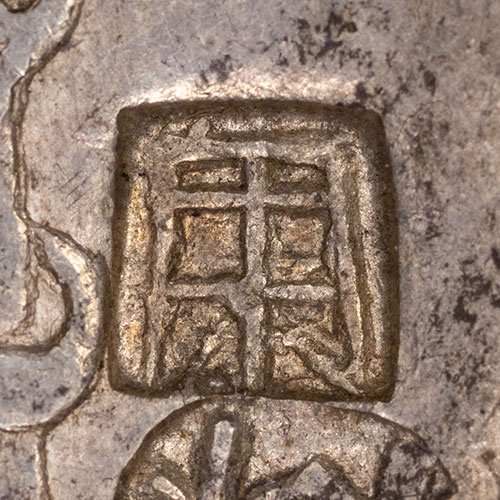 用 - yòng - use, employ
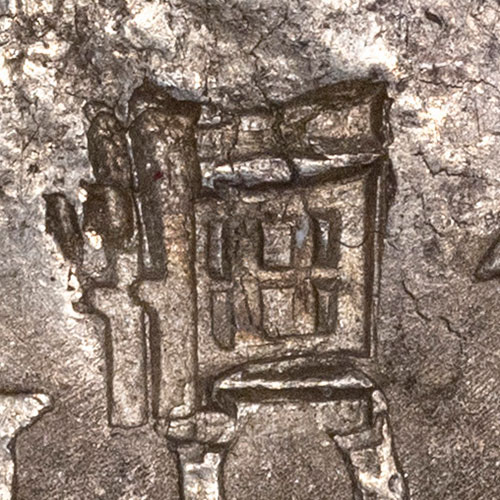
 Similar to 莦 - shāo - grass
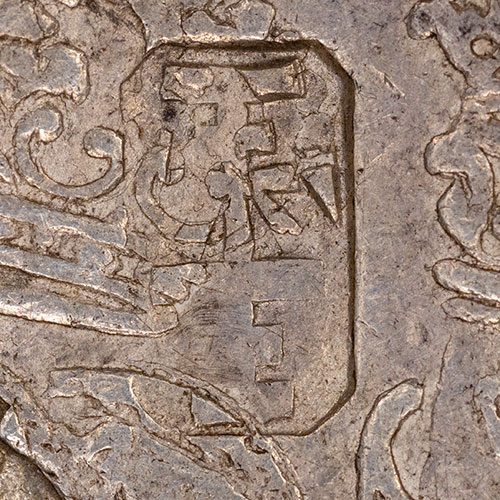
 Possibly 㾄 - dú or chóu - to blame, to grieve, sorrowful, sad and weary
 Unknown chopmark
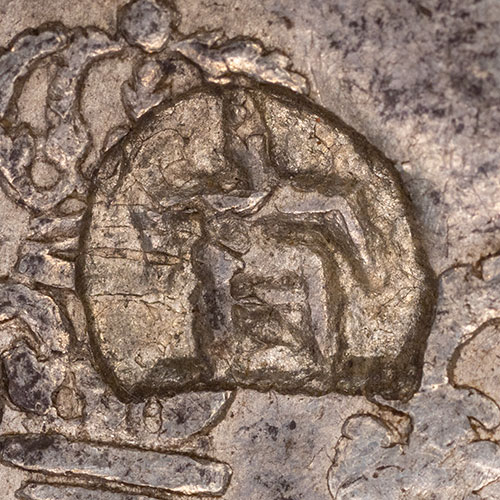 Unknown chopmark
Provenance:
Purchased in a lot of 2 coins from the May 2023 Spink e-Auction of World & Ancient Coins (Auction 389) featuring The John C. Huntington Collection
Lot #421
Auction Description:
South China Sea Trade. Pair of Chopmarked Spanish Colonial Mexico City mint 8 Reales. Pillar - Dos mundos types, 1748 Mo MF. A number of neatly applied raised character chops.
Extremely Fine details; and Portrait type, 1801 Mo FM. A number of small incuse chops. About Fine details. (2)
John C. Huntington was a professor at Ohio State University for more than 40 years, receiving numerous distinctions for his work. He specialized in the Buddhist art and religious traditions of Asia, publishing widely and mentoring numerous graduate students in the field.
1750-Mo MF Mexico 8 Reales Ferdinand VI type
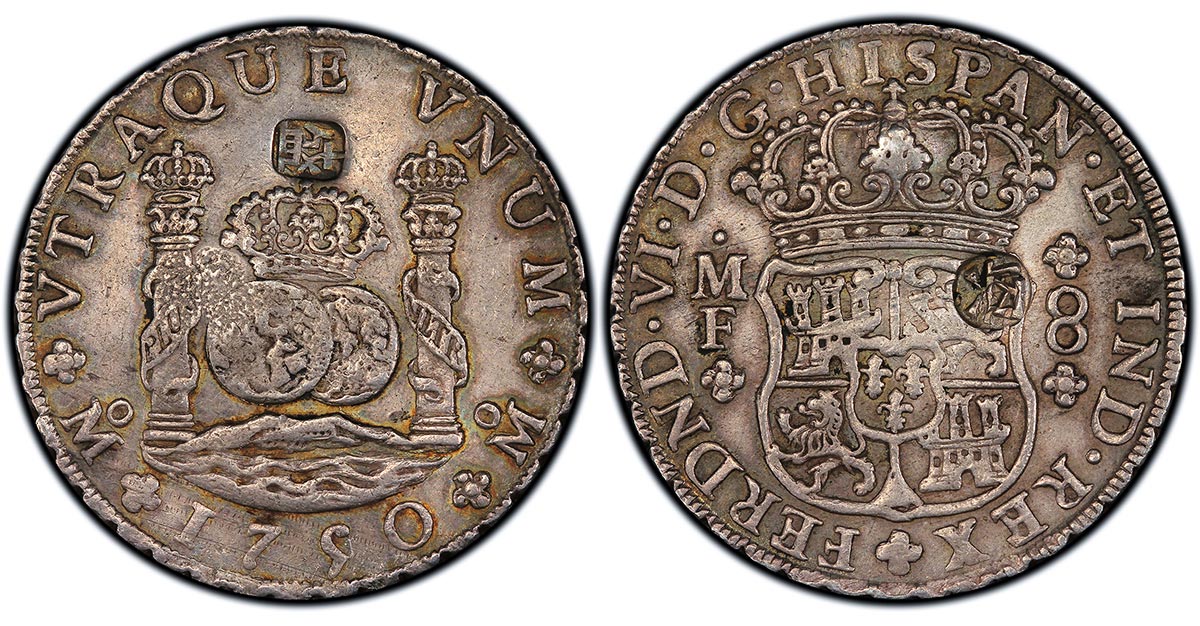
Specifications:
27.07 g, .917 fine silver, .798 troy oz (actual silver weight)
Recorded mintage: unknown
Catalog reference: KM 104.1
Details:
This coin is similar to the 1748/7 above, but shown here because it's a special coin to me. This is not only because it's a great looking coin, it was one of the first nice chopmarked
coins I purchased back in 2013 when I was just getting into chopmarked coins.
Notable chopmarks:
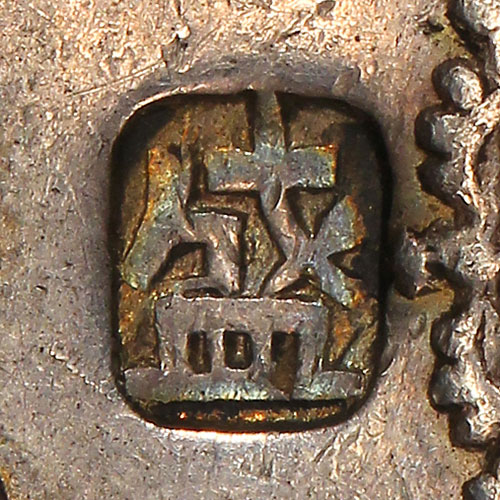 盛 - shèng - flourishing, abundant
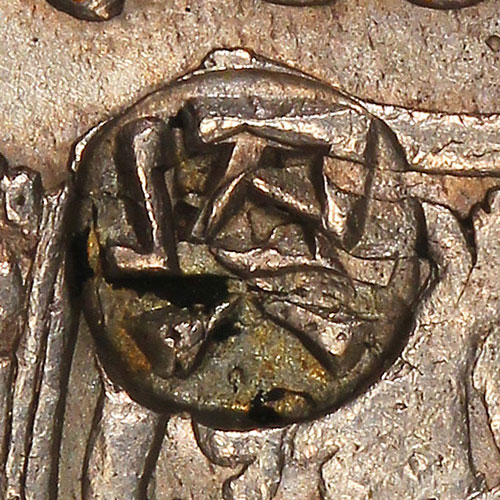 㒷 - (variant form of 興) xìng - to prosper, to rise, to flourish
Provenance:
Purchased at the Santa Clara Coin Show from Falcone Coins (San Jose, CA) in 2013.
1759-G P Guatemala 8 Reales Ferdinand VI type
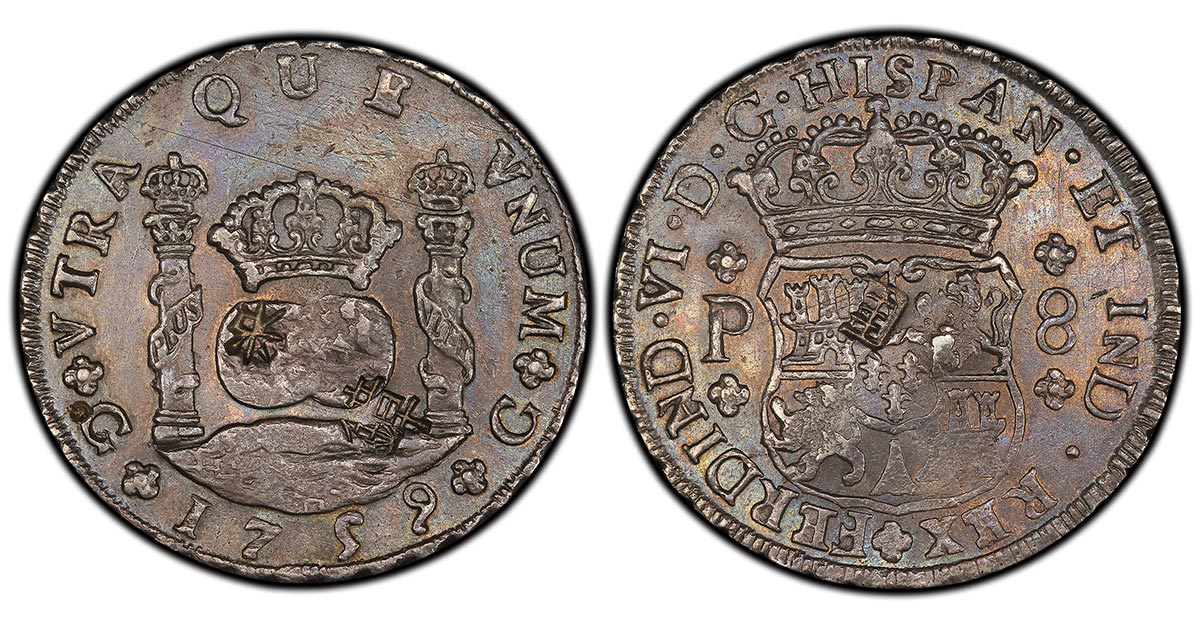
Specifications:
27.07 g, .917 fine silver, .798 troy oz (actual silver weight)
Recorded mintage: unknown
Catalog reference: KM 18
Details:
This issue belongs to the Guatemala-mint pillar (columnario) 8 reales series struck from 1754 to 1771, a comparatively short production run within the broader pillar coinage.
During the mid-18th century, Guatemala’s silver supply was modest compared to the great mining centers of Mexico and Peru, and the Guatemala City mint functioned primarily as a regional coinage facility rather than a major producer. Much of the silver coined there was sourced from nearby Central American deposits or from bullion routed through the region, and output was correspondingly limited. As a result, Guatemala-mint 8 reales are much scarcer than their Mexican counterparts and are more associated with regional circulation and Pacific trade, vs. export to China.
In terms of chopmarked examples from Guatemala, all denominations are rare. In his book, Gullberg lists chopmarked 8 reales from Guatemala as "quite rare" with 11-25 known.
This coin is the epitome of what I strive for with this collection. High state of preservation, a few nice chops, with original and attractive surfaces. A one of a kind coin that I am proud to hold. Just two obverse and one reverse chop, all interesting and fairly well defined. One obverse drill mark exposes pure silver within.
Notable chopmarks:
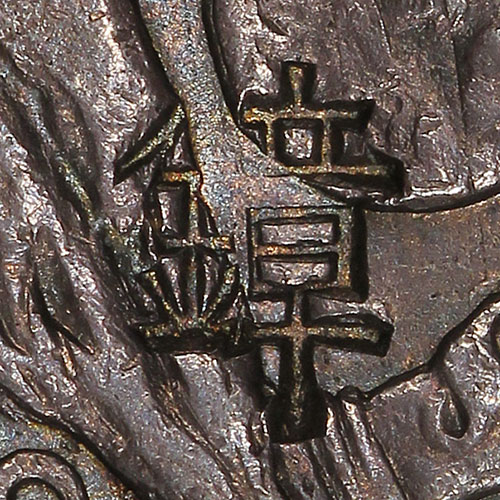 鏱 - zhāng - surname
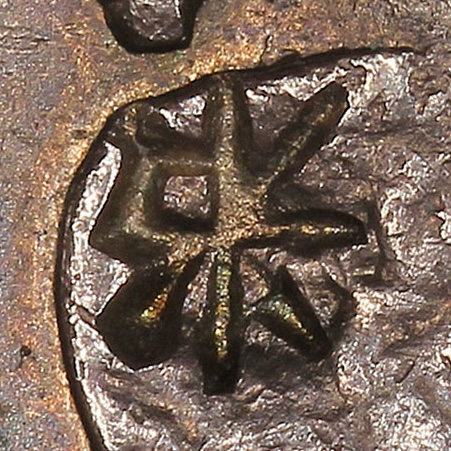 Possibly 乐 - (simplified form of 樂) lè - happy, joy, music
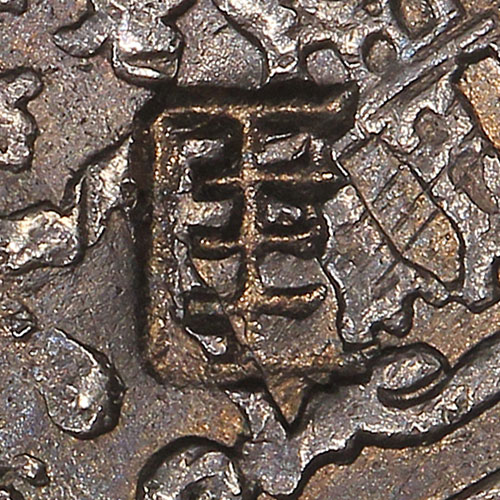 匡 - kuāng - correct, rectify, assist
Provenance:
Purchased from the January 2015 Heritage World and Ancient Coin Auction in Dallas
Lot #35245
Auction Description:
Ferdinand VI Pillar Dollar of 8 Reales 1759 G-P XF Details (Chopmarked, Test Drilled) NGC
KM18. Guatemala City mint, assayer, "P". Nicely toned with a strong strike for the type.
From The Santa Maria Collection
The Santa Maria Collection is a named provenance associated with a series of notable world and Latin American coins that have appeared in major auction offerings, particularly those handled by Heritage Auction Galleries. Unfortunately, not much more is known about the collection or who formed it.
1761-LM JM Peru 1 Real Carolus III type (Ex. Murphy / Rose Plate Coin)
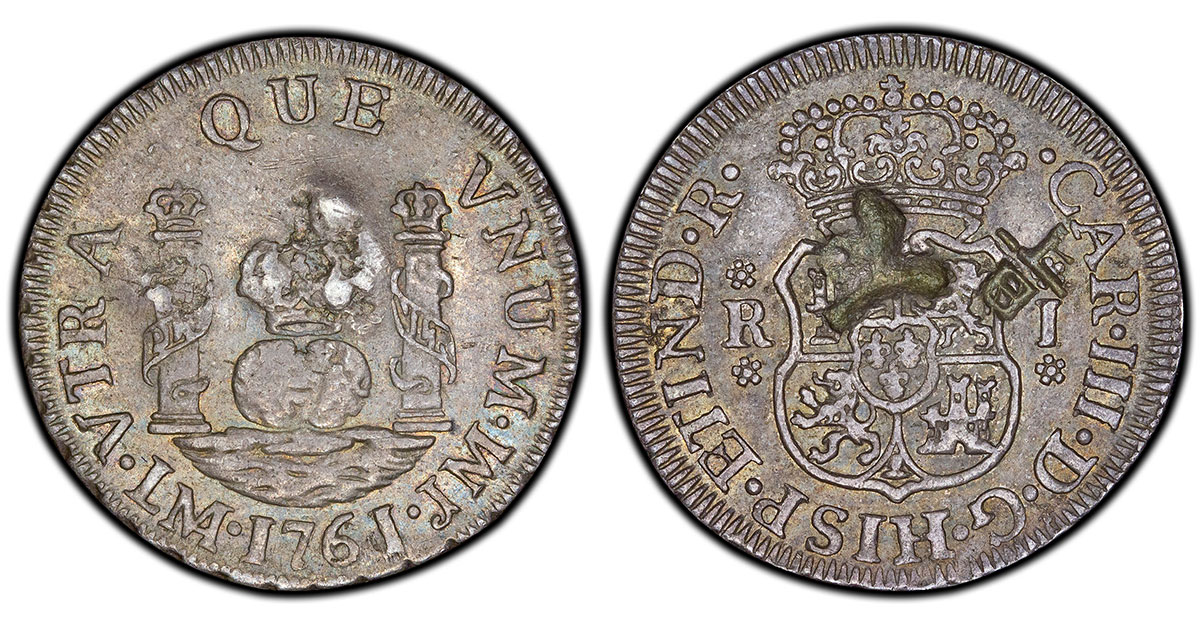
Specifications:
3.384 g, .9170 fine silver, .0998 troy oz (actual silver weight)
Recorded mintage: unknown
Catalog reference: KM 61
Details:
The Lima mint began striking pillar coinage in 1751, nearly two decades after Mexico City introduced the type, and its production ran at a notably smaller scale than its
Mexican counterpart. Peruvian pillars are considered more available than the scarce Guatemala, Bogotá, or Santiago issues, but they sit well behind Mexico in overall survival
numbers. This 1761 1 real was struck five years into Charles III's reign, at a point when the colonial machinery of Bourbon Spain was operating at something close to peak
efficiency: silver was flowing steadily from Potosí through Lima's mint, and the Viceroyalty of Peru was still the administrative heart of Spanish South America, its
jurisdiction stretching from Panama to the southern tip of the continent.
The assayer initials JM stand for José Rodríguez Carassa and Manuel Iglesias Abarca, who shared the Lima assaying office through much of Charles III's reign, and whose joint mark appears on Lima coinage across multiple denominations during this period. The 1 real was the smallest standard denomination in the pillar series, weighing 3.38 grams at .917 fine silver, and saw heavy everyday use across the viceroyalty. This 1761 example sits near the end of the pillar type's production run at Lima: by 1772, Charles III would replace the globe-and-pillar design with the royal bust coinage that remained standard until the end of Spanish colonial rule.
Notable chopmarks:
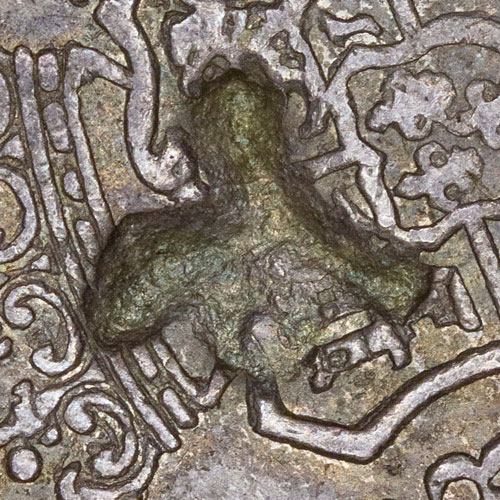 Unknown chopmark
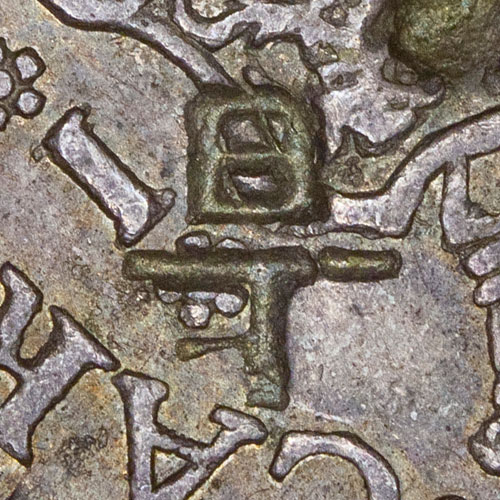 㫖 - (variant form of 旨) zhǐ - delicious, fine, imperial decree
Provenance:
Purchased from the Stack's Bowers April 2026 Hong Kong Showcase Auction
Lot #49774
Auction Description:
PERU. Real, 1761-LIMA JM. Lima Mint. Charles III. PCGS Genuine--Chopmark, AU Details.
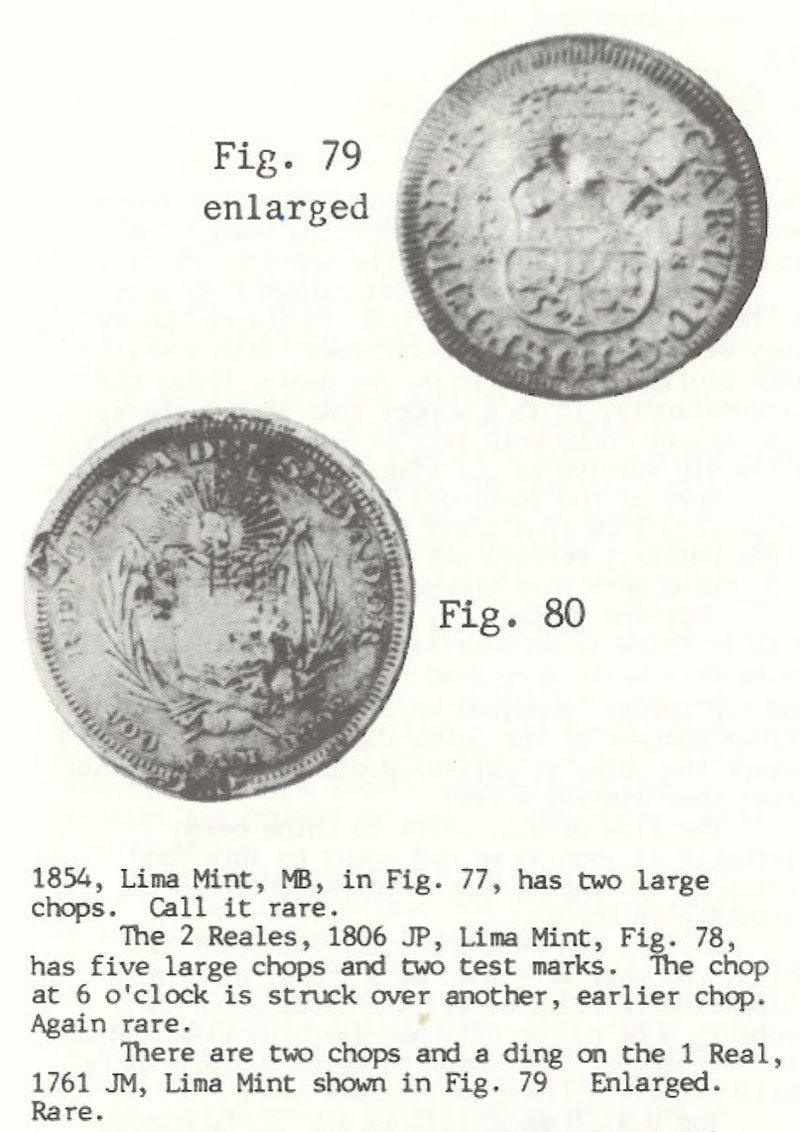
KM-61; Cal-344; Yonaka-L1-61; Murphy-Fig. 367 (Plate Coin); Rose-Fig. 79 (Plate Coin). Variety without dots above mintmark. One large size and one medium size incuse Chinese chops including, "上日" (Shang Ri), "ㅅㅇ" (Meaning unknown). This beautifully preserved example displays lovely rich old cabinet patina with much underlying luster that pops out when tilted in the light. The medium size chop is bold and easily read, while the larger character is somewhat obscured and difficult to fully identify. A handsome example of tough to locate date offering much originality and a pleasing appearance.
Provenance: From the Edgar Murphy Collection.
Ex: F. M. Rose Collection, featured as figure 79 on page 21 in his book "Chopmarks".
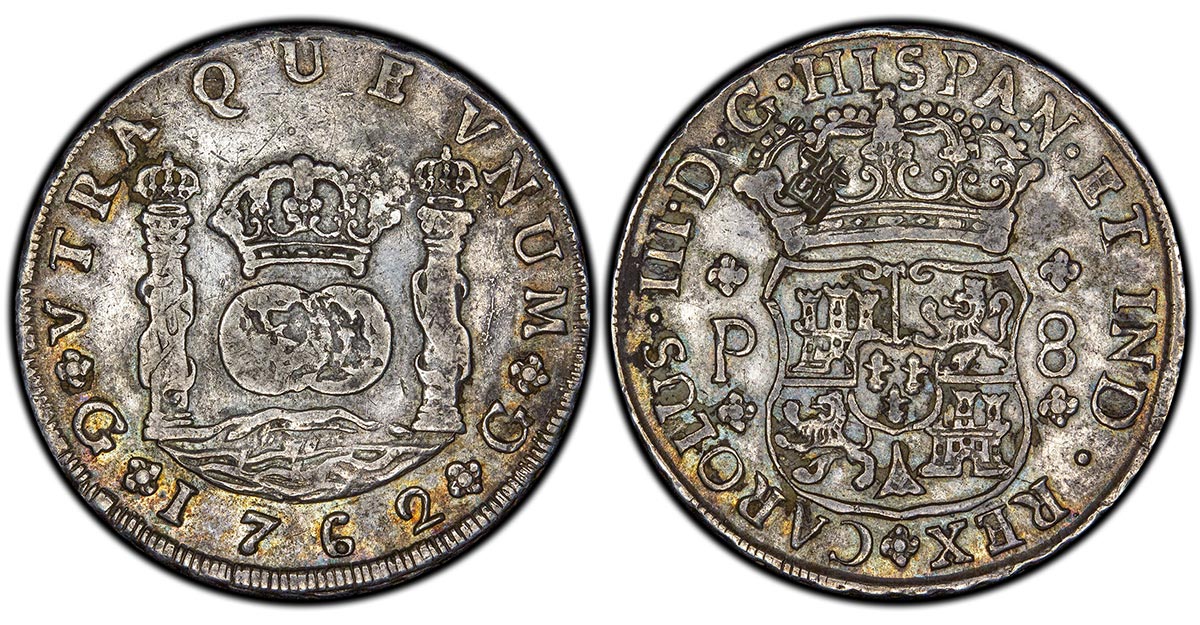
1762-G P Guatemala 8 Reales Carolus III type
Specifications:
27.07 g, .917 fine silver, .798 troy oz (actual silver weight)
Recorded mintage: unknown
Catalog reference: KM 27.1
Details:
As noted above with the 1759 Guatemala 8 reales, all denominations of chopmarked pillars from Guatemala are rare. After searching for about 10 years, this is only the second Carlos III pillar
dollar with chopmarks I've seen.
The 1762-G P Guatemala 8 reales, struck under Carlos III, was produced at the Casa de la Moneda of Guatemala, a relatively small but important regional mint within the Spanish colonial system. Authorized by the Crown in 1731 and organized under the direction of the Viceroy of New Spain, the mint began operations in Antigua Guatemala in the early 1730s, using the “G” mintmark seen on this coin. Although Guatemala lacked major silver deposits of its own, the mint played a key role in converting regional bullion into coin for circulation and export, particularly through Pacific trade routes. The presence of Chinese chopmarks on this example confirms that at least some Guatemala-mint silver moved well beyond its intended regional sphere, entering Asian trade networks where even secondary-mint issues were accepted and chopmarked.
This example shows one clear, bold chopmark on the reverse. There is possibly a second mark, or a faint partial extension of the primary mark above and to the left.
Notable chopmarks:
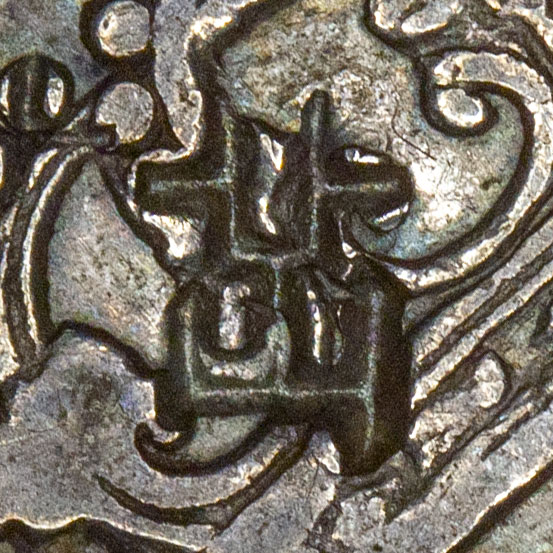 Possibly 茁 - zhuó - sprout, grow
Provenance:
Purchased from the June 2022 Wednesday & Thursday World & Ancient Coins Select Auction (232223) at Heritage Auctions
Lot #62571
Auction Description:
Charles III 8 Reales 1762 G-P XF Details (Chopmarked) NGC, Guatemala City mint, KM27.1
1762-M JP Spain 8 Reales
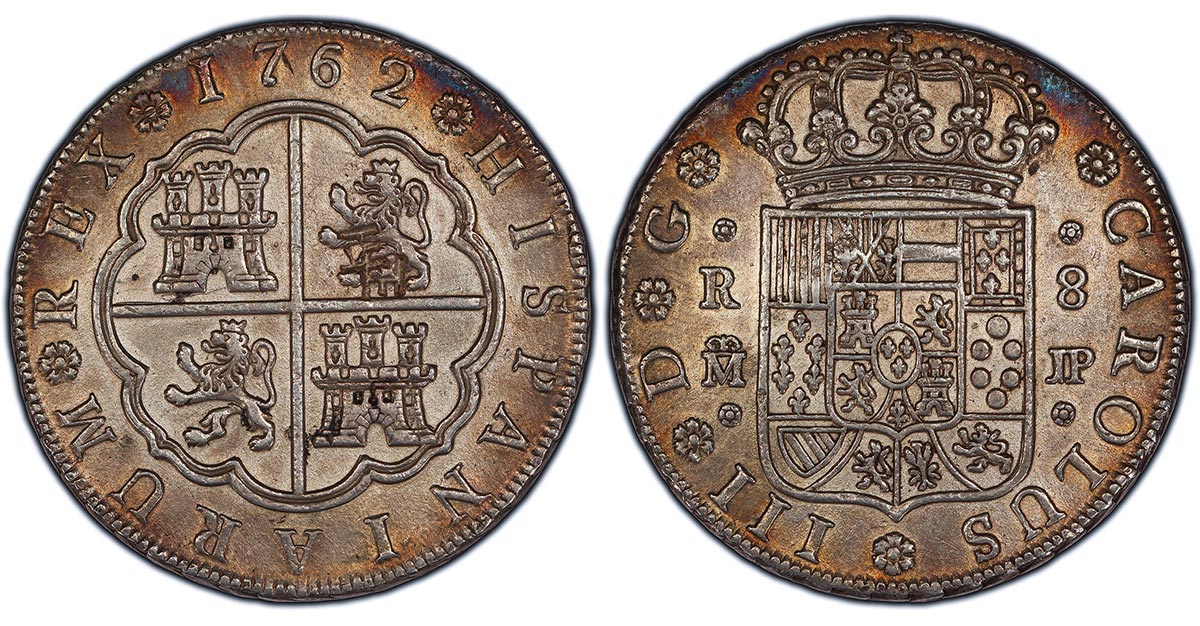
Specifications:
27.07 g, .903 fine silver, .7859 troy oz (actual silver weight)
Recorded mintage: unknown
Catalog reference: KM 399.1
Details:
The 1762-M JP Spain 8 reales, struck at the Madrid mint, was intended primarily for domestic circulation, not for overseas trade. Unlike Spanish American 8 reales, which were
produced in enormous quantities to support imperial commerce, Madrid issues were struck in far smaller numbers and were normally absorbed within Spain or nearby European markets.
The presence of Chinese chopmarks on this type is therefore exceptional, as Spanish-mint 8 reales rarely entered Asian commerce in the first place. When encountered, chopmarks
likely indicate an unusual history, secondary movement through European trade channels before reaching China, making chopmarked Madrid issues among the scarcer and more historically
fascinating examples of Spanish silver in the China trade.
During the mid-18th century, Spain struck relatively few crown-sized silver coins, and metropolitan production of the 8 reales effectively ceased after 1736, not resuming until 1772, with the notable exception of the 1762 issue. Carlos III, who ascended the throne in late 1759, introduced a new royal coat of arms in 1761, the first major revision since 1700. This redesign incorporated the arms of the Italian houses of Farnese and Medici, reflecting Carlos’s earlier rule over Naples and Sicily. The 1762 8 reales and 8 escudos uniquely feature this new coat of arms on the obverse; it would not reappear on reales coinage and only later, in modified form, on the reverse of escudos beginning in 1771, making the 1762 issue a distinct and historically bounded type.
The 1762 royal arms are among the most complex ever used on Spanish coinage, visually expressing the breadth of Spanish dynastic influence. Arranged clockwise from the upper left are the arms of Aragon; Aragon-Sicily; Austria; Burgundy modern; the Medici balls at 3 o’clock; Brabant; Tyrol; Flanders; Burgundy ancient; and at 9 o’clock, the Farnese fleur-de-lis. At the center lie the quartered arms of Castile and León, with the pomegranate of Granada below and the fleur-de-lis of Anjou in the inescutcheon. The reverse simplifies this complexity, returning to the traditional arms of Castile and León alone, underscoring the ceremonial and political intent of the 1762 obverse design.
This issue was minted both at the Madrid and Sevilla mint. Possibly unique with chopmarks - this is the sole example I'm aware of, and other major chopmark collections are missing this type. It's unlikely this coin journeyed to Asia with many others, since this otherwise commmon coin is almost never found with chopmarks.
Notable chopmarks:
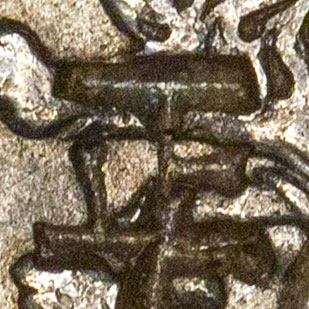 正 - zhèng - correct, straight, upright
Provenance:
Purchased from the Alliance Coin & Banknote Inc. Toronto Coin Expo Fall 2021 Sale Lot #76
Auction Description:
KM.399.1, PCGS AU Details with a single merchant chop-mark on reverse
Previously from The London Coinex Auction, September 28, 2005 by Spink & Son (Auction 5014), Lot #835
Auction Description:
Spain, Carlos III (1759-88), 8 Reales, 1762, Madrid, assayer JP, crowned shield dividing R/mintmark - 8/JP, rev. shield within roseace (Cay.11136; KM.399.1), Chinese chopmark on reverse, very fine Estimate £ 200-250. (sold for £260)
1764-MO MF Mexico 8 Reales Carlos III pillar type
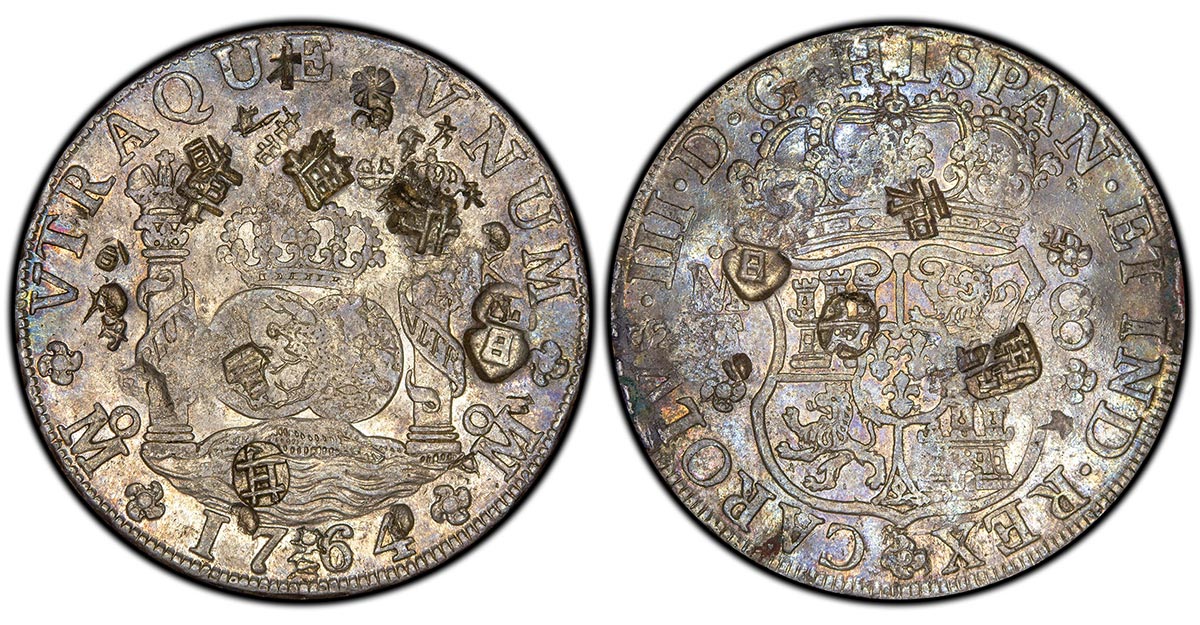
Specifications:
27.07 g, .917 fine silver, .798 troy oz (actual silver weight)
Recorded mintage: unknown
Catalog reference: KM 105
Details:
Carlos III of Spain (reigned 1759–1788) marked a clear break from the more inward-looking reigns of Philip V and Ferdinand VI, bringing a more assertive and reform-oriented approach to
government. Drawing on his experience as ruler of Naples and Sicily, he advanced Bourbon reforms aimed at administrative efficiency, economic modernization, and firmer oversight of imperial
institutions. Under his reign, Spanish silver coinage was more tightly regulated and standardized, reinforcing confidence in pillar dollars as instruments of state finance and international
trade.
The 1764 pillar dollar belongs to the final phase of the pillar series, struck from 1760 to 1771 during the reign of Carlos III. The following year, 1772, marked a major transition in Spanish coinage with the introduction of royal portrait designs, a format that would dominate Spanish and Spanish American silver through the reigns of Carlos III, Carlos IV, and Ferdinand VII until the era of independence.
Notable chopmarks:
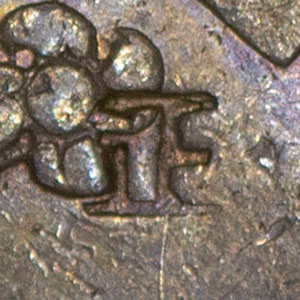
 昌 - chāng - prosperous, flourishing
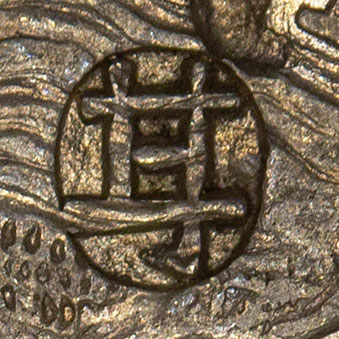
 正 - zhèng - correct, straight, upright
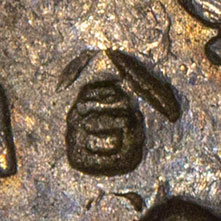
 耳 - ěr - ear
 合 - hé - combine, join, close, suit
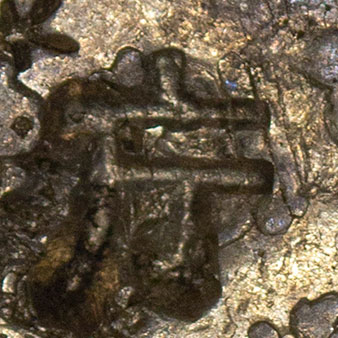 庁 - tīng - hall, office
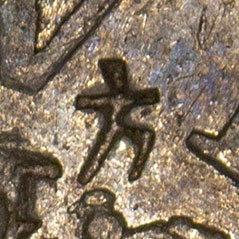 方 - fāng - square, direction, side
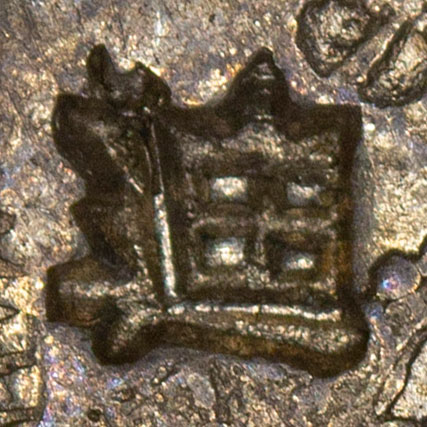 廸 - (variant of 迪) dí - enlighten, guide
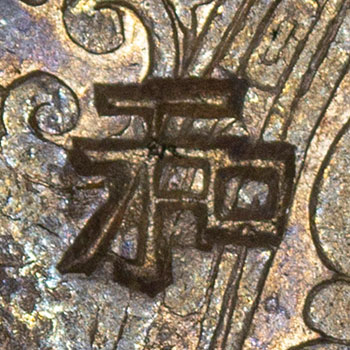 和 - hé - harmony, peace, and
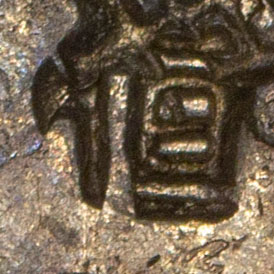 恒 - héng - constant, persistent
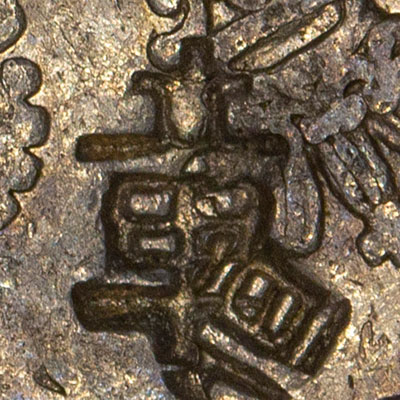 童 - tóng - child
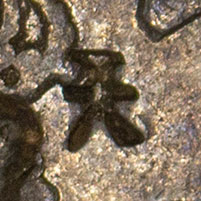 天 - tiān - heaven, sky, day
Provenance:
Purchased on eBay in March 2018 from a seller in Dzerzhinsky, Moscow Region, Russian Federation.
Previously purchased from Annaletta Pasamba, a dealer in the city of Manila, Philippines.
1766 United East India Company Rupee, Java
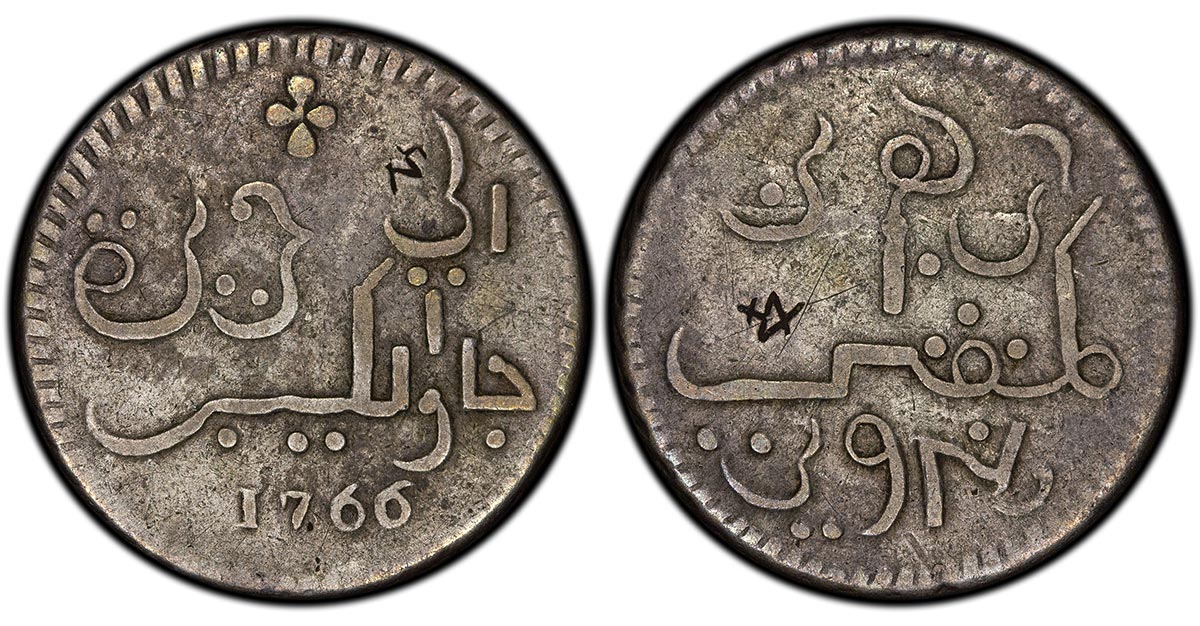
Specifications:
13.150 g, .833 fine silver, .3522 troy oz (actual silver weight)
Recorded mintage: unknown
Catalog reference: KM 175
Details:
The Dutch East India Company (VOC), founded in 1602 and active until 1799, was the first true multinational corporation and the dominant European commercial power in Asia for much of the
17th and 18th centuries. Formed by consolidating competing Dutch trading ventures and granted a monopoly by the States-General, the VOC operated as a shareholder company governed by the
Heren XVII. From its headquarters in Amsterdam and its Asian capital at Batavia (modern Jakarta), the Company built a vast network of ports, warehouses, and fortresses across Southeast
Asia, India, and beyond, trading in spices, tea, textiles, porcelain, and silver. Its reach and authority were so extensive that it exercised quasi-sovereign powers, including the right to
wage war, administer territory, and issue coinage.
This 1766 VOC rupee from Java belongs to this highly developed colonial monetary system, struck to facilitate regional trade where local and Indian-style silver currencies were preferred. VOC rupees were not intended as purely Dutch coins, but as hybrid coinage, designed to be used within regional commerce. Their circulation extended well beyond Company settlements, passing through indigenous markets, ports, and merchant networks that were not under direct VOC control. As such, these coins often moved independently of their issuing authority once released into circulation.
The presence of two chopmarks on this rupee confirms that it entered Chinese or China-facing trade networks, where silver was evaluated and accepted through private merchant validation rather than by familiar type or denomination. Chopmarks on VOC rupees are a well-documented phenomenon and reflect the reality that Company coinage, like Spanish American silver, was absorbed into broader Asian bullion flows.
Notable chopmarks:
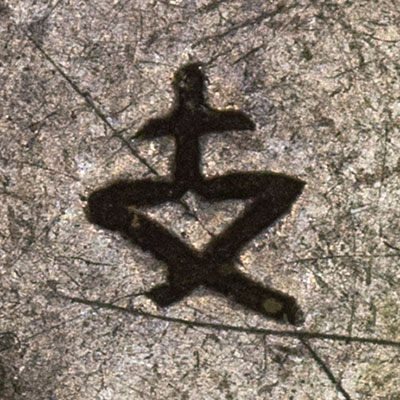 支 - zhī - branch, support, pay
(seen once on both obverse and reverse)
Provenance:
Purchased from the Stephen Album Sale #28 May 18-20 2017 Lot #947
Auction Description:
JAVA: AR rupee, 1766. KM-175. United East India Company issue with two small Chinese chopmarks, Fine, R.
Estimated Value $100 - 150.
It is likely that these unusual Chinese chopmarks were applied by local Chinese merchants.
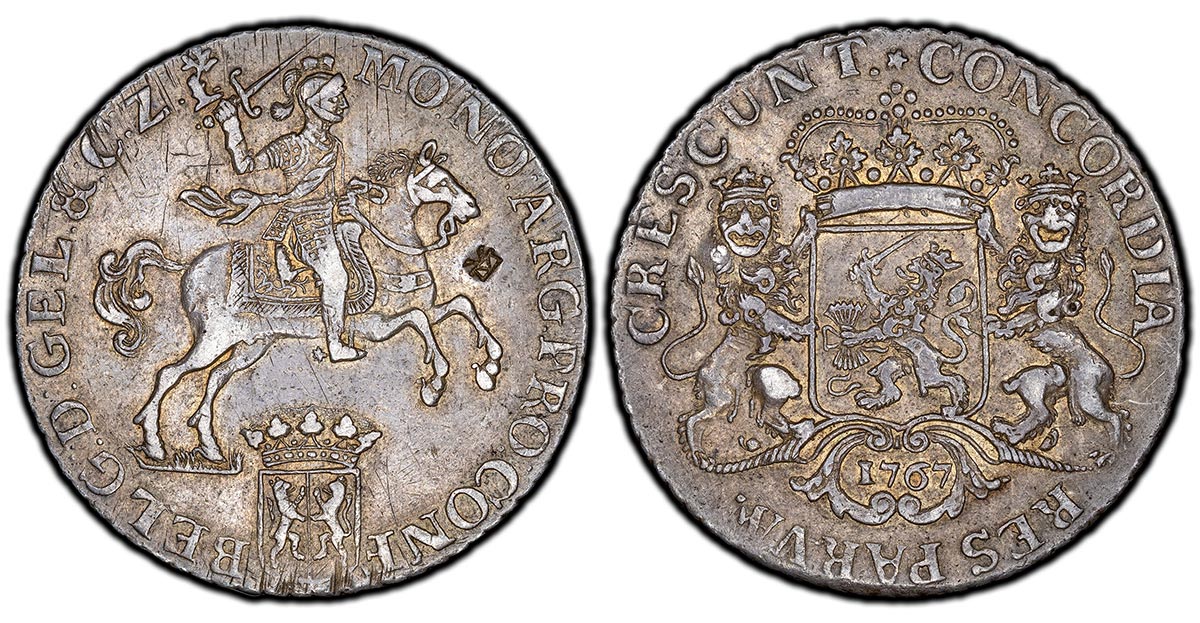
1767 Netherland Ducaton Silver Rider, Gelderland Province
Specifications:
32.779 g, .941 fine silver, .992 troy oz (actual silver weight)
Recorded mintage: Unknown, probably 100-200k range
Catalog reference: KM 95.3, D-1834
Details:
The 1767 Gelderland ducaton "Silver Rider" is larger than typical crown-sized silver dollars. Issued by the Dutch Republic, Ducatons functioned as international trade silver,
comparable in role, though not in exact weight, to Spanish American crowns. The obverse features the armored mounted knight “Rider”, a long-standing Dutch motif symbolizing
provincial authority and military readiness, while the reverse displays a central shield charged with a rampant lion, flanked by two heraldic supporting lions, with the provincial
legend of Gelderland around.
The presence of a Chinese chopmark indicates that this coin moved beyond European circulation and entered Asian trade networks, where large silver coins were valued primarily for their bullion content. Although far less common in China than Spanish American 8 reales, Dutch ducatons are known to have circulated in Southeast Asia and occasionally reached Chinese markets through VOC and private trade. The chopmark reflects merchant testing, confirming that the coin was evaluated and approved for use within a Chinese commercial context. Chopmarked examples are uncommon and provide direct evidence of the global reach of Dutch provincial silver in the 18th-century silver economy.
It's interesting to note that the only other time I've seen this archaic chopmark character is on a 1750 Mexico 8 Reales, just 17 years older than this coin.
Notable chopmarks:
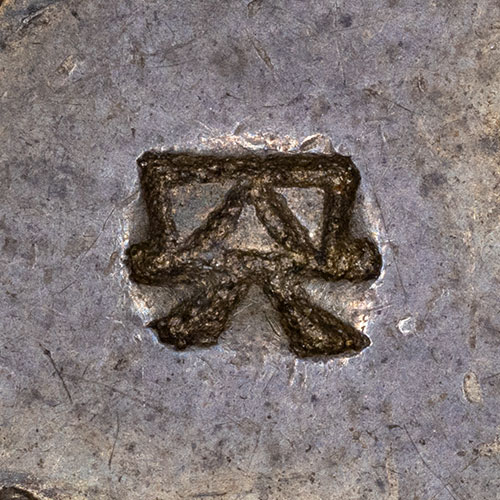 㒷 - (variant form of 興) xìng - to prosper, to rise, to flourish
Provenance:
Purchased from a dealer in New Jersey, United States in March 2024.
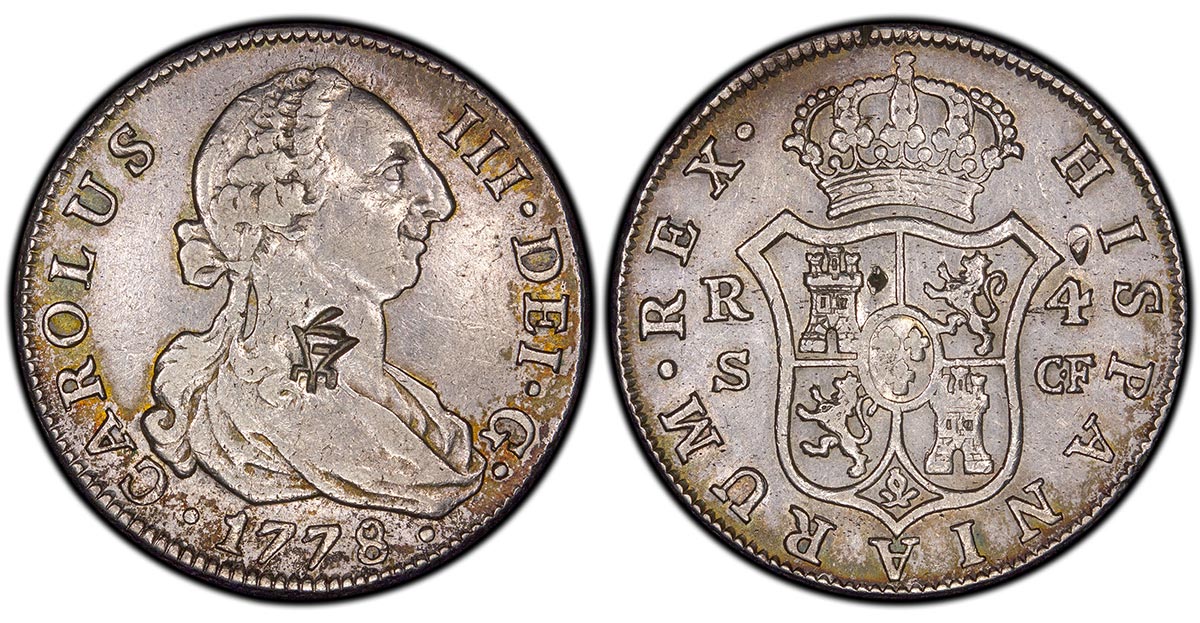
1778-S CF Spain 4 Reales Carlos III portrait type (Ex. Walls / Leverage)
Specifications:
13.54 g, 0.903 fine silver, 0.3931 troy oz (actual silver weight)
Recorded mintage: unknown
Catalog reference: KM 413.2
Details:
This handsome 1778-S CF Spain 4 reales is a Carlos III portrait-type struck at the Seville mint, bearing the CF assayer mark used from 1772 to 1782. This example shows an obverse
chopmark, along with a reverse drill mark and a test punch.
Hal Walls, who previously owned this coin, was a respected numismatist best known for his focused and scholarly work on chopmarked, countermarked and general trade coinage, at a time when the subject was often overlooked. His collection emphasized authentic circulation evidence, chopmarks, countermarks, test cuts, and trade wear, rather than pristine condition, and it helped legitimize chopmarked coins as prized historical artifacts.
This coin was featured in the June 2018 edition of The Chopmark News on page 30.
Notable chopmarks:
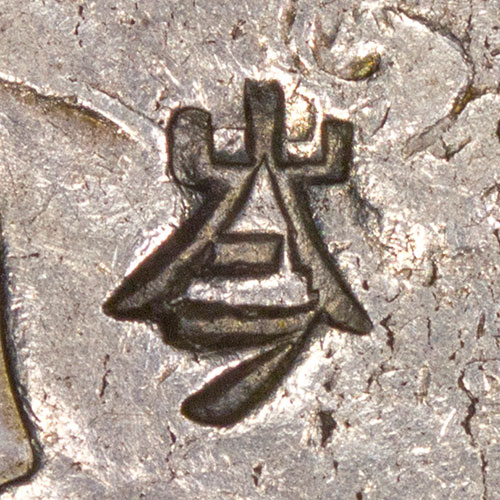 岑 - cén - small hill, cliff
Provenance:
Acquired in trade rom fellow chopmark collector Taylor Leverage, February 2018. Taylor is author of the excellent book
"By Weight, not by Coyne, An Introduction to Chopmarked Coins"
Previously from La Colección Bohol, Aureo & Calicó Auction 299, November 9, 2017 Lot #1342
Auction Description:
1778. Carlos III. Sevilla. CF. 4 reales. 13,51 g. Resello oriental grande en anverso y dos punzonadas en reverso. Rara. MBC
The Bohol collection consisted of over 500 lots focused on Spanish coinage from the Philippines.
Ex-Hal Walls, Paul Bosco Aug 4/97 Sale, lot 377 (2 coin lot, sold with another 1778 Spain 4R with chopmarks) Sold: $100 for the pair.
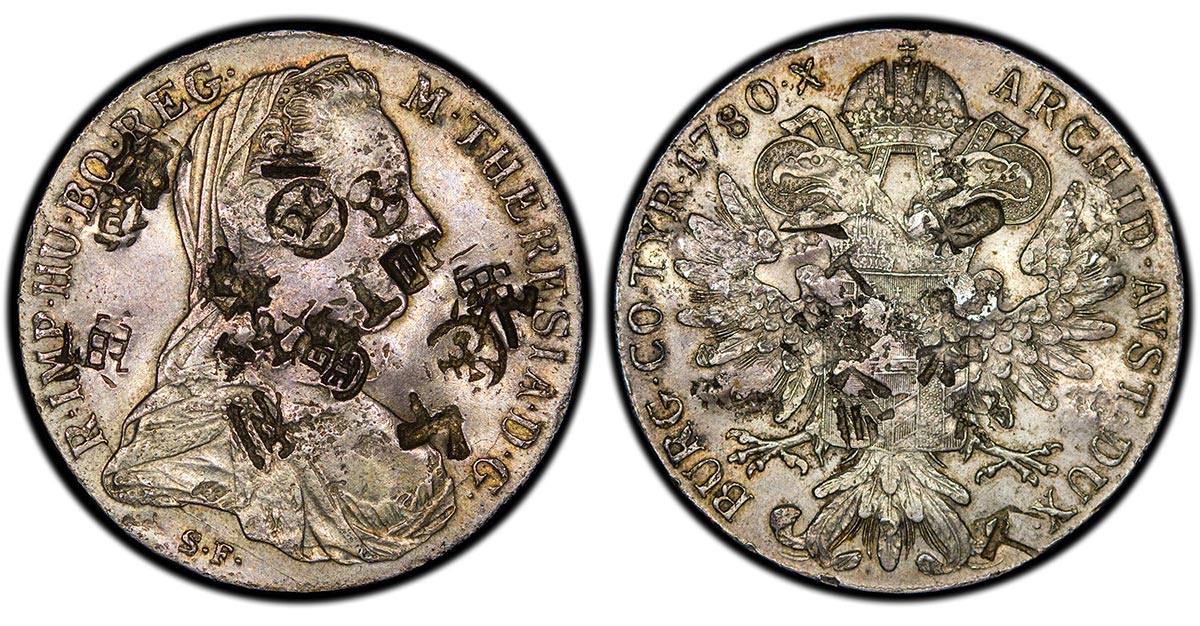
"1780" Maria Theresa Thaler Restrike (early restrike 1780's-1900's) (Ex. Vandendriessche)
Specifications:
28.07 g, .833 fine silver, .752 troy oz (actual silver weight)
Recorded mintage: a huge number of these were struck, upwards of 300 million
Catalog reference: KM 1866.2
Details:
The 1780 Maria Theresa thaler is one of the most prolific and widely circulated silver trade coins in history. First struck during the reign of Empress Maria Theresa and frozen with the
date 1780 after her death, the type was produced in enormous quantities over more than a century. Official and semi-official restrikes were issued from the late 18th century well into the
19th and early 20th centuries, at mints across the Habsburg Empire and beyond, all adhering closely to the familiar design and silver standard. The coin became a preferred medium of exchange
across Central Europe, the Middle East, East Africa, and parts of South Asia, valued for its consistent fabric and recognizability.
Despite its role as a global trade coin and its extraordinary mintage, Maria Theresa thalers are surprisingly uncommon with Chinese chopmarks. While some examples clearly did reach China-facing trade, as evidenced by chopmarked pieces, the type never achieved the same level of acceptance in China as Spanish American dollars or later Japanese and Mexican silver. It remains a mystery to me why these coins aren't common with chopmarks, as we would expect given the large production and far-reaching circulation and acceptance.
Notable chopmarks:
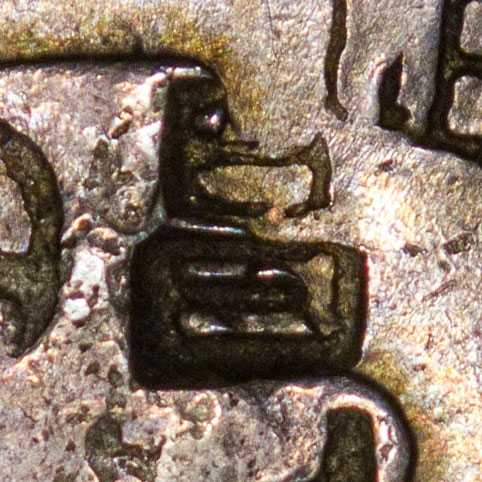 昌 - chāng - prosperous, flourishing
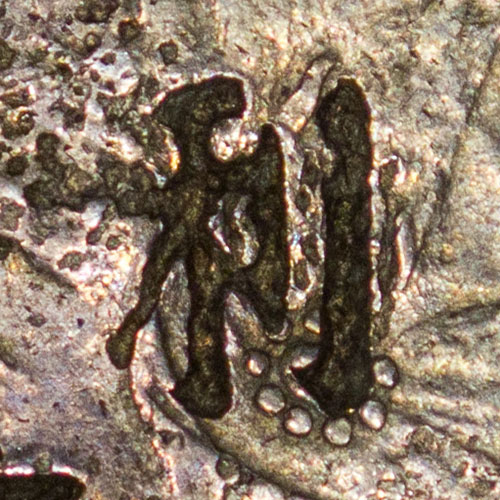 利 - lì - profit, benefit, advantage
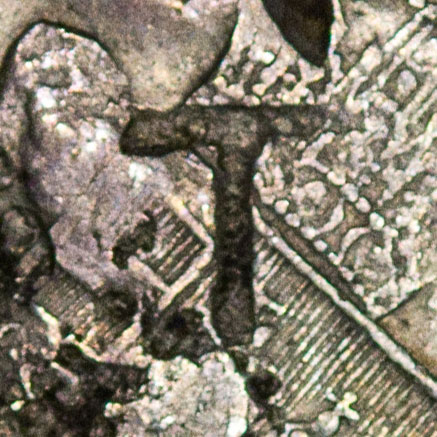 丅 - (ancient version of 下) xià - below, down, under
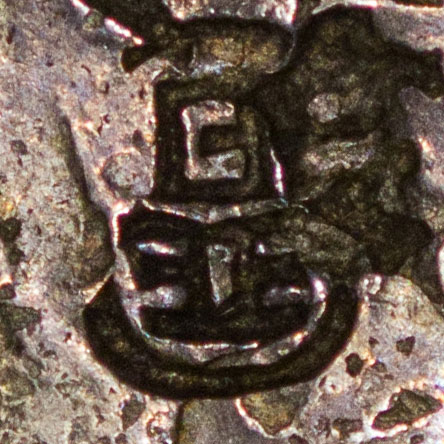 暃 - fēi - sunset
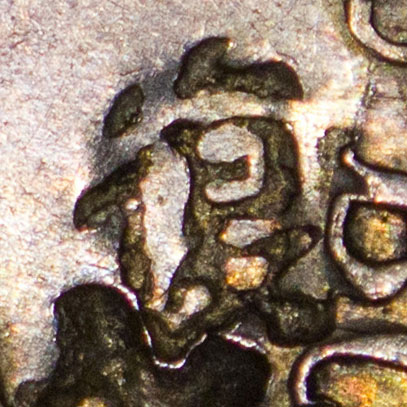 復 - fù - return, repeat
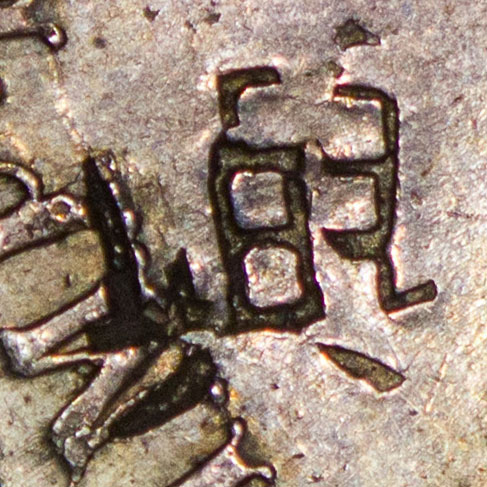 興 - xīng - rise, prosper
(incomplete punch or broken tool?)
興 - xīng - rise, prosper
(incomplete punch or broken tool?)
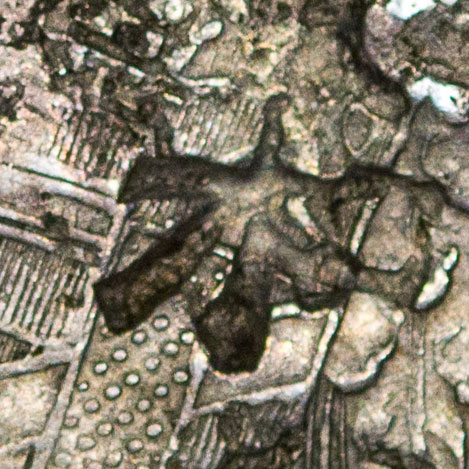 木 - mù - tree, wood, Japanese Kanji radical 75
Provenance:
Ex. Jerome Vandendriessche Collection
Purchased from the Stephen Album Sale 26 September 2016 Lot #724
Auction Description:
Austrian Maria Theresa thaler dated 1780 (sic) with Chinese merchant chopmarks, ex Jerome Vandendriessche Collection.
Estimated Value$150 - 200.
This famous trade coin travelled the world, yet is seldom found with Chinese chops. With about 30 chops, many of them quite distinctive, this is surely the finenest known piece. From the
Jerome Vandendriessche Collection which was formed 1950s to mid-1970s in Belgium.
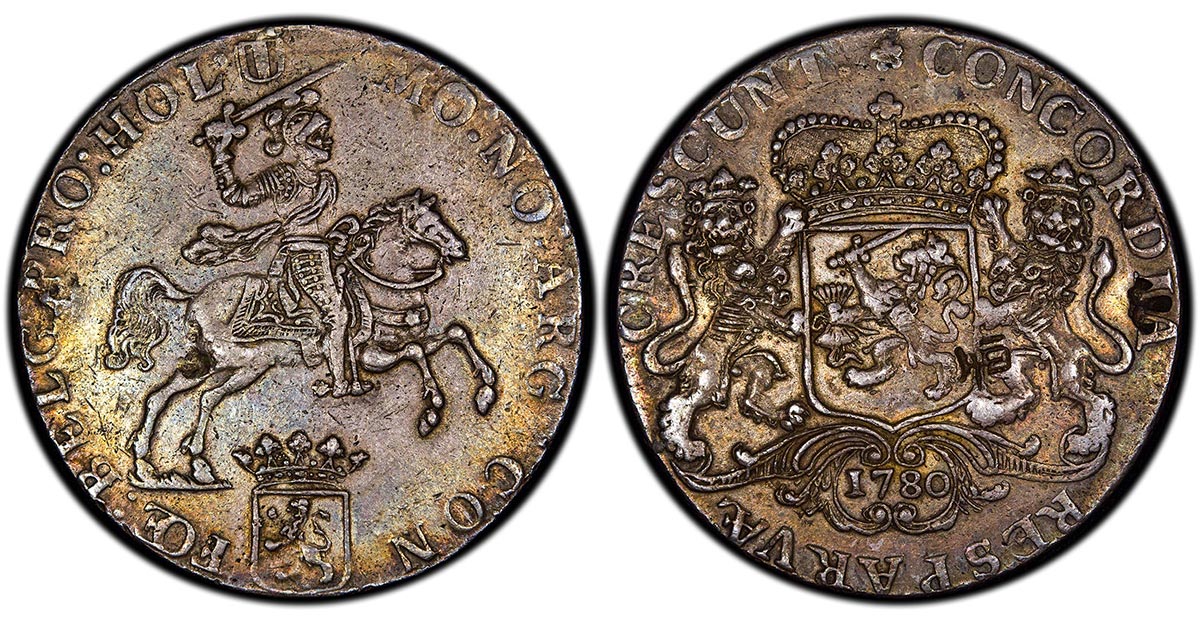
1780 Netherland Ducaton "Silver Rider" Hollandia Province (Ex. Walls / Waddell)
Specifications:
32.779 g, .941 fine silver, .992 troy oz (actual silver weight)
Recorded mintage: 90,000 (for 1779-80)
Catalog reference: KM 90.2
Details:
The Netherlands “Silver Rider” ducaton was introduced in 1659 as a large, high-quality silver trade coin, easily recognized by its mounted knight on horseback. Struck to a standard of
32.78 grams / .941 fine, the ducaton was valued at 60 stuivers. The reverse displays the crowned arms of the United Netherlands, with a provincial shield beneath the rider identifying
the issuing province, in this case Hollandia. Production of silver rider ducatons continued until 1798, and the type became one of the most stable and trusted silver denominations in
northern European trade.
This 1780 Hollandia ducaton falls in the later phase of this long-running series, when the coin’s design and silver standard were already well established. We wouldn't call this type common with chopmarks, one possible reason could be the higher silver content led to many ending up in the melt bucket. I'm thankful this one was spared.
Notable chopmarks:
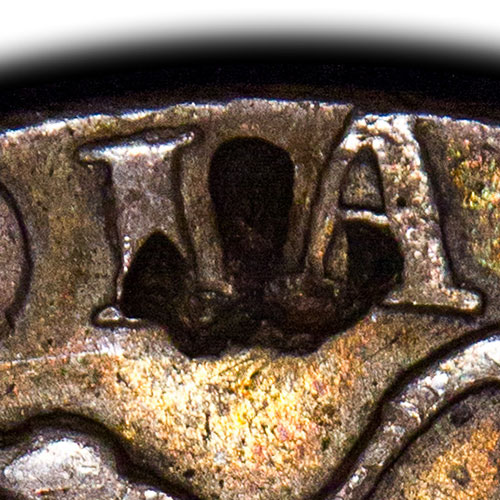
 - Liushutong script variant of 山 - shān - mountain, hill
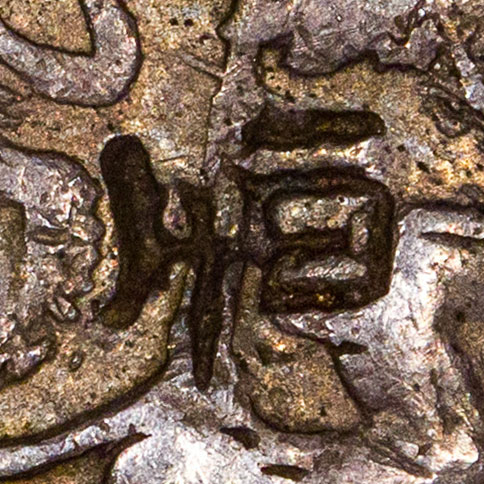 恒 - héng - constant, persistent
There appears to be an additional stroke, maybe coincidentally to the left of this chopmark
Provenance:
From the Ron Waddell Collection
Purchased from Ron via private sale in September 2016
Previously purchased from D.A.P. Coins (Duwayne A. Perry), Farmers Branch, TX.
The D.A.P. Coins flip label noted this coin as previous owned by Hal Walls, who built one of the finest world trade coin collections ever assembled.
1784 Fort Marlborough 2 Sukus, Sumatra, Indonesia, British East India Company, Calcutta Mint (Ex. Pridmore)
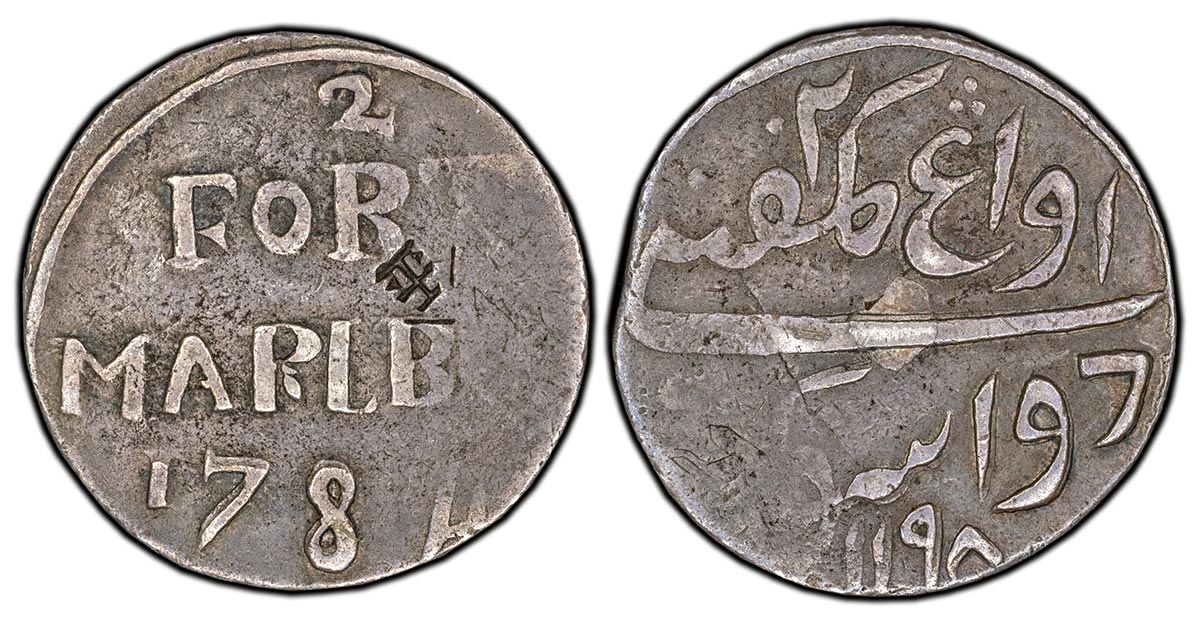
Specifications:
12.69 g silver
Recorded mintage: unknown
Catalog reference: KM 271, Pridmore-2
Details:
This 1784 Fort Marlborough 2 Sukus, struck at the Calcutta Mint for use in Sumatra, is a product of the British East India Company’s (EIC) short-lived experiment in localized colonial
coinage. Fort Marlborough, established by the English in 1685 near modern Bengkulu (Benkoelen), served as Britain’s principal outpost on Sumatra’s west coast and a strategic counterweight
to Dutch power in the region. The fort functioned primarily as a pepper-trading center, but chronic shortages of suitable small change made commerce difficult. To address this, the EIC
authorized the striking of coins denominated in sukus, a locally understood unit of account, rather than attempting to force unfamiliar British denominations into circulation. The
denomination of 2 sukus equaled 4 reales or a half Spanish milled dollar.
Minting of the Fort Marlborough sukus coinage was brief, it was struck for only two years - 1783 and 1784, and production ceased once the experiment proved inefficient and the fort itself declined in importance. Coins were struck in Calcutta, then shipped to Sumatra, reflecting both the absence of local minting infrastructure and the centralized control exercised by the EIC. These issues were never intended for wide imperial circulation; they were strictly regional utility coinage, designed to function in local markets alongside foreign silver and indigenous monetary practices. Their limited mintage and narrow circulation window make surviving examples historically significant, and rare.
The presence of a Chinese chopmark on a 2 Sukus piece is notable and suggests that the coin entered China-facing trade channels despite its local intent. Sumatra had long-standing commercial ties with Chinese merchants, particularly in pepper, tin, and regional trade goods, and Chinese traders were active along the Indonesian archipelago. It is plausible that the coin was accepted as bullion-weight silver rather than fiduciary currency, tested and validated by a Chinese merchant before being reused in settlement or exchange. Such a chopmark indicates that even specialized EIC colonial coinage could be drawn into broader Asian silver networks, where acceptance depended not on issuing authority, but on metal content and merchant trust.
Obverse (Arabic script):
(Uang kompeni) اواڠ كمفني
(Uang kompeni) دوا سوكو
(AH 1198) ١١٩٨
Obverse translation:
Company money
Two suku
AH 1198
Reverse:
2
FORT
MARLBRO
1784
This coin was pictured in The Chopmark News Volume 13, Issue 1 on page 13-12, under the title "Which ChopMarked Coins are Unique?"
Notable chopmarks:
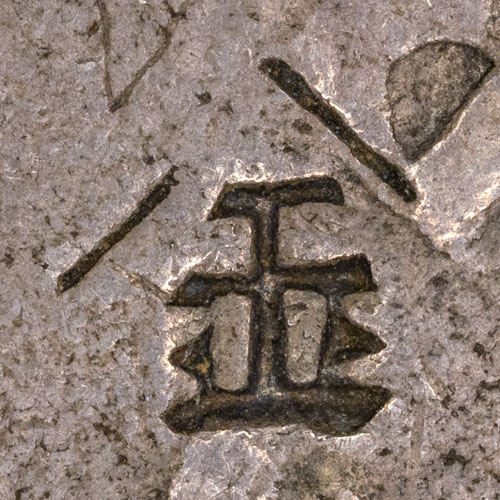 金 - jīn - gold, metal, money
Provenance:
Stephen Album Rare Coins Auction 52, May 16 2025, Lot #1237
Auction Description:
SUMATRA: AR 2 sukus (12.69g), Fort Marlbro, 1784//AH1198, KM-271, Prid-2, British East India Company issue struck at the Calcutta Mint for circulation
in and around Fort Marlborough; some weakness, clear date, one small chopmark on the obverse (possibly Chinese), VF, RR, ex Solar Collection.
The denomination of 2 sukus equaled 4 reales or a half Spanish milled dollar. They were the last silver coins struck for this area. From then on they would rely
on Spanish silver and the copper coins struck locally and at the Soho Mint in England. Fort Marlborough was the main fort in the Bencoolen Presidency and was a
British possession in Sumatra based in the area of what is now Bengkulu City. In 1785 it was downgraded to Bencoolen Residency and placed under the Bengal Presidency.
The British ceded Fort Marlborough and the City of Benculen (Bengkulu) to the Dutch as part of the Anglo-Dutch Treaty of 1824.
Previously from the Heritage Auctions January 2008 New York, NY Signature World Coin Auction #458, Lot #52523
Auction Description:
Fort Marlbro Silver 2 Sukus 1784 - AH1198, KM271, toned VF, one chop mark on the obverse, very scarce and popular type struck for this British settlement in the East Indies.
Previously from the Glendining & Co October 18-19, 1982 sale of The Pridmore Collection of the Coins of the British Commonwealth of Nations, Part II (in conjunction with A.H. Baldwin & Sons), Lot #208
Auction Description:
Fort Marlborough, 2-Sukus or Half-Dollar, 1784 (Pr. 2). One edge flat and chop mark on obverse, fine, the rarer date.

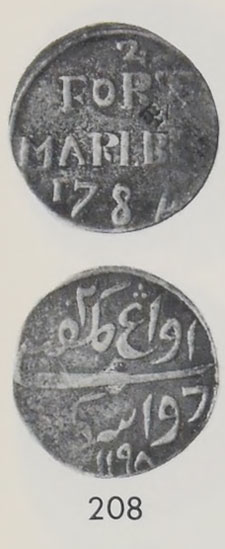
Major Fred S. Pridmore was one of the chief experts in British Commonwealth coins, authoring multiple books on the subject. His books were not reproductions from past works, rather they were meticulously researched original material. He exposed a large number of fakes and fantasies and he was one of the first to realise the historical importance of tokens. His numbering system is still used today for many British coins, including British Trade Dollars, and coins from his magnificent collection are prized by the next generation of collectors.
1785-Mo FM Mexico 2 Reales Carlos III portrait type (Ex. Kendall)
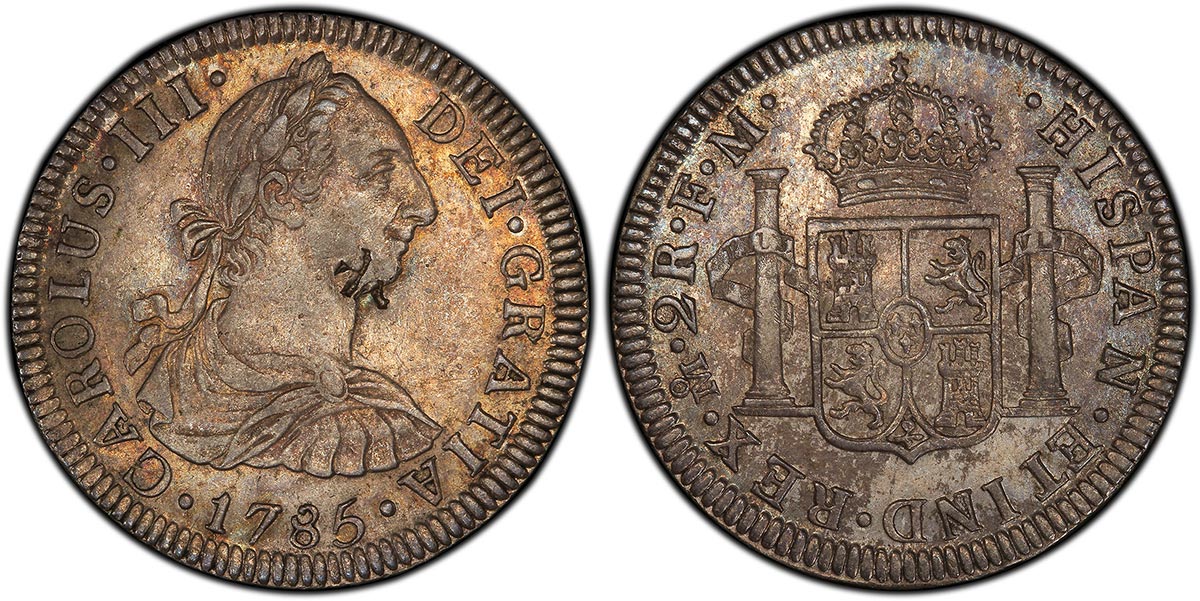
Specifications:
6.77 g, .903 fine silver, .196 troy oz (actual silver weight)
Recorded mintage: unknown
Catalog reference: KM 88.2
Details:
Spanish 2 Reales from Mexico City, Charles III type. Nicely preserved with original toning and one obverse chopmark. By the 1780s, The Mexico city Mint was producing huge
quantities of high-quality milled silver, driven by reforms under Carlos III that modernized mining, stabilized fineness, and ensured international trust in the coinage.
Even small denominations like the 2 Reales were part of this vast monetary current, circulating locally in New Spain while also feeding export needs in the East.
Notable chopmarks:
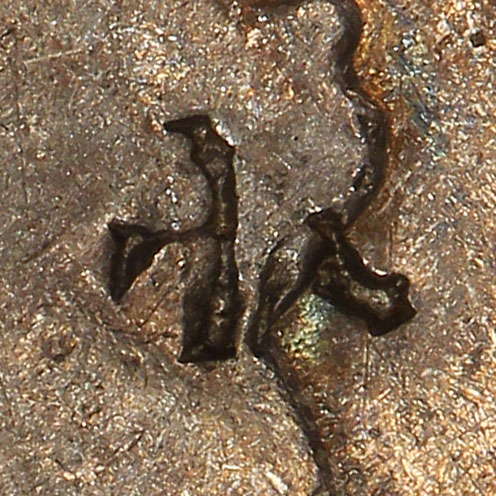 小 - xiǎo - small, tiny, insignificant
Provenance:
From the Henry P. Kendall Foundation Collection
Mr. Kendall purchased from dealer G. Hearn, March 3, 1966
Stack's Bowers March 2015 Baltimore Lot #2633
Auction Description:
Handsomely Toned and Countermarked Mexico City 1785 2 Reales
Mexico. 1785-Mo FM 2 Reales. Cal-type 141 #1352, KM-88.2a. AU Details--Chopmark (PCGS). Secure Holder.
Charles III (1759-1788). An early example of the silver portrait coinage that had replaced the pillar coinage beginning in 1772, though portrait gold coinage had been struck since the
1730's. Single chopmark of Asian origin at king's chin, otherwise a well struck example with good definition to the king's bust. Handsome medium toning with gold and orange hues over
surfaces with good remaining luster.
From the Henry P. Kendall Foundation
Provenance: From the Henry P. Kendall Foundation Collection. Purchased from G. Hearn, March 3, 1966.
This auction included the original paper envelope from the 1966 sale.
Henry P. Kendall is considered one of the great American business leaders of the 20th century by the Harvard Business School, being instrumental in advancing the textile industry. He emphasized basic product research and the application of scientific management to all phases of manufacturing, purchasing and sales. His company was a major supplier of textiles for a variety of industrial and consumer uses, including Curity Diapers and Curad finger bandages.
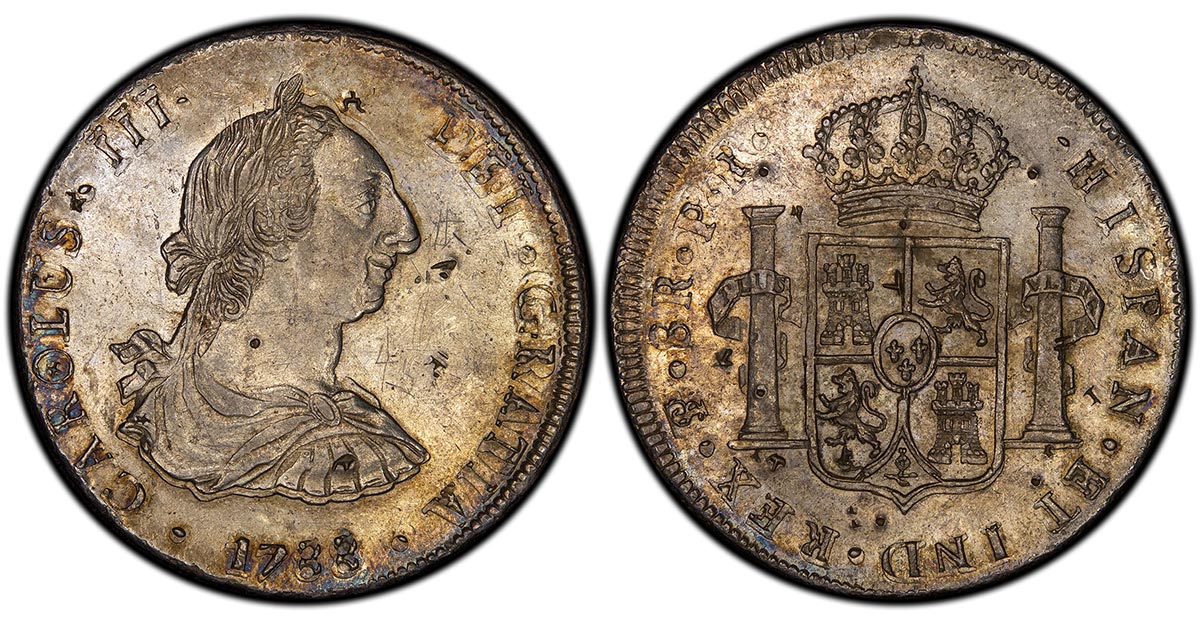
1788-PTS PR Bolivia 8 Reales Carlos III portrait type
Specifications:
27.07 g, .903 fine, .785 troy oz (actual silver weight)
Recorded mintage: unknown
Catalog reference: KM 55
Details:
Nearly uncirculated, well preserved example of this portrait 8 Reales from Bolivia. Showing exclusively the small style of chopmark, and many test cuts and punches as well. Notably,
the coin is double struck on both the obverse and reverse.
The 1788-PTS PR Bolivia 8 reales, struck at the Potosí mint under Carlos III, belongs to the final decades of Spanish colonial silver production in Upper Peru. Although Potosí’s output had declined from its 16th- and 17th-century peak, it remained a major source of silver in the late 18th century, supplying bullion for both imperial finance and international trade. Potosí 8 reales of this period continued to circulate widely beyond South America through established Atlantic and Pacific trade routes.
Notable chopmarks:
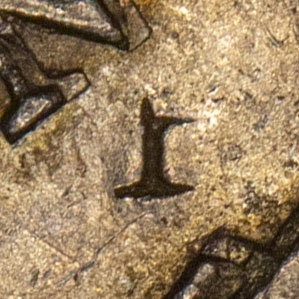 上 - shàng - above, up, top
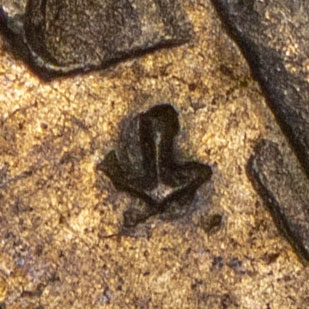
 - Bronze script variant of 山 - shān - mountain, hill
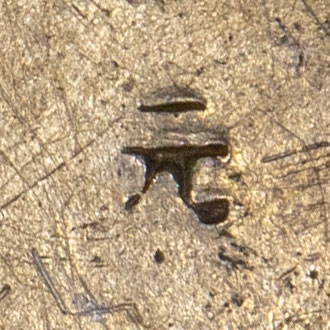 元 - yuán - dollar, unit of currency, basic, primary
Provenance:
Daniel Sedwick Treasure, World, U.S. Coin and Paper Money Treasure Auction, November 5 2018 Auction 24, Lot #1996
Auction Description:
Potosi, Bolivia, bust 8 reales, Charles III, 1788PR, in-collar double strike, with chopmarks as from circulation in China, NGC UNC details / chopmarked.
KM-55; CT-997. 26.99 grams. An interesting, high-grade coin exhibiting an in-collar double strike with small degree of rotation (hence the deformed legends
and "doubling" around bust) as well as chopmarks, test punches, and even scratched-in Chinese characters from use in Asia. Rather bright with light gold toning
that gets darker around the rims.
1791-PTS PR Bolivia 8 Reales Carlos IIII portrait type
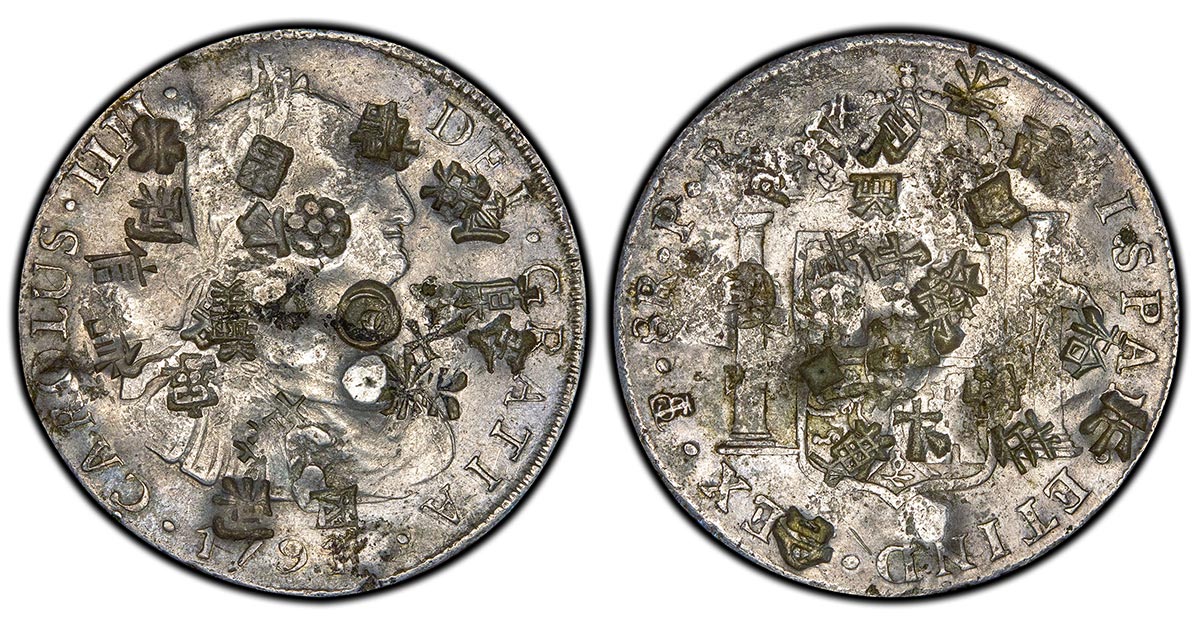
Specifications:
27.067 g, .896 fine, .7797 troy oz (actual silver weight)
Recorded mintage: unknown but slightly scarce
Catalog reference: KM 73
Details:
Struck in 1791 at Potosí, this 8 Reales belongs to the early portrait coinage of Carlos IIII, issued during the final decades of Spanish colonial silver production. The Potosí mint,
long one of the principal sources of crown-sized silver coinage, continued to supply both regional commerce and international trade, with its dollars moving along established routes
into circulation across Spanish America and beyond. By this period, the portrait-type coinage reflected an effort to maintain continuity and recognizability in design at a time when
Spanish-American silver remained a familiar and widely trusted medium of exchange.
Around this time, the official standard for Spanish imperial silver was quietly reduced from .903 fine to .896, a modest but deliberate adjustment introduced as part of late eighteenth-century monetary reforms intended to increase mint revenue while preserving confidence in the coinage. The change reflected growing fiscal pressure on the Spanish crown after decades of costly wars and expanding imperial obligations, which increased the need to draw greater return from colonial silver production without disrupting circulation. By slightly lowering the fineness while leaving the coins’ weight and appearance unchanged, the crown was able to extend available bullion and increase seigniorage while maintaining the established trust placed in Spanish-American dollars in both local use and long-distance trade.
Notable chopmarks:
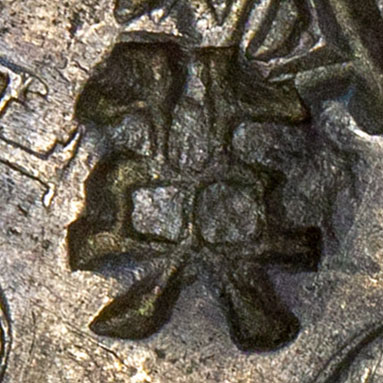 英 - yīng - flower, hero, Britain
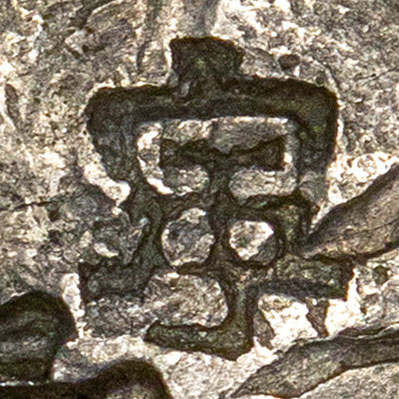 Possibly 寕 - níng - peaceful, rather
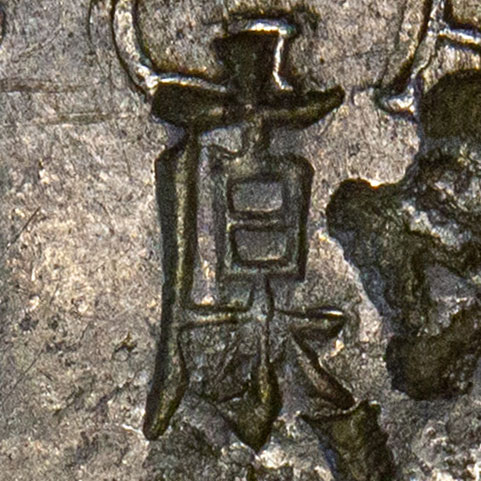 Possibly 原 - yuán - source, original
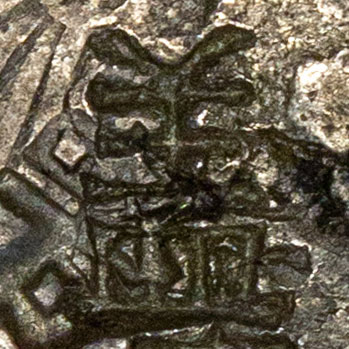 盖 - gài - cover, lid
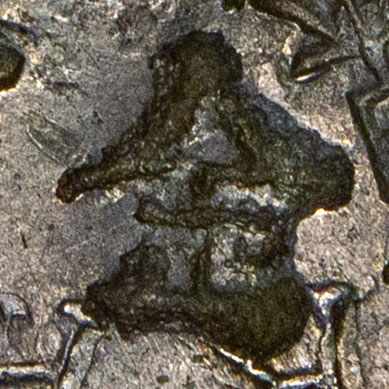 全 - quán - whole, complete, all
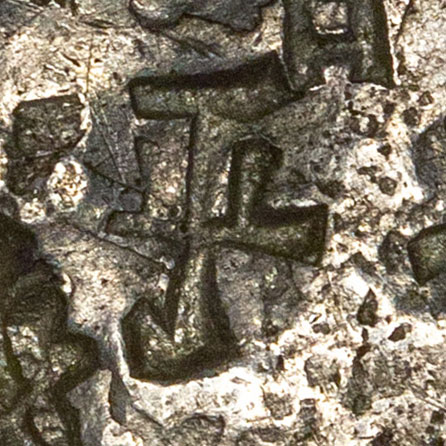 乎 - hū - particle, at, in
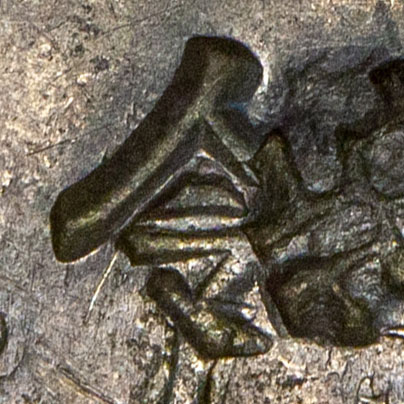 令 - lìng - order, command
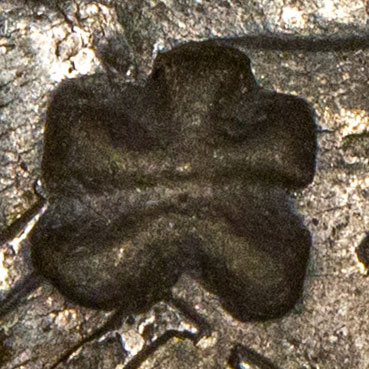 六 - liù - six
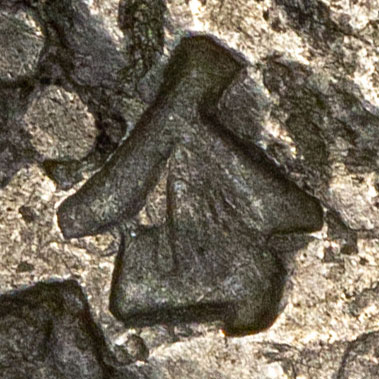 仚 - xiān - to fly, immortal
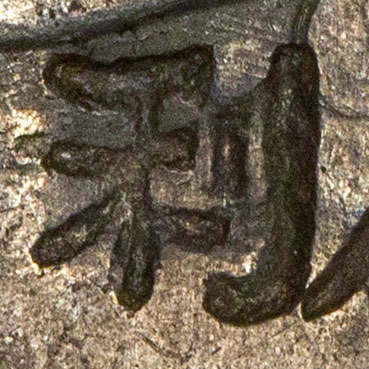 利 - lì - profit, benefit, advantage
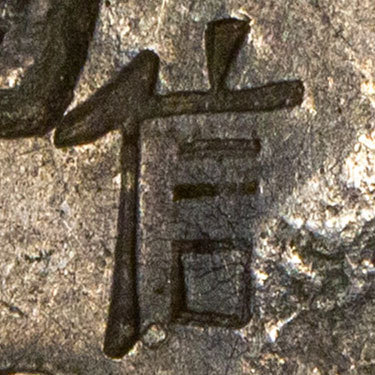 信 - xìn - trust, letter, believe
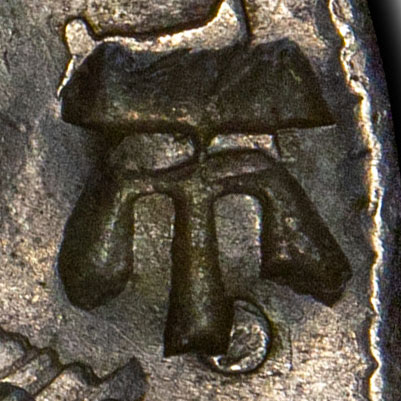 帀 - zā - to go around
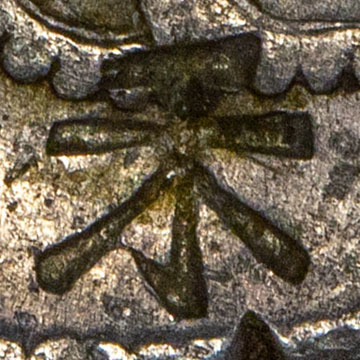 禾 - hé - grain, cereal
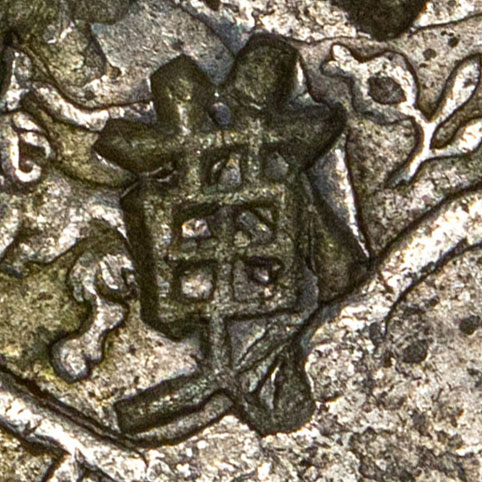 䒶 - (variant of 天) tiān - heaven, sky, day
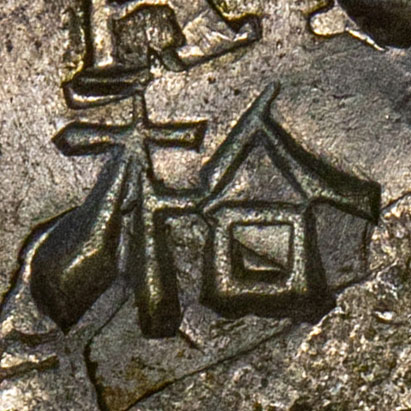 秴 - huó - grain
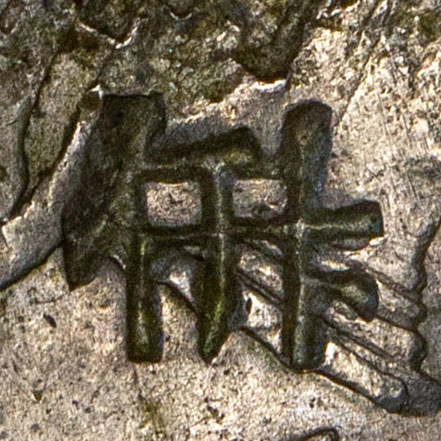 Possibly 俄 - é - suddenly, Russia
Provenance:
From Ben Dalgleish, a collector who finds chopmarked coins in the coin markets of Hong Kong, September 2021
1791-So DA Chile 2 Reales Carlos IIII legend, bust of Carlos III portrait type
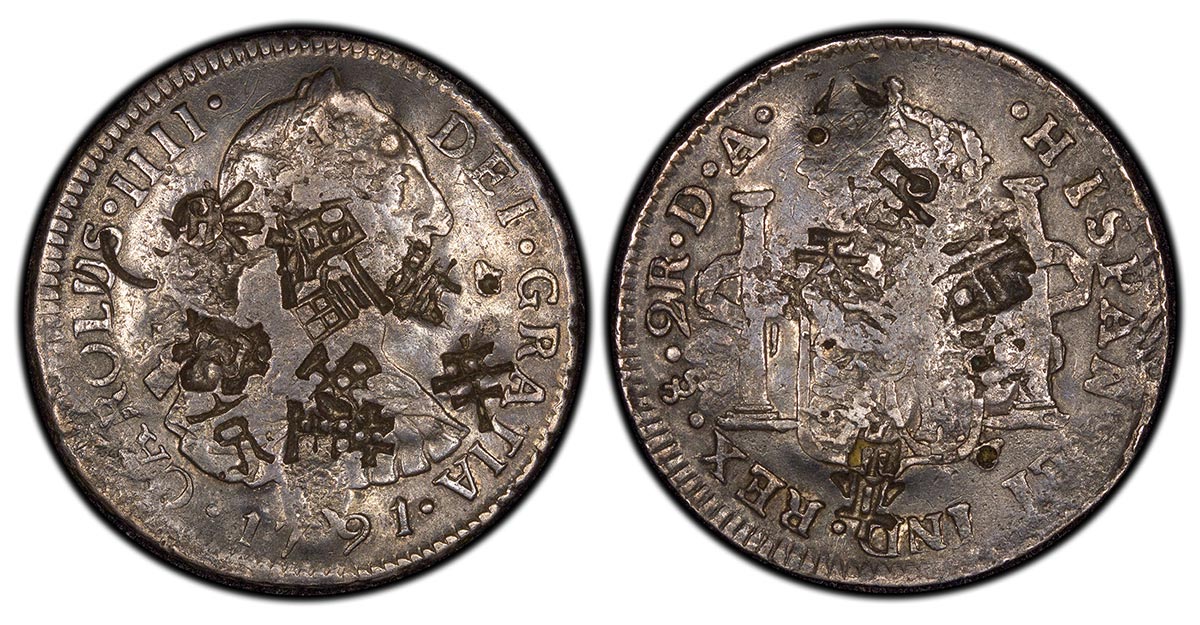
Specifications:
6.767 g, .8960 fine, .1949 troy oz (actual silver weight)
Recorded mintage: 54,000 (includes Carlos IV legend KM 37)
Catalog reference: KM 59
Details:
Struck in 1791 at Santiago, this Chilean 2 Reales belongs to a period when the Chile mint operated on a far smaller scale than the major silver-producing centers of Upper Peru,
as evidenced by the tiny 54,000 mintage of this example. Established in the mid-eighteenth century to reduce dependence on coin shipments from Lima and to provide a stable
supply of currency for local use, the Santiago mint converted limited regional silver production and imported bullion into circulating coinage intended primarily for everyday
exchange. Smaller denominations such as the 2 Reales were essential in local markets, mining districts, and coastal trade, where reliable fractional silver had long been in short
supply and where the needs of circulation differed from the large export-oriented output of mints such as Potosí. Coins of this type still might eventually enter Pacific trade
through consolidation with larger payments moving north to Lima or Acapulco, where Spanish-American silver formed part of the bullion and coin shipments carried across the Pacific
by the Manila galleons
This issue reflects an unusual circumstance created by the change of monarch from Carlos III to Carlos IIII in 1788. Although the legend was updated to name the new king, the portrait used on early issues continued to depict the earlier bust of Carlos III. The delay resulted from the practical realities of colonial minting, as new portrait models and dies required approval in Spain and time to reach distant mints, and smaller operations such as Santiago were less likely to suspend production while awaiting replacements. The result was a temporary mismatch in which the name of the reigning monarch appeared alongside the portrait of his predecessor.
Notable chopmarks:
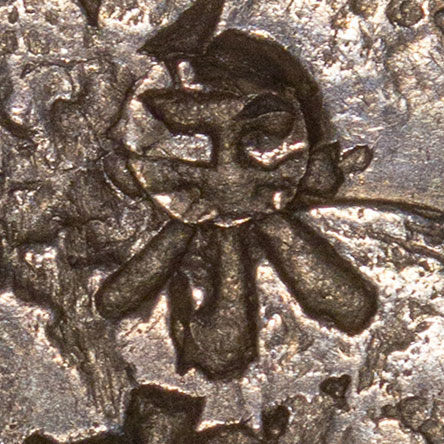 禾 - hé - grain, cereal
 克 - kè - overcome, gram, can
 辛 - xīn - bitter, painful
 峦 - luán - mountain range
 - Liushutong script variant of 八 - bā - eight
Provenance:
Purchased on eBay in September 2017 from a seller in Colorado, United States
1791 Netherland Ducaton "Silver Rider" Zeeland Province
Specifications:
32.779 g, .941 fine silver, .991 troy oz (actual silver weight)
Recorded mintage: 124,000
Catalog reference: KM 92
Details:
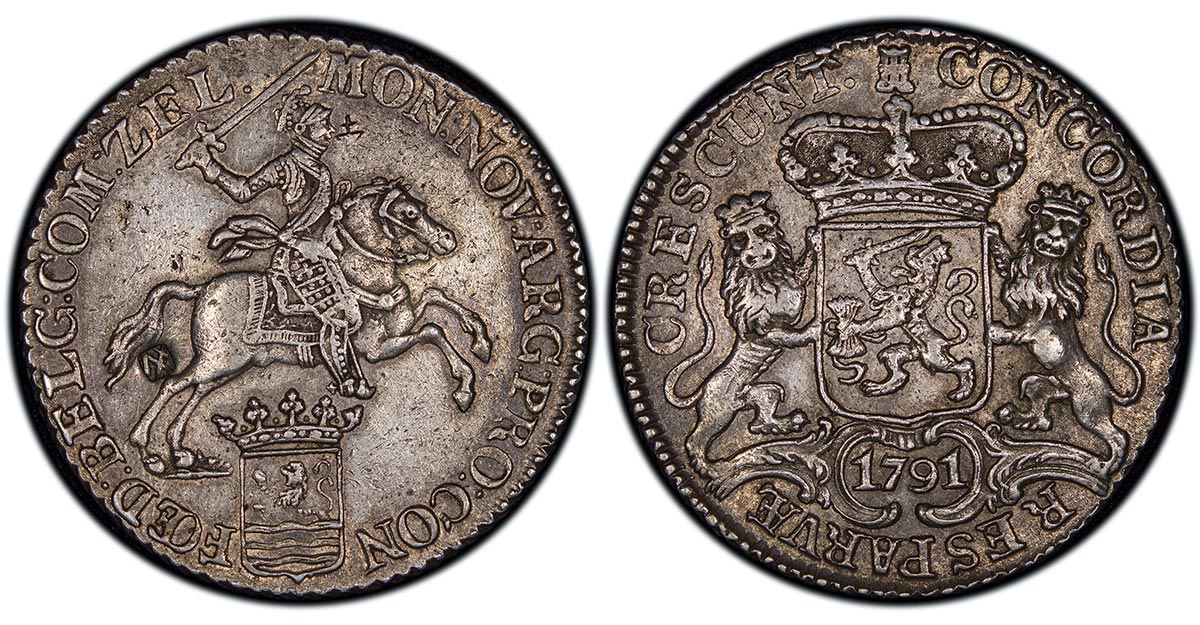
1791 Netherlands Ducaton “Silver Rider,” Zeeland Province mint, 32.78g, .941 fine silver, with a recorded mintage of 124,000 pieces, containing approx. 126% fine silver of the
standard Spanish 8 Reales. The type was struck by several provinces of the Dutch Republic from the mid-seventeenth century through the late eighteenth century. The obverse depicts
an armored knight riding right, holding a raised sword and a bundle of arrows, symbolizing defense and provincial unity, with the legend “MON : NOV : ARG : PRO : CON FOED : BELG :
COM : ZEL .” (New silver coin of the Province of Zeeland of the United Provinces of the Netherlands). The reverse displays the crowned arms of Zeeland in an ornate cartouche: a
central shield flanked by two rampant lions as supporters, with the motto “CONCORDIA RES PARVAE CRESCUNT” (With harmony small things grow).
By the late eighteenth century, the Dutch Republic was experiencing economic and political strain following the Fourth Anglo-Dutch War (1780–1784), yet Dutch silver coinage continued to be produced for both domestic circulation and overseas commerce. The ducaton originated as a large trade denomination during the height of Dutch maritime expansion, when Amsterdam functioned as a major clearing point for bullion arriving from Spanish American mines through European trade networks. Provincial issues such as Zeeland’s reflected the decentralized monetary structure of the Republic, in which individual provinces retained minting authority while maintaining broadly consistent weight standards.
This type is encountered with chopmarks but is far less common than Spanish-American dollars or later trade coinages. Examples that reached China likely traveled through Dutch East India Company shipping routes into Batavia and onward into South China trade ports, where heavier European silver coins were occasionally accepted alongside more familiar dollar-sized pieces. Chopmarked examples are considered relatively scarce.
Notable chopmarks:
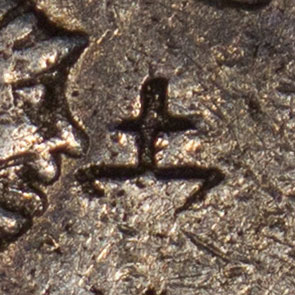 支 - zhī - branch, support, pay
(partial chopmark, bottom portion missing)
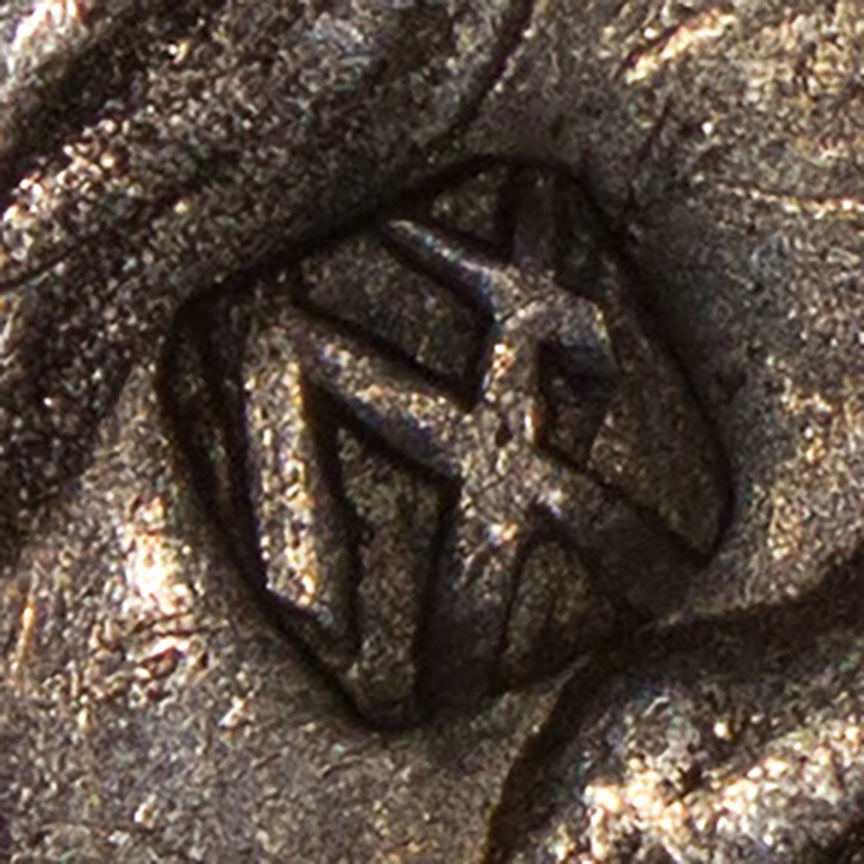 Unknown symbol chopmark
Provenance:
Purchased from the November 2016 MPO Auctions (Netherlands) via Heritage Auctions Europe Sale 52 Lot #1555
Auction Description:
Zilveren Rijder 1791 (Delm. 1028 / CNM 2.49.58) met op VZ 2x Chinese chopmark - ZF
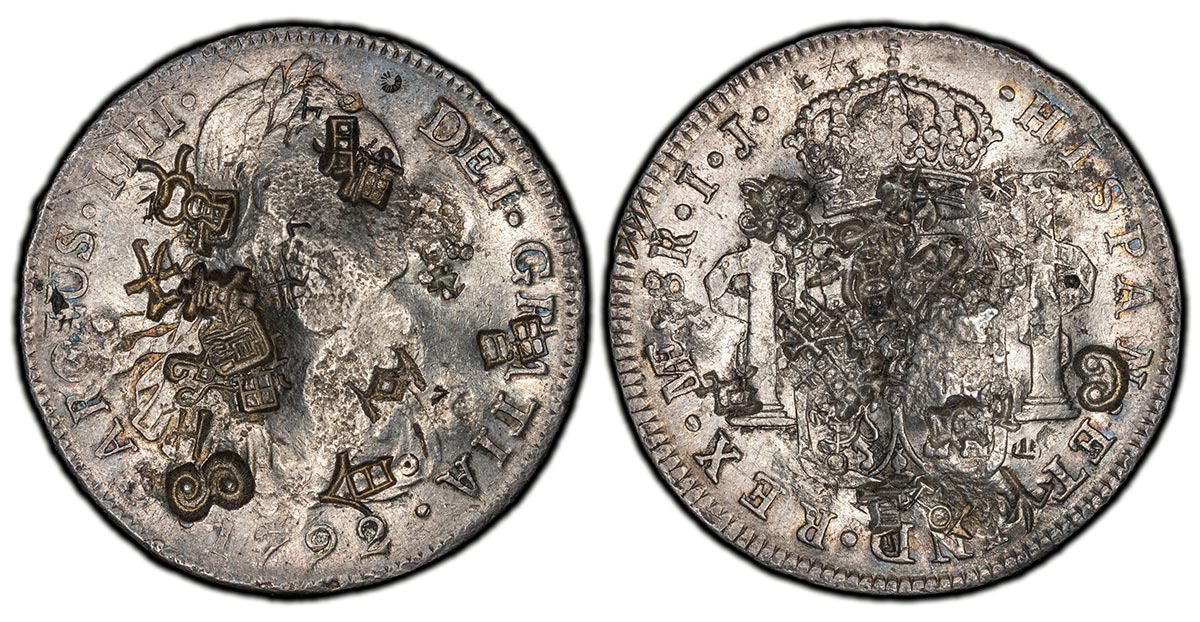
1792-LM IJ Peru 8 Reales Carlos IIII portrait type
Specifications:
27.07 g, .896 fine, .780 troy oz (actual silver weight)
Recorded mintage: 4,661,000
Catalog reference: KM 97
Details:
By the final decades of the eighteenth century, silver production supplying the Lima Mint had begun to decline from the exceptionally high levels seen earlier in the colonial period.
During the seventeenth century and early eighteenth century, large volumes of bullion from Upper Peru, especially the mines of Potosí, had supported sustained and heavy coinage output
at Lima, which functioned as one of the principal mints serving the Pacific side of the Spanish Empire. By the 1780s and 1790s, however, ore quality in several major mining districts
had diminished and production costs had increased, resulting in more irregular bullion deliveries to the mint. Coinage continued at substantial levels, but annual outputs were generally
lower and less consistent than in earlier generations, reflecting broader shifts in Andean mining productivity and the growing administrative pressures facing late Bourbon colonial
institutions in the years preceding the Spanish American wars of independence (1808–1826).
This coin displays many large chopmarks, with a small number of lighter marks sprinkled in. It illustrates the transitional period in chopmarking during the late eighteenth and early nineteenth centuries, when smaller, lightly applied marks became less common and were gradually replaced by larger, more deeply punched chops.
Notable chopmarks:
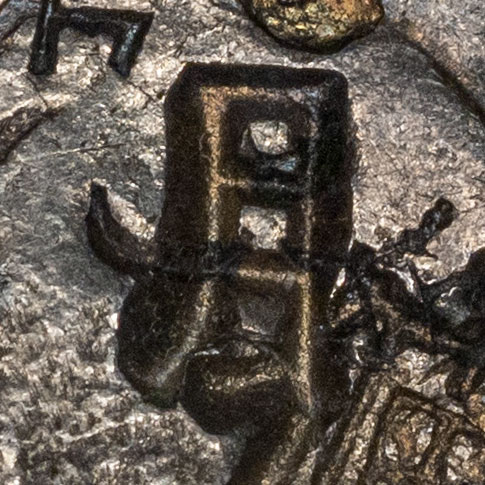 月 - yuè - moon, month
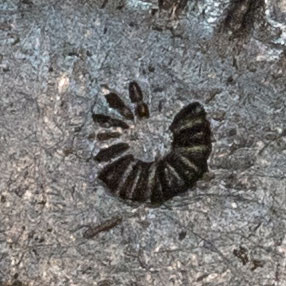 Chrysanthemum (菊花)A radiating chrysanthemum or sunburst. The chrysanthemum (菊花, júhuā), one of the Four Noble Plants, is an emblem of longevity and noble endurance (菊 jú echoes 久 jiǔ, 'long-enduring'); read as a sunburst it carries connotations of brightness and vitality. Sunburst marks are among the more common abstract chopmarks.
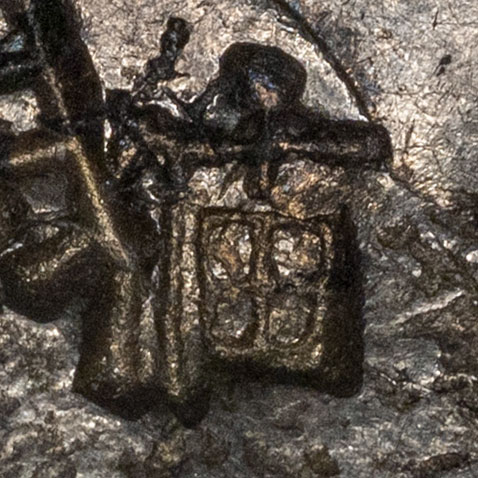 庙 - miào - temple, shrine
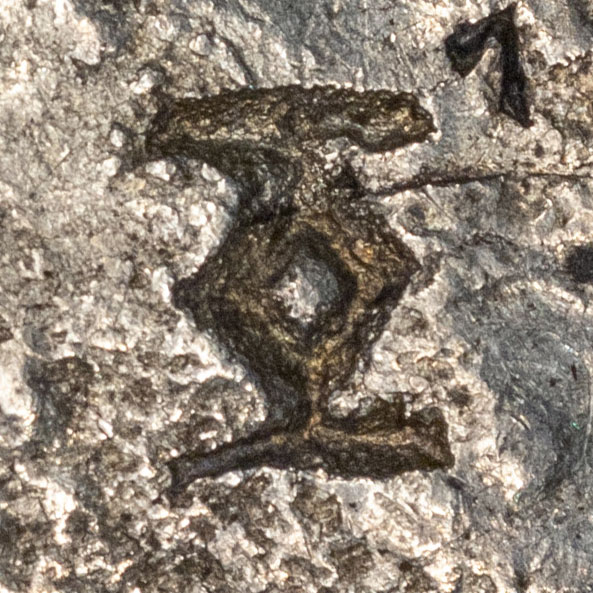
 - Liushutong script variant of 亚 - yà - Asia, second
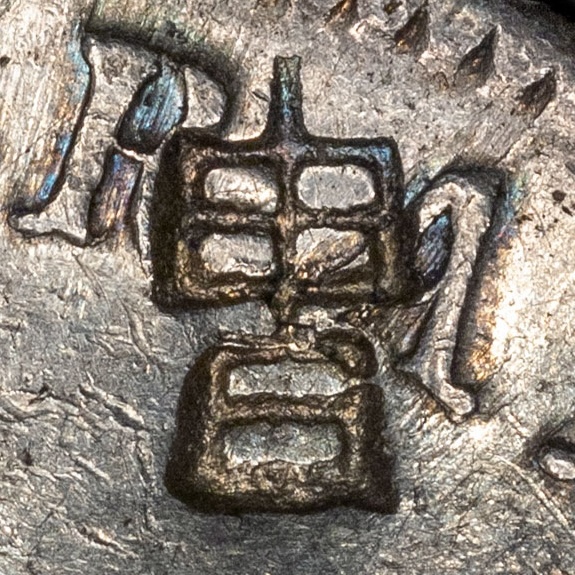 Similar to 曺 - (a variant form of 曹) cáo - plaintiff and defendant (obsolete), central government (obsolete), official (obsolete)
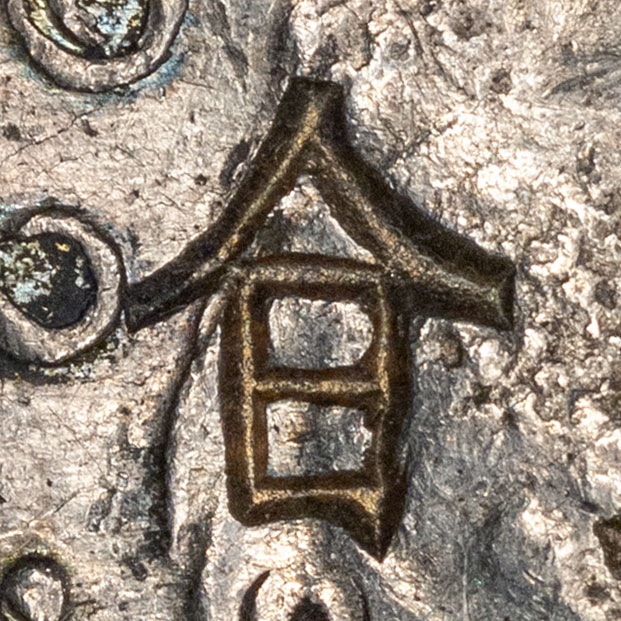 Possibly 仑 - lún - logical order
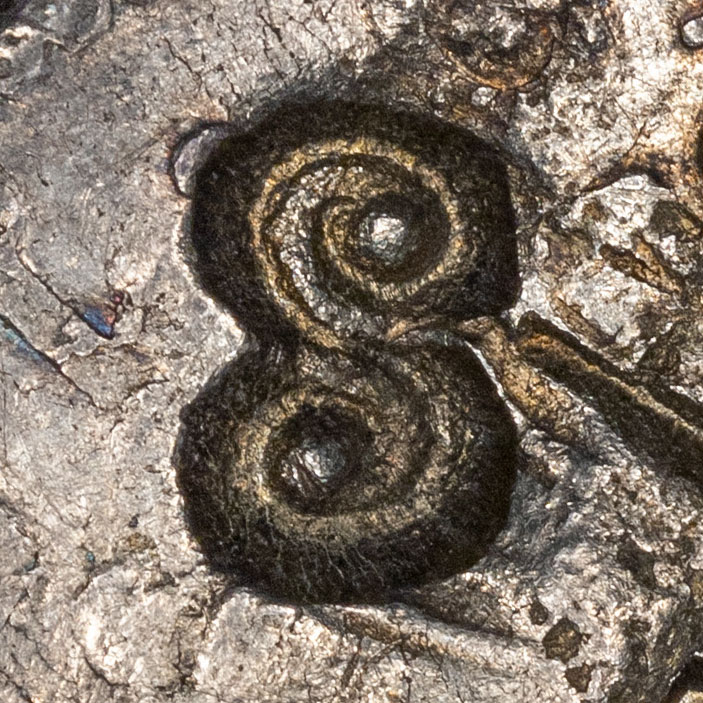 Variant of
  - Liushutong script variant of 申 - shēn - extend, 9th earthly branch
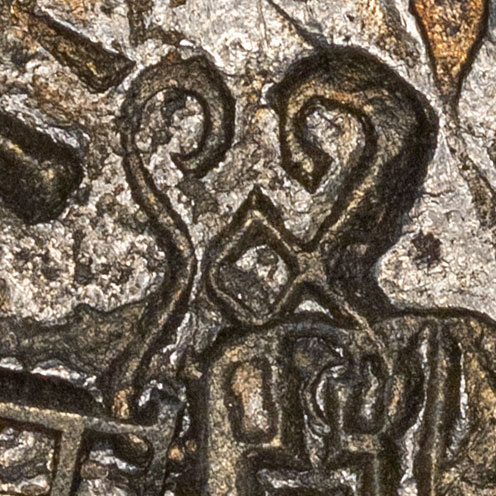 Symbol chopmark
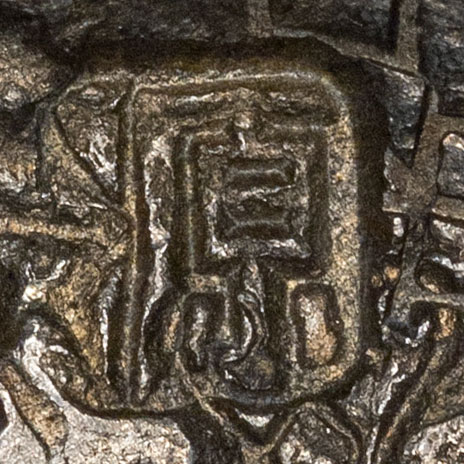 Probably 東 - (traditional form of 东) dōng - east
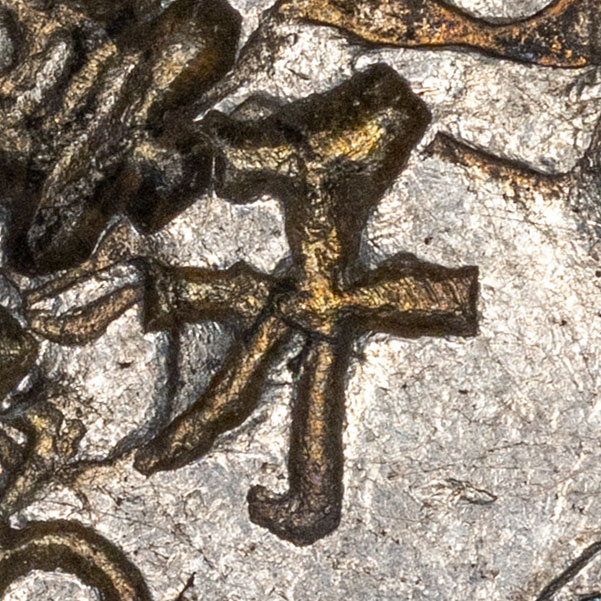 Abbreviated 禾 - hé - grain, cereal
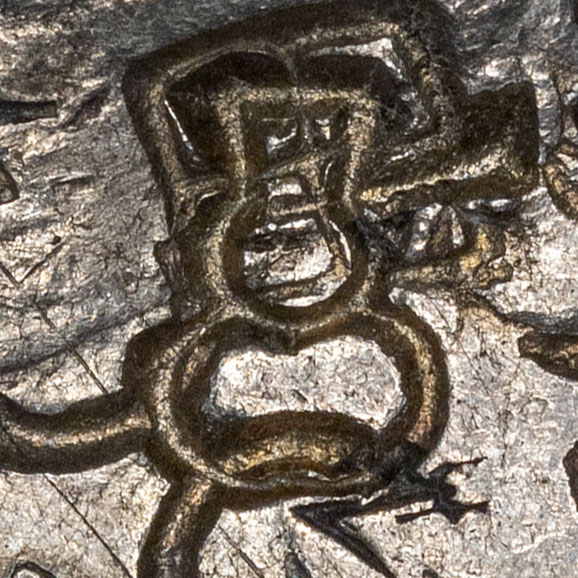 Bottle gourd (葫蘆)The gourd (葫蘆, húlu) is one of the most auspicious Chinese motifs: húlu echoes 福祿 (fúlù, 'blessings and prosperity'), and its many seeds wish for abundant descendants. It is a Daoist emblem of healing and immortality, the vessel of the immortal Li Tieguai (李鐵拐) and one of the hidden Eight Immortals' attributes (暗八仙), and is hung to ward off illness and evil.
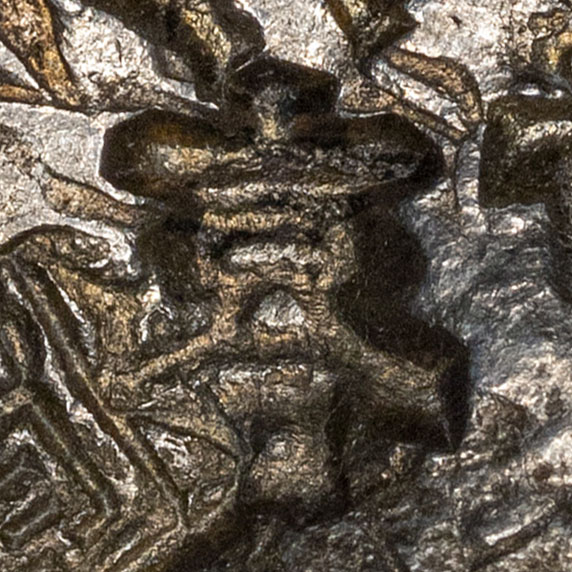 Similar to 束 - shù - bundle, bind, restrain
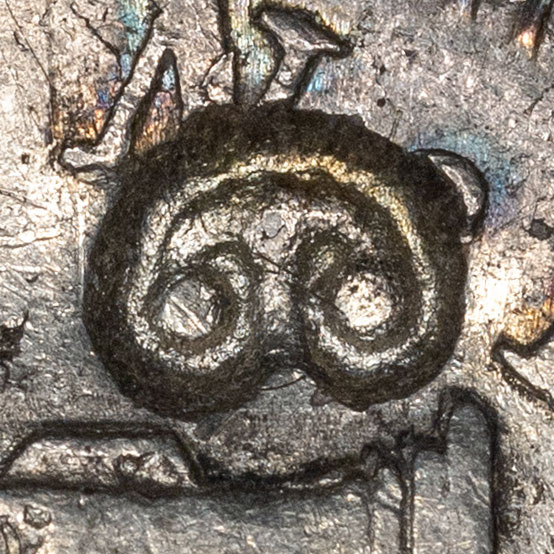 Symbol chopmark
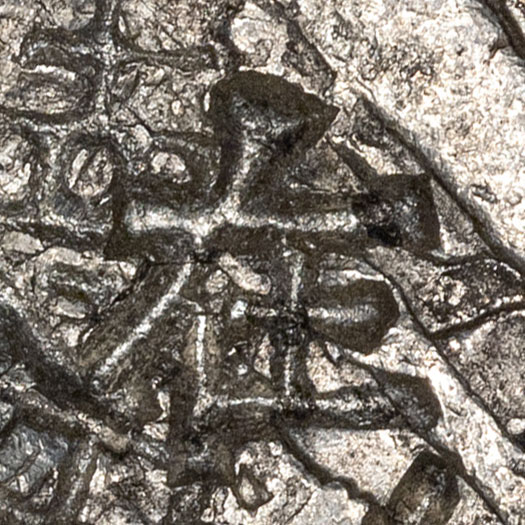 在 - zài - at, in, exist
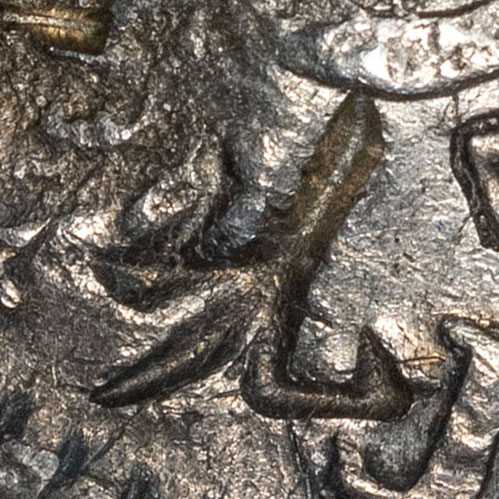 乆 - (variant of 久) jiǔ - long time, old story, a surname
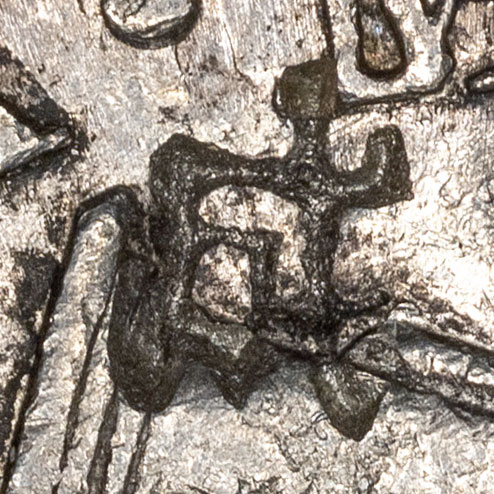 成 - chéng - accomplish, become, complete
Provenance:
From the Spink January 2024 Hong Kong Auction -
Lot #3088
Auction Description:
Mexico and Portugal, a group of 2x, including, 1792 silver 8 reales and 1898 silver 1000 reis (400th Anniversary of the Discovery of India commemorative issue), (KM-109), (KM-539),
8 reales Good, chopmarked and bent; 1000 reis About Extremely Fine (2)
1792-S CN Spain 8 Reales Carlos IIII portrait type
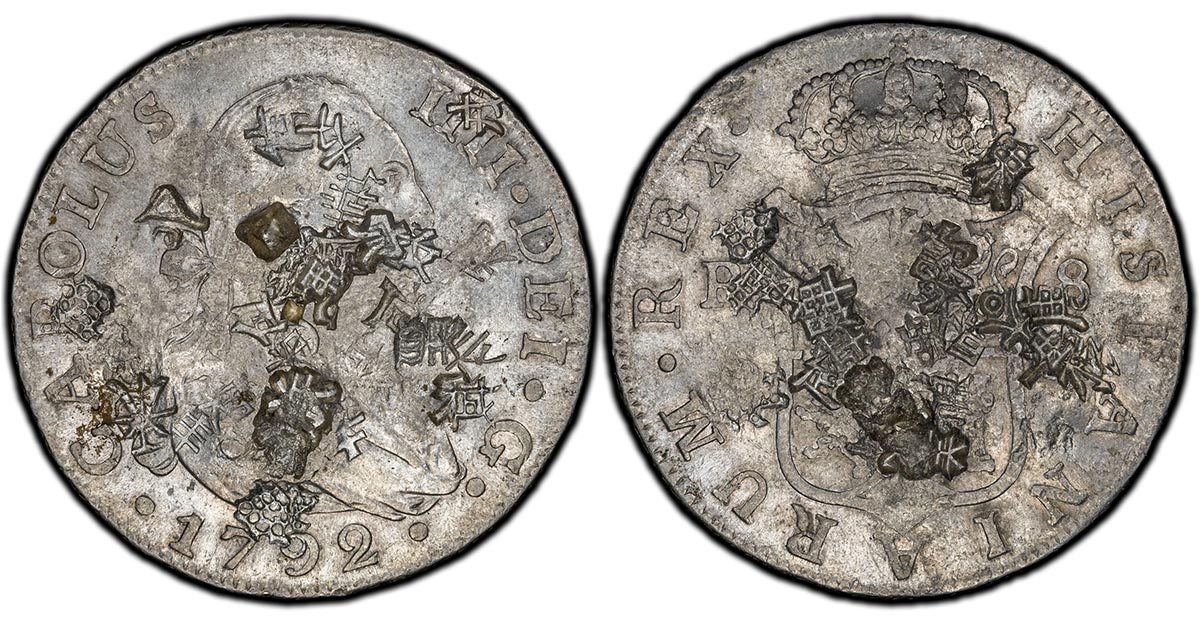
Specifications:
27.07 g, .903 fine, .7859 troy oz (actual silver weight)
Recorded mintage: unknown
Catalog reference: KM 432.2, Calbeto #769
Details:
The 1792 Spain 8 Reales, Seville mint, contains 27.064g, .903 fine, with an assayer mark CN. The obverse features a laureate portrait of Charles IV facing right, surrounded by
the legend "CAROLUS IIII DEI GRATIA" (Charles IV, by the grace of God), with the date 1792 below the bust. The reverse displays a freestanding rendition of the arms of Castile
and León contained within an armorial shield, a design unique to mainland Spanish issues that replaced the famed pillars and globes featured on colonial Spanish 8 Reales of the
same period. The portrait type was introduced across the Spanish Empire in 1772 under Charles III, continuing a design standardization that would persist through multiple monarchs.
The reverse legend reads "HISPAN ET IND REX" (King of Spain and the Indies), with the mintmark 'S' for Seville and the assayer's initials 'CN' flanking the shield. Unlike the
colonial mints, mainland Spanish issues required no transitional types at the ascension of Charles IV in 1788, as dies could be implemented immediately.
Charles IV's reign (1788-1808) witnessed the formal closing of the Casa de Contratación in 1790, bringing mainland oversight of colonial trade to a conclusion after more than two centuries of operations. The portrait 8 Reales had been introduced in 1772 under the Bourbon Reforms of Charles III, part of a broader effort to standardize coinage across the Spanish Empire. The new portrait type also saw fineness reduced from .9167 (used for pillar 8 Reales since 1732) to .903 through secret decree, a reduction that remained in effect through Charles IV's reign. By the 1790s, Spanish silver production remained dominated by Mexican mints, which were responsible for approximately 80% of global silver output during the 18th century, while mainland Spanish mints produced primarily for domestic European consumption. Seville, once the sole legal port for American trade until 1680, had long since ceded that role to Cádiz as the Guadalquivir River silted up. The limited export of mainland Spanish coinage to Southeast Asia contrasted sharply with the flood of colonial Mexican and Peruvian issues that dominated Chinese commerce.
This type is rare with chopmarks. While colonial Spanish portrait 8 Reales became the most widely used trade coin in Chinese history, referred to as "Buddha head silver," mainland Spanish issues seldom reached China in significant numbers. The few examples that did likely arrived through direct trade channels available to Spain under the Canton System (1757-1842), during which Spain maintained access to both Canton and Portuguese Macau, as well as exclusive access to Amoy. The Charles IV 8 Reales of Spain is notably scarcer with chopmarks than contemporary portrait issues from Mexico, Peru, or Bolivia, though minor denominations of the same design are relatively more common than the crown-sized pieces.
Notable chopmarks:
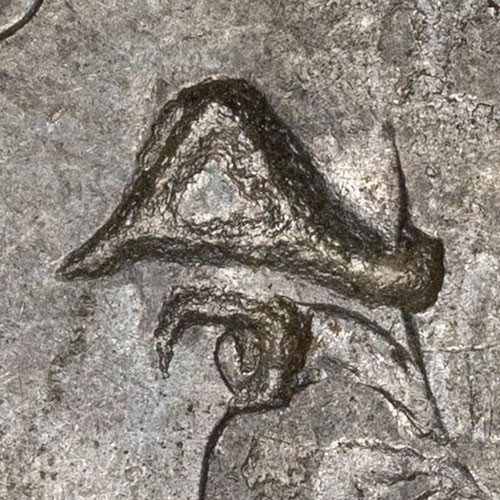 合 - hé - combine, join, close, suit
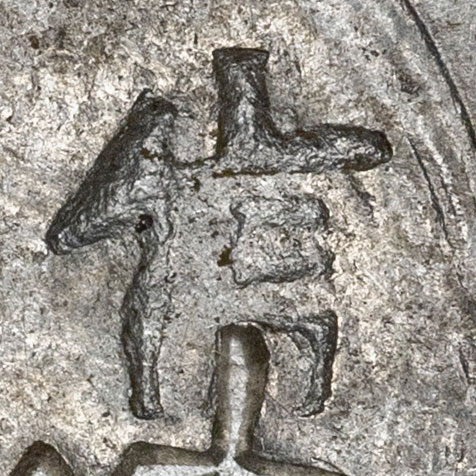 信 - xìn - trust, letter, believe
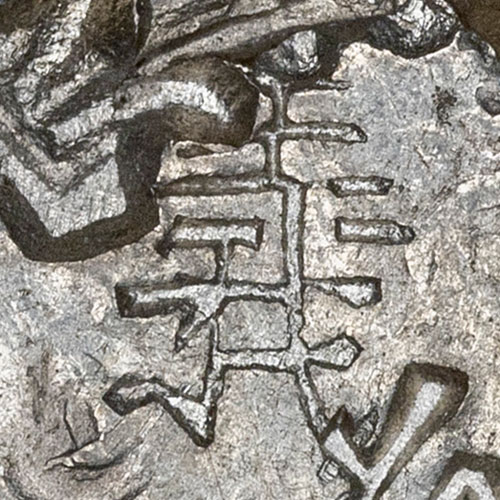 Likely 義 - yì - righteousness, justice
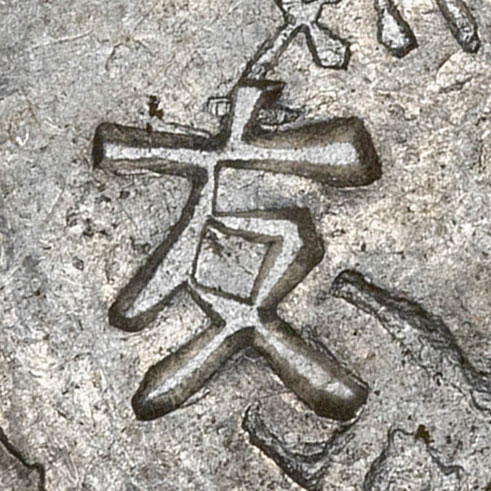 友 - yǒu - friend, friendliness
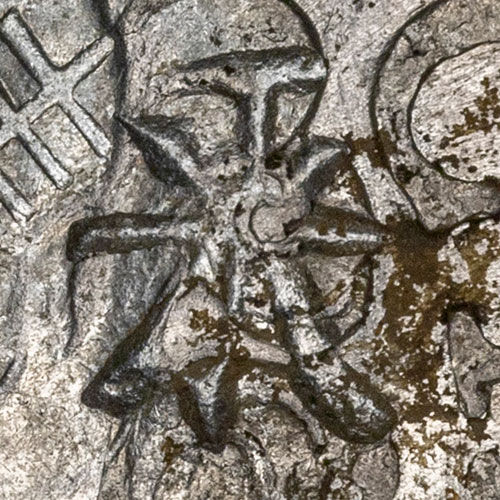 釆 - biàn - distinguish
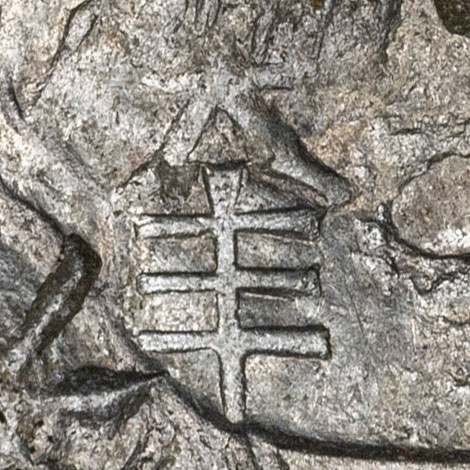 大丰 - dà fēng - great abundance (a common auspicious merchant or shop name) - 大 (dà, 'great') with 丰 (fēng, 'abundant, lush'; also the simplified form of 豐), so the mark reads as 'great abundance', a stock auspicious business name of the kind merchants chose for good fortune. As a chopmark it most likely identifies the silver shop or merchant house that tested the coin and accepted it as genuine silver.
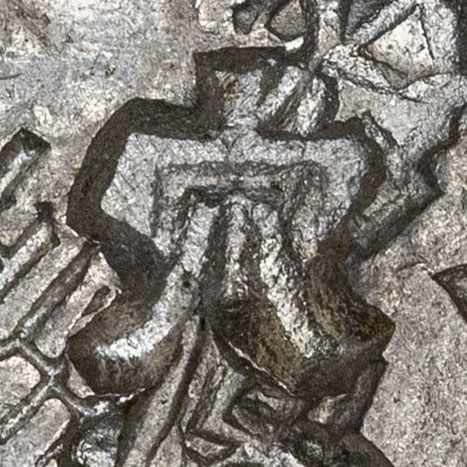 穴 - xué - cave, hole
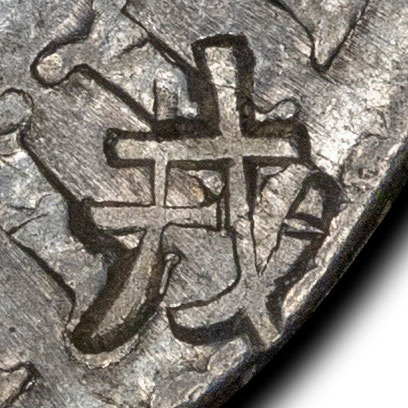 This is a really strange looking chopmark, no clue what it means
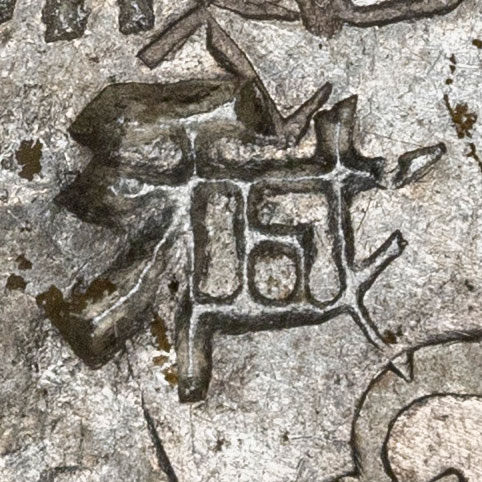 稢 - (variant of 稶) yù - plentiful appearance of proso millet (a grass species used as a crop)
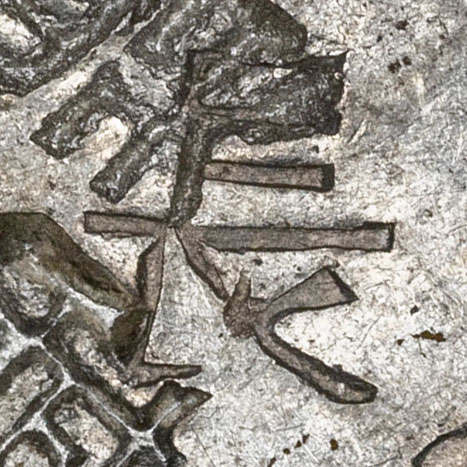 長 - cháng - long, length
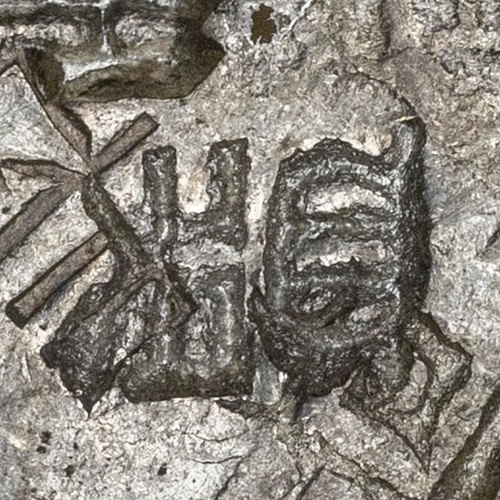 Unknown chopmark
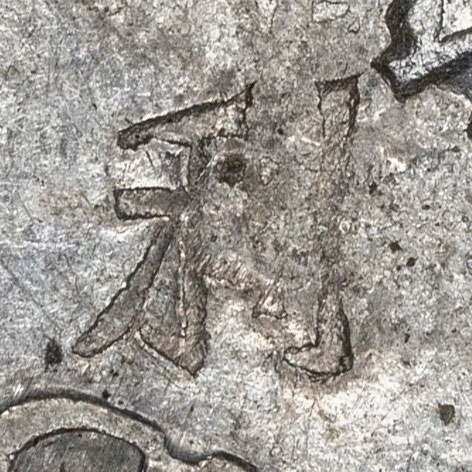 利 - lì - profit, benefit, advantage
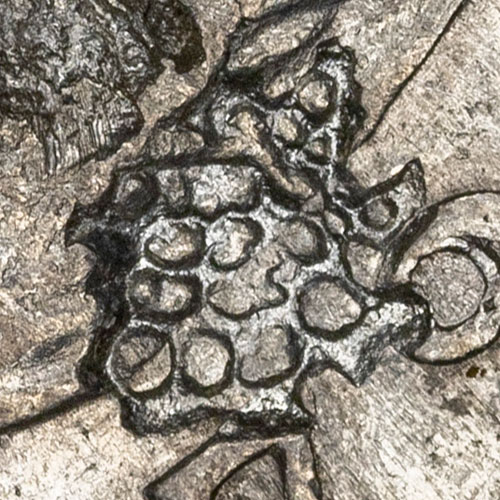 This chopmark tool appears to be broken or rusted
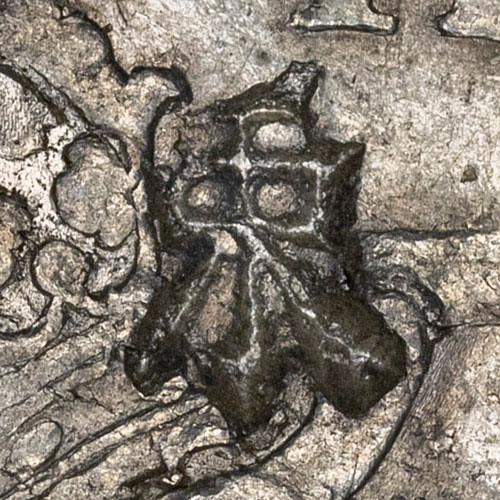 束 - shù - bundle, bind, restrain
Provenance:
From the Heritage April 7-8 2024 Spring Hong Kong World Coins Showcase Auction #61369 -
Lot #21816
Auction Description:
Charles IV 8 Reales 1792 S-CN Fine Details (Chopmarked) NGC, Seville mint, KM432.2, Cal-769. Featuring a variety of chopmarks on both faces, a true testament to the history that
this piece has seen.
1793-M MF Spain 4 Reales Carlos IIII type
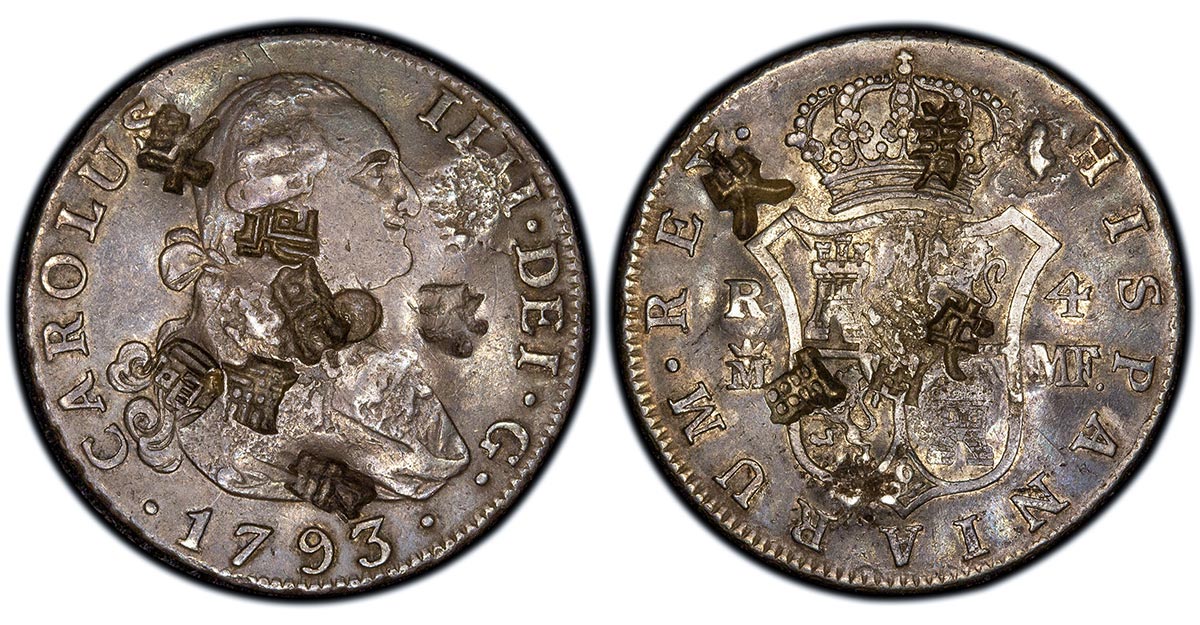
Specifications:
13.54 g, .896 fine silver, .390 troy oz (actual silver weight)
Recorded mintage: unknown
Catalog reference: KM 431.1
Details:
Mainland Spanish Portrait Four Reales present a numismatic anomaly: unlike virtually every other series where minor denominations are scarcer with chopmarks than their crown
equivalents, chopmarked Four Reales of Spain substantially outstrip their Eight Reales counterparts in surviving examples, a phenomenon unique or nearly so among similar designs.
The reason for this remains unknown, though the prevalence may relate to the reduced intrinsic value making the denomination less attractive for melting while still containing
sufficient silver to warrant testing by Chinese shroffs. Madrid, which shared exclusive minting rights for gold and silver with Seville from 1730 onward, produced coinage primarily
for domestic European consumption, making any chopmarked examples relatively scarce compared to the flood of colonial Mexican and Peruvian issues that dominated the China trade.
Notable chopmarks:
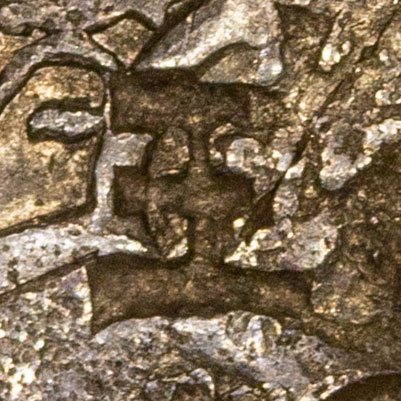 王 - wáng - king, ruler
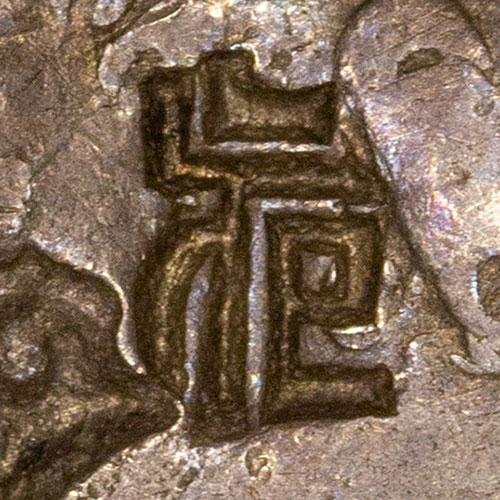 Possibly 疕 - bǐ - head sore
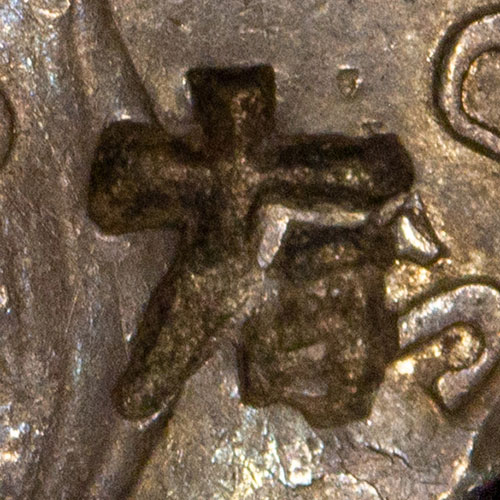 Similar to 有 - yǒu - have, exist
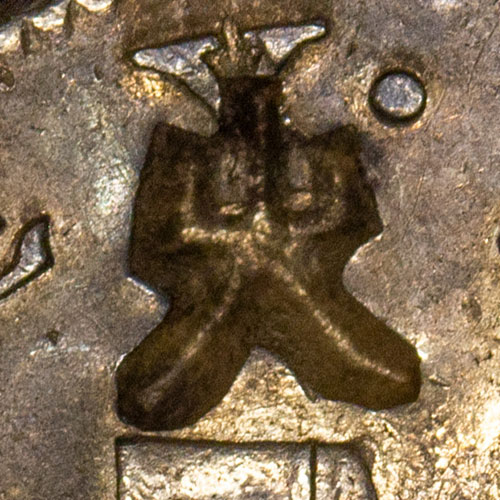 㞤 - yín - to help, aid, assist, ancient form of 岑 (a relatively high, pointed hill), silent, still, quiet
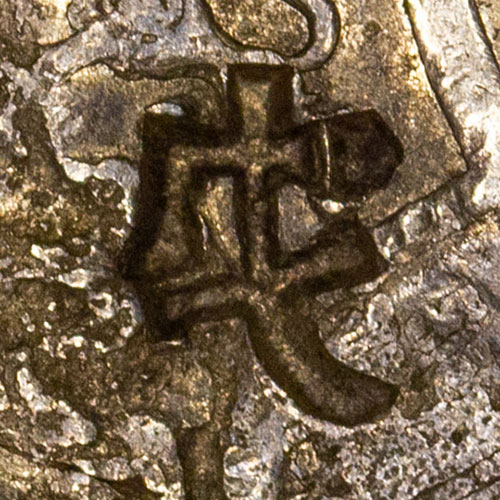 戊 - wù - 5th heavenly stem
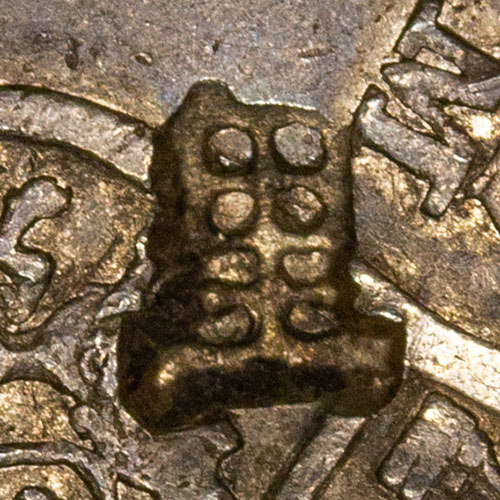 里 - lǐ - inside, village, li
Provenance:
Purchased on eBay in April 2016 from a seller in Great Britain.
1794 Netherland 3 Gulden (60 Stuiver), West Friesland Province
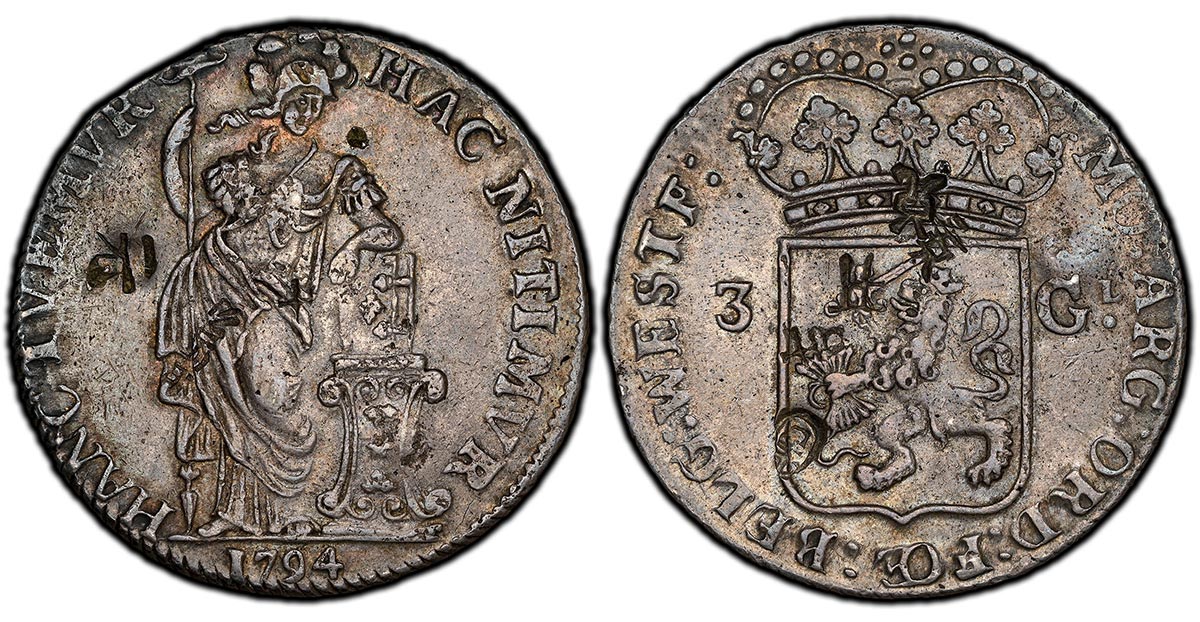
Specifications:
31.82 g, .920 fine silver, .9412 troy oz (actual silver weight)
Recorded mintage: 5,554,000 for 1791-94
Catalog reference: KM 141.2
Details:
The 1794 West Friesland 3 gulden (60 stuivers), KM-141.2, was struck during the final years of the Dutch Republic, at a moment when political ideology was increasingly reflected in coin
design. The obverse features the standing Dutch Maiden (Nederlandse Maagd) holding a liberty pole and cap, a republican symbol that replaced the earlier Silver Rider motif as part of a
broader late-18th-century shift away from martial imagery toward civic and constitutional ideals. This transition was driven by internal political pressures within the Republic, particularly
the growing influence of reformist and Patriot movements, rather than by any change in denomination or silver standard. The reverse bears a crowned shield with the arms of West Friesland,
identifying the provincial authority in the decentralized Dutch minting system.
Valued at 60 stuivers, the 3 gulden fit squarely within the traditional Dutch accounting system, in which the stuiver served as the basic unit of reckoning across provinces. One gulden equaled 20 stuivers, making the 3 gulden a straightforward expression of an established value. In practice, the 60-stuiver standard corresponded to the long-used ducaton, and both circulated as crown-sized silver units. The shift from the Silver Rider to the standing Maiden reflected political and symbolic change, not a redefinition of value or silver content.
Notable chopmarks:
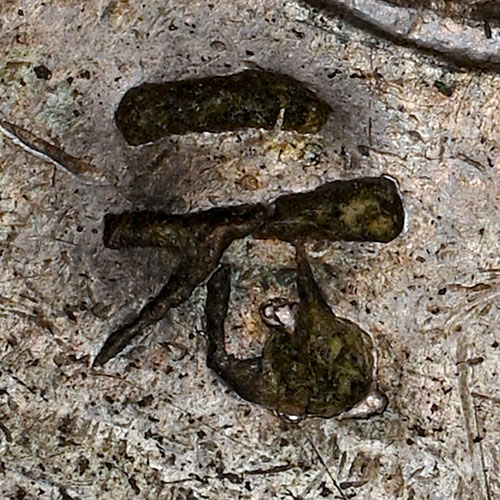 元 - yuán - dollar, unit of currency, basic, primary
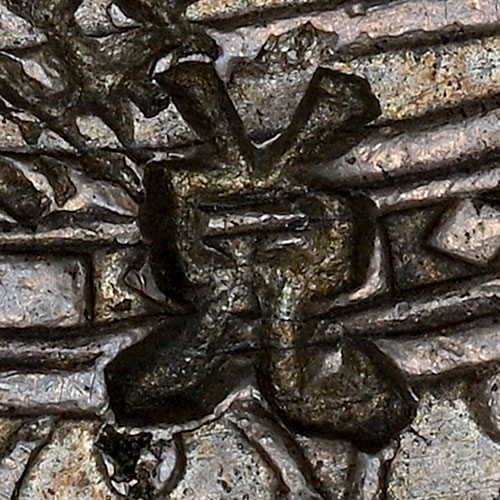 兑 - duì - exchange, convert
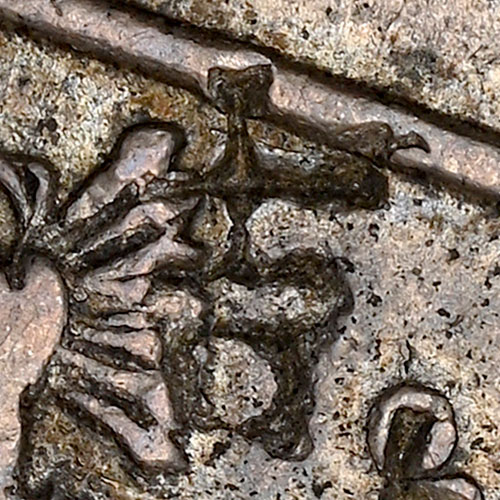 吉 - jí - auspicious, lucky
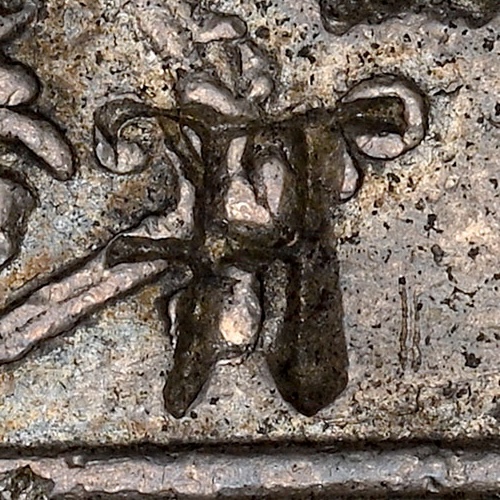 开 - kāi - open, start
Provenance:
Purchased on eBay in September 2023 from a seller in New Westminster, Canada.
The seller is a dealer who purchased the coin out of an estate sale collection long ago in the United States.
1796 Netherlands East Indies 1 Rupee (Ex. Bowman / Murphy)
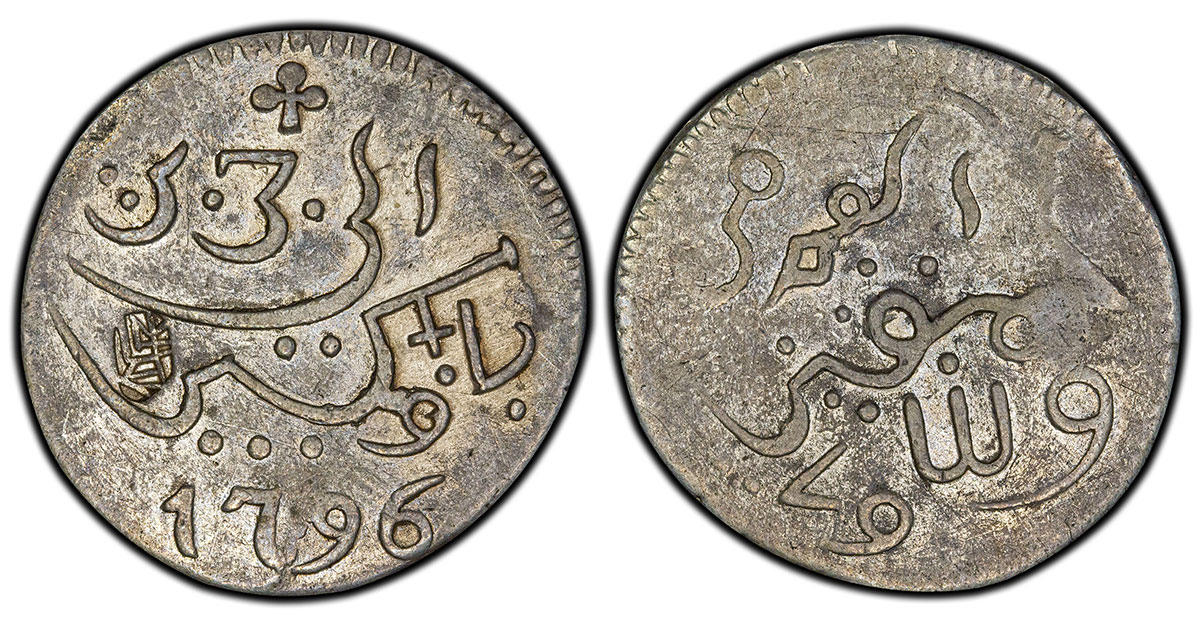
Specifications:
13.150 g, .7920 fine silver, .3348 troy oz (actual silver weight)
Recorded mintage: unknown
Catalog reference: KM 175.2
Details:
placeholder
Notable chopmarks:
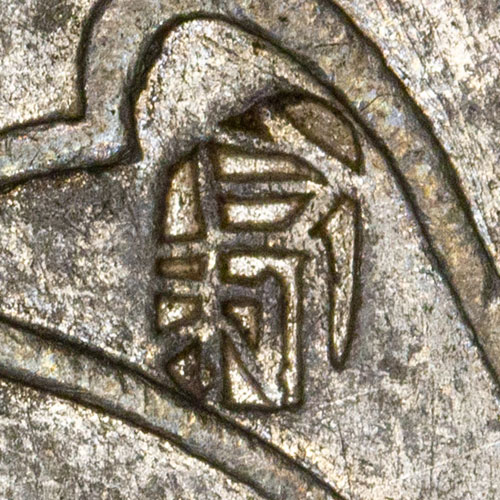 氣 - qì - gas, air, breath, weather
Provenance:
Purchased from the Stack's Bowers April 2026 Hong Kong Showcase Auction
Lot #49765
Auction Description:
NETHERLANDS EAST INDIES. Java (under Kingdom of the Netherlands). Rupee, 1796. PCGS Genuine--Chopmark, EF Details.
KM-175.2; Murphy-Fig. 362 (Plate Coin); Leverage-Fig. 151 (Plate Coin). A single medium size in relief pseudo-Chinese chop on the obverse, "氣". Wholesome and original looking, this nicely preserved example displays light attractive gray tone with remaining luster in the protected areas. The chop is bold and clear, but difficult to attribute. An interesting piece with a pleasing appearance offering good eye appeal and much originality.
Provenance: From the Edgar Murphy Collection.
Ex: J.D. Bowman Collection.
1800-So AJ Chile 8 Reales
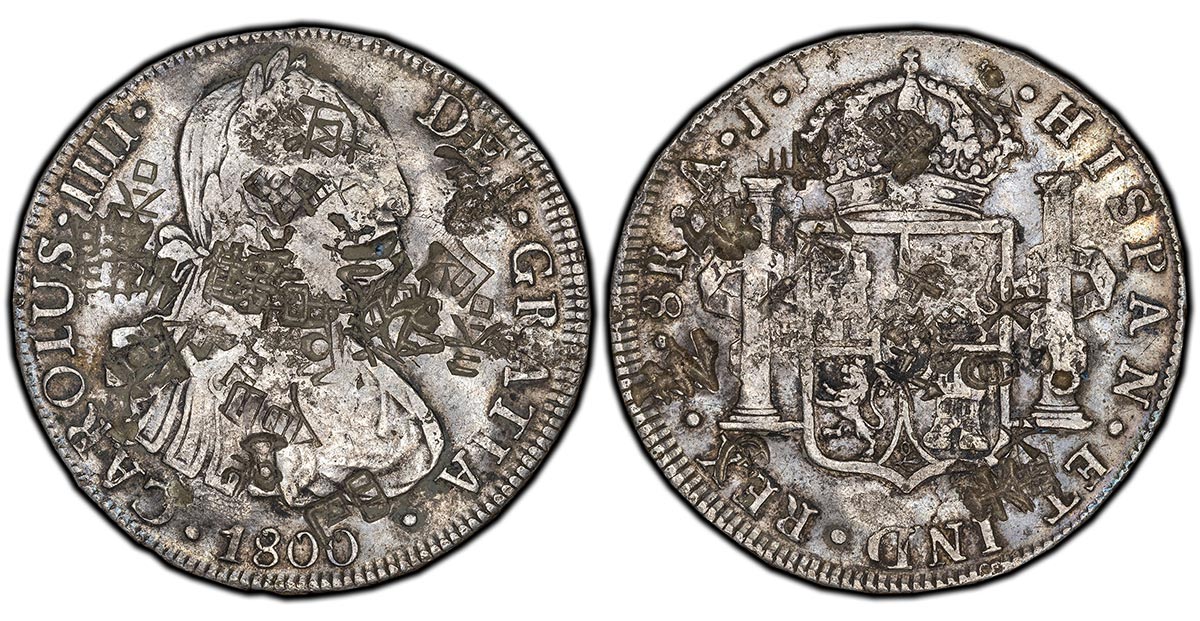
Specifications:
27.067 g, .8960 fine silver, .7797 troy oz (actual silver weight)
Recorded mintage: 184,000
Catalog reference: KM 51
Details:
The 1800 Chile 8 Reales, Santiago mint, contains 27.064g, .896 fine, with a recorded mintage of 184,000. The obverse features a laureate portrait of Charles IV
facing right with the legend "CAROLUS IIII DEI GRATIA" (Charles IV, by the grace of God) and date below. The reverse displays the crowned Spanish arms between pillars, with "HISPAN
ET IND REX" (King of Spain and the Indies), mintmark 'So', denomination '8R', and assayer initials 'AJ'. The .896 fineness reflects the 1785 reduction mandated across Spanish colonial
mints from the .903 standard.
Chile was a minor source of precious metal compared to Mexico City, Lima, and Potosí. Following the devastating 1598 Mapuche uprising, which resulted in the loss of major gold-producing regions, the colony shifted to agriculture. While Chile's port of Arica served as a shipping hub for Bolivian silver from Potosí bound for Lima beginning around 1545, virtually no Chilean-produced metal from this early period reached China. Mining gradually returned during the 18th century, with silver production rising from 1,000 kg to 5,000 kg annually between 1700 and 1800. An 1805 enlargement of the Santiago mint allowed increased production under Ferdinand VII.
Chilean Portrait 8 Reales are scarce with chopmarks, orders of magnitude rarer than issues from prolific Latin American mints. No direct Chile-China trade route existed; Chilean coins likely reached Southeast Asia through Lima along with Peruvian silver, or via American merchants trading along the Pacific coast during their triangular routes between the United States, the Pacific Northwest, and Canton. A study by W.F. Spalding (prior to 1920) documented Chilean 8 Reales of Charles III and Charles IV in a Chinese bank's possession alongside more common Mexican, Peruvian, and Bolivian issues, confirming their presence in Chinese commerce despite limited circulation.
Many obverse and reverse chopmarks, with a chopmark obscuring the So mintmark.
Notable chopmarks:
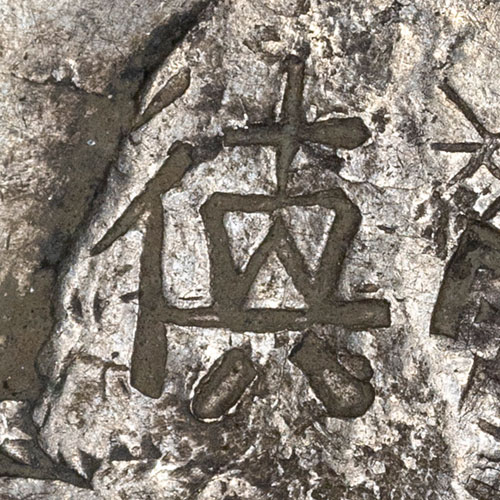 Unknown Chinese character chopmark
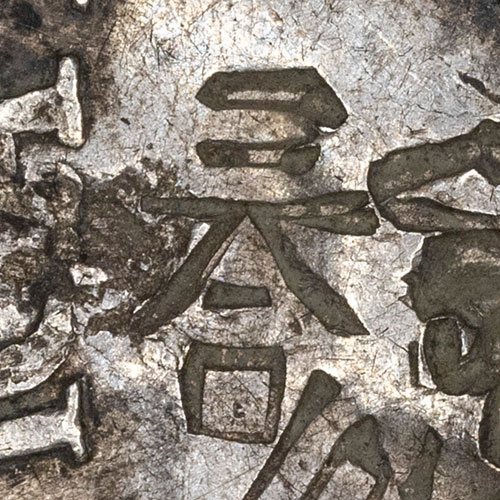 Similar to 吞 - tūn - swallow, absorb, to drink
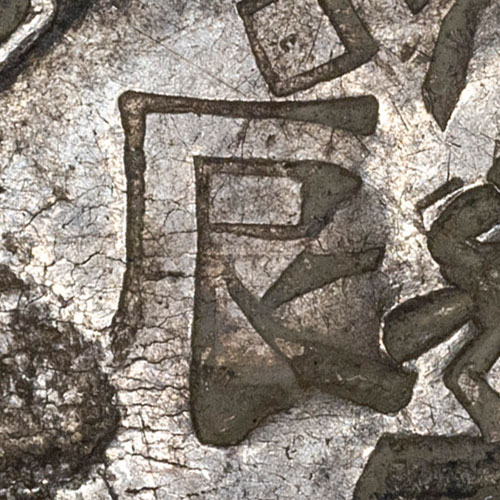 Unknown Chinese character chopmark
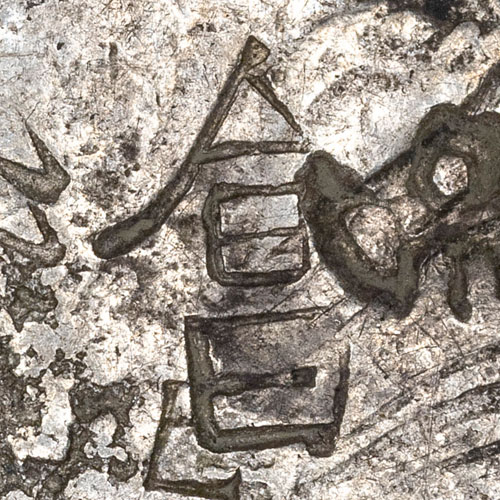 Unknown Chinese character chopmark
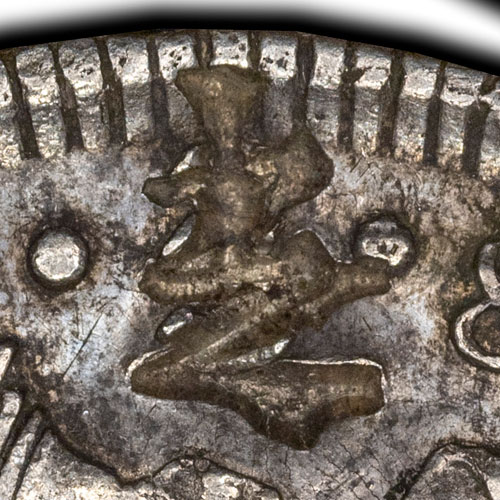 Possibly 㐊 - unknown chopmark - unknown meaning
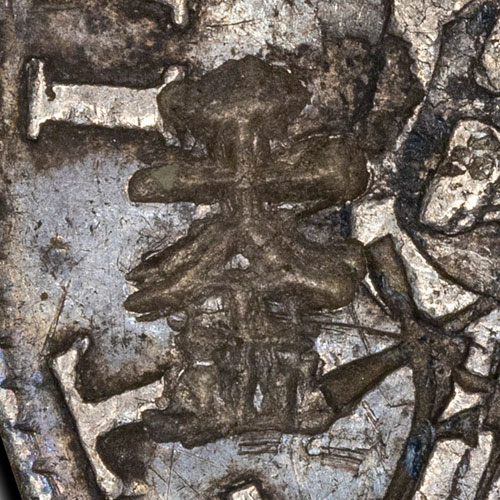 Similar to 岙 - ào - mountain col
Provenance:
From Ben Dalgleish, a collector who finds chopmarked coins in the coin markets of Hong Kong, June 2023
1800-NG M Guatemala 8 Reales
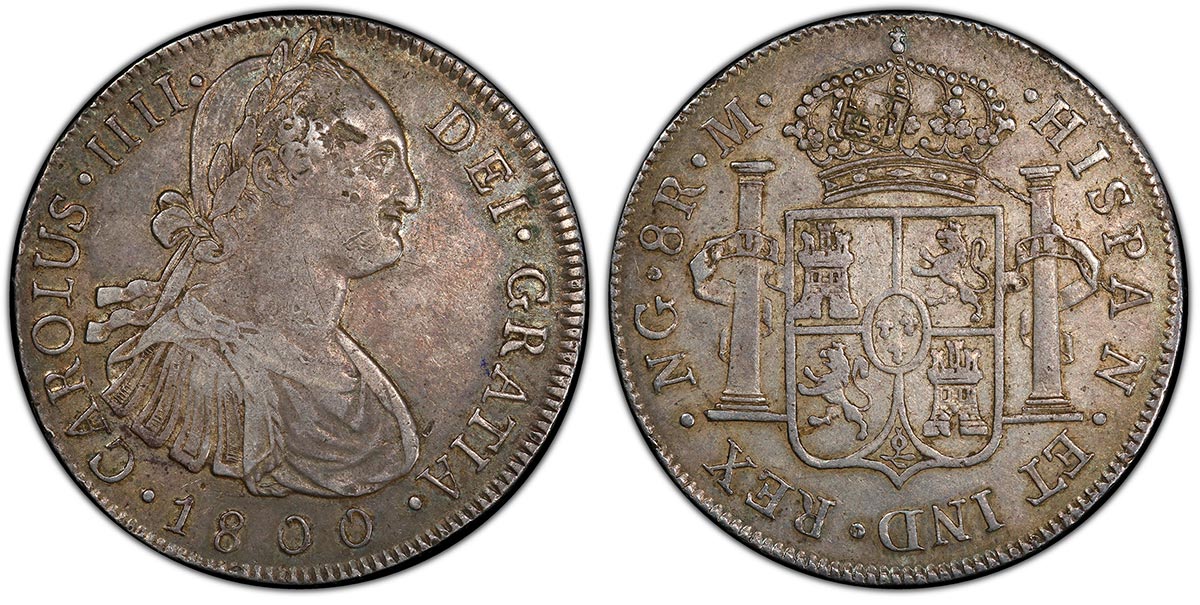
Specifications:
27.067 g, .8960 fine silver, .7797 troy oz (actual silver weight)
Recorded mintage: unknown
Catalog reference: KM 53
Details:
The 1800 Guatemala 8 Reales, Nueva Guatemala mint, contains 27.064g, .896 fine, with assayer mark M for Manuel Eusebio Sanchez (who served 1785 through the colonial period and into
the Federation era). The obverse features a laureate portrait of Charles IV facing right with the legend "CAROLUS IIII DEI GRATIA" (Charles IV, by the grace of God) and date below.
The reverse displays the crowned Spanish arms between the pillars of Hercules with "HISPAN ET IND REX" (King of Spain and the Indies), mintmark 'NG' for Nueva Guatemala, denomination
'8R', and assayer initial 'M'. The .896 fineness reflects the secret 1786 reduction from .903 mandated across colonial mints. The mint relocated from Santiago (destroyed by earthquakes
in 1773) to Guatemala City in 1776, with the mintmark changing from 'G' to 'NG' to reflect the new capital.
Guatemala was a relatively minor Spanish colonial silver producer lacking significant mineral wealth, with no mint established until Philip V's reign. The population of Santiago remained approximately 25,000 as late as 1770. While deficient in precious metals, Guatemala became valuable as a commercial hub given its geographic position near the center of Spanish New World holdings and its role as a supplementary trade route to the Manila Galleon exchange. Despite this advantageous position, the introduction of coinage overlapped with the final decades of the trans-Pacific galleon trade, which officially suspended in 1815 but had become practically extinct before the end of the 18th century.
Guatemala Portrait 8 Reales are semi-rare with chopmarks. A study by W.F. Spalding testing coin fineness in a Chinese bank (prior to 1920) notably excluded Guatemala 8 Reales while including those from Mexico, Peru, Bolivia, and even Chile. Despite Guatemala's supplementary role in the Manila Galleon network connecting Acapulco to the Philippines, few Guatemalan coins reached China compared to the flood of Mexican and Peruvian silver that dominated Chinese commerce. The type's rarity reflects both limited production and the decline of established Pacific trade routes during its period of issue.
One reverse chopmark, hidden neatly inside the details of the crown.
Notable chopmarks:
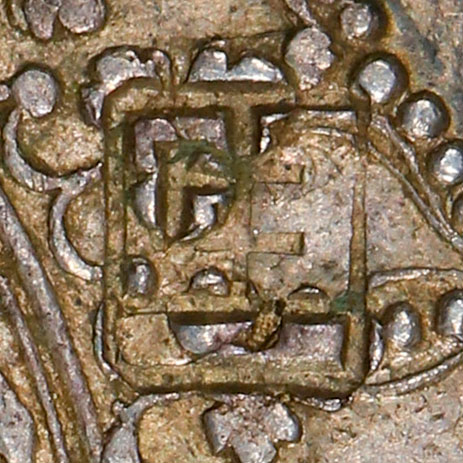 生 - shēng - life, birth, grow
Provenance:
Purchased from dealer Paul Brombal (Santa Barbara, CA) in February 2019 at the Spring Long Beach show
1804-L JP Peru 2 Reales Carlos IIII type
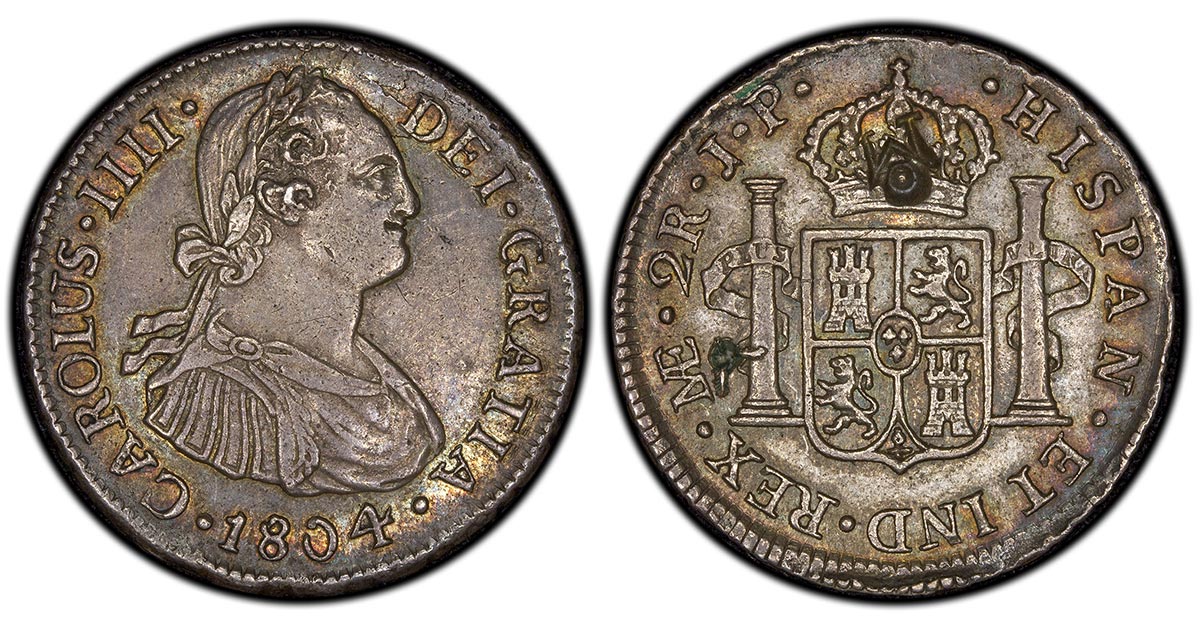
Specifications:
6.77 grams, .896 fine silver, .195 troy oz (actual silver weight)
Recorded mintage: unknown
Catalog reference: KM 95
Details:
The 1804 Peru 2 Reales, Lima mint, contains 6.77g, .896 fine, with assayer marks JP (José Rodríguez Carasa & Patricio Nicolás de Ágreda). The obverse features a laureate portrait
of Charles IV with "CAROLUS IIII DEI GRATIA" (Charles IV, by the grace of God) and date below. The reverse displays crowned Spanish arms between pillars with "HISPAN ET IND REX"
(King of Spain and the Indies). Lima's Portrait 2 Reales are common with chopmarks among minor denominations, though substantially scarcer than Eight Reales equivalents.
Lima served as capital of the Viceroyalty of Peru from 1543, growing into one of the Americas' most populous cities by funneling Potosí silver through the port of Callao. Though never experiencing a production golden age comparable to Potosí or Mexico, Peru served as a continuous trade facilitator for centuries. The Bourbon Reforms' loss of Bolivian silver production and exclusive overseas trade access did not halt Lima's coinage, which continued unabated into Charles IV's reign. Despite these reforms, Lima's well-to-do remained heavily reliant on royal patronage, effectively quashing early independence sentiment that emerged elsewhere in Spanish America.
This coin bears a unique "Mo" chopmark, an imitation of the Mexico City mintmark, a rare phenomenon where shroffs replicated familiar mintmarks rather than applying Chinese characters. Such pseudo-mintmark chopmarks are fun curiosities, with examples documented on U.S. Trade Dollars as well. The practice likely originated from shroffs copying marks from the vast quantities of Mexican coinage flooding Chinese markets. In general, minor denominations are substantially scarcer with chopmarks than crowns, appearing much less frequently despite continuous production alongside Eight Reales.
I absolutely love the look of this coin.
Notable chopmarks:
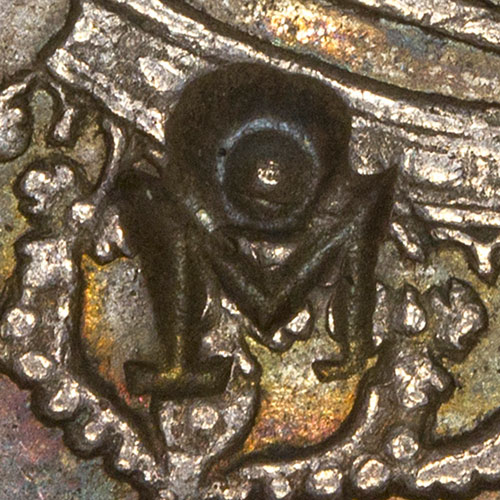 Mexico City mintmark (Mo)Resembles the 'oM' / 'Mo' mint mark of the Casa de Moneda de Mexico (the Mexico City mint), seen on Spanish-colonial and Republic-era 8 reales. As a chopmark its significance is uncertain; it may be a merchant's mark echoing a familiar coin device rather than a script character.
Provenance:
Purchased on eBay in March 2018 from a seller in Staten Island, New York.
1806 US Draped Bust Half Dollar
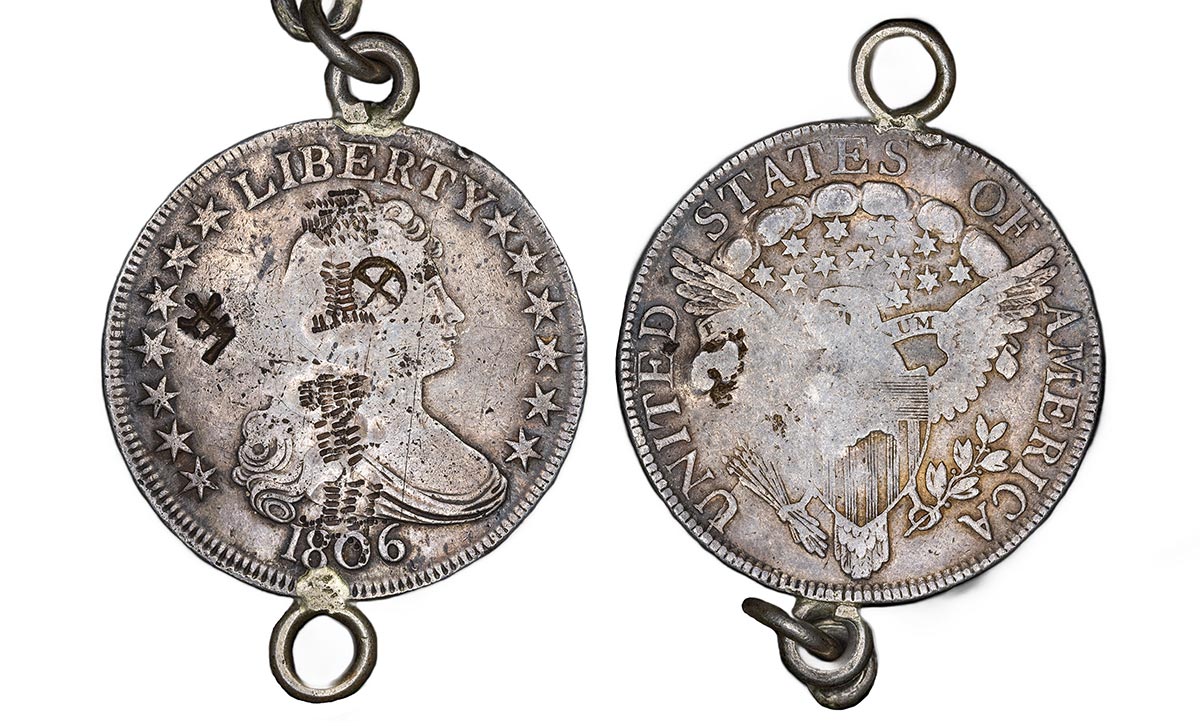
Specifications:
13.48 grams, .892 fine silver, .3866 troy oz (actual silver weight)
Recorded mintage: 839,576
Catalog reference: KM 35
Details:
The 1806 Draped Bust half dollar (KM-35, variety O-119) represents an exceptional survival from early U.S. federal coinage and remains exceedingly rare when encountered with
Chinese chopmarks. Struck at the Philadelphia Mint, this denomination was not produced for Asian export. The first American trade expedition to China departed in 1784 aboard the
Empress of China, establishing direct U.S.-China commerce. According to contemporary British East India Company records from 1796, American merchants arrived in Canton bearing the
new coinage of the fledgling nation, 1795 dollars, though observers erroneously described Liberty's portrait as George Washington. Chinese scholar Zhu Lian (1736-1820) documented in
his Notes from the Bright Study the circulation of "silver coins with the phoenix" during his youth, which modern scholarship attributes to early American silver dollars. However,
the American trading vessel Rapid, which wrecked off northwestern Australia en route from Boston to Canton in 1811 carrying an estimated 280,000 silver crowns, yielded only 13 U.S.
silver dollars among the approximately 20,000 coins recovered during 1979-82 excavations, suggesting limited penetration of American federal coinage into the China trade compared to
Spanish colonial issues.
Numismatist Arthur Wright observed that half dollars "seldom, if ever, found substantial demand in China" apart from the westernmost regions where such pieces traded at values approximating the Indian Rupee. An 1859 dispatch from the U.S. Legation at Shanghai documented Chinese merchant resistance to American silver: "The gold and silver coins of the United States are not much known in China; the latter are not taken readily from their inferiority in purity and weight, in the opinion of the natives, to the Mexican (coinage)." The presence of chopmarks on this specimen confirms its authentication within Chinese commercial practice as bullion-grade silver, making it a tangible artifact of the limited early penetration of U.S. federal coinage into Southeast Asian markets. Wright further noted that domestic Chinese equipment for testing smaller silver denominations reflected minimal demand for half-crown pieces, reinforcing their marginal role in the China trade.
The suspension loop affixed to this coin and dotted markings require interpretation beyond its function as commercial silver. Documentation from numismatic literature confirms that temple officials in remote mountainous regions of Szechuan and Tibet applied countermarks to silver coins as late as 1919, operating from religious centers that functioned as local government. The markings on this specific coin indicate association with 仙姑媽 (Xiān Gū Mā), a localized female deity venerated primarily in Fujian and Taiwan rather than the mainstream imperial pantheon. However, the broader protocols governing such votive offerings, including how foreign silver coins were selected for this purpose, the mechanisms by which valuable pieces were reclaimed after ceremonial use, and the geographic distribution of this practice, remain subjects requiring further study.
Such objects survive because they were never intended as permanent dedications. In practice, knowledgeable temple officials or priests understood that the offering’s ritual efficacy did not require the physical retention of the silver, and valuable pieces were often removed after the ceremony and re-entered circulation or private hands. This pragmatic reuse explains both the scarcity of intact talisman groups and their frequent composition from recognizable, high-silver trade coins, whose intrinsic value made them suitable for ritual display but also worth reclaiming afterward.
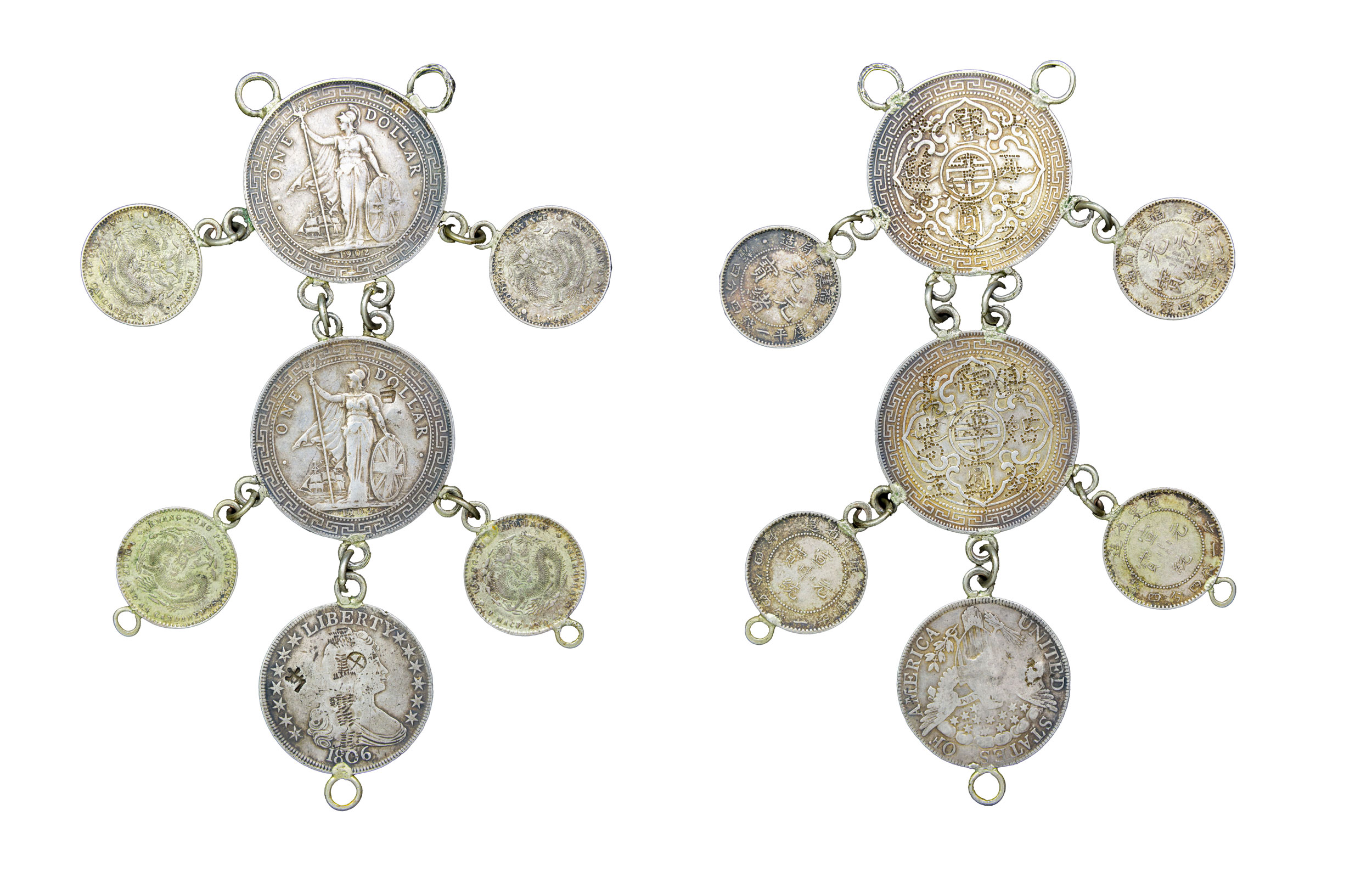
Here’s a careful, line-by-line interpretation of the inscriptions on the British Trade Dollars in this talisman offering. Keep in mind this is ritual language, not a single coherent sentence. These inscriptions function as invocations and registrations, typical of talismanic objects rather than narrative text.
香火牌
“Incense-fire plaque” / “Votive tablet”
This identifies the object as a religious offering, formally registering incense and devotion rather than serving a monetary purpose.
山西天子
“Shanxi Heavenly Lord” (likely a regional or honorific title)
This is not a known imperial reference in this context. In talismanic usage, such titles often denote a localized or syncretic heavenly authority, possibly borrowed or adapted for ritual completeness rather than strict geography.
觀音佛組
“Guanyin Buddha Assembly”
An invocation of Guanyin (Avalokiteśvara) and associated bodhisattvas, anchoring the talisman in Buddhist compassion and protection.
伽藍天王
“Heavenly King of the Sangharama”
A Buddhist temple guardian deity (伽藍神), responsible for protecting monasteries, ritual spaces, and offerings.
仙姑媽
“Immortal Lady Mother (Xiān Gū Mā)”
The primary focus of the offering. As you noted, this is a regional demi-goddess worshipped mainly in Fujian and Taiwan, associated with localized protection and intercession rather than universal Buddhist authority.
福德正神
“God of Fortune and Virtue”
A formal title commonly associated with local earth gods (Tudi Gong) or prosperity deities. Its inclusion broadens the talisman’s protective and beneficent scope.
良嵩王
“King Liang Song” (almost certainly a local or syncretic spirit)
This does not correspond to a major canonical deity. Names like this are typical of regional spirit-kings or deified historical figures, included to reinforce local legitimacy and ritual completeness.
Taken together, this inscription is not meant to be read as prose, but as a stacked invocation calling upon Buddhist authority (Guanyin, temple guardians), local folk deities (Xiān Gū Mā, regional spirit-kings), and prosperity and protection gods (福德正神). This structure is typical of late Qing–Republican talismanic practice, especially in Fujian–Taiwan religious culture, where Buddhist, Daoist, and folk elements were freely combined. The text effectively registers the offering with multiple layers of divine oversight, maximizing protection, legitimacy, and ritual efficacy. In the context of a coin-based talisman offering, the inscription confirms that the coin was being used as a sacred object, not money; its silver content made it symbolically potent, while the text transformed it into a temporary devotional instrument, consistent with your observation that such offerings were often later reclaimed once the ritual purpose was fulfilled.
Notable chopmarks:
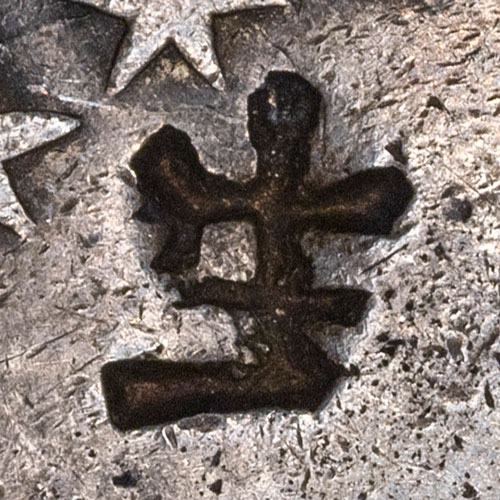 生 - shēng - life, birth, grow
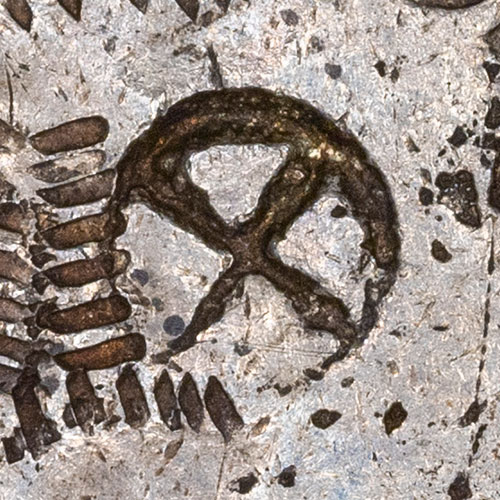 Crossed circleSuggests a wheel. A four-spoked wheel evokes the Buddhist 法輪 (fǎlún, Dharma wheel), whose four spokes are read as the Four Noble Truths; the quartered circle is also an old emblem of the sun and of the four directions. Circle-and-cross marks recur as abstract chopmarks.
Provenance:
From Ben Dalgleish, a collector who finds chopmarked coins in the coin markets of Hong Kong, June 2023
1809-NG M Nueva Guatemala 8 Reales, Ferdinand VII Legend, Carlos IIII Portrait
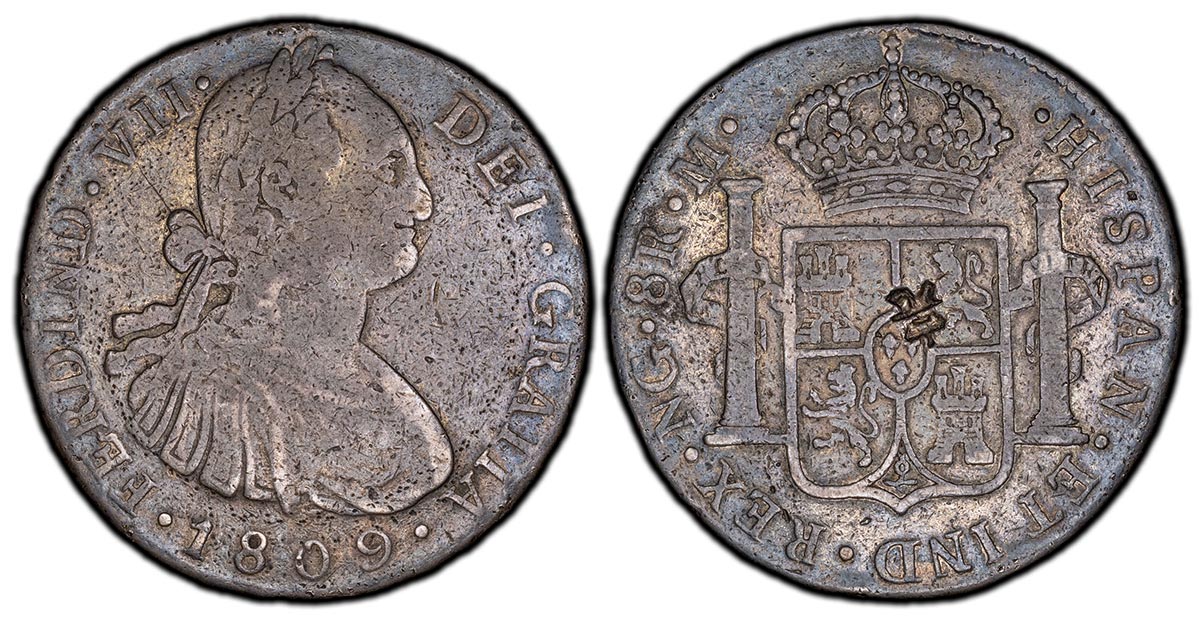
Specifications:
27.07 grams, .896 fine silver, .7797 troy oz (actual silver weight)
Recorded mintage: unknown
Catalog reference: KM 64
Details:
The 1809 Guatemala 8 Reales, Nueva Guatemala mint, represents a transitional type (KM# 64, 1808-10) necessitated by political upheaval in Europe. The obverse retains the laureate
portrait of Charles IV facing right, but the legend reads "FERDIN VII DEI GRATIA" (Ferdinand VII, by the grace of God), a mismatch reflecting the practical realities of colonial
minting.
Napoleon Bonaparte's 1808 forced abdication of Ferdinand VII and installation of his brother Joseph on the Spanish throne created a crisis across Spanish colonies. The imprisonment inspired revolutionary activity in the Captaincy General of Guatemala, including independence movements in San Salvador and León as early as 1811, though these were quickly suppressed. Colonial mints faced the challenge of continuing coinage production while lacking proper portrait dies of the new monarch. Mints at Mexico, Peru, and Chile responded by creating improvised "imaginary bust" designs approximating Ferdinand VII's appearance, crude portraits that became known by nicknames like "Alien Head" in Peru. Guatemala's mintmasters took a different approach: rather than attempting to improvise an unfamiliar portrait, they pragmatically retained Charles IV's existing portrait dies while updating only the legends to acknowledge Ferdinand VII's accession. This practical solution allowed uninterrupted production until official portrait dies could be obtained from Spain, which arrived by 1812.
Notable chopmarks:
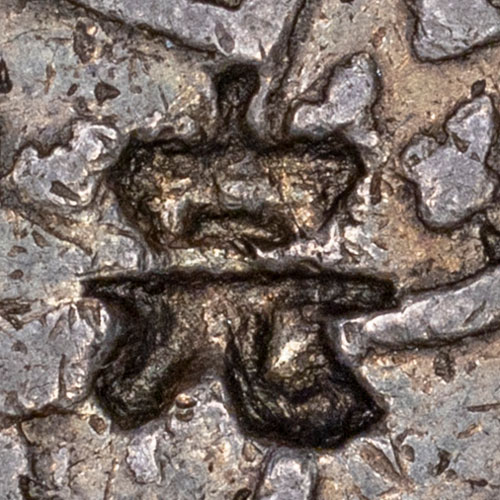 完 - wán - complete, finish
Provenance:
Purchased from fellow collector Taylor Leverage in February, 2025. Previously purchased from an eBay seller in late 2024.
1809 United States Capped Bust Half Dollar
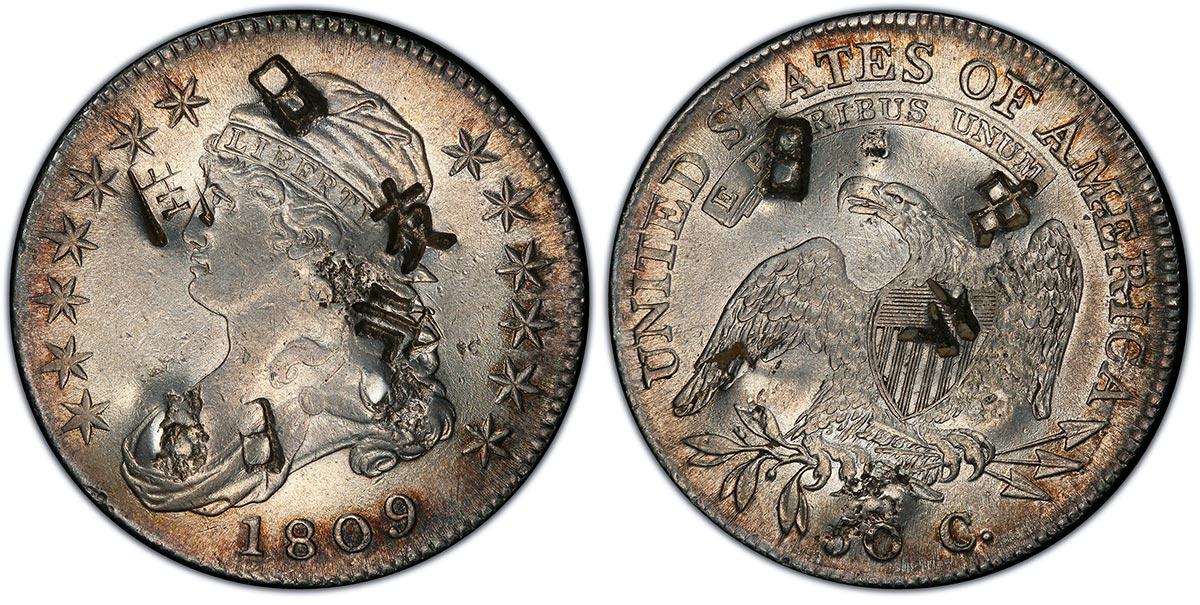
Specifications:
13.48 grams, .892 fine silver, .3866 troy oz (actual silver weight)
Recorded mintage: 1,405,810
Catalog reference: KM 37
Details:
This 1809 Capped Bust Half Dollar represents one of the earliest American silver denominations to potentially reach Chinese markets, though its presence there was minimal.
Contemporary sources document that 60% of U.S.-China trade value during the Napoleonic Wars era (1803-15) was conducted in Spanish colonial silver, and an 1859 dispatch from the
U.S. Legation at Shanghai noted that American coins "are not much known in China; the latter are not taken readily from their inferiority in purity and weight, in the opinion of t
he natives, to the Mexican (coinage)." Arthur Wright observed that half dollars "seldom, if ever, found substantial demand in China" except in westernmost regions. The extreme
rarity of chopmarked Capped Bust half dollars (R-4) indicates that few were exported to China in the first place; American merchants likely recognized Chinese preference for Spanish
colonial crowns and carried those instead, or if shipped, these half dollars failed to achieve meaningful circulation in the Chinese economy. The scarcity of surviving chopmarked
examples stands in stark contrast to the abundance of chopmarked Spanish colonial Eight Reales and later U.S. Trade Dollars, suggesting the Capped Bust half dollar played at most a
marginal role in Sino-American commerce despite being the most readily available American silver denomination during the peak decades of early U.S.-China trade.
Notable chopmarks:
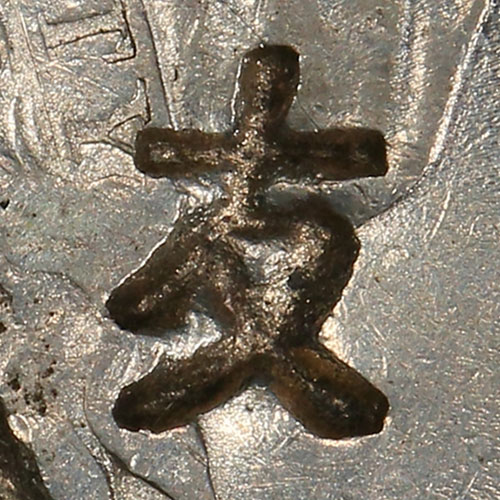 友 - yǒu - friend, friendliness
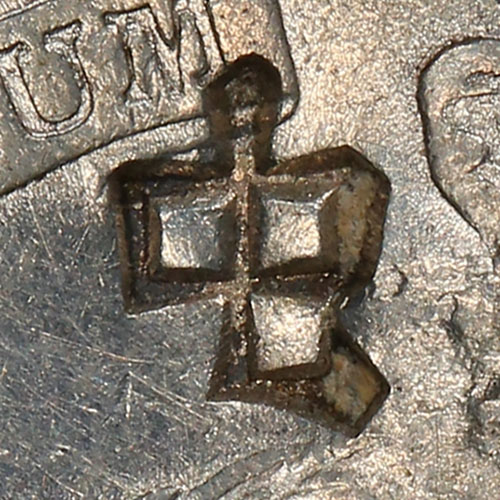 Similar to 中 - zhōng - center, middle, China
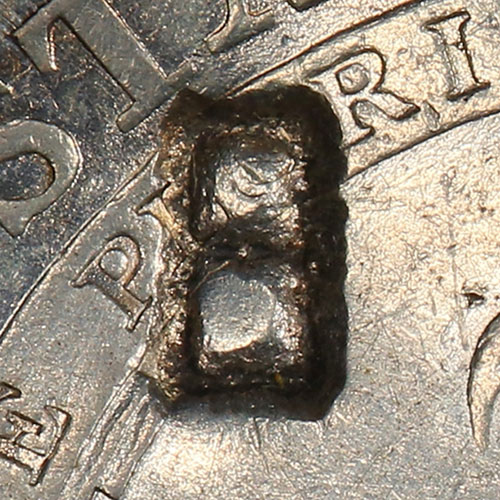 日 - rì - sun, day
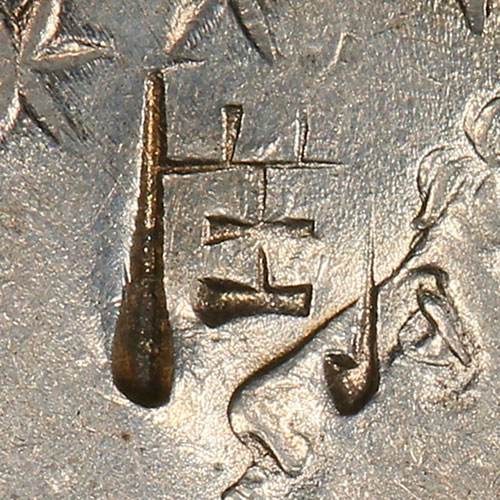 Unknown
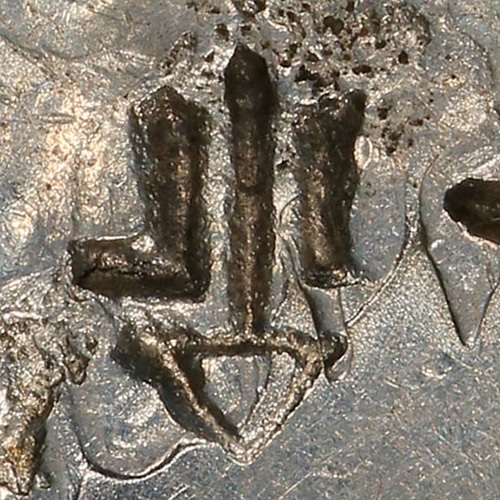
 - Liushutong script variant of 公 - gōng - public, fair, duke
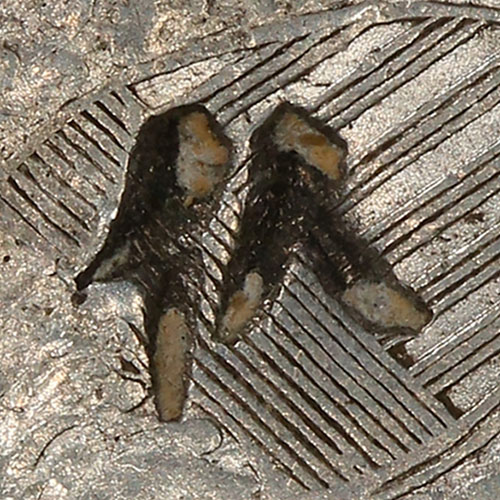 Possibly 仈 - bā - eight
Provenance:
Purchased December 4, 2022 at GreatCollections online auction
Lot #1266776
1810-L JP Peru 8 Reales Ferdinand VII "Imaginary bust" type (Ex. Bowman)
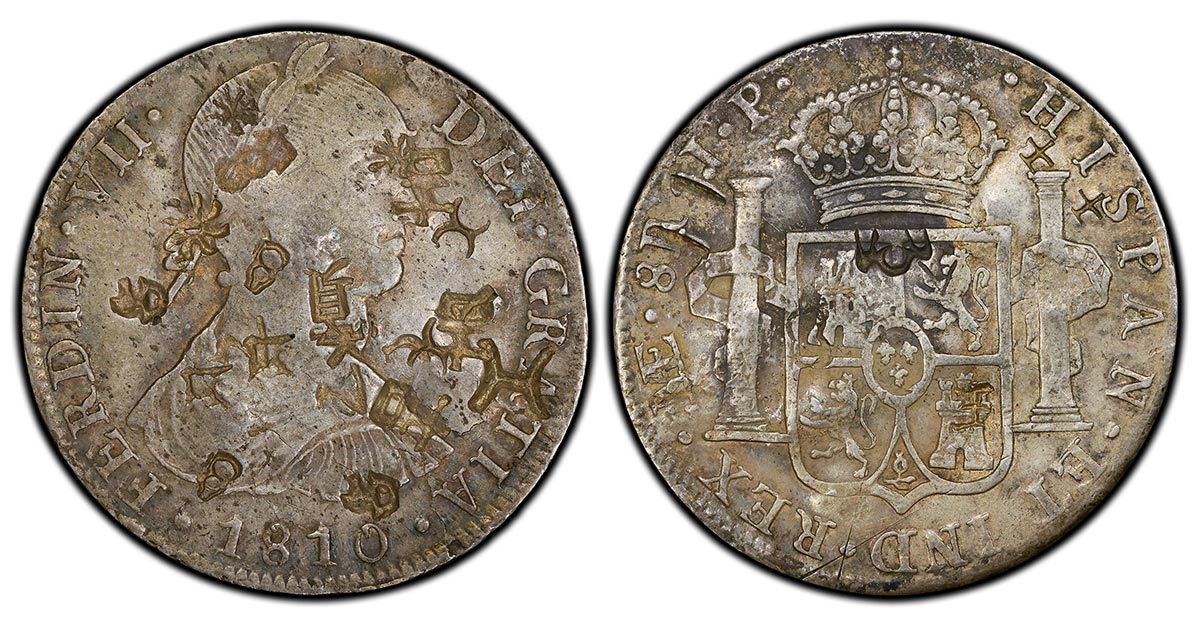
Specifications:
27.07 g, .896 fine, .780 troy oz (actual silver weight)
Recorded mintage: 4,380,000
Catalog reference: KM 106.2
Details:
Napoleon Bonaparte's forced abdication of Ferdinand VII in 1808 and installation of his brother Joseph on the Spanish throne created an immediate crisis for colonial mints:
how to strike coins bearing Ferdinand VII's portrait when no proper dies existed in the Americas. With transatlantic communication and die shipments severely disrupted by the
Napoleonic Wars, the mint at Lima, like its counterparts in Mexico and Chile, was forced to improvise a portrait based entirely on local engravers' imagination. The result was
notoriously crude, a peculiar stylized bust that earned enduring nicknames including "Alien Head" due to its otherworldly appearance. Peru's response differed markedly from
Guatemala's pragmatic solution of retaining Charles IV's portrait with updated legends, as seen above.
Under Viceroy José Fernando de Abascal y Sousa, Peru established itself as the most resolute Royalist bastion in the Americas, refusing to accept Napoleonic rule while actively suppressing independence movements and reclaiming silver-producing territories. The improvised portrait continued until proper portrait dies finally arrived from Spain around 1811-12. The "Imaginary Bust" type is much scarcer with chopmarks than standard Portrait coinage from Lima, mostly reflecting its brief production window during a period when global silver flows to China were in steep decline. Latin American independence movements disrupted mining operations and mint production across the Spanish colonies, while the Napoleonic Wars interfered with shipping routes and international commerce. British Foreign Office calculations from 1833 estimated that global silver production had fallen by nearly 50% in the 1810s compared to the 1790s, creating a "silver famine" in China that would persist for decades.
Notable chopmarks:
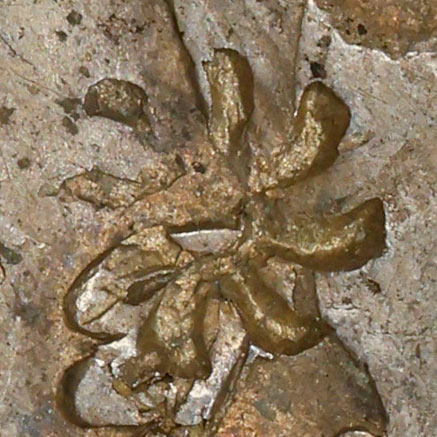 Saw blade or curved sunburstNot firmly identified. A radiating disc of curved rays reads as a whirling sun or pinwheel; stars and sunbursts are among the more common abstract chopmarks, here given a spinning, rotational form. The wheel-like motion may loosely evoke a 法輪 (fǎlún, the Buddhist Dharma wheel) or a simple sun and light emblem, though it may equally be a maker's or decorative mark.
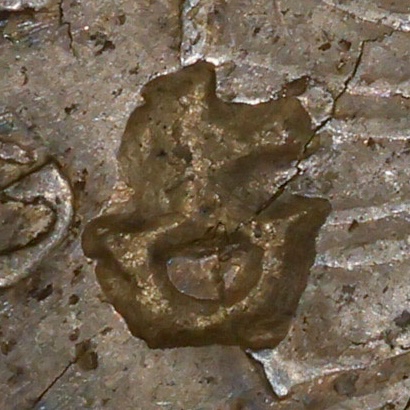 占 - zhàn - divine, occupy, take
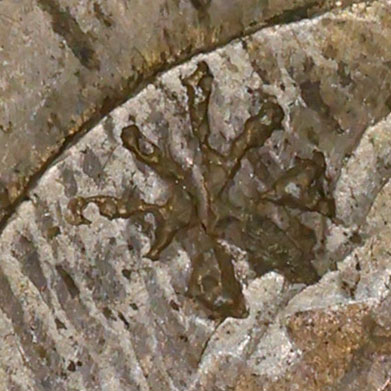 Similar to 氷 - bīng - ice
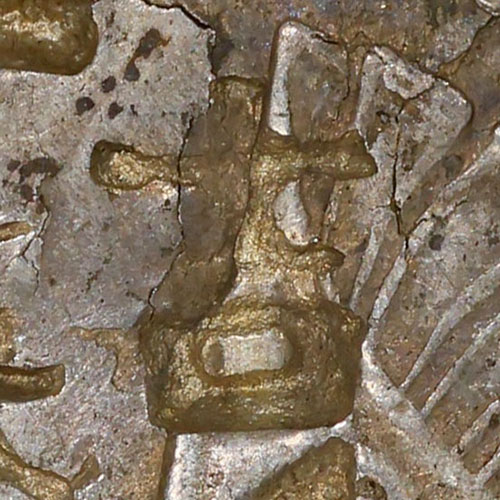 吉 - jí - auspicious, lucky
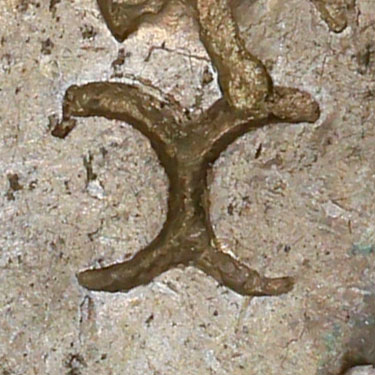 Symbol chopmark
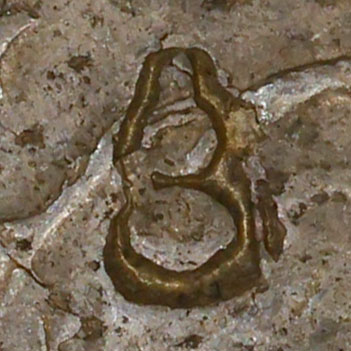 Bottle gourd (葫蘆)The gourd (葫蘆, húlu) is one of the most auspicious Chinese motifs: húlu echoes 福祿 (fúlù, 'blessings and prosperity'), and its many seeds wish for abundant descendants. It is a Daoist emblem of healing and immortality, the vessel of the immortal Li Tieguai (李鐵拐) and one of the hidden Eight Immortals' attributes (暗八仙), and is hung to ward off illness and evil.
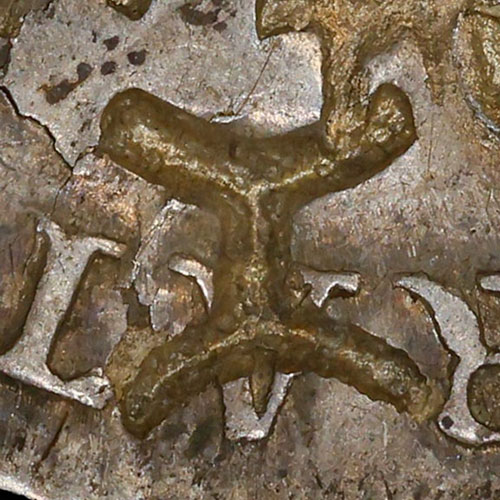 Possibly
  - Bronze script variant of 工 - gōng - work, labor, skill
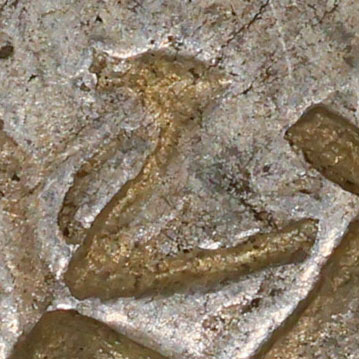 乙 - yǐ - second, 2nd heavenly stem
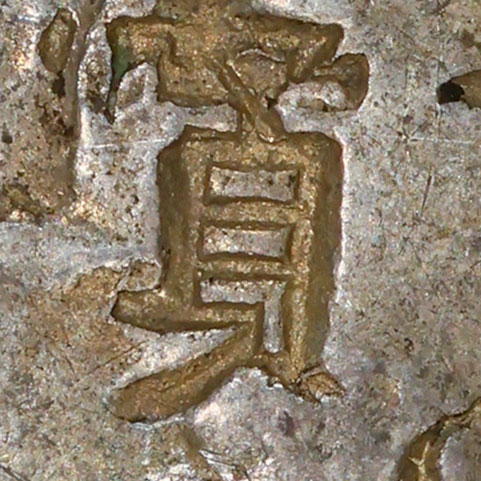 Need to figure this one out
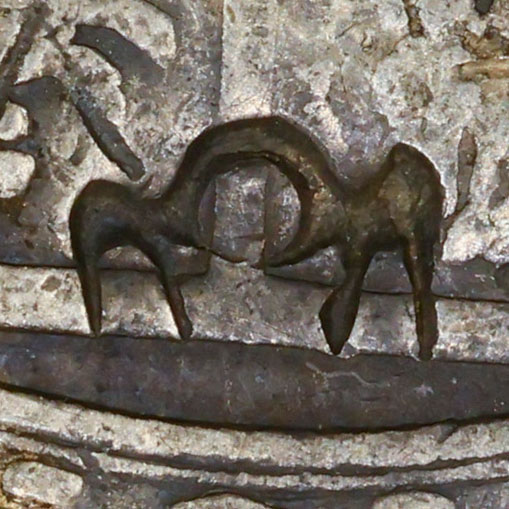
 - Bronze script variant of 共 - gòng - common, together, to share
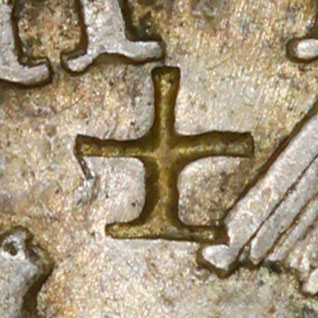 士 - shì - scholar, gentleman, soldier
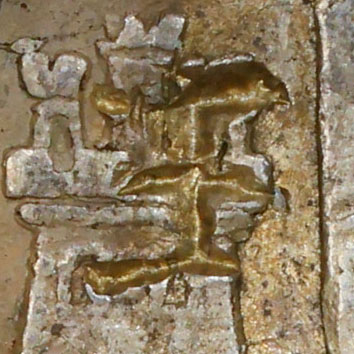 王 - wáng - king, ruler
Provenance:
From the Stack's Bowers November 2023 World Collectors Choice Auction - World Coins Part 2
Lot #74734
The lot was comprised of 2 coins, an 1820 Mexico 8 reales and this coin.
Auction Description:
MIXED LOTS. Duo of Spanish Colonial 8 Reales (2 Pieces), 1810 & 1820. Ferdinand VII. Both PCGS Certified.
1) PERU. 1810-L JP. Lima Mint. PCGS Genuine--Chopmark, VF Details. KM-106.2; Cal-1241. "Imaginary" Portrait type.
2) MEXICO. 1820-Mo JJ. Mexico City. PCGS Genuine--Chopmark, EF Details. KM-111; Cal-1336.
An interesting pairing of chopmarked crowns. Despite the multitude of chops visible, neither coin circulated excessively. Both offer plenty of detail along with attractive toning
and even remnants of underlying luster.
Estimate: $100 - $200.
Ex J.D. Bowman, as described in the Chopmarked Collectors Club newsletter, Volume 2, Issue 2, July 1991, page 2-57. Bowman was an original contributor to the Chopmark Collectors Club newsletters, and assembled one of the finest chopmark collections of all time. Bowman worked closely with Santa Barbara coin dealer Paul Brombal, in fact J.D. credits Paul with "most all of my chops he got for me in Singapore, Hong Kong & Manilla over the years."
1811-M AI Spain 4 Reales with bust of Joseph Napoleon
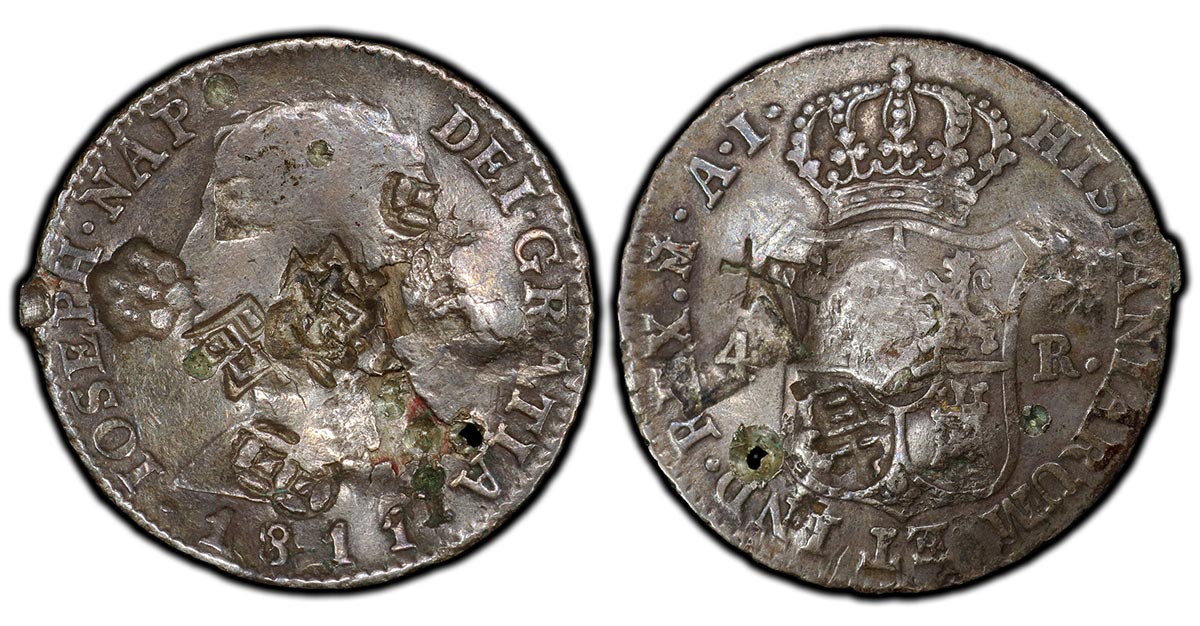
Specifications:
5.41 g, .903 fine silver, .157 troy oz (actual silver weight)
Recorded mintage: unknown
Catalog reference: KM 540.1
Details:
The 1811-M AI (Antonio Ibarrola) Spain 4 reales, struck at the Madrid mint, was issued during the French occupation of Spain under Joseph Napoleon, with production spanning
1809–1813 at Madrid and Seville. This coin belongs to a disrupted monetary system imposed during wartime conditions and differs fundamentally from the traditional Spanish 4
reales: rather than equaling half a peso, the Joseph Napoleon 4 reales was tariffed at one-fifth of a peso, reflecting Napoleonic fiscal reforms and the abandonment of
long-standing Spanish standards. The portrait and legends mark a sharp break from Bourbon issues and were widely rejected or discounted within Spain, contributing to uneven
circulation and survival.
The presence of Chinese chopmarks indicates that, despite its contested status at home, the coin later circulated as bullion silver in the trade networks of China. Coins of Joseph Napoleon are rare with chopmarks, as Spanish metropolitan issues seldom reached Asian markets and politically suspect types even less so. This example documents an unusual afterlife for a short-lived and unpopular occupation issue, validated abroad even after its authority had collapsed at home.
Notable chopmarks:
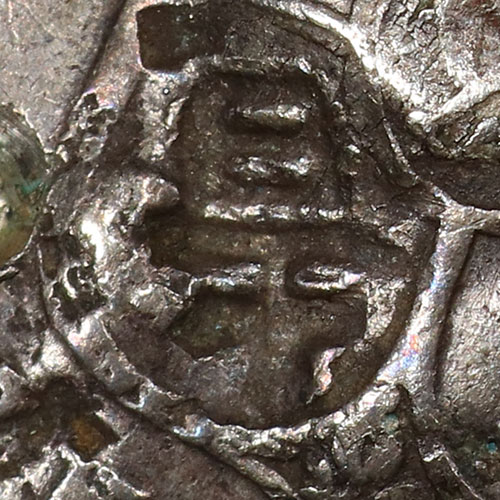 旱 - hàn - drought, dry
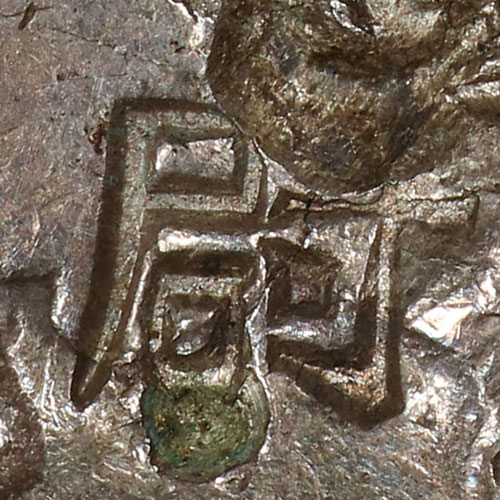 Appears to be a combination of 后 and 寸 with unknown meaning
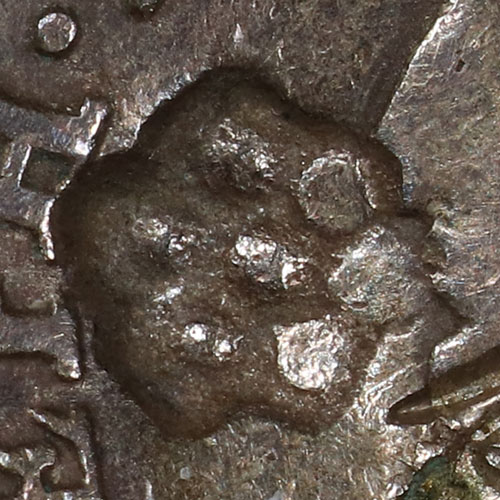 Seven stars (七星)Suggests the 七星 (qīxīng, 'Seven Stars') of the Big Dipper (北斗七星), a major Daoist emblem of the northern heavens carrying strong protective and exorcistic associations; the seven-star pattern is a recognized auspicious marking. The seven rings may alternatively evoke the 七寶 (qībǎo, 'Seven Treasures') of Buddhism.
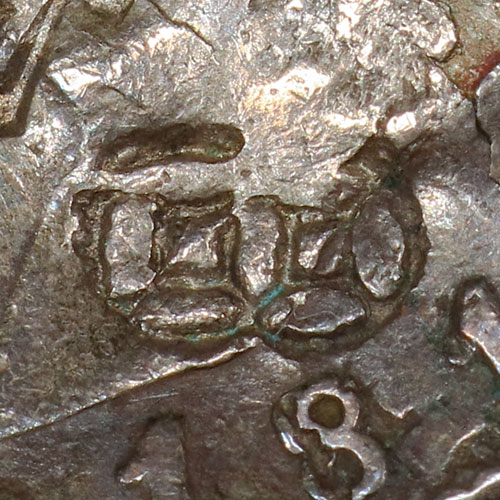 Double cash coins (雙錢)The double coins (雙錢, shuāngqián), one of the Eight Treasures (八寶) of Chinese decorative art. Doubling the single cash coin's wish for wealth, it stands for abundance and unbroken prosperity; the interlinked pair also reads as connectedness and good fortune arriving in twos.
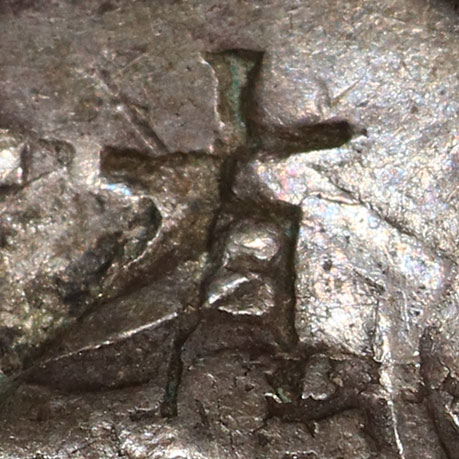 有 - yǒu - have, exist
Provenance:
Purchased on eBay in November 2018 from a seller in Fort Wayne, Indiana.
1813-PTS J Argentina Rio De La Plata 8 Reales (Ex. Revd. Charles Campbell)
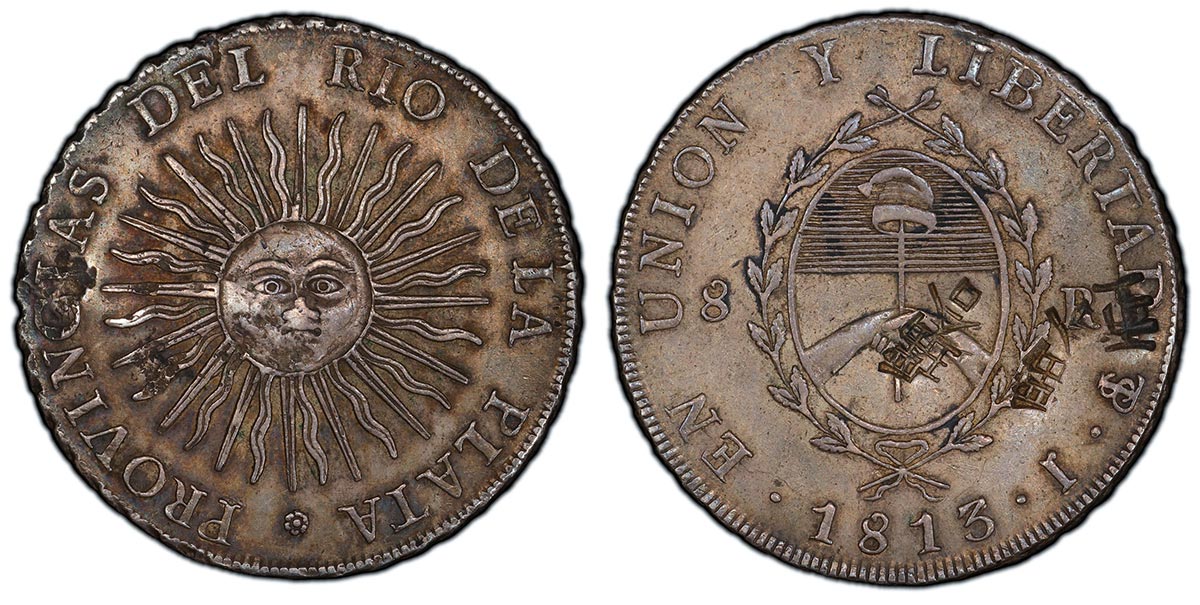
Specifications:
26.5 to 27.06 g, .850 to .896 fine, .7793 troy oz (actual silver weight)
Recorded mintage: unknown, as records were most likely destroyed when the mint was recaptured by Spanish crown forces
Catalog reference: KM 5
Details:
The 1813-PTS J Argentina (Río de la Plata) 8 reales, KM-5, is a one-year type, struck only in 1813 following the capture of Potosí by revolutionary forces under Manuel
Belgrano. By decree of the General Assembly in Buenos Aires on April 13, 1813, the mint was authorized to strike the first silver and gold coinage of the emerging
Argentine state, with specifications dispatched to Potosí shortly thereafter. The earliest silver crowns reached Buenos Aires by July 28, 1813, and production continued
only until November, when royalist forces retook the city. Later issues using related designs, 1815 (KM-14) and 1826–1837 (KM-20, struck at La Rioja), are more available,
underscoring the brief and fragile circumstances of the 1813 emission.
Referring to an 1826 8 Reales from Argentina featured in Rose's Chopmarks, Gullberg writes "Rose speculated that a ship stopping for water and stores may have stopped in Buenos Aires where the coin was picked up. The coin was light as compared to the Carolus dollar (0.7793 oz. of pure silver vs. 0,7980 oz. of pure silver for the Carolus) but it was obviously accepted by more than one merchant. I know of only one other, which was sold in Taipei in September, 2006, making it a very rare coin chopmarked. One collector searched for twentyyears for an example never finding one. As it appeared in the shroff handbook many more examples must have made their way to Asia; many must have been melted into sycee in the nineteenth century. Taiwanese called the coin the "head with sun shadow" or the "long face"."
This coin was featured on the cover of the December 2017 issue of The Chopmark News. I need to confirm this with Colin, but this appears to be the third known example (one other also dated 1813). Quite rare with Chopmarks and nice original condition make this coin a very special part of this collection. This coin was featured on the cover of the Chopmark News journal, December 2017, vol. 21, issue 3.
Notable chopmarks:
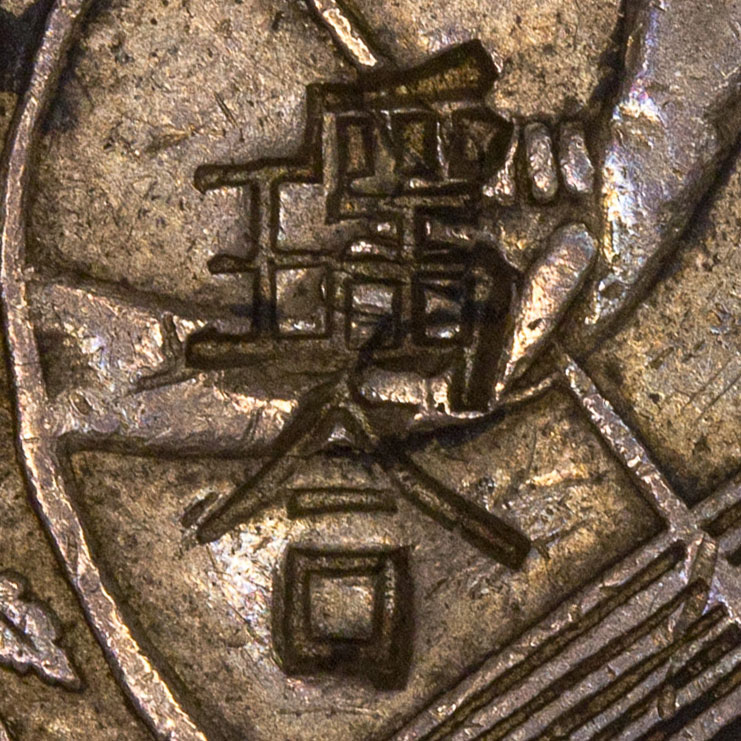 瑶合 - yáo hé - Yaohe (a merchant or shop name) - 瑶 (yáo, 'precious jade') is an elegant, auspicious character; 合 (hé, 'to join, unite') is a common element in firm and partnership names (商号), comparable to the 記 suffix. So 瑶合 reads as the house mark of a 'Yaohe' shop or partnership, struck by the merchant or silver shop that tested the coin and accepted it as genuine.
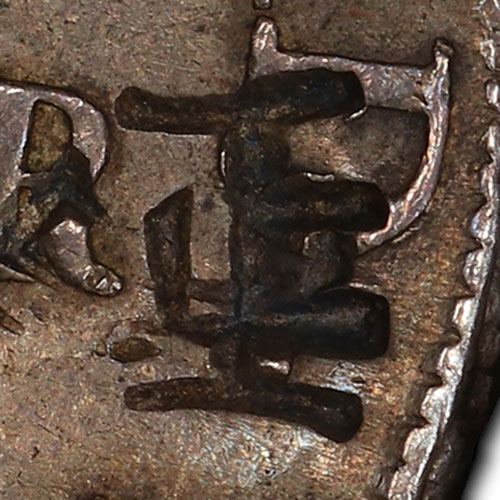 正 - zhèng - correct, straight, upright
Provenance:
From the collection formed by the late Revd. Charles Campbell
Dix Noonan Webb, London, Coins and Historical Medals September 13-15 2017 Sale, Session 1,
Lot #174
Auction Description:
World Coins, ARGENTINA, Rio de la Plata, 8 Réales, 1813j, Potosí (KM. 5). Chopmarks on reverse, otherwise about very fine £100-150
Reverend Charles Thomas Campbell (1902-83) first took an interest in numismatics in the late 1930s by studying the history of religion through the evidence of ancient coins. On such coins, symbols represent the dominant faith or the choice of the rulers. Surviving paperwork points to the fact that his collection was largely formed during the 1940s, with the London dealer Bert Seaby the principal source. Revd. Campbell's numismatic interests extended beyond the ancient world and on retirement he became well known around Boston, giving talks to local societies about his collection. As a subscriber to Spink's Numismatic Circular and Seaby's Coin & Medal Bulletin, he kept up-to-date annotations of listings of similar pieces to those in his collection whenever they passed through the trade and his original envelopes with this information are sold with his coins and medals. He passed away in 1983 leaving this fascinating and broad-ranging collection to his grandchildren and the collection has been unavailable for study since that time.
1813-So FJ Santiago, Chile 2 Reales
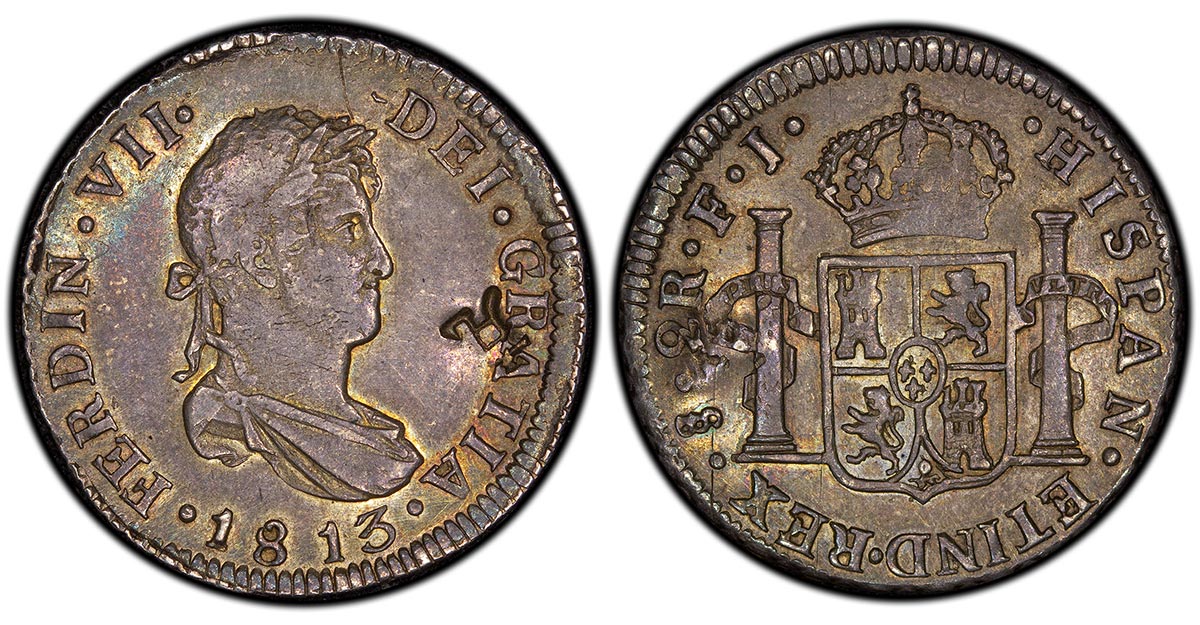
Specifications:
6.767 g, .8960 fine silver, .1949 troy oz (actual silver weight)
Recorded mintage: 136,000
Catalog reference: KM 79
Details:
The 1813-So FJ (Francisco Javier de la Fuente, attributed) Santiago, Chile 2 reales is a late colonial silver issue struck during a period of political instability as Chile
moved toward independence. Produced at the Santiago mint for everyday circulation, the denomination reflects the continued need for subsidiary silver even as larger crown-sized
coins dominated long-distance trade. This example is notable for its well-preserved original surfaces, showing iridescent toning with beautiful color, difficult to find on
early-19th-century Chilean minors.
The presence of a single obverse Chinese chopmark indicates circulated for at least a small time in the China trade, an uncommon fate for this small-denomination piece. While 2 reales were not typically favored in Asian trade, occasional examples reached Chinese markets through aggregation with larger silver or secondary circulation routes.
Notable chopmarks:
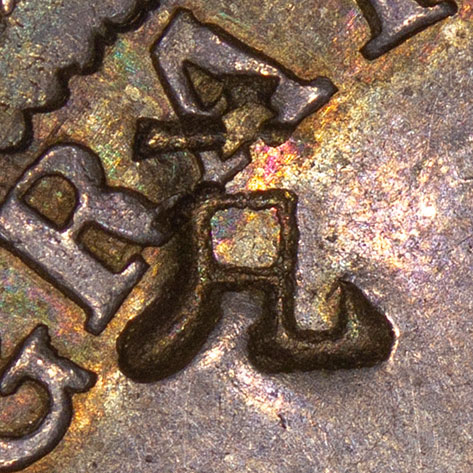 克 - kè - overcome, gram, can
Provenance:
From the Katz June 2018 Auction #14 (Prague, Czech Republic) Lot #2260
Auction Description:
KM# 79; Silver; With Countermark; XF- Nice Toning
1813/2-P JF Colombia 8 Reales, Popayán mint, Ferdinand VII with Carlos IIII bust type
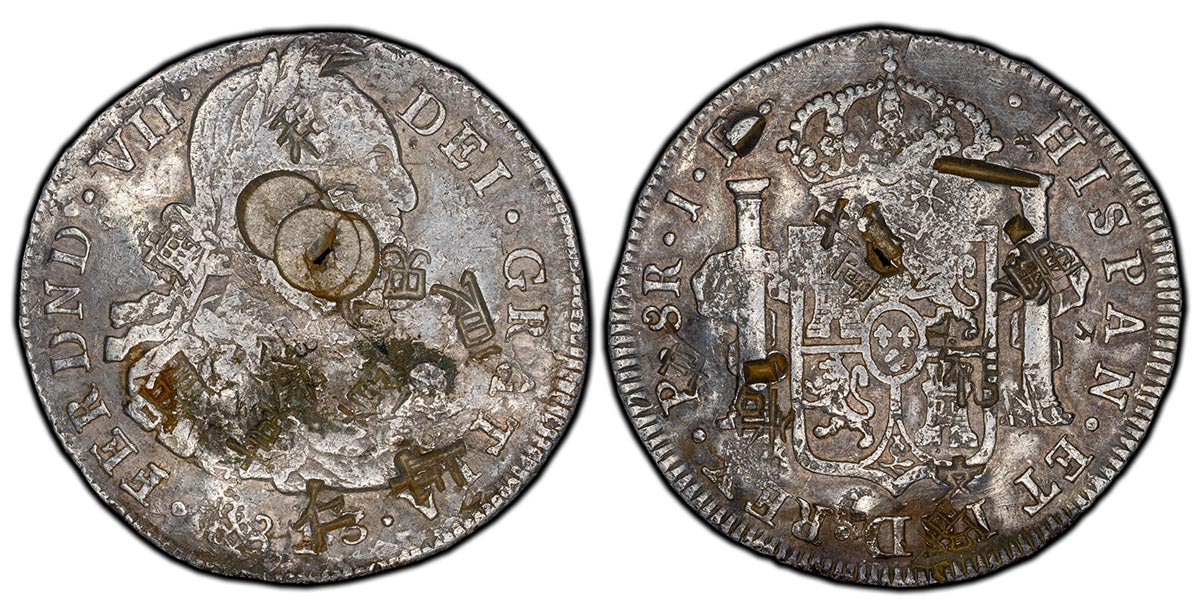
Specifications:
27.07 g, .917 fine, .798 troy oz (actual silver weight), although this coins weighs around 26g
Recorded mintage: Unknown
Catalog reference: KM 71
Details: The 1813/2-P JF (Juan Camilo Delgado / Francisco Mariano de Rada) Colombia 8 reales, struck at the Popayán mint, in what was known as "New Granada" at the time. It's a classic “transitional authority” issue - the coin names Ferdinand VII in the legend while retaining the Carlos IV bust, and the 1813/2 overdate reflects practical die reuse during a period of disruption. This coin represents the only attempt to strike portrait reales in Colombia during colonial times. It was issued from the Popayán mint from 1810-14, then again in 1816 and 1820. While other mints such as Mexico City and Santiago were using the standard bust of Ferdinand VII, Popayán persisted in continuing the bust of the abdicated Charles IV until the end of the colonial period, much later than other mints.
Popayán’s minting history is unusually turbulent even by colonial standards, authorized only after decades of local lobbying, it finally began coinage in 1758, was ordered closed in 1761, reopened in 1766–67, and then operated through repeated occupations during the independence wars before ultimate transfer and dismantling of equipment in the early 1820s. Popayán is better known for its gold output, and its milled silver crowns of this type are widely regarded as prohibitively rare.
Popayán 8 Reales are often described as “different,” likely due to a difference in silver content - specified at about .917 fine silver, whereas Mexico City portrait 8 reales of Carlos IV are commonly cited around .896 fine for the late reform period. A curious detail that may be more legend than truth, is that Popayán's silver coins were minted from the silver left over from the gold refining process (there were no large silver mines in Colombia at that time), which means that these coins may have a high percentage of gold in their composition. This claim should be tested with metallurgical analysis for confirmation.
For a "New Granada" silver dollar, the most defensible route to explain the Chinese chopmarks is indirect movement into broader Atlantic or Pacific specie streams (often via Caribbean ports and international merchants) and then onward into the established channels feeding southern China’s silver markets, rather than any Popayán/New Granada linkage directly to China.
This date is known in two obv varieties, a normal 1813 date and an 1813/2 overdate. It appears this is the latter. The normal 1813 date is very rare, maybe 2 known, and the overdate is around 8 known, or around 10 total known for the date.
Notable chopmarks:
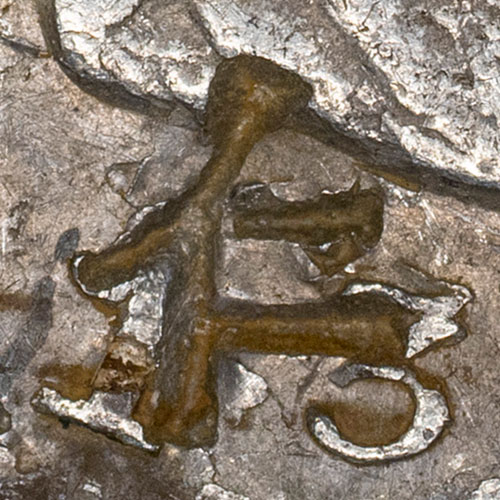 仁 - rén - benevolence, humanity, kernel
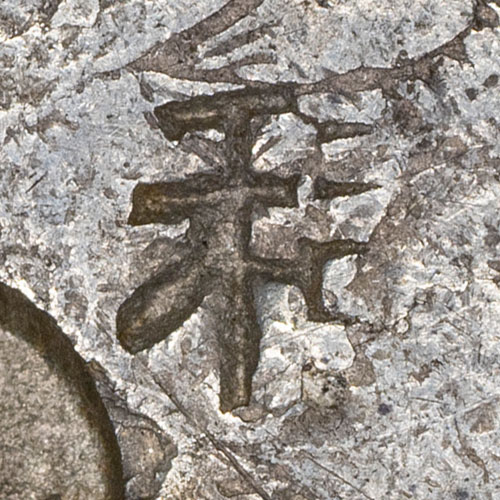 Similar to 和 - hé - harmony, peace, and
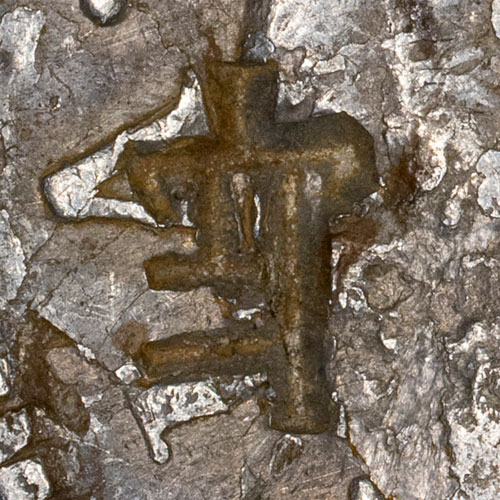 Unknown chopmark
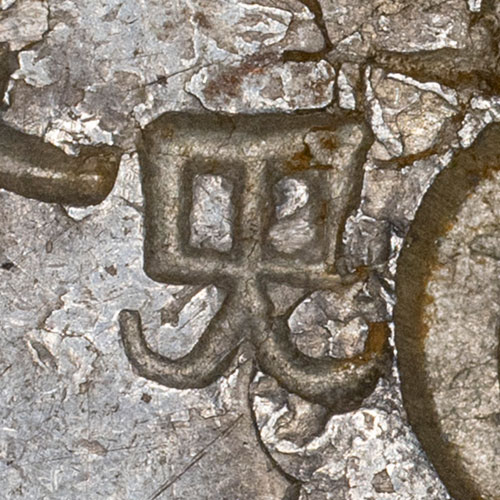 Probably 央 - yāng - center, middle
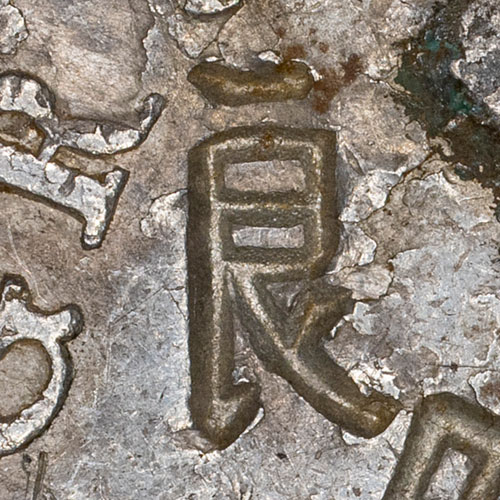 良 - liáng - good, fine
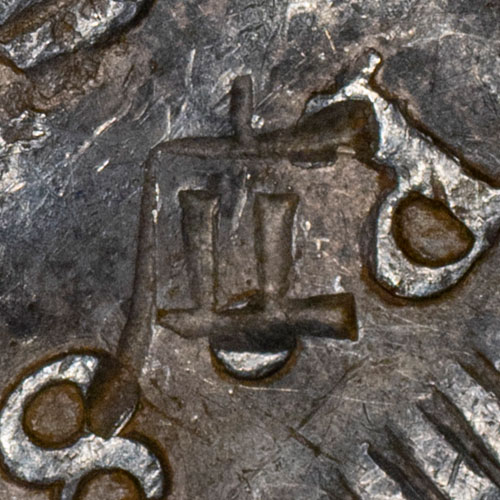 Similar to 应 - yìng - to answer, to respond, to comply with, to deal or cope with
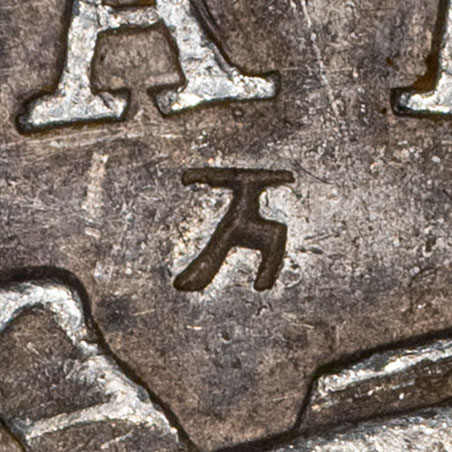 万 - wàn - ten thousand, myriad, also Japanese Kanji for various, many, all
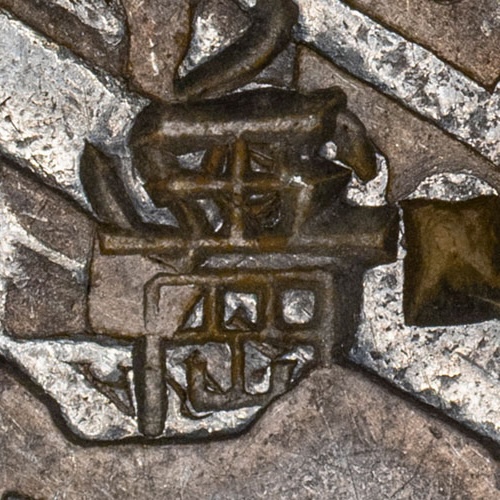 Probably 崗 - gǎng - mound, lookout post, sentry, guard
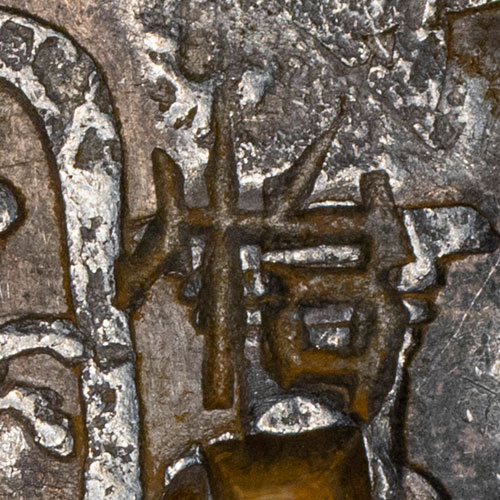 怡 - yí - happy, joyful
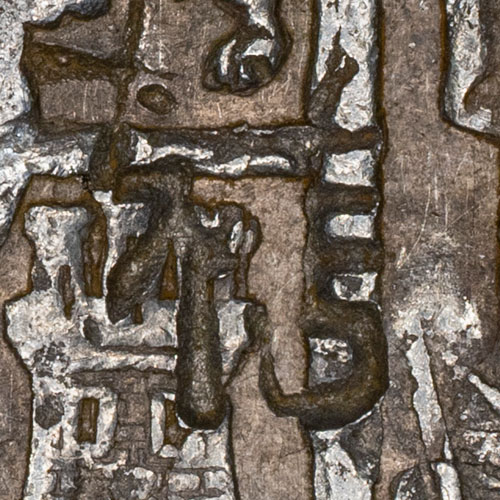 Similar to 䄆 - huó or huàn - to worship, an institution, law, to perform rites in honor of gods
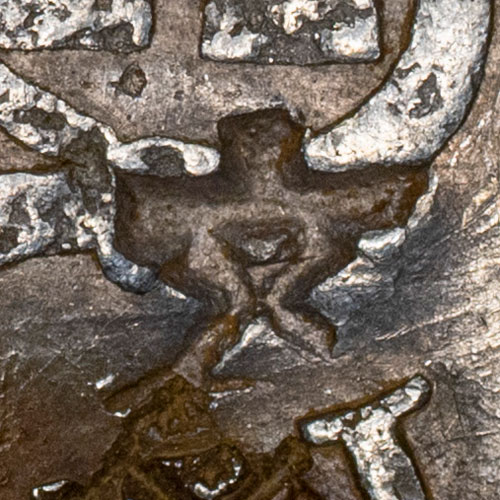 文 - wén - writing, literature, culture, (old) classifier for coins
Provenance:
Purchased from Hong Kong dealer Mateo Zhao in April 2025. Mateo notes that this coin was found in Jiang Xi province, China in 2023.
1813 New South Wales 15 Pence / Dump
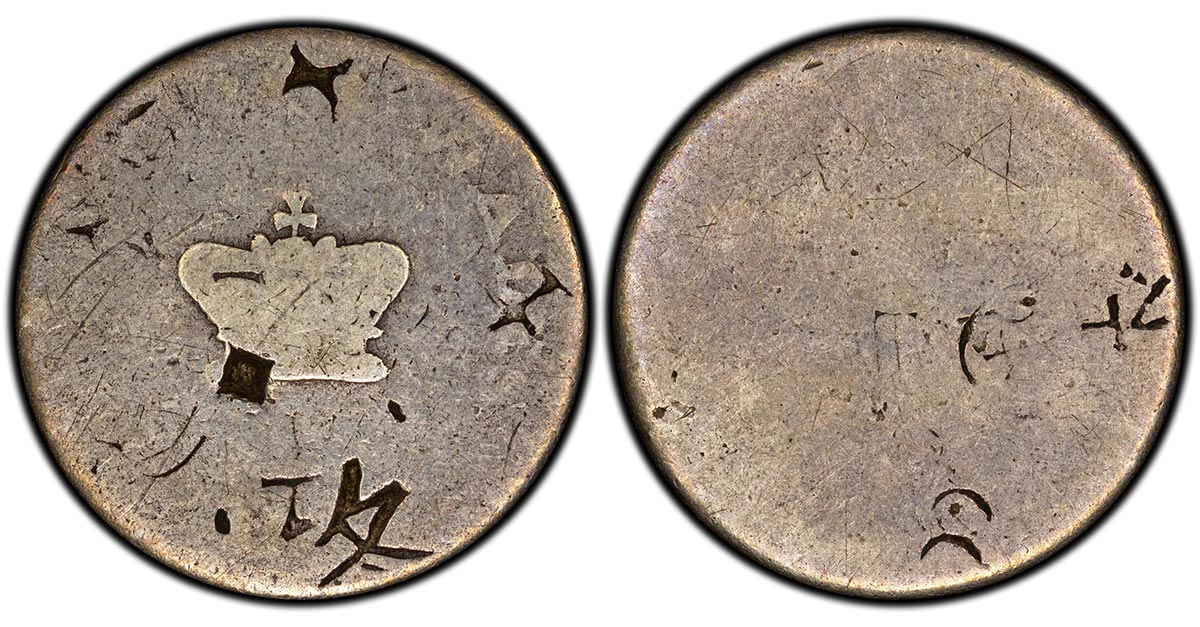
Specifications:
.903 fine silver (matching Spanish 8 Reales these were made from)
Recorded mintage: 39,910 (estimated)
Catalog reference: KM 1.1
Details:
When the colony of New South Wales was founded in 1788, there was an overall shortage of coins circulating. Most foreign coins including British, Dutch, Indian and Portuguese left
the colony by way of trade with visiting merchant ships. The colonists were forced to barter, and a popular local rum became unofficial currency. The practice of using rum as a
currency was prohibited by Governor Bligh in 1806, eventually culminating in the overthrow of the government with the "Rum Rebellion" in 1808.
To overcome this shortage of coins, Governor Lachlan Macquarie used Spanish dollars sent by the British government to produce suitable coins. For this purpose, 40,000 Spanish dollars arrived on November 26th, 1812 on the HMS Samarang from Madras, via the East India Company.
Included with the shipment were strict instructions to prevent the newly arrived coinage from leaving the country, so after consultation with the Judge Advocate and other officials, Governor Macquarie employed a convicted forger named William Henshall to cut the centers out of the coins and counterstamp them, making them useless outside the colony. The central plug (known as a dump) was valued at 15 pence (1 shilling, 3 pence), and was restruck with a new design (a crown on the obverse, the denomination on the reverse), while the holey dollar received an overstamp around the hole ("New South Wales 1813" on the obverse, "Five Shillings" on the reverse). This distinguished the coins as belonging to the colony of New South Wales, creating the first official currency produced specifically for circulation on the island. The combined nominal value of the holey dollar and the dump was 6 shillings, 3 pence, or 25% more than the value of a Spanish dollar, making it unprofitable to export the new coins from the colony.
The project to convert the 40,000 Spanish coins took over a year to complete. Of the 40,000 Spanish dollars imported, 39,910 holey dollars and 39,910 dumps were made, with the balance assumed to have been spoiled during the conversion process. On July 1, 1813 Governor Macquarie issued a proclamation that the new money shall be a legal Tender, also setting their value. The converted coins went into circulation in 1814.
From 1822, the government began to recall the coins and replace them with sterling coinage. By the time the holey dollar was finally demonetized in 1829, most of the 40,000 coins in circulation had been exchanged for legal tender and melted down into bullion. Experts estimate that only 350 holey dollars and 1500 dumps remain extant.
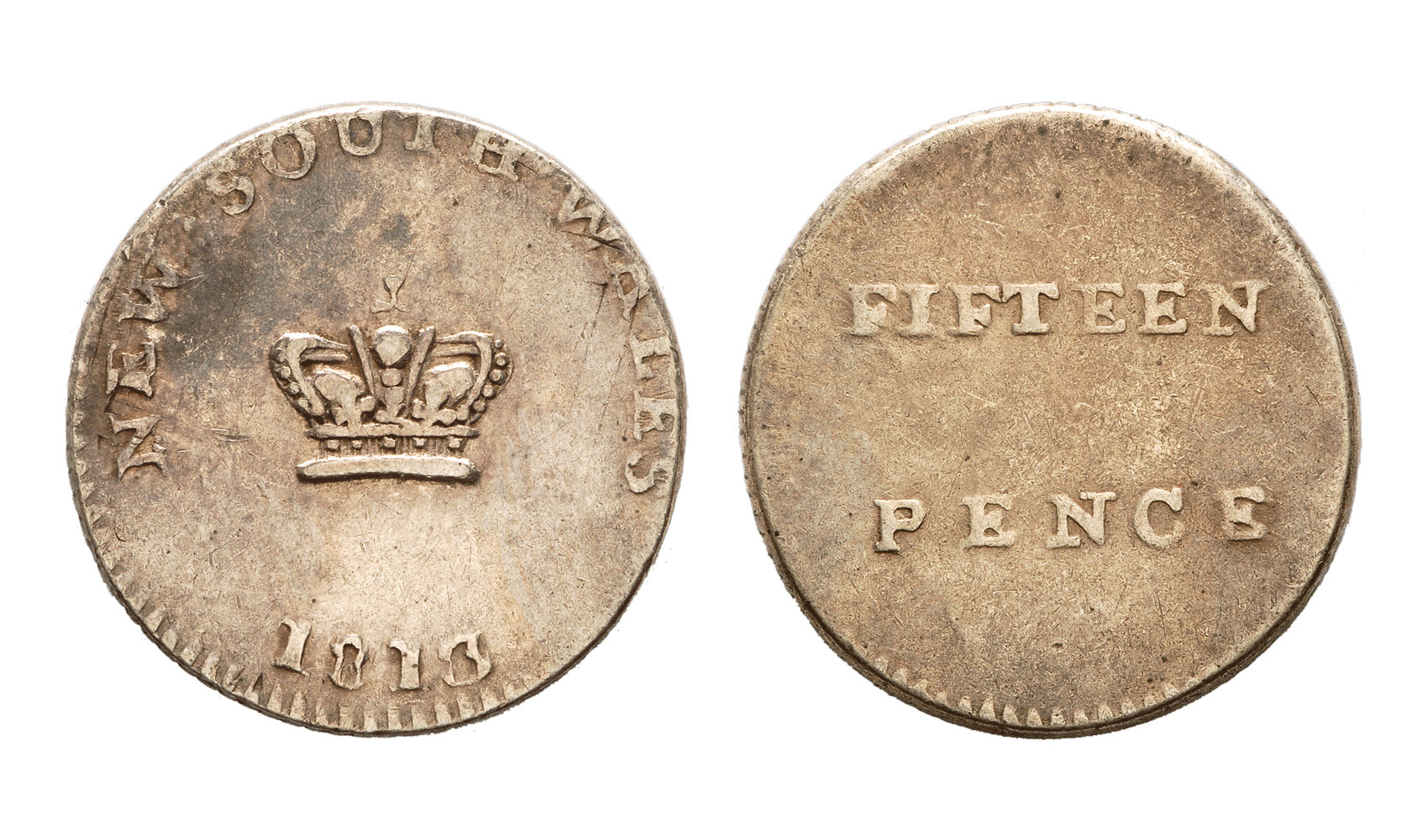
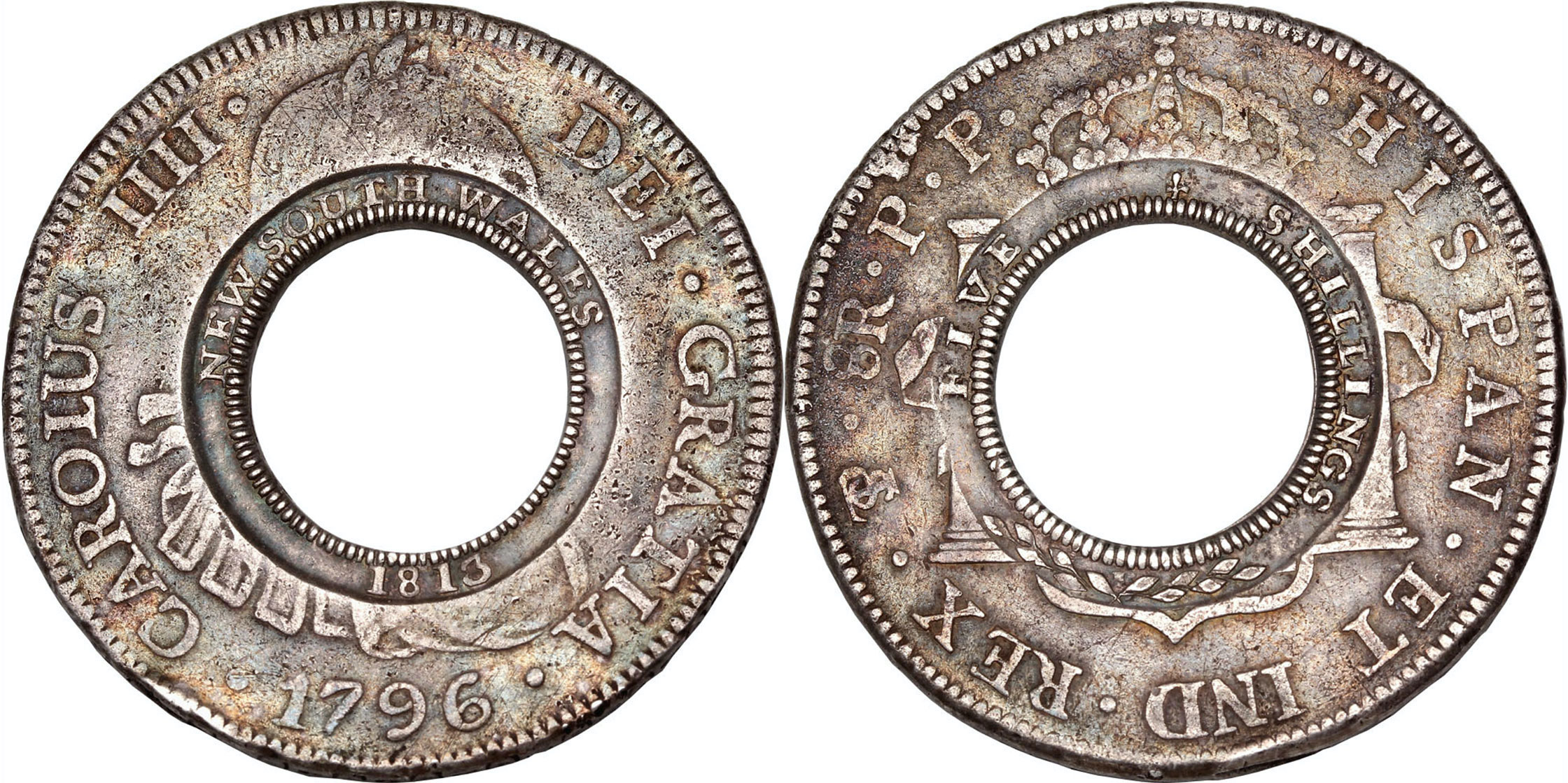
Notable chopmarks:
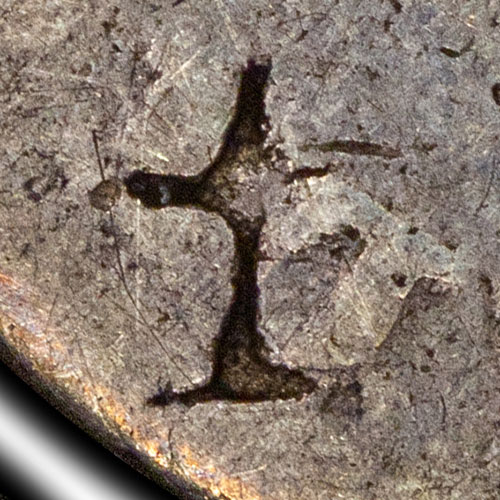 土 - tǔ - earth, soil, land, Japanese radical 32
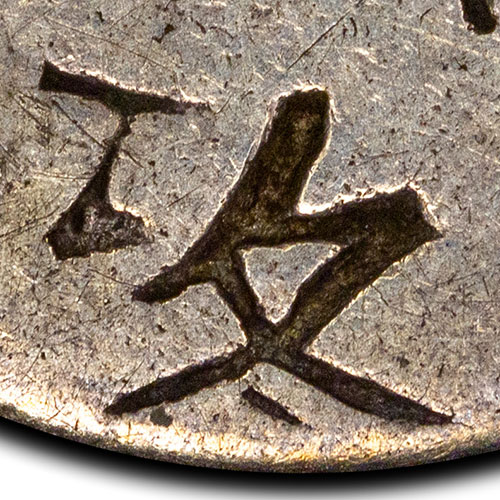 攻 - gōng - attack, study
Provenance:
From the Noble Auctions 121 sale 30 Jul–2 Aug 2019 in Sydney Australia Lot #1168
Auction Description:
NEW SOUTH WALES, fifteen pence or dump, 1813 (Mira dies A/1). Heavily worn, good/poor but cleaned, with Chinese chopmarks, one of only about four known. (with Chinese chopmarks)
1814-Ga MR Guadalajara, Mexico War for Independence 8 Reales
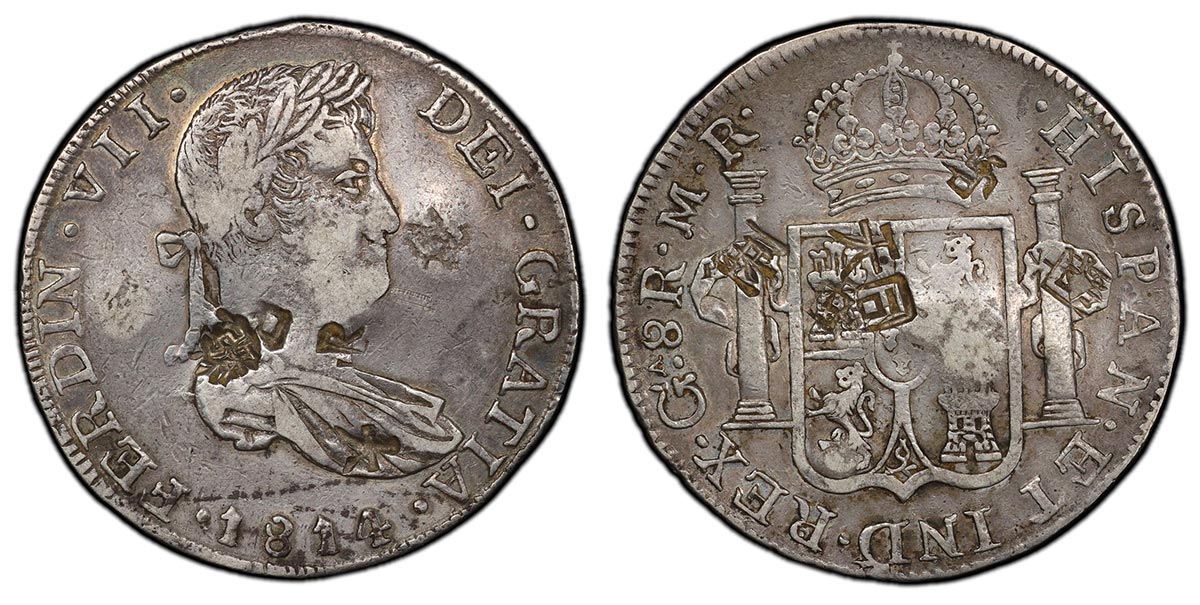
Specifications:
27.07 g, .903 fine silver, .780 troy oz (actual silver weight)
Recorded mintage: unknown
Catalog reference: KM 111.3
Details:
The 1814-Ga MR (Manuel de la Rocha) Guadalajara 8 reales (KM-111.3) was struck during the height of Mexico’s War for Independence (1810–1821) at the Guadalajara mint, a facility
established only a few years earlier in 1812 to serve western New Spain. The mint was created out of necessity, as insurgency, disrupted communications, and regional instability
made reliance on Mexico City impractical. Operating under difficult wartime conditions and shifting political control, Guadalajara produced crown-size silver to sustain local
commerce and military finance. Issues of this period are typically scarcer and more irregular than peacetime royal coinage, reflecting both the youth of the mint and the pressures
under which it functioned.
The presence of Chinese chopmarks indicates that this insurgency-era crown later circulated as bullion silver within Asian trade networks, detached from its original political setting. Mexican 8 reales, regardless of mint or faction, continued to move west via established Pacific routes through Acapulco and Manila, where acceptance depended on metal content rather than legitimacy. Chopmarks on a Guadalajara independence issue highlight this neutrality of the silver market: although the coin was struck amid rebellion and contested authority, its silver ensured acceptance abroad. The piece thus records both the regional improvisation of wartime Mexico and the continued global reach of Mexican silver in the early 19th century.
Notable chopmarks:
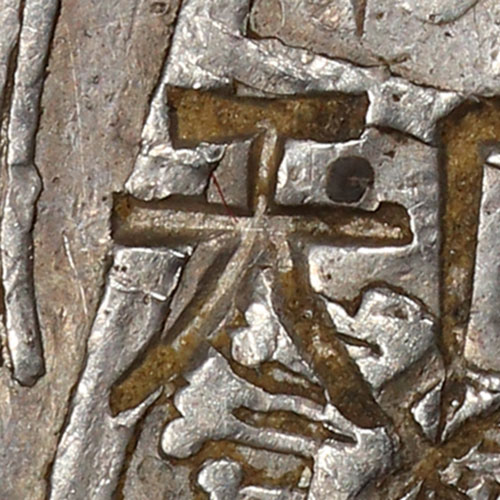 天 - tiān - heaven, sky, day
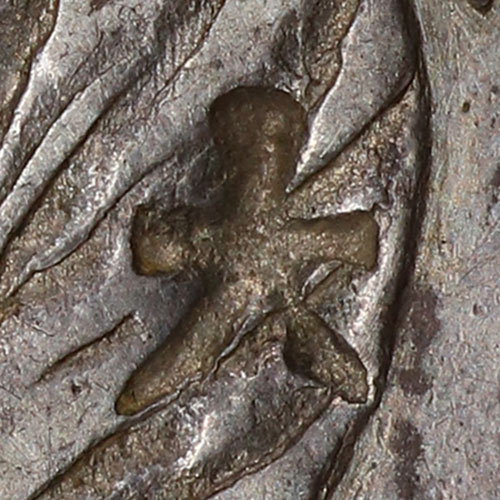 大 - dà - big, great, large
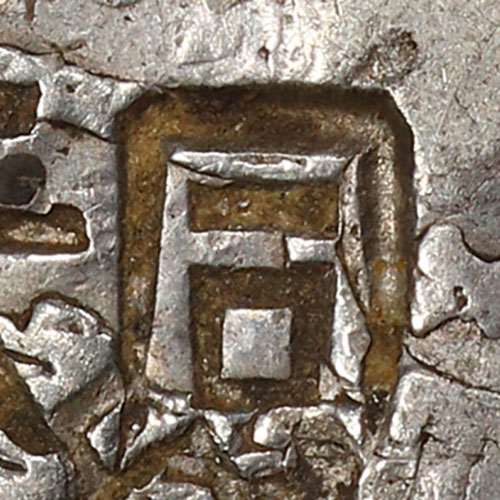 同 - tóng - same, together, with
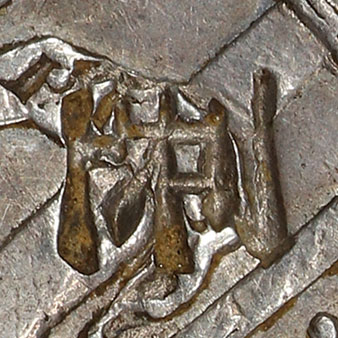 俐 - lì - clever, smart
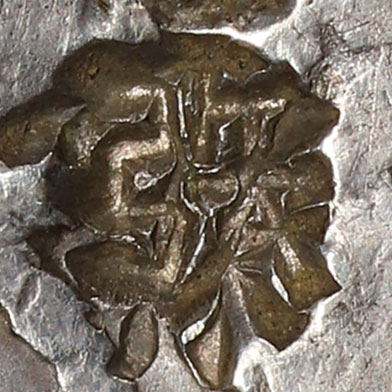 矤 - shěn - arrow
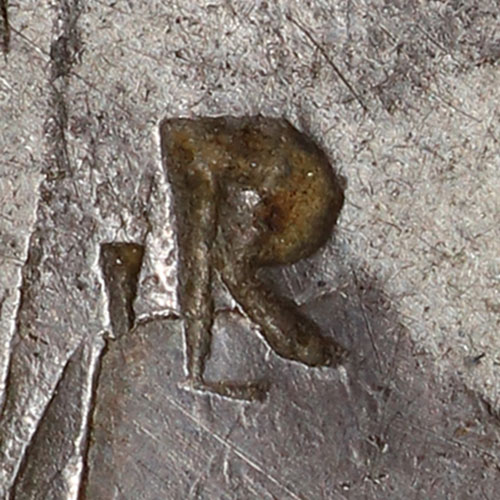 R - Latin-letter chopmark
Provenance:
From the Tauler y Fau May 2018 Floor Auction #10 (Madrid, Spain)
Lot #438
Auction Description:
8 reales. 1814. Guadalajara. MR. (Cal-438). Ag. 27,06 g. Resellos orientales. Raros sobre esta ceca. MBC.
1814 Spain 8 Reales, Cadiz mint, Ferdinand VII Type
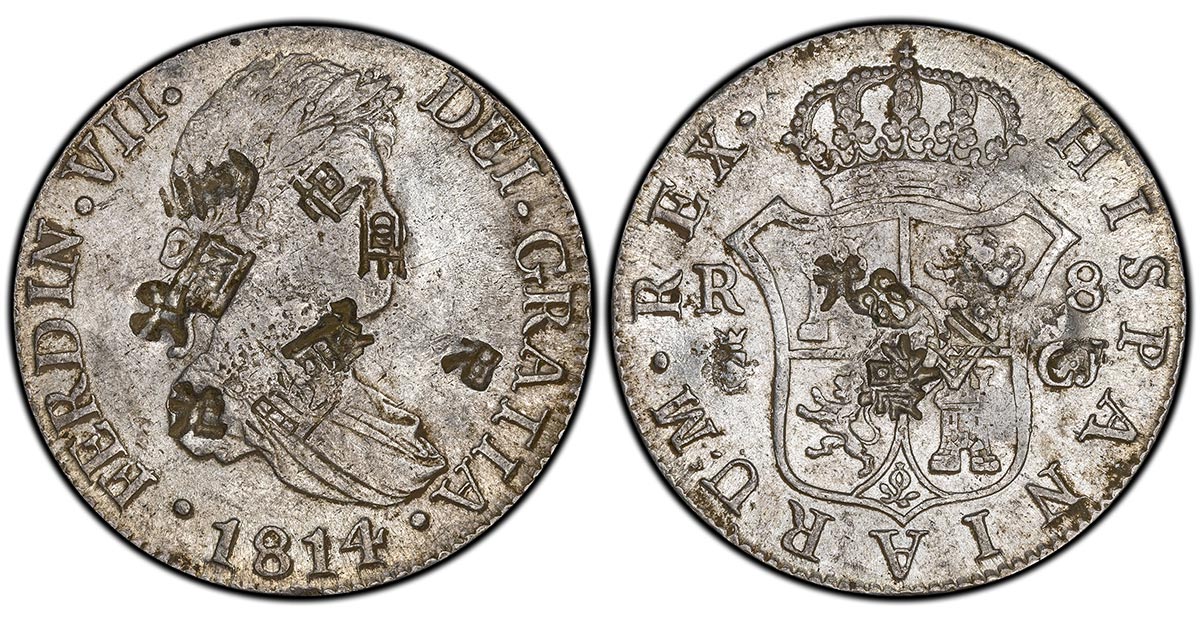
Specifications: 27.07 g, .903 fine silver, .7859 troy oz (actual silver weight) Recorded mintage: unknown but available Catalog reference: KM 466.2
Details: The Peninsular War (1807–1814) was the military conflict fought in the Iberian Peninsula by Spain, Portugal, and the United Kingdom against the invading and occupying forces of the First French Empire during the Napoleonic Wars. In 1808, the French army invaded Spain and by 1811 had overwhelmed most Spanish resistance. One holdout was the port of Cadiz, sustained by aid from the British navy. There the Supreme Junta issued eight reales of this type 1810-15.
Following the occupation of Seville, Cádiz became the Spanish seat of power, and was targeted by 70,000 French troops under the command of the Marshals Claude Victor and Nicolas Jean-de-Dieu Soult for one of the most important sieges of the war. Defending the city were 2,000 Spanish troops who, as the siege progressed, received aid from 10,000 Spanish reinforcements as well as British and Portuguese troops. During the siege, which lasted two and a half years, the Cortes of Cádiz – which served as a parliamentary Regency after Ferdinand VII was deposed – drew up a new Spanish Constitution to reduce the strength of the monarchy, which was eventually revoked by Fernando VII when he returned.
Notable chopmarks:
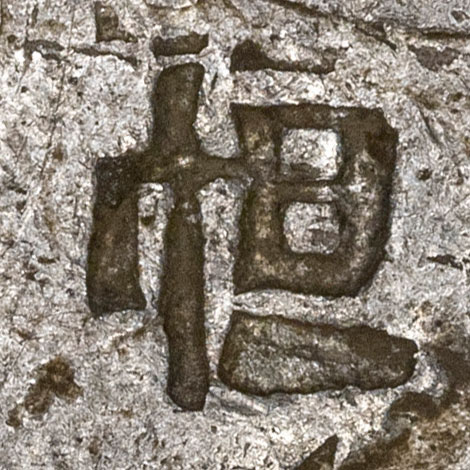 恒 - héng - constant, persistent
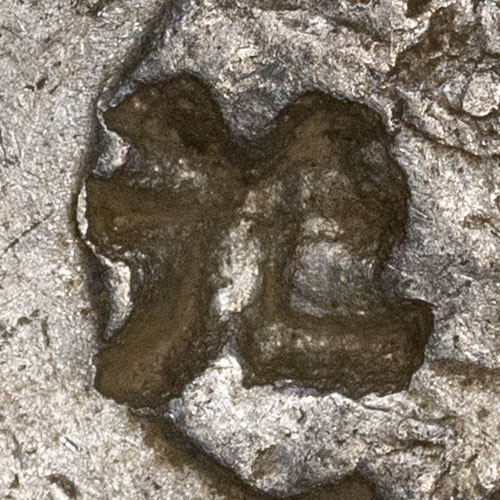 光 - guāng - light, brilliant, shine; only
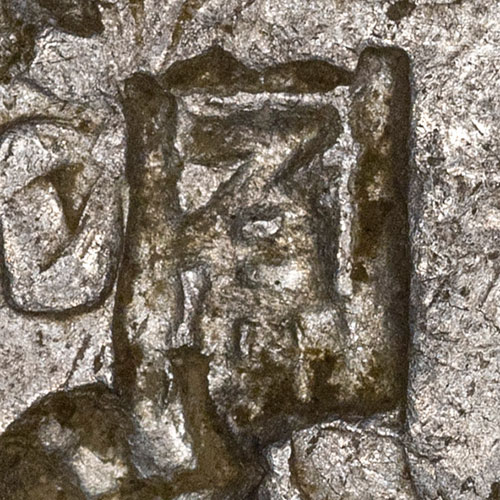 Unknown character
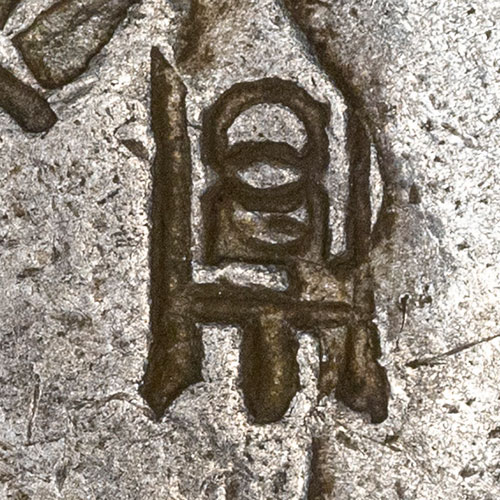 Unknown symbol
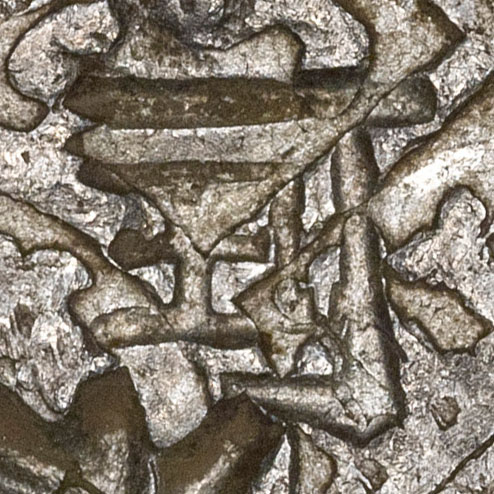 Unknown Character
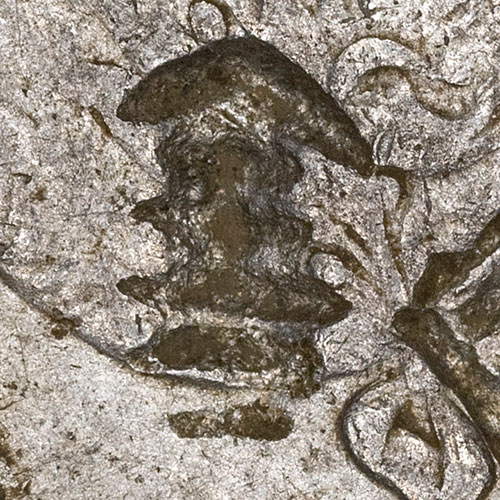 Unknown character
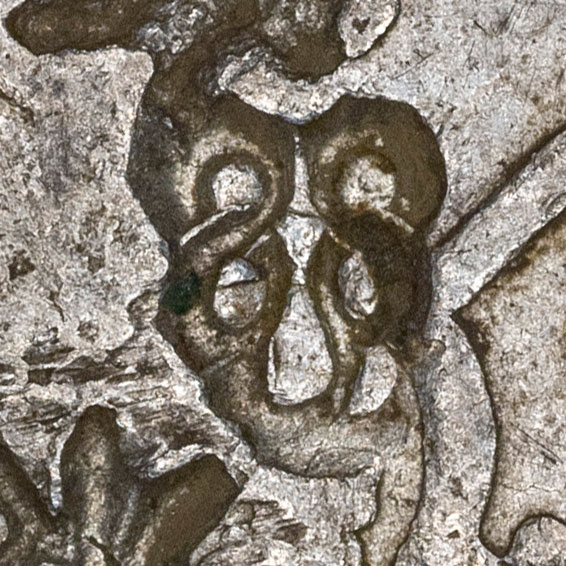 Unknown symbol
Provenance:
From the Stack's Bowers September 2023 World Collectors Choice Online Auction
Lot #75688
The lot was comprised of 2 coins, an Unc details 1795-S Charles IIII and this coin. A representative of Stack's passed on information that both of these coins came from a massive collection purchased as part of an estate. No additional information is available, unfortunately.
1815-PTS PJ Bolivia 8 Reales Ferdinand VII draped bust type (Royalist issue during wartime)
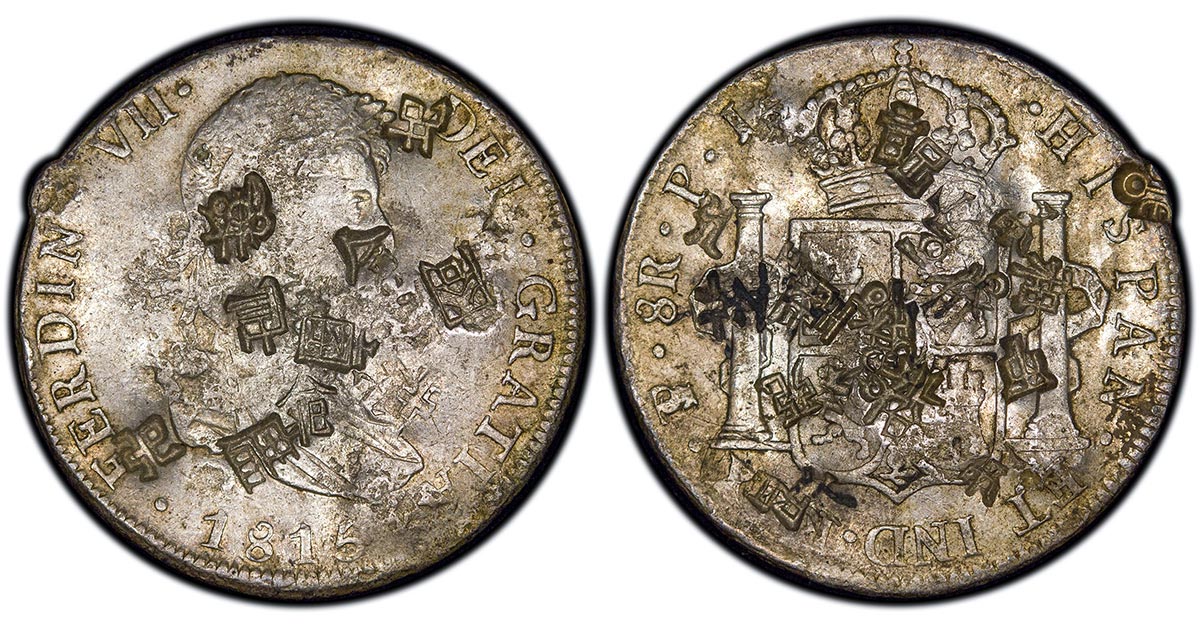
Specifications:
27.07 g, .896 fine, .780 troy oz (actual silver weight)
Recorded mintage: unknown
Catalog reference: KM 84
Details:
The 1815-PTS PJ Bolivia 8 reales (KM-84) was struck at the Potosí mint during a volatile phase of the South American wars of independence, when control of Upper Peru shifted
repeatedly between Spanish royalist forces and patriot armies aligned with the United Provinces of the Río de la Plata. From 1813 to 1815, the mint changed hands several times,
disrupting production. In 1815, royalist forces regained and held Potosí long enough to resume organized operations, issuing a substantial quantity of crown-sized silver bearing
the draped bust of Ferdinand VII, restored to the throne in 1814. Although minting resumed at scale, operations still reflected wartime realities, with pressures on bullion
supply and administration. Even amid shifting political control in Upper Peru, Potosí 8 reales continued to move into established trade channels, as the evidenced by the chopmarks.
Notable chopmarks:
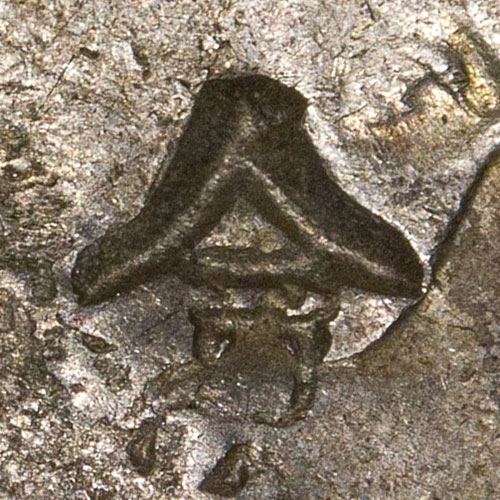 合 - hé - combine, join, close, suit
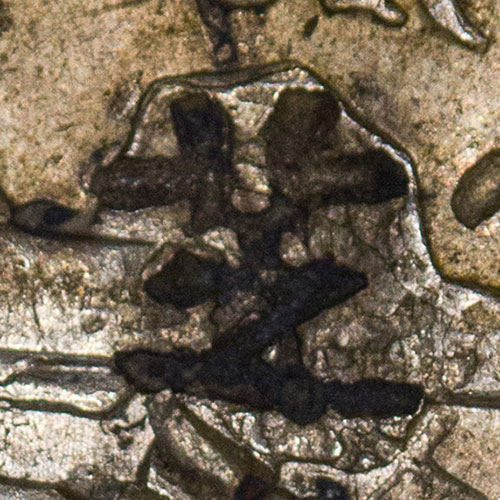 芝 - zhī - sesame, glossy ganoderma
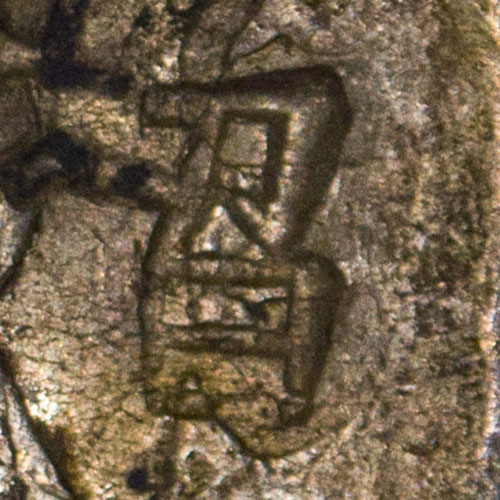 召 - zhào - summon, call
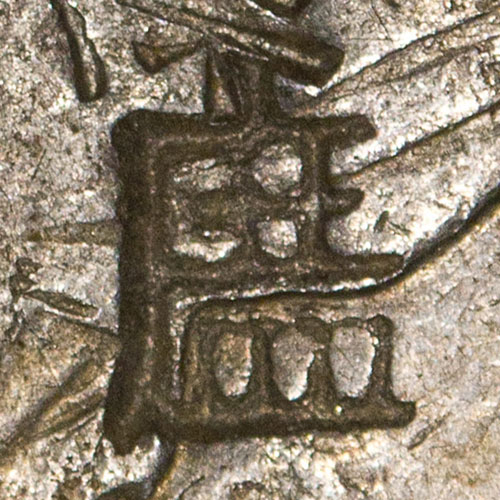 庶 - shù - numerous, many, common, ordinary, born by a concubine or illegitimate partner
Deeper explanation of this character: The Shù character is seldom used today, it means "lowborn citizen". It was only really used by nobles to describe everyone below them. Merchants
were actually considered really low class, and would often earn enough money to buy their way into political office and become a noble themselves. One thought might be that the coin was
stamped to indicate it was for use by the commoners. Another thought could be that it was an insult or inside joke to tease other merchants, but this is pure speculation. The synonym of
Shù is 嫡, which means highborn - first child of the first wife. Since polygamy was a thing, the first wife would have all the true heirs, and the cocubines children were all of the Shù
side. If you use the two words together, it can mean family tree, and how the wife and concubine family are separated.
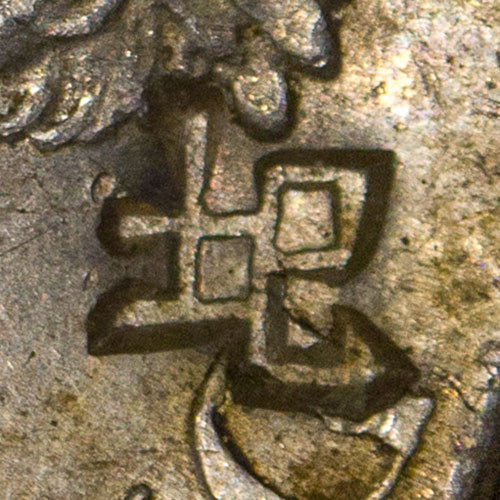 圯 - yí - bridge
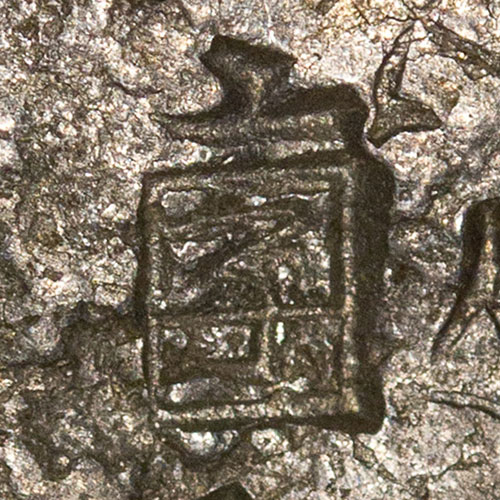 囝 - jiǎn - child
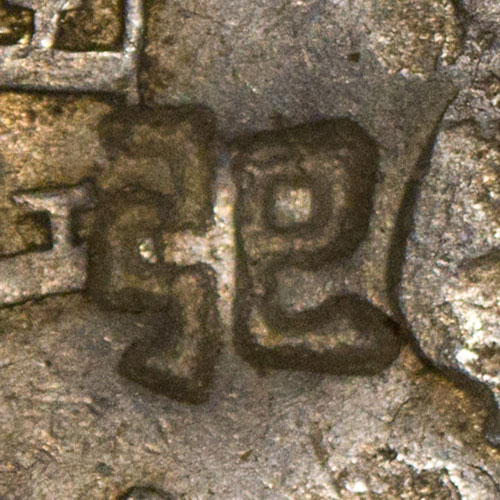 弓巳 - combination of 弓 - gōng, meaning "bow" (weapon) and 巳 - sì meaning "6th earthly branch"
Provenance:
From the Ron Waddell Collection
Purchased from Ron via private sale in September 2016
1815-B Brazil 960 Reis over 1804-PTS PJ Bolivia 8 Reales (Ex. Goodman / Waddell)
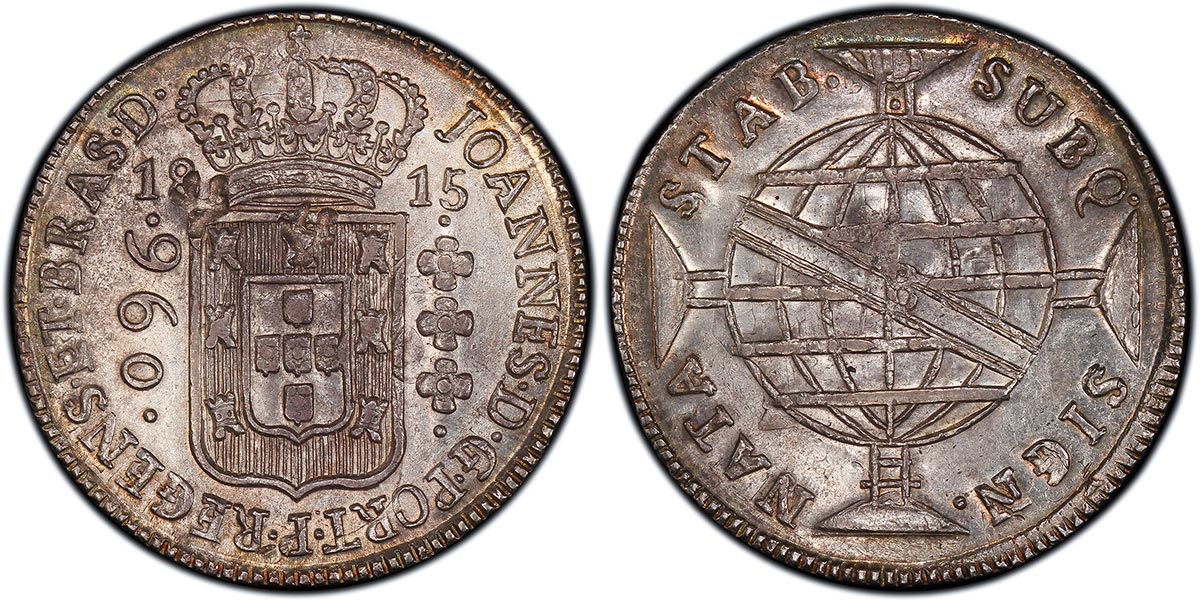
Specifications:
26.89 g, .896 fine silver, .775 troy oz (actual silver weight)
Recorded mintage: unknown
Catalog reference: KM 307
Details:
The 1815-B Brazil 960 Réis (KM-307), struck over an 1804-PTS PJ Bolivia 8 Reales, is an emergency overstrike produced at the Bahia mint during a pivotal moment in Brazilian
monetary history. Following the transfer of the Portuguese royal court to Rio de Janeiro in 1808, Brazil became the administrative center of the Portuguese Empire, creating
acute demand for large-denomination silver coinage. Lacking sufficient domestic silver and formal planchets, Brazilian authorities authorized the conversion of circulating
foreign crowns, most commonly Spanish American 8 reales, into locally tariffed coinage. The 960 réis denomination was struck to meet this need, valued specifically for use within
Brazil’s colonial accounting system rather than for international trade.
The 1815-B issue belongs to the most historically significant phase of this program. In 1815, Brazil was elevated from colony to Kingdom of Brazil, forming the United Kingdom o f Portugal, Brazil, and the Algarves, and large-scale overstriking was undertaken to regularize the circulating silver stock. These overstrikes were often forceful and incomplete, leaving host-coin details visible beneath the Brazilian design, a deliberate and accepted consequence of expediency.
The Chinese chopmarks on this piece, hidden in the coat of arms, were applied after the Brazilian overstrike, a sequence made clear by their sharp, well-defined impressions, which would not survive a later restriking without distortion. This indicates that the 960 réis entered China-facing bullion circulation as a Brazilian coin, rather than merely as an earlier Spanish American crown. That distinction is important: it shows that Brazilian emergency silver, created for domestic necessity, could still move into long-distance trade networks where validation depended solely on metal. The chopmarks document merchant acceptance of the overstruck piece in its Brazilian form, providing direct evidence that early 19th-century Brazilian silver, even when struck over foreign hosts, participated in the same bullion economy that absorbed Spanish American dollars. To further this, Gullberg writes "The 960 Reis was 0.8960 fine giving an actual silver weight (ASW) of 0.7746 oz. of pure silver. Interestingly, the Brazilian 960 Reis appears in the Tawianese shroff handbook, proving that it did make it's way to Taiwan and China in the nineteenth century. The Taiwanese called it the "balloon silver.""
From Frank Rose's book "Chopmarks", page 14.:
"It is surprising that there is not a good supply of chopmarked 960 Reis of Elizondo's types 1 to 5. (Note: These are KM #'s-307, 313, 326, 368, 385). The overstruck 960's were a well known trade coin: and the silver value was certainly there. The 960 was one of the foreign coins that had legal tender status in the United States until the Act of 1857. If nothing else there should have been some carried from the U.S. by traders who threw in a few to top off a chest of silver. I have one chopmarked 960, but its chops are dubious: It is not shown."
Extremely rare with chopmarks, Gullberg estimates 2-5 known. Frank Rose owned one in his collection (but dubious chops, as stated above). It is surprising to me that this coin is shown in the shroff handbook, given they are so rarely found with chopmarks.
Notable chopmarks:
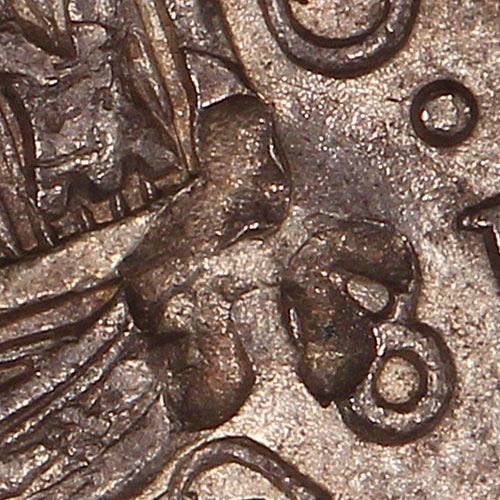 介 - jiè - between, introduce
Provenance:
From the Ron Waddell Collection
Purchased from Ron via private sale in June 2016
Ex. Superior Irving Goodman Sale June 2-4 1996, Lot #130
Auction Description:
BRAZIL. Joao as Regent. 960 Reis, 1815 (Bahia). Cr-94; Eliz-18: KM-307.1.
Perhaps the only Brazil coin we have noted with Chinese chop-marks. The Brazilians tried hard for over a decade to break into that lucrative trade market but were generally unsuccessful.
About Uncirculated.
Ex. Freeman Craig 8th Mail Bid Auction and Reference Catalog, May 1983, Sausalito, CA, lot #85
Auction Description:
Brazil 960 Reis 1815 Bahia, E18, C94, Over Potosi 180_PJ 8R. In our Nov. 1981 auction we offered a Minas shield c/m piece which also had Chinese chops. This piece is our first
regular 960 Reis to feature two large chopmarks. With Brilliant luster, Almost UNCIRCULATED.
Featured as the plate coin in Gullberg's Chopmarked Coins - A History, p.40
Also featured in the Chopmark Collector's Club newsletter, Volume 6 No. 1, January 2000, pages 6-7.
1815-16 Zacatecas, Mexico War for Independence 2 Reales
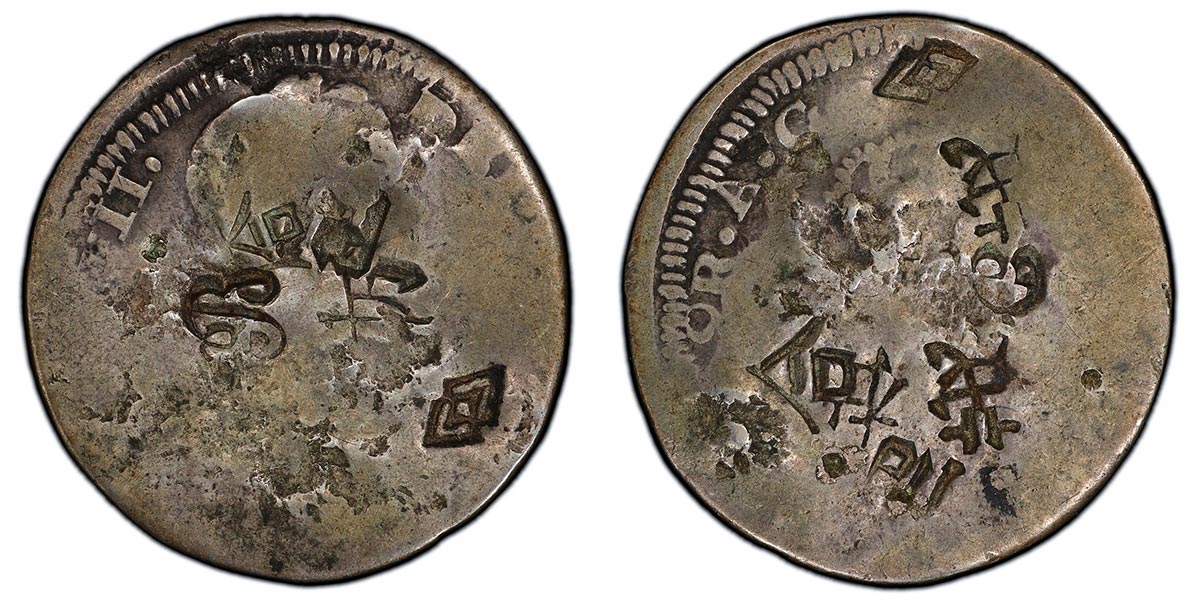
Specifications:
6.77 g, .896 fine silver, .196 troy oz (actual silver weight)
Recorded mintage: unknown
Catalog reference: KM 93.4
Details:
One of a series minted 1815-16 in Zacatecas during the reign of Ferdinand VII. It uses a local version of the "standard bust" of Ferdinand. The mounting anarchy unleashed
during the War of Independence forced the royal authorities to open branch mints, of which Zacatecas was one of the more prolific. Assayer AG is recorded for 1814-20. The
Zacatecas mint remained open after independence, striking coins for the Republic of Mexico until 1905.
This example shows that even crudely minted silver was accepted for commerce in China. The coin itself started out with an extremely poor strike prior to picking up some wear. Multiple chopmarks seen on both the obverse and reverse as well as a few drill marks.
I've been told by a 2 Reales specialist the date is likely 1816.
Notable chopmarks:
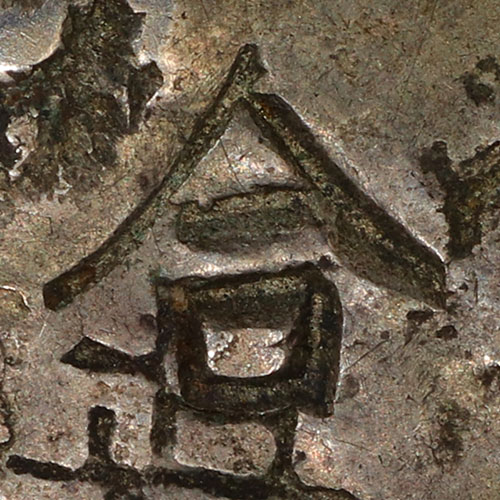 合 - hé - combine, join, close, suit
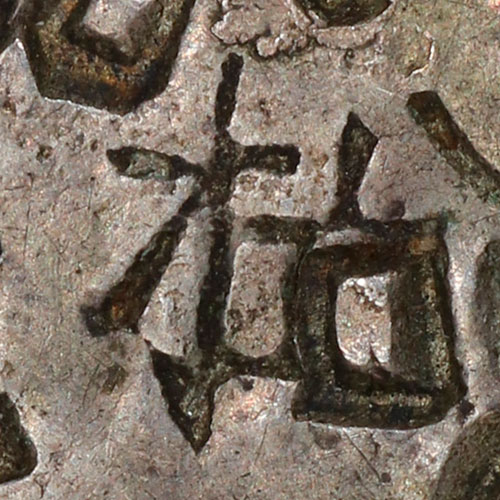 Combination of 才 and 土
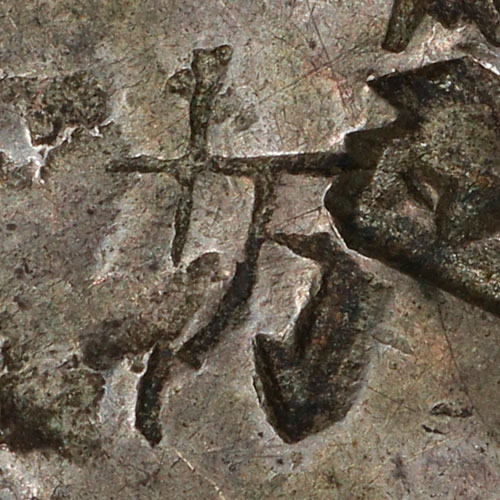 Combination of characters with unknown meaning
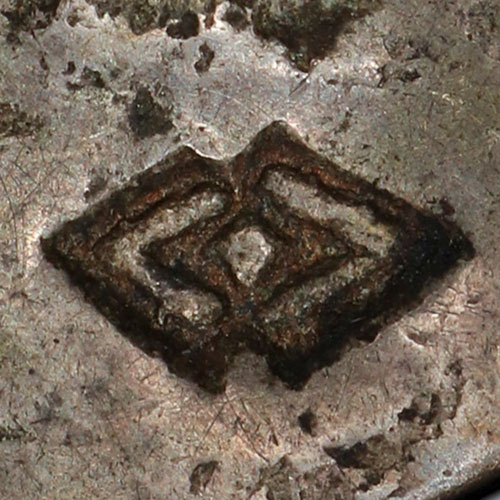 Double lozengeCommonly seen chopmarked on trade coins; significance not firmly identified.
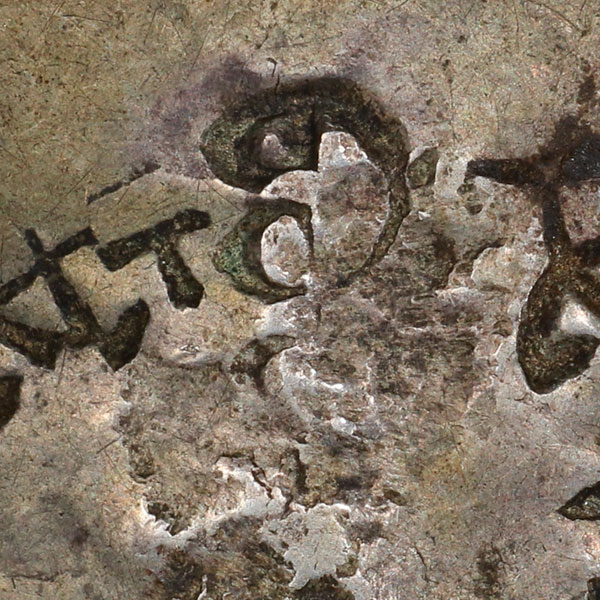 ᠪᠣᠣ - boo - treasure / mint mark (寶) - 'treasure, precious'; the Manchu equivalent of Chinese 寶 (bǎo). It is the word that opens Qing-dynasty cash-coin mint marks (boo + mint name, e.g. boo-ciowan), so as a chopmark it reflects the Manchu-script money vocabulary of Qing officialdom.
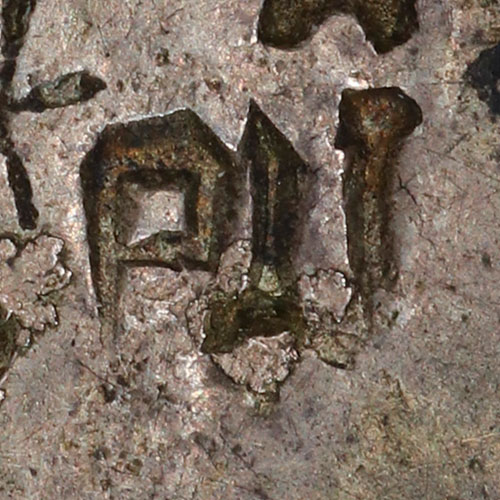 Partial chopmark, combination of characters with unknown meaning
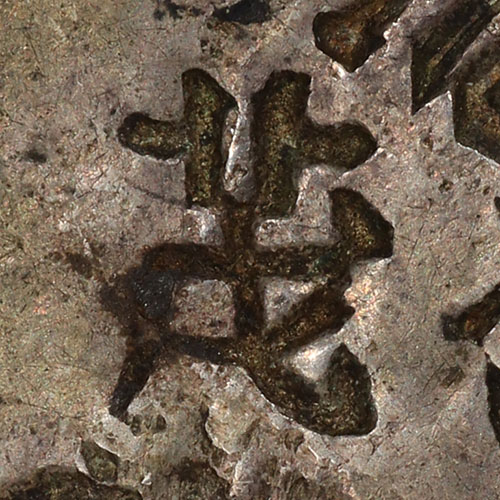 茂 - mào - luxuriant, dense
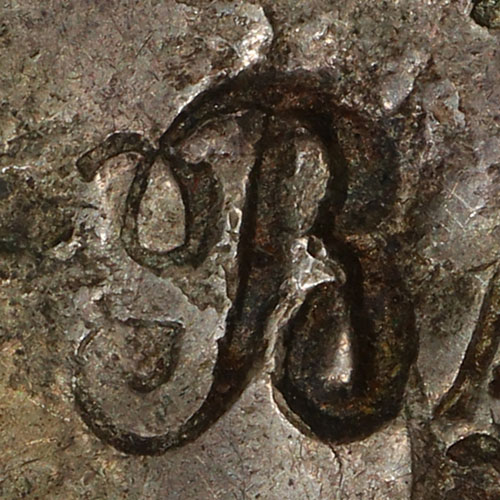 A cursive or monogram B - Latin-letter chopmark
Provenance:
Purchased on eBay in January 2018 from a seller in Wylie, Texas.
1816-L JP Peru 4 Reales Ferdinand VII draped bust type (Ex. Kendall)
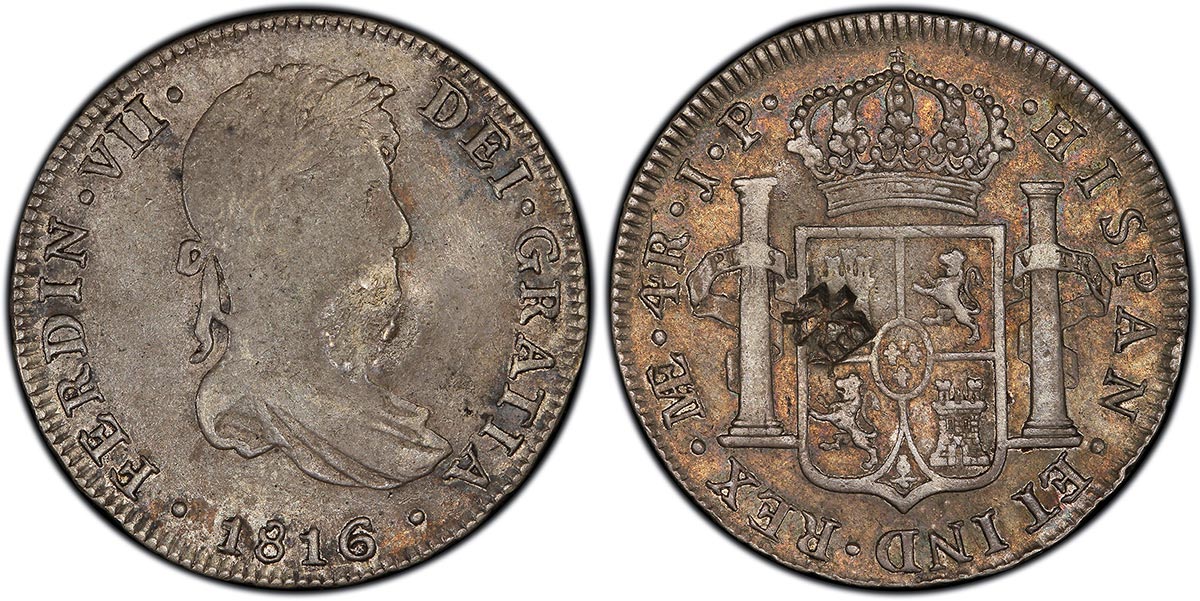
Specifications:
13.54 grams, .896 fine silver, .390 troy oz (actual silver weight)
Recorded mintage: unknown
Catalog reference: KM 116
Details:
Spanish 4 Reales from Lima, Peru of Ferdinand VII type. This specimen is one of a series struck 1811-21 during the reign of Ferdinand VII (1808-33). As a class, colonial coinage
of Peru is much less plentiful than that of Mexico, tho it is more available than the remaining mints. However, in his book "Pillars and Portraits" Harris noted finding about
one-fourth as many Peruvian four reales of Charles IV as that of Mexico, so it is safe to say that this type is scarce. Assayer "JP" is noted for the years 1803-23.
Nicely preserved with some thick skin tone and one reverse chopmark. The portrait is notriously weakly struck with this type, especially from this mint.
Notable chopmarks:
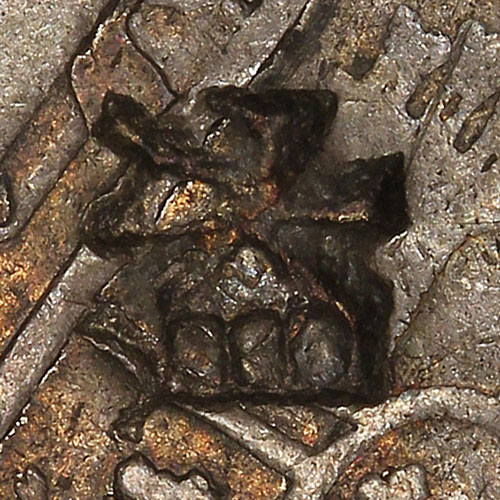 益 - yì - benefit, increase
Provenance:
From the Henry P. Kendall Foundation Collection
Stack's Bowers March 2015 Baltimore Lot #2634
Purchased from London dealer Geoffery Hearn, March 3, 1966
Auction Description:
Peruvian 1816-L 8 Reales Chopmarked for Asian Circulation
Peru. 1816-L JP 8 Reales. Cal-type 209 #745, KM-116. VF Details--Chopmark (PCGS). Secure Holder.
Lightly struck, as common for this issue. One chopmark in center of reverse attesting to brief circulation in Asia as Spanish silver coins were the preferred medium of exchange in global
trade at the time. Struck a mere five years before Peru
officially declared its independence from the now declining Spanish Empire. Toned with underlying peripheral luster.
From the Henry P. Kendall Foundation
Provenance: From the Henry P. Kendall Foundation Collection. Purchased from G. Hearn, March 3, 1966.
This auction included the original paper envelope from the 1966 sale.
Henry P. Kendall is considered one of the great American business leaders of the 20th century by the Harvard Business School, being instrumental in advancing the textile industry. He emphasized basic product research and the application of scientific management to all phases of manufacturing, purchasing and sales. His company was a major supplier of textiles for a variety of industrial and consumer uses, including Curity Diapers and Curad finger bandages.
1816-M GJ Spain 8 Reales, Madrid mint, Ferdinand VII type
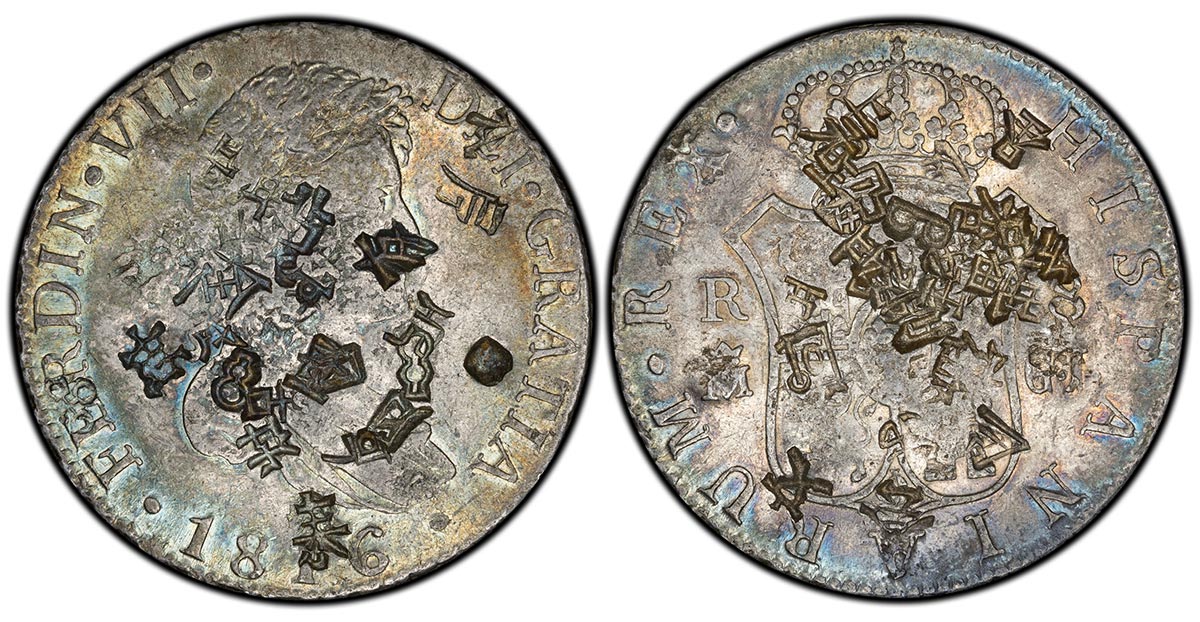
Specifications:
27.07 grams, .903 fine silver, .7859 troy oz (actual silver weight)
Recorded mintage: unknown
Catalog reference: KM 466.3
Details:
The 1816-M GJ Spain 8 reales from the Madrid mint, struck under King Ferdinand VII, reflects Spain’s effort to reassert royal authority and monetary stability in the turbulent
aftermath of the Napoleonic occupation (1808–1814) and during the early waves of independence movements across Spanish America. These 8 reales circulated both domestically and
abroad as a familiar and respected silver trade coin at a moment when Spain’s political power was waning, yet surprisingly they are quite scarce with chopmarks, especially when
compared to Mexican and Bolivian counterparts of the same time period.
Notable chopmarks:
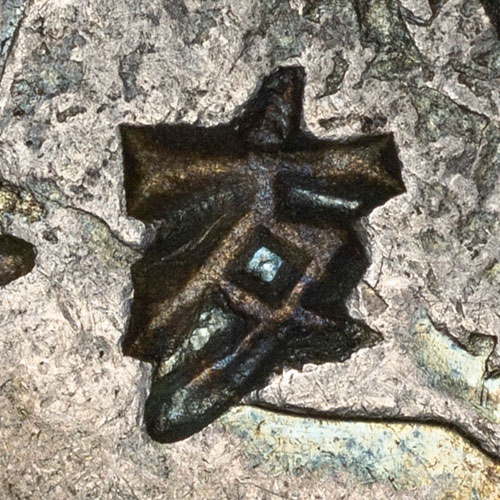 友 - yǒu - friend, friendliness
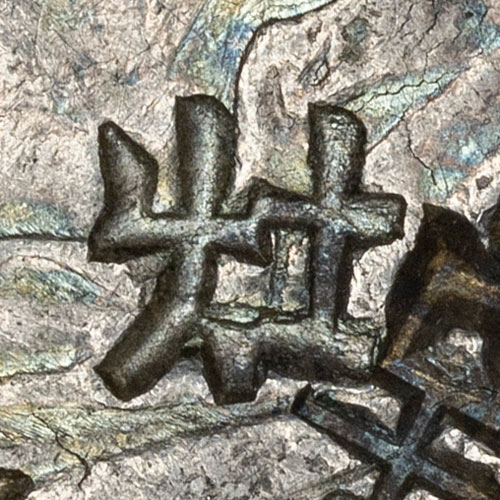 灶 - zào - kitchen stove
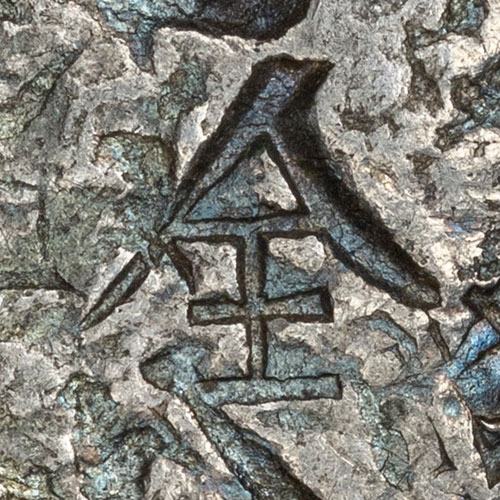 全 - quán - whole, complete, all
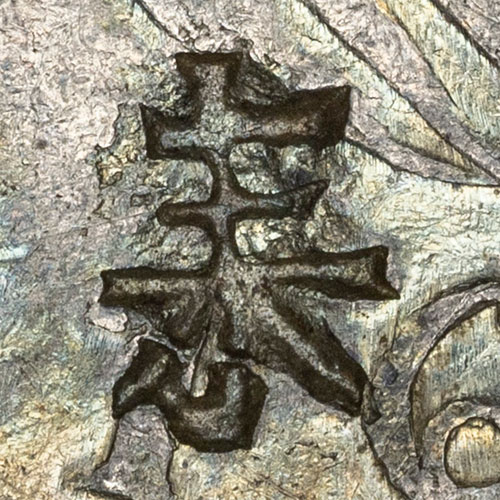 耒 - lěi - plow, plow handle
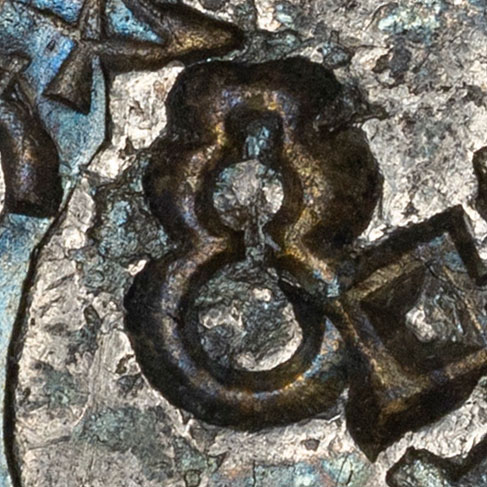 Bottle gourd (葫蘆)The gourd (葫蘆, húlu) is one of the most auspicious Chinese motifs: húlu echoes 福祿 (fúlù, 'blessings and prosperity'), and its many seeds wish for abundant descendants. It is a Daoist emblem of healing and immortality, the vessel of the immortal Li Tieguai (李鐵拐) and one of the hidden Eight Immortals' attributes (暗八仙), and is hung to ward off illness and evil.
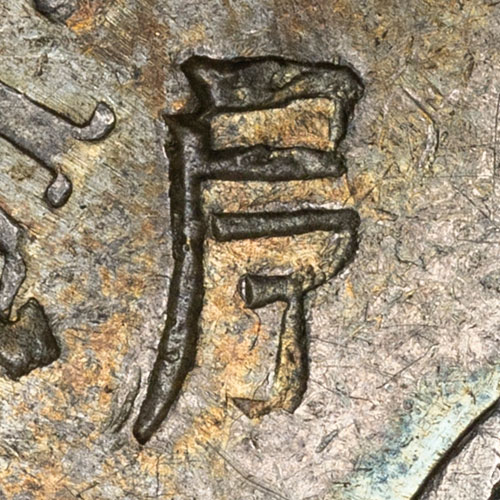 㞌 - yùn - pregnant, to conceive
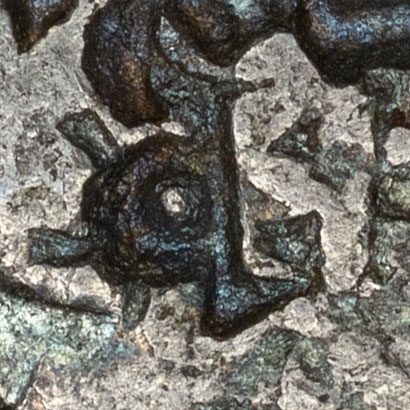 Possibly a manchu character, the vowel ū
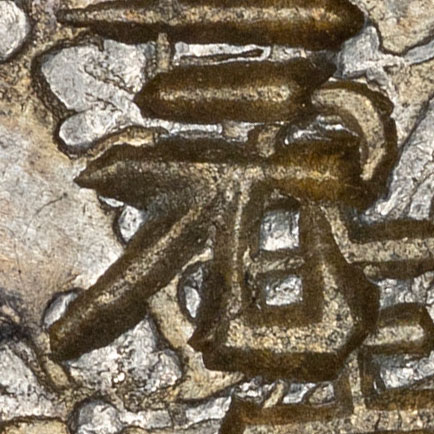 元 - yuán - dollar, unit of currency, basic, primary
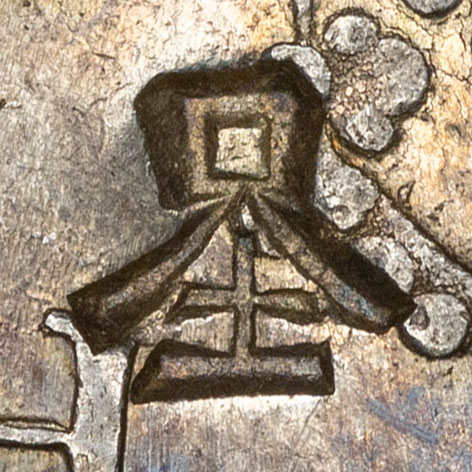 Unknown chopmark
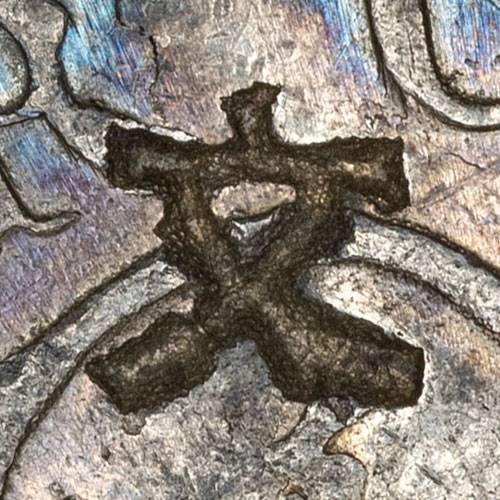 文 - wén - writing, literature, culture, (old) classifier for coins
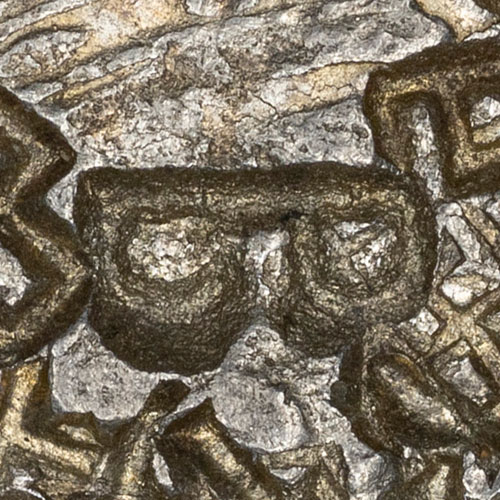 Possibly a manchu character
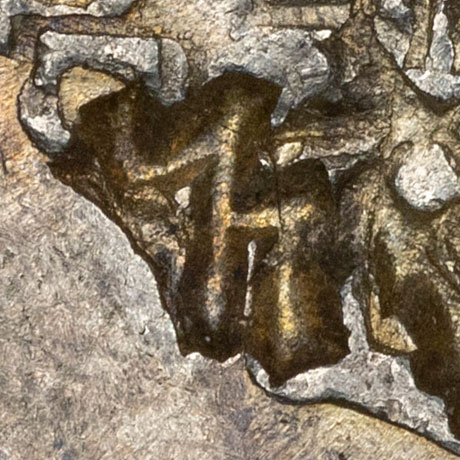 Unknown chopmark
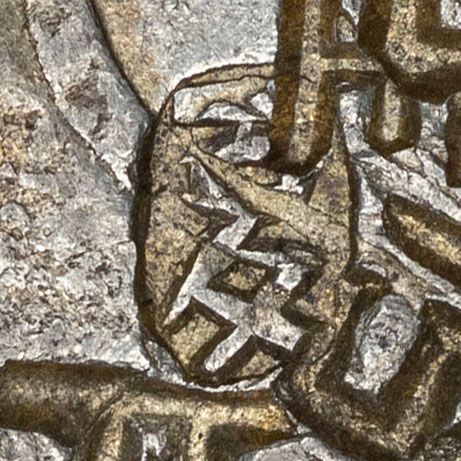 Unknown assayer chopmark
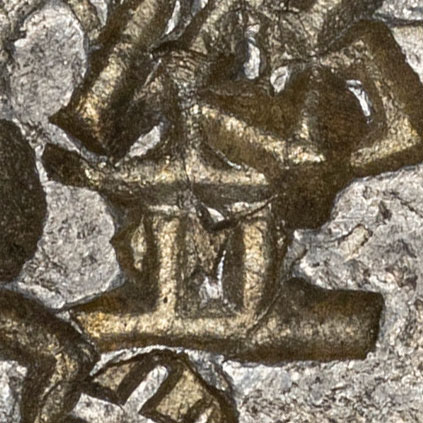 立 - lì - stand, establish
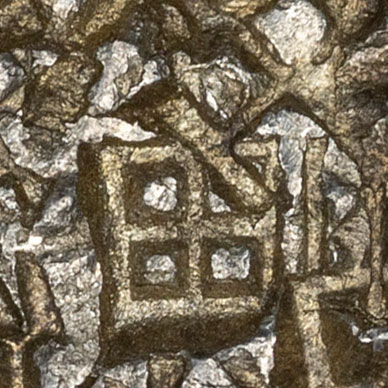 由 - yóu - from, reason, cause
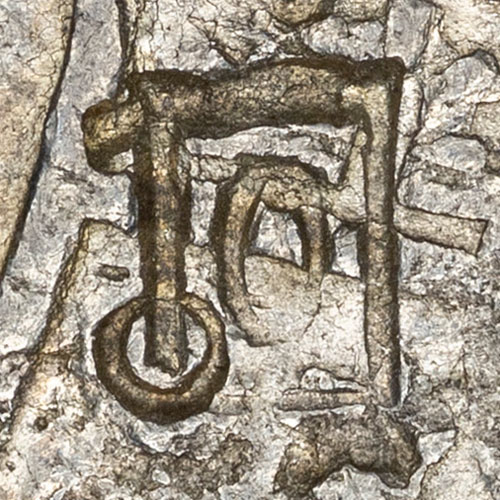
 - Seal script variant of 回 - huí - return, reply, turn
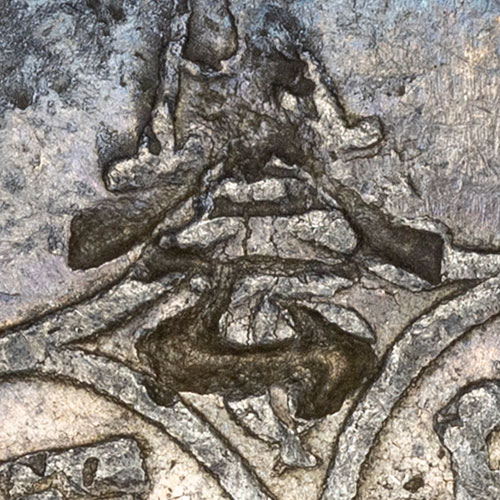 会 - huì - meet, gather, can
Provenance:
Stephen Album Rare Coins Auction 51, January 23-26, 2025 Lot #4073
Auction Description:
CHINESE CHOPMARKS: SPAIN: Fernando VII, 1808-1833, AR 8 reales, 1816-M, KM-466.3, about 12 or more large chopmarks on each side, an interesting group, VF-XF. A very rare European
host coin for Chinese chopmarks!
1817 Russia Alexander I Ruble
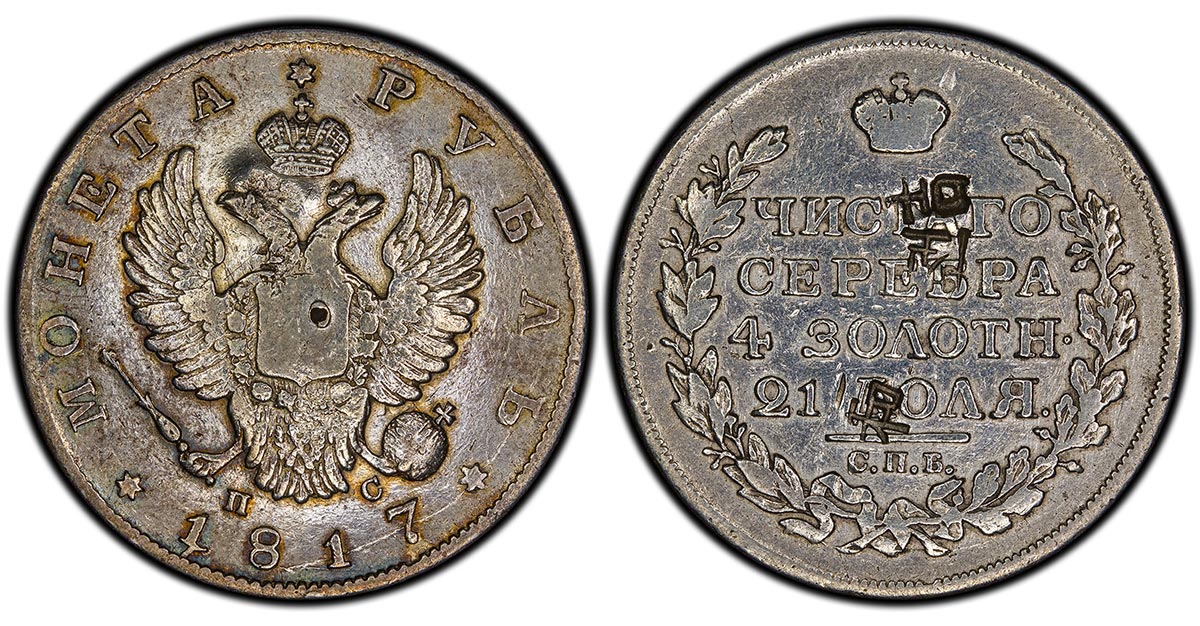
Specifications:
20.73 g, .868 fine silver, .5785 troy oz (actual silver weight)
Recorded mintage: 11,775,000
Catalog reference: KM C130, Dav-281
Details:
The 1817 Russian ruble, struck under Alexander I (1801–1825), belongs to the standard imperial silver coinage of the early nineteenth century, issued in the aftermath of the
Napoleonic Wars as Russia reaffirmed a stable silver-based currency. The type was struck for a number of consecutive years with a consistent design and monetary standard,
primarily at the St. Petersburg mint, and was intended for domestic circulation and state payments rather than overseas trade. With a standard of approximately 20.73 grams of
.868 fine silver, the ruble contained less total silver than a contemporary Spanish 8 reales, but remained substantial enough by weight to be readily assessed and accepted as
bullion in markets accustomed to evaluating crown-sized foreign silver.
The 1817 Russian ruble (KM C130; Dav-281) employs the eagle-type design, with the crowned double-headed imperial eagle occupying the obverse, holding orb and scepter as symbols of imperial authority, with the date placed below. The reverse presents a crown above a multi-line Cyrillic inscription stating the denomination РУБЛЬ (“ruble”) and issue formula, enclosed within a laurel wreath tied at the base, with mint and official letters incorporated into the reverse layout.
Russian silver entered China through a distinct pathway from the maritime trade that carried Spanish American and later Mexican dollars to the southern ports. Overland commerce between Russia and Qing China was regulated through frontier exchange systems centered on Kyakhta and related routes, where silver functioned as a settlement medium in trade involving tea, furs, and manufactured goods. Within these networks, coins circulated by weight and assay, and unfamiliar foreign pieces were subject to testing before acceptance. While Russian rubles are documented in this context, they appear far less frequently than Spanish or colonial crowns, reflecting both the geographic limits of their distribution and the specialized nature of Sino-Russian trade.
Chopmarked Russian silver remains exceptionally rare in the numismatic record. In Chopmarked Coins – A History, Colin Gullberg records only two authenticated examples of chopmarked Russian coins, both from the F. M. Rose collection, underscoring how infrequently Russian imperial silver entered commercial environments where chopmarking was practiced. This rarity aligns with the fact that most rubles reaching China did so through controlled overland channels rather than open maritime bullion flows. An 1817 ruble bearing Chinese chopmarks represents an unusual intersection between Russian imperial coinage and Chinese merchant validation practices.
Notable chopmarks:
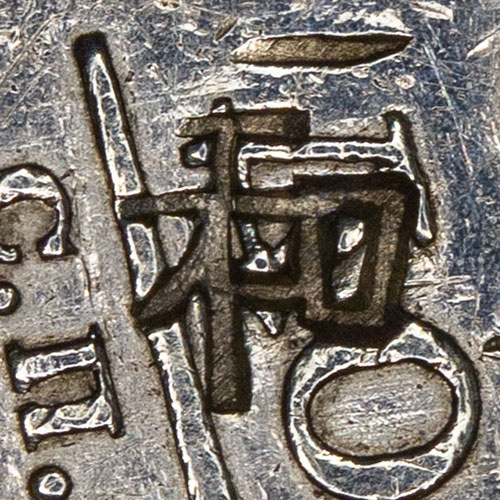 和 - hé - harmony, peace, and
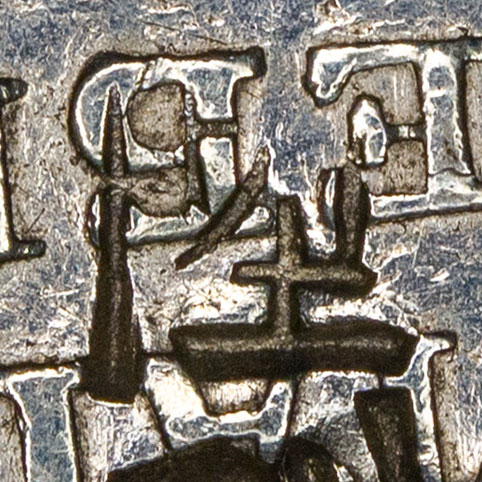 Partial chopmark, tough to decipher without the missing pieces
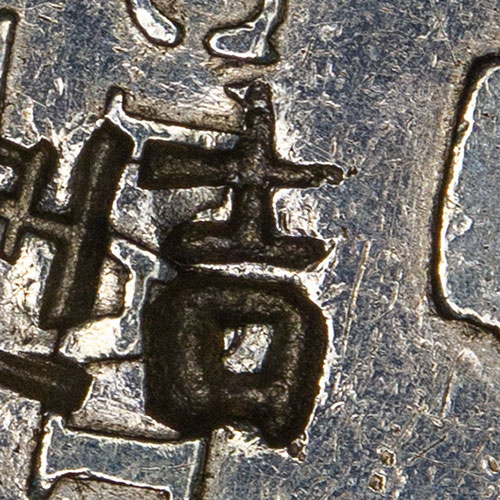 吉 - jí - auspicious, lucky
Provenance:
From Ben Dalgleish, a collector who finds chopmarked coins in the coin markets of Hong Kong, March 2020
1818-MO JJ Mexico 8 Reales Ferdinand VII draped bust type
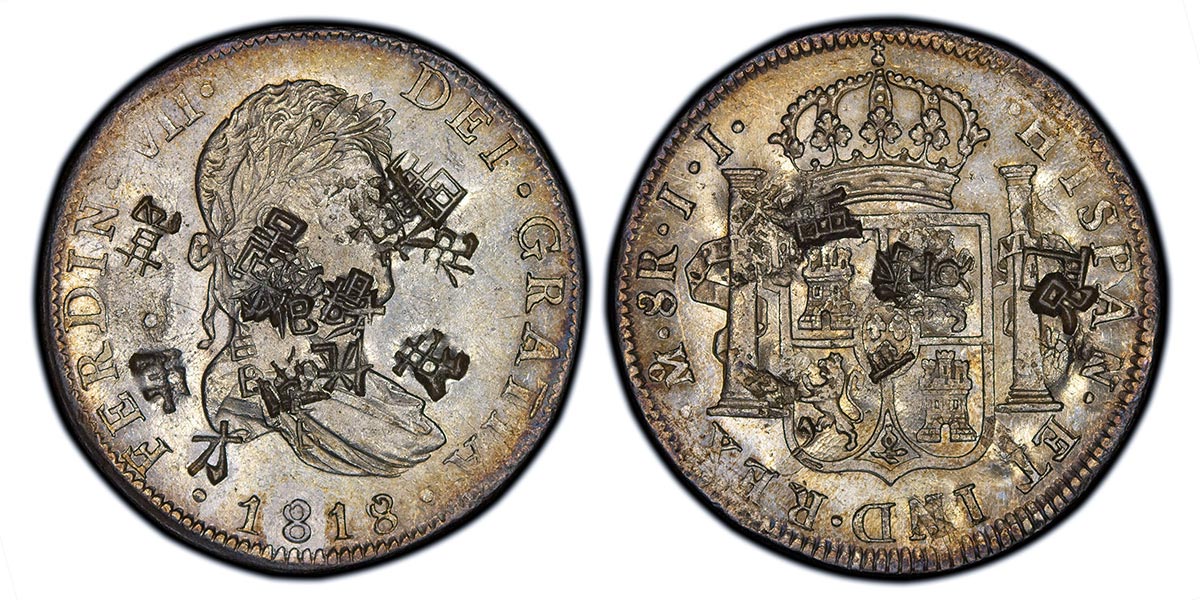
Specifications:
27.07 g, .896 fine silver, .780 troy oz (actual silver weight)
Recorded mintage: unknown
Catalog reference: KM 111
Details:
The 1818-Mo JJ (Joaquín Dávila Madrid, José García Anzaldo) 8 reales of Ferdinand VII, draped bust type, was struck 1811-1821, during the final and most unsettled years of Spanish
rule in New Spain, as the War for Independence disrupted administration but did not halt silver production. Mexico City remained the principal mint of the empire and continued to
issue crown-sized silver to the traditional standard, supplying both local circulation and long-established export channels. The type features the draped bust of Ferdinand VII with
full royal titulature on the obverse and the crowned Spanish arms on the reverse, a conservative design maintained even as political authority weakened.
The presence of Chinese chopmarks records the coin’s later circulation as bullion within China-facing trade networks, where Mexican 8 reales were long familiar and routinely accepted by weight and assay. Even by the late 1810s, Mexico City dollars continued to reach Asian markets through Pacific routes and private trade, and their established reputation ensured ready testing and validation by merchants. Chopmarked examples of this late Ferdinand VII issue are less frequently encountered than earlier pillar or bust dollars, and this is a particularly well preserved example.
Notable chopmarks:
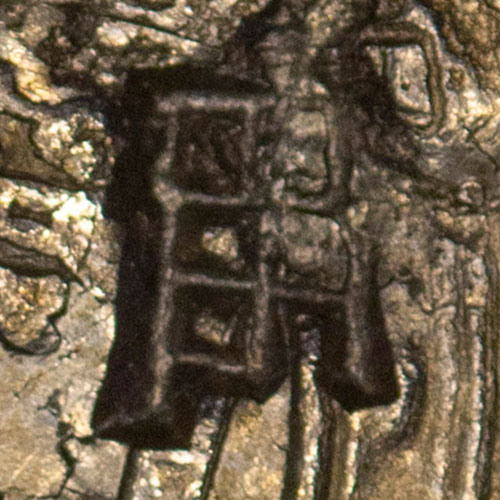 Similar to 用 - yòng - use, employ
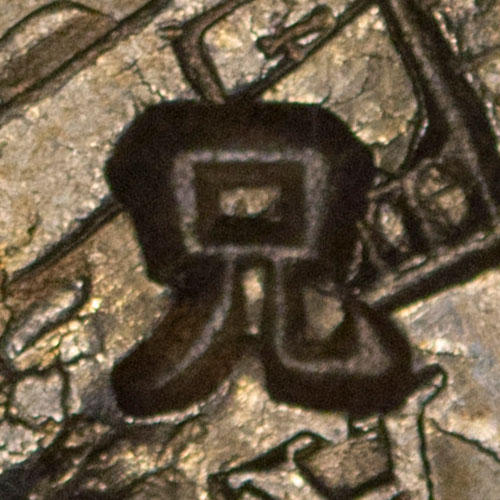 兄 - xiōng - elder brother
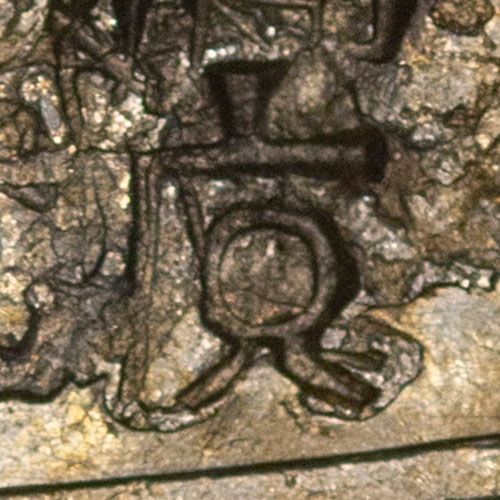 㡶 - zhǐ - dwell, to live in a place
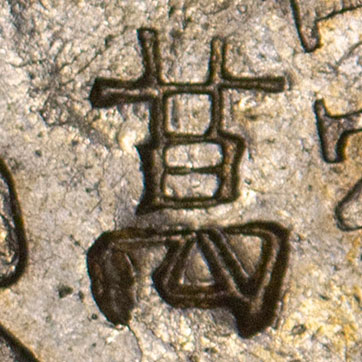 葛 - gé - kudzu, cloth
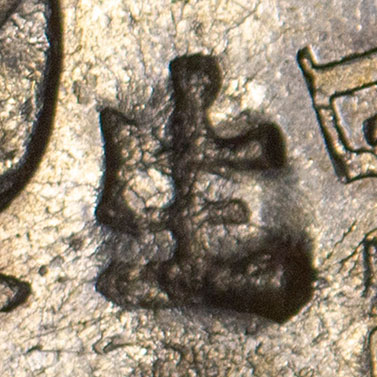 生 - shēng - life, birth, grow
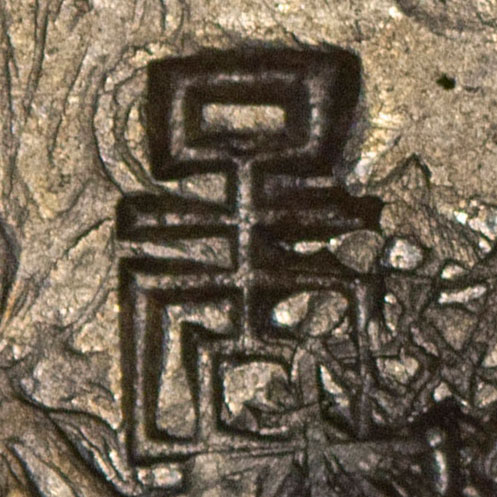 啚 - tú - mean, stingy
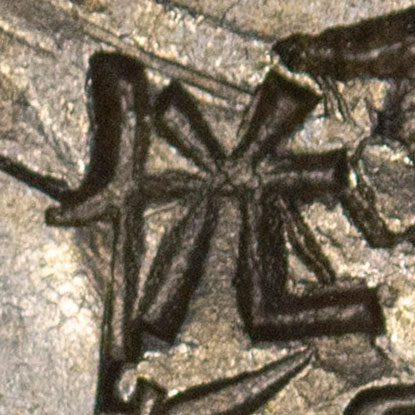 侊 - guāng - bright
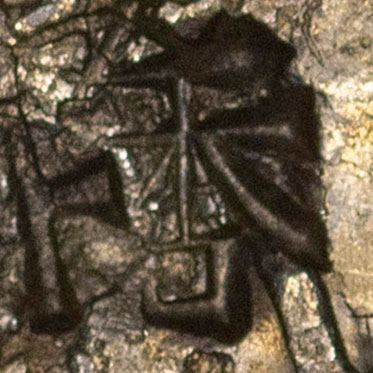 㕿 - Han character - not present in Kangxi dictionary
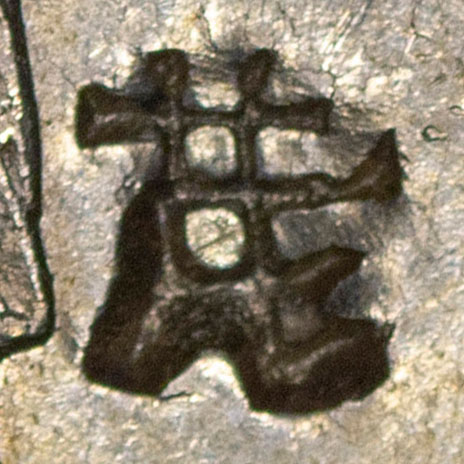 茂 - mào - luxuriant, dense
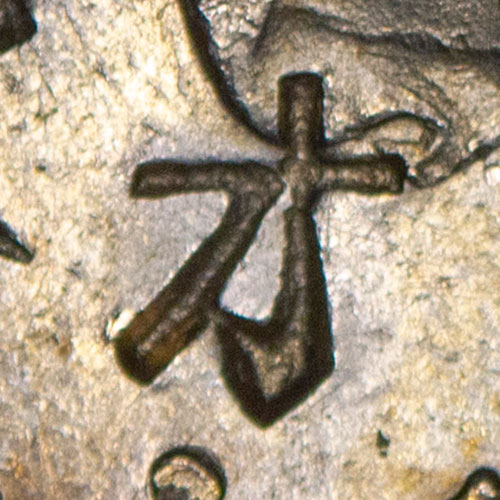 才 - cái - talent, ability, just
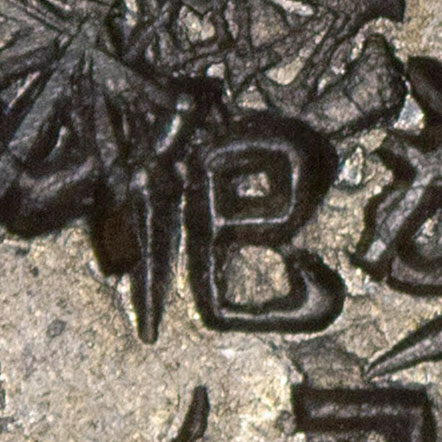 㐶 - (variant of 化) huà - to change, to transform, to become, to turn into
Provenance:
Purchased on eBay in February 2015 from a seller in Chicago, Illinois.
1818-MO JJ Mexico 8 Reales - shipwreck survivor
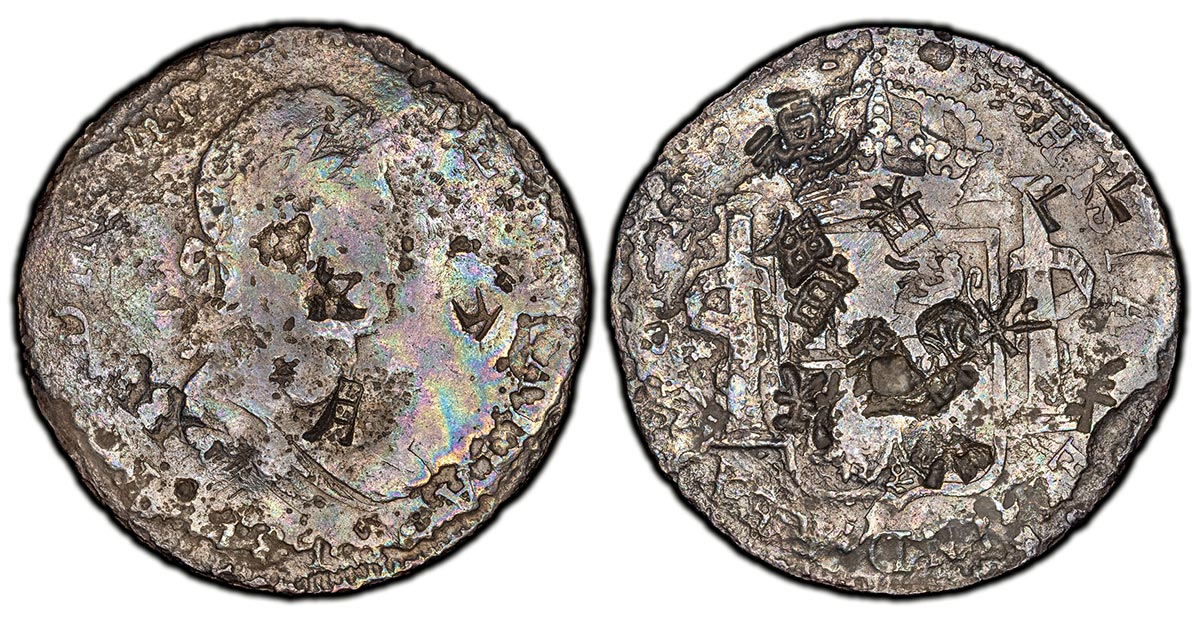
Specifications:
27.07 g, .896 fine silver, .780 troy oz (actual silver weight)
Recorded mintage: unknown
Catalog reference: KM 111
Details:
An 1818-Mo JJ Mexico 8 reales showing saltwater exposure is not surprising for silver that spent time in maritime commerce. Dollars were commonly shipped in bulk (bagged, boxed,
or in chests) as settlement coin for cargoes, and losses at sea, storm, grounding, fire, capture, or the ship’s crew quickly throwing heavy cargo overboard to save the vessel
when they were in immediate trouble, regularly left silver on the seabed to tone, corrode, or etch in a distinctive way. The chopmarks materially change the most likely path of
events, because they indicate the coin had already circulated in China-facing bullion markets before it sank; in other words, this isn’t just “Mexican coinage outbound,” but
Mexican coinage that reached China and then re-entered the export stream as bullion, a pattern explicitly seen elsewhere when chopped coins were later treated as ordinary trade
silver and moved onward (e.g., chopped pieces flowing back into colonial ports). In the 1810s this re-export could plausibly occur through the Manila–South China–Southeast Asia
corridor, especially as the traditional galleon system was breaking down and voyages were delayed or disrupted (with documented cases of ships not being allowed to discharge or
return on schedule).
Notable chopmarks:
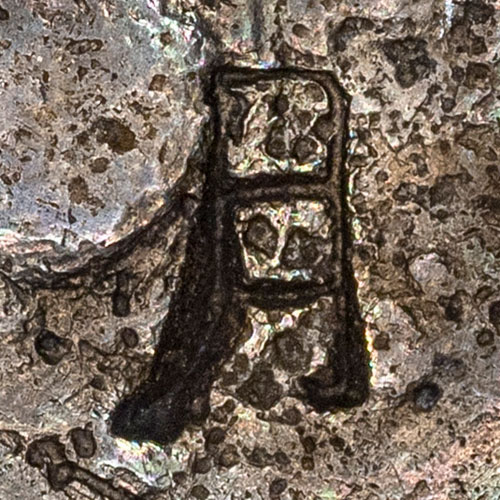 月 - yuè - moon, month
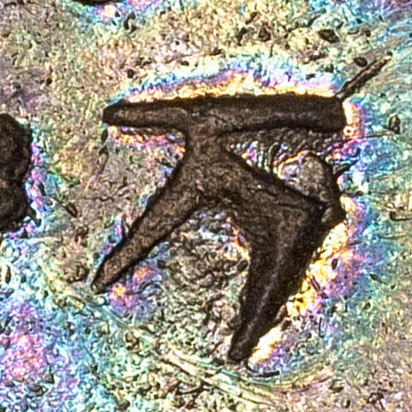 Probably 万 - wàn - ten thousand, myriad, also Japanese Kanji for various, many, all
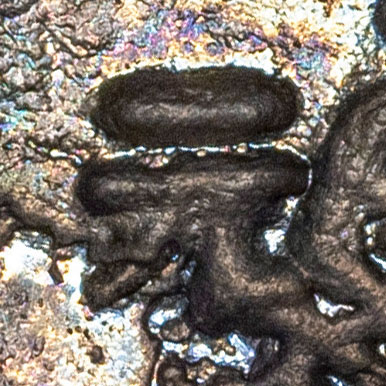 元 - yuán - dollar, unit of currency, basic, primary
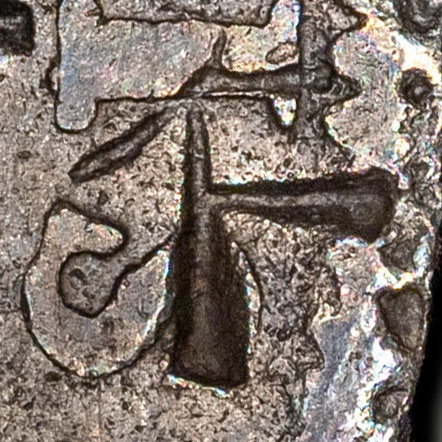 仁 - rén - benevolence, humanity, kernel
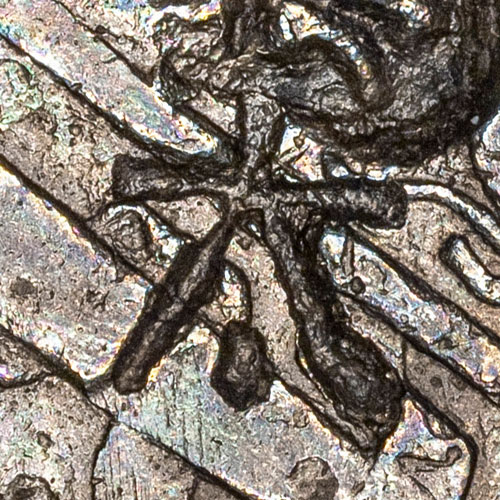 太 - tài - too, very, great
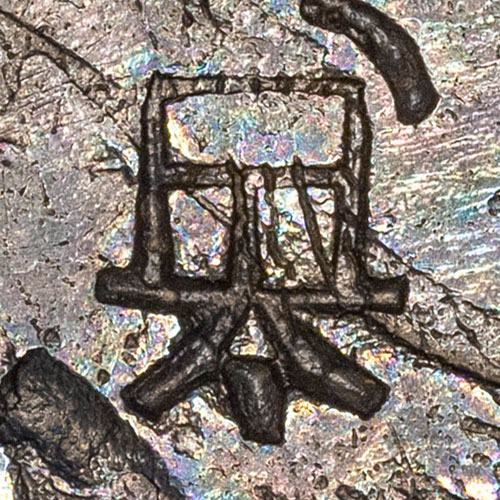 Unknown chopmark
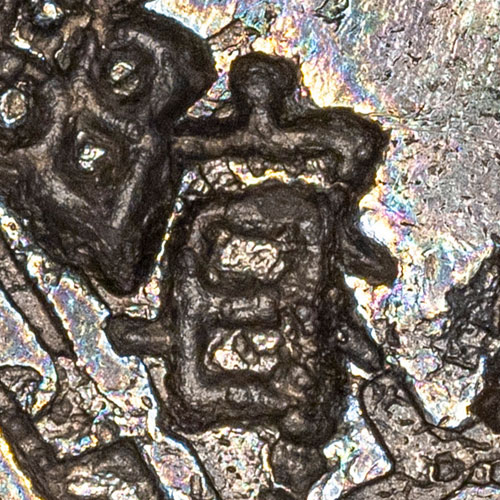 Unknown character
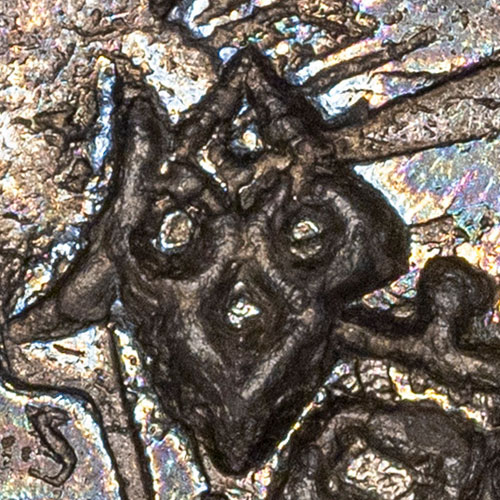 Unknown symbol
Provenance:
Purchased in April 2018 at the Santa Clara coin show.
1818 Lima, Peru 8 Reales Ferdinand VII draped bust type
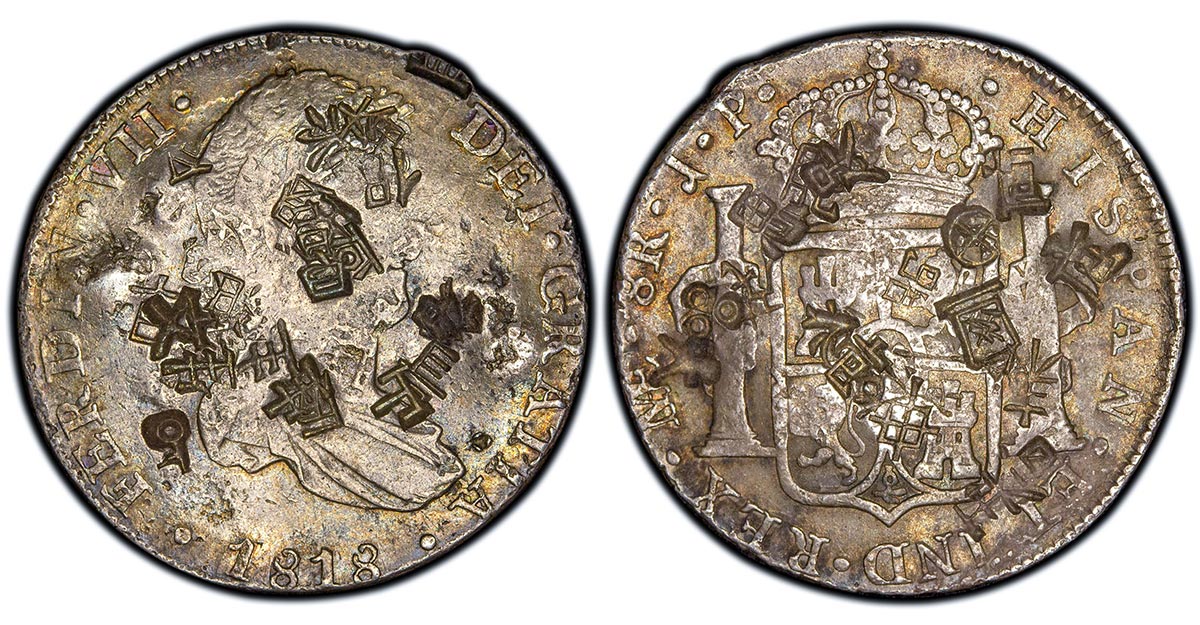
Specifications:
26.0674 g, .896 fine silver, .7797 troy oz (actual silver weight)
Recorded mintage: unknown
Catalog reference: KM 117.1
Details:
This 1818 Lima 8 reales of Ferdinand VII belongs to the late colonial draped-bust series struck as Spain struggled to maintain control over Peru during the later phase of
the wars of independence. Lima remained one of the last firmly royalist mints in South America, continuing to issue high-quality silver coinage even as revolutionary movements
disrupted production elsewhere. Despite the political turmoil of the period, Lima issues are generally well made, reflecting the mint’s long experience and the importance
of Peruvian silver to the imperial treasury.
The presence of Chinese chopmarks on an 1818 Lima 8 reales documents the coin’s later absorption into China-facing bullion networks, where Spanish American crowns continued to circulate by weight well into the nineteenth century. By this date, such coins would have reached East Asian markets primarily through established Pacific routes linking Peru and Mexico to Manila, and onward through private and regional trade into southern China. Chopmarks on late Ferdinand VII issues from Lima are generally less common than on earlier pillar or bust dollars.
Notable chopmarks:
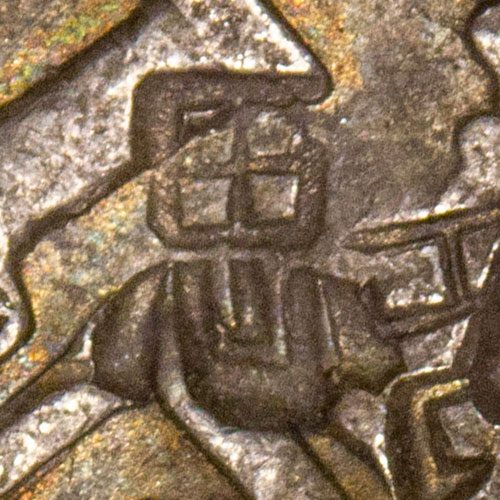 思 - sī - think, thought
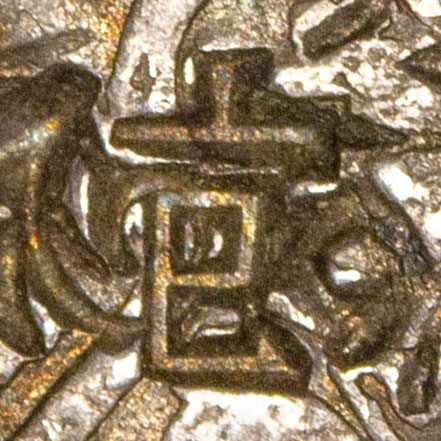 它 - tā - it
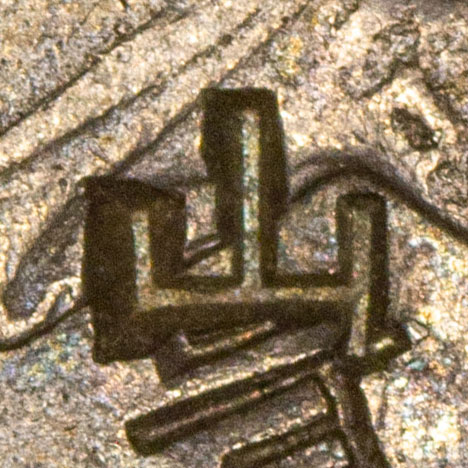 山 - shān - mountain, hill
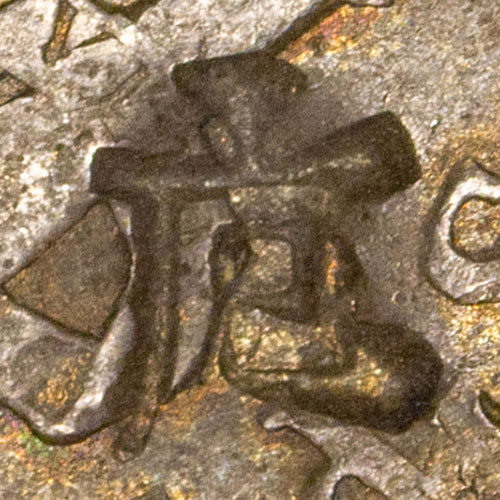 庀 - pǐ - to prepare, to manage
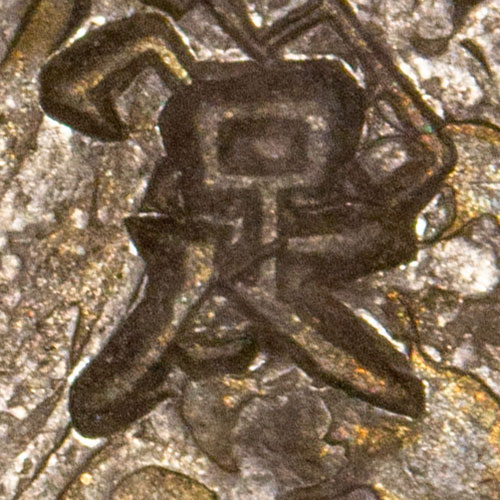 足 - zú - foot, sufficient
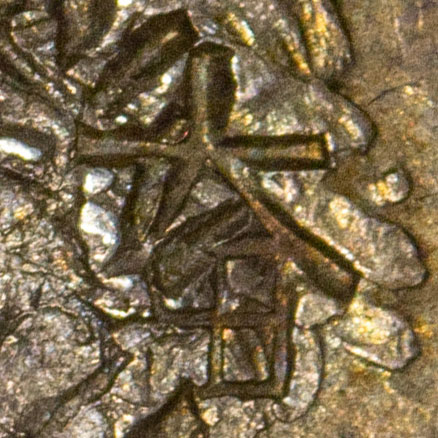 奋 - fèn - strive, exert
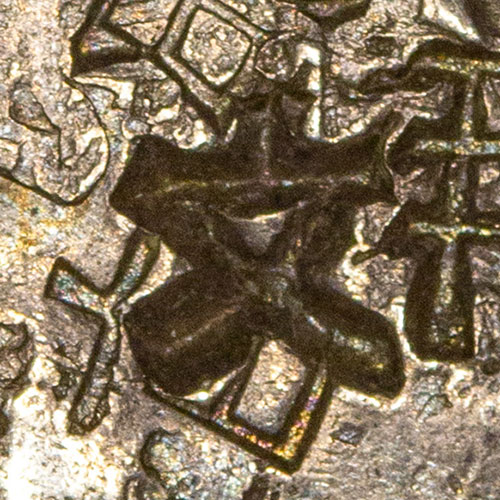 文 - wén - writing, literature, culture, (old) classifier for coins
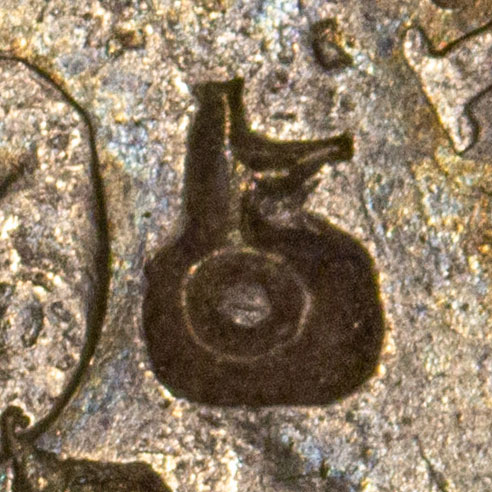 Stylized 占 - zhàn - divine, occupy, take
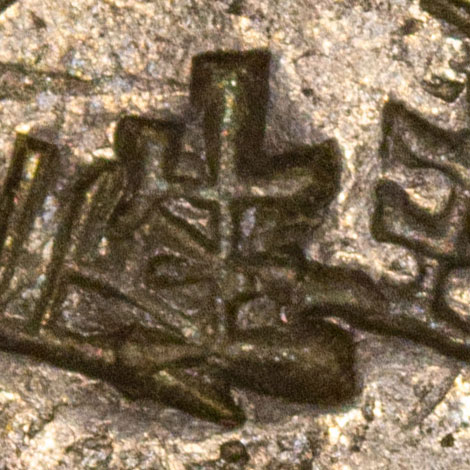 生 - shēng - life, birth, grow
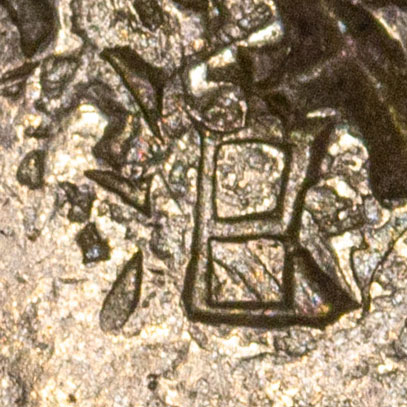 汜 - sì - tributary, stream
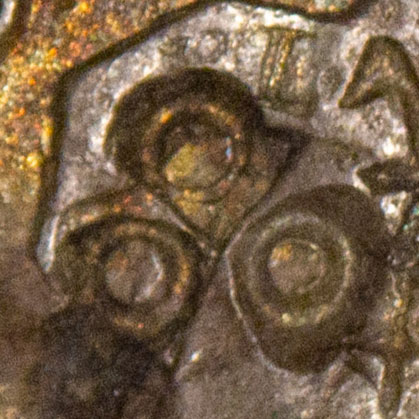 Three circlesSpeculatively a stylized or symbolic form of 品 (pǐn, 'goods / article / quality / rank'); the character is itself three 口 boxes in the same one-over-two arrangement.
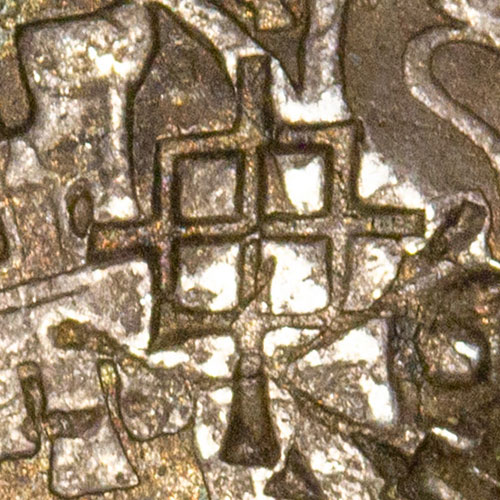 申 - shēn - extend, 9th earthly branch
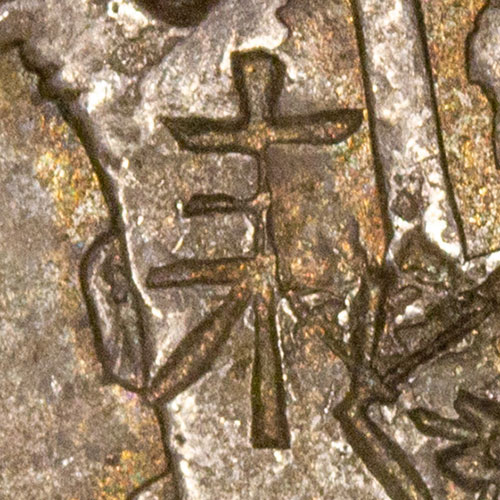 耒 - lěi - plow, plow handle
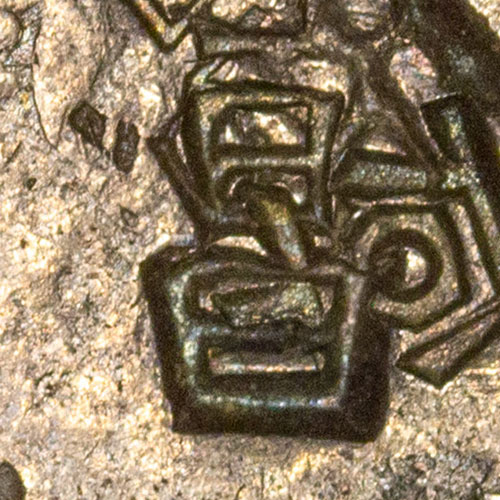 昌 - chāng - prosperous, flourishing
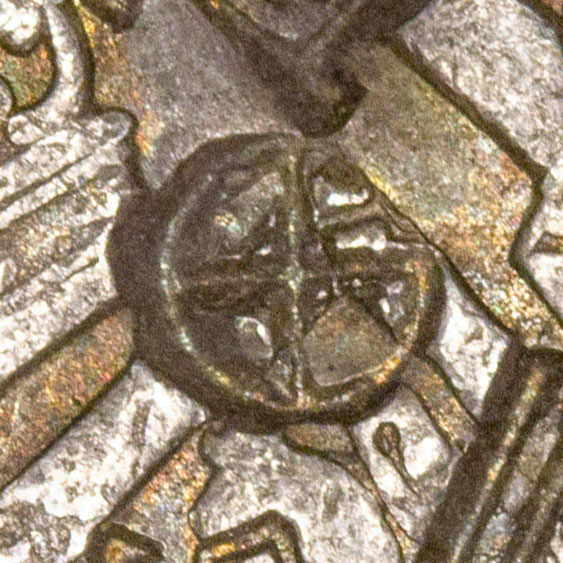 Crossed circleSuggests a wheel. A four-spoked wheel evokes the Buddhist 法輪 (fǎlún, Dharma wheel), whose four spokes are read as the Four Noble Truths; the quartered circle is also an old emblem of the sun and of the four directions. Circle-and-cross marks recur as abstract chopmarks.
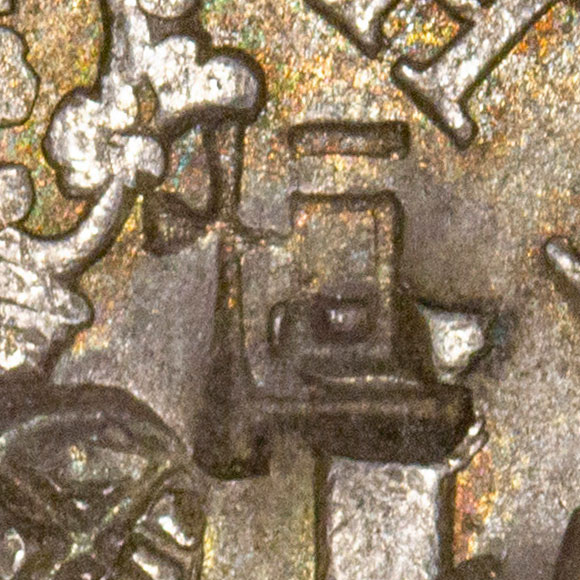 恒 - héng - constant, persistent
Provenance:
From Ben Dalgleish, a collector who finds chopmarked coins in the coin markets of Hong Kong, March 2020
1819-NG M Guatemala 8 Reales Ferdinand VII draped bust type (Ex. Murphy)
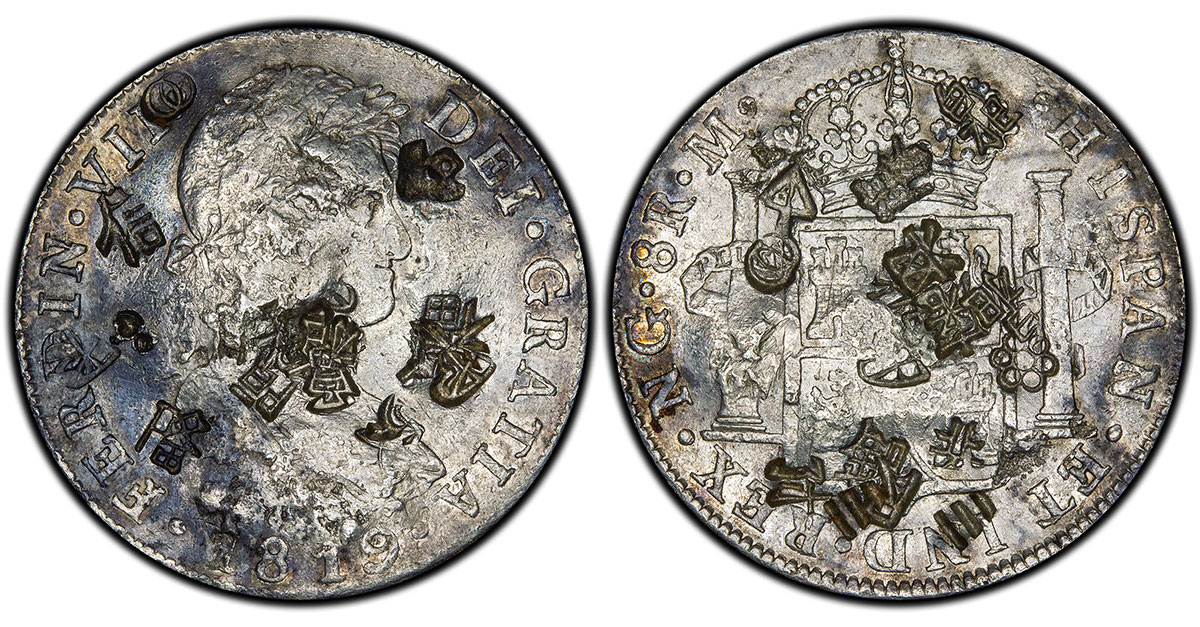
Specifications:
27.07 g, .896 fine silver, .7797 troy oz (actual silver weight)
Recorded mintage: unknown
Catalog reference: KM 69
Details:
By 1819, Spain's hold on its American colonies was unraveling. Ferdinand VII had been restored to the throne five years earlier following Napoleon's defeat, but the wars
of independence that had spread across South America were creeping northward, and the Captaincy General of Guatemala, a territory stretching from the Yucatan to Costa Rica,
was two years away from declaring its own independence. The Nueva Guatemala mint continued striking silver through this period, serving regional commerce in indigo, cacao,
and trade goods that moved across Central America and into the broader Pacific network. The assayer initial M identifies the work of Manuel Eusebio Sanches, who held the
position through much of the production run for this type.
The Nueva Guatemala mint was itself a product of catastrophe. The 1773 earthquake that destroyed Santiago de Guatemala, the original colonial capital, forced the relocation of the entire city to its present site, and the mint moved with it, reestablishing at the new location that gave these coins their NG mintmark. The 8 reales struck there circulated across the full breadth of the Captaincy General and beyond, and examples with chopmarks from Asian trade are only semi-scarce, a reminder that Spanish colonial silver from even the smaller provincial mints found its way into global commerce. Guatemalan issues of this period are quite a bit less common than their Mexican or Peruvian counterparts, reflecting the more modest scale of the mint's output.
Notable chopmarks:
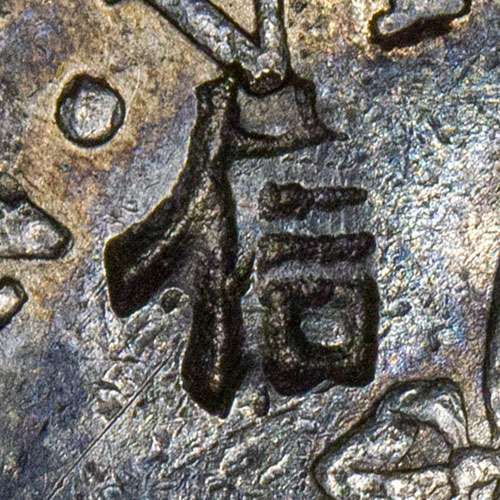 信 - xìn - trust, letter, believe
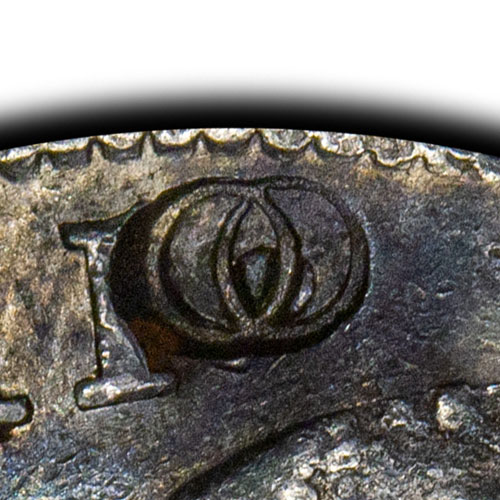
 - Liushutong script variant of 環 - huán - jade ring or bracelet; ring
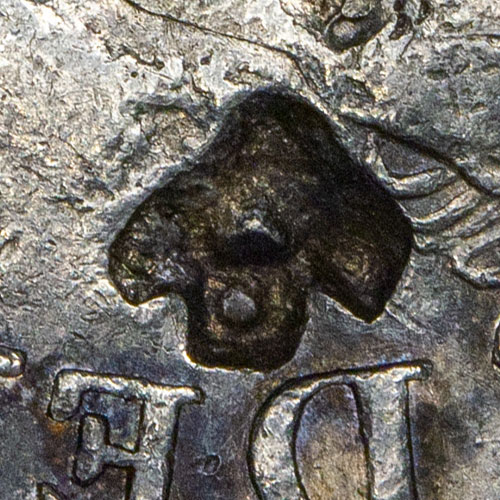 合 - hé - combine, join, close, suit
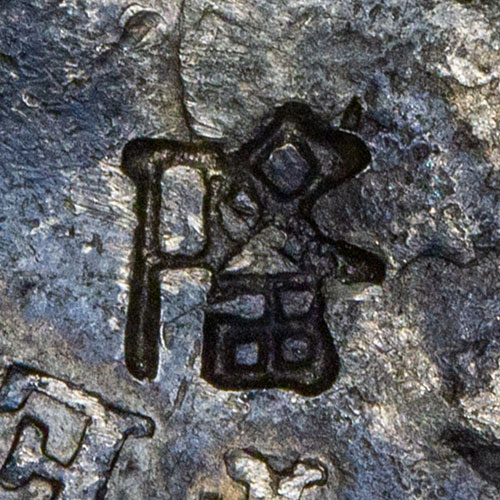 偹 - bèi - prepare, ready, perfect
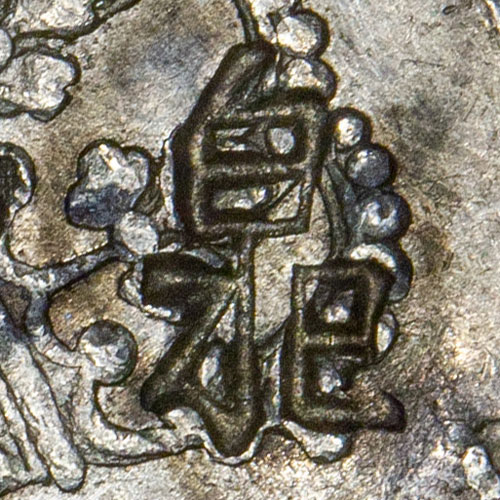 Unknown chopmark
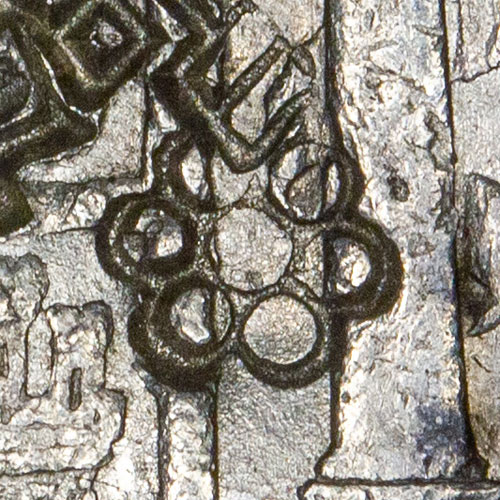 Seven stars (七星)Suggests the 七星 (qīxīng, 'Seven Stars') of the Big Dipper (北斗七星), a major Daoist emblem of the northern heavens carrying strong protective and exorcistic associations; the seven-star pattern is a recognized auspicious marking. The seven rings may alternatively evoke the 七寶 (qībǎo, 'Seven Treasures') of Buddhism.
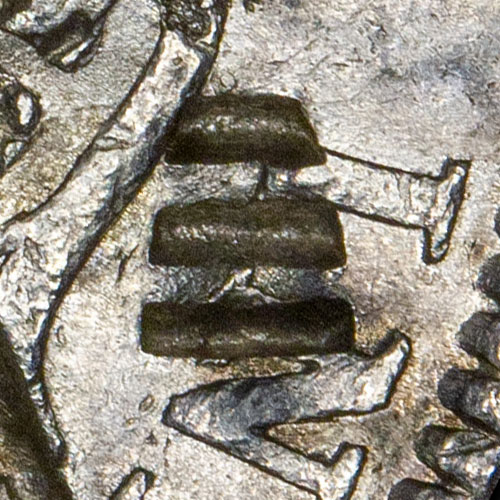 三 - san - three
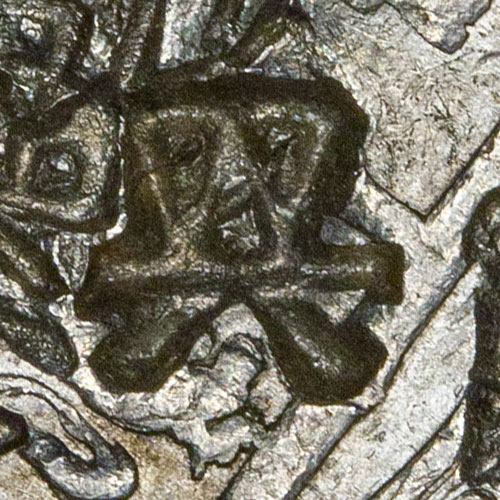 㒷 - (variant form of 興) xìng - to prosper, to rise, to flourish
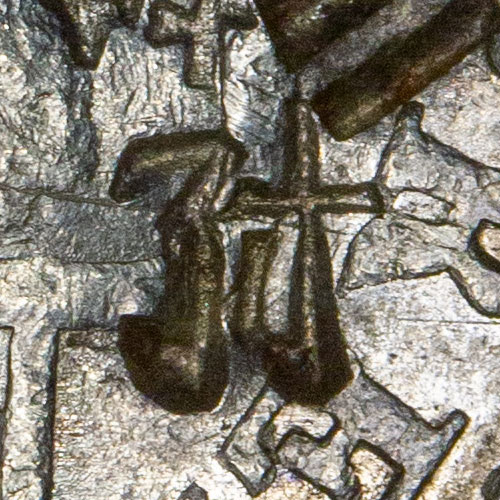 Unknown chopmark
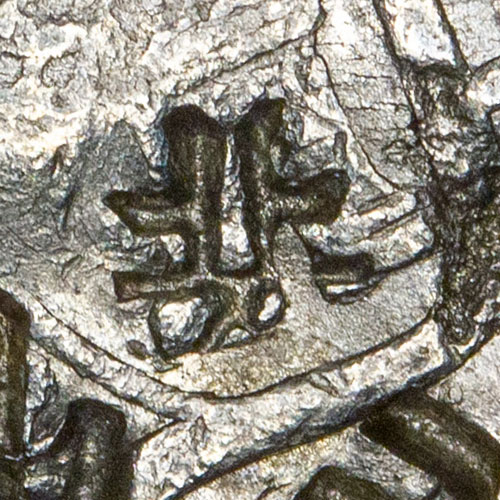 Unknown chopmark
Provenance:
Purchased from the Stack's Bowers April 2026 Hong Kong Showcase Auction
Lot #49665
Auction Description:
GUATEMALA. 8 Reales, 1819-NG M. Nueva Guatemala Mint. Ferdinand VII. PCGS Genuine--Chopmark, VF Details.
KM-69; Cal-1234; Murphy-Fig. 208 (Plate Coin); Leverage-Fig. 98 (Plate Coin). Numerous medium size incuse Chinese and pseudo-Chinese chops on both sides, most are obscured due to overlap or other obstructions, but includes "三" (San), "了十" (Le Shi), "开" (Kai), "ↀ" (overlapping circles) as well as many others. This decently preserved example exhibits many mottled light gray and slate patina with remaining luster in the protected areas. A wholesome example with many interesting chops that need further study.
Provenance: From the Edgar Murphy Collection.
1821-Go JM Guanajuato, Mexico War for Independence 8 Reales (Ex. Bowman)
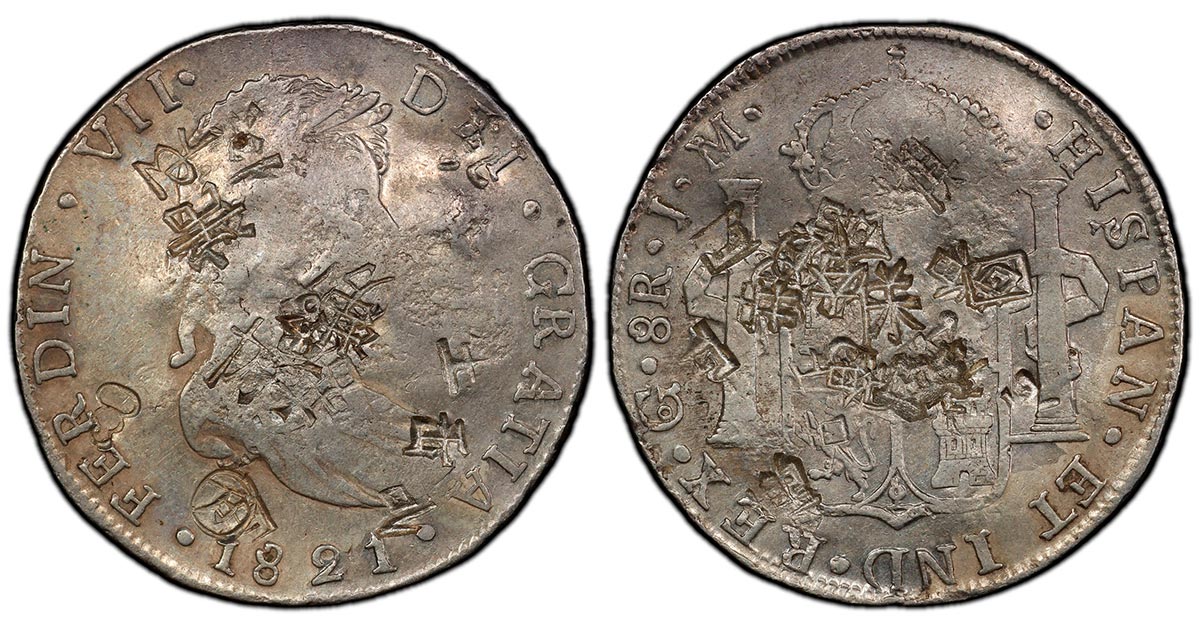
Specifications:
27.07 g, .903 fine silver, .786 troy oz (actual silver weight)
Recorded mintage: unknown
Catalog reference: KM 111.4
Details:
The 1821-Go JM (José Antonio Mucharraz) 8 reales is a late War for Independence royalist issue from the Guanajuato provisional mint, struck in one of New Spain’s richest
mining districts at a moment when moving bullion and coin had become hazardous and irregular. As insurgency and bandits made overland transport to Mexico City dangerous
, especially for mule-train silver, royalist authorities authorized provisional mints close to mining regions to keep coinage flowing locally and for military/state needs.
In the specific case of Guanajuato, the mint is reported to have been established as a rebel facility by Hidalgo in 1810, while the first documented coinage is under Spanish
colonial authority in 1812; and one source adds that operations were suspended in 1813 and reopened in 1821 as circumstances allowed.
By 1821, the year of the Plan of Iguala and the rapid unravelling of Spanish authority in Mexico, Guanajuato was striking 8 reales that still carried the familiar royal portrait and legends even as political control was shifting on the ground. That tension is part of the appeal of the date: it is coinage of the “old regime” produced at the exact moment the new one was forming, before new national designs could be fully organized and distributed. As a result, 1821 Guanajuato crowns read as true transitional artifacts, standard-weight dollars from a major silver center, minted under extraordinary conditions, and closely tied to the last workable months of Spain’s monetary system in Mexico.
Notable chopmarks:
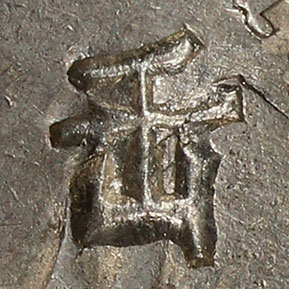 击 - jī - strike, hit
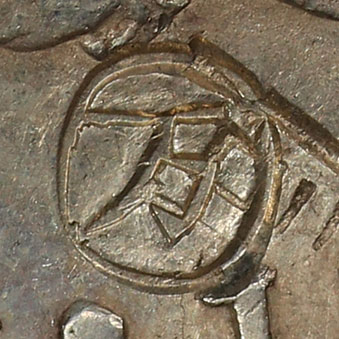 万 - wàn - ten thousand, myriad, also Japanese Kanji for various, many, all
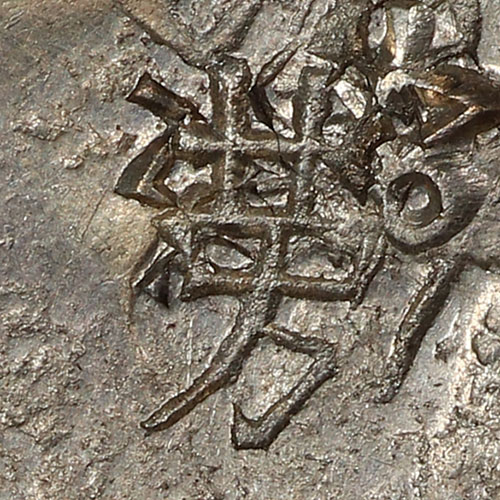 芳 - fāng - fragrant
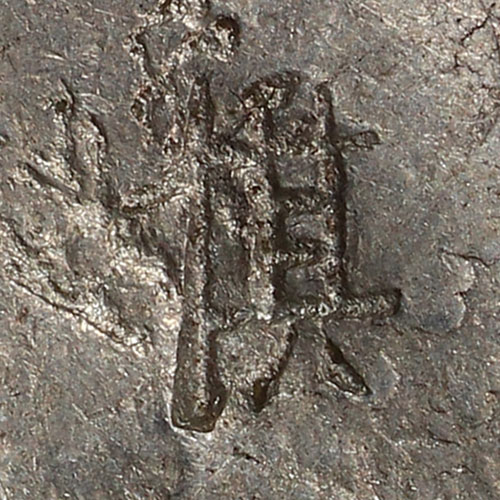 倛 - qī - mask
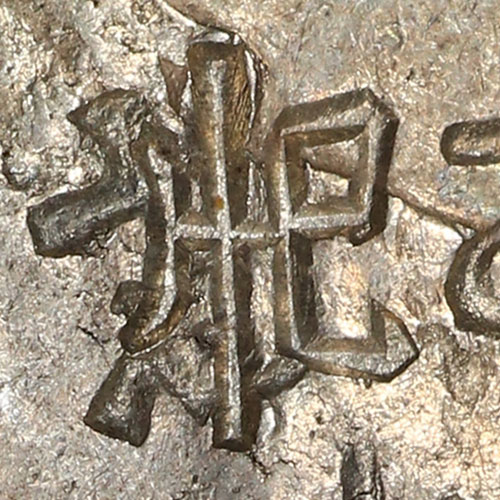 Possibly 忋 - gǎi - to rely on, look up to
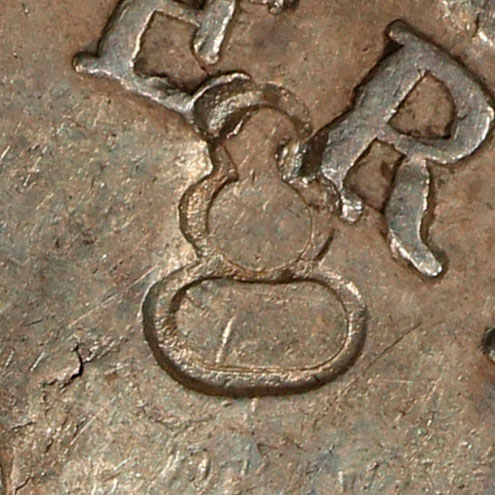 Bottle gourd (葫蘆)The gourd (葫蘆, húlu) is one of the most auspicious Chinese motifs: húlu echoes 福祿 (fúlù, 'blessings and prosperity'), and its many seeds wish for abundant descendants. It is a Daoist emblem of healing and immortality, the vessel of the immortal Li Tieguai (李鐵拐) and one of the hidden Eight Immortals' attributes (暗八仙), and is hung to ward off illness and evil.
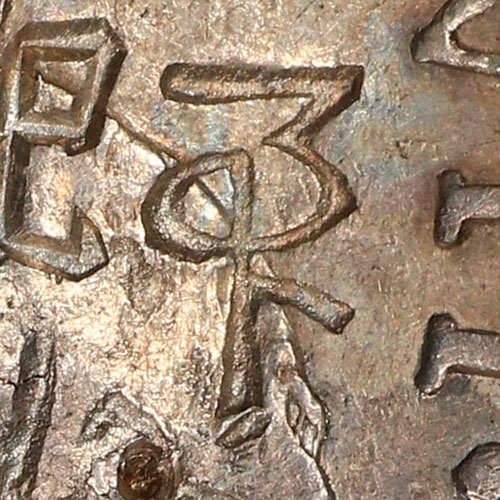 Unknown, possibly Japanese chopmark
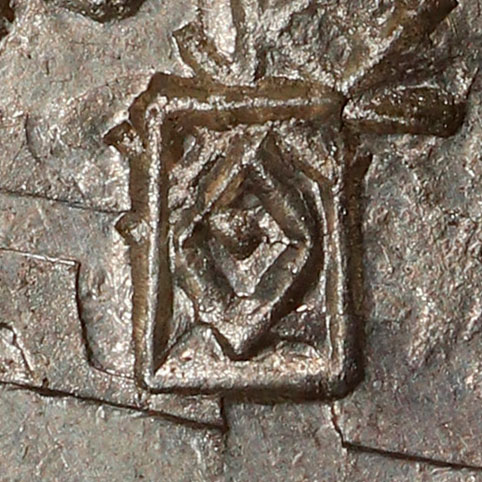 - Seal script variant of 回 - huí - return, reply, turn
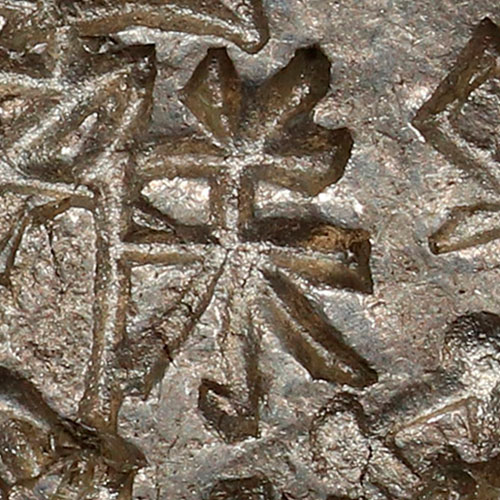 Possibly 䒩 - hé - a variety of grass
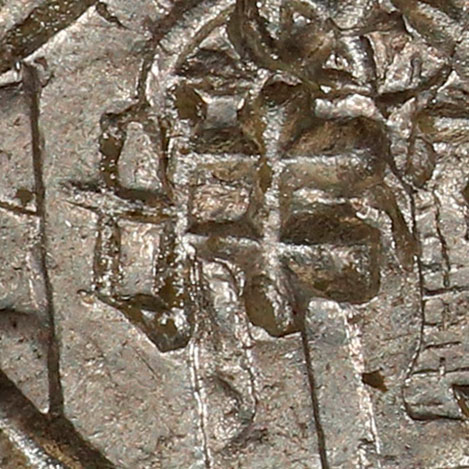 Unknown character combination
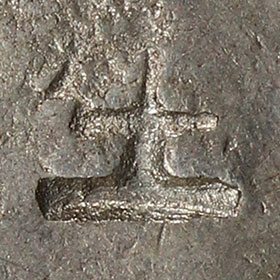 土 - tǔ - earth, soil, land, Japanese radical 32
Provenance:
From the Tauler y Fau May 2018 Floor Auction #10 (Madrid, Spain) Lot #440
Auction Description:
8 reales. 1821. Guanajuato. JM. (Cal-453). Ag. 26,32 g. Resellos orientales. Raros sobre esta ceca. EBC-.
Ex J.D. Bowman, as described in the Chopmarked Collectors Club newsletter, Volume 2, Issue 2, July 1991, page 2-58. Bowman was an original contributor to the Chopmark Collectors Club newsletters, and assembled one of the finest chopmark collections of all time. Bowman worked closely with Santa Barbara coin dealer Paul Brombal, in fact J.D. credits Paul with "most all of my chops he got for me in Singapore, Hong Kong & Manilla over the years."
1821 Princely States, Hyderabad India Rupee
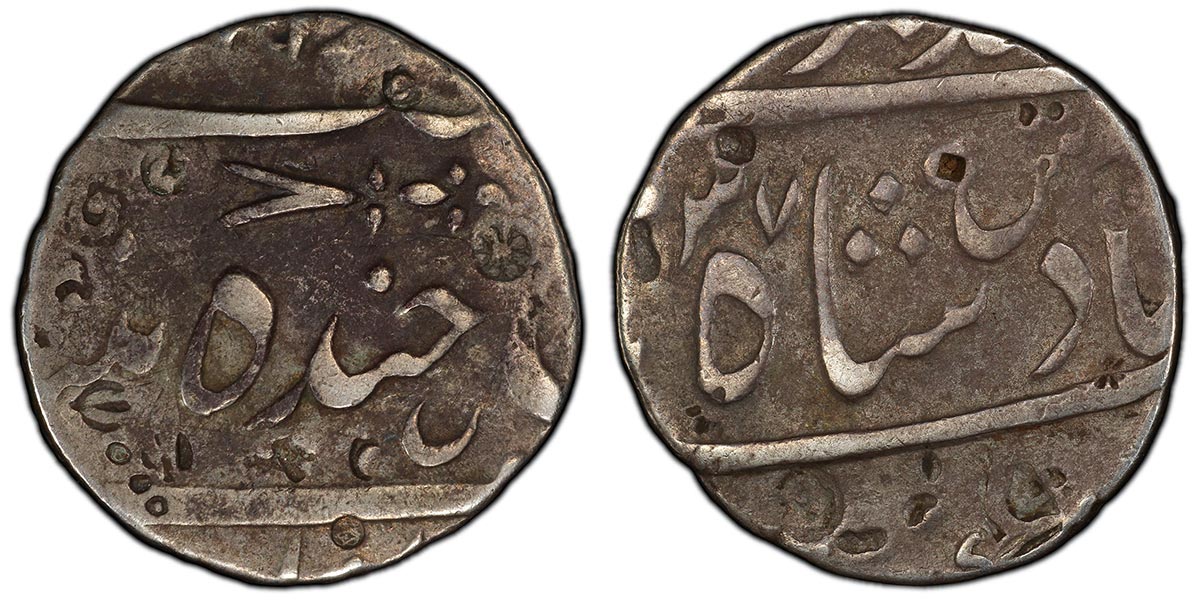
Specifications:
Weight varies - 10.70-11.60 grams
Recorded mintage: unknown
Catalog reference: C# 48.1
Details:
The 1821 Hyderabad rupee (Princely State of Hyderabad, Asaf Jah III / Sikandar Jah, r. 1803–1829) is a typical early-19th-century Deccan silver rupee: a locally issued piece
that nonetheless sits within the broader Indo-Islamic monetary tradition, often carrying Persian/Urdu legends and, in many cases, being struck in the name of the Mughal emperor
Muhammad Akbar II as a formal convention even when real authority was regional. Hyderabad struck silver at more than one mint (notably Hyderabad and Aurangabad in this period),
and dates are usually given in Hijri/regnal form, so a “1821” attribution commonly corresponds to AH 1236–1237 (circa 1821/22) rather than a Western date on the coin itself.
The marks on this coin are curious, they don't immediately appear to be of Chinese origin. Indian shroff marks and Chinese chopmarks can look superficially similar because they come from the same basic purpose, private verification of silver, but we are typically able to differentiate between the two. Shroff marks are often small test punches, sometimes simple geometric shapes, and can be concentrated in predictable areas (including edges) associated with local testing practice; Chinese chopmarks are typically more deliberate identity marks, often larger and more distinctive, intended to show that a merchant/banker had tested and accepted the piece. For an 1821 Hyderabad rupee, shroff marks are the higher-probability explanation if the punches look modest and “utility”-driven, since this coin would most naturally circulate in Indian and adjacent regional bullion markets. A true Chinese chopmark is possible, especially if the coin traveled through Southeast Asian ports with strong Chinese merchant communities, but it’s the less common outcome for Hyderabad rupees unless there’s corroborating context (Chinese characters, a recognizable chop style, or a broader group of China-validated pieces). Based on their appearance I would lean towards Indian shroff marks for this piece.
Notable chopmarks:
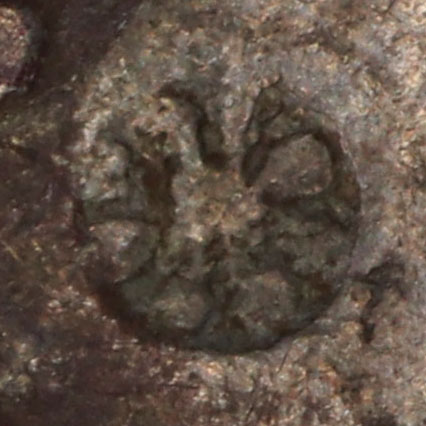 Shroff mark
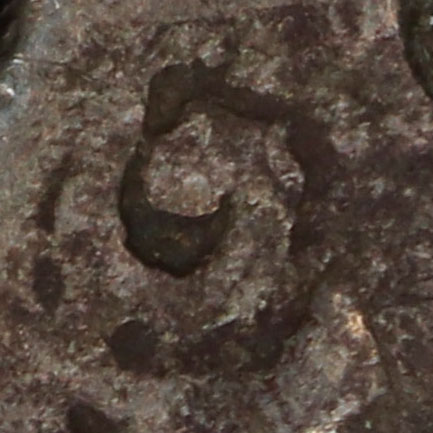 Shroff mark
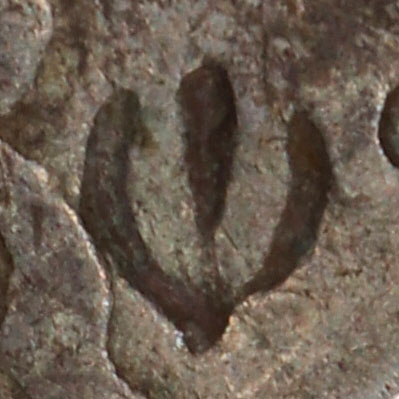 Shroff mark
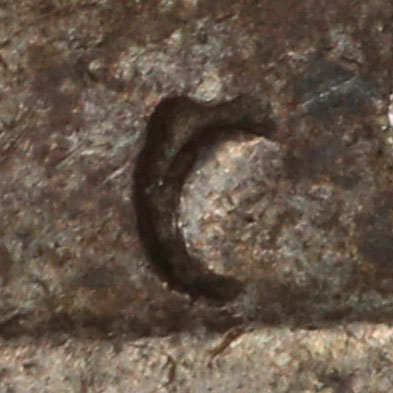 Shroff mark
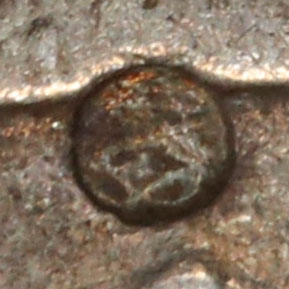 Shroff mark
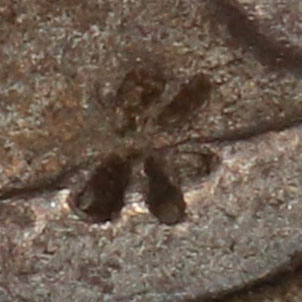 Shroff mark
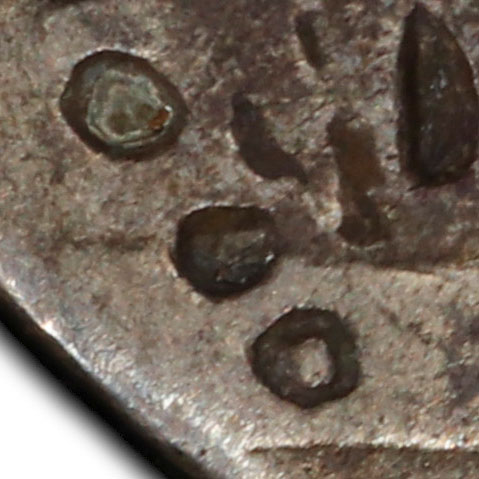 Shroff mark
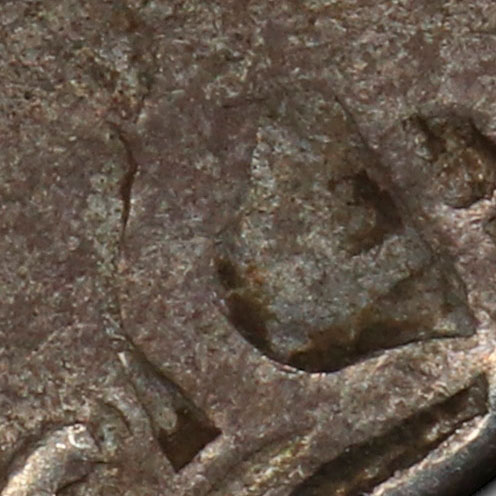 Shroff mark
Provenance:
Purchased on eBay in January 2018 from dealer Harry Regan out of Rockville, Maryland.
1821-Zs RG Zacatecas, Mexico War for Independence 8 Reales
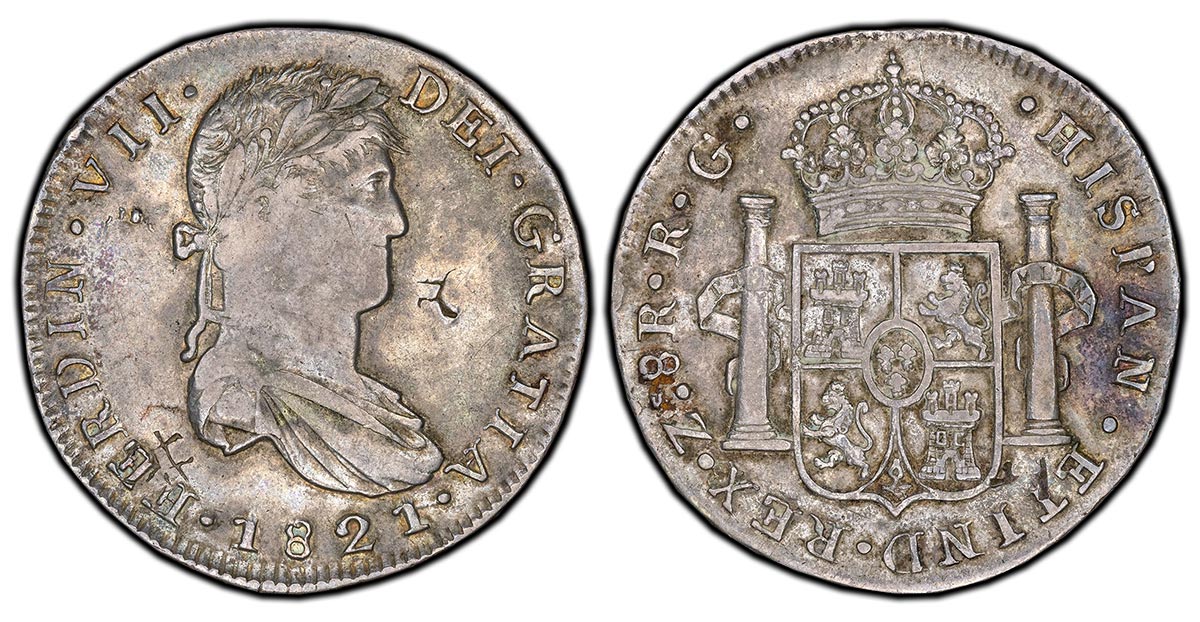
Specifications:
27.07 g, .903 fine silver, .7859 troy oz (actual silver weight)
Recorded mintage: unknown
Catalog reference: KM 111.6
Details:
1821-Zs RG (José Rodríguez Gallinar) 8 reales (KM-111.6) is the signature “frozen date” royalist branch-mint issue of Zacatecas, struck in the last phase of Mexico’s War of
Independence. Zacatecas had been a major silver district since the great discoveries of the 1540s, and wartime disruption made reliable local coinage a strategic necessity for both
commerce and military finance. In 1821, administrative efforts to improve the mint’s output included appointing a new director (Dionisio Sancho) effective 1 January, and surviving
1821 issues are specifically associated with the RG assayer, José Rodríguez Gallinar. In practice, Zacatecas continued striking 8 reales dated 1821 well after independence, using
the pre-independence date as a convenient fiction, until 1825, when Cap-and-Rays coinage replaced the royalist bust style.
Notable chopmarks:
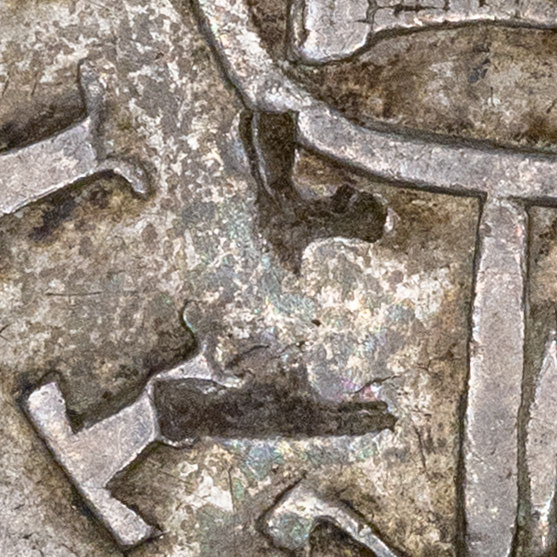 上 - shàng - above, up, top
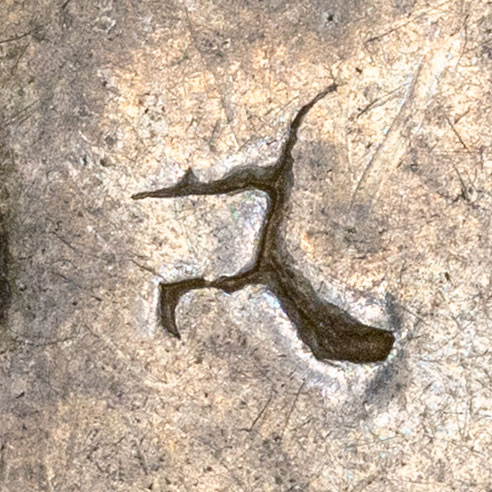 Unknown or partial chopmark
18218rchop2
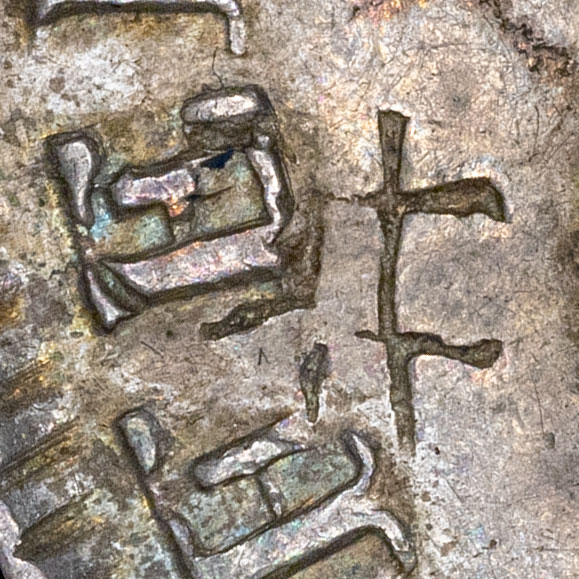 Partial, incomplete chopmark
Provenance:
Purchased on eBay in July 2023 from a seller in Sacramento, California.