Chinese Provincial Dragon Dollars
For centuries, China's silver economy ran on foreign coins, mostly Spanish and Mexican dollars trusted for their consistent weight and fineness. By the 1890s, falling silver prices, lost seigniorage, and the example of Japan's Meiji mint gave Qing reformers both the motive and the model for a domestic coinage. The result was a family of provincial silver dollars denominated at 7 mace 2 candareens, each struck with a dragon on the reverse and each reflecting the character of the mint that produced it. Kwangtung (Guangdong) led the way from Canton, its high-volume issues setting the standard that others followed; Hupeh (Wuchang) and Kiangnan (Jiangning/Nanjing) emerged as strong, consistent producers along the Yangtze, while Anhwei, Chihli, and Chekiang yielded more experimental or short-lived issues. Inland and frontier mints in Szechuan, Fengtien, and Kirin added distinctive varieties shaped by geography and logistics, and their coins typically show fewer chopmarks than the southern trade issues that moved through coastal and Southeast Asian markets. The provincial era ended as it had to: the 1908 Tai-Ching-Ti-Kuo Dollar and the 1911 Xuantong Year 3 Dollar attempted to unify standards nationwide, the product of two decades of provincial trial and error, just as the dynasty itself collapsed.
Similar to the Mexican 8 Reales set, this set aims to include one from each province or mint. For this collection, I still need to find a nice example from Anhwei Province, and Manchurian Provinces, Yunnan and Sinkiang Provinces are not known with chopmarks or excessively rare.
(1890-1908) KwangTung (Guangdong) Province, China - "Heaton Dies" Variety
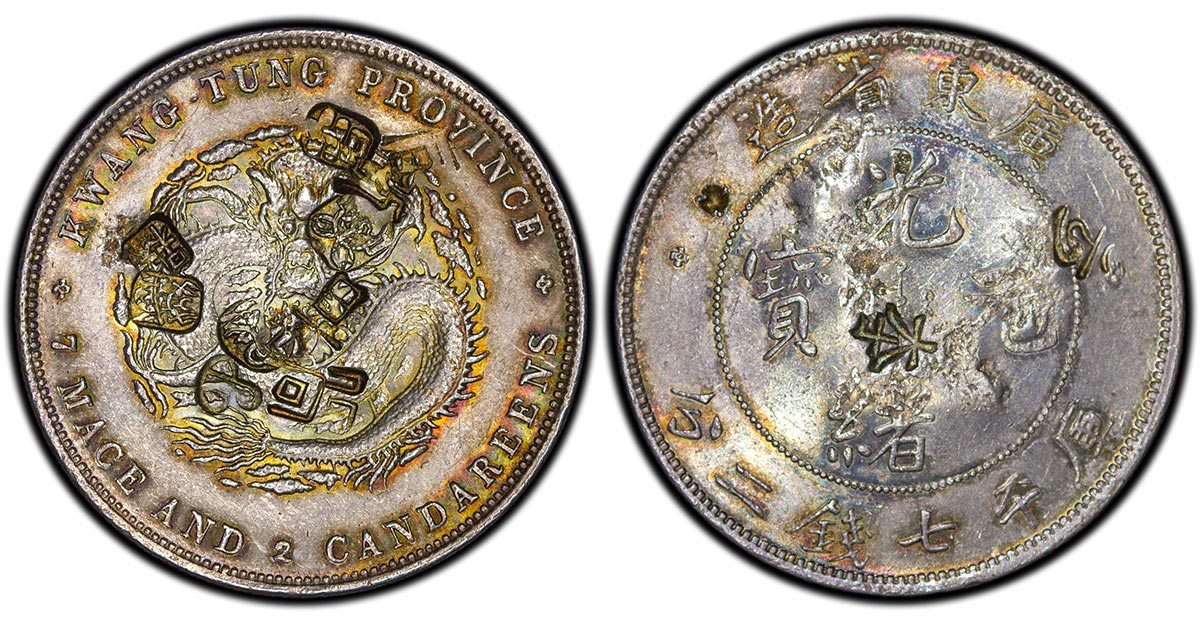
Specifications:
27 g, .900 fine silver, .781 troy oz (actual silver weight)
Recorded mintage: unknown
Catalog reference: KM Y203
Details:
The Kwangtung (Guangdong) silver dollars, minted from 1890 through 1908, were the earliest and most influential of China’s provincial machine-struck silver coinages, emerging
from Guangdong’s unique position as the epicenter of China’s foreign trade. Produced at the Canton (Guangzhou) Mint, the empire’s earliest modern mint, these dollars were
deliberately modeled on the Mexican eight reales and struck to the 7 mace 2 candareens standard, with a fineness generally around .900 silver, making them among the closest-
adhering provincial issues to stated weight and purity specs. Early reliance on imported machinery and foreign-engraved dies from Birminghang, England resulted in comparatively
consistent planchets and strikes, especially when contrasted with later-established inland mints that struggled with equipment, funding, or skilled labor. In comparison to
provinces such as Chekiang or Anhwei, where weight drift, uneven striking, and short production runs are more common, Kwangtung dollars show a notably higher level of metallurgical
reliability, rivaled mainly by Hupeh and, later, Kiangnan issues.
Their circulation in the intensely commercial Pearl River Delta, Hong Kong, and southern treaty-port networks exposed them to constant scrutiny by merchants and shroffs; consequently, Kwangtung dollars are among the most frequently encountered Chinese provincial dollars with chopmarks. In contrast to inland-minted issues, which sometimes saw more limited local circulation, Kwangtung dollars often traveled widely across southern China and Southeast Asia, making chopmarked examples not only common but historically representative of their role as a trusted, workhorse trade coin of the late Qing silver economy.
The “Heaton Dies” variety of the Kwangtung dollar refers to a subset of early Guangdong silver dollars struck using dies prepared by the Heaton Mint (Ralph Heaton & Sons) of Birmingham, England, a private firm that supplied coinage equipment and dies worldwide in the late 19th century. This variety is closely tied to the very first phase of China’s modern coinage experiments, around 1890–1891, when the Canton Mint was still developing technical expertise and relied heavily on foreign suppliers. “Heaton Dies” Kwangtung dollars are distinguished not by an explicit mintmark, but by stylistic and technical traits, including a more European-style dragon, with sharper engraving, proportionally longer body, and less of the sinuous, calligraphic flow seen on later locally engraved dies. The rosettes on the coins are different and feature a hollow center on the Heaton Dies variety. The Chinese characters "Ku" (of the Ku-Ping weight system) and "Kuang" are also different - the center stroke does not connect to the top of the character as it does on the generic dies. This variety has long been known and is very popular among Chinese coin collectors.
Notable chopmarks:
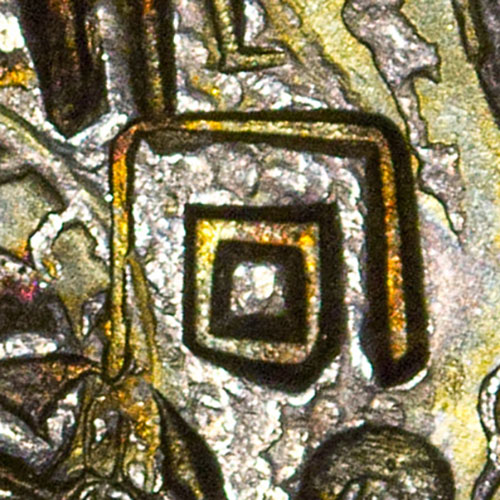
 - Seal script variant of 冋 - jiōng - wilderness
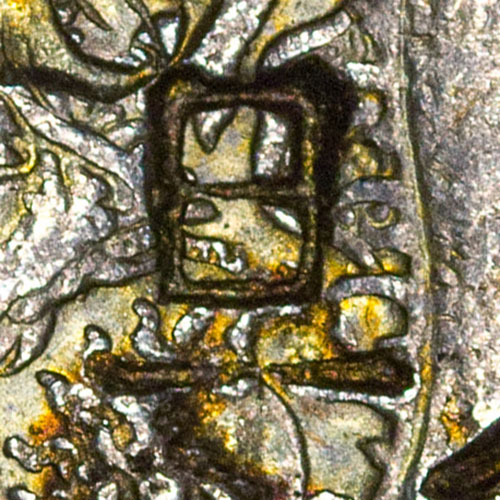 旦 - dàn - dawn, morning
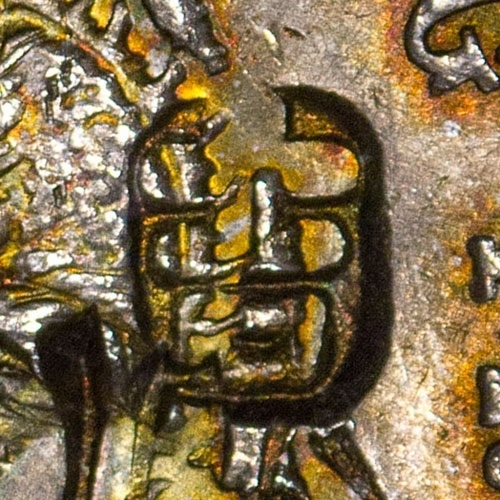
 - Seal script variant of 臼 - jiù - mortar
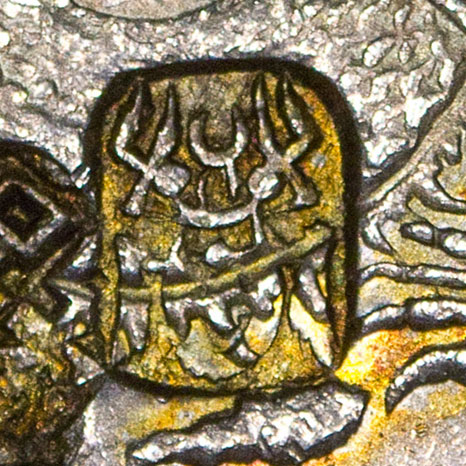 Unknown seal script chopmark
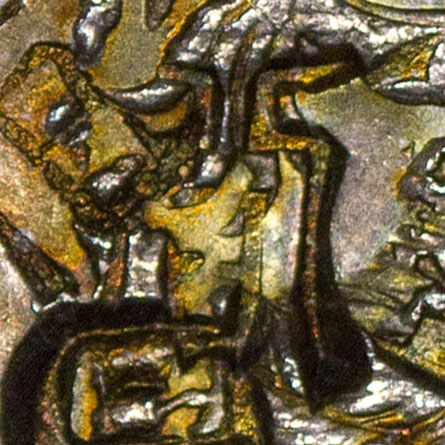
 - Liushutong script variant of 公 - gōng - public, fair, duke
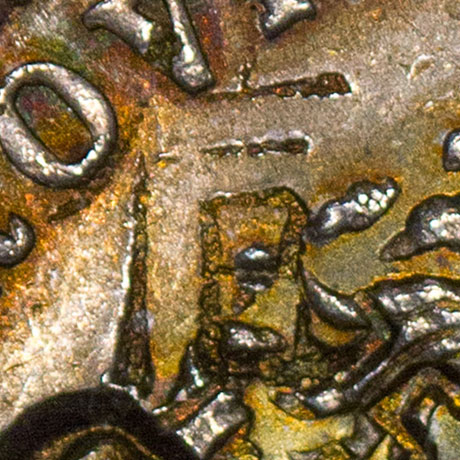 Similar to 佗 - tuó - he, she, other
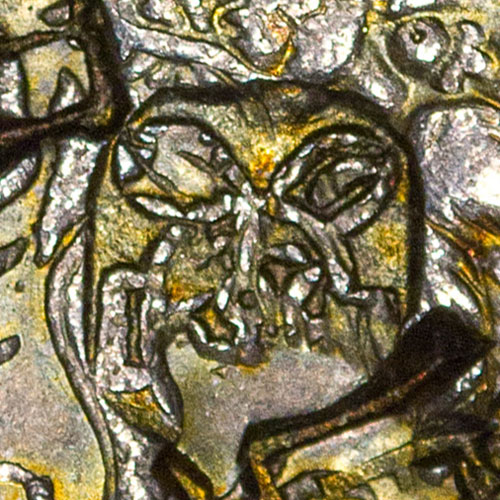 Another seal script chopmark that needs further study
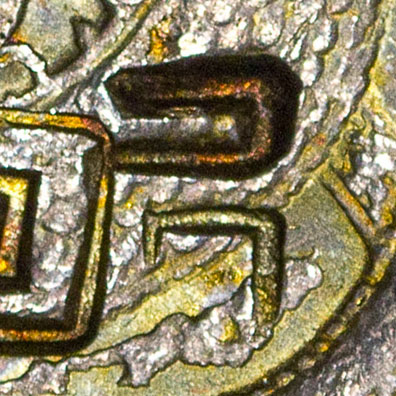
 - Liushutong script variant of 尺 - chǐ - ruler, foot measure
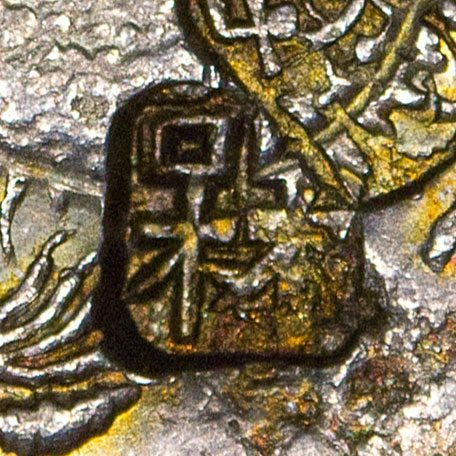 槑 - (old variant of 梅) méi - plum, Japanese apricot (Prunus mume), stupid
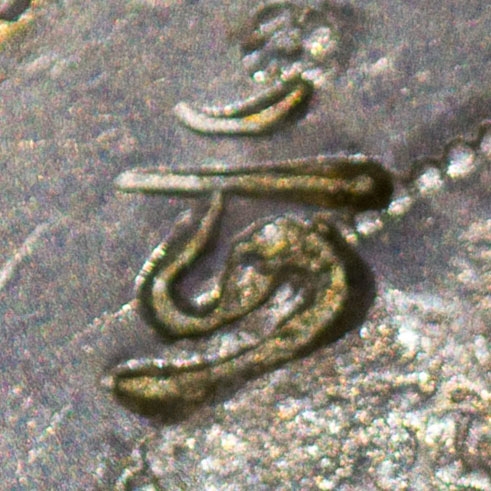
 - Seal script variant of 于 - yú - at, in, to
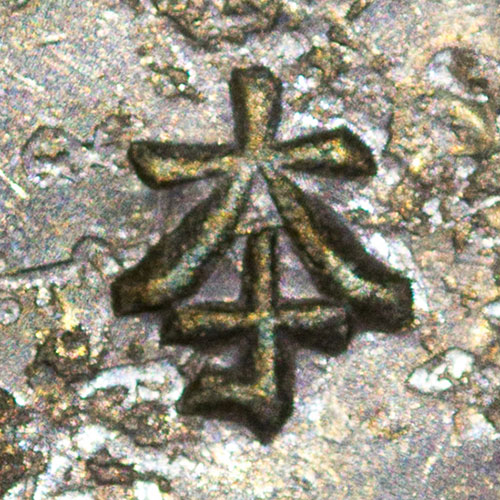 夲 - tāo - advance quickly
![[Styled chopmark, possibly 尸]](/coins/dragondol/1890ChinaKwangtung7m2c/chops/1890dollarchopletterp.jpg) Styled chopmark, possibly 尸
Styled chopmark, possibly 尸
1895-1907 China Hu-Peh (Hubei) Province 7 Mace and 2 Candareens
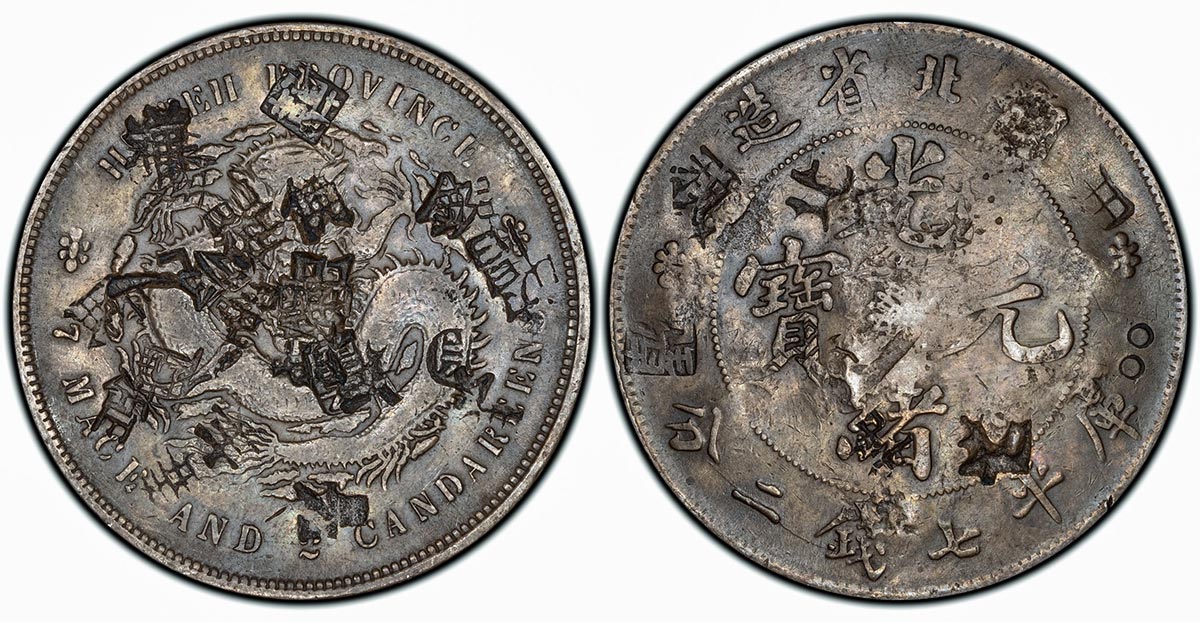
Specifications:
26.700 g, .900 fine silver, .7726 troy oz (actual silver weight)
Recorded mintage: 19,935,000
Catalog reference: Y# 127.1
Details:
Hupeh (Hubei) silver dollars represent one of the most technically disciplined provincial coinages of late Qing China, reflecting both the province’s strategic importance
along the middle Yangtze and the reformist ambitions of its leadership. Struck at the Wuchang Mint, sanctioned in 1893 and which began producing coinage in 1895 under the
direction of Zhang Zhidong, these dollars were produced with imported Western machinery and a strong emphasis on metallurgical reliability. Hupeh dollars were issued to the
standard 7 mace 2 candareens, with fineness generally close to .900 silver and remarkably consistent weight and purity. Although Hupeh did not benefit from direct treaty-port
exposure, its position on the Yangtze ensured broad circulation into Shanghai and northern markets, where the coins gained a reputation as trustworthy trade silver.
Chopmarked Hupeh dollars are common, many with dozens of chopmarks on each side.
Later in 1909-1911 ruler Hsüan-t'ung minted nearly identical coins from Hupeh Province, with the only design change being the ruler identified on the reverse.
Notable chopmarks:
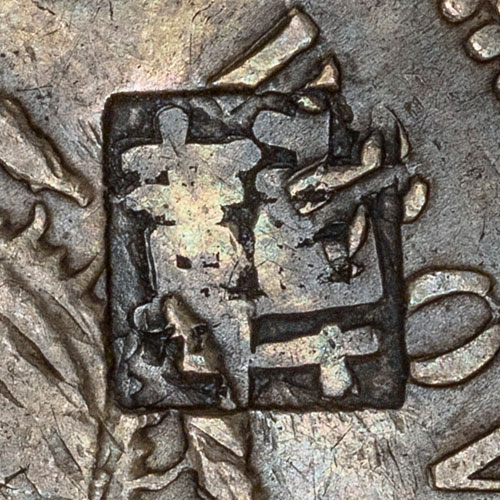 Unknown complex chopmark
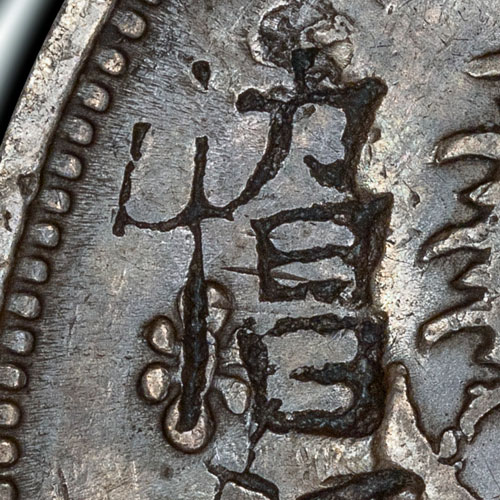 Large, complex chopmark, combination of 忄力 and 昌
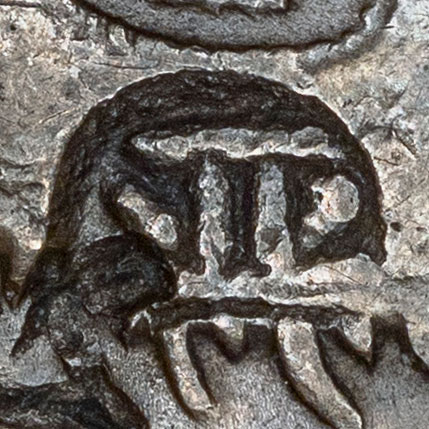 亚 - yà - Asia, second
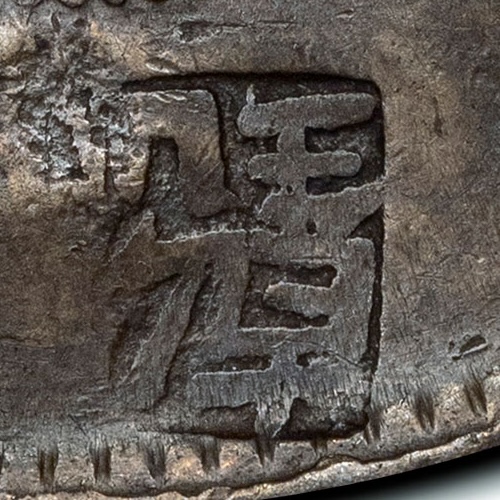 Complex chopmark
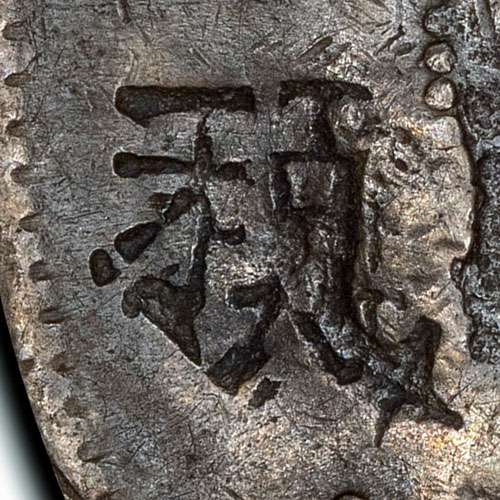 Similar to 䅡 - xǔ - a kind of grass
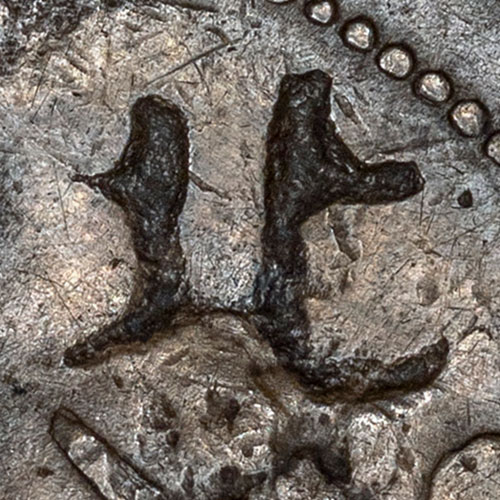 北 - běi - north
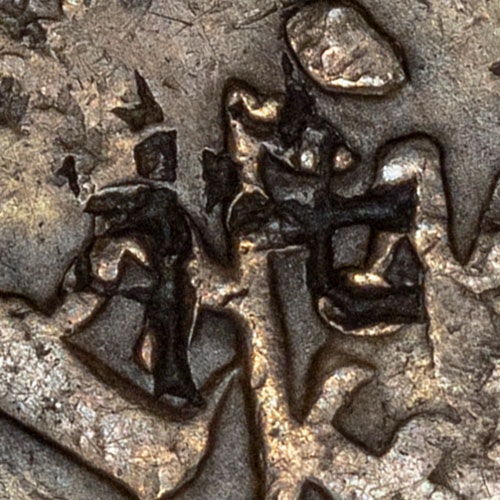 Maybe 㲺 - jí - to discharge, to sprinkle
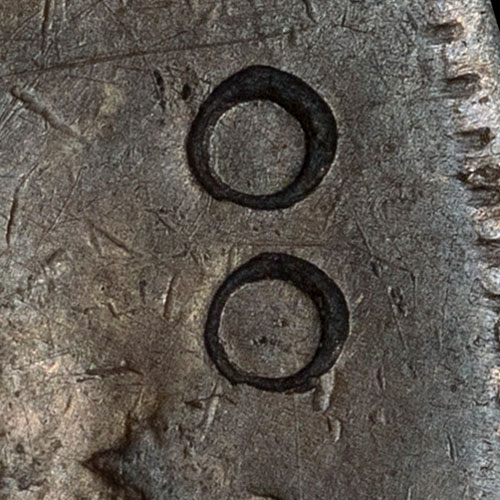 Two circles chop
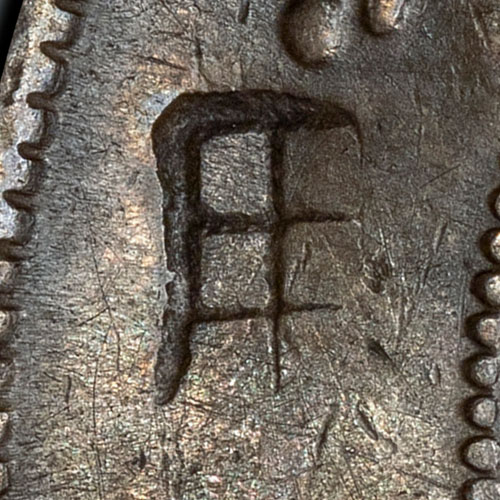 Partial 用 - yòng - use, employ
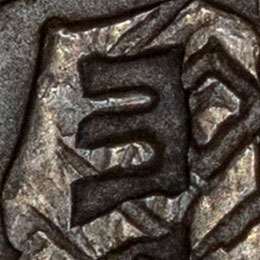 Unknown chopmark
Year 23 (1897) Chihli (Zhili) Yuan (Dollar), Tientsin (Pei Yang Arsenal) Mint, China
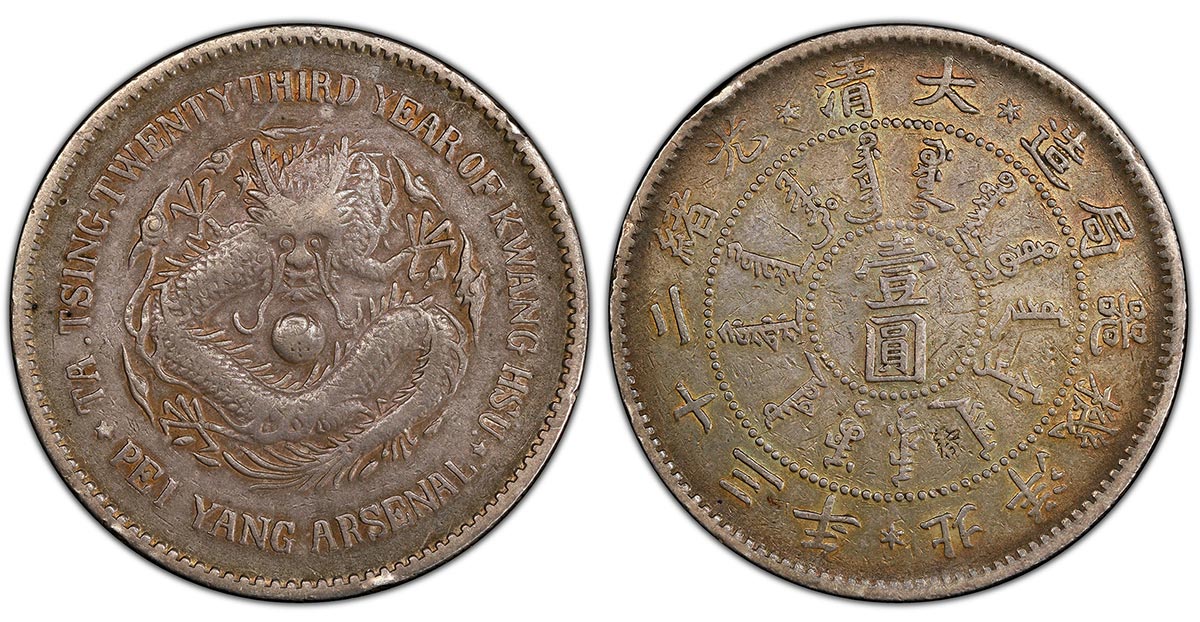
Specifications:
26.70 g, 0.900 fine silver, 0.7727 oz (actual silver weight)
Recorded mintage: 1,120,000
Catalog reference: KM Y65.1
Details:
Chihli (or Zhihli) was a province originally incorporating the present-day capital city of Beijing. The word 'Zhihli' translates to 'centrally ruled', in other words,
the region was under the direct administration of the Emperor rather than functioning as a normal province. Chihli had several mints, the earliest beginning operations
in 1645 AD. While coins had been produced in the Chihli Province of China for thousands of years, it was not until 1896 that a mint was setup in the East Arsenal of
Tientsin which produced both struck silver and copper coins for circulation.
In Guangxu Year 23 (1897), the Chihli (Zhili) “Pei Yang Arsenal” dollar was struck at Tientsin (Tianjin)’s East Arsenal/Pei Yang Arsenal as part of an early northern experiment in modern, machine-made coinage and face-value denomination. The broader Pei Yang series is notable for using the Yuan (圓) / Jiao (角) structure (and on many denominations you literally see the “角” and “圓” on the coin) while much of China still operated day-to-day on weight-based silver accounting, ie. 7 mace 2 candareens for dollars. This mismatch in denomination may have helped drive poor initial acceptance and later melting/re-minting into weight-denominated issues. Another difference, the coins are visually unique - featuring 3 languages, English legends on the reverse, and Chinese & Manchu on the obverse.
Technically, these dollars were intended to be fully competitive with the leading provincial dollars: the type is commonly listed at about 26.7g and .900 silver (squarely in the late-Qing dollar standard, reflecting a serious attempt at a credible, standardized product from a well-equipped arsenal mint rather than an improvised local issue. Compared with Kwangtung, which was trade-driven, high-volume, and constantly stress-tested in the southern treaty-port ecosystem, Pei Yang/Zhili dollars were more strategic in nature, struck near the political center and tied to an arsenal-industrial base, while still matching technical expectations.
Because Chihli was not a primary southern trade hub, these dollars circulated mainly in northern and central China, often within official or semi-official channels, which helps explain why chopmarked examples are distinctly scarcer than for Kwangtung or other southern provincial issues. When chopmarks do appear, they usually indicate secondary circulation into broader commercial networks rather than routine validation of trade silver, underscoring the Chihli dollar’s role as an early, cautious step toward standardized silver coinage rather than a mass-market trade coin. The coin pictured here is a good example of a single, small, light chopmark atypical to what you'd see on a coin traveling through a trade port like Canton.
Notable chopmarks:
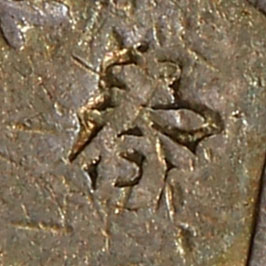 春 - chūn - spring
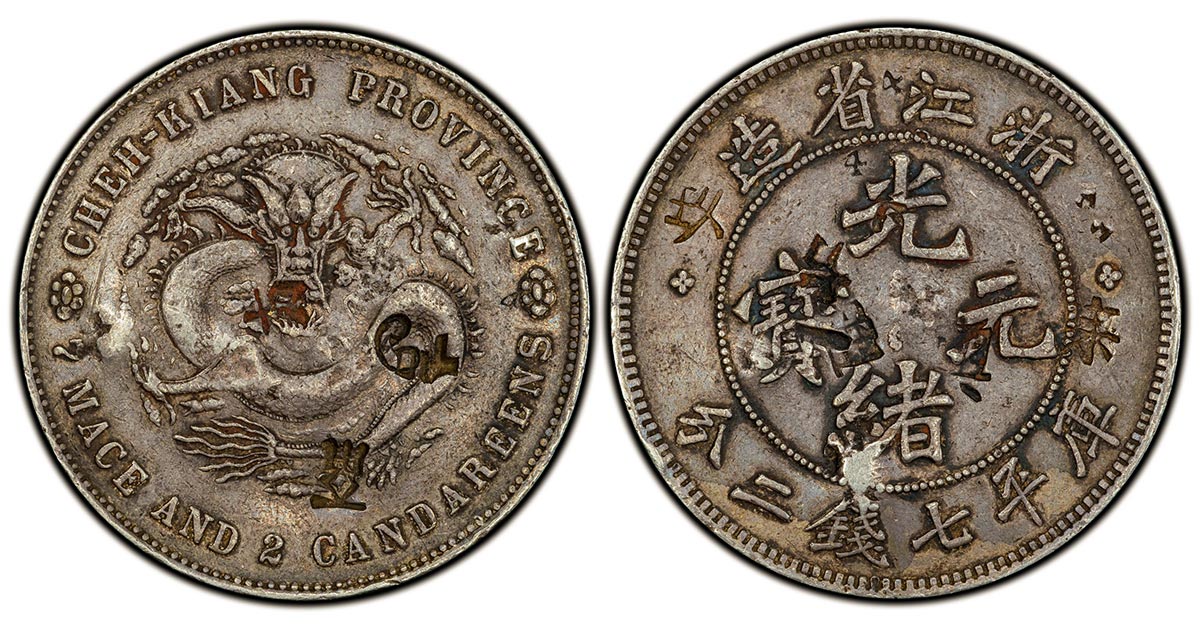
(1898-99) Cheh-kiang (Chekiang) Province, China 7 Mace 2 Candareens (Dollar)
Specifications:
27.50 g, 0.900 fine silver, 0.7957 oz (actual silver weight)
Recorded mintage: unknown
Catalog reference: K# Y55, L&M-282, Kann-119
Details:
Chekiang (or Zhejiang) is a densely populated, coastal province immediately south of Shanghai. The first Chekiang mint was located in the capital Hangchow (Hangzhou).
The 1898–1899 Chekiang 7 Mace 2 Candareens "dollar” is tied to the province’s short-lived, late-Qing push to modernize coinage at the Hangchow Mint. The mint that was
approved in 1897, equipped with machinery imported from Germany, and then quickly swept up in central efforts to rein in provincial silver output. For years, collectors
and auction catalogers connected Chekiang dragon dollars to 1902 because Chekiang later commissioned a separate set of Birmingham-made 1902 patterns (often noted by the
province spelling CHE-KIANG rather than CHEHKIANG/CHEH-KIANG used on the Hangchow coin). Later study of foreign manufacturing showed that the Hangchow “Wei-bei / 尔寶”
circulating type belongs to 1898–1899 (Guangxu 24–25), while 1902 properly belongs to the later Birmingham pattern set and not the Hangchow issue.
Hangchow Mint operation is unusually well documented in modern write-ups. Records note machinery by Schuler and dies engraved by Otto Beh, with dies delivered in 1898, and delays due to mismatched date inscriptions that required re-engraving. Striking began in early 1899 and the mint was then ordered shut and the was equipment shipped to Beijing. The dollar itself is the standard large dragon-dollar format, but unlike big producers such as Kwangtung/Hupeh/Kiangnan which struck coins for many years, Chekiang’s run was brief, contributing to both extreme rarity and the “experimental” aura around the issue.
As for chopmarks, maybe half of the very few known examples are chopped. Chopmarks historically make sense for this coin, as public confidence was weak at time of issue, causing frequent testing and chopping of these coins. In general rarity terms, this is widely treated as a major Chinese dragon dollar rarity, prized in any condition.
Deeper dive:
In Bruce W. Smith’s Chekiang study in JEAN-08, he effectively separates the “Chekiang dragon dollar” material into three distinct groupings, one dated pattern group, and two separate undated “sets” distinguished by how the province name is written on the Chinese side.
-
Dated Kwang-hsü 23 (1897) patterns
Smith treats the 1897-dated Chekiang dollars (and related denominations) as patterns, including a dated dollar and half dollar that he notes are not listed in Kann’s catalog for those denominations. They sit in the context of Chekiang’s stop-start late-Qing minting experiments and prototype work associated with outside suppliers, rather than as a normal, circulating provincial dollar issue. Smith explicitly ties “poor quality” to the “22nd Year” coins, stating that the 22nd Year pieces with errors in the English legends “must be” the poor-quality coins rejected by the Provincial Treasurer in 1897, and he argues they were probably made at Hangchow by inexperienced staff, not at Wuchang (which he characterizes as a high-quality mint where such English blunders would be unlikely). -
Undated set with “CHEH-KIANG” in Wei-style script
Smith’s first undated set spells the province CHEH-KIANG and uses what he calls Wei-style characters. A key diagnostic he highlights is the “p’ing” character written incorrectly, in the same manner seen on some Kwangtung and Szechuan dragon dollars, useful because it’s an objective calligraphic marker that helps separate this set from the other undated group. -
Undated set with “CHE-KIANG” in K’ai-style (regular-script) characters
Smith’s second undated set is the one he focuses on in detail under the “Heaton Mint Chekiang K’ai Style Dragon Dollar of 1902” heading. This is the regular-script (k’ai-shu) look that collectors often call “regular script.” Within this K’ai-style group, Smith also documents different strikings/materials (notably silver, silver-plated, and copper patterns), which is why people sometimes talk about “multiple versions” even within the same design family.
The coin pictured here, and basically any coin available today with or without chopmarks, would come from group #2.
Notable chopmarks:
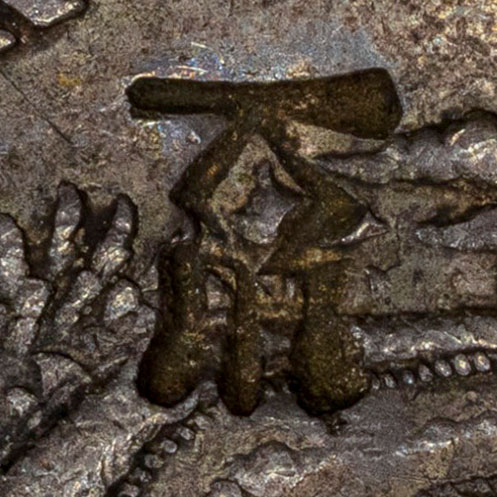 Probably a styled version of 京 - jīng - capital, Beijing, a surname
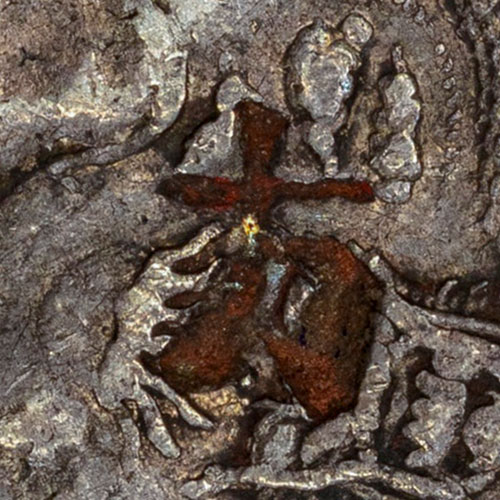 方 - fāng - square, direction, side
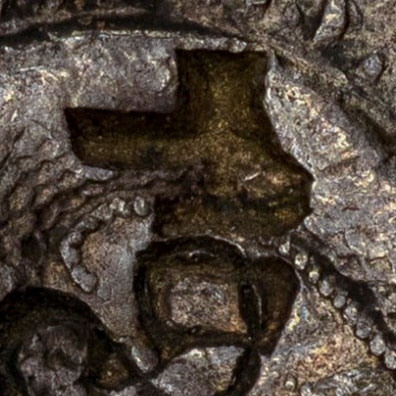 吉 - jí - auspicious, lucky
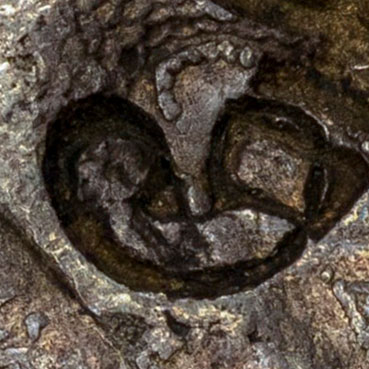 Unknown chopmark, possibly mongolian
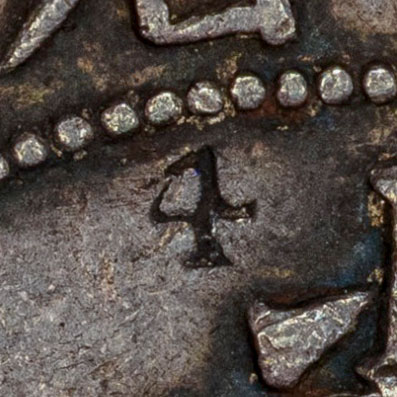 Unknown chopmark, similar shape to number 4
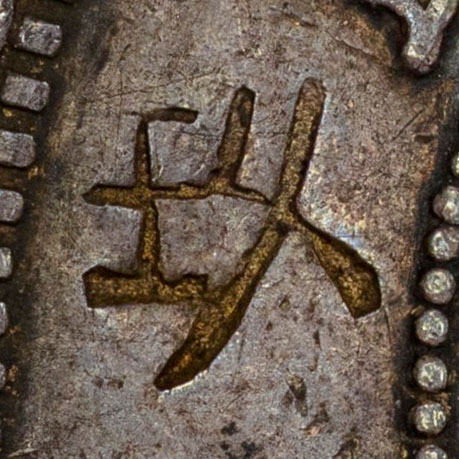 Combination of 王乆, an archaic variant of 玖 - jiǔ - nine, black jade
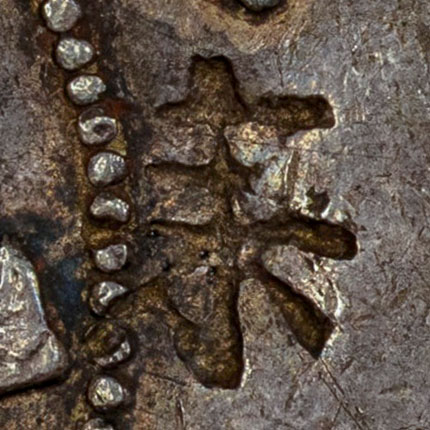 耒 - lěi - plow, plow handle
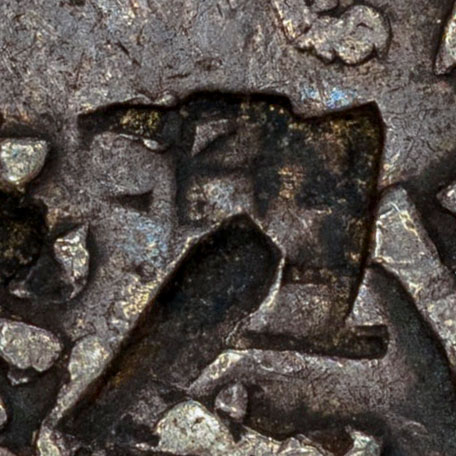 Possibly 興 - xīng - rise, prosper
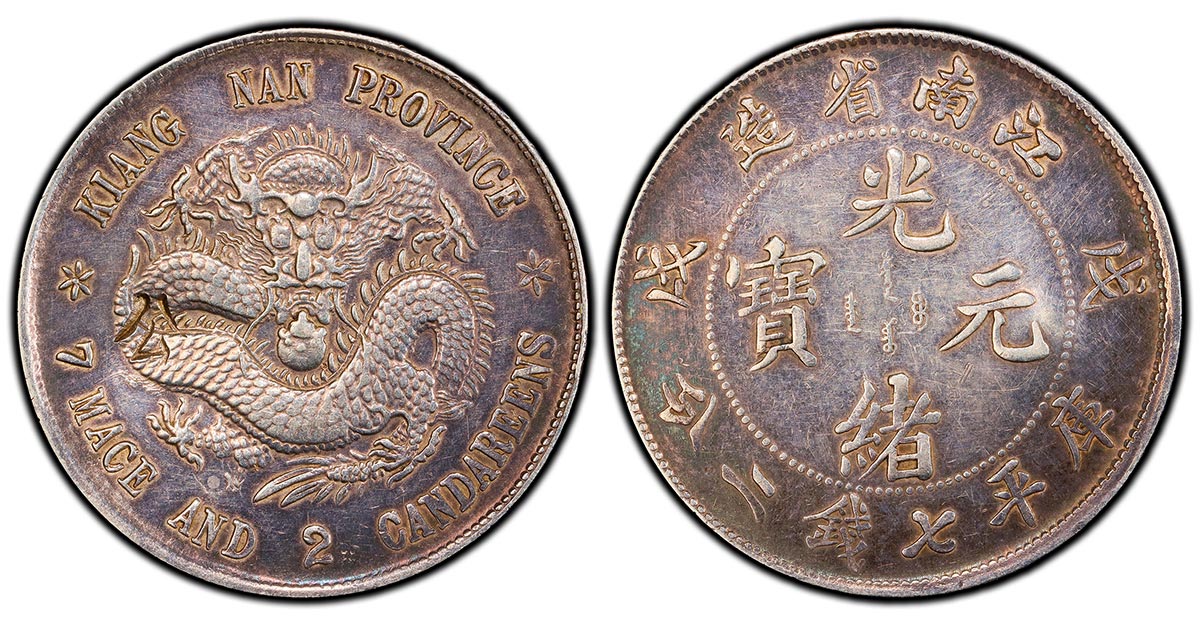
Year 24 (1898) Kiangnan (Jiangnan) Province, China 7 Mace 2 Candareens (Dollar)
Specifications:
27.000 g, 0.900 fine silver, 0.7813 oz (actual silver weight)
Recorded mintage: unknown
Catalog reference: Y# 145a.2, LM-217
Details:
Kiangnan dollars came from the late-Qing push to modernize silver coinage in one of China’s richest commercial regions along the lower Yangtze. Production centered at the
Nanking mint in Jiangning (modern Nanjing), a major modern facility that began striking these provincial dollars in 1897, as the government tried to create a machine-struck
silver coin that could circulate reliably alongside (and against) the foreign trade dollars already entrenched in commerce. From 1899 on, the Nanking mint was one of the
most prolific mints in China and coins from the later years are more common.
Technically, Kiangnan dollars were intended to meet the same “standard dollar” specs at .900 fine with a weight around 26.7g (varies slightly by subtype/variety), putting them in the top tier for consistent, specification-driven production compared with many smaller or more weakly equipped provincial mints. Kiangnan is often grouped with the more reliable producers (like Kwangtung & Hupeh) rather than provinces known for shorter runs or greater manufacturing variability.
You can easily find Kiangnan dollars with chopmarks, and many examples show heavy circulation. Chopmarks are typically smaller than those found on trade port coins such as Kwantung issues. The single large chopmark on the example pictured here is not typical for Kiangnan types.
Notable chopmarks:
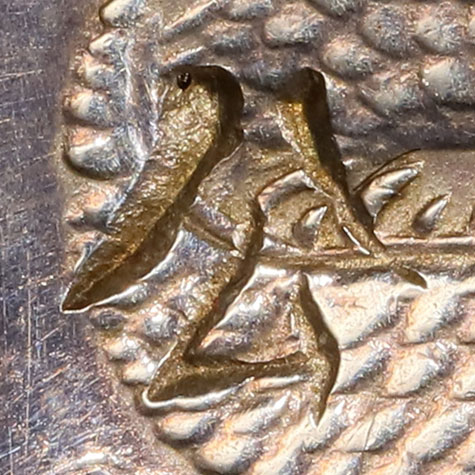 公 - gōng - public, fair, duke
Year 25 (1899) Chihli (Zhili) Pei Yang, China 7 Mace 2 Candareens (Dollar)
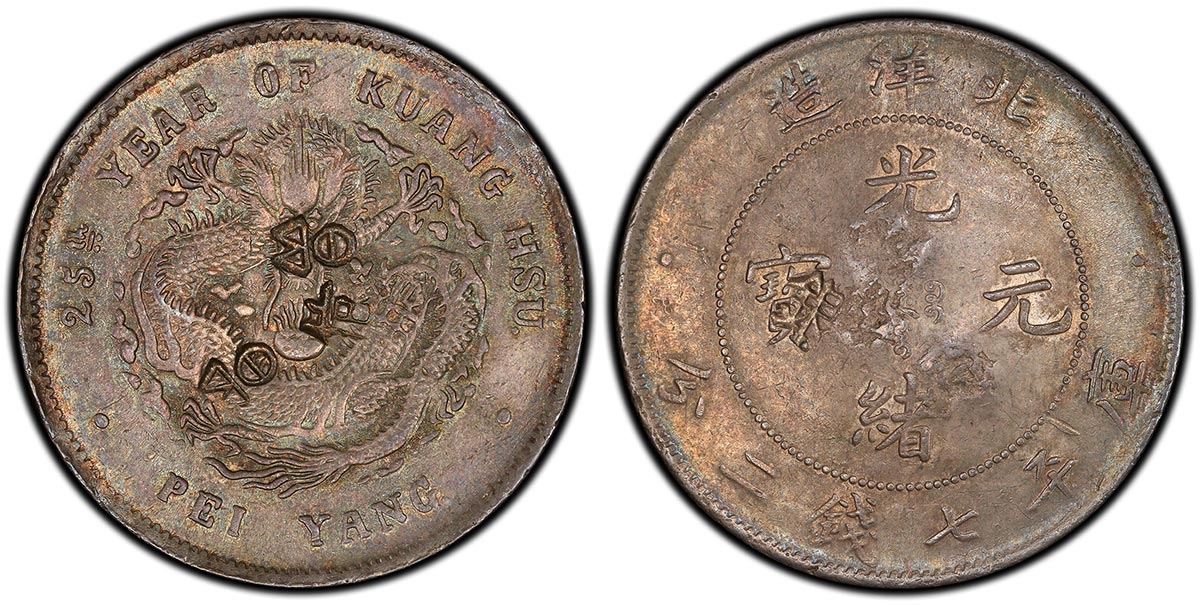
Specifications:
26.70 g, 0.900 fine silver, 0.7727 oz (actual silver weight)
Recorded mintage: 1,566,000
Catalog reference: KM Y73
Details:
The Year 25 (1899) Chihli “Pei Yang” dollar is the final year Pei-Yang/Tientsin dragon-dollar type, struck to the standard late-Qing dollar specs commonly listed around
.900 silver, ~26.7g, ~39mm, and explicitly labeled in the Chinese ring legend as Kuping 7 mace 2 candareens (庫平七錢二分). The reverse English reads “25th Year of Kuang
Hsu” and the mint identifier has been shortened to “PEI YANG”. It differs from the earlier 1897 (Guangxu Year 23) “Pei Yang Arsenal” 1 Yuan issue, which belongs to the
decimal/face-value experiment and literally names “PEI YANG ARSENAL” in the English legend while showing “壹圓” (1 Yuan) on the obverse. By 1899 the design language shifted
toward the standardized provincial “Guangxu Yuanbao” framework, still a “dollar” in function, but emphasizing the traditional weight standard on the coin and presenting the
issuer more as the Pei Yang/Beiyang brand than spelling out “arsenal.”
The later year Pei Yang issues appear to be a little more available with large chopmarks than the earlier years, but still not common in general. This example is particularly nice for the type, especially given the chopmarks.
Notable chopmarks:
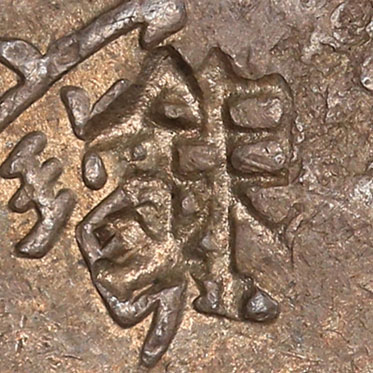 銀 - (traditional version of 银) yín - silver, silver-colored, relating to money or currency
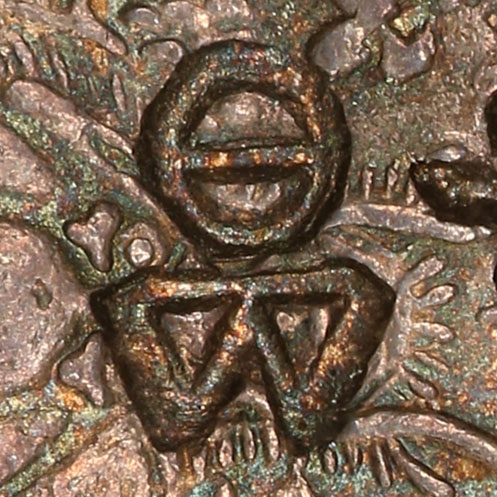 Stylized version of 显 - (simplified form of 顯) xiǎn - prominent, conspicuous, apparent, manifest
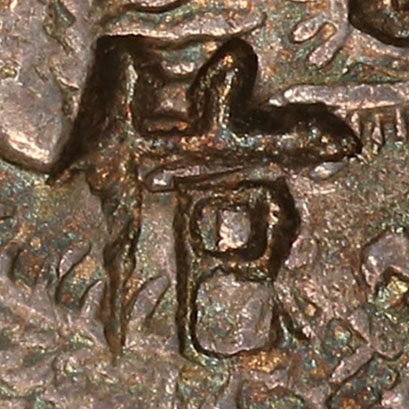 佗 - tuó - he, she, other
(1901-1908) Szechuan (Sichuan) Province, China 7 Mace 2 Candareens (Dollar)
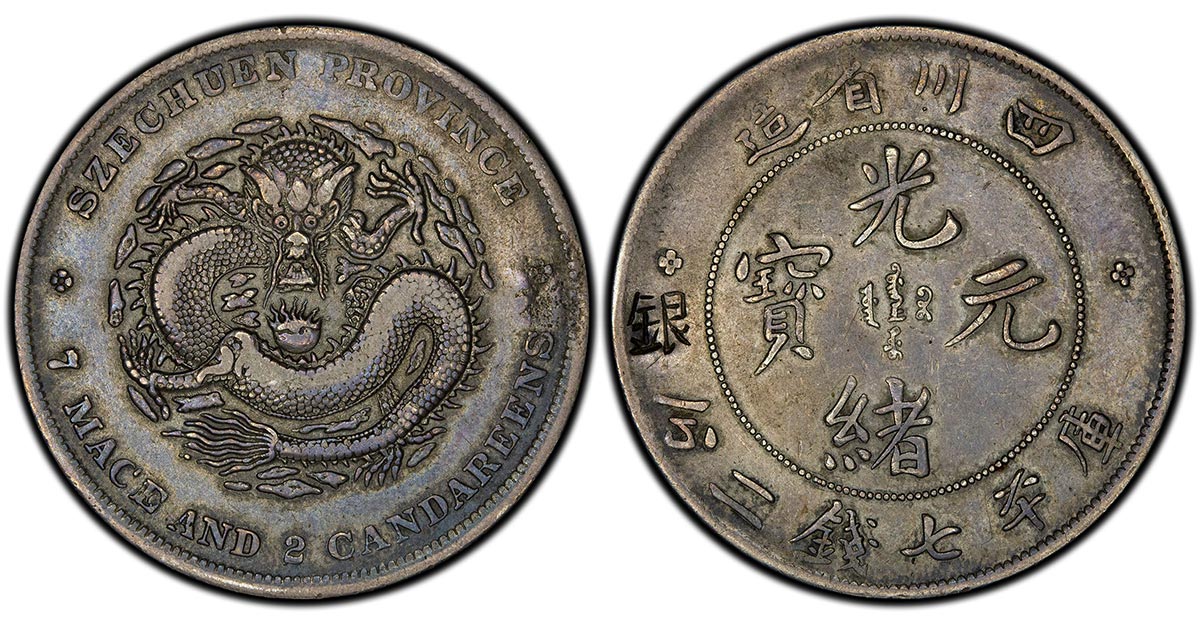
Specifications:
26.80 g, 0.900 fine silver, 0.7755 oz (actual silver weight)
Recorded mintage: 6,487,000
Catalog reference: KM-Y238
Details:
Szechuan (Sichuan) Province is in the south central part of China, and is an important economic power in the country. The capital is Chengdu. In the early 20th Century
it, along with Tibet, was made a special administrative district, acknowledging the dominance of non-Han Chinese people in the region. The Szechuan mint with modern
equipment opened in 1898 with machinery brought from New Jersey, USA. Another mint was opened in Chungking in 1905.
The (1901–1908) Szechuan Province 7 Mace 2 Candareens “dragon dollar” is another example of the late-Qing wave of provincial machine-struck silver. The Szechuan issue more specifically was meant to help standardize commerce in a region that was geographically far inland in China’s southwest. This issue is believed to have run from 1901–08 and is associated with the Chengdu Mint; references also note an earlier related emission in 1898, with no recorded minting in 1899–1900, an example of the “stop-start” nature of the series.
Szechuan dollars are not common in general, so it's more difficult to say if they are more often found with chopmarks or not. When we do see them with chops, it is often with just one or two chops rather than many.
Notable chopmarks:
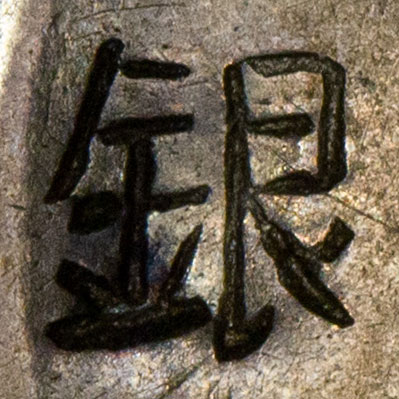 銀 - (traditional version of 银) yín - silver, silver-colored, relating to money or currency
1903 Fung-tien (Fengtien) Province 7 Mace 2 Candareens (Dollar) "Fung Boo" variety
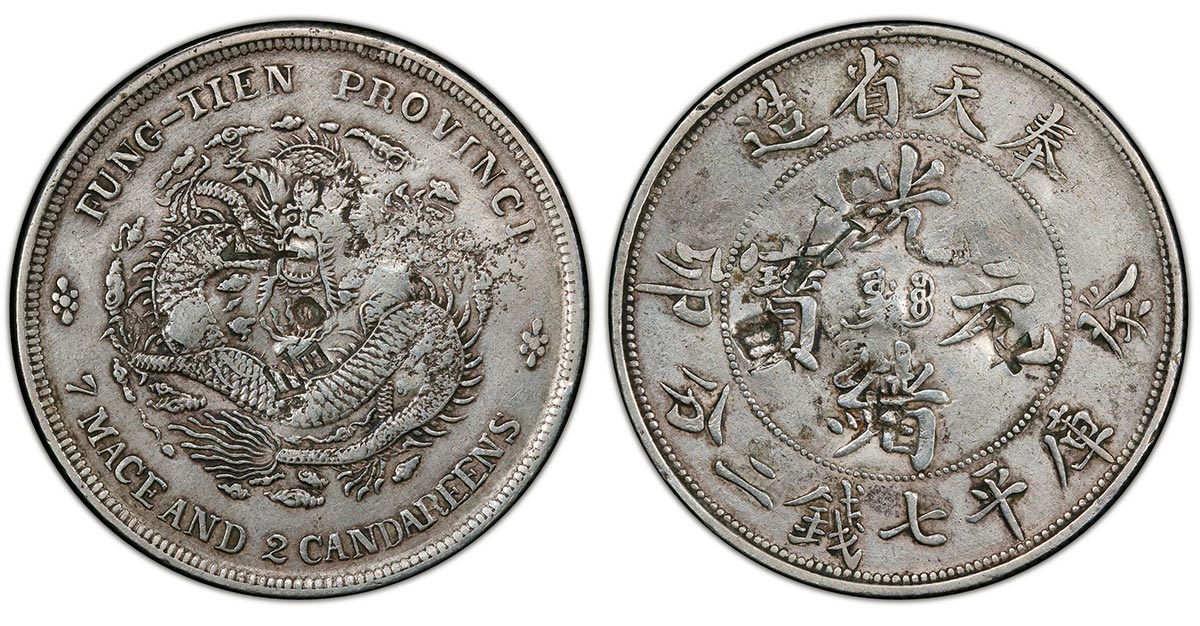
Specifications:
26.4000 g, 0.8500 silver, 0.7215 troy oz (actual silver weight)
Recorded mintage: 262,000
Catalog reference: L&M-483; K-251B; KM-Y-92; WS-0598
Details:
Fung-tien (Fengtien) province was renamed Liaoning Province in 1929, named after the Liao River that runs through it. This coastal province sits in the northeast region of
China formerly called Manchuria and is bounded by North Korea to the east and the Yellow Sea to the south. The province issued its 7 mace 2 candareens “dragon dollars” from
the Mukden (Shenyang) mint, a modern facility established with imported machinery in 1897.
Technically, Fengtien dollars are distinctive because the "standard" they followed is commonly given as 26.40g at .850 fine silver, rather than the more typical ~26.7g / .900 seen on many other Chinese provincial dollars. Collectors often talk about Fengtien in terms of varieties and strike/die characteristics (e.g., dragon mouth style, character shapes). This is the “Fung Boo” variety, with the central Manchu characters “Boo Fung” reversed, although this variety seems to be more common than that with the correct orientation.
The provincial mint operated from 1897-1931. Dollars of this mint are generally scarce, and sometimes found with chopmarks as this example shows, although not nearly as often as coins made in the coastal trading heavy regions.
Notable chopmarks:
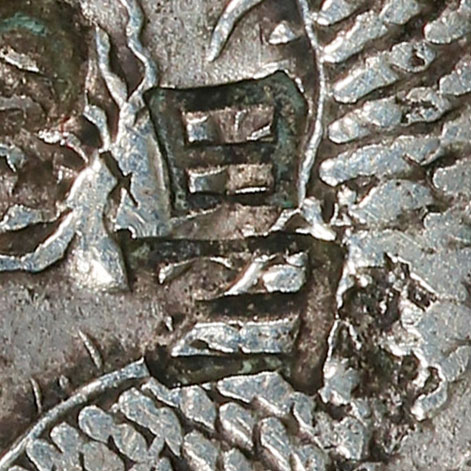 昌 - chāng - prosperous, flourishing
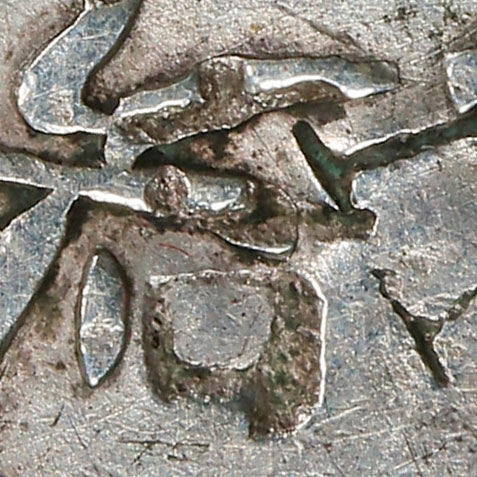 吉 - jí - auspicious, lucky
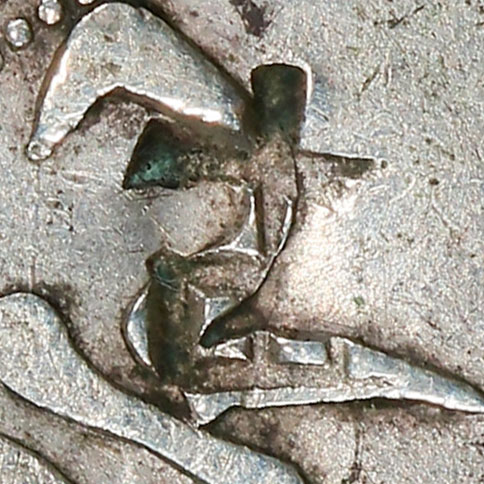 Unknown chopmark
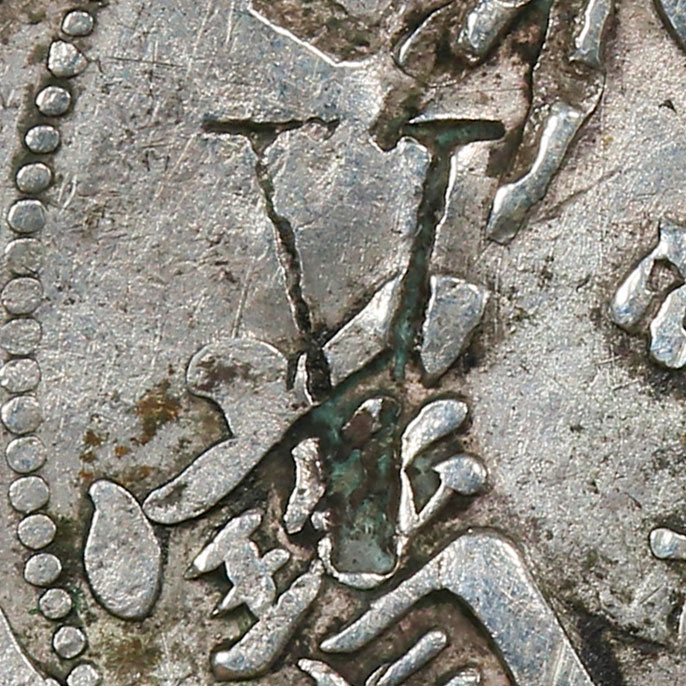 V - Latin-letter chopmark
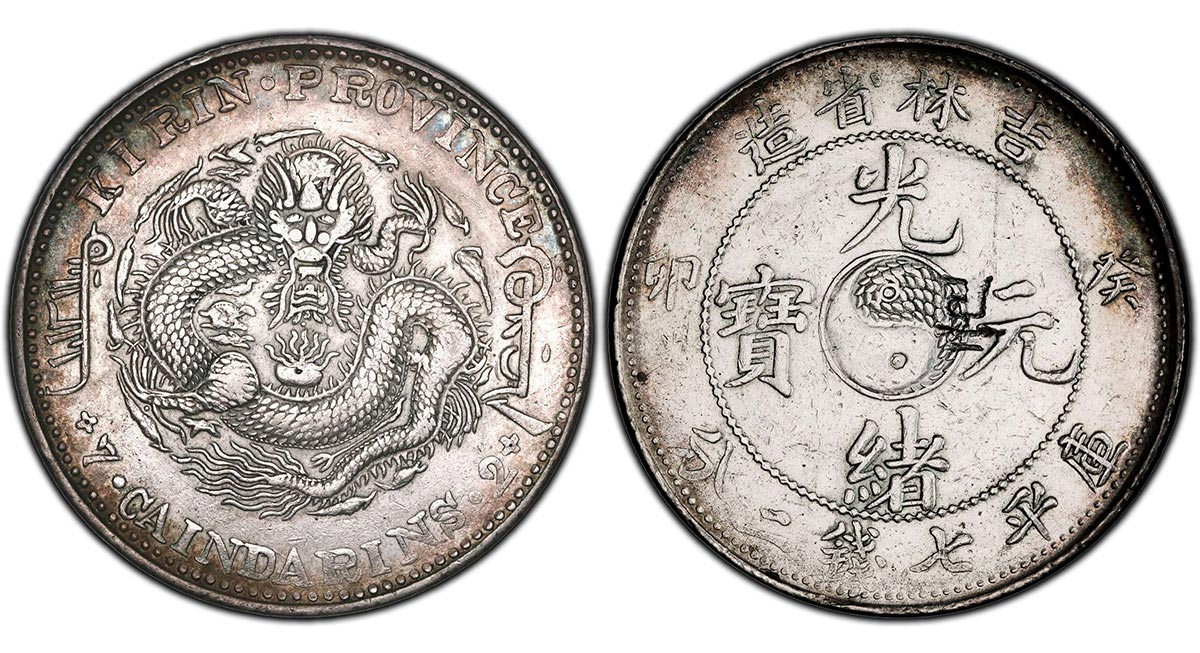
1903 Kirin (Jilin) Province 7 Mace 2 Candareens (Dollar)
Specifications:
26.10 g, silver
Recorded mintage: Unknown
Catalog reference: L&M-547; Kann-468; KM-Y-183a.2
Details:
The province of Kirin (Jilin) sits between Heilongjiang (to the north) and Liaoning (to the south), with Inner Mongolia to the west and Russia & North Korea on its eastern
border. The mint opened in 1881 and for many years struck only trial pieces. Silver milled coins were produced from 1895 onward. Many were dated using the sexagenary cycle.
The mint burnt down in 1911. Kirin dollars are unique due to their low weight standard, published by major references as ~26.1g, suggesting the mint was aiming at a slightly
lighter dollar than the more common 26.7g / .900 standard you see listed for most provincial issues.
Chopmarked Kirin dollars are definitely available, although the pieces in general are getting expensive, especially the scarcer varieties.
Notable chopmarks:
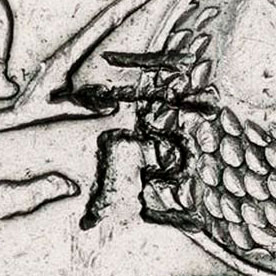
 - Liushutong script variant of 元 - yuán - dollar, unit of currency, basic, primary
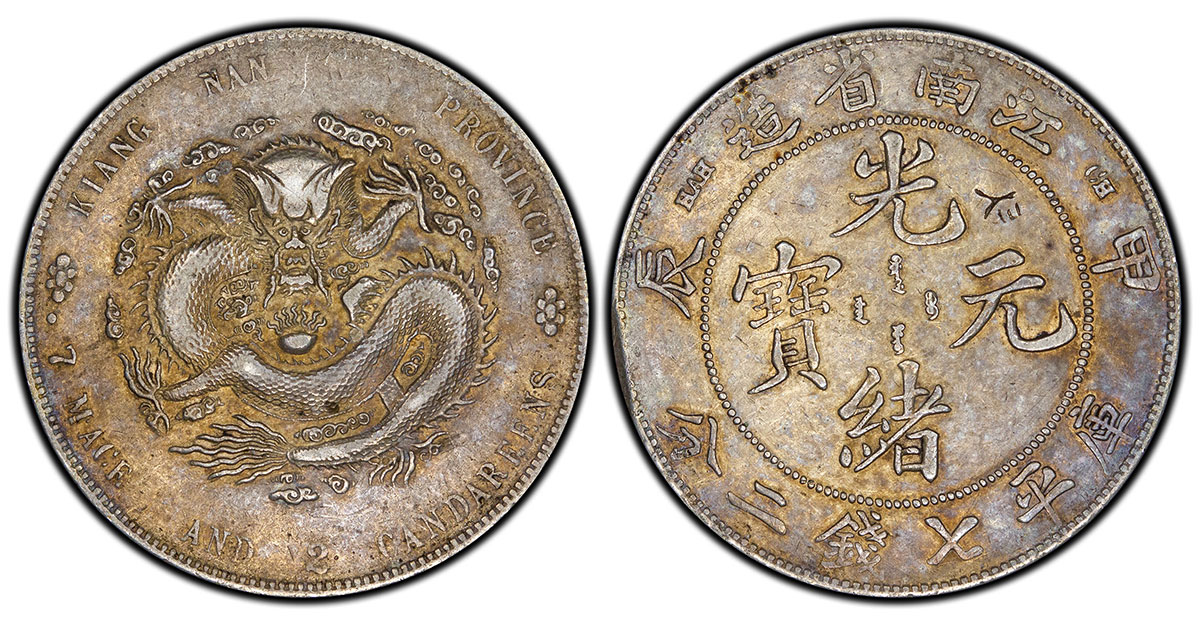
1904 Kiangnan (Jiangnan) Province, China 7 Mace 2 Candareens (Dollar)
Specifications:
27.000 g, 0.900 fine silver, 0.7813 oz (actual silver weight)
Recorded mintage: unknown
Catalog reference: Y# 145a.14, LM-257
Details:
By 1904, the Kiangnan dollar had accumulated several years of institutional changes that are legible directly on the coin. Concerns about inconsistent silver content in
earlier years had prompted the mint to bring in a British assayer, H.A. Holmes, whose initials HAH had appeared on Kiangnan dollars since 1901 as a quality guarantee, a
tacit acknowledgment that outside verification had become necessary to sustain public confidence in the coinage. The 1904 issue, known by its cyclical date Jia Chen, is
further distinguished by the addition of either a TH or CH mark alongside the HAH initials (this example shows CH), reflecting a period of rapid turnover in mint leadership:
three different directors cycled through the position between April 1903 and April 1904 alone, and the marks are generally read as the initials of the die engraver and the
incoming director respectively. The coins bearing the CH mark correspond to the tenure of Zhang Qian Jie, who took charge in April 1904 and under whom the bulk of that year's
production was struck. By this point the Nanking mint was running at high volume, and the 1904 issue is among the more common Kiangnan dates, sitting between the scarce 1903
and 1905 issues on either side.
Compared to the 1898 issue, the 1904 coin reflects several years of die evolution. The legend text is noticeably smaller and more compressed, a change that accumulated gradually across the series rather than appearing all at once. The dragon itself was also revised mid-year in 1904, with the face and the flame detail to the left of the central fireball the most visible points of difference from the earlier design. Some 1904 coins retain the old dragon on the obverse paired with the new reverse, a transitional combination that resulted from new dies being completed at different times during that year's production run.
Notable chopmarks:
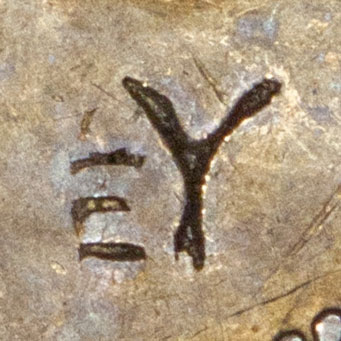 A combination of 三 - san - three and 丫 - yā - bifurcation, fork
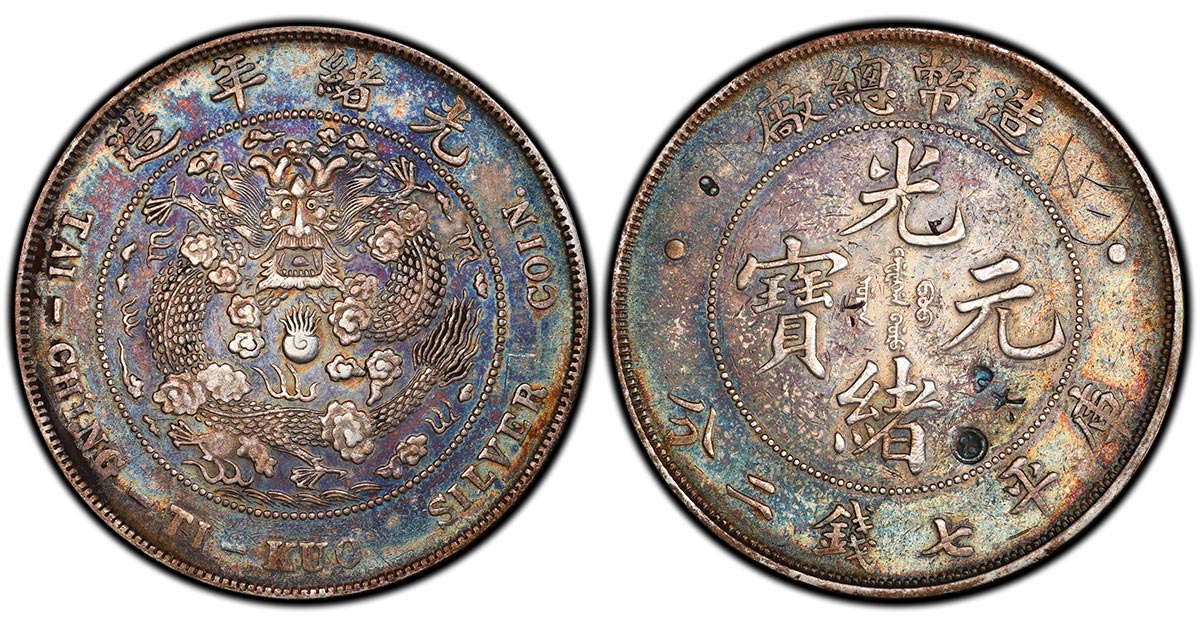
(1908) China "Tai-Ching-Ti-Kuo" Dollar, Tientsin Mint
Specifications:
26.90 g, 0.900 fine silver, 0.7784 troy oz (actual silver weight)
Recorded mintage: unknown
Catalog reference: Y-14 LM-11 K-216
Details:
A stellar example of this 1 year type. It is incredibly difficult to find attractive, chopmarked examples of this type. The smaller sized chopmarks found here are quite
interesting, along with what appears to be a Chinese character 东 (dōng, meaning "East") scratched into the reverse around 2 o'clock.
Perhaps the best-known Dragon Dollar from Kuang-hsü's reign, this short-lived issue--produced for only a single year--relates to a perennial problem of the late Empire: how to reconcile the issue of diverse provincial coinage into a single, unified national standard. Indeed, the problem would continue to plague the nation's rulers from Hsüan-t'ung (Pu Yi) to Yuan Shih-kai. Following the reestablishment of the Tientsin mint in 1906, after its destruction during the Boxer Rebellion in 1900, the Qing government attempted to introduce a new standard to replace the then-standard monetary system of Mace-Candareens, tied to the inherently western Dollars-Cents, with a Tael system, striking a series of 4 coins including the Tael, 5 Mace, 2 Mace, and Mace (the so-called "Chung" Tael standard). Ultimately, due to provincial dissent, these issues were revoked, only to be replaced by another series of 4 coins--this time the Dollar, 50 Cents, 20 Cents, and 10 Cents--which were similarly failed due to the death of the Emperor in 1908. This series, however, left its mark with its instantly recognizable Tai-Ching-Ti-Kuo ("The Great Qing Empire") design, which proliferated on late Imperial copper coinage. (source: Heritage Auctions)
“Tai-Ching-Ti-Kuo” (大清帝國) literally means “Great Qing Empire.” Coins bearing this legend were imperial (central) issues, not provincial ones. The Tientsen mint was likely chosen for this issue because Tientsin was close to Beijing, it was politically reliable, it was already industrialized and it was equipped with modern Western mint machinery. The specs for this coin were tightly controlled, unlike many provincial issues. This issue was intended to replace provincial dragon dollars and compete directly with Mexican, British and Japanese trade coins circulating at the time. You can think of this issue as the first serious attempt at a unified national silver dollar in China, a shift from provincial autonomy to an Imperial standard. In many ways, it is the prototype of modern Chinese national coinage.
Chopmarks on this issue are generally scarce. To understand why, remember this issue was an imperial issue with official backing (not provincial), and were distributed through banks and treasuries. The coin specs were tightly controlled, thus the trust put in this coin was inherently high to begin with. The coins were circulated mainly in North China, away from trading ports where chopmarking was more common. When chopmarks are present, the chops are usually small, light, or simply little pecks, possibly test marks. Heavy chopmarked examples or large chopmarks are atypical and should raise questions.
Notable chopmarks:
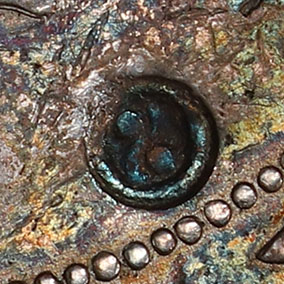 Yin-yang (太極圖)Yin and yang (陰陽), the Daoist emblem of complementary opposites held in dynamic balance such as dark and light, earth and heaven, each carrying the seed of the other and together forming the 太極 (tàijí, 'supreme ultimate'). A widely used auspicious and protective motif.
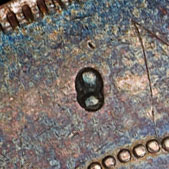 Two dots symbol chopmark
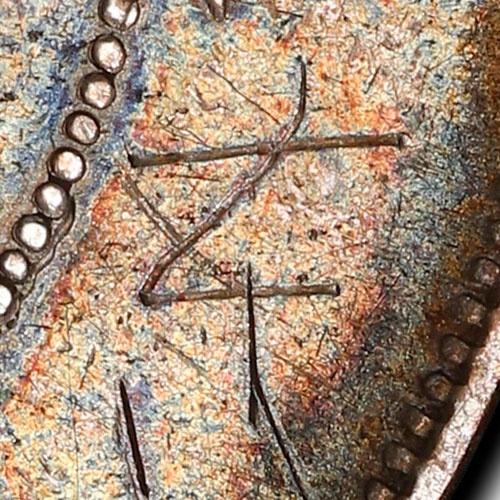 Scratched 车 - chē - vehicle, cart
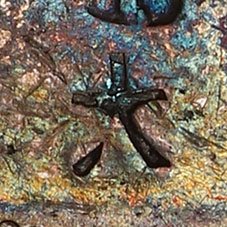 大 - dà - big, great, large
Year 3 (1911) Chinese One Dollar
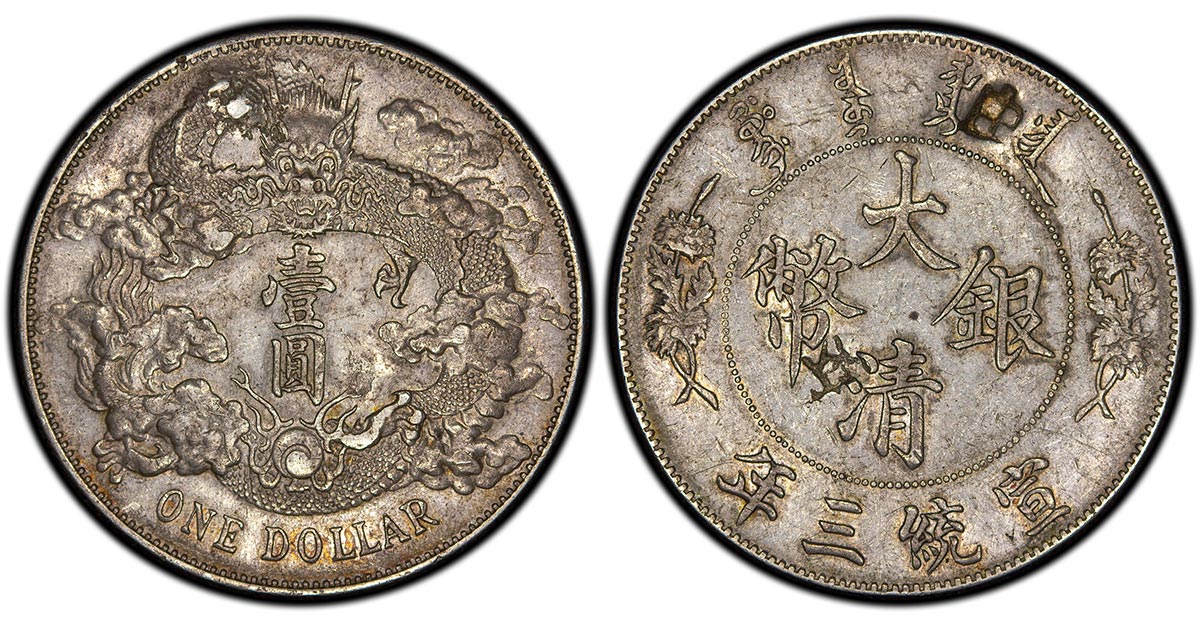
Specifications:
26.9 g, 0.900 fine silver, 0.778 troy oz (actual silver weight)
Recorded mintage: 77,153,000
Catalog reference: KM Y31, LM-37
Details:
The 1911 silver dragon dollar, officially named "Great Qing Silver Coin (大清銀幣)" is perhaps one of the most popular of all the silver dragon dollars among numismatists and
collectors. A product of the Central Tientsin (Tianjin) Mint, they were struck during 1911 - a year of great political significance for China, as it was the year of the start
of the Xinhai Revolution which resulted in the eventual downfall of the Qing Dynasty (1644-1912) and Imperial China. Its popularity among enthusiasts is perhaps linked to this
turning point in Chinese history, but the coin itself also bears an undoubtedly attractive and intricate design. This coin type was the last coin to be produced under Imperial
Chinese rule.
Some context - the 1908 Tai-Ching-Ti-Kuo dollar was the first serious national attempt at a standard silver dollar, but it lacked a regnal date on the coin and a fully standardized, repeatable design. By 1910–1911, the court wanted clear dating (to anchor trust and accounting), a cleaner imperial identity (less “trade-dollar” ambiguity) and uniformity across mints (in practice, Tientsin dominated). The result was the Xuantong Year 3 issue, which was more explicit, more formal, and more modern.
The reverse face features a highly detailed dragon, set amidst a fire and smoke motif. On coins in good condition, the individual scales on the dragon are remarkably identifiable. Forming a ring, the body of the dragon surrounds inscription translating as, "one dollar". Outside the bounds of the dragon's body is the inscription in English, "ONE DOLLAR". This coin is unique among Imperial Chinese coinage, in that it is the only type to bear the DOLLAR denomination. Other late Qing Dynasty coins have their denomination expressed as a weight in mace and candareens, as well as "Treasury Yuan".
The obverse face features a central block of four characters which vertically refer to the Qing Dynasty; and horizontally, which when read right to left translate as, "silver coin". Beneath these characters is an inscription which (again when read right to left) translate as, "Xuantong Year Three". This refers to the year of striking of the coin - the third year of the reign of Emperor Xuantong (reigned December 1908 - February 1912).
Notable chopmarks:
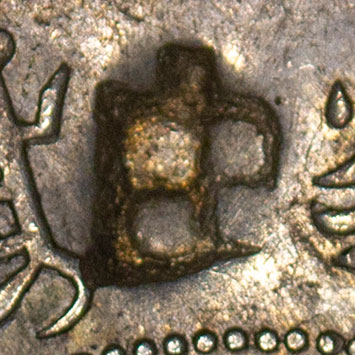 由 - yóu - from, reason, cause