1910 Mexico "Caballito" Peso (Ex. Murphy)
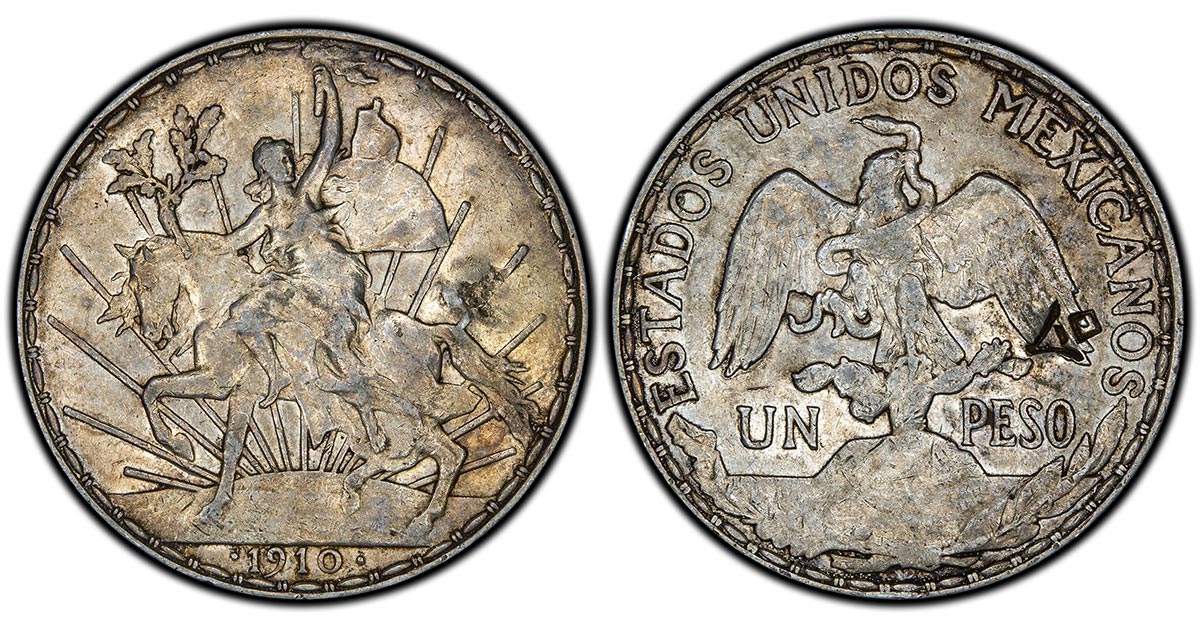
Specifications:
27.07 g, 0.903 fine silver, 0.786 troy oz (actual silver weight)
Recorded mintage: 3,814,000
Catalog reference: KM 453
Details:
The 1910 “Caballito” peso of Mexico was struck at the Mexico City mint and represents the final major artistic redesign of Mexico’s silver peso prior to the upheavals of the
Mexican Revolution. The issue was struck to the traditional Mexican peso spec 27.07 / .903 fine, conforming closely to the long-established crown standard that had defined
Mexican trade silver for centuries. Clearly a modernized Art Nouveau–influenced design, one side depicts a symbolic Liberty, holding a torch and olive branch sitting aside a
horse, while the opposite side displays the Mexican national eagle with snake, together with legend “ESTADOS UNIDOS MEXICANOS” (United Mexican States), and denomination “UN PESO”.
The year 1910 was a transitional time both within Mexico and across the globe. In Mexico, the long presidency of Porfirio Díaz was reaching its breaking point, with political repression, economic inequality, and social unrest converging to ignite the Mexican Revolution later that year. Internationally, the early twentieth century was characterized by accelerating industrialization, imperial competition, and growing strain within traditional political systems. While many Western nations had consolidated gold-based monetary regimes and modern banking institutions, large parts of Asia, including China, continued to operate within silver-based economies that relied heavily on physical bullion rather than abstract credit. This divergence created a world in which older monetary practices and newer political realities coexisted uneasily. Against this backdrop, long-established trade relationships and material standards often proved more durable than the governments that oversaw them, allowing silver coinage to function as a connective medium even as empires, constitutions, and regimes entered periods of rapid transformation.
The Caballito peso was issued at a symbolic moment marking the centennial of Mexican independence, shortly before the outbreak of revolutionary conflict that would disrupt mint operations and silver production. By 1910, Mexican pesos had already spent more than a century as the dominant silver coin in global trade, particularly in East Asia, where their consistency and familiarity had entrenched them as the preferred reference standard. Although the international monetary environment was increasingly shaped by gold standards and modern banking systems, silver remained essential in large parts of China and Southeast Asia. Mexico’s decision to preserve the traditional peso standard, even while updating its iconography, reflects the continued importance of bullion credibility over aesthetic or ideological considerations in international silver circulation. Despite all of this, chopmarking coins in China had generally fallen out of normal practice by this time, so Caballito pesos with chopmarks are fairly rare.
Notable chopmarks:
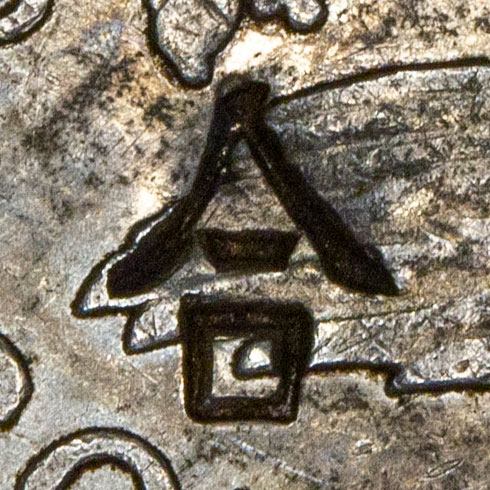 合 - hé - combine, join, close, suit
Provenance:
From fellow collector Ed Murphy, who compiled one of the broadest and most complete chopmark collections of all time, September 2025.