1859-S United States Seated Dollar, early days of the San Francisco Mint
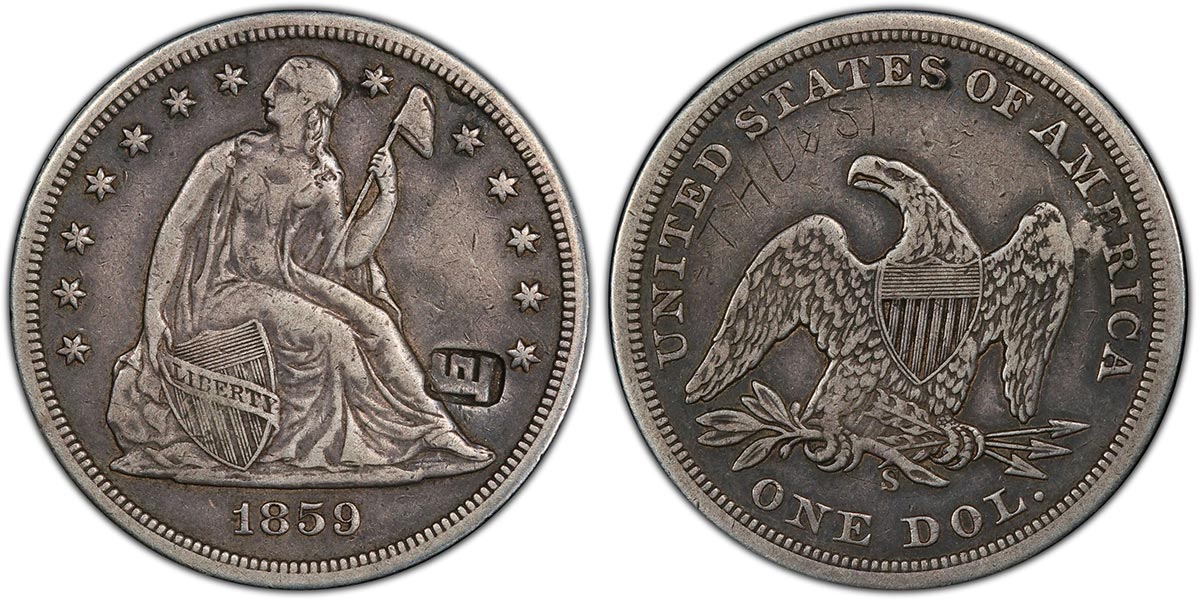
Specifications:
26.73 g (412.5 grains), .900 fine silver, .77344 troy oz (actual silver weight), reeded edge
Recorded mintage: 20,000
Catalog reference: PCGS 6925
Details:
The U.S. Seated Dollar was initially devised as a coin for circulation at home. It was not initially designed for foreign trade, and ultimately failed at this purpose. It
can however lay claim to it's place in numismatic history as the pre-cursor to my favorite series - the U.S. Trade Dollar. At 0.77344 oz. of silver, the U.S. Seated Dollar
is of lower silver content than the Mexican Carolus dollar's 0.7858 oz., the
preferred trade dollar of Chinese merchants at the time.
Because the Chinese merchants favored Mexican Carolus dollars the Mexican coins traded at a premium. In the western U.S., merchants and bankers paid a percentage to convert their silver into the Mexican coinage, in effect making the Chinese goods they were importing more expensive. At some point in the late 1850's, a group of merchants organized and approached San Francisco Mint officials about producing a U.S. silver dollar at the western mint. In 1859 the San Francisco mint produced the modest sum of 20,000 Seated Dollars, the first silver dollar produced out west. It is believed that nearly all of the 20,000 mintage was exported to China.This 1859-S seated dollar is historically significant as, in my opinion, the first U.S. trade dollar albeit in an unofficial capacity.
From Silver Dollars & Trade Dollars of the United States by Q. David Bowers:
Neil Carothers, in Fractional Money (pp. 149-150), noted the following (Carothers obtained this information from Bankers Magazine, Vol. 8, p. 932.) "In 1859 local [San Francisco] merchants presented bullion for coinage into silver dollars for export. When Director Snowden refused the superintendent's request for dies, that official insisted, saying there was a great excess of subsidiary silver in California which might possibly be relieved by the coinage of silver dollars. Snowden yielded to this absurd suggestion." (But see the following quoted passages, which tell a different story.)
The silver trade situation:
John M. Willem, in The United States Trade Dollar, quotes a letter from Charles H. Hempstead, superintendent of the San Francisco Mint, dated November 18, 1858, writing to Director James Ross Snowden that in San Francisco:
We are now attracting to our shores large quantities of silver, in bars, from Mexico, for which we pay in silver coins. By reference to your letter of the fourth of August last, I find that you say that single "silver deposits may be received, but they are only payable in silver dollars or in fine silver bars." We have never received any dies for silver dollars, nor am I aware of the reason why this branch has never made that denomination of coin. I would, therefore, suggest that the coinage of silver dollars (if it be not contrary to the policy of government) would relieve us of just one-half of the labor now necessary in the coinage of large quantities of Mexican silver. (This is in reference to the coining in San Francisco of silver dimes, quarters, and half dollars. It cost nearly twice as much to coin a given amount of silver into two half dollars as it did to make one single dollar, and several times as much to coin 10 dimes.)
On February 19, 1859 Snowden sent this reply:
As the facts stated by you indicate the propriety of coinage of silver dollars at your branch of the mint, I have caused four pairs of dies of that denomination to be prepared and forwarded to you per express. A weight for the adjustment of the coin (from which others can be made) will be found in the box containing the dies.
The San Francisco Bulletin, as quoted by Willem, commented:
The authority to coin silver dollars, received by mail yesterday, is quite an object to the commerce of the Pacific Coast. Crude silver has today been deposited for coinage to the amount of upward of $7,000 by one house in the Mexican trade.
The same source noted that on August 1859 Merchants Magazine related that "every vessel leaving San Francisco for Chinese ports takes a large amount of Mexican dollars."
It's worth noting that silver dollars were not popular for circulation out west, where Gold dollars had much higher demand and usage. This adds support to the idea that these silver dollars were produced with the sole intent to ship them east. Today there are approximately 10 known Seated Dollars with chopmarks, and I believe that approximately 15-25 have survived. As Gullberg states in his book, the reason for this low survivorship is a mystery. Despite the low mintages of Seated Dollars in San Francisco, virtually all of them were shipped east so one would assume the survivorship (with chopmarks) would be higher. When one considers that U.S. Seated Dollars were a massive failure in China, the picture becomes more clear. It is almost certainly true that the vast majority of U.S. Seated Dollars shipped to China were melted.
It's also worth noting that the Hal Walls Collection of World Trade Coins, sold by Paul J. Bosco in August 1997 had a chopmarked 1859-S Seated Dollar, and a couple others have been discovered over the past 5 years.
The description for lot 25 in that sale read as follows:
1859 S. Liberty Seated Dollar. Scarce Date. Large but light chopmark on eagle's right wing. Otherwise VF-30.
The Hal Walls coin sold for $650. Numerous other important coins sold in this same auction, such as a chopmarked 1799 Dollar as well as a chopmarked, uncirculated condition 1878-CC Trade Dollar. I really wish I could have attended this sale and bid on the collection!
An interesting question to consider is how many of the original 1859-S $1 mintage of 20k were melted. I'm not sure the catalogers source, but a 2018 Stack's Bowers auction stated "Alone among San Francisco Mint Liberty Seated dollars of the No Motto type, the 1859-S is an isolated issue most examples of which were produced for a single purpose. Of the 20,000 pieces struck in total, the first 15,000 coins delivered were intended solely for export. Indeed, the San Francisco-based firm of Bolton, Barren & Co. acquired 8,985 of these coins for use in the China trade. Those examples that went overseas -- 75% of the mintage -- were invariably lost through melting. Fortunately for today's collectors, the additional 5,000 pieces making up the total mintage were retained stateside and released into circulation on the West Coast. Survivors of that delivery -- and they are few -- are usually well worn, often impaired, and constitute the majority of 1859-S silver dollars obtainable by today's collectors." (source:Stack's Bowers)
Notable chopmarks:
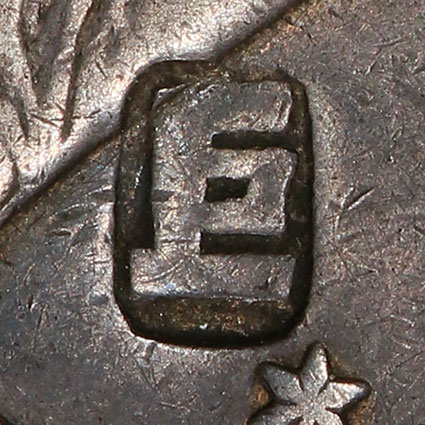 巨 - jù - huge, great
Provenance:
Purchased on eBay in May 2019 from a dealer in Rochester, New York.