1839-So IJ Chile 8 Reales
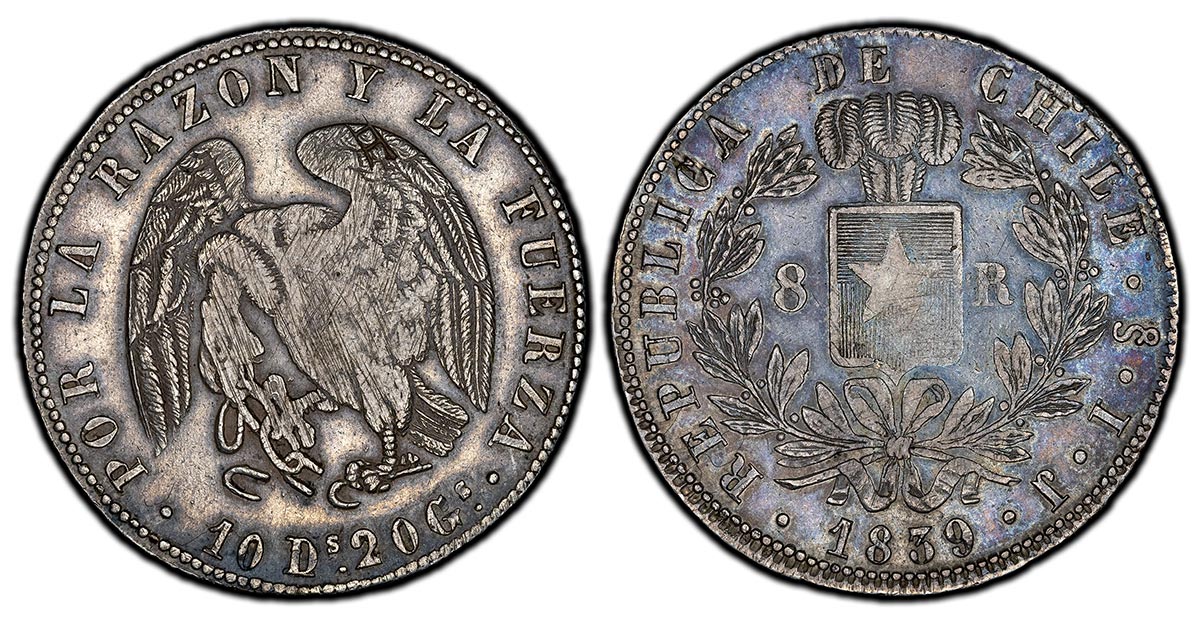
Specifications:
26.700 g, .902 fine silver, .7743 troy oz (actual silver weight)
Recorded mintage: 205,000
Catalog reference: KM 96.1
Details:
The 1839-So IJ (Ignacio Morán Fuenzalida / José Vicente Larraín) Chile 8 Reales (KM 96.1) is a full crown-sized silver issue of the early Republic, struck at Santiago to
.902 fine, 26.70 g, 39 mm, with a recorded mintage of 205,000 for the date. Its paired national motifs are the Chilean arms within a wreath and the condor breaking a chain
with the patriotic motto “POR LA RAZON Y LA FUERZA” (“By reason and by force”). In terms of metal supply, this is very much a “Norte Chico” era coin: Chile’s northern
mining districts were expanding fast in the 1830s, and the Chañarcillo discovery (1832) near Copiapó helped drive a major silver boom that could feed export and coinage
bullion alike. Striking took place at La Moneda, purpose-built as Santiago’s mint (opened 1805) and still functioning as the coinage works through the 19th century.
In context, this is a product of Chile’s early republican state, confident enough by the 1830s to replace inherited colonial types with an overtly national design program (the condor and arms were adopted for coinage in the mid-1830s, associated with the English artist/designer Charles Wood). The date is also contemporary with Chile’s decisive intervention against the Peru–Bolivian Confederation; the conflict ended in 1839 with the restorationist victory at Yungay, and the dissolution of the Confederation followed soon after, background that helps explain why Chilean coinage of this decade leans into sovereignty, legitimacy, and “strength” in its public messaging.
As to China-trade context, Chopmarks on this type are pretty rare, somewhat due to the short run and low mintage, in combination with Chile’s limited direct commercial dealings in China-facing trade. Chilean crown-sized silver did move through Pacific commercial channels, often indirectly via inter-American and British/American trading networks, yet it was never as routinely encountered in China as the ubiquitous Mexico and Lima issues. A chopmarked example therefore points to a plausible route through Pacific ports (Valparaíso and neighboring entrepôts) into broader “dollar” circulation, where private verification still operated and an unfamiliar-but-correct silver crown could be accepted and marked in the usual way.
Notable chopmarks:
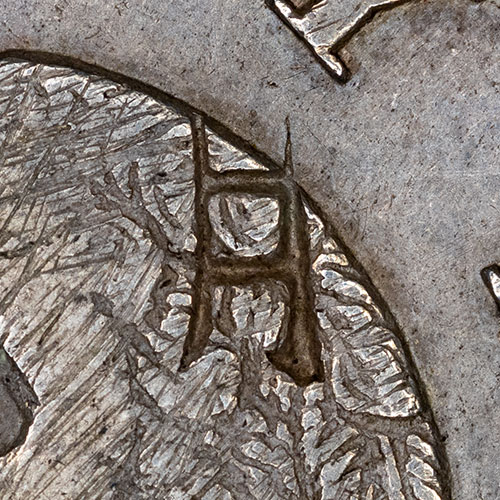 月 - yuè - moon, month
Provenance:
Purchased by private sale from Javier Campos Santander, a collector from Santiago, Chile who is heavily involved with ANUCH, la Asociación Numismática de Chile, in February 2024.