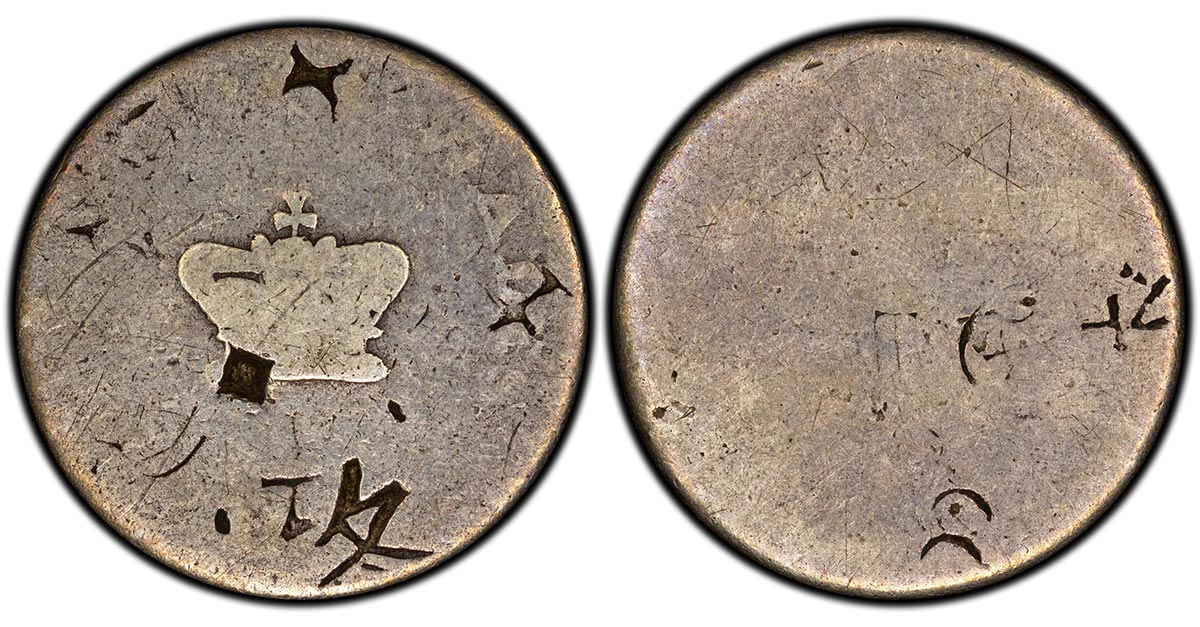
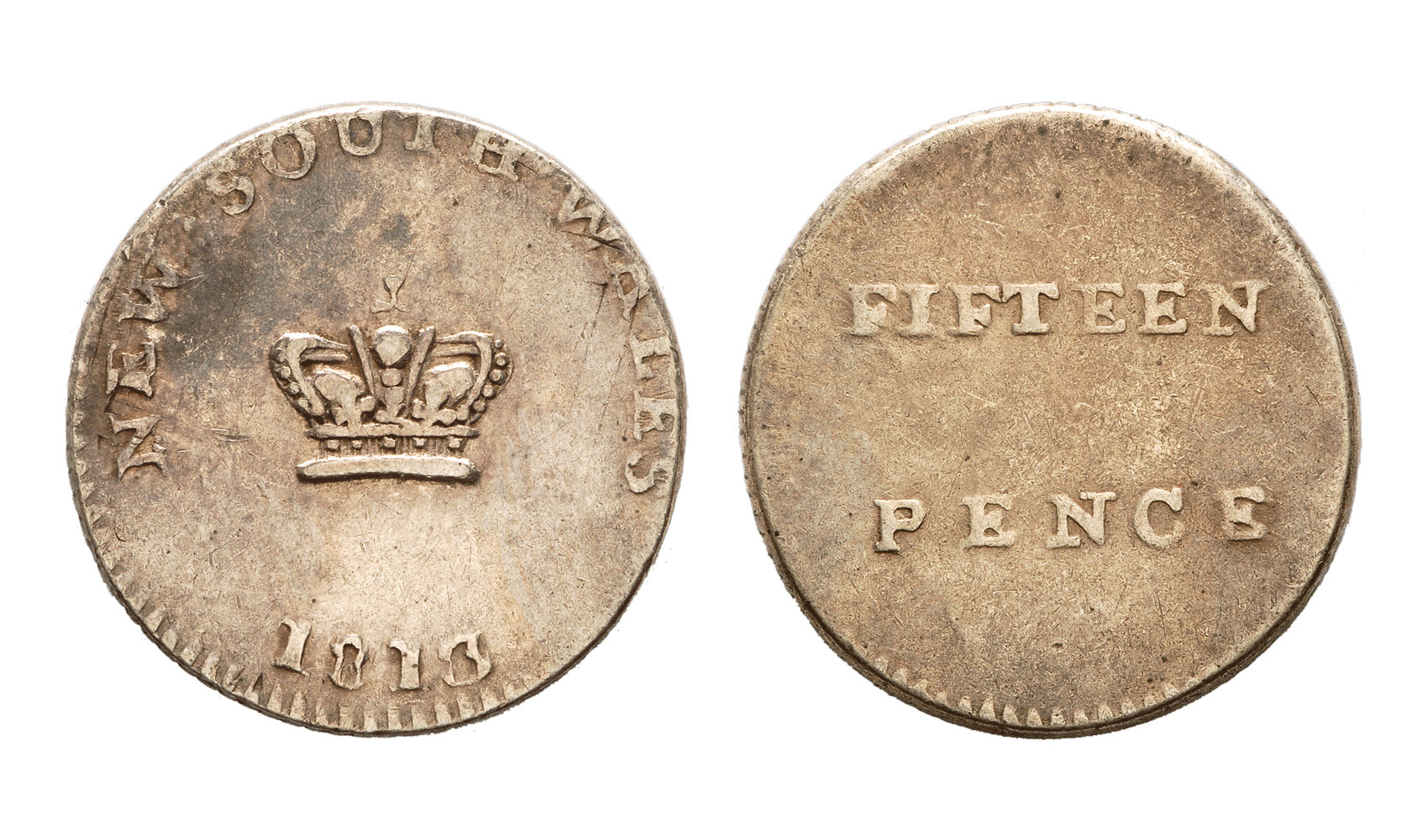
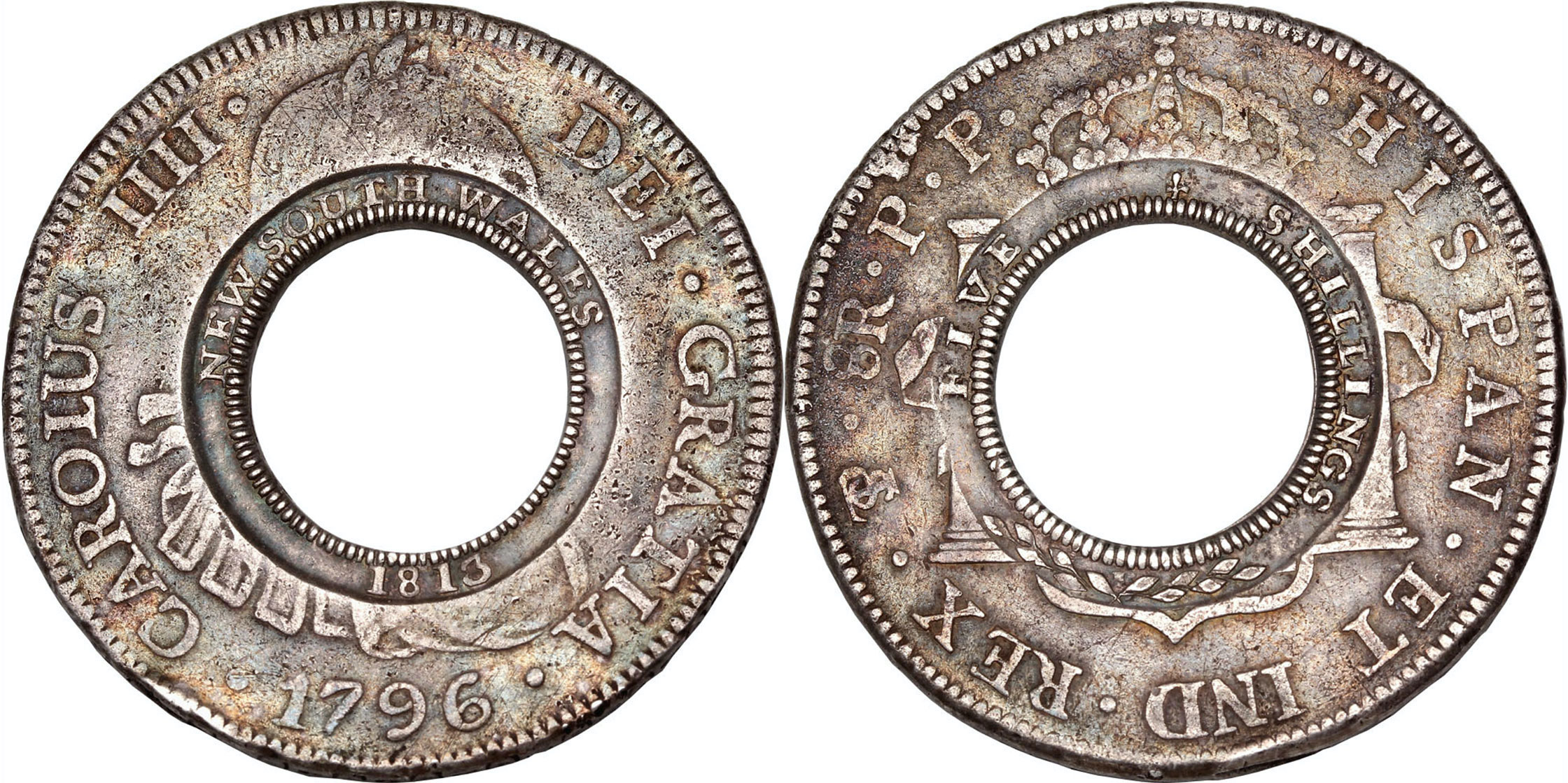
1813 New South Wales 15 Pence / Dump
Specifications:
.903 fine silver (matching Spanish 8 Reales these were made from)
Recorded mintage: 39,910 (estimated)
Catalog reference: KM 1.1
Details:
When the colony of New South Wales was founded in 1788, there was an overall shortage of coins circulating. Most foreign coins including British, Dutch, Indian and Portuguese left
the colony by way of trade with visiting merchant ships. The colonists were forced to barter, and a popular local rum became unofficial currency. The practice of using rum as a
currency was prohibited by Governor Bligh in 1806, eventually culminating in the overthrow of the government with the "Rum Rebellion" in 1808.
To overcome this shortage of coins, Governor Lachlan Macquarie used Spanish dollars sent by the British government to produce suitable coins. For this purpose, 40,000 Spanish dollars arrived on November 26th, 1812 on the HMS Samarang from Madras, via the East India Company.
Included with the shipment were strict instructions to prevent the newly arrived coinage from leaving the country, so after consultation with the Judge Advocate and other officials, Governor Macquarie employed a convicted forger named William Henshall to cut the centers out of the coins and counterstamp them, making them useless outside the colony. The central plug (known as a dump) was valued at 15 pence (1 shilling, 3 pence), and was restruck with a new design (a crown on the obverse, the denomination on the reverse), while the holey dollar received an overstamp around the hole ("New South Wales 1813" on the obverse, "Five Shillings" on the reverse). This distinguished the coins as belonging to the colony of New South Wales, creating the first official currency produced specifically for circulation on the island. The combined nominal value of the holey dollar and the dump was 6 shillings, 3 pence, or 25% more than the value of a Spanish dollar, making it unprofitable to export the new coins from the colony.
The project to convert the 40,000 Spanish coins took over a year to complete. Of the 40,000 Spanish dollars imported, 39,910 holey dollars and 39,910 dumps were made, with the balance assumed to have been spoiled during the conversion process. On July 1, 1813 Governor Macquarie issued a proclamation that the new money shall be a legal Tender, also setting their value. The converted coins went into circulation in 1814.
From 1822, the government began to recall the coins and replace them with sterling coinage. By the time the holey dollar was finally demonetized in 1829, most of the 40,000 coins in circulation had been exchanged for legal tender and melted down into bullion. Experts estimate that only 350 holey dollars and 1500 dumps remain extant.
Notable chopmarks:
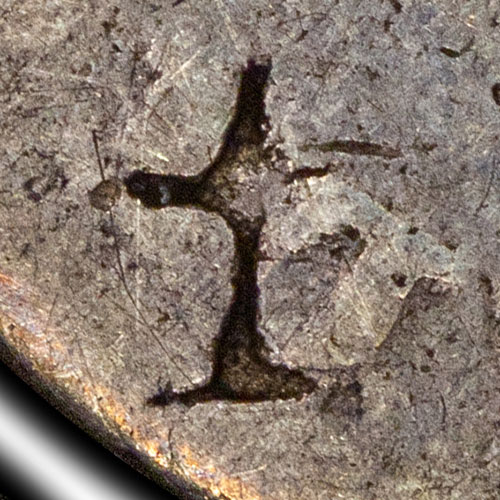 土 - tǔ - earth, soil, land, Japanese radical 32
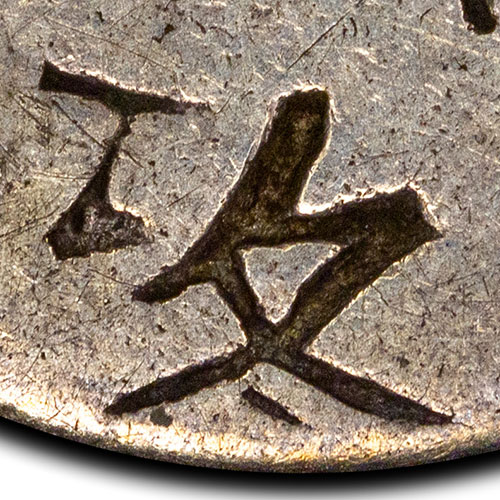 攻 - gōng - attack, study
Provenance:
From the Noble Auctions 121 sale 30 Jul–2 Aug 2019 in Sydney Australia Lot #1168
Auction Description:
NEW SOUTH WALES, fifteen pence or dump, 1813 (Mira dies A/1). Heavily worn, good/poor but cleaned, with Chinese chopmarks, one of only about four known. (with Chinese chopmarks)