1762-M JP Spain 8 Reales
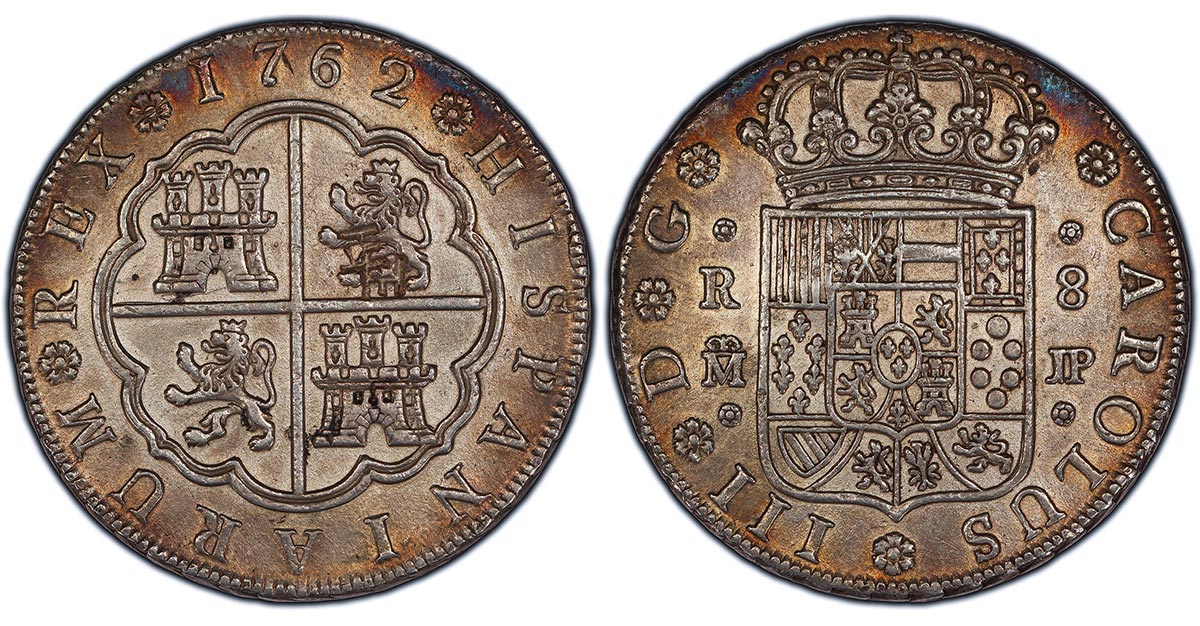
Specifications:
27.07 g, .903 fine silver, .7859 troy oz (actual silver weight)
Recorded mintage: unknown
Catalog reference: KM 399.1
Details:
The 1762-M JP Spain 8 reales, struck at the Madrid mint, was intended primarily for domestic circulation, not for overseas trade. Unlike Spanish American 8 reales, which were
produced in enormous quantities to support imperial commerce, Madrid issues were struck in far smaller numbers and were normally absorbed within Spain or nearby European markets.
The presence of Chinese chopmarks on this type is therefore exceptional, as Spanish-mint 8 reales rarely entered Asian commerce in the first place. When encountered, chopmarks
likely indicate an unusual history, secondary movement through European trade channels before reaching China, making chopmarked Madrid issues among the scarcer and more historically
fascinating examples of Spanish silver in the China trade.
During the mid-18th century, Spain struck relatively few crown-sized silver coins, and metropolitan production of the 8 reales effectively ceased after 1736, not resuming until 1772, with the notable exception of the 1762 issue. Carlos III, who ascended the throne in late 1759, introduced a new royal coat of arms in 1761, the first major revision since 1700. This redesign incorporated the arms of the Italian houses of Farnese and Medici, reflecting Carlos’s earlier rule over Naples and Sicily. The 1762 8 reales and 8 escudos uniquely feature this new coat of arms on the obverse; it would not reappear on reales coinage and only later, in modified form, on the reverse of escudos beginning in 1771, making the 1762 issue a distinct and historically bounded type.
The 1762 royal arms are among the most complex ever used on Spanish coinage, visually expressing the breadth of Spanish dynastic influence. Arranged clockwise from the upper left are the arms of Aragon; Aragon-Sicily; Austria; Burgundy modern; the Medici balls at 3 o’clock; Brabant; Tyrol; Flanders; Burgundy ancient; and at 9 o’clock, the Farnese fleur-de-lis. At the center lie the quartered arms of Castile and León, with the pomegranate of Granada below and the fleur-de-lis of Anjou in the inescutcheon. The reverse simplifies this complexity, returning to the traditional arms of Castile and León alone, underscoring the ceremonial and political intent of the 1762 obverse design.
This issue was minted both at the Madrid and Sevilla mint. Possibly unique with chopmarks - this is the sole example I'm aware of, and other major chopmark collections are missing this type. It's unlikely this coin journeyed to Asia with many others, since this otherwise commmon coin is almost never found with chopmarks.
Notable chopmarks:
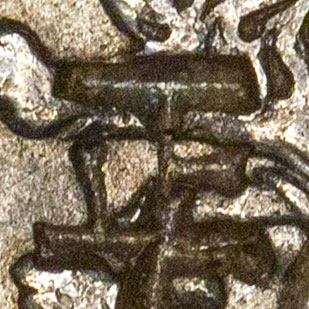 正 - zhèng - correct, straight, upright
Provenance:
Purchased from the Alliance Coin & Banknote Inc. Toronto Coin Expo Fall 2021 Sale Lot #76
Auction Description:
KM.399.1, PCGS AU Details with a single merchant chop-mark on reverse
Previously from The London Coinex Auction, September 28, 2005 by Spink & Son (Auction 5014), Lot #835
Auction Description:
Spain, Carlos III (1759-88), 8 Reales, 1762, Madrid, assayer JP, crowned shield dividing R/mintmark - 8/JP, rev. shield within roseace (Cay.11136; KM.399.1), Chinese chopmark on reverse, very fine Estimate £ 200-250. (sold for £260)